Business Development and Lead Generation: A 2026 Playbook
Business development and lead generation get blurred into one job, and that confusion quietly kills pipeline. Here's how the two actually differ, where they connect, and the 2026 stack that makes both work.
Business development and lead generation get treated as synonyms in most job ads, pitch decks, and Slack channels. They are not. Confusing them is one of the quietest ways to break a go-to-market motion: you hire for one, measure the other, and wonder why pipeline stalls. This guide separates the two cleanly, shows where they overlap, and gives you a concrete 2026 playbook — metrics, team structure, and the data stack that feeds both.
TL;DR#
- Lead generation fills the top of the funnel with contacts who match your profile. Business development builds the relationships, partnerships, and market access that make those leads convertible at scale.
- They are sequential and circular: lead gen creates volume, BD creates leverage, and good BD makes the next round of lead gen cheaper.
- The metrics differ — lead gen lives on volume and cost-per-lead; BD lives on partnership value, deal size, and time-to-revenue.
- The shared dependency is data accuracy. Both functions collapse without verified contacts, correct firmographics, and a clean way to reach decision-makers.
- A modern setup pairs a precise email finder and data enrichment layer with CRM, outreach, and partnership tooling.
What is the difference between business development and lead generation?#
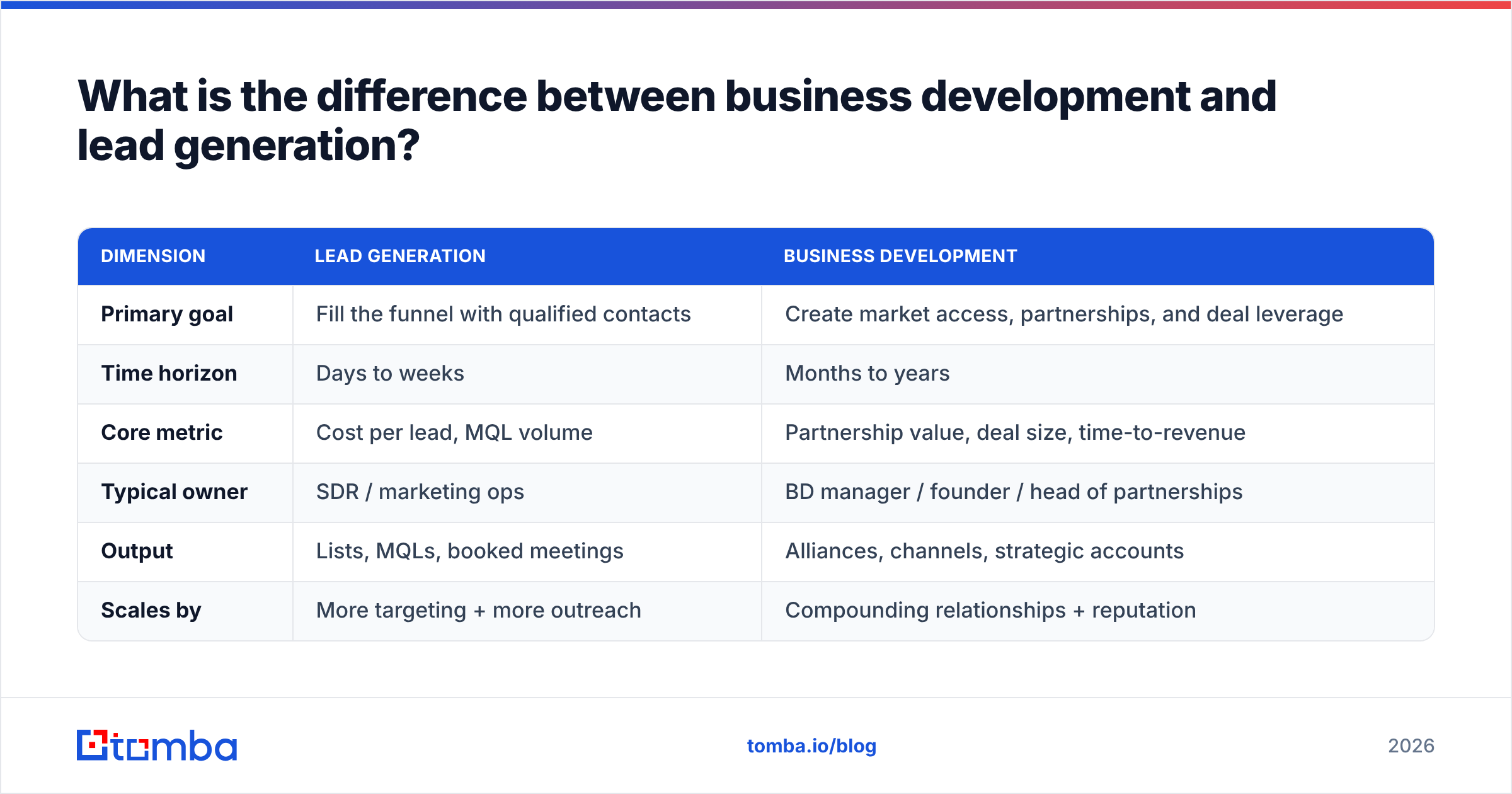
Lead generation is about volume; business development is about leverage. Lead generation is the repeatable engine that identifies, attracts, and captures contacts who could buy from you. Business development is the broader, slower work of opening markets, forging partnerships, and creating the conditions in which those leads turn into revenue.
Think of it like fishing. Lead generation is casting nets — you want as many qualified fish as possible in the boat. Business development is deciding which waters to fish in, negotiating access to private lakes, and building a relationship with the harbor so you get the best dock every season. One is throughput. The other is strategy and access.
Here's where teams go wrong: they label an SDR seat "Business Development Representative," hand it a dialer, and call it BD. That role is doing lead generation with a fancier title. True business development includes channel partnerships, co-marketing, strategic alliances, new-market entry, and large-account relationship building — work that rarely shows up in a weekly "leads booked" number.
| Dimension | Lead Generation | Business Development |
|---|---|---|
| Primary goal | Fill the funnel with qualified contacts | Create market access, partnerships, and deal leverage |
| Time horizon | Days to weeks | Months to years |
| Core metric | Cost per lead, MQL volume | Partnership value, deal size, time-to-revenue |
| Typical owner | SDR / marketing ops | BD manager / founder / head of partnerships |
| Output | Lists, MQLs, booked meetings | Alliances, channels, strategic accounts |
| Scales by | More targeting + more outreach | Compounding relationships + reputation |
Why do business development and lead generation get confused?#
Three reasons. First, the job titles bleed into each other — "BDR" became the standard name for outbound prospecting roles, even though those roles are pure lead generation. Second, both functions sit at the front of the revenue process, so to an outsider they look identical. Third, small companies genuinely combine them: a founder doing early sales is doing both at once, building partnerships in the morning and cold-emailing prospects in the afternoon.
The confusion is expensive once you scale. If you measure a partnerships hire on weekly lead volume, they will optimize for cheap, low-value meetings instead of the one alliance that could 10x distribution. If you measure an SDR on "strategic relationships," you will never know your cost per opportunity. Naming the functions correctly is the first step to staffing and measuring them correctly.
How does lead generation actually work in 2026?#
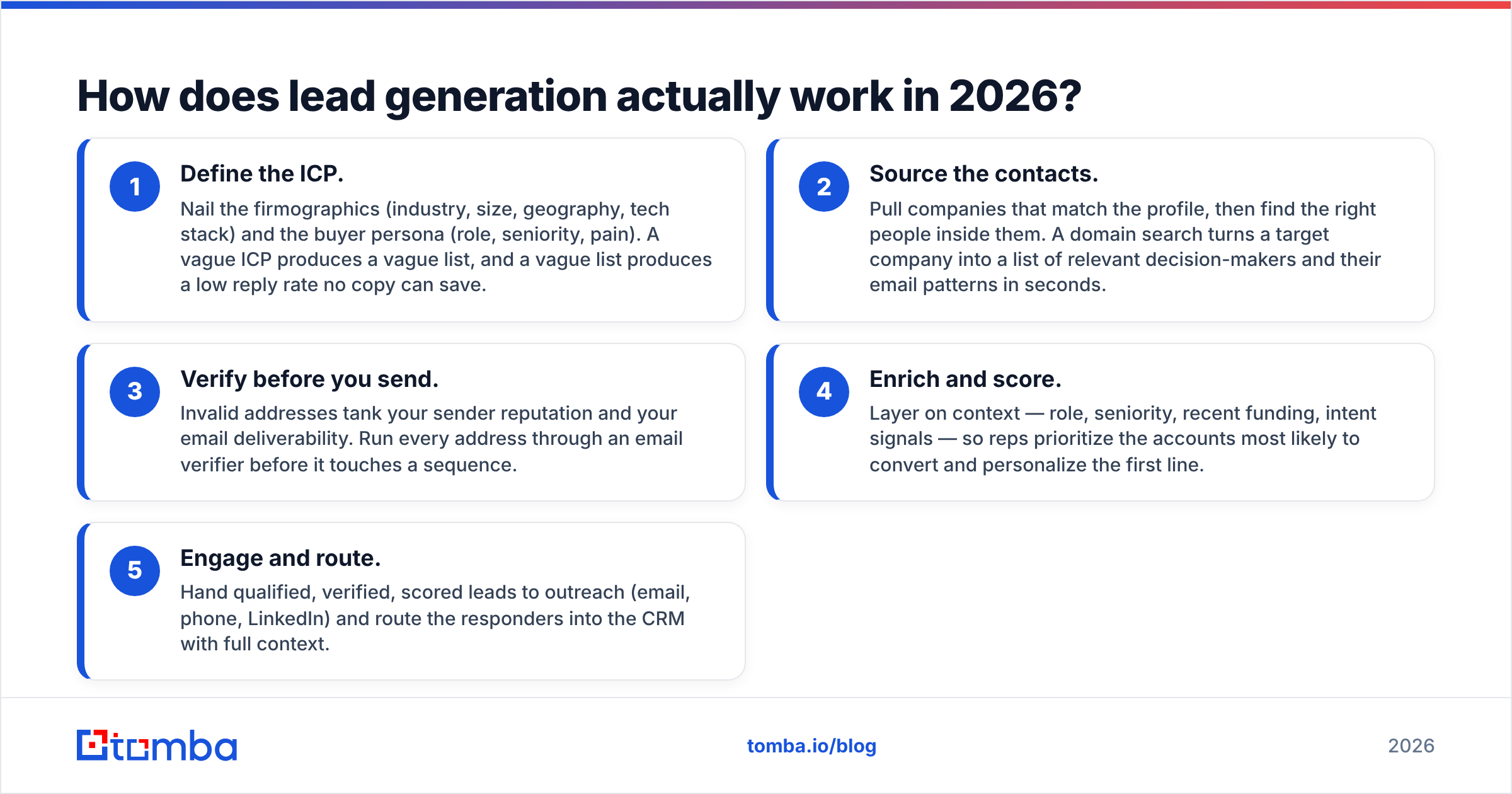
Modern lead generation is a pipeline of five repeatable stages. The leverage in each stage comes from data quality — bad inputs multiply waste at every step downstream.
- Define the ICP. Nail the firmographics (industry, size, geography, tech stack) and the buyer persona (role, seniority, pain). A vague ICP produces a vague list, and a vague list produces a low reply rate no copy can save.
- Source the contacts. Pull companies that match the profile, then find the right people inside them. A domain search turns a target company into a list of relevant decision-makers and their email patterns in seconds.
- Verify before you send. Invalid addresses tank your sender reputation and your email deliverability. Run every address through an email verifier before it touches a sequence.
- Enrich and score. Layer on context — role, seniority, recent funding, intent signals — so reps prioritize the accounts most likely to convert and personalize the first line.
- Engage and route. Hand qualified, verified, scored leads to outreach (email, phone, LinkedIn) and route the responders into the CRM with full context.
The difference between a 1% and a 6% reply rate is rarely the email copy. It is the precision of steps 1–4. You cannot personalize your way out of a list aimed at the wrong people with half-invalid addresses.
How does business development create leverage lead gen can't?#
Business development changes the slope of the curve. Lead generation is largely linear — double the outreach, roughly double the leads, double the cost. Business development is non-linear because relationships compound.
A single channel partnership can deliver a steady stream of pre-qualified referrals that cost you nothing per lead after the deal is signed. A co-marketing alliance puts your brand in front of an audience you'd otherwise pay dearly to reach. A strategic integration — say, becoming a recommended app in a platform's marketplace — can generate inbound for years. None of that shows up in a "leads this week" dashboard, which is exactly why BD needs its own scorecard.
BD also feeds lead generation directly. When you land a marquee logo through a strategic relationship, that becomes social proof in every cold email. When a partner co-hosts a webinar, the attendee list becomes a warm lead source. Good BD lowers the cost and raises the conversion rate of the next lead-gen cycle. The two functions are a loop, not a line.
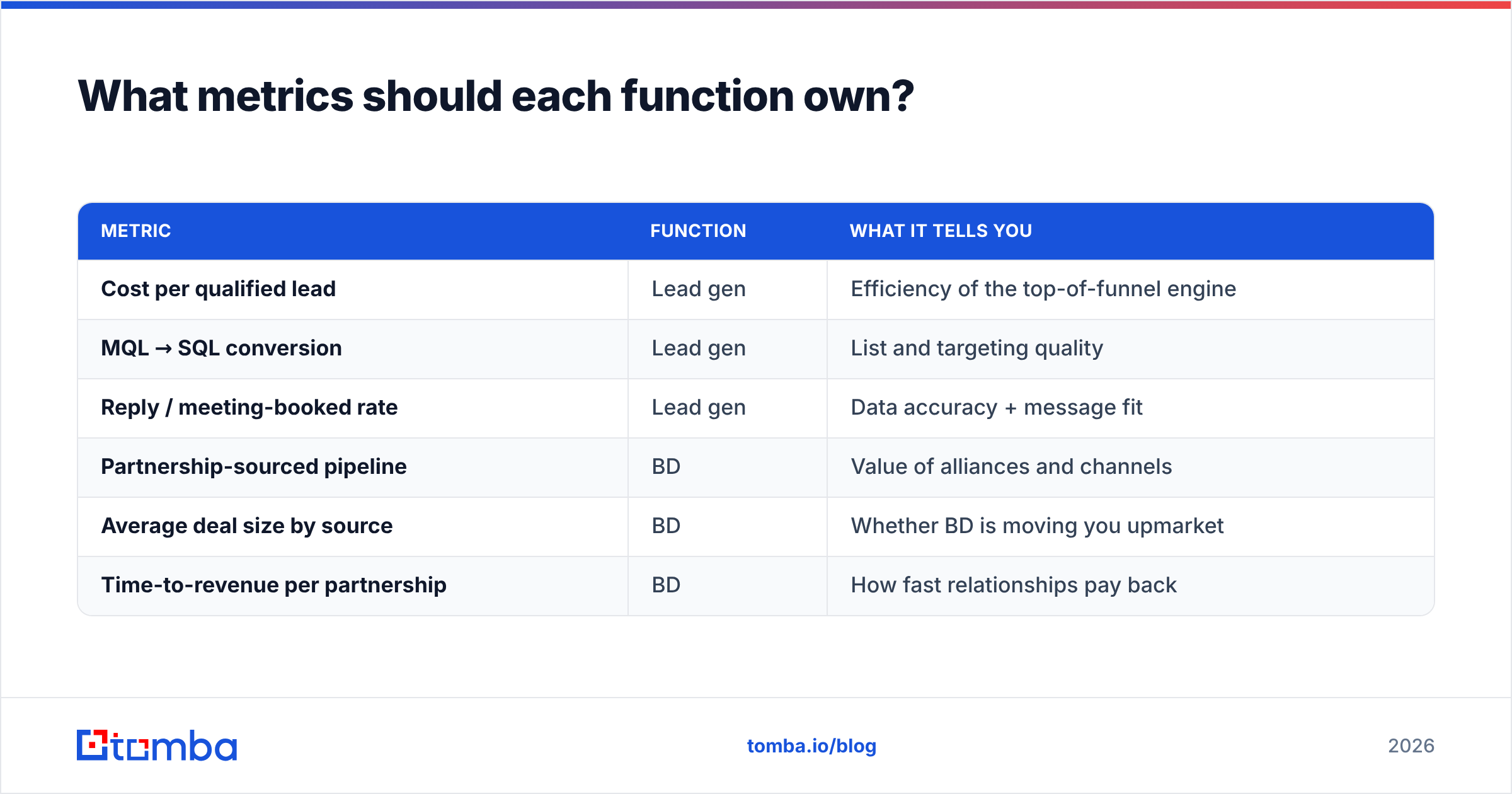
What metrics should each function own?#
Measure them separately or you will starve the slower one. Lead generation answers "are we filling the funnel efficiently?" Business development answers "are we building durable advantages?"
| Metric | Function | What it tells you |
|---|---|---|
| Cost per qualified lead | Lead gen | Efficiency of the top-of-funnel engine |
| MQL → SQL conversion | Lead gen | List and targeting quality |
| Reply / meeting-booked rate | Lead gen | Data accuracy + message fit |
| Partnership-sourced pipeline | BD | Value of alliances and channels |
| Average deal size by source | BD | Whether BD is moving you upmarket |
| Time-to-revenue per partnership | BD | How fast relationships pay back |
A healthy revenue org reviews both scorecards in the same meeting but never blends them into a single vanity number. If you only watch lead volume, you will under-invest in the partnerships that make every future lead cheaper. If you only watch partnerships, you will run out of near-term pipeline while you wait for alliances to mature.
What tools power business development and lead generation?#
The stack splits into four layers. The data layer sits underneath everything — it is the one place where cutting corners poisons both functions at once.
- Data and contact layer. This is where you find and verify the people you want to reach. A precise bulk email finder, verification, and contact enrichment feed clean records into everything above. Garbage here means wasted spend everywhere else.
- CRM layer. Your CRM is the system of record for both leads and relationships — HubSpot, Salesforce, or Pipedrive. BD tracks long-cycle accounts here; lead gen tracks the fast-moving funnel.
- Outreach layer. Email sequencers, dialers, and LinkedIn tools execute the lead-gen motion at volume and keep partnership conversations on cadence.
- Intelligence layer. Intent data, website visitor reveal, and signal tools tell you which accounts to prioritize this week.
For a deeper look at how buyers rate these categories, G2's sales software grids and HubSpot's sales tools breakdown are useful neutral references. The point is not to buy one of everything — it is to make sure the data layer is accurate before you spend on the layers above it.

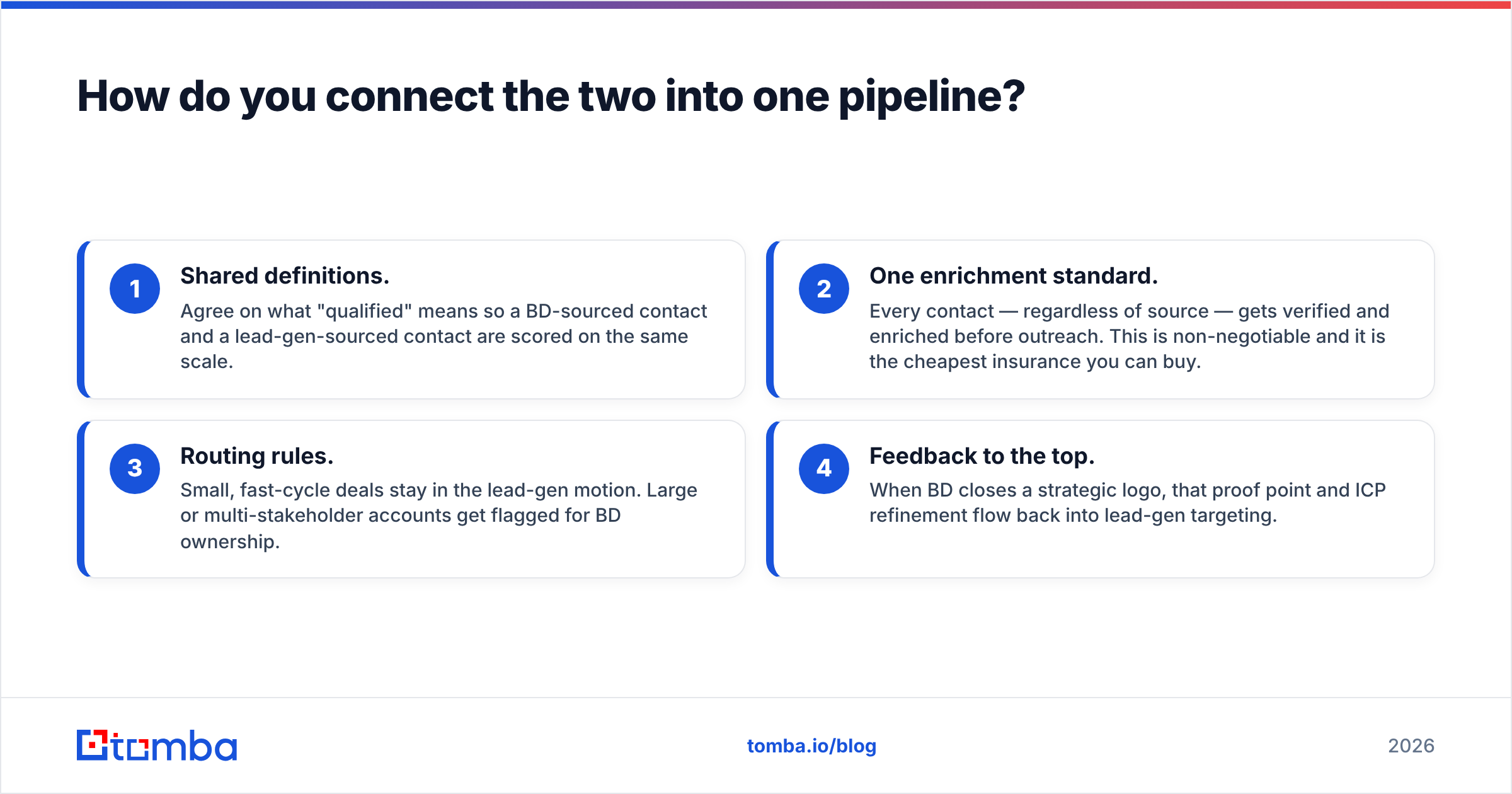
How do you connect the two into one pipeline?#
The handoff is where most teams leak revenue. A BD partnership generates a list of warm contacts, but if those contacts go into a sequence unverified and unenriched, the warm advantage evaporates on the first bounce. Conversely, a lead-gen engine that surfaces a recurring buyer at a strategic account should trigger a BD conversation, not just another automated follow-up.
Build the loop explicitly:
- Shared definitions. Agree on what "qualified" means so a BD-sourced contact and a lead-gen-sourced contact are scored on the same scale.
- One enrichment standard. Every contact — regardless of source — gets verified and enriched before outreach. This is non-negotiable and it is the cheapest insurance you can buy.
- Routing rules. Small, fast-cycle deals stay in the lead-gen motion. Large or multi-stakeholder accounts get flagged for BD ownership.
- Feedback to the top. When BD closes a strategic logo, that proof point and ICP refinement flow back into lead-gen targeting.
Connect your data layer to the rest of the stack with native integrations so a verified contact lands in the CRM and the sequencer without a CSV round-trip. The less manual the handoff, the less data decays in transit.
How do you choose where to invest first?#
Start with whichever function is the current bottleneck, and fix the data layer regardless. If you have strong relationships but a thin funnel, invest in lead generation: tighten the ICP, expand sourcing, and verify aggressively. If you have plenty of leads but deals are small and slow, invest in business development: pursue channel partners and move upmarket.
Stage matters too. Early-stage companies usually lead with founder-driven BD because relationships open the first doors and there's no brand to generate inbound yet. As you scale, lead generation industrializes the repeatable motion while BD chases the compounding bets. Most teams over-rotate on one — early teams ignore systematic lead gen until growth stalls; later teams treat BD as a side project until a competitor locks up the key partnership first.
Whatever you choose, the constant is data. A partnership is worthless if you can't reach the right person inside the partner's accounts, and a lead-gen engine is worthless if half its addresses bounce. Both functions live or die on whether you can find a real decision-maker and reach them on the first try.
Common mistakes that stall both functions#
- Treating BDRs as business development. Outbound prospecting is lead generation. Calling it BD hides the fact that no one owns real partnerships.
- Skipping verification. Sending to unverified lists burns sender reputation and drags down deliverability for your good contacts too.
- One blended metric. A single "leads" number lets the slow, high-value BD work get cut every time a quarter looks soft.
- Manual data handoffs. Every CSV export is a chance for records to go stale, duplicate, or lose enrichment context.
- Buying outreach before fixing data. A bigger sequencer aimed at a bad list just helps you fail faster.
The bottom line#
Business development and lead generation are partners, not synonyms. Lead generation fills the funnel with qualified, verified contacts. Business development builds the relationships and market access that make those contacts convert at scale — and that make the next round of lead generation cheaper. Measure them separately, connect them deliberately, and never let the data layer that feeds both go stale.
That data layer is exactly where Tomba fits. The Tomba Email Finder gives you verified, decision-maker contacts by name, company, or domain — so your lead-gen engine reaches real inboxes and your BD outreach lands with the right person the first time. Start free with 25 searches a month, then scale on plans from $49/mo; see the full Tomba pricing when you're ready to move from a thin funnel to a predictable one.
// get started
Find, verify and enrich your first contacts today
Start on the free plan with 25 searches a month, then scale when your team is ready.
Free plan · No credit card required · GDPR & CCPA
// about the author