Business Development Funnel: Stages, Metrics & Tactics 2026
A practical breakdown of the business development funnel in 2026 — every stage, the metrics that matter, and the tactics that move deals from cold to closed.
You can have a brilliant product and a motivated team and still watch revenue stall — because the path between "we found a company that might care" and "they signed" is leaky, undefined, or living in three people's heads. The business development funnel is how you make that path explicit, measurable, and fixable.
This guide breaks down the full funnel for 2026: what each stage actually means, the metrics that tell you where deals die, and the tactics that move accounts forward without burning your team out.
TL;DR#
- The business development funnel is the structured journey from raw target account to closed revenue — broader than a sales pipeline because it includes pre-pipeline market work like research, sourcing, and qualification.
- It has six core stages: target identification, outreach, qualification, opportunity, proposal/negotiation, and close — each with its own conversion rate and failure mode.
- What gets measured gets fixed. Track stage-to-stage conversion, velocity, and cost per qualified lead, not just total revenue.
- Data quality is the silent killer. Roughly half of most funnels leak at the top because contact data is stale, unverified, or missing entirely.
- Tools matter at the top of funnel — accurate contact discovery and enrichment (like Tomba Email Finder) widen the mouth of the funnel before any tactic can help.
What is a business development funnel?#
A business development funnel is the staged model of how a potential customer moves from "an account you've never spoken to" to "a signed, paying client." Think of it like a water filtration system: you pour a large, messy volume of raw prospects in the top, and each stage filters out the bad fits so that what comes out the bottom is clean, qualified revenue.
It overlaps with the sales funnel but is not identical. The sales funnel usually starts once a lead is in your CRM and a salesperson owns it. The business development funnel starts earlier — at market research and account sourcing — and is concerned with creating opportunities, not just converting ones that already exist. In many B2B orgs, business development reps (BDRs) own the top half and account executives (AEs) own the bottom half.
The distinction matters because most teams obsess over the bottom (close rate, discounts, objection handling) while the biggest leaks are at the top: bad targeting and broken contact data. You cannot close a deal with someone you never reached.

What are the stages of the business development funnel?#
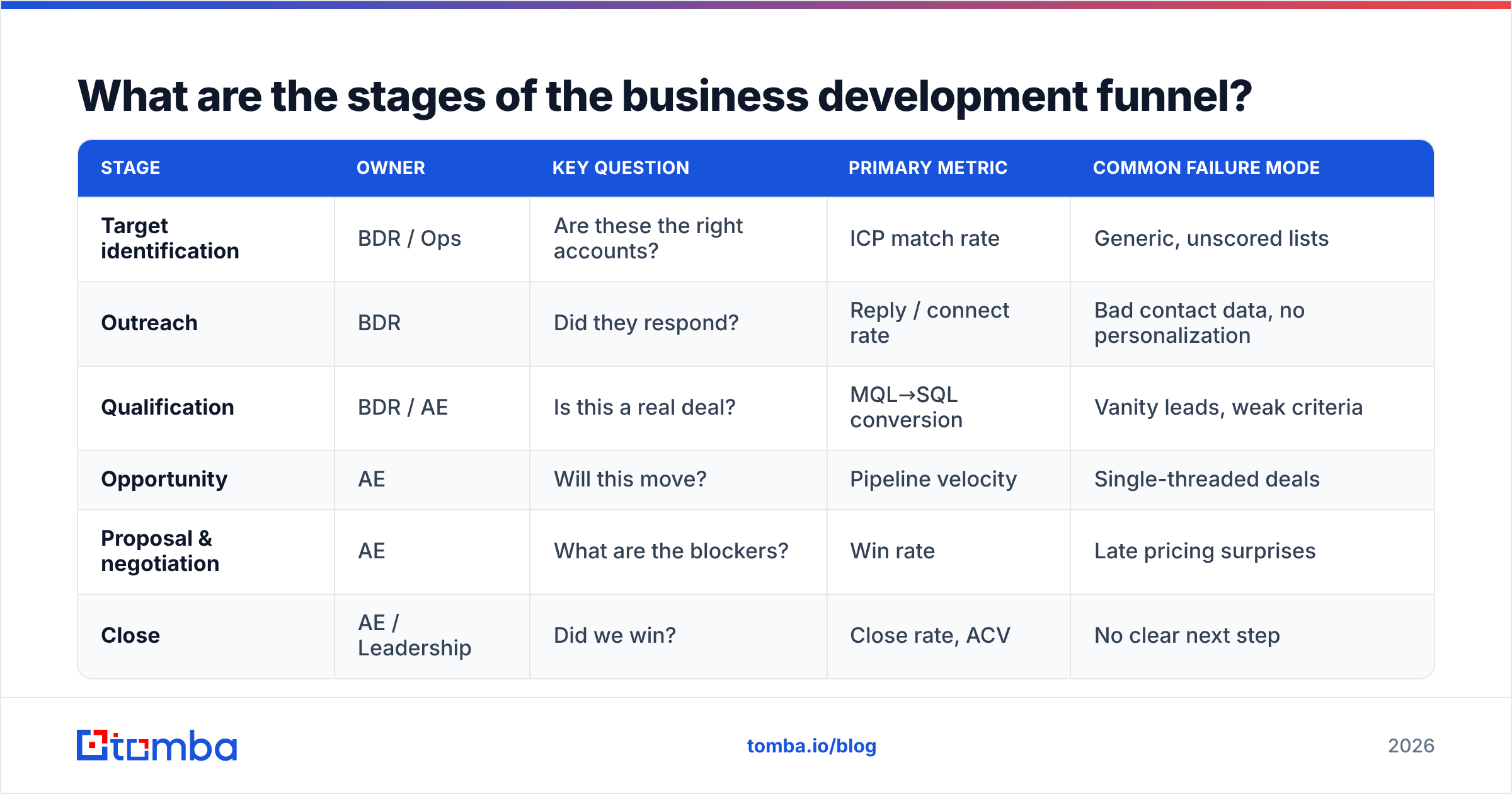
Most effective funnels use six stages. The exact labels vary by company, but the function of each stage is consistent.
- Target identification — You define your ideal customer profile (ICP) and build a list of accounts and contacts that match. This is where firmographic and contact data quality is decided.
- Outreach — You make first contact across email, phone, and social. The goal is a response, not a sale.
- Qualification — You confirm the prospect has budget, authority, need, and timeline (or your framework of choice). Unqualified leads exit here, on purpose.
- Opportunity — A qualified lead becomes a tracked deal with an estimated value and a champion inside the account.
- Proposal & negotiation — You present pricing, scope, and terms; objections get handled here.
- Close — The deal is won or lost. Won deals hand off to onboarding; lost deals feed your nurture and re-engagement lists.
Here is how the stages map to owners, the question each answers, and the primary metric you should watch.
| Stage | Owner | Key question | Primary metric | Common failure mode |
|---|---|---|---|---|
| Target identification | BDR / Ops | Are these the right accounts? | ICP match rate | Generic, unscored lists |
| Outreach | BDR | Did they respond? | Reply / connect rate | Bad contact data, no personalization |
| Qualification | BDR / AE | Is this a real deal? | MQL→SQL conversion | Vanity leads, weak criteria |
| Opportunity | AE | Will this move? | Pipeline velocity | Single-threaded deals |
| Proposal & negotiation | AE | What are the blockers? | Win rate | Late pricing surprises |
| Close | AE / Leadership | Did we win? | Close rate, ACV | No clear next step |
Why does the top of the funnel leak the most?#
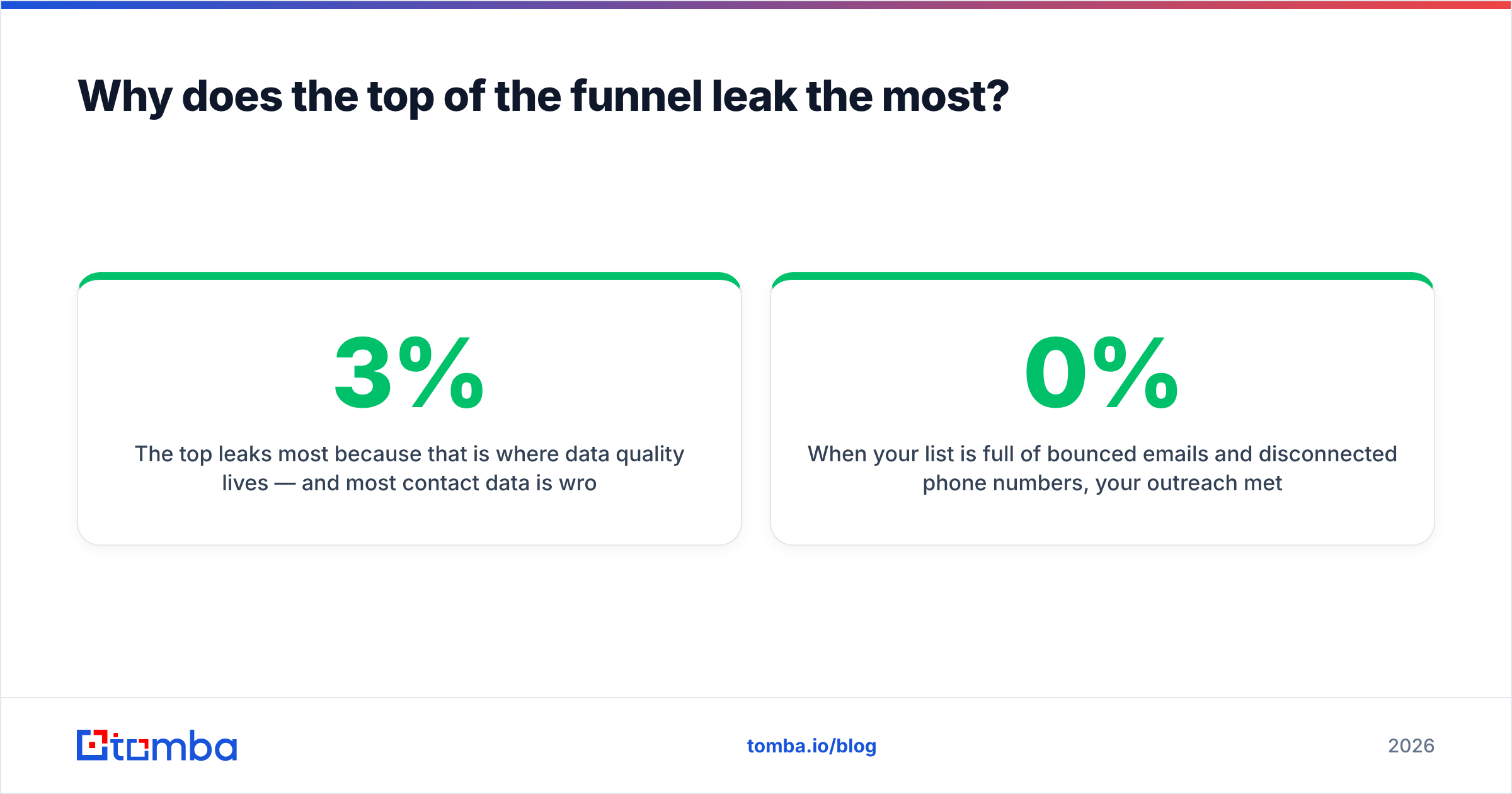
The top leaks most because that is where data quality lives — and most contact data is wrong before anyone touches it. Industry estimates put B2B data decay at roughly 2–3% per month, which compounds to a quarter of your database going stale in a year as people change jobs, companies rebrand, and emails get deactivated.
When your list is full of bounced emails and disconnected phone numbers, your outreach metrics collapse for reasons that have nothing to do with your message. A 0% reply rate on an undeliverable email looks identical to a 0% reply rate on a bad pitch — but the fixes are completely different.
This is why serious teams invest in contact discovery and verification before they invest in clever copywriting. Running your target list through a domain search to find the right people at each account, then validating addresses with an email verifier before send, protects your sender reputation and means your funnel math reflects reality. Enriching thin records with firmographic and role data via data enrichment sharpens targeting at the very first stage, where mistakes are cheapest to fix.
According to HubSpot's research on sales benchmarks, response rates on personalized, well-targeted outreach dramatically outperform spray-and-pray volume — but personalization is impossible without accurate underlying data.
How do you measure a business development funnel?#
You measure it with three lenses: conversion, velocity, and cost. Revenue is the output; these three are the inputs you can actually control.
- Stage-to-stage conversion rate — the percentage of deals that advance from one stage to the next. This pinpoints where you leak. A healthy funnel has predictable, improving conversion at each step.
- Funnel velocity — how fast deals move through. Slow velocity ties up pipeline and hides forecasting problems. Velocity is often expressed as (number of opportunities × win rate × average deal value) ÷ sales cycle length.
- Cost per qualified lead (CPQL) — total spend (tools, salaries, ads) divided by qualified leads produced. This tells you whether scaling the funnel is profitable or just expensive.
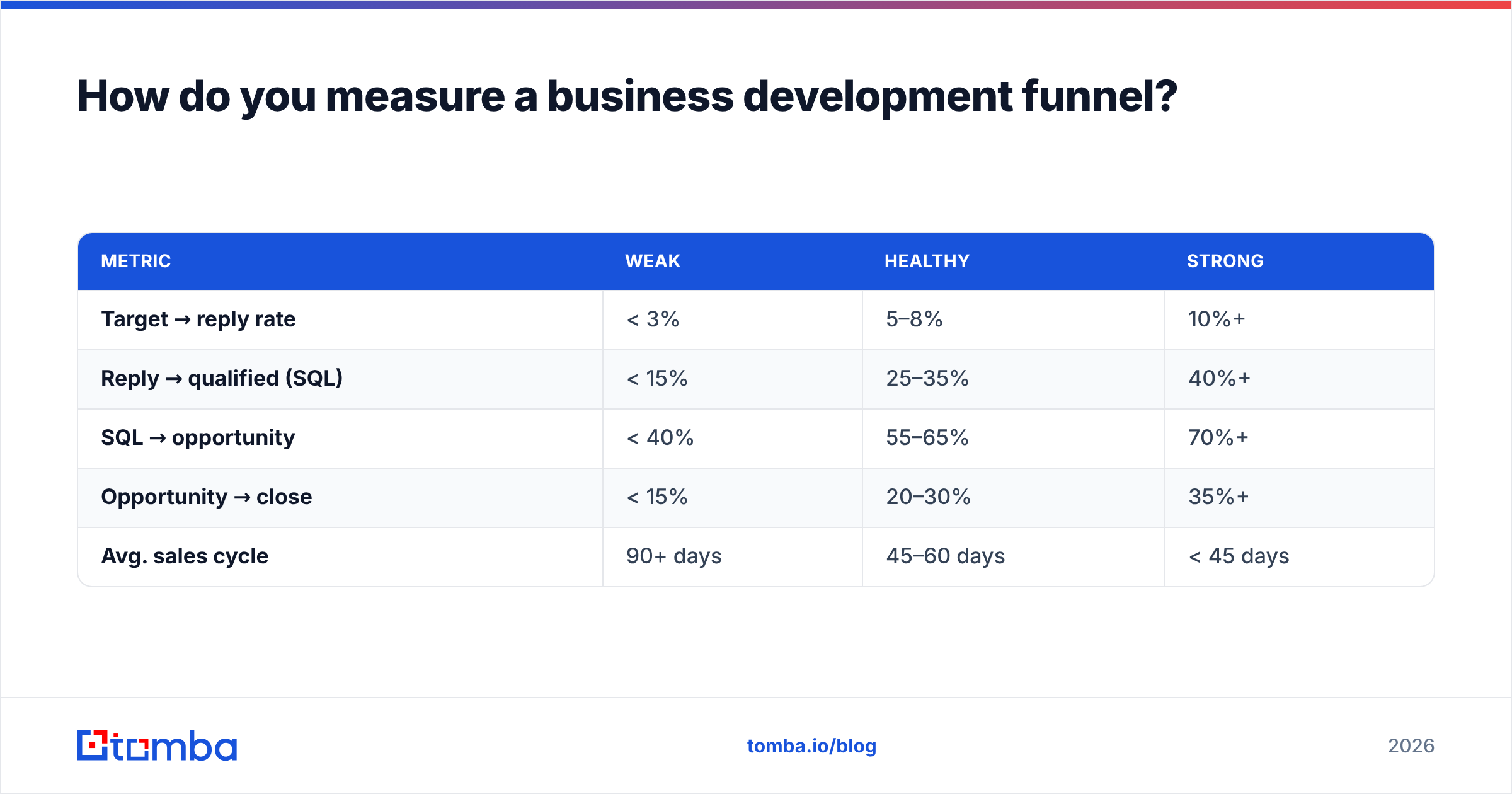
A simple benchmark table for a mid-market B2B SaaS funnel looks roughly like this. Use it as a starting reference, not gospel — your numbers depend on ICP, price point, and motion.
| Metric | Weak | Healthy | Strong |
|---|---|---|---|
| Target → reply rate | < 3% | 5–8% | 10%+ |
| Reply → qualified (SQL) | < 15% | 25–35% | 40%+ |
| SQL → opportunity | < 40% | 55–65% | 70%+ |
| Opportunity → close | < 15% | 20–30% | 35%+ |
| Avg. sales cycle | 90+ days | 45–60 days | < 45 days |
For context on how analysts frame pipeline health and forecasting maturity, Gartner's sales research and Salesforce's State of Sales reports are useful external benchmarks to compare against your own data.
How do you fix each stage of the funnel?#
You fix a funnel stage by stage, starting with the one that leaks most — not by adding more volume to the top. Pouring more raw leads into a funnel with a 3% reply rate just wastes money faster.
Fix targeting first. Tighten your ICP using closed-won data: what do your best customers have in common (industry, size, tech stack, trigger events)? Score accounts against that profile and cut the bottom 40%. Quality of list beats quantity of list every time.
Fix outreach data second. Before you touch messaging, make sure the messages are reaching humans. Verify emails, find direct phone numbers with a phone finder, and confirm you are reaching decision-makers, not generic inboxes. A clean list lifts every downstream metric at once.
Fix qualification third. Write explicit, written criteria for what makes a lead "qualified" and enforce them. The discipline to disqualify fast is what keeps your AEs working real deals instead of polishing zombies. A clear definition of a marketing qualified lead versus a sales-ready one prevents handoff friction between teams.
Fix the bottom last. Proposal and negotiation problems (late pricing surprises, single-threaded deals, no mutual close plan) are real, but they affect a smaller absolute number of deals than top-of-funnel leaks. Multi-thread every opportunity — find a champion and an economic buyer — so one person leaving the company doesn't kill the deal.
What tools support the business development funnel?#
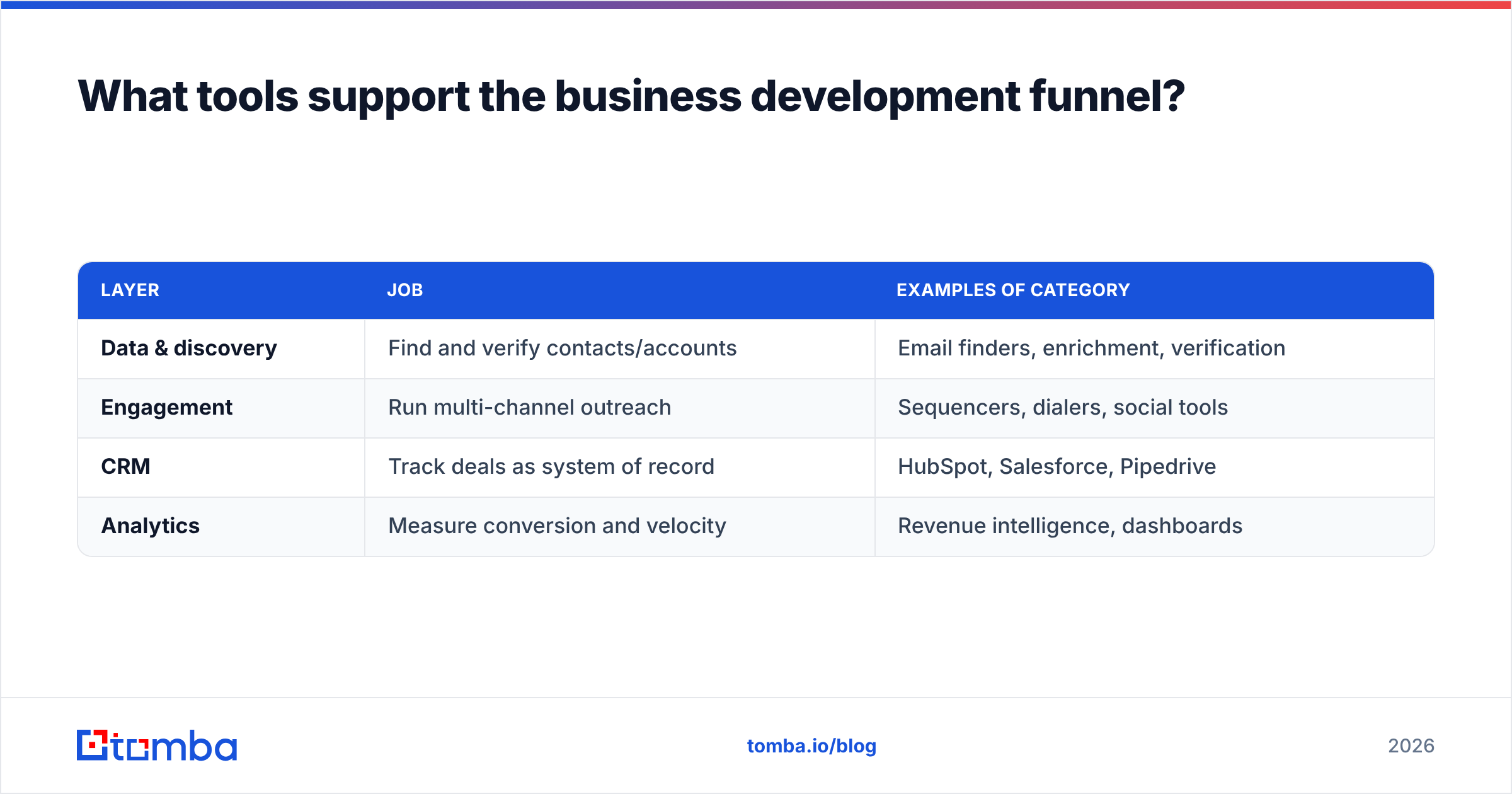
The funnel is powered by a stack, and the stack splits roughly by stage. You do not need every category on day one — you need accurate data at the top and a clean system of record at the bottom.
| Layer | Job | Examples of category |
|---|---|---|
| Data & discovery | Find and verify contacts/accounts | Email finders, enrichment, verification |
| Engagement | Run multi-channel outreach | Sequencers, dialers, social tools |
| CRM | Track deals as system of record | HubSpot, Salesforce, Pipedrive |
| Analytics | Measure conversion and velocity | Revenue intelligence, dashboards |
The highest-leverage investment is almost always the data layer, because it determines whether everything downstream operates on truth or noise. If you are evaluating budget, the Tomba pricing tiers scale with funnel volume: a Free tier with 25 searches a month to test the workflow, Starter at $49/mo, Growth at $99/mo, and Pro at $249/mo for teams running serious top-of-funnel volume. Independent reviews on platforms like G2 are a useful sanity check before you commit to any vendor in this category.
How is the business development funnel changing in 2026?#
The biggest shift is from volume to precision. Inbox providers have tightened bulk-sending rules, buyers are fatigued by mass outreach, and AI has made generic personalization trivial to detect. The funnels that win in 2026 are narrower at the top and far cleaner — fewer, better-targeted accounts reached through verified channels with genuinely relevant context.
Three concrete trends:
- Signal-based targeting is replacing static lists. Teams trigger outreach off hiring, funding, and product-launch signals rather than blasting an entire industry.
- Data hygiene is a sender-reputation issue, not just a CRM nicety. Sending to unverified addresses now actively damages deliverability, so verification has moved from "nice to have" to mandatory pre-send.
- Consolidation of the stack. Teams are merging discovery, enrichment, and verification into fewer tools to keep data consistent across the funnel, often pulling everything through a single email finder API.
The fundamentals haven't changed — define your market, reach the right people, qualify honestly, and close cleanly. What's changed is that sloppiness at the top of the funnel is now punished faster and more visibly than ever.
Build your funnel on accurate data#
A business development funnel is only as strong as the contacts that enter it. If your top-of-funnel list is full of guesses, stale emails, and generic info@ addresses, no amount of clever sequencing or negotiation training will save your numbers.
Start where the leak is biggest. Use Tomba Email Finder to discover verified, decision-maker email addresses by name, company, or domain — so the people you pour into the top of your funnel are real, reachable, and worth your team's time. Pair it with verification before send, and watch every downstream conversion metric move in the right direction. You can test the full workflow on the free tier before scaling up.
Map your stages, measure your conversions, fix your data first — and the rest of the funnel finally starts behaving.
// get started
Find, verify and enrich your first contacts today
Start on the free plan with 25 searches a month, then scale when your team is ready.
Free plan · No credit card required · GDPR & CCPA
// about the author