Business Development Pipeline Stages: The 2026 Guide
A clear, stage-by-stage breakdown of the business development pipeline in 2026 — what each stage means, the metrics that matter, and how to stop deals leaking out.
Most "pipelines" are just a list of names someone hopes will turn into revenue. A real business development pipeline is a sequence of stages with clear entry and exit criteria, so you always know what a deal needs next and what it's actually worth. This guide breaks down every stage, the metrics that matter, and where deals quietly leak out.
TL;DR#
- A business development pipeline is a staged model that tracks a relationship from first identification to a signed deal and beyond — not just a sales forecast.
- Most teams run 6–8 stages: sourcing, qualification, discovery, evaluation, proposal, negotiation, closed-won, and post-close expansion.
- Each stage needs exit criteria (what must be true to advance) and a conversion benchmark, or your forecast is fiction.
- The biggest leaks happen early — bad data at sourcing and weak qualification poison everything downstream.
- Clean contact data feeds the top of the funnel; you can find email addresses and enrich accounts before a rep ever logs a touch.
What is a business development pipeline?#
A business development pipeline is a visual, staged map of every potential relationship moving toward a closed deal. Think of it like an airport's departure board: each flight (deal) sits at a known gate (stage), with a status that tells you whether it's boarding, delayed, or cleared for takeoff. Without that board, you're guessing which deals are about to leave the ground.
The difference between business development (BD) and pure sales matters here. Sales pipelines usually start when a lead is already interested. BD pipelines start earlier — at market identification and relationship-building — and often extend later, into partnerships and expansion. That's why BD pipelines tend to have more front-end stages than a standard sales process and pipeline built only around inbound demand.
A useful pipeline does three jobs:
- Forecasting — multiply deal value by stage probability to predict revenue.
- Diagnosis — show exactly where deals stall so you can fix the stage, not blame the rep.
- Coaching — give managers a shared vocabulary for what "good" looks like at each step.
What are the core business development pipeline stages?#
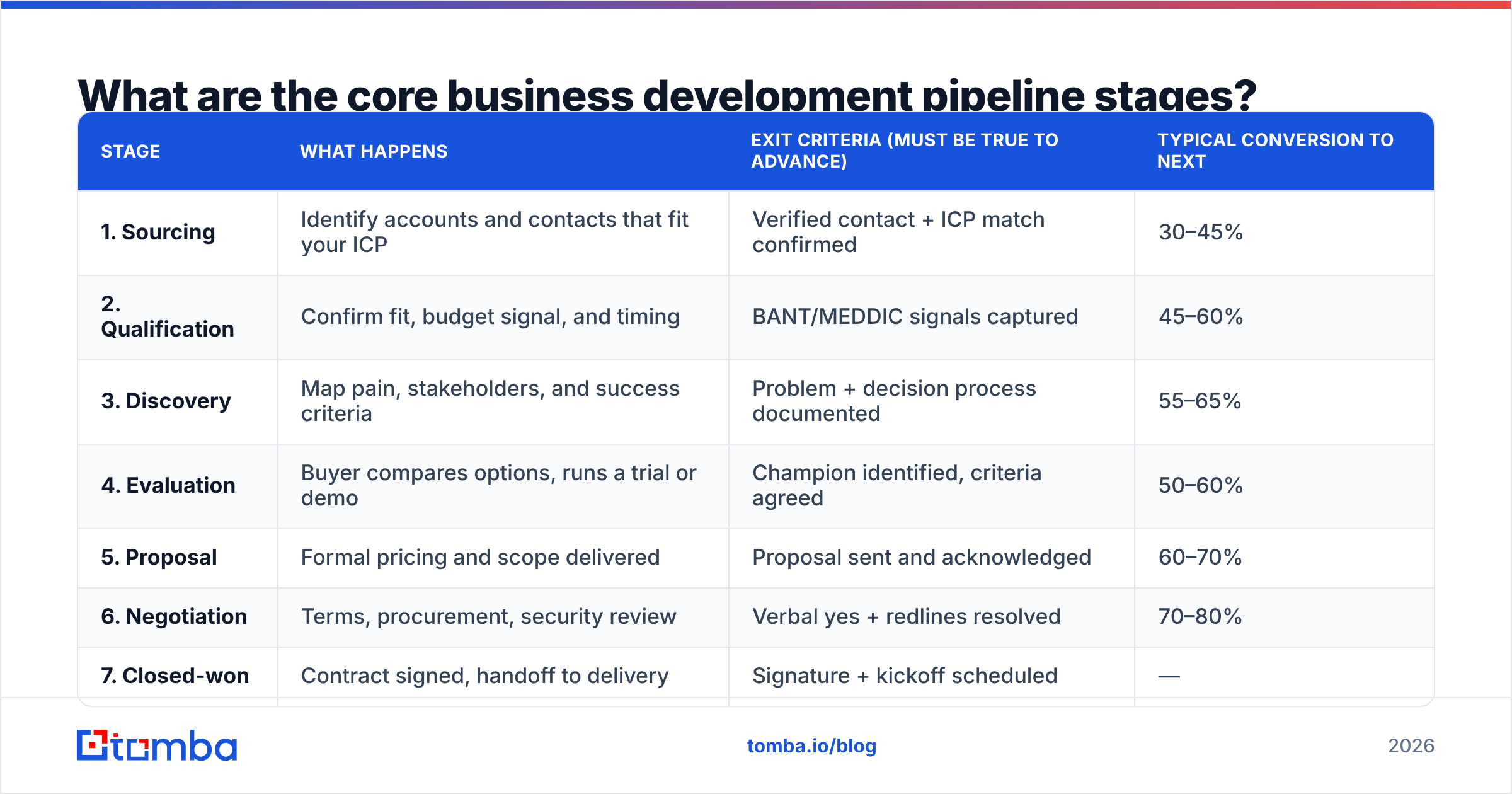
Here is the seven-stage model most modern BD teams use, with the exit criteria that move a deal forward. Treat these as gates: a deal does not advance until its criteria are objectively met.
| Stage | What happens | Exit criteria (must be true to advance) | Typical conversion to next |
|---|---|---|---|
| 1. Sourcing | Identify accounts and contacts that fit your ICP | Verified contact + ICP match confirmed | 30–45% |
| 2. Qualification | Confirm fit, budget signal, and timing | BANT/MEDDIC signals captured | 45–60% |
| 3. Discovery | Map pain, stakeholders, and success criteria | Problem + decision process documented | 55–65% |
| 4. Evaluation | Buyer compares options, runs a trial or demo | Champion identified, criteria agreed | 50–60% |
| 5. Proposal | Formal pricing and scope delivered | Proposal sent and acknowledged | 60–70% |
| 6. Negotiation | Terms, procurement, security review | Verbal yes + redlines resolved | 70–80% |
| 7. Closed-won | Contract signed, handoff to delivery | Signature + kickoff scheduled | — |
The exact stage names matter less than the discipline. What kills pipelines is subjective advancement — a rep nudging a deal to "Proposal" because the prospect was friendly on a call. Define each gate as a yes/no fact, not a feeling.
Stage 1 — Sourcing#
This is where data quality is won or lost. If you load the pipeline with unverified names and stale emails, every downstream metric lies to you. Pull accounts that match your ideal customer profile, then enrich each one with verified contacts. A domain search returns the people behind a company in seconds, and an email verifier strips out the addresses that would otherwise bounce and wreck your sender reputation.
Stage 2 — Qualification#
Qualification answers one question: should we spend time here? Use a framework (BANT, MEDDIC, or your own) and record the signals as structured fields, not free-text notes. A qualified deal has a named problem, a plausible budget, and a reason to act now. Everything else goes back to nurture.
Stage 3 — Discovery#
Discovery is where you earn the right to sell. Map the buying committee, the cost of inaction, and the buyer's own definition of success. Deals that skip real discovery tend to die in negotiation, because nobody internally was convinced they needed to change.
Stages 4–7 — Evaluation through close#
From here the deal becomes a project. The buyer evaluates, you propose, both sides negotiate, and procurement does its thing. Your job is to remove friction: fast answers, a clear champion, and no surprises in legal or security review.
How long should each stage take?#
Stage duration — often called velocity — is as important as conversion rate. A deal that converts at 70% but sits in Negotiation for 90 days is still a problem, because it ties up forecast and rep attention.
- Sourcing → Qualification: days, not weeks. If it drags, your ICP or data is wrong.
- Discovery: 1–3 weeks depending on deal size.
- Evaluation: the most variable stage; enterprise trials can run a quarter.
- Negotiation: cap it. Set internal SLAs so deals don't rot in procurement.
Track the median age in stage for every deal. Anything more than 1.5× the median is a flag to either advance, downgrade, or kill. Healthy pipelines are constantly pruned — a bloated pipeline full of zombie deals produces a confident-looking forecast that never lands.
How do you measure pipeline health?#
Four numbers tell you almost everything. Watch them weekly, not quarterly.
- Stage conversion rate — the percentage advancing from each stage to the next. This is your leak detector.
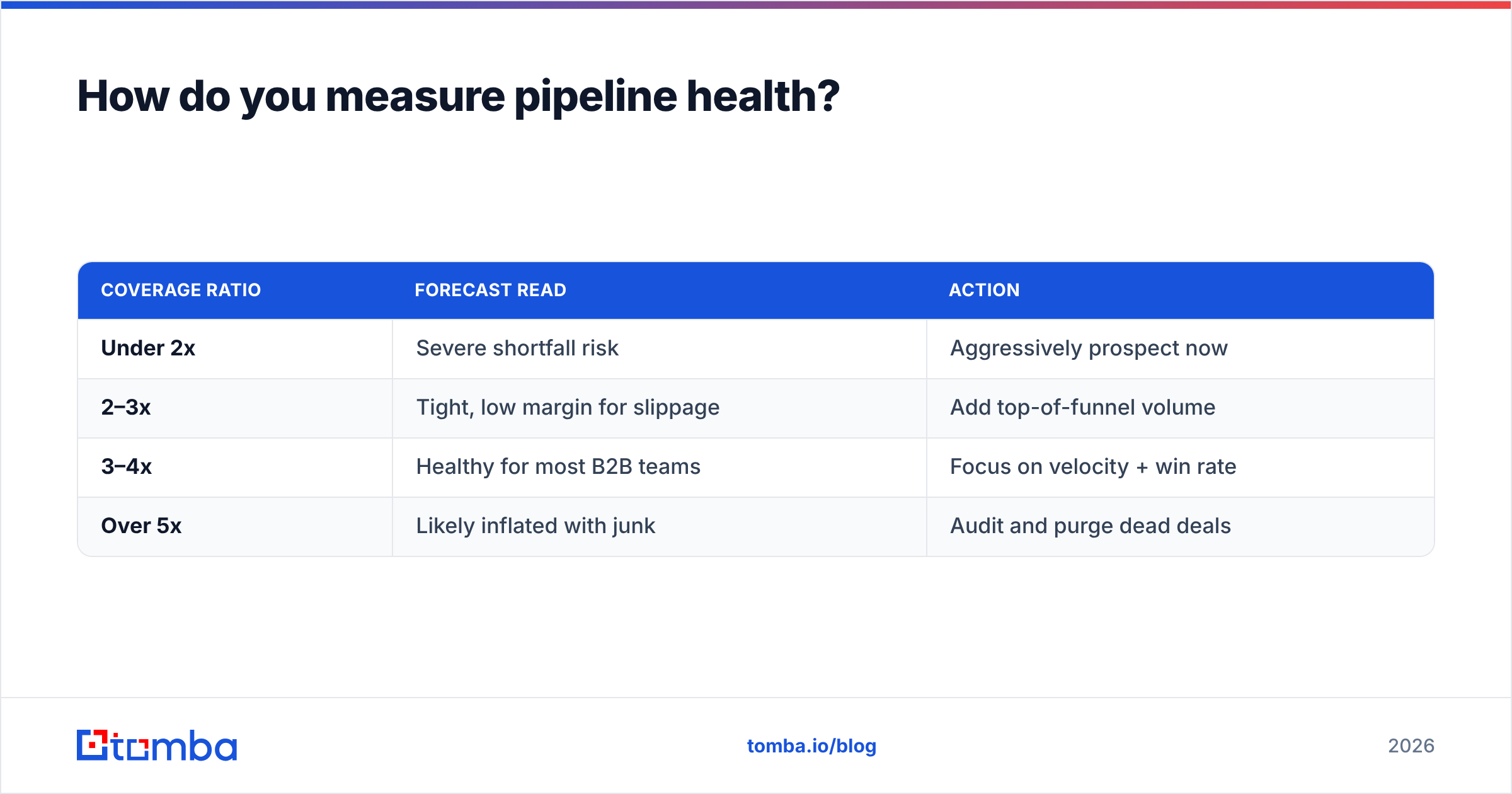
- Pipeline coverage — total open pipeline value divided by your quota. Most teams target 3–4x coverage to hit number.
- Average deal velocity — days from sourcing to closed-won. Falling velocity means a healthier process.
- Win rate — the share of qualified deals that close. Track your overall win rate and segment it by source, because not all top-of-funnel is equal.
A quick benchmark on coverage and what it implies:
| Coverage ratio | Forecast read | Action |
|---|---|---|
| Under 2x | Severe shortfall risk | Aggressively prospect now |
| 2–3x | Tight, low margin for slippage | Add top-of-funnel volume |
| 3–4x | Healthy for most B2B teams | Focus on velocity + win rate |
| Over 5x | Likely inflated with junk | Audit and purge dead deals |
If your coverage looks great but deals never close, the problem is almost always quality at sourcing — too many unqualified accounts inflating the number. Fixing the front of the funnel fixes the forecast.
Which tools support each pipeline stage?#
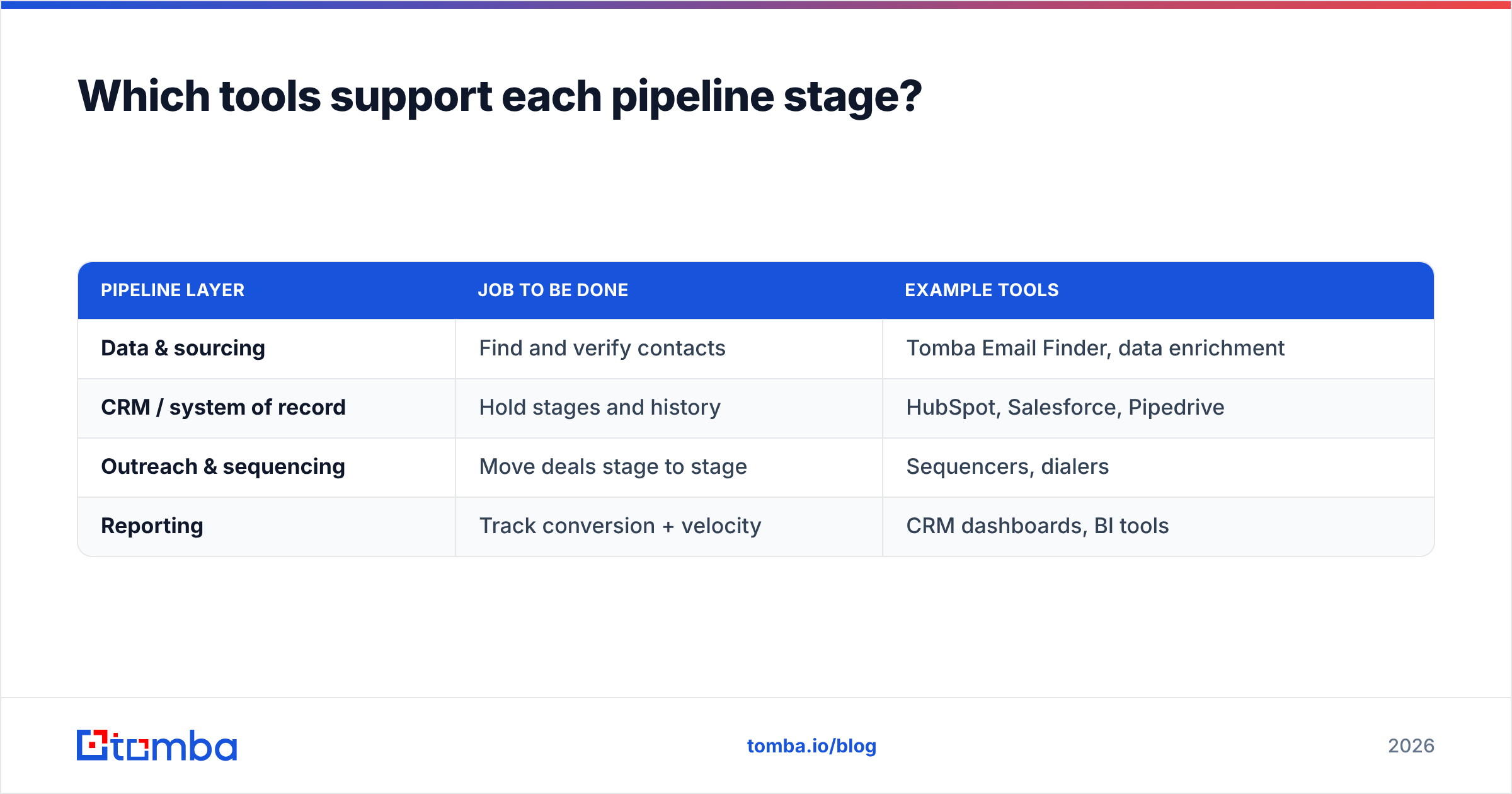
You don't need a 12-app stack. You need clean data going in, a CRM holding the stages, and automation moving deals between them. Here's how the layers map.
| Pipeline layer | Job to be done | Example tools |
|---|---|---|
| Data & sourcing | Find and verify contacts | Tomba Email Finder, data enrichment |
| CRM / system of record | Hold stages and history | HubSpot, Salesforce, Pipedrive |
| Outreach & sequencing | Move deals stage to stage | Sequencers, dialers |
| Reporting | Track conversion + velocity | CRM dashboards, BI tools |
The data layer is the one teams under-invest in, and it's the one with the highest leverage. A CRM full of unverified emails produces low reply rates, bad sender reputation, and a polluted forecast. Feeding it verified emails and enriched company data at the sourcing stage is the cheapest reliability upgrade you can make. According to HubSpot's research on sales data, reps already lose a large share of their week to non-selling admin — clean inbound data removes a big chunk of that.
For teams running BD across many accounts, a bulk email finder lets you enrich an entire target list at once and push verified contacts straight into the sourcing stage, so reps start every week with a full, clean top-of-funnel.
What are the most common pipeline leaks?#
Most pipelines don't fail at the close. They fail quietly, upstream, for predictable reasons:
- Garbage at sourcing. Unverified contacts inflate volume and tank reply rates. Verify before you load.
- Soft qualification. "Seemed interested" is not a stage gate. Require objective signals.
- No exit criteria. If advancement is subjective, your forecast is a mood ring.
- Zombie deals. Old opportunities nobody will kill make coverage look healthier than it is.
- No single source of truth. Stages tracked in spreadsheets plus CRM plus someone's head guarantees drift.
Fixing leaks is a discipline problem more than a tooling problem — but the right tooling makes the discipline cheap to maintain. When advancing a stage requires verified data and a checked box, reps stop fudging it.
How do you build a pipeline from scratch?#
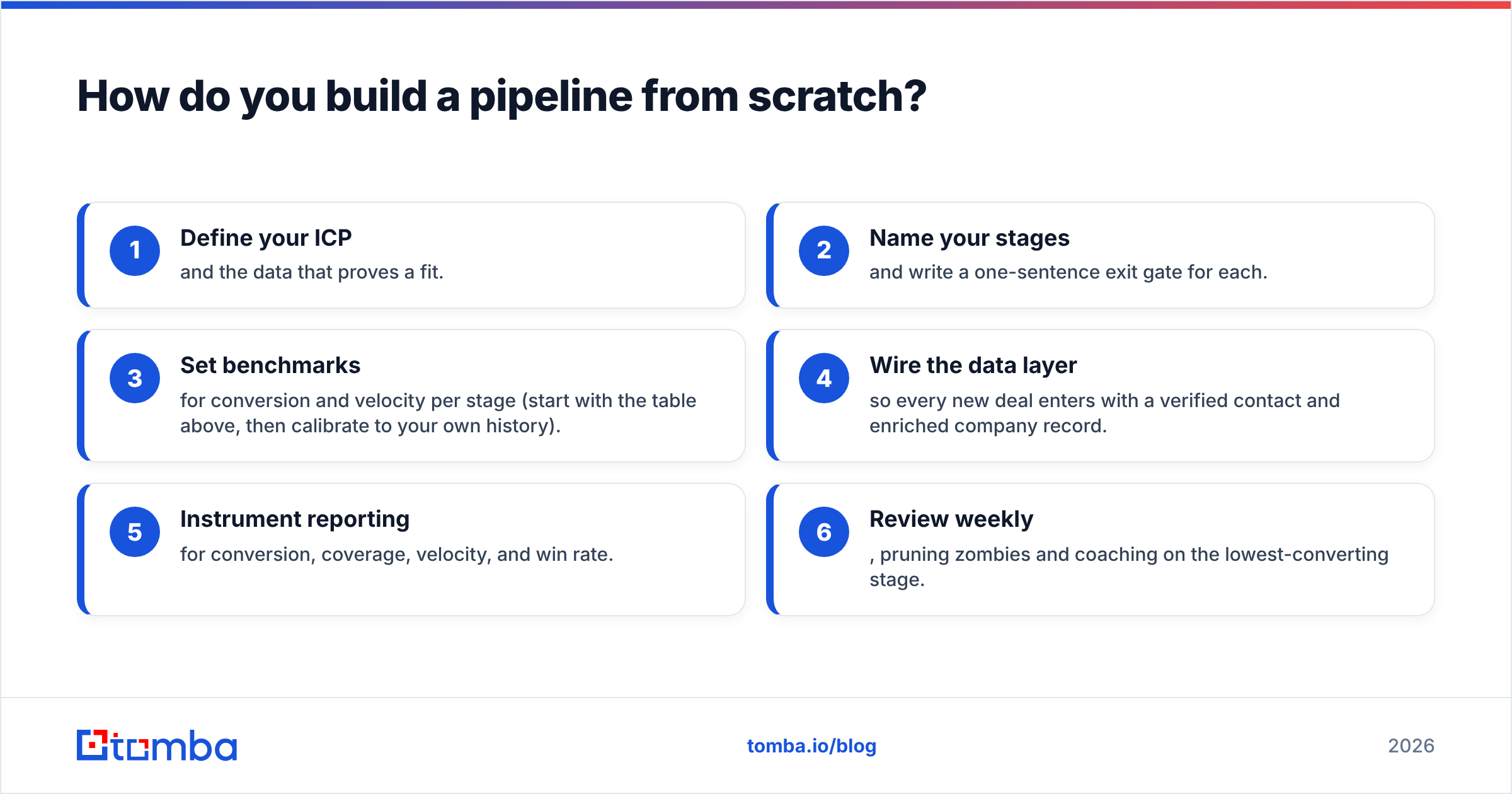
If you're standing one up, work backward from the close:
- Define your ICP and the data that proves a fit.
- Name your stages and write a one-sentence exit gate for each.
- Set benchmarks for conversion and velocity per stage (start with the table above, then calibrate to your own history).
- Wire the data layer so every new deal enters with a verified contact and enriched company record.
- Instrument reporting for conversion, coverage, velocity, and win rate.
- Review weekly, pruning zombies and coaching on the lowest-converting stage.
Within a quarter you'll have real benchmarks instead of borrowed ones, and the pipeline becomes a forecasting instrument instead of a wish list. For deeper definitions of the terms above, the B2B glossary is a useful reference to align your team on shared language.
Start with clean data at the top of the funnel#
Every stage downstream inherits the quality of stage one. If your sourcing step pulls in verified, enriched contacts, qualification gets sharper, discovery gets faster, and your forecast starts telling the truth. If it pulls in stale lists, no amount of process saves you.
That's the cheapest, highest-leverage fix available — and it's where to start. Use the Tomba Email Finder to source and verify contacts for every account entering your pipeline, enrich them in bulk, and push clean records straight into your CRM. Check the Tomba pricing plans — a free tier with 25 searches a month lets you test the workflow before you scale it across the whole team. Build the pipeline on clean data, and every stage after it gets easier.
Ready to find emails that actually work?
Join 150,000+ professionals who stopped guessing and started sending. Free credits on signup — no credit card required.
Get the Tomba newsletter
Practical outbound tactics and product updates — once every two weeks.
About the author