Business Follow Up Email: Templates & Timing for 2026
Most deals die in the gap between the first email and the follow-up. Here are the templates, timing, and sequence rules that turn silence into replies in 2026.
The first email rarely closes anything. The follow-up does. Yet most reps send one polite "just checking in," get nothing, and quietly give up — leaving a pipeline full of warm contacts who simply needed a second nudge. A business follow up email is not a reminder that you exist. It is a fresh reason to reply.
This guide breaks down the templates, timing, and sequencing that actually move deals in 2026 — without sounding desperate or robotic.
TL;DR#
- 80% of deals need 5+ touches, but the average rep stops at 2. The follow-up gap is where most revenue leaks.
- Add new value every time. "Just checking in" converts poorly; a fresh insight, resource, or question converts far better.
- Cadence matters more than volume. Space touches across days 2, 5, 9, and 16, then go quiet with a clean breakup email.
- Subject lines and timing decide opens. Short, specific, lowercase-friendly subjects beat clever ones.
- Reach the right person first. A flawless sequence sent to a dead inbox is wasted — verified contact data is the multiplier on every follow-up below.
What Is a Business Follow Up Email?#
A business follow up email is any message you send after an initial point of contact to keep a conversation, deal, or relationship moving forward. It covers cold outreach follow-ups, post-meeting recaps, proposal nudges, post-demo check-ins, networking touches, and the "are we still doing this?" re-engagement note.
Think of it like watering a seed you already planted. The first email is the seed; without follow-up water, almost nothing grows. The data backs this up — multiple sales studies have found that the majority of conversions happen on the fourth touch or later, while most salespeople quit after one or two. The follow-up is not the annoying part of selling. It is the selling.
The catch: a bad follow-up is worse than none. Generic "circling back" emails train your prospect to ignore you. Every follow-up has to earn its place in the inbox.
)
Why Do Most Follow Up Emails Fail?#
Most follow-ups fail for three predictable reasons, and each has a fix.
- They add no new value. "Just bumping this to the top of your inbox" gives the reader nothing to react to. Every message needs a reason to exist — a case study, a relevant trigger event, a sharper question.
- They guilt-trip the reader. "I haven't heard back from you" makes it the prospect's fault. It puts them on defense. Keep the tone collaborative, not accusatory.
- They reach the wrong inbox. If your email lands on an outdated or guessed address, the best copy in the world bounces. Sequence quality is capped by data quality. Using a reliable email verifier before you send keeps your bounce rate low and your sender reputation intact.
There's also a quieter failure: giving up too early. According to research summarized by sales platforms like HubSpot, persistence across a structured sequence dramatically outperforms one-and-done outreach. The reps who win are the ones who follow up more — but smarter.
How Many Follow Up Emails Should You Send?#
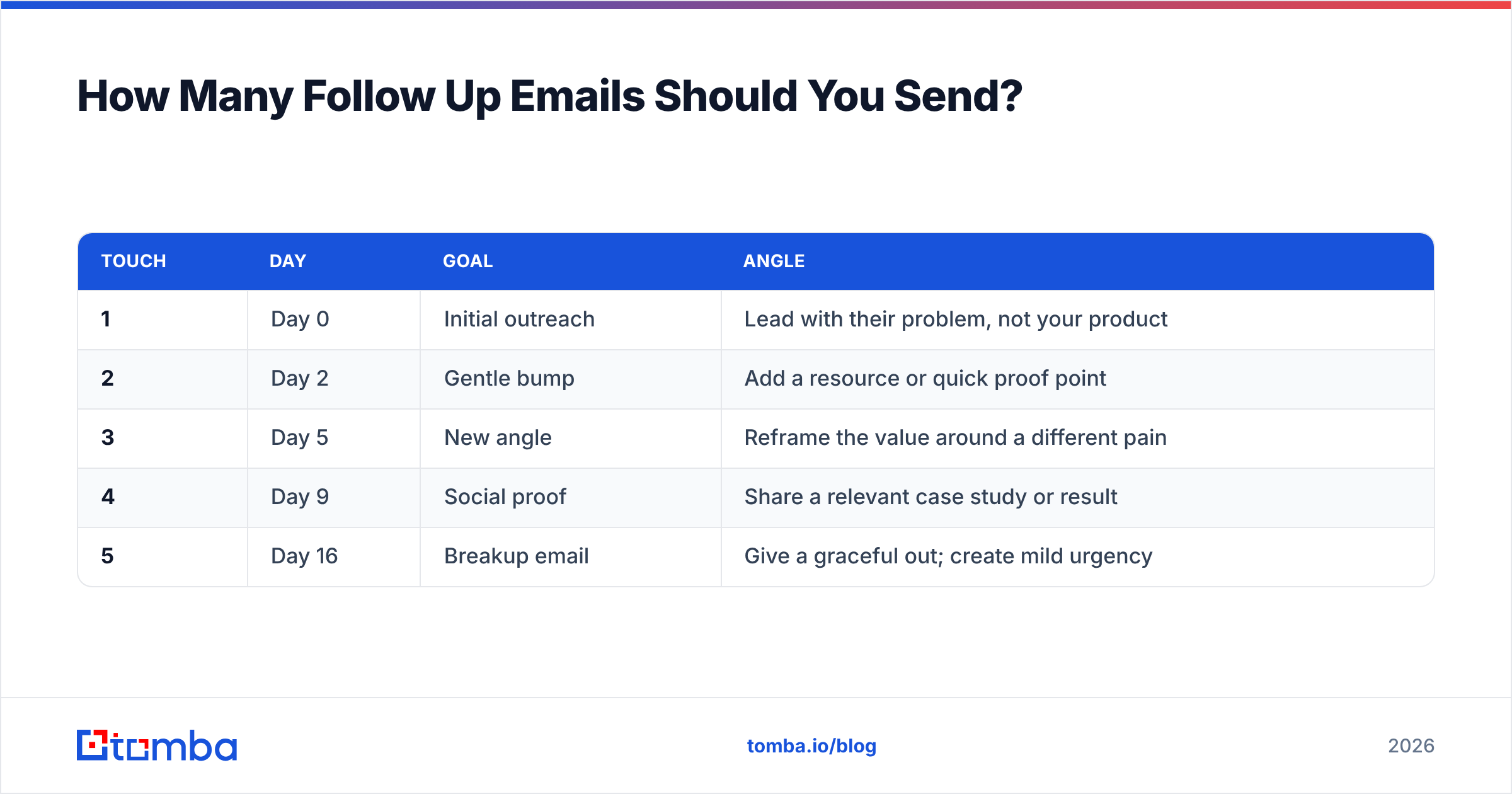
The honest answer: 4 to 6 touches total, including the first email, spread over roughly two to three weeks. Fewer than that and you leave money on the table. More than that without a response and you're hurting your domain reputation and your brand.
Here's a cadence that works across most B2B scenarios:
| Touch | Day | Goal | Angle |
|---|---|---|---|
| 1 | Day 0 | Initial outreach | Lead with their problem, not your product |
| 2 | Day 2 | Gentle bump | Add a resource or quick proof point |
| 3 | Day 5 | New angle | Reframe the value around a different pain |
| 4 | Day 9 | Social proof | Share a relevant case study or result |
| 5 | Day 16 | Breakup email | Give a graceful out; create mild urgency |
The "breakup" email is the secret weapon. Telling someone you'll close the file often gets more replies than the previous four messages combined — loss aversion is real. Notice the spacing widens as you go: tight at the start when interest is fresh, looser later so you don't crowd the inbox.
If a prospect engages at any point, you exit the sequence and switch to a human, contextual reply. The cadence is a fallback for silence, not a script to bulldoze through.
What Are the Best Business Follow Up Email Templates?#
Below are field-tested templates you can adapt. Keep them short — under 90 words is the sweet spot for follow-ups. Replace the brackets and cut anything that doesn't earn its line.
1. The post-meeting recap#
Subject: recap + next steps from today
Hi [Name],
Thanks for the time today. Quick recap of what we agreed:
- [Point 1]
- [Point 2]
Next step on my side: [action] by [date]. Anything I missed?
[Your name]
2. The value-add bump#
Subject: thought of you when I saw this
Hi [Name],
Saw [article/trigger event] and it reminded me of the [problem] we touched on. Here's a quick breakdown of how teams like [peer company] handled it: [link].
Worth a 15-minute chat next week?
3. The proposal nudge#
Subject: any questions on the proposal?
Hi [Name],
Following up on the proposal I sent [day]. Happy to walk through pricing or scope on a quick call — or if it's easier, reply with the one thing holding you back and I'll address it directly.
4. The breakup email#
Subject: should I close your file?
Hi [Name],
Haven't heard back, which usually means now isn't the right time. I'll stop reaching out for now — but if [problem] is still on your radar this quarter, just reply and I'll pick it back up.
All the best,
[Your name]
Notice none of these say "just checking in." Each gives the reader something specific to respond to. If you want a deeper bank of ready-to-use copy, Tomba's cold email templates library is a useful starting point you can tailor to your sequence.
)
When Is the Best Time to Send a Follow Up Email?#
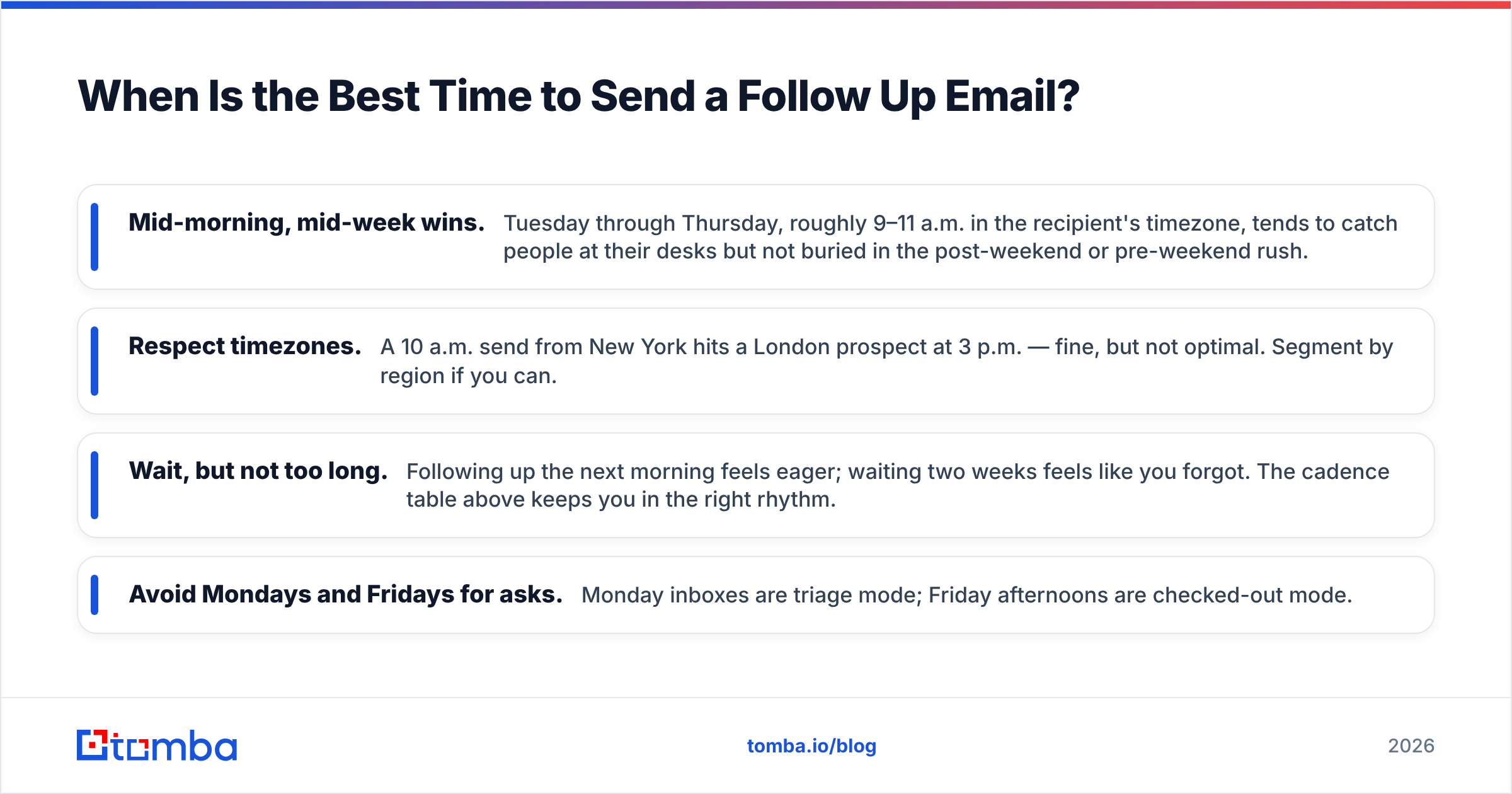
Timing won't save bad copy, but it noticeably lifts open rates on good copy. A few rules that hold up:
- Mid-morning, mid-week wins. Tuesday through Thursday, roughly 9–11 a.m. in the recipient's timezone, tends to catch people at their desks but not buried in the post-weekend or pre-weekend rush.
- Respect timezones. A 10 a.m. send from New York hits a London prospect at 3 p.m. — fine, but not optimal. Segment by region if you can.
- Wait, but not too long. Following up the next morning feels eager; waiting two weeks feels like you forgot. The cadence table above keeps you in the right rhythm.
- Avoid Mondays and Fridays for asks. Monday inboxes are triage mode; Friday afternoons are checked-out mode.
One practical lever: tools like Instantly and other sending platforms let you schedule by recipient timezone and throttle volume to protect deliverability. If you send at scale, that throttling matters as much as the send time itself.
How Do You Write a Subject Line That Gets Opened?#
The subject line is the gatekeeper. For follow-ups specifically, these patterns perform:
- Reply-style threading: Keep the original subject and let it thread ("Re: [original]"). Continuity signals an ongoing conversation, not a cold pitch.
- Short and lowercase: "quick question" or "next steps?" reads like a colleague, not a campaign.
- Specific over clever: "pricing for [Company]" beats "Unlock your growth potential."
- Curiosity with substance: "should I close your file?" works because it implies a real decision.
Avoid spam triggers — excessive capitalization, "FREE," multiple exclamation points — which can hurt your email deliverability and route you straight to the junk folder. If you're unsure, run drafts through a spam checker before sending.
How Do Manual Follow-Ups Compare to Automated Sequences?#
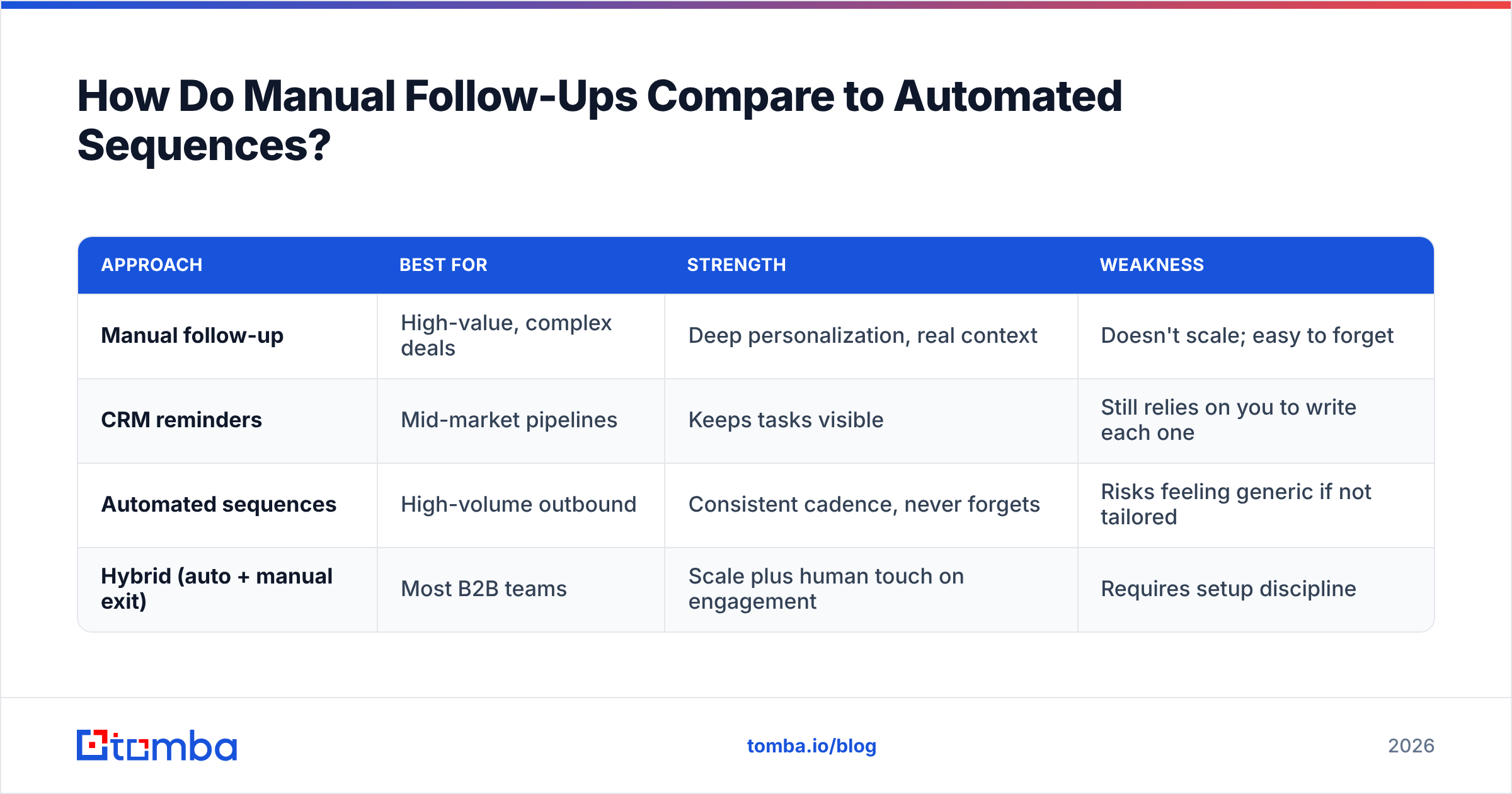
Both have a place. The right choice depends on deal size, volume, and how personalized each touch needs to be.
| Approach | Best for | Strength | Weakness |
|---|---|---|---|
| Manual follow-up | High-value, complex deals | Deep personalization, real context | Doesn't scale; easy to forget |
| CRM reminders | Mid-market pipelines | Keeps tasks visible | Still relies on you to write each one |
| Automated sequences | High-volume outbound | Consistent cadence, never forgets | Risks feeling generic if not tailored |
| Hybrid (auto + manual exit) | Most B2B teams | Scale plus human touch on engagement | Requires setup discipline |
The hybrid model is what most strong teams run: an automated cadence handles the silence, and the moment a prospect replies or clicks, a human takes over with a contextual message. You get the reliability of automation without the cold, mass-mail feel that kills trust.
Whatever you choose, the foundation is the same — accurate contact data feeding the sequence. Automating follow-ups to bad addresses just automates your bounce rate.
How Does Contact Data Make or Break Your Follow-Ups?#
Here's the part most "follow-up tips" articles skip: your sequence is only as good as the inbox it reaches. You can write the perfect five-touch cadence, time it flawlessly, and still get nothing if the email address is wrong, outdated, or a catch-all that silently swallows messages.
This is where the workflow connects upstream. Before a single follow-up goes out:
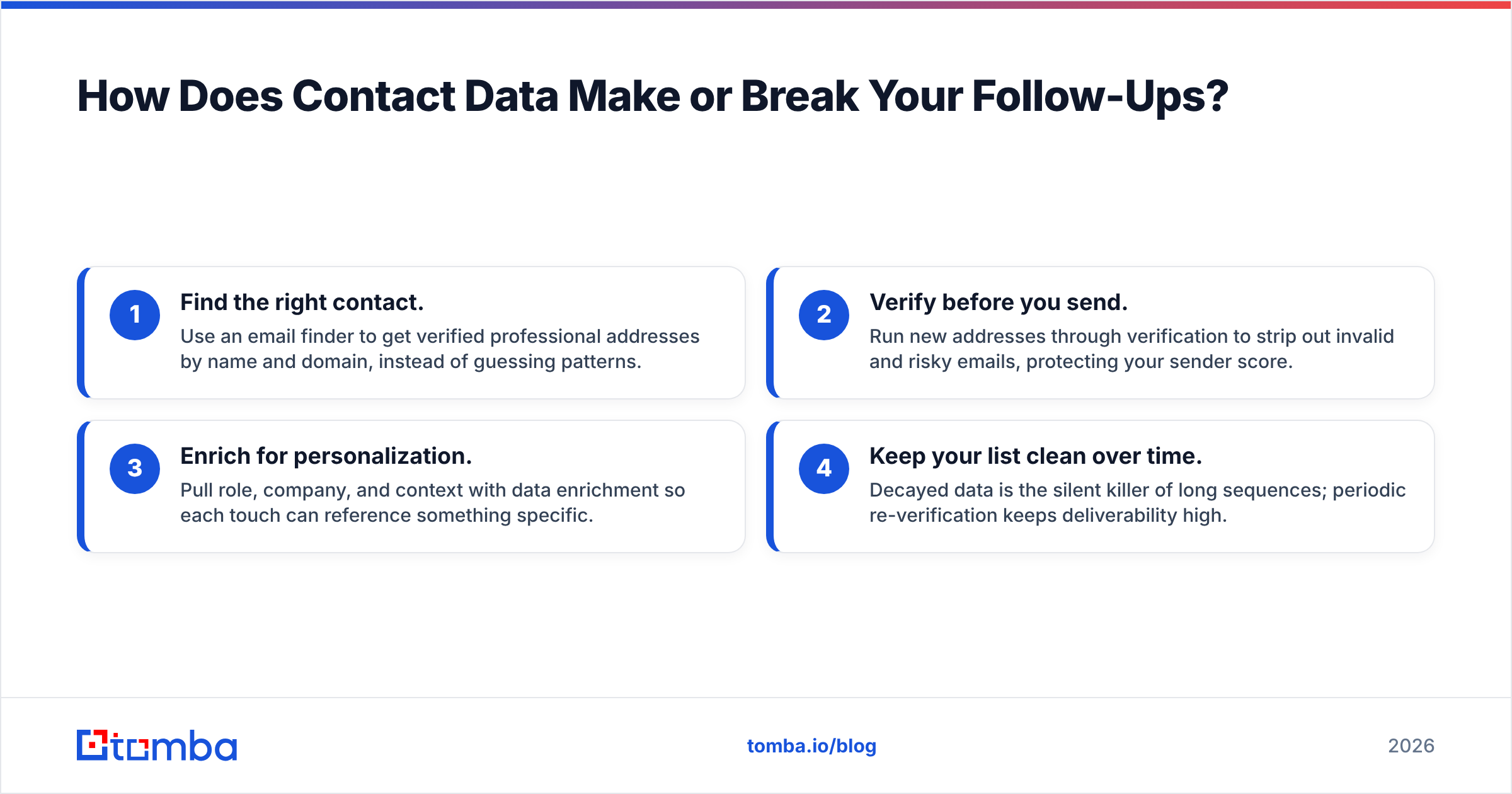
- Find the right contact. Use an email finder to get verified professional addresses by name and domain, instead of guessing patterns.
- Verify before you send. Run new addresses through verification to strip out invalid and risky emails, protecting your sender score.
- Enrich for personalization. Pull role, company, and context with data enrichment so each touch can reference something specific.
- Keep your list clean over time. Decayed data is the silent killer of long sequences; periodic re-verification keeps deliverability high.
Tomba's Tomba pricing starts with a free tier of 25 searches per month, then Starter at $49/mo and Growth at $99/mo — enough to test the full find-verify-enrich loop before scaling. Compared to manually hunting addresses across LinkedIn and company sites, the time saved compounds across every follow-up you send.
The lesson: treat data as part of your follow-up strategy, not a separate chore. The best copy in the world can't out-perform a wrong email address.
What Mistakes Should You Avoid?#
A quick checklist of the follow-up sins that quietly tank reply rates:
- Sending the same email twice. Forwarding your original with "bumping this" adds zero value. Every touch needs a new angle.
- Following up too aggressively. Daily emails read as desperation. Respect the cadence.
- Burying the ask. One clear call to action per email. If you ask for three things, you get zero.
- Ignoring the breakup. Skipping the final "should I close your file?" leaves the highest-converting touch on the table.
- Never cleaning your list. Bouncing emails wreck your sender reputation, which drags down deliverability for every contact — even the valid ones.
Frequently Asked Questions#
How long should I wait before sending a follow up email? Two business days after the initial email is the standard first bump. After that, widen the gap — roughly 3, 4, and 7 days between subsequent touches — so you stay persistent without crowding the inbox.
How many times can I follow up before it's too many? Four to six total touches, including the first email, is the safe range for cold outreach. If you've sent a graceful breakup email and still hear nothing, stop and revisit the contact next quarter.
Should follow-up emails be in the same thread? Yes, for most cases. Threading with "Re: [original subject]" preserves context and signals an ongoing conversation rather than a fresh cold pitch, which tends to lift open rates.
What's the single biggest follow-up mistake? Sending value-free "just checking in" emails to addresses you never verified. Fix both — add a fresh reason to reply, and confirm the inbox is real — and your reply rate climbs immediately.
Turn Follow-Ups Into Replies#
A great follow-up sequence is half craft, half data. You now have the templates, the cadence, and the subject-line patterns. The missing piece is making sure every one of those carefully written touches actually lands in a real, active inbox.
Start with the Tomba Email Finder to source and verify professional email addresses before your first send. Pair it with verification and enrichment, plug the clean contacts into the five-touch cadence above, and let your follow-ups do what they were always meant to do — turn silence into conversations, and conversations into closed deals.
// get started
Find, verify and enrich your first contacts today
Start on the free plan with 25 searches a month, then scale when your team is ready.
Free plan · No credit card required · GDPR & CCPA
Get the Tomba newsletter
Product and data updates
// about the author