Business Pipeline in 2026: How to Build One That Actually Closes
A practical 2026 guide to building a business pipeline that predicts revenue: stages, metrics, the tools that fill it, and the mistakes that quietly kill forecasts.
A business pipeline is the single most honest document in your company. It tells you what revenue is actually coming, not what you hope is coming. Yet most pipelines are bloated with stale deals, vague stages, and contacts that bounce the moment a rep hits send. This guide fixes that.
TL;DR#
- A business pipeline is the staged, visual representation of every active deal from first touch to closed-won — and it only works when every stage has an objective exit criterion.
- The four health metrics that matter: stage conversion rate, average deal velocity, win rate, and pipeline coverage (pipeline value ÷ quota).
- Garbage in, garbage out: a pipeline built on bad contact data forecasts fiction. Accurate emails and verified leads are the foundation, not an afterthought.
- Most teams confuse a pipeline (your deals) with a forecast (your prediction) and a sales funnel (the volume model). They are related but not interchangeable.
- The right stack is small: a CRM for the pipeline, a data tool to fill it, and a verifier to keep it clean.
What is a business pipeline?#
A business pipeline is a structured, stage-by-stage view of every deal your team is working, ordered by how close each one is to closing. Think of it like an airport departures board: every flight (deal) has a gate (stage), a status, and an expected departure time. When you glance at the board, you instantly know what's boarding, what's delayed, and what's been cancelled.
The pipeline answers three questions a spreadsheet of "leads" never can: How much revenue is in play? How likely is each deal to close? And what has to happen next to move it forward?
The key difference between a real pipeline and a glorified contact list is exit criteria. A deal doesn't move from "Discovery" to "Proposal" because a rep feels good about it. It moves because a defined, observable event happened — a budget was confirmed, a decision-maker was identified, a demo was completed. Without that discipline, your stages drift into wishful thinking and your forecast becomes a story.
)
What are the stages of a business pipeline?#
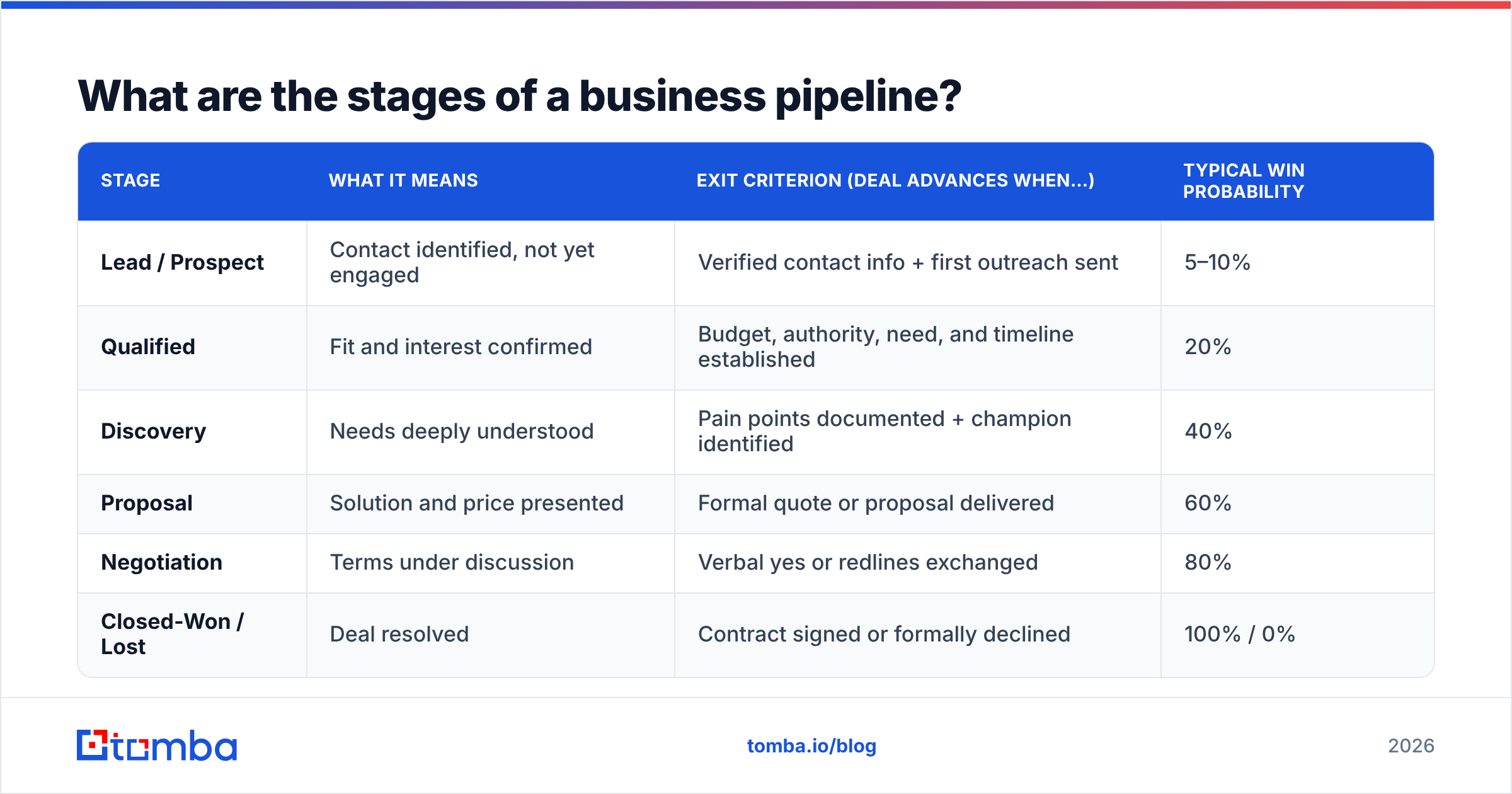
Most B2B pipelines have five to seven stages. More than seven and reps stop updating them; fewer than four and you lose forecasting resolution. Here is a clean, widely used structure with the objective exit criterion that lets a deal advance.
| Stage | What it means | Exit criterion (deal advances when…) | Typical win probability |
|---|---|---|---|
| Lead / Prospect | Contact identified, not yet engaged | Verified contact info + first outreach sent | 5–10% |
| Qualified | Fit and interest confirmed | Budget, authority, need, and timeline established | 20% |
| Discovery | Needs deeply understood | Pain points documented + champion identified | 40% |
| Proposal | Solution and price presented | Formal quote or proposal delivered | 60% |
| Negotiation | Terms under discussion | Verbal yes or redlines exchanged | 80% |
| Closed-Won / Lost | Deal resolved | Contract signed or formally declined | 100% / 0% |
Notice the probabilities aren't decoration. Multiply each open deal's value by its stage probability and you get weighted pipeline value — the single best leading indicator of revenue. A $50,000 deal in Negotiation contributes $40,000 to your weighted forecast; the same deal in Discovery contributes $20,000.
The first stage is where most pipelines rot. If your "Lead" column is full of unverified guesses — firstname@company.com patterns you scraped and never checked — every downstream metric inherits that rot. This is why filling the top of the pipeline with accurate, deliverable contacts matters more than any clever stage logic. A solid email finder and a verification step turn the noisy top of funnel into a trustworthy base layer.
Business pipeline vs. sales funnel vs. forecast: what's the difference?#
These three terms get used interchangeably, and the confusion costs real money in planning meetings. Here's the distinction in one place.
- Sales funnel — A volume model. It describes how many prospects exist at each conceptual level (awareness → interest → decision) and the drop-off between them. It's aggregate and statistical: "we need 1,000 leads to close 20 deals." The funnel is about rates.
- Business pipeline — A deal model. It tracks named, individual opportunities through concrete stages with owners, values, and dates. It's operational: "Acme Corp is in Negotiation, $80K, closing March 14." The pipeline is about specific deals.
- Forecast — A prediction. It's the subset of the pipeline you commit to closing in a given period, adjusted by judgment and weighting. The forecast is about what you'll actually book.
Put simply: the funnel tells you how much to pour in, the pipeline tells you what's flowing through, and the forecast tells you what will come out the other end this quarter. You need all three, but you manage the pipeline daily. For deeper definitions of adjacent terms, the B2B glossary is a useful reference.
How do you measure pipeline health?#
A pipeline that looks full can still be sick. These four metrics separate a healthy pipeline from a vanity dashboard.
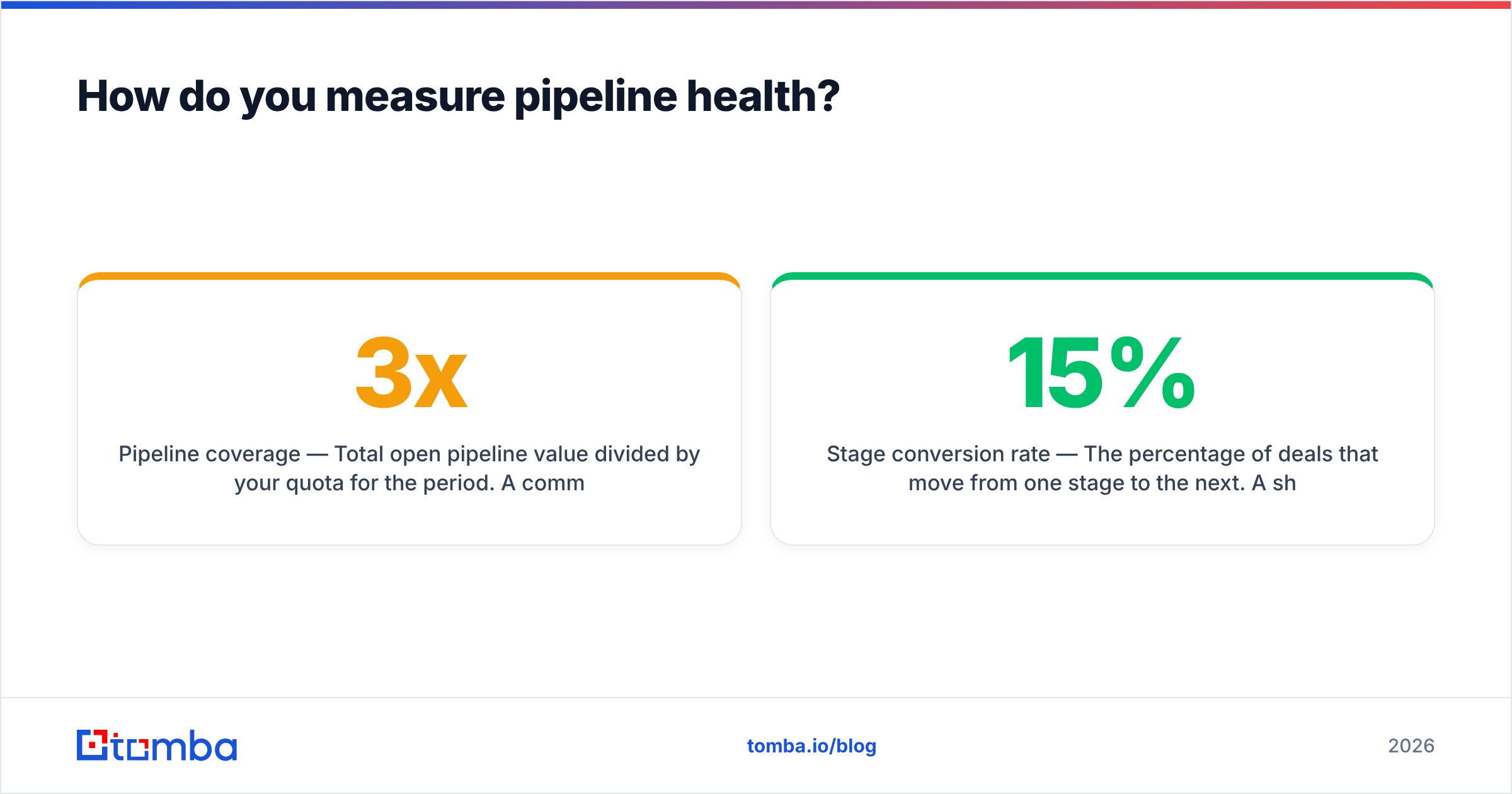
- Pipeline coverage — Total open pipeline value divided by your quota for the period. A common benchmark is 3x to 4x: if you need to close $1M, you want $3–4M in qualified pipeline, because most deals won't close. Below 3x, you have a top-of-funnel problem.
- Stage conversion rate — The percentage of deals that move from one stage to the next. A sharp drop at a specific stage (say, only 15% get from Proposal to Negotiation) points to a fixable bottleneck — usually pricing or a missing champion.
- Deal velocity — The average number of days a deal spends in the pipeline before closing. Rising velocity means friction; falling velocity means your process is tightening. Track it per stage to find where deals stall.
- Win rate — Closed-won divided by total closed (won + lost). This is your closing efficiency and a core input to forecasting. HubSpot's research on sales benchmarks is a good external reference point for what "normal" looks like across industries; see the HubSpot Sales Hub resources for current data.
The brutal truth most teams discover: stalled deals are worse than lost deals. A lost deal frees up the rep; a stalled deal sits in the pipeline inflating the forecast while quietly going nowhere. Set an automatic rule — any deal with no activity for 30 days gets flagged for review or removed.
What tools do you need to build and manage a business pipeline?#
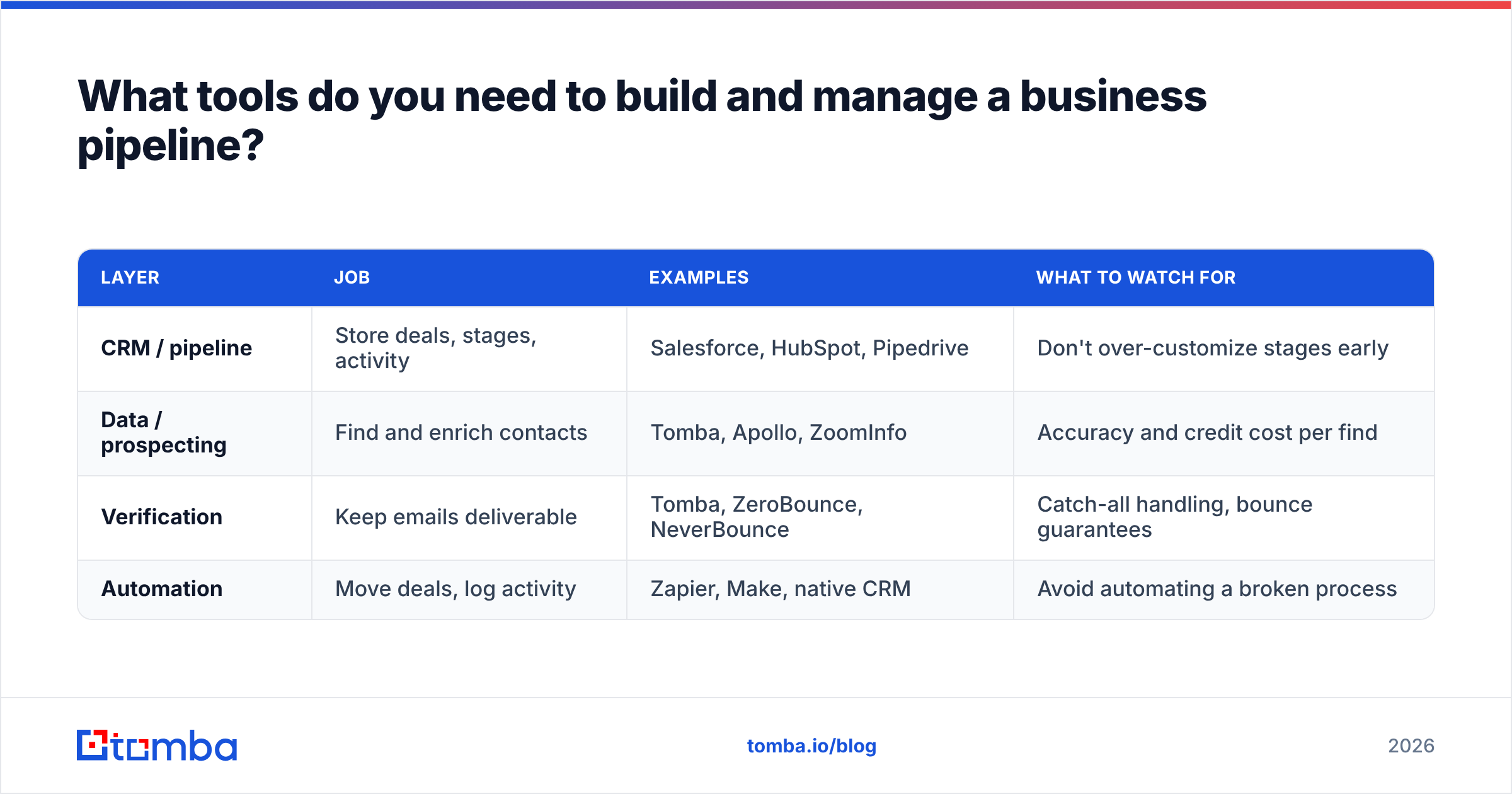
You need fewer tools than vendors will tell you. The minimum viable stack has three layers: a CRM to hold the pipeline, a data source to fill it with accurate contacts, and a verifier to keep it clean. Here's how the categories compare.
| Layer | Job | Examples | What to watch for |
|---|---|---|---|
| CRM / pipeline | Store deals, stages, activity | Salesforce, HubSpot, Pipedrive | Don't over-customize stages early |
| Data / prospecting | Find and enrich contacts | Tomba, Apollo, ZoomInfo | Accuracy and credit cost per find |
| Verification | Keep emails deliverable | Tomba, ZeroBounce, NeverBounce | Catch-all handling, bounce guarantees |
| Automation | Move deals, log activity | Zapier, Make, native CRM | Avoid automating a broken process |
The data layer is where pipelines are won or lost. A CRM is only as valuable as the contacts inside it, and contacts decay fast — roughly 22–30% of B2B data goes stale every year as people change jobs. Feeding your pipeline from a reliable source and running addresses through an email verifier before reps touch them protects both your deliverability and your forecast accuracy. For teams building lists at scale, a bulk email finder turns a target account list into a verified contact set in one pass.
)
Connecting these layers is the last mile. Most teams use a native HubSpot integration or a Salesforce integration so enriched, verified contacts flow straight into pipeline stages without copy-paste. Automation should move data, not paper over a broken process — automate logging and stage hygiene first, sequences second.
How do you keep a business pipeline clean?#
A clean pipeline is a discipline, not a feature you buy. Four habits do most of the work.
1. Enforce exit criteria ruthlessly. If a deal can't meet the criterion to advance, it stays put — no exceptions for optimism. This single rule prevents the "everything is in Proposal" inflation that wrecks forecasts.
2. Run a weekly pipeline review. Twenty minutes per rep, deal by deal: What's the next step? What's the date? What's blocking it? Deals without a clear next step get demoted or closed-lost. Salesforce's research on sales productivity, summarized in their State of Sales report, repeatedly ties this cadence to higher win rates.
3. Verify before you commit. Don't let a deal advance past qualification on an unverified contact. A bounced email at the proposal stage isn't an inconvenience — it means the deal was never real. Verification at entry keeps phantom deals out.
4. Kill zombie deals on a schedule. Anything untouched for 30+ days is reviewed; 60+ days is closed unless a rep can justify it with a concrete next step and date. Your forecast will drop — and become true, which is the entire point.
For pipelines that depend on phone-based selling, the same hygiene applies to numbers: a phone finder plus validation keeps your dialer list from burning rep hours on dead lines.
What are the most common business pipeline mistakes?#
The failures repeat across companies of every size.
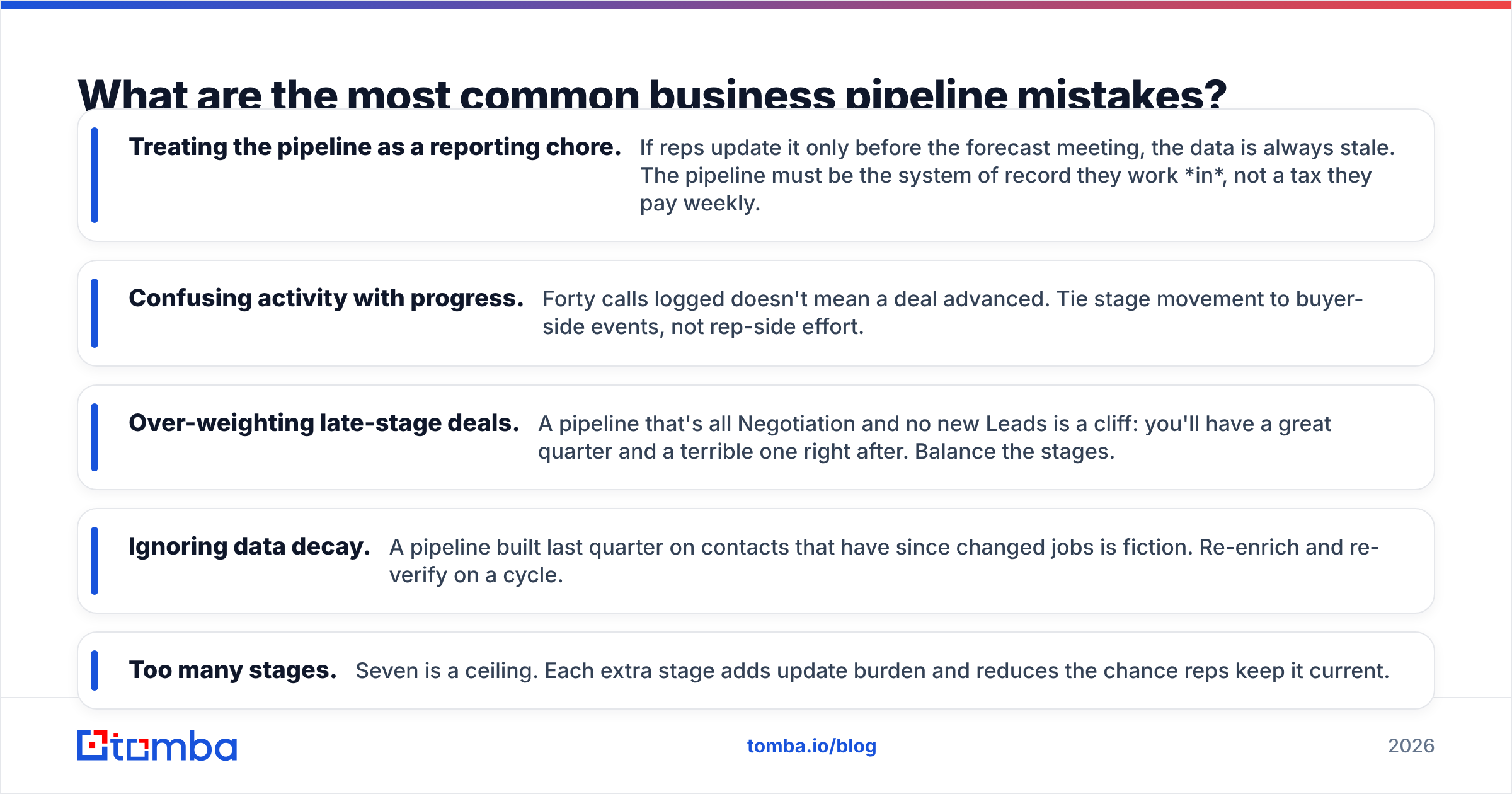
- Treating the pipeline as a reporting chore. If reps update it only before the forecast meeting, the data is always stale. The pipeline must be the system of record they work in, not a tax they pay weekly.
- Confusing activity with progress. Forty calls logged doesn't mean a deal advanced. Tie stage movement to buyer-side events, not rep-side effort.
- Over-weighting late-stage deals. A pipeline that's all Negotiation and no new Leads is a cliff: you'll have a great quarter and a terrible one right after. Balance the stages.
- Ignoring data decay. A pipeline built last quarter on contacts that have since changed jobs is fiction. Re-enrich and re-verify on a cycle.
- Too many stages. Seven is a ceiling. Each extra stage adds update burden and reduces the chance reps keep it current.
The throughline: a business pipeline is only as trustworthy as the data and discipline behind it. The mechanics — stages, probabilities, reviews — are simple. The hard part is refusing to lie to yourself about which deals are real.
Build your pipeline on data you can trust#
A pipeline forecasts revenue only when its foundation is solid: real people, deliverable emails, and verified contacts at the top of every stage. That's where most pipelines quietly fail, and it's the cheapest problem to fix. Use the Tomba Email Finder to populate the top of your pipeline with accurate, professional email addresses by name, company, or domain — then verify them before a single rep makes contact. Start on the free tier (25 searches/month) to test it against your target accounts, and scale to the Starter plan at $49/month when you're ready to fill the pipeline in volume. See full Tomba pricing for the plan that matches your team's size. A clean pipeline starts with clean data — build yours on it.
// get started
Find, verify and enrich your first contacts today
Start on the free plan with 25 searches a month, then scale when your team is ready.
Free plan · No credit card required · GDPR & CCPA
// about the author