Business Plan Go-To-Market Strategy: A 2026 Playbook
A business plan is the map; the go-to-market strategy is the engine that drives revenue. Here's how to connect them in 2026 — ICP, channels, pricing, and pipeline.
TL;DR
- A business plan explains why your company exists and how it makes money. A go-to-market (GTM) strategy is the operational layer that explains how you'll actually win customers — they fail when treated as separate documents.
- The order that works in 2026: define your ICP → pick the motion (PLG, sales-led, or hybrid) → choose channels → set pricing → instrument the funnel → ship.
- Most GTM plans die at execution because the data layer is an afterthought. You can't run targeted outbound on a list you can't reach.
- Use a one-page GTM canvas, not a 40-page deck. Speed of iteration beats polish.
- This guide gives you a fill-in-the-blank framework, a comparison of the three core GTM motions, and a 90-day rollout you can copy.
What is the difference between a business plan and a go-to-market strategy?#
Your business plan is the thesis. Your go-to-market strategy is the campaign that proves the thesis is true.
Think of it like opening a restaurant. The business plan is the concept, the location, the financial model, and the menu economics — it tells investors the place can be profitable. The go-to-market strategy is how you fill the tables on opening night and keep them full: which neighborhoods you flyer, what the launch promo is, who you partner with, and how you turn first-time diners into regulars.
Technically, a business plan covers the whole company: mission, market size, competitive landscape, financial projections, org structure, and funding needs. A business plan go to market strategy is the subset focused entirely on customer acquisition — the repeatable system that converts a target market into paying users.
The two break when founders write the business plan, raise money, and then improvise the GTM. By 2026, that gap is the single most common reason early-stage revenue stalls: a beautiful plan with no engine attached.
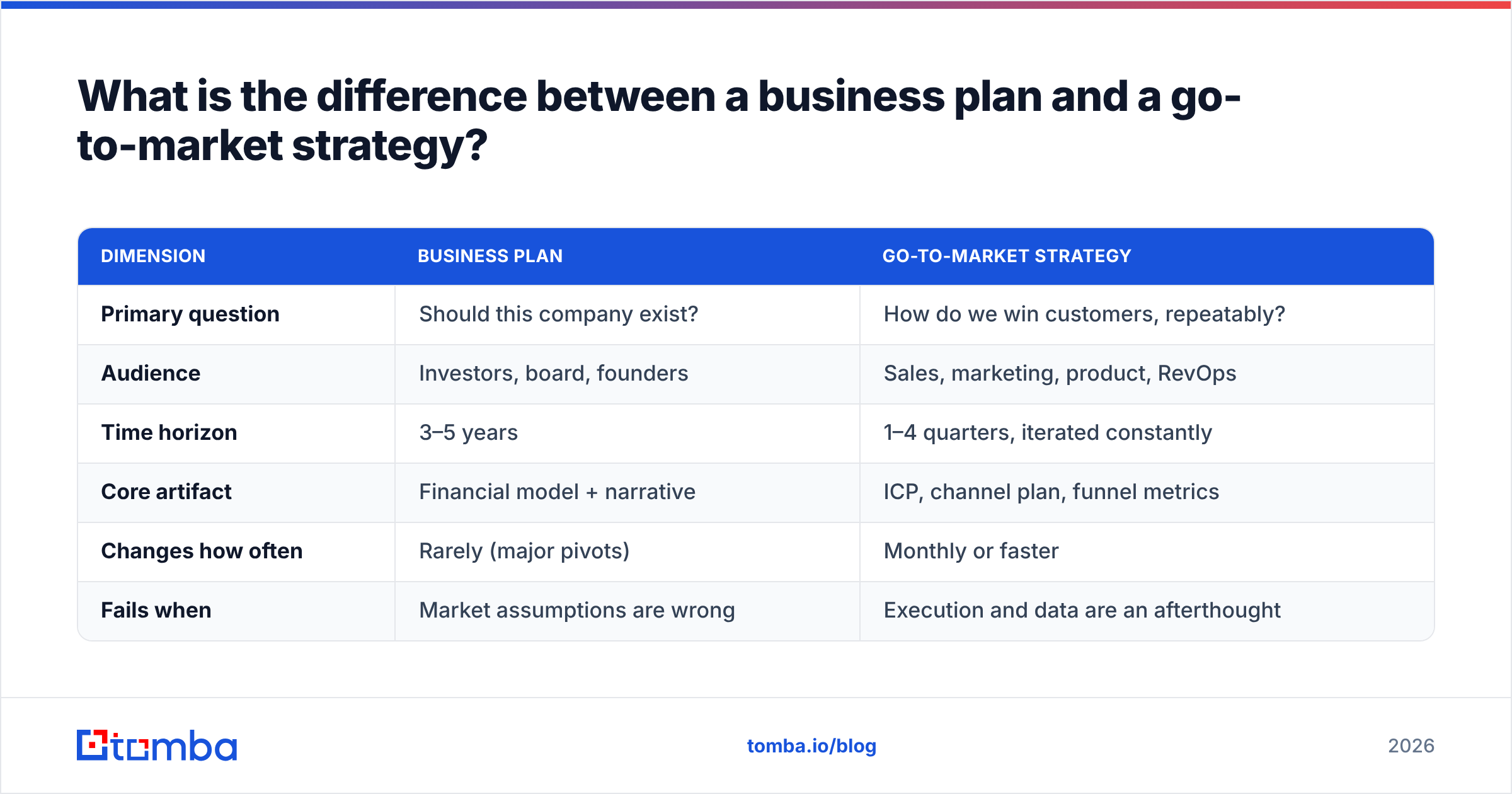
| Dimension | Business plan | Go-to-market strategy |
|---|---|---|
| Primary question | Should this company exist? | How do we win customers, repeatably? |
| Audience | Investors, board, founders | Sales, marketing, product, RevOps |
| Time horizon | 3–5 years | 1–4 quarters, iterated constantly |
| Core artifact | Financial model + narrative | ICP, channel plan, funnel metrics |
| Changes how often | Rarely (major pivots) | Monthly or faster |
| Fails when | Market assumptions are wrong | Execution and data are an afterthought |
How do you build a go-to-market strategy step by step?#
Work in this order. Skipping a step forces you to guess later, and guessing is expensive.
- Define the ICP, not just the market. "B2B SaaS companies" is a market. "Series A-to-B SaaS companies with 50–200 employees, a VP of Sales already hired, and an outbound team using a CRM" is an ICP. The tighter the ICP, the cheaper every downstream step becomes.
- Nail the positioning and message. Write one sentence: For [ICP] who [problem], [product] is the [category] that [unique value], unlike [alternative]. If you can't fill that in cleanly, your GTM will be muddy no matter how good the channels are.
- Choose the motion. Product-led, sales-led, or hybrid. This decides your whole cost structure (more on this below).
- Pick 2 channels — not 7. Early GTM dies from spreading thin. Pick the two channels where your ICP already pays attention and go deep.
- Set pricing and packaging. Pricing is a GTM lever, not a finance afterthought. A free tier changes your entire acquisition motion.
- Build the data and tooling layer. This is the step everyone underestimates: the contact data, enrichment, and routing that makes the other five steps actually executable.
The first three steps are strategy. The last three are where strategy meets reality — and where most plans quietly collapse because nobody scoped the unglamorous infrastructure.
Which go-to-market motion should you choose?#
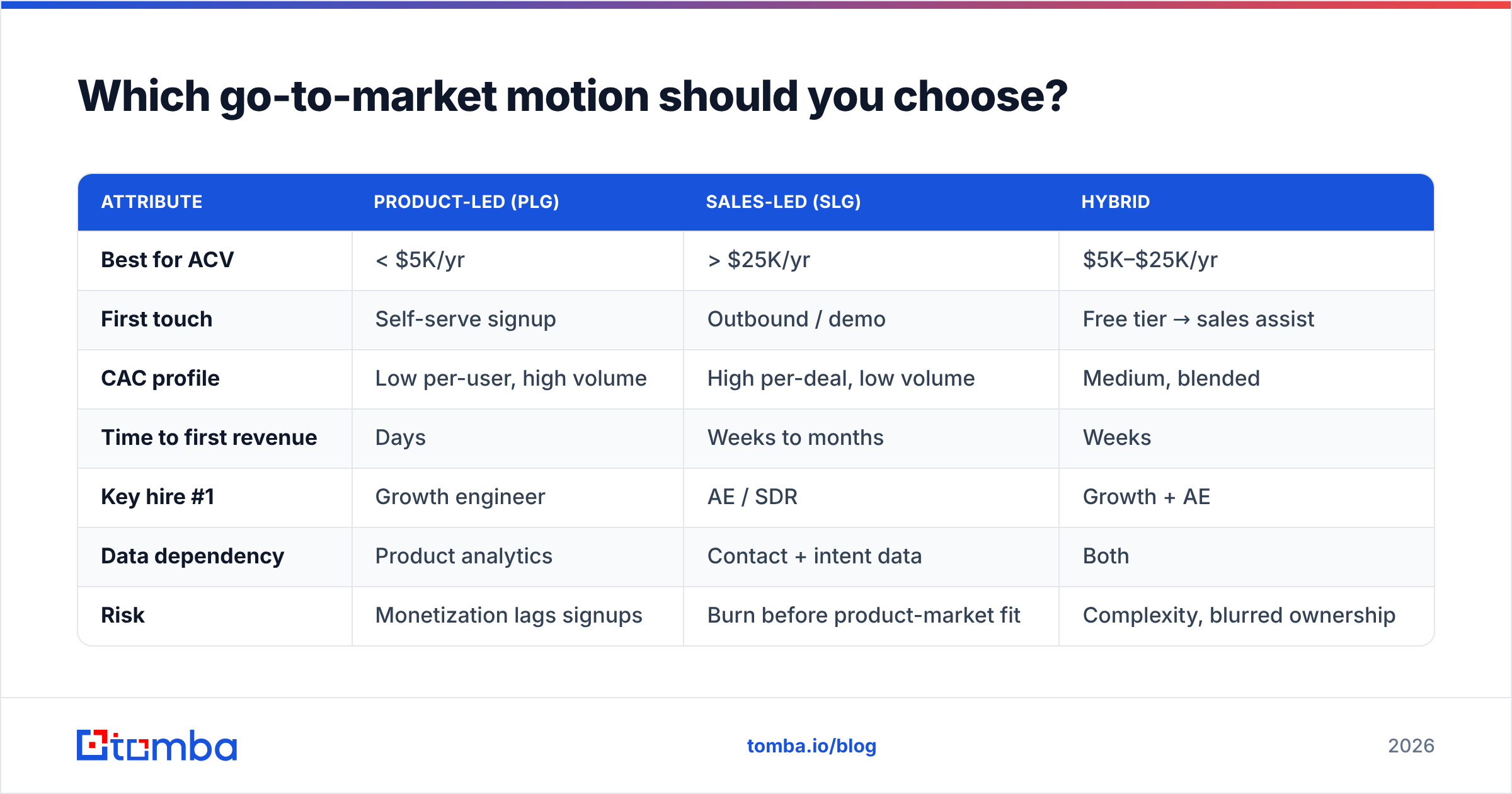
Your motion determines your hiring plan, your pricing, and your burn rate. Pick deliberately. Here's how the three core motions compare for a 2026 B2B launch.
| Attribute | Product-Led (PLG) | Sales-Led (SLG) | Hybrid |
|---|---|---|---|
| Best for ACV | < $5K/yr | > $25K/yr | $5K–$25K/yr |
| First touch | Self-serve signup | Outbound / demo | Free tier → sales assist |
| CAC profile | Low per-user, high volume | High per-deal, low volume | Medium, blended |
| Time to first revenue | Days | Weeks to months | Weeks |
| Key hire #1 | Growth engineer | AE / SDR | Growth + AE |
| Data dependency | Product analytics | Contact + intent data | Both |
| Risk | Monetization lags signups | Burn before product-market fit | Complexity, blurred ownership |
Most 2026 B2B companies land on hybrid: a free or low-friction entry point that captures demand, plus a sales motion that converts the accounts worth chasing. The catch is that hybrid demands both a product-analytics stack and a strong outbound data engine. If you pick hybrid, budget for both from day one.
A practical rule: if your annual contract value is below roughly $5K, fighting for a human sales motion is usually a mistake — lean PLG. Above $25K, self-serve alone leaves money on the table — you need humans in the loop. For more on aligning these moving parts across teams, the discipline of revenue operations exists precisely to keep marketing, sales, and success pointed at the same number.
Why does the data layer make or break GTM execution?#
A go-to-market strategy is only as strong as your ability to reach the people in your ICP. This is the part that slide decks skip and quarters die on.
Say you ran the strategy work perfectly. You know your ICP is heads of demand-gen at 100–500 person SaaS firms in North America. Great — now you need their actual email addresses, verified, deduplicated, and routed into your sequencer. Without that, your beautiful positioning sits in a doc and your SDRs scrape LinkedIn by hand at 15 contacts an hour.
This is where teams switch from manual list-building to a reliable data engine. An email finder turns a name and company domain into a deliverable address; an email verifier strips out the bounces before they wreck your sender reputation. Run a domain search against a target account and you get the whole org's reachable contacts in one pass instead of guessing email formats one person at a time.
The deliverability stakes are real. A list that's 30% invalid doesn't just waste sends — it tanks your domain reputation, and once that happens even your good emails land in spam. Cleaning your list before launch protects the channel you're about to depend on. (If cold email is one of your two channels, treat list hygiene as a launch-blocking requirement, not a nice-to-have.)
The point: budget for data the same way you budget for ad spend. A GTM plan that assumes "we'll figure out the contacts later" has a hole in the middle of it.
How do pricing and packaging fit into the plan?#
Pricing is the most under-used GTM lever in early-stage companies. It's not a number you set once — it's an acquisition tool.
Three packaging decisions shape your whole motion:
- Free tier vs. free trial vs. demo-only. A free tier (like the one Tomba offers at 25 searches/month) lowers acquisition friction and feeds a PLG motion, but it costs you in support and infrastructure. A time-boxed trial creates urgency. Demo-only suits high-ACV sales-led plays.
- Per-seat vs. usage-based vs. tiered. Usage-based pricing has dominated 2024–2026 because it aligns cost with value, but it makes revenue harder to forecast. Tiered plans (Starter / Growth / Pro) are easier for buyers to self-select into.
- The anchor tier. Most buyers cluster on the second tier. Design your middle plan as the one you actually want most customers on, and price the others to make it look obvious.
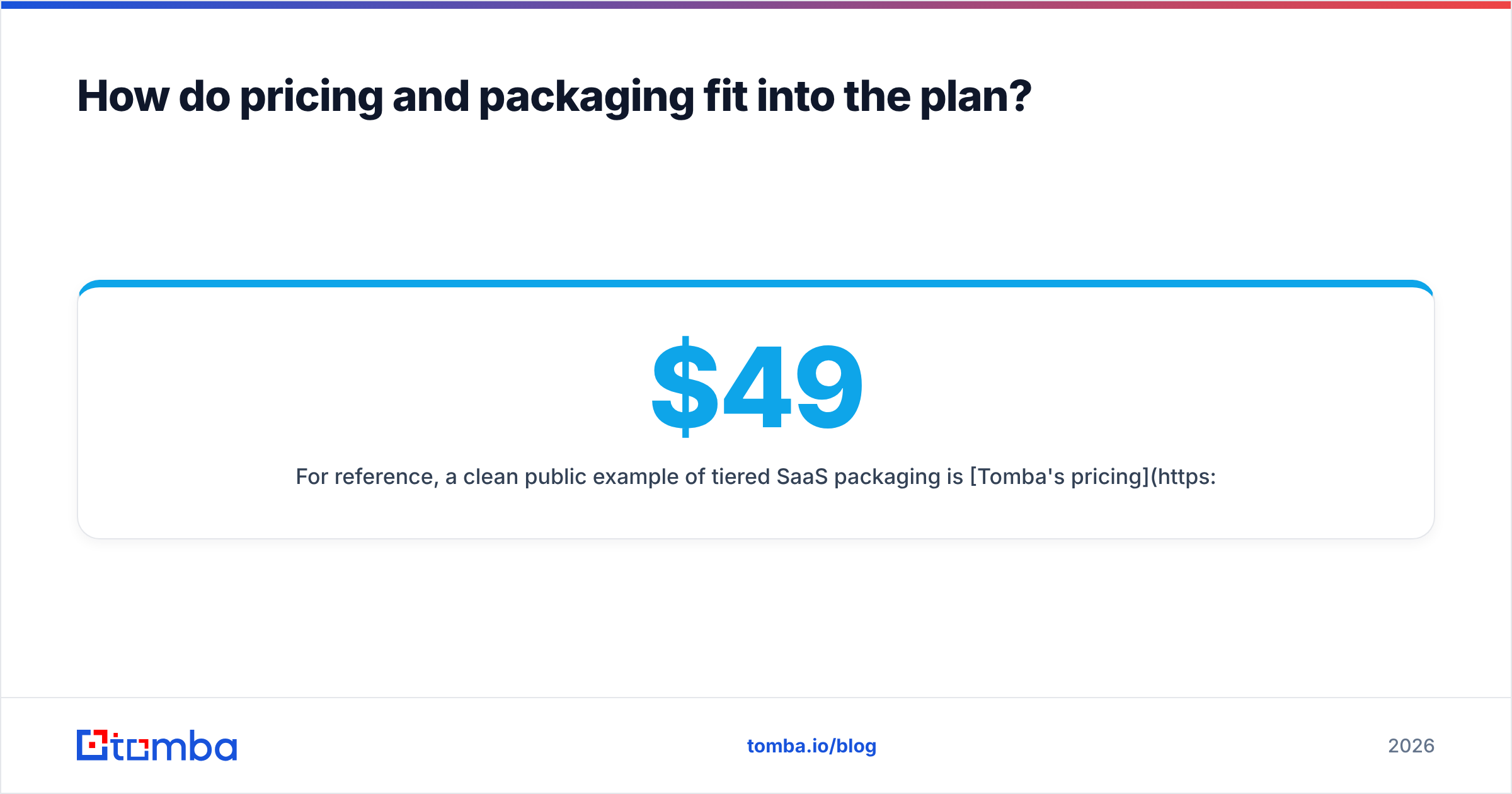
For reference, a clean public example of tiered SaaS packaging is Tomba's pricing: a free tier at 25 searches, Starter at $49/mo, Growth at $99/mo, Pro at $249/mo, and custom Enterprise. Notice the gaps are deliberate — each jump unlocks a distinctly bigger use case, so buyers can self-select without a sales call.
Whatever you choose, write the pricing logic into the GTM plan. If your acquisition channel is self-serve but your pricing requires a 45-minute demo to understand, the two are fighting each other.
What metrics prove the strategy is working?#
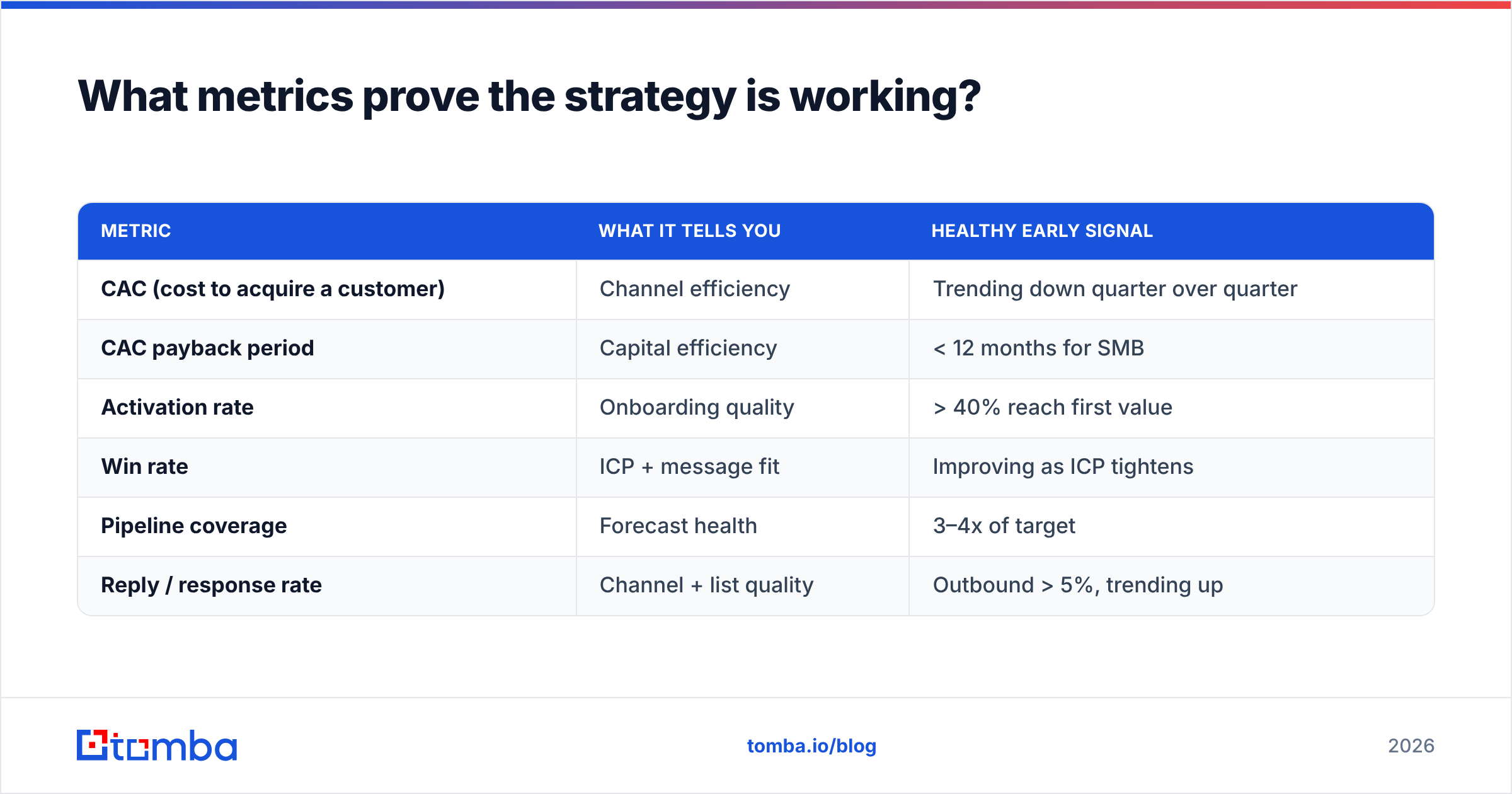
You don't get to call a GTM strategy "working" based on vibes. Instrument these from day one, because you'll iterate on whichever number is weakest.
| Metric | What it tells you | Healthy early signal |
|---|---|---|
| CAC (cost to acquire a customer) | Channel efficiency | Trending down quarter over quarter |
| CAC payback period | Capital efficiency | < 12 months for SMB |
| Activation rate | Onboarding quality | > 40% reach first value |
| Win rate | ICP + message fit | Improving as ICP tightens |
| Pipeline coverage | Forecast health | 3–4x of target |
| Reply / response rate | Channel + list quality | Outbound > 5%, trending up |
The trap is measuring activity (emails sent, calls made) instead of outcomes. Track the funnel end to end so you can see where it leaks. If your response rate is low, the problem is usually the list or the message, not the volume — sending more bad email to bad addresses just amplifies the failure. Diagnose before you scale.
A useful discipline: pick one "north star" leading indicator per channel and review it weekly. Lagging metrics like revenue tell you what already happened; leading metrics like activation rate or reply rate tell you what's about to.
What does a 90-day GTM rollout look like?#
Strategy without a calendar is a wish. Here's a concrete 90-day sequence that turns the plan above into motion.
- Days 1–30 — Foundation. Lock the ICP and positioning sentence. Build your target account list and enrich it with verified contacts. Stand up the CRM, the sequencer, and tracking. Write the first message variants. Pick your two channels and nothing else.
- Days 31–60 — First motion. Launch outreach to a small, controlled segment (200–400 accounts). Run both channels. Measure reply rate, activation, and meeting-booked rate. Talk to every early customer — these conversations sharpen your ICP faster than any analytics dashboard.
- Days 61–90 — Iterate and scale. Kill the weaker channel or message. Double down on what's converting. Tighten the ICP based on who actually closed. Now — and only now — increase volume. Scaling a broken funnel just produces more failure, faster.
Notice that scaling comes last. The most common 2026 mistake is pouring budget into a channel before the message and data are validated. Validate small, then scale what works.
Common mistakes that sink a GTM strategy#
- Targeting "everyone." A broad ICP feels safe and guarantees a vague message that converts nobody.
- Picking too many channels. Two channels done well beats six done poorly. Focus is a feature.
- Treating data as free. Bad contact data silently caps every other investment you make.
- Confusing the plan with the strategy. A finished deck is not traction. Execution is the strategy.
- Scaling before validation. More spend on an unvalidated funnel is just a faster way to run out of money.
- No clear owner. If marketing, sales, and product each think someone else owns the number, no one does.
Turn your GTM plan into real pipeline#
A go-to-market strategy is only as good as the contacts you can actually reach — and that's the step most plans underfund. Before you scale a single channel, make sure your target list is real, verified, and deliverable.
Start with the Tomba Email Finder: turn your ICP account list into verified, reachable contacts in minutes instead of scraping by hand. Pair it with the email verifier to protect your sender reputation, and the free tier gives you 25 searches a month to validate the motion before you commit a dollar. Build the engine first — then let your strategy run on it.
Ready to find emails that actually work?
Join 150,000+ professionals who stopped guessing and started sending. Free credits on signup — no credit card required.
Get the Tomba newsletter
Practical outbound tactics and product updates — once every two weeks.
About the author