How to Build a Business Sales Plan in 2026 (Template + Steps)
A business sales plan turns vague revenue hopes into a measurable system. Here's the 7-part framework, a fill-in template, and the metrics that actually move the number in 2026.
A business sales plan is the difference between a team that hits quota on purpose and one that hopes the pipeline shows up. Most plans fail not because the strategy is wrong, but because they stop at a revenue goal and skip the operating system underneath it. This guide gives you that system: the seven components, a template you can copy, and the numbers that tell you whether the plan is working before the quarter ends.
TL;DR#
- A business sales plan documents who you sell to, how you reach them, what you'll measure, and who owns each number — not just a revenue target.
- The strongest plans are built bottom-up from activity math (leads → meetings → deals), not top-down from a wishful annual figure.
- Seven sections cover it: goals, target market, value proposition, channels, team structure, KPIs, and budget.
- Bad data quietly breaks every plan. If reps work stale or unverified contacts, your conversion assumptions are fiction.
- Review the plan monthly against leading indicators, not just closed revenue, so you can correct course mid-quarter.
What is a business sales plan?#
A business sales plan is a written document that defines your revenue targets and the exact go-to-market motion you'll use to hit them. Think of it like a flight plan: the destination (revenue goal) is one line, but the value comes from the route, the fuel calculations, and the checkpoints that tell the pilot whether they're on course. A target without a route is just a wish.
It is not a business plan (that covers the whole company) and it is not a sales forecast (that's a prediction). A sales plan is the operating manual: who your reps call, what they say, which channels you fund, and how you'll know it's working.
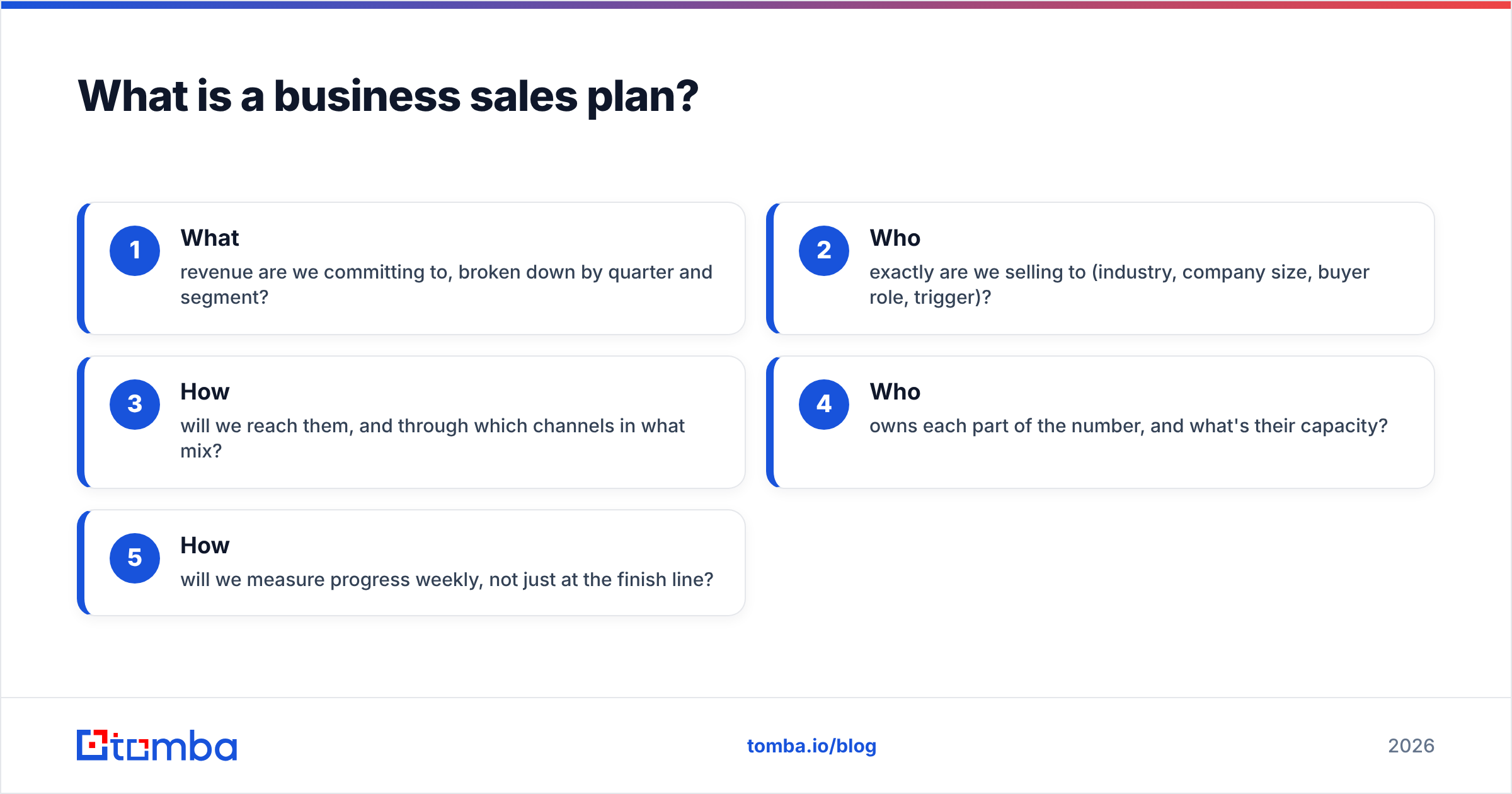
A complete plan answers five questions without hand-waving:
- What revenue are we committing to, broken down by quarter and segment?
- Who exactly are we selling to (industry, company size, buyer role, trigger)?
- How will we reach them, and through which channels in what mix?
- Who owns each part of the number, and what's their capacity?
- How will we measure progress weekly, not just at the finish line?
If your current plan can't answer all five on one page, it's a goal dressed up as a plan.
Why do most business sales plans fail?#
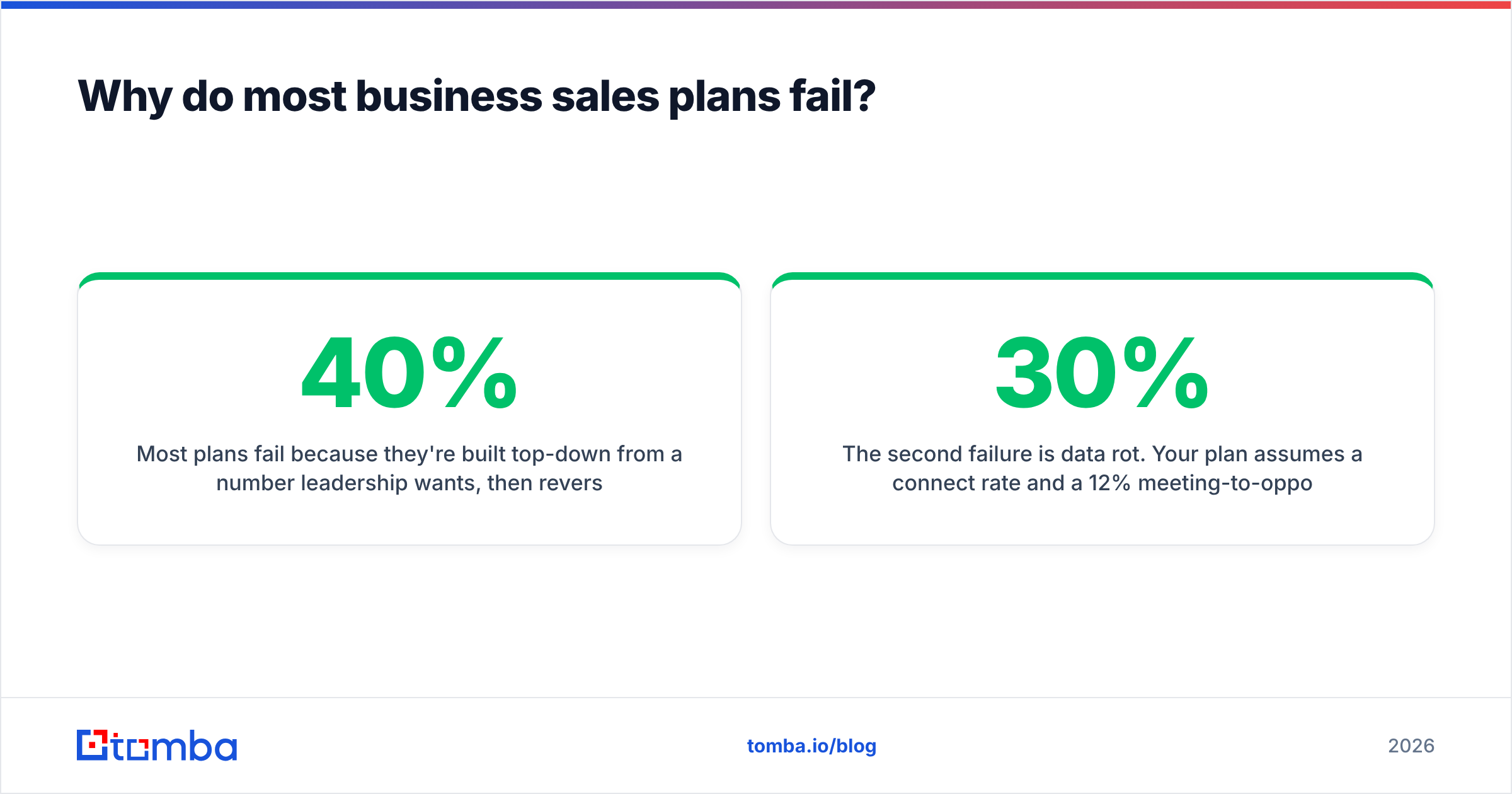
Most plans fail because they're built top-down from a number leadership wants, then reverse-engineered with optimistic conversion rates to make the math close. The board says "grow 40%," and the plan becomes a spreadsheet tuned to justify it rather than a model of what the team can actually execute.
The second failure is data rot. Your plan assumes a 30% connect rate and a 12% meeting-to-opportunity rate. Those assumptions collapse when reps burn hours on bounced emails and disconnected numbers. Industry research consistently shows B2B contact data decays fast — people change jobs, companies rebrand, domains move. A plan resting on a stale list is a plan resting on sand.
The third failure is no ownership. When a number belongs to "the team," it belongs to no one. Every metric in a strong plan has a name next to it.
What are the 7 components of a business sales plan?#
Use these seven sections as your table of contents. Each one should fit on a page or less — a plan nobody reads is a plan nobody follows.
1. Revenue goals and targets#
Start with the committed number, then break it down. Split by quarter, by segment (new business vs. expansion), and by rep. Build it bottom-up: if a rep closes 4 deals a quarter at a $12K average, and you have 5 reps, your realistic new-business number is $240K/quarter — not whatever the board hoped.
2. Target market and ICP#
Define your Ideal Customer Profile in concrete filters: industry, employee count, revenue band, geography, tech stack, and the buying trigger that makes now the right time. The tighter the ICP, the higher your conversion — and the cheaper your data sourcing.
3. Value proposition and positioning#
Write the one-sentence reason a prospect switches to you, plus the three proof points that back it. Map this to each buyer role; a CFO and a VP of Sales care about different outcomes.
4. Sales channels and motion#
Decide your channel mix: outbound, inbound, partner, and self-serve. Specify the motion for each — is outbound a multi-channel sequence across email, phone, and LinkedIn outreach, or email-only? This is where most plans are vague and most quarters are lost.
5. Team structure and roles#
Name who does what. SDRs source, AEs close, CS expands. Document capacity per role so your targets respect human limits.
6. KPIs and metrics#
Pick leading indicators you can read weekly (activity, connect rate, meetings booked) and lagging ones (revenue, win rate). More on these below.
7. Budget and tooling#
List the cost of tools, data, and headcount against expected return. A plan that ignores cost-per-acquired-contact will overspend on channels that look busy but don't convert.
How do you build a sales plan step by step?#
Work through these steps in order. Skipping the early ones is why later ones break.
- Audit last year's numbers. Pull your real conversion rates at each stage. Use actuals, not aspirations.
- Define the ICP and size the market. Count how many accounts actually match. If the list is too small for the goal, the goal is wrong.
- Build the activity model. Work backward from revenue: deals needed → opportunities → meetings → contacts worked. This exposes whether you have enough top-of-funnel.
- Source clean contact data. Populate the model with verified contacts. This is the step that makes or breaks your assumptions — a bulk email finder and email verifier keep your funnel math honest.
- Assign ownership and capacity. Put a name on every number and confirm it fits a human workload.
- Set the review cadence. Weekly pipeline review, monthly plan review, quarterly reset.
What types of sales plans should you choose?#
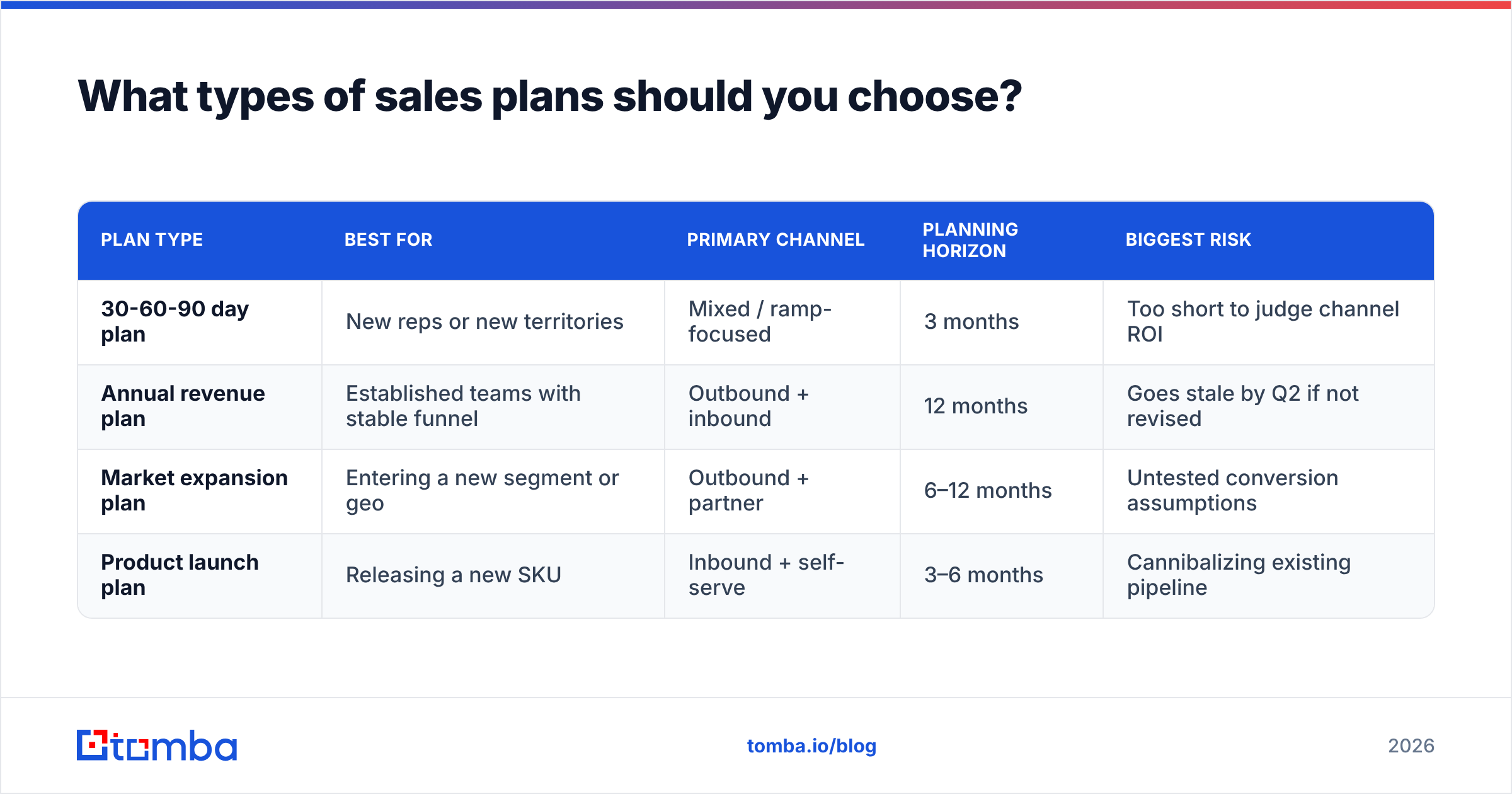
Not every business needs the same plan. Match the format to your stage and motion. The table below compares the four most common types so you can pick a starting point instead of building from a blank page.
| Plan type | Best for | Primary channel | Planning horizon | Biggest risk |
|---|---|---|---|---|
| 30-60-90 day plan | New reps or new territories | Mixed / ramp-focused | 3 months | Too short to judge channel ROI |
| Annual revenue plan | Established teams with stable funnel | Outbound + inbound | 12 months | Goes stale by Q2 if not revised |
| Market expansion plan | Entering a new segment or geo | Outbound + partner | 6–12 months | Untested conversion assumptions |
| Product launch plan | Releasing a new SKU | Inbound + self-serve | 3–6 months | Cannibalizing existing pipeline |
Most B2B teams run an annual revenue plan as the spine and nest a 30-60-90 inside it for new hires. If you're moving upmarket or into a new region, layer a market expansion plan on top with its own ICP and data sourcing — don't assume your current contact lists translate.
Which KPIs belong in a business sales plan?#
Track a short stack of leading and lagging indicators. Leading metrics let you fix the quarter while it's still happening; lagging metrics tell you if you won. If you only watch revenue, you're driving by looking in the rear-view mirror.
- Activity volume — calls, emails, and touches per rep per day. The earliest signal.
- Connect / reply rate — the health check on your data and messaging. A falling rate often means list decay, not a copy problem.
- Meetings booked — the bridge between activity and pipeline.
- Opportunity-to-close — your win rate, the truth-teller on qualification.
- Average deal size and sales cycle — the levers that make the activity model add up.
- Cost per acquired customer — ties the plan back to budget.
A practical rule: if a metric can't change a decision you'd make this week, it doesn't belong on the weekly dashboard. Park it in the quarterly review instead.
How does data quality decide whether your plan works?#
Clean contact data is the single highest-leverage input in a sales plan, because every downstream number inherits its error rate. If 20% of your contacts bounce, you don't have a 20% data problem — you have a 20% tax on every conversion assumption, every rep's day, and every forecast. Tools like HubSpot and Salesforce store your pipeline beautifully, but they don't guarantee the contacts inside are real; that's a separate job.
This is where sourcing and verification earn their keep. Before a sequence ever runs, you want emails found by domain and name, then verified, and catch-all domains flagged so reps don't waste a touch on a dead address. The cleaner the input, the more trustworthy your activity model — and the less your monthly review turns into "why did connect rate crater?"
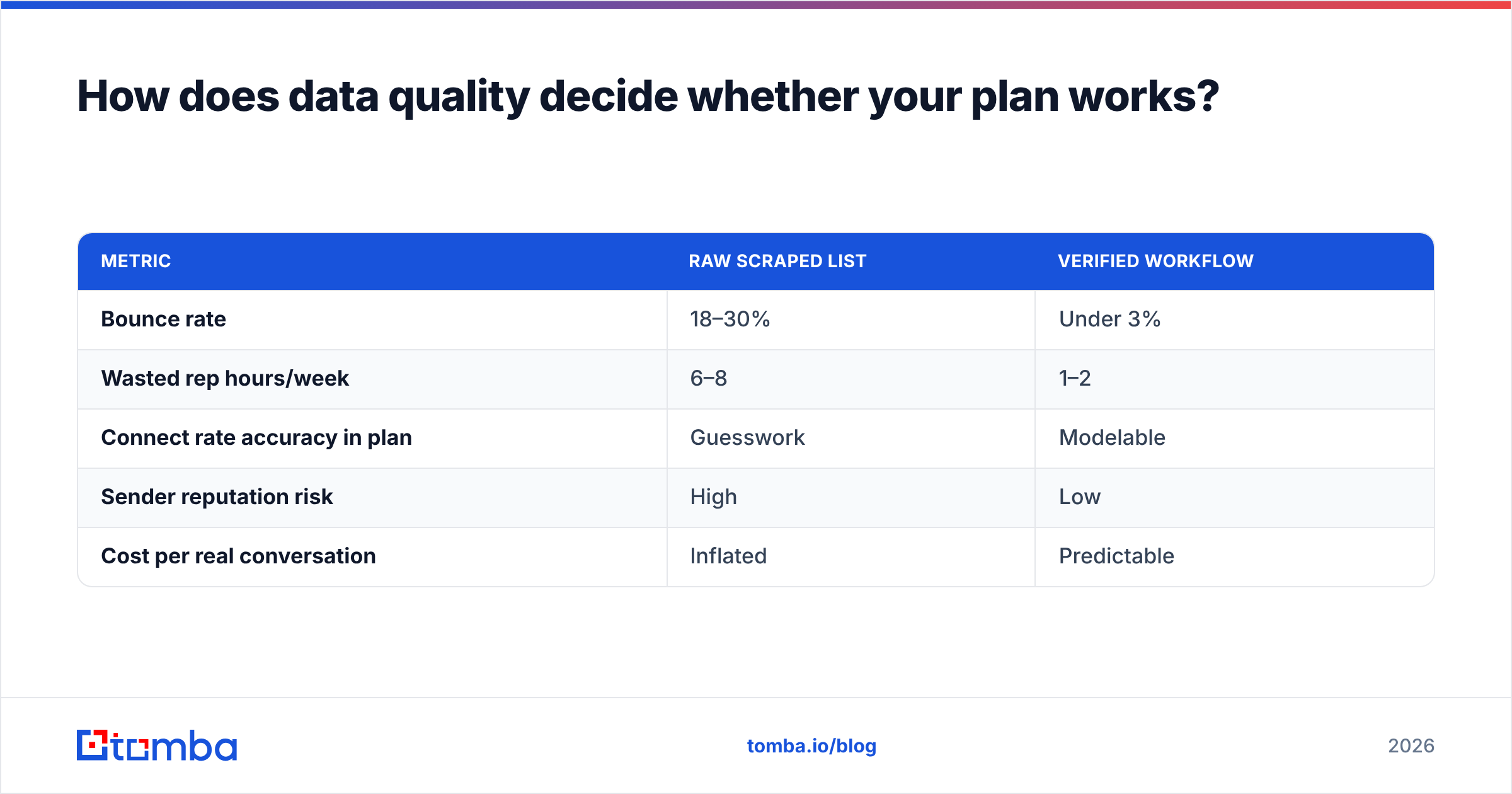
Here's how a verified-data workflow changes the math versus a raw scraped list:
| Metric | Raw scraped list | Verified workflow |
|---|---|---|
| Bounce rate | 18–30% | Under 3% |
| Wasted rep hours/week | 6–8 | 1–2 |
| Connect rate accuracy in plan | Guesswork | Modelable |
| Sender reputation risk | High | Low |
| Cost per real conversation | Inflated | Predictable |
You can compare third-party review scores on G2 before committing to a data vendor, but the principle holds regardless of provider: model your plan on verified contacts, or model it on fiction.
What does a simple business sales plan template look like?#
Copy this skeleton into a doc and fill each line. Keep it to two pages. A plan you'll actually update beats a beautiful one you won't.
- Revenue goal: $______ for the year, split $______/quarter.
- Segments: ___% new business, ___% expansion.
- ICP: [industry], [employee range], [buyer role], [trigger].
- Value prop: "We help [ICP] achieve [outcome] without [pain]."
- Channels & mix: outbound ___%, inbound ___%, partner ___%.
- Activity model: ___ deals → ___ opps → ___ meetings → ___ verified contacts.
- Team: [names + roles + capacity].
- KPIs: activity, reply rate, meetings, win rate, CAC.
- Tools & budget: [data, CRM, sequencing] = $______/mo.
- Review cadence: weekly pipeline, monthly plan, quarterly reset.
Pair this with a documented sales process and pipeline so the plan and the day-to-day execution use the same stage definitions. A plan that defines "opportunity" differently than your CRM does will produce forecasts nobody trusts.
How often should you review and update the plan?#
Review leading indicators weekly, the full plan monthly, and reset the model quarterly. The mistake is treating the plan as a document you write in January and open again in December. By then the data is stale, the ICP has shifted, and three of your assumptions are wrong.
A useful cadence:
- Weekly: Are activity and reply rates on track? Fix data or messaging now.
- Monthly: Are we pacing to the quarterly number? Reallocate effort across channels.
- Quarterly: Re-pull conversion actuals, refresh the ICP, and rebuild the activity model from real numbers.
Each review should change something — a target, a channel mix, a data source. A review that ends with "looks fine" usually means nobody looked hard enough.
Build your plan on contacts that are actually real#
A business sales plan is only as good as the funnel feeding it, and the funnel is only as good as the contact data underneath. Before you commit reps to a quarter of activity, source and verify the contacts your model depends on. The Tomba Email Finder finds professional emails by name, domain, or company, and pairs with verification and data enrichment so the numbers in your plan reflect people who'll actually pick up. Start free with 25 searches a month, scale on the $49/mo Starter plan when the model proves out, and see full Tomba pricing when you're ready to commit. Plan with real data — and let the quarter take care of itself.
Ready to find emails that actually work?
Join 150,000+ professionals who stopped guessing and started sending. Free credits on signup — no credit card required.
Get the Tomba newsletter
Practical outbound tactics and product updates — once every two weeks.
About the author