What Is Business to Business (B2B)? The Complete 2026 Guide
Business to business (B2B) selling has its own buyers, cycles, and economics. Here's how B2B works in 2026 — models, the buying committee, and the data stack that fuels it.
TL;DR
- Business to business (B2B) is commerce where one company sells to another company rather than to an individual consumer — think a CRM vendor selling to a 200-person sales team, not a phone case selling to a shopper.
- B2B deals involve multiple decision-makers, longer sales cycles, higher contract values, and rational ROI-driven buying — the opposite of impulse B2C purchases.
- The B2B engine runs on accurate contact data: you can't sell to a committee you can't reach, which is why email finding and enrichment sit at the front of every pipeline.
- B2B models range from SaaS subscriptions and wholesale distribution to managed services and marketplaces — each with its own pricing and motion.
- Winning at B2B in 2026 means pairing clean data, tight ICP targeting, and multi-threaded outreach instead of spraying generic cold emails.
What is business to business (B2B)?#
Business to business is any transaction where the buyer and the seller are both organizations. A software company licensing its platform to a hospital network, a steel mill supplying an auto manufacturer, a design agency retained by a SaaS startup — all of it is B2B.
Here's the everyday analogy: B2C is like a restaurant serving walk-in diners one plate at a time, while B2B is like that same kitchen signing a year-long contract to cater a corporate campus. The walk-in decides in seconds and pays a few dollars. The catering contract involves the facilities manager, the finance team, and a procurement officer, takes weeks to close, and is worth six figures. Same food, completely different sale.
Technically, B2B describes the relationship and motion, not the product. The same laptop can be sold B2C (a student buys one online) or B2B (a company orders 500 with a volume discount, net-60 payment terms, and a dedicated account manager). What changes is who buys, how they decide, and how much friction sits between "interested" and "signed."
Because organizations buy deliberately, B2B revenue is built on relationships, reputation, and data rather than impulse. That single fact shapes everything downstream — your pricing, your sales team structure, and the tools you reach for.
)
How is B2B different from B2C?#
The clearest way to understand business to business is to put it next to its sibling, business-to-consumer. The mechanics diverge on almost every axis.
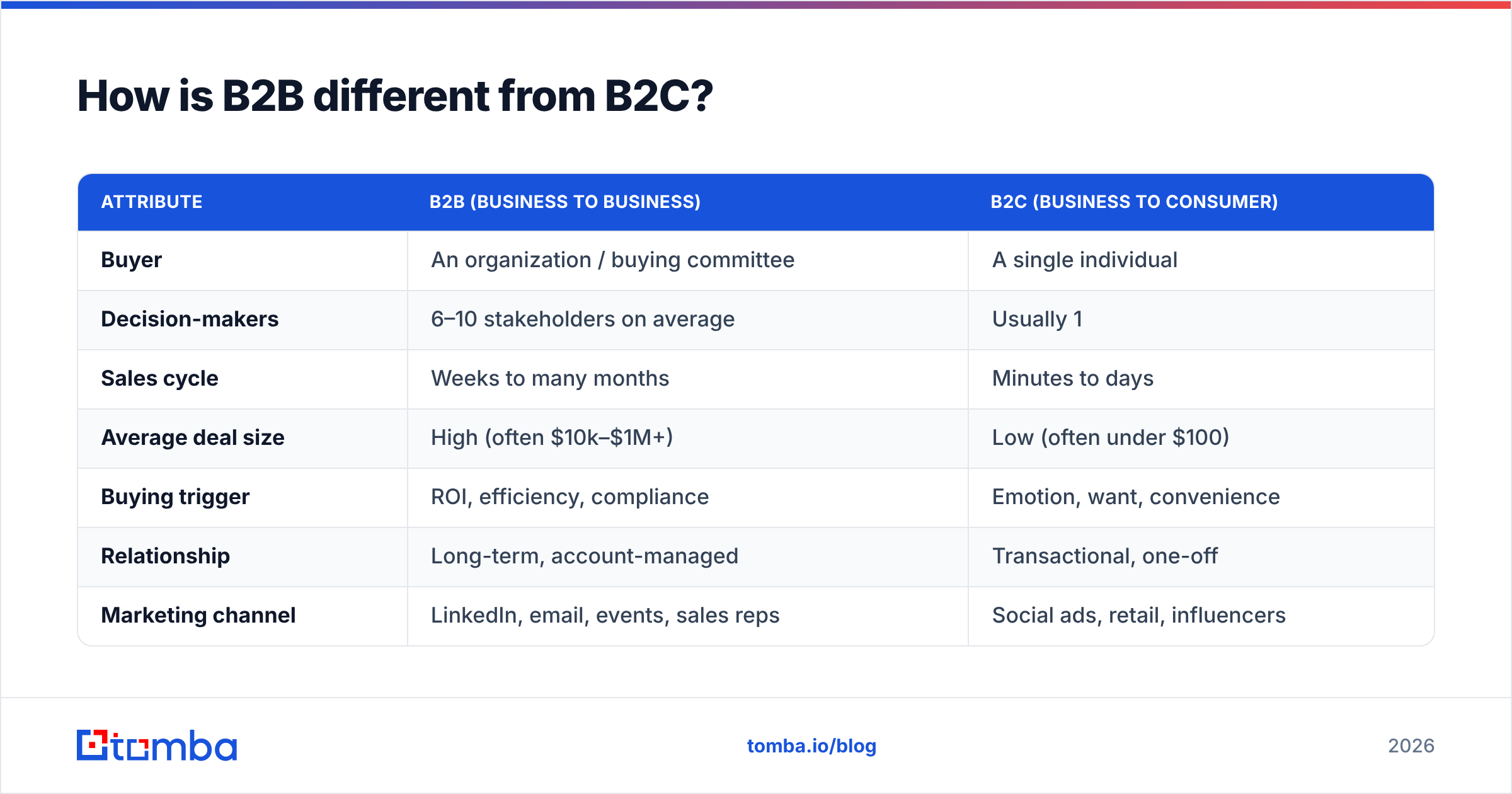
| Attribute | B2B (Business to Business) | B2C (Business to Consumer) |
|---|---|---|
| Buyer | An organization / buying committee | A single individual |
| Decision-makers | 6–10 stakeholders on average | Usually 1 |
| Sales cycle | Weeks to many months | Minutes to days |
| Average deal size | High (often $10k–$1M+) | Low (often under $100) |
| Buying trigger | ROI, efficiency, compliance | Emotion, want, convenience |
| Relationship | Long-term, account-managed | Transactional, one-off |
| Marketing channel | LinkedIn, email, events, sales reps | Social ads, retail, influencers |
| Payment terms | Invoicing, net-30/60, contracts | Instant card payment |
The practical takeaway: in B2B you are not persuading a person, you are equipping a champion inside the buyer's company to persuade their colleagues. Your collateral, pricing page, and ROI math all have to survive a conversation you'll never be in the room for.
That's also why B2B prospecting is a data problem first and a persuasion problem second. You need the right people at the right accounts before any messaging matters. Tools like an email finder and data enrichment exist precisely to close that gap at the top of the funnel.
What are the main types of B2B business models?#
"Business to business" is an umbrella over several distinct models. Knowing which one you operate (or sell into) dictates your pricing, your sales cycle, and your data needs.
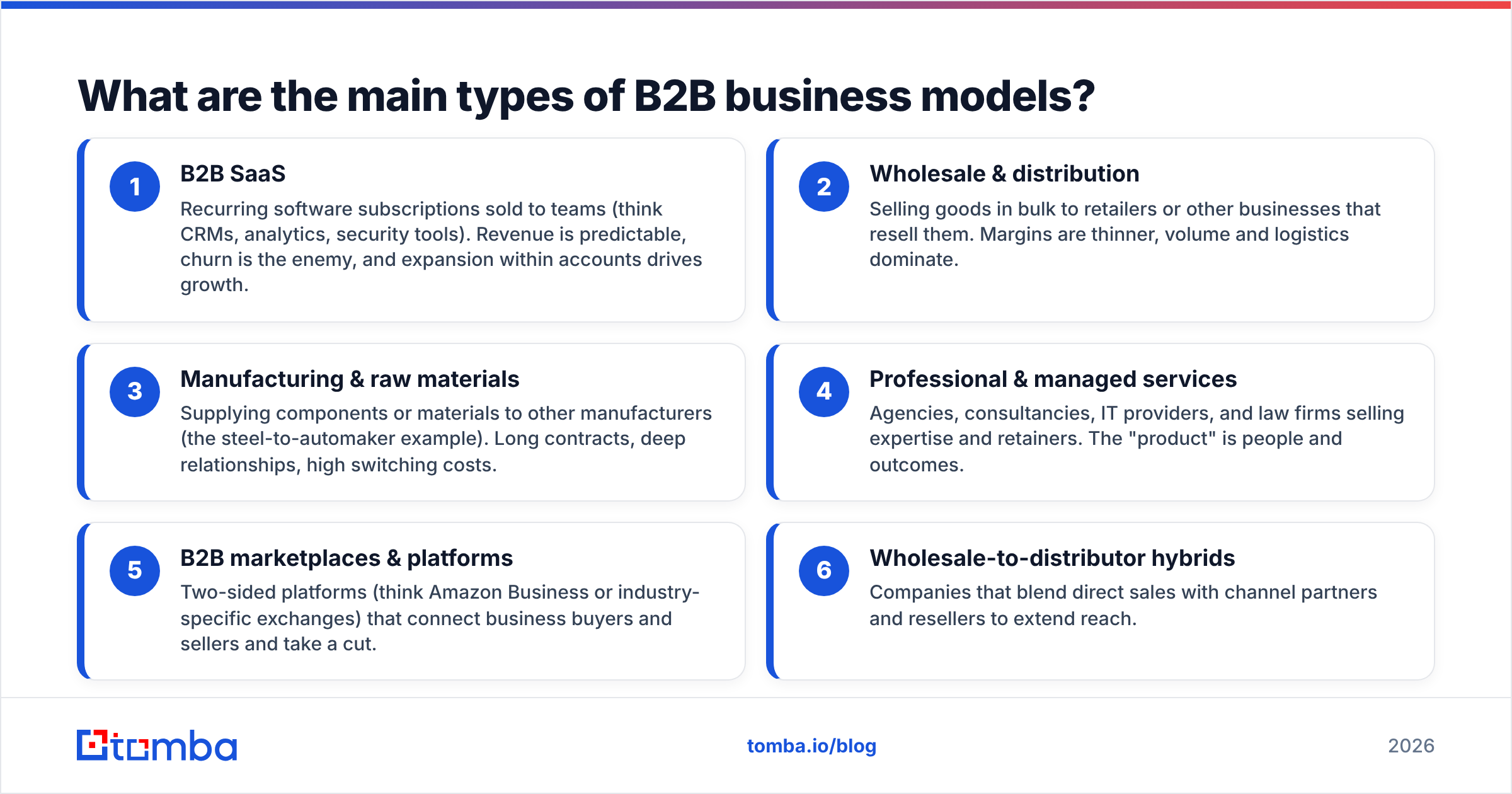
- B2B SaaS — Recurring software subscriptions sold to teams (think CRMs, analytics, security tools). Revenue is predictable, churn is the enemy, and expansion within accounts drives growth.
- Wholesale & distribution — Selling goods in bulk to retailers or other businesses that resell them. Margins are thinner, volume and logistics dominate.
- Manufacturing & raw materials — Supplying components or materials to other manufacturers (the steel-to-automaker example). Long contracts, deep relationships, high switching costs.
- Professional & managed services — Agencies, consultancies, IT providers, and law firms selling expertise and retainers. The "product" is people and outcomes.
- B2B marketplaces & platforms — Two-sided platforms (think Amazon Business or industry-specific exchanges) that connect business buyers and sellers and take a cut.
- Wholesale-to-distributor hybrids — Companies that blend direct sales with channel partners and resellers to extend reach.
Each model still shares the same bottleneck: reaching the actual humans who sign. Whether you charge $49 a month or $4 million a year, the deal stalls if your outreach lands in the wrong inbox.
Who actually buys in a B2B deal?#
The single biggest mistake new B2B sellers make is treating an account as one buyer. According to Gartner, the typical B2B buying group for a complex solution involves six to ten decision-makers — each armed with their own information and often pulling in different directions.
A realistic enterprise software deal might involve:
- Champion — the person who wants your product and sells it internally.
- Economic buyer — controls the budget and signs off on spend.
- Technical evaluator — vets security, integrations, and feasibility.
- End users — the team who'll live in the product daily.
- Procurement / legal — negotiates terms, redlines the contract.
- The skeptic — the stakeholder who defaults to "do nothing."
Selling to one of them and ignoring the rest is how deals die in "we decided to hold off." This is why multi-threading — building relationships across the committee — is the core B2B competency in 2026. And multi-threading is impossible without contact data for each role, which means your prospecting tooling has to find more than one email per account. A domain search that returns every reachable contact at a company, mapped to their department, is worth more than a single name.
)
What does the modern B2B sales process look like?#
B2B sales in 2026 is a pipeline, not a pitch. It moves through stages, and data quality compounds at every step.
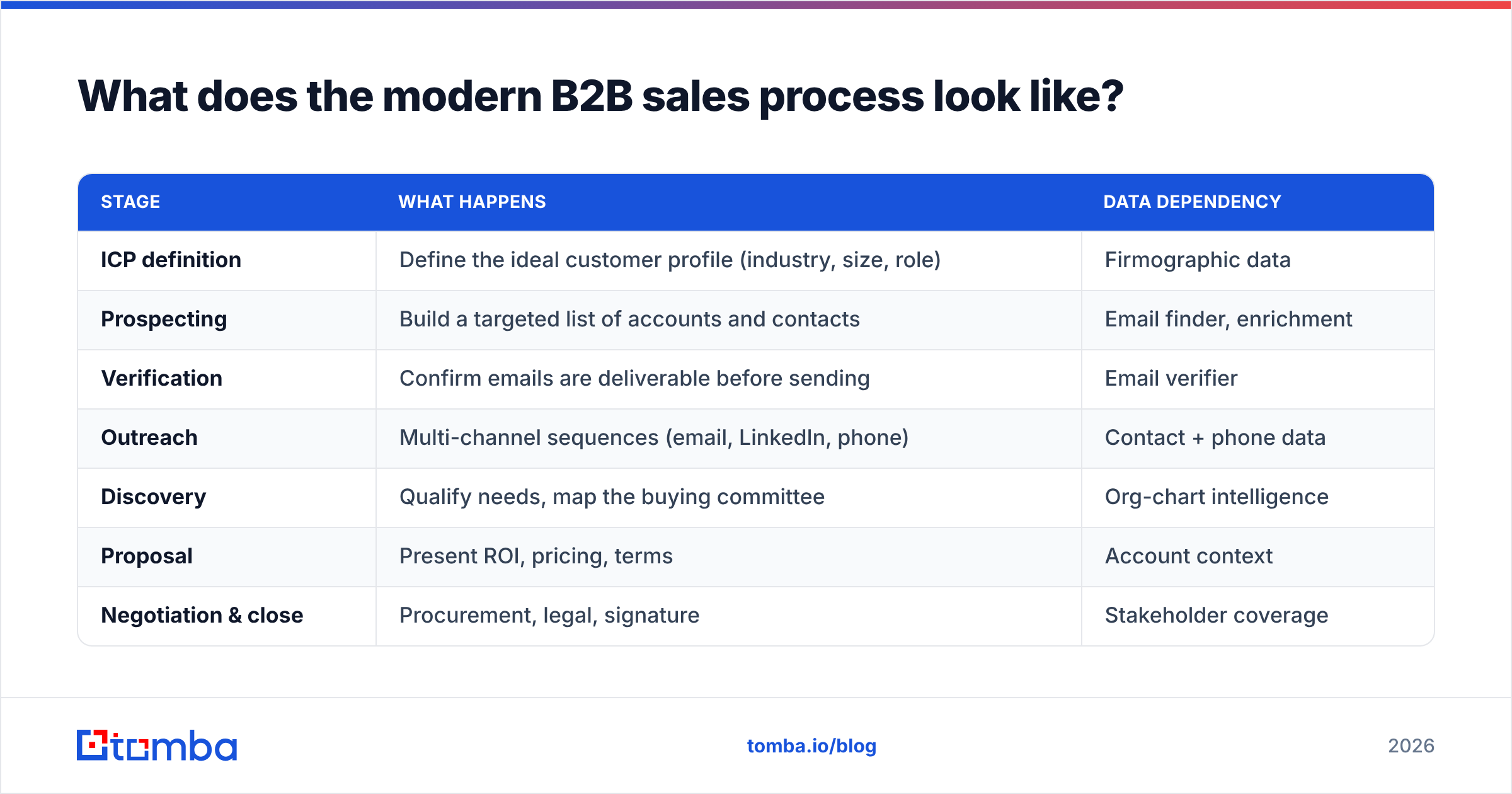
| Stage | What happens | Data dependency |
|---|---|---|
| ICP definition | Define the ideal customer profile (industry, size, role) | Firmographic data |
| Prospecting | Build a targeted list of accounts and contacts | Email finder, enrichment |
| Verification | Confirm emails are deliverable before sending | Email verifier |
| Outreach | Multi-channel sequences (email, LinkedIn, phone) | Contact + phone data |
| Discovery | Qualify needs, map the buying committee | Org-chart intelligence |
| Proposal | Present ROI, pricing, terms | Account context |
| Negotiation & close | Procurement, legal, signature | Stakeholder coverage |
| Expansion | Upsell, cross-sell, renew | Ongoing enrichment |
Notice that the first half of the pipeline is almost entirely a data exercise. If your list is full of guessed addresses, your sequences bounce, your sender reputation tanks, and the rest of the process never gets to happen. Verifying contacts with an email verifier before you hit send is the unglamorous step that protects everything downstream — see HubSpot's guidance on email deliverability for why bounce rates wreck campaigns.
The deliverability chain is simple: bad data → high bounce rate → damaged sender reputation → emails landing in spam → no replies. Fix it at the source and the whole funnel breathes.
Why does data quality make or break B2B?#
Because in B2B you have a finite, knowable universe of buyers — and you have to reach a specific person inside a specific company. There's no "wide net" to fall back on like there is in consumer advertising.
Consider the math. Say your total addressable market is 5,000 target accounts, each with five relevant stakeholders. That's 25,000 people you might ever sell to. If 30% of your contact data is stale or wrong — a conservative figure given that people change jobs constantly — you've silently deleted 7,500 opportunities before you've written a single email.
Three data problems quietly drain B2B pipelines:
- Wrong or guessed emails — they bounce, hurt your domain, and waste rep time.
- Missing stakeholders — you reach one contact and never multi-thread the account.
- Decayed records — titles, companies, and emails go stale every quarter.
The fix is a repeatable enrichment habit: find verified contacts at your target domains, confirm they're deliverable, and keep records fresh. A bulk email finder handles the scale, while ongoing contact enrichment fights decay. The goal isn't more data — it's accurate data that turns your TAM from a spreadsheet into a reachable list.
How do you price and compare B2B tools?#
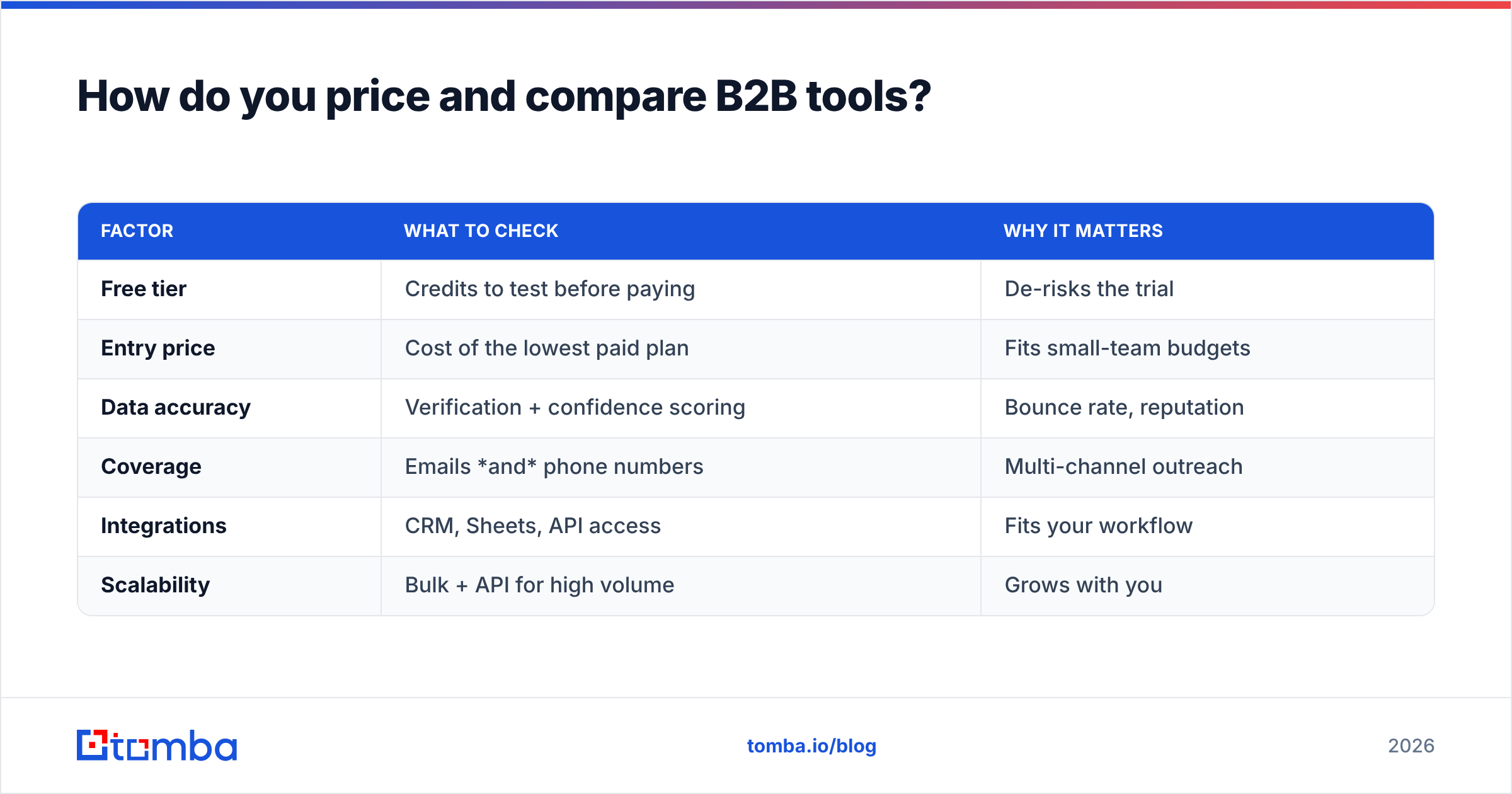
B2B buyers — including you, when you're buying your own stack — evaluate tools on ROI, not sticker shock. The right question isn't "what's cheapest," it's "what's the cost per usable contact and per closed deal."
When you compare prospecting platforms, weigh these dimensions against your volume:
| Factor | What to check | Why it matters |
|---|---|---|
| Free tier | Credits to test before paying | De-risks the trial |
| Entry price | Cost of the lowest paid plan | Fits small-team budgets |
| Data accuracy | Verification + confidence scoring | Bounce rate, reputation |
| Coverage | Emails and phone numbers | Multi-channel outreach |
| Integrations | CRM, Sheets, API access | Fits your workflow |
| Scalability | Bulk + API for high volume | Grows with you |
For context, Tomba's structure follows that logic: a Free tier with 25 searches a month to test the data, then Starter at $49/mo, Growth at $99/mo, Pro at $249/mo, and custom Enterprise pricing — full Tomba pricing is public. The point of sharing it isn't the numbers; it's the pattern. A good B2B tool lets you validate the data quality on a free tier before you ever commit budget, which is exactly how your own buyers will evaluate you.
If you're benchmarking options, read independent reviews on G2 alongside vendor pages — B2B buyers trust peer signals, and so should you.
What are the biggest B2B mistakes to avoid in 2026?#
- Single-threading. Pinning a six-figure deal on one champion who might leave or go quiet. Map and contact the whole committee.
- Skipping verification. Sending to unverified lists, torching your domain reputation in week one.
- Generic messaging. Treating a CFO and an end user with the same pitch. B2B persuasion is role-specific.
- Buying static lists. Purchased databases decay fast; a real-time finder beats a stale CSV every time.
- Confusing activity with progress. 1,000 emails to bad addresses is worse than 100 to verified, well-targeted contacts.
Avoid these and you're already ahead of most teams, because the fundamentals — accurate data, tight targeting, multi-threaded outreach — are what consistently separate B2B teams that hit quota from teams that blame the market.
Where should you start with B2B?#
Start at the top of the funnel, because nothing downstream works without it. Define a sharp ICP, then build a list of real, verified contacts at those accounts — not guesses, not a purchased CSV that's six months stale.
That's the job Tomba Email Finder is built for: enter a company domain or a name, and get back verified professional email addresses for the people who actually make decisions, scored for deliverability so your sequences land instead of bounce. Pair it with domain search to cover the whole buying committee and the email verifier to keep your sender reputation clean. Spin up the free tier (25 searches, no card), point it at your top 25 target accounts, and see how many reachable, verified contacts you can build in an afternoon. In B2B, the team with the cleanest data usually wins — make that team yours.
// get started
Find, verify and enrich your first contacts today
Start on the free plan with 25 searches a month, then scale when your team is ready.
Free plan · No credit card required · GDPR & CCPA
// about the author