Business to Business Email Format: The 2026 B2B Guide
The exact business to business email format that gets opens, replies, and meetings in 2026 — structure, templates, a side-by-side teardown, and the data hygiene step most reps skip.
The difference between a B2B email that books a meeting and one that dies in the trash is rarely the offer. It is the format. The same pitch, restructured into a tighter shape, can swing reply rates by double digits. This guide breaks down the exact business to business email format that works in 2026 — every component, a good-versus-bad teardown, copy-ready templates, and the one data step most reps skip.
TL;DR#
- A high-performing business to business email format has six parts: from-line, subject, preview text, opener, body, and a single CTA — in that priority order.
- Keep it to 50–125 words. Shorter cold emails consistently out-reply long ones because busy buyers scan, they do not read.
- Lead with the recipient, not your company. The first sentence should be about them; the second can introduce you.
- Use one call to action. Two asks split attention and cut reply rates.
- Format is wasted if the email never lands. Verify the address and personalization data before you send — bounces wreck sender reputation faster than bad copy.
What is a business to business email format?#
A business to business email format is the repeatable structure you use to write an email from one company to another — usually for sales, partnerships, recruiting, or vendor outreach. Think of it like the frame of a house. The decor (your specific words) changes per prospect, but the load-bearing structure stays the same: a credible sender, a scannable subject, a relevant opener, a tight value body, and one clear next step.
The format matters more in B2B than in consumer email because the audience is different. A B2B buyer reads dozens of pitches a week, often on mobile, between meetings. They are not browsing — they are triaging. Your format either survives the three-second scan or it does not. Get the structure right and even an average offer earns a reply. Get it wrong and a great offer never gets read.
Why does B2B email format matter so much?#
Because attention is the scarcest resource in the inbox. According to HubSpot's sales benchmarks, the vast majority of cold emails are decided in seconds based on subject line and the visible first line. Three forces make format decisive:
- Mobile-first reading. More than half of B2B email is opened on a phone, where a four-paragraph wall of text looks like a chore. Short paragraphs and white space win.
- Triage behavior. Buyers archive in bulk. A scannable format — one idea per line, a bolded value point, a single link — earns a pause.
- Deliverability math. Spam filters score formatting signals: link count, image-to-text ratio, ALL-CAPS, and risky words. A clean format keeps you in the primary inbox.
Format is also what makes outreach scalable. Once you have a structure that converts, you can template it, personalize the variables, and send at volume without rewriting from scratch each time.
What are the core components of a B2B email?#
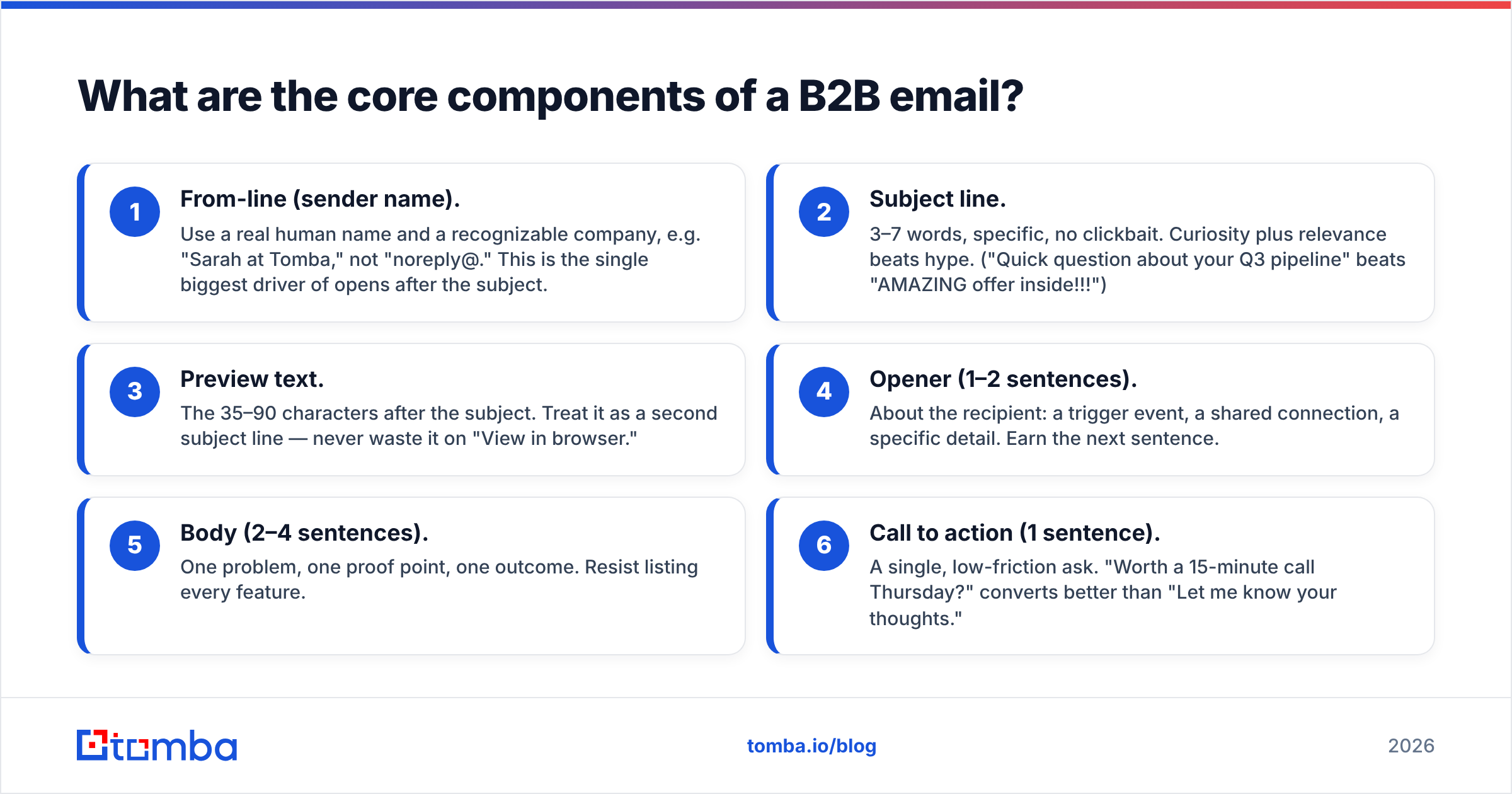
Every effective business to business email format is built from the same six blocks. Nail each one and the email almost writes itself.
- From-line (sender name). Use a real human name and a recognizable company, e.g. "Sarah at Tomba," not "noreply@." This is the single biggest driver of opens after the subject.
- Subject line. 3–7 words, specific, no clickbait. Curiosity plus relevance beats hype. ("Quick question about your Q3 pipeline" beats "AMAZING offer inside!!!")
- Preview text. The 35–90 characters after the subject. Treat it as a second subject line — never waste it on "View in browser."
- Opener (1–2 sentences). About the recipient: a trigger event, a shared connection, a specific detail. Earn the next sentence.
- Body (2–4 sentences). One problem, one proof point, one outcome. Resist listing every feature.
- Call to action (1 sentence). A single, low-friction ask. "Worth a 15-minute call Thursday?" converts better than "Let me know your thoughts."
A reliable email signature caps the email with your name, title, company, and one link — never a stack of badges and banners that trip spam filters.
What does a winning B2B email format look like?#
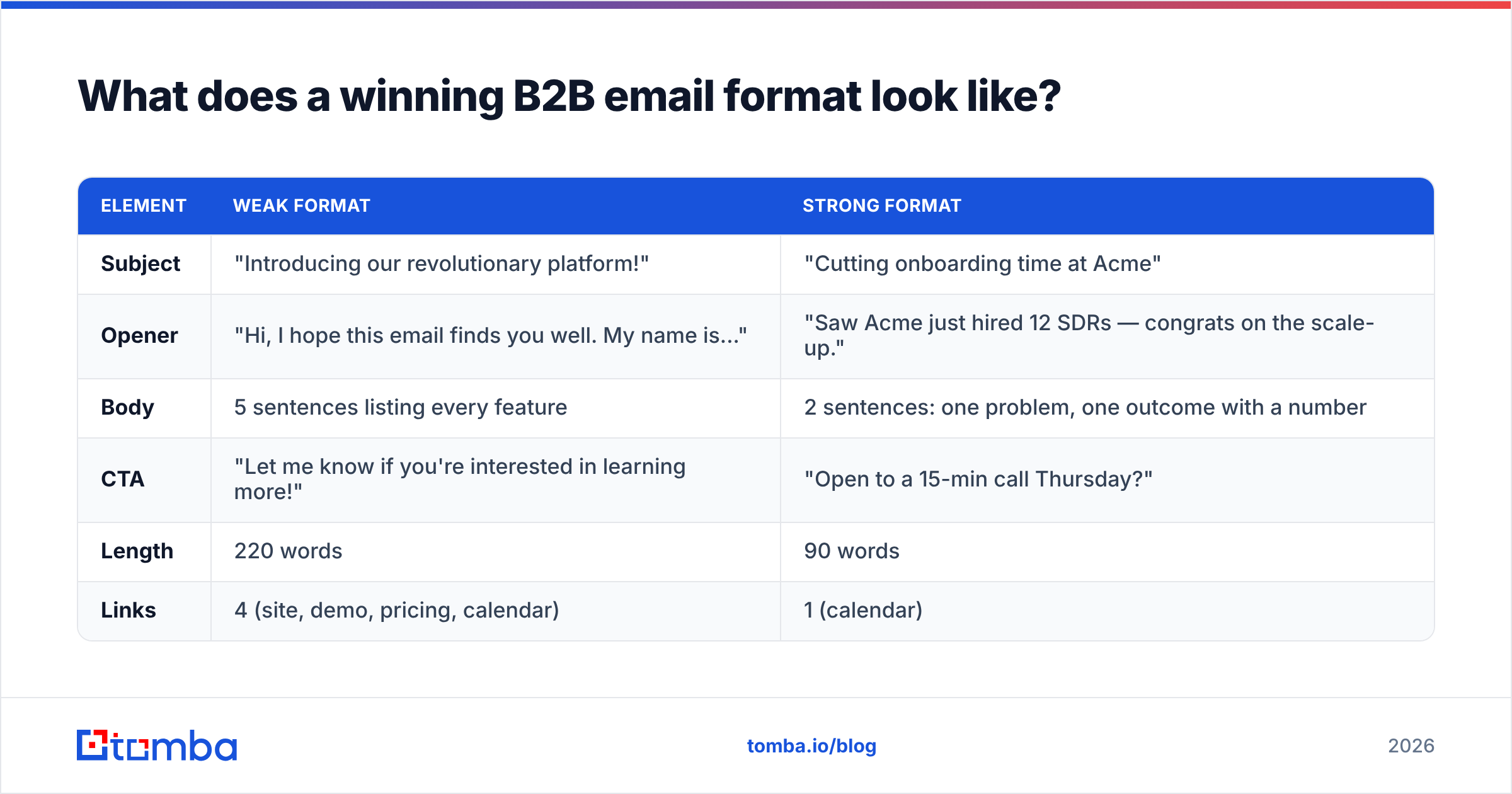
Here is the same outreach written two ways. The teardown shows why structure, not vocabulary, decides the outcome.
| Element | Weak format | Strong format |
|---|---|---|
| Subject | "Introducing our revolutionary platform!" | "Cutting onboarding time at Acme" |
| Opener | "Hi, I hope this email finds you well. My name is..." | "Saw Acme just hired 12 SDRs — congrats on the scale-up." |
| Body | 5 sentences listing every feature | 2 sentences: one problem, one outcome with a number |
| CTA | "Let me know if you're interested in learning more!" | "Open to a 15-min call Thursday?" |
| Length | 220 words | 90 words |
| Links | 4 (site, demo, pricing, calendar) | 1 (calendar) |
The strong version is not cleverer. It is shorter, recipient-first, and asks for one thing. That is the entire game.
What is the ideal length and tone for B2B email?#
Short and conversational. Aim for 50–125 words in the body. Write the way you would speak if you bumped into the prospect at a conference — direct, warm, and specific, without slang or filler. Cut every sentence that is about you when it could be about them.
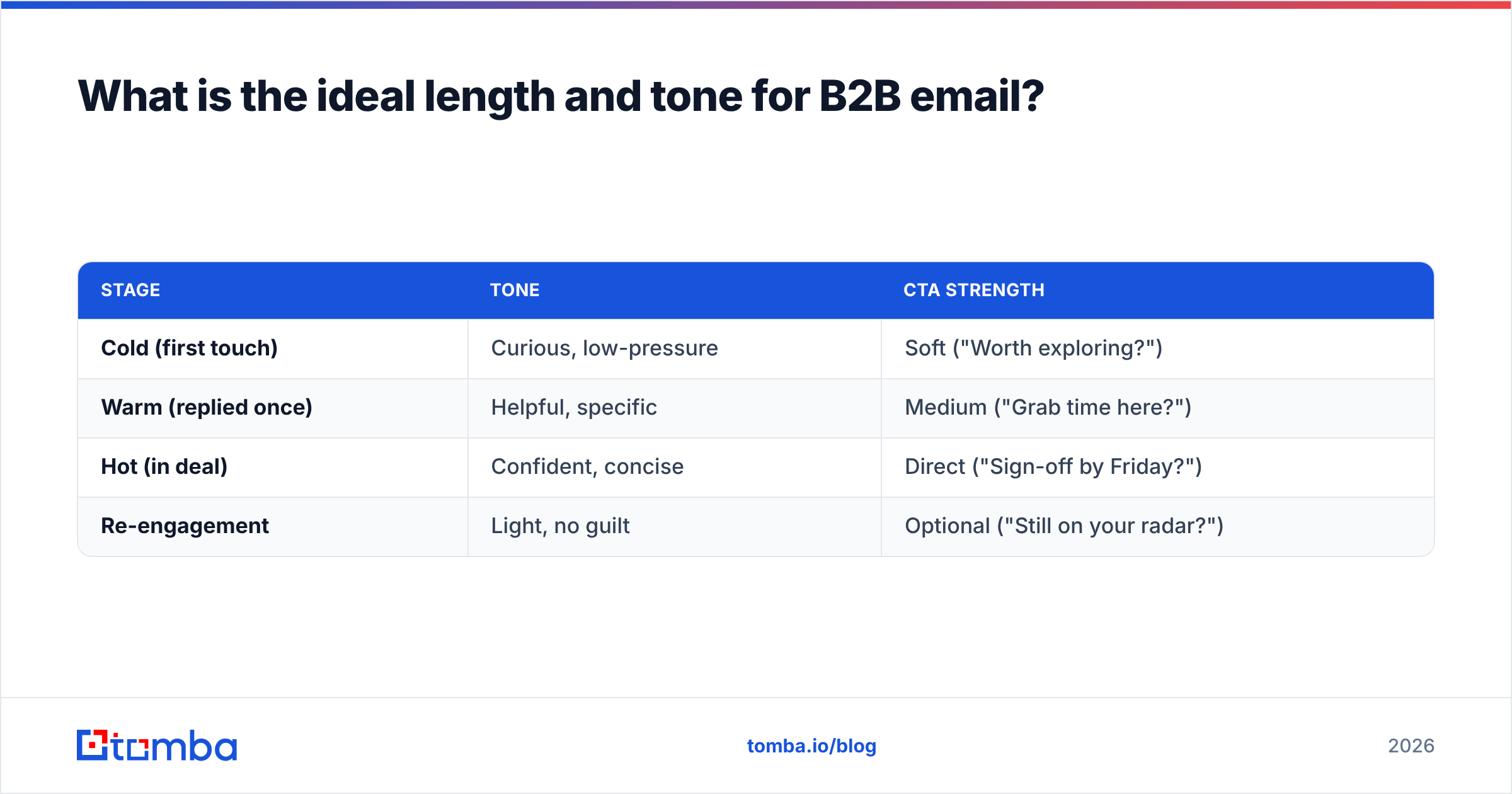
Tone scales with relationship stage:
| Stage | Tone | CTA strength |
|---|---|---|
| Cold (first touch) | Curious, low-pressure | Soft ("Worth exploring?") |
| Warm (replied once) | Helpful, specific | Medium ("Grab time here?") |
| Hot (in deal) | Confident, concise | Direct ("Sign-off by Friday?") |
| Re-engagement | Light, no guilt | Optional ("Still on your radar?") |
Avoid the two classic failure modes: the over-formal "Dear Sir/Madam, I am writing to inquire" (reads like a 1990s fax) and the over-casual "Hey!! 🚀🚀" (reads like spam). Professional-conversational is the sweet spot.
How do you write each part of the email?#
Subject line. Be specific to the recipient's world. Reference a company, a metric, or a trigger. Test variants with a subject line generator and keep them under 50 characters so they do not truncate on mobile.
Opener. Never open with your own name and title. Open with something only this prospect would recognize: their recent funding, a new hire, a product launch, a podcast they were on. Relevance buys the next five seconds.
Body. Use the problem-proof-outcome pattern. State the problem they likely feel, give one concrete proof point ("we cut a 40-person sales team's research time in half"), and name the outcome they want. One idea. Bold at most one phrase.
CTA. Ask for a single, specific, low-commitment next step. Interest-based CTAs ("Are you the right person for this?") often beat meeting-based CTAs on the very first touch because they lower the cost of replying.
What are some B2B email format templates?#
Copy these, swap the brackets, and personalize the opener with a real detail. Browse more ready-made email templates when you need variety.
1. Cold outreach (trigger-based)
Subject: Acme's new SDR hires
Hi [First name],
Saw Acme just brought on 12 SDRs — fast growth.
New reps usually burn their first weeks hunting for contact data instead of selling. We helped [similar company] cut that research time roughly in half so reps started booking in week one.
Worth a 15-minute call Thursday to see if it fits?
[Your name]
2. Follow-up (no reply)
Subject: Re: Acme's new SDR hires
Hi [First name], floating this back up in case it slipped past. One question: is contact-data quality something your team is actively trying to fix this quarter? A yes or no is plenty.
3. Re-engagement (gone cold)
Subject: Still on your radar?
Hi [First name], we spoke a few months back about your team's outbound data. Timing may have been off. If it is back on the table, happy to send a quick before/after from a team your size — no call required.
Notice the shared skeleton: short subject, recipient-first opener, one value idea, one ask. That is the business to business email format working underneath three different goals.
How do you make sure the format actually lands?#
This is the step most reps skip — and it quietly kills more campaigns than any subject line. A flawless format is worthless if the email bounces or the personalization is wrong. Two safeguards:
Verify the address. Every bounce damages your domain reputation and pushes future emails toward spam folders. Run your list through an email verifier before you send so you are only mailing real, deliverable inboxes. High bounce rates are one of the fastest ways to tank email response rate across an entire domain.
Source clean contact data. "Hi [First name]" with a blank or wrong name is worse than no email at all. Pull accurate names, roles, and addresses with a reliable email finder so your personalization tokens never misfire. You can read independent reviews of these tools on G2 to compare accuracy claims.
Format earns the open. Data quality earns the trust. You need both.
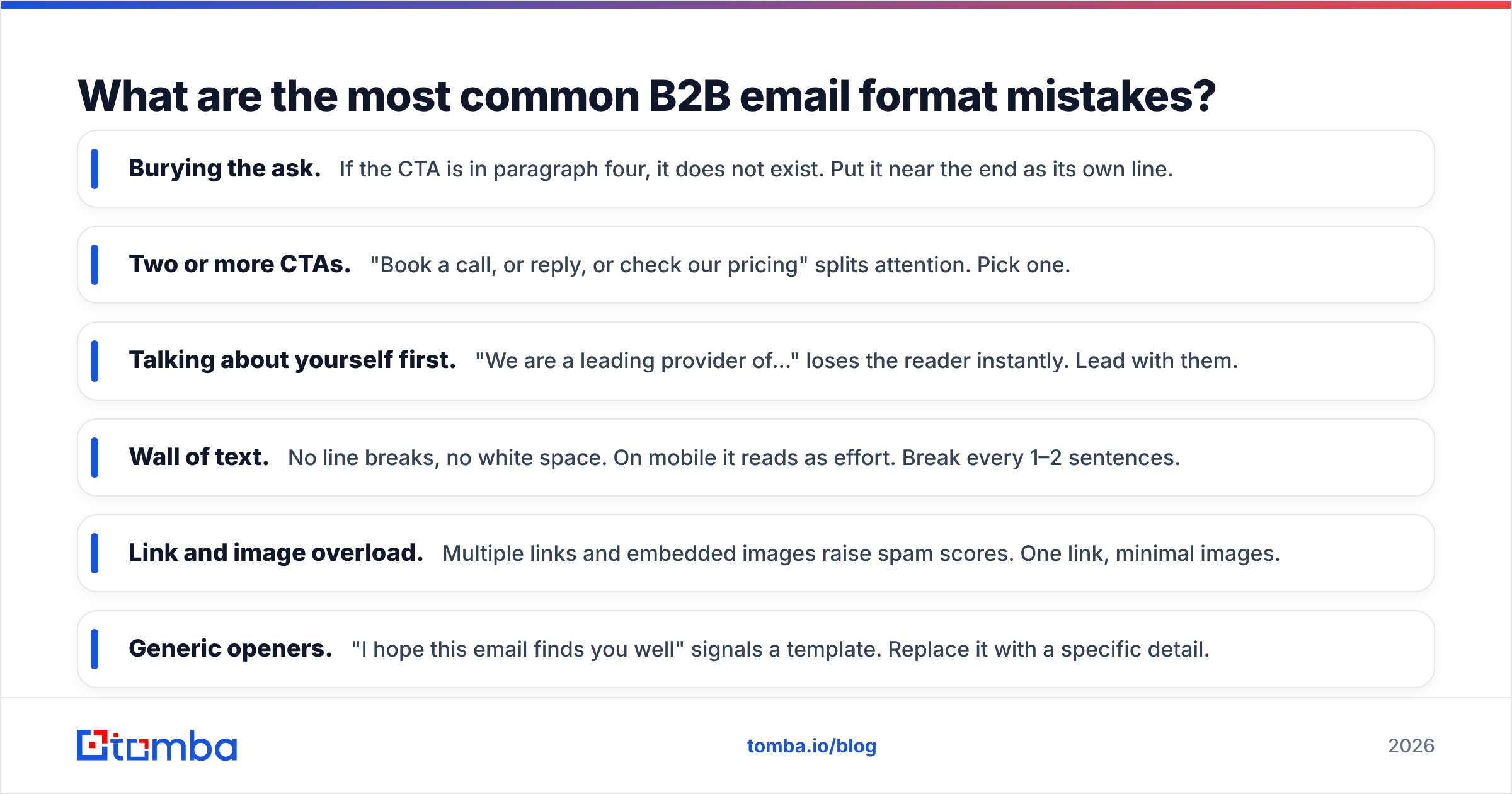
What are the most common B2B email format mistakes?#
- Burying the ask. If the CTA is in paragraph four, it does not exist. Put it near the end as its own line.
- Two or more CTAs. "Book a call, or reply, or check our pricing" splits attention. Pick one.
- Talking about yourself first. "We are a leading provider of…" loses the reader instantly. Lead with them.
- Wall of text. No line breaks, no white space. On mobile it reads as effort. Break every 1–2 sentences.
- Link and image overload. Multiple links and embedded images raise spam scores. One link, minimal images.
- Generic openers. "I hope this email finds you well" signals a template. Replace it with a specific detail.
- Skipping verification. Sending to unverified lists spikes bounces and burns your domain. Clean first, send second.
How is B2B email format changing in 2026?#
Three shifts are reshaping the format this year. First, AI-assisted personalization at scale means generic templates stand out as lazy — buyers can tell. The winning move is structured templates with genuinely researched openers. Second, stricter inbox filtering from major providers rewards plain-text-style emails with low link counts and authenticated domains. Third, interest-first CTAs are replacing aggressive meeting asks on cold touches, because they respect the buyer's time and lift first-reply rates.
The underlying definition of professional email has not changed. What has changed is the tolerance for noise — it is near zero. Tight, relevant, verified, single-ask emails are the format that survives.
Frequently asked questions#
How long should a B2B email be? Keep the body between 50 and 125 words. Cold emails skew shorter; in-deal emails can run slightly longer because the reader already cares.
Should B2B emails be formal? Professional-conversational, not stiff. Skip "Dear Sir/Madam" and skip excessive slang or emojis. Write like a competent colleague.
How many CTAs should an email have? One. A single, specific, low-friction ask consistently out-converts multiple competing requests.
What is the best opening line for a B2B email? A specific, recipient-focused observation — a trigger event, a recent hire, a shared connection — never your own name and title.
Do I really need to verify emails before sending? Yes. Bounces from bad addresses damage sender reputation and route future emails to spam, undoing all your formatting work.
Put the format to work#
A great business to business email format is only as good as the data behind it. Before you send a single line of that perfectly structured cold email, make sure every address is real and every name is right. The Tomba Email Finder gives you verified professional emails by name, company, or domain — so your templates personalize cleanly and land in the primary inbox instead of bouncing into a spam trap. Start on the free tier (25 searches a month), scale to Starter at $49/mo when outreach ramps, and check the full Tomba pricing for higher-volume plans. Get the format right, get the data right, and watch your reply rate follow.
// get started
Find, verify and enrich your first contacts today
Start on the free plan with 25 searches a month, then scale when your team is ready.
Free plan · No credit card required · GDPR & CCPA
// about the author