Business to Business Marketing Strategy: 2026 Playbook
A practical 2026 framework for building a business to business marketing strategy that fills pipeline — ICP, channels, data, and a measurable funnel that actually converts.
TL;DR
- A business to business marketing strategy is the documented plan for how you reach, educate, and convert other companies — not consumers — into pipeline and revenue.
- The four pillars that decide whether it works: a sharp ICP, the right channel mix, clean contact data, and a funnel you actually measure.
- Account-based plays beat spray-and-pray in 2026: fewer, better-fit accounts get more attention and convert at higher rates.
- Bad data quietly kills good strategy. If 20–30% of your list bounces or targets the wrong title, every channel underperforms.
- Start narrow, instrument everything, and let pipeline (not impressions) be the scoreboard.
What is a business to business marketing strategy?#
A business to business marketing strategy is your plan for turning other companies into customers. The buyer is an organization — usually a buying committee of 5 to 11 people, according to Gartner — not a single shopper with a credit card. That one fact changes everything: longer sales cycles, multiple stakeholders, higher deal values, and a heavy emphasis on trust and proof over impulse.
Where B2C marketing optimizes for volume and emotion, B2B marketing optimizes for fit and confidence. You are not trying to reach everyone. You are trying to reach the handful of accounts that match your ideal customer profile, get in front of the people who influence the decision, and give them enough evidence to say yes.
Think of it like commercial fishing versus a spearfishing trip. B2C casts a wide net and keeps whatever it catches. B2B picks a specific fish, in a specific reef, and goes after it deliberately. The strategy is the map of which reef, which fish, and which spear.
)
How is B2B marketing different from B2C?#
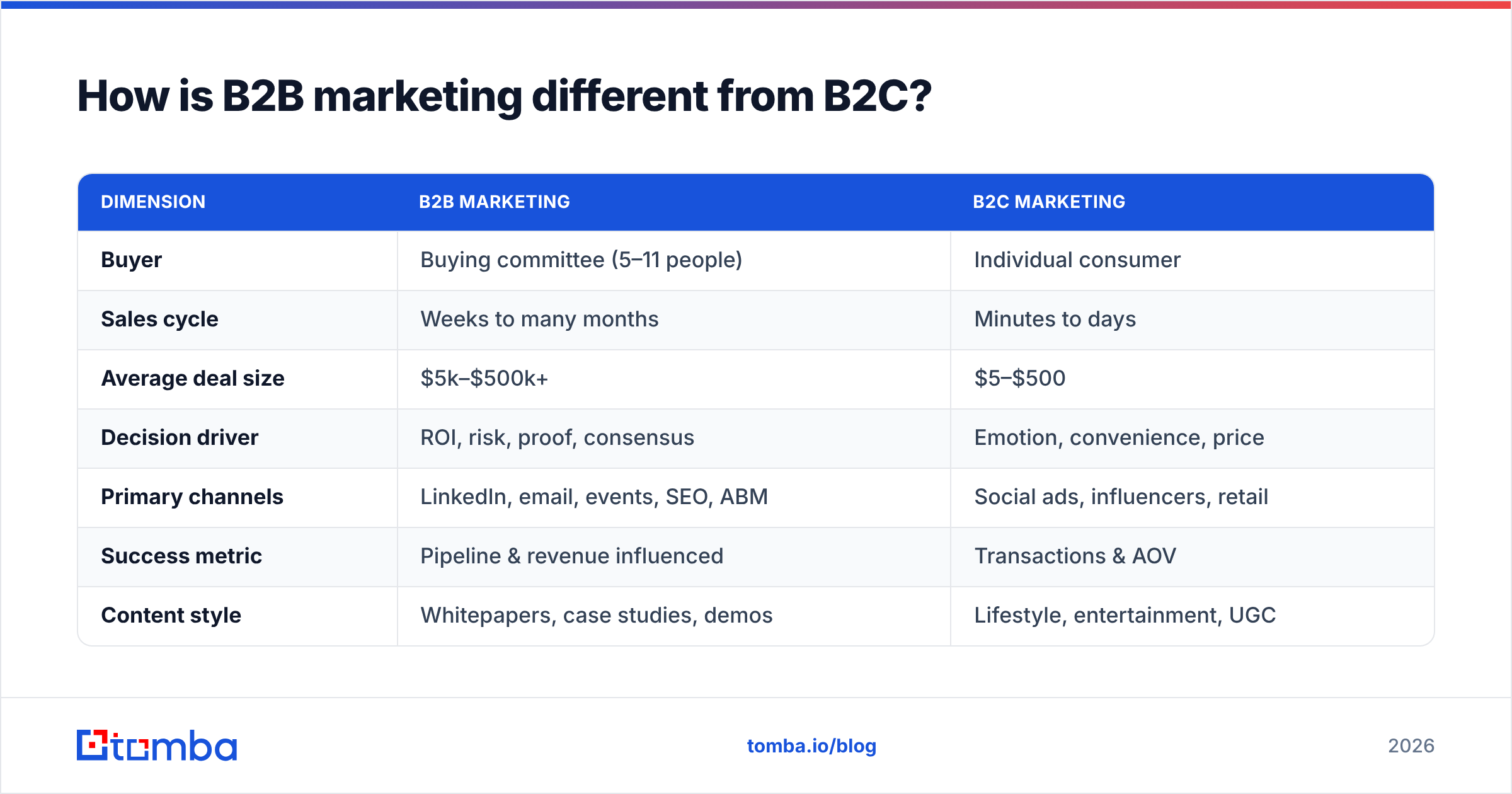
The mechanics differ enough that copying a B2C playbook usually backfires. Here is the practical contrast.
| Dimension | B2B marketing | B2C marketing |
|---|---|---|
| Buyer | Buying committee (5–11 people) | Individual consumer |
| Sales cycle | Weeks to many months | Minutes to days |
| Average deal size | $5k–$500k+ | $5–$500 |
| Decision driver | ROI, risk, proof, consensus | Emotion, convenience, price |
| Primary channels | LinkedIn, email, events, SEO, ABM | Social ads, influencers, retail |
| Success metric | Pipeline & revenue influenced | Transactions & AOV |
| Content style | Whitepapers, case studies, demos | Lifestyle, entertainment, UGC |
The takeaway: in B2B you are marketing to a process, not a person. Your strategy has to serve the champion who loves you, the finance lead who doubts you, and the security reviewer who has never heard of you — often in the same deal.
What are the core pillars of a B2B marketing strategy?#
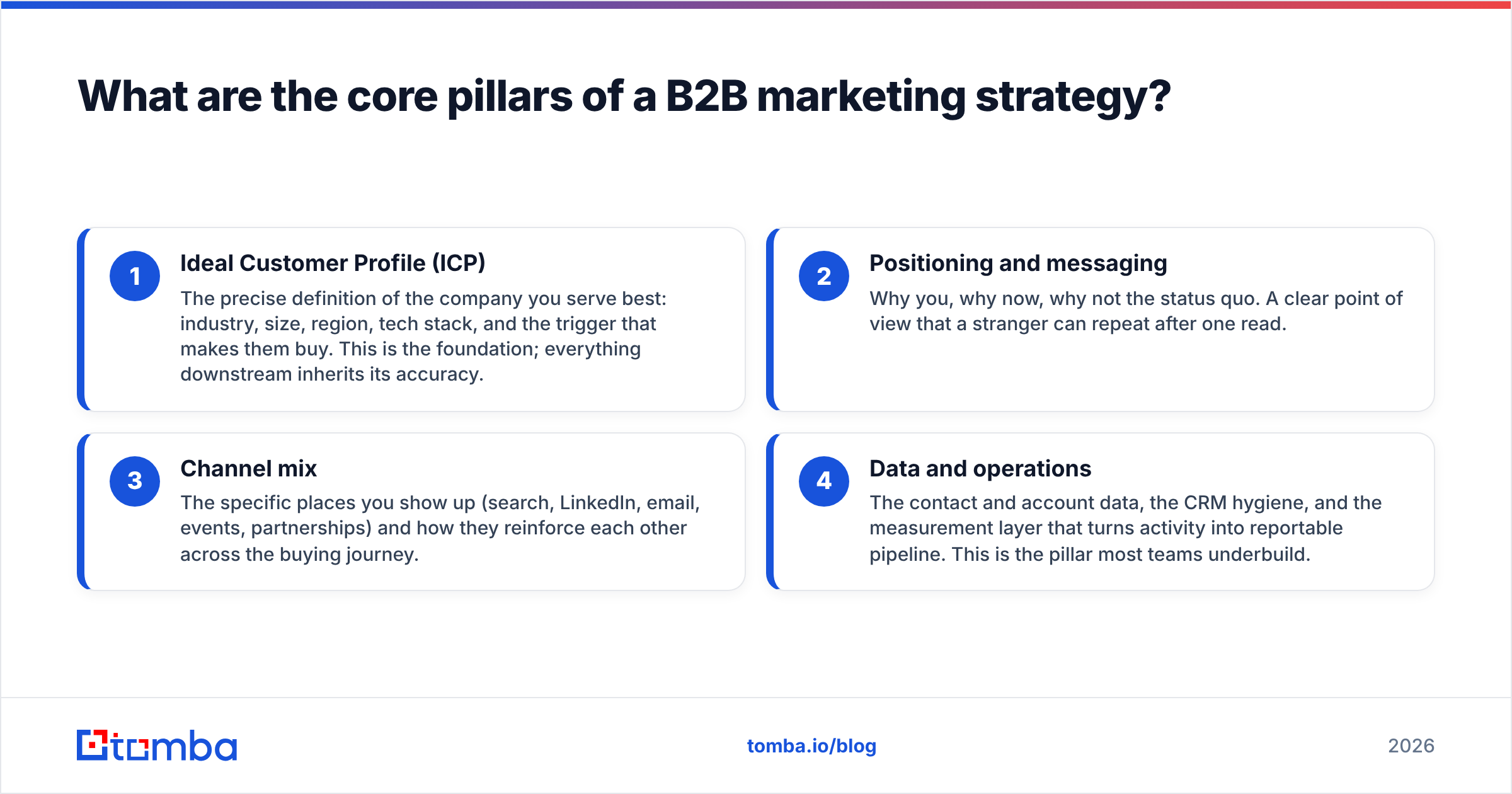
Strong strategies are built on four pillars. Skip one and the others wobble.
- Ideal Customer Profile (ICP) — The precise definition of the company you serve best: industry, size, region, tech stack, and the trigger that makes them buy. This is the foundation; everything downstream inherits its accuracy.
- Positioning and messaging — Why you, why now, why not the status quo. A clear point of view that a stranger can repeat after one read.
- Channel mix — The specific places you show up (search, LinkedIn, email, events, partnerships) and how they reinforce each other across the buying journey.
- Data and operations — The contact and account data, the CRM hygiene, and the measurement layer that turns activity into reportable pipeline. This is the pillar most teams underbuild.
Notice that two of the four pillars — ICP and data — are about who you reach, not what you say. That ratio is deliberate. The best message sent to the wrong account is wasted budget.
How do you define your ICP and target accounts?#
Start with your best existing customers and reverse-engineer the pattern. Pull your top 20 accounts by retention and expansion, then look for what they share: company size band, industry, the role of the person who championed you, and the event that triggered the purchase (a funding round, a new hire, a compliance deadline).
Turn that pattern into firmographic and signal-based filters:
- Firmographics: industry, employee count, revenue, geography.
- Technographics: the tools they already run that signal a fit (or a gap you fill).
- Intent and triggers: hiring for a relevant role, recent funding, leadership changes, or active research behavior.
Once the profile is set, build the actual account list and the contacts inside each account. This is where strategy meets execution — and where most plans stall, because the list is stale, incomplete, or pointed at the wrong titles. A good B2B database and reliable data enrichment turn a fuzzy ICP into a working list of named accounts with verified decision-makers attached.
If you are sourcing contacts by company, domain search lets you pull every relevant email at a target account in one pass, so your ABM list isn't built one guess at a time.
Which channels belong in a 2026 B2B marketing strategy?#
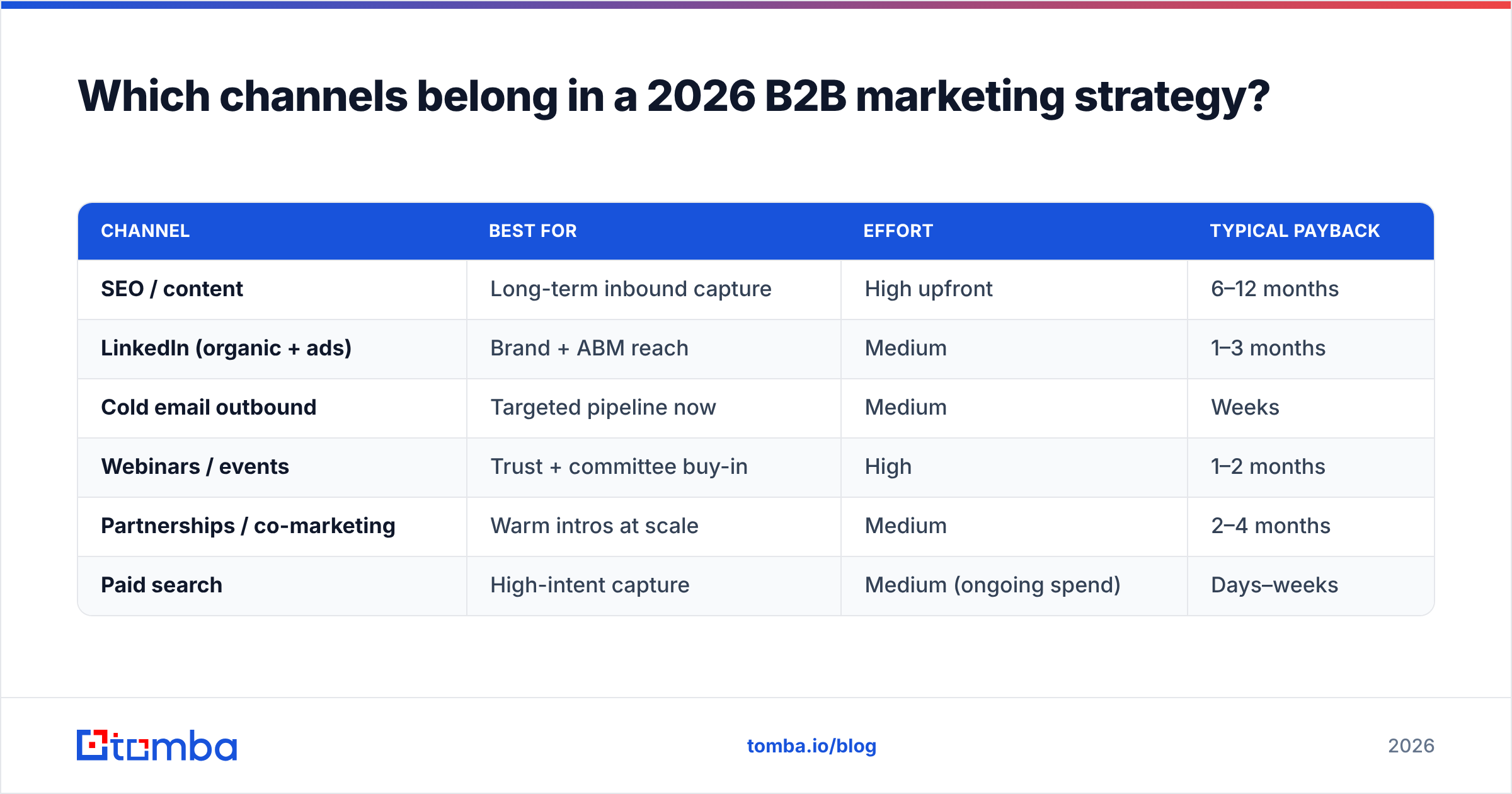
There is no single best channel — there is the right combination for your buyer. Most effective programs blend a demand-creation layer (educating people who don't know they have a problem) with a demand-capture layer (catching people already searching). Here is how the main channels stack up.
| Channel | Best for | Effort | Typical payback |
|---|---|---|---|
| SEO / content | Long-term inbound capture | High upfront | 6–12 months |
| LinkedIn (organic + ads) | Brand + ABM reach | Medium | 1–3 months |
| Cold email outbound | Targeted pipeline now | Medium | Weeks |
| Webinars / events | Trust + committee buy-in | High | 1–2 months |
| Partnerships / co-marketing | Warm intros at scale | Medium | 2–4 months |
| Paid search | High-intent capture | Medium (ongoing spend) | Days–weeks |
A practical 2026 default for a small or mid-market team: SEO and LinkedIn for demand creation, paid search and outbound email for demand capture, and one recurring webinar to give the buying committee something to rally around. Outbound email remains the fastest lever to pull when you need pipeline this quarter — provided your list is accurate. For the mechanics of reach without burning your domain, see the difference sender reputation makes before you scale sends.
)
Why does data quality make or break the strategy?#
Because every channel multiplies your data — for better or worse. Send a brilliant campaign to a list that is 25% wrong and you have funded a 25% failure rate before a single word was read. Industry reviews on G2 consistently show that the teams who win at outbound aren't the ones with the cleverest copy; they're the ones whose contact data is verified and current.
Data decays fast. People change jobs, companies rebrand, and email formats shift. A list that was clean in January is measurably worse by June. Three habits keep it healthy:
- Verify before you send. Run new contacts through an email verifier so bounces don't damage your domain reputation.
- Enrich continuously. Fill missing titles, phone numbers, and company fields so segmentation actually works.
- Re-validate quarterly. Treat your database like produce, not canned goods — it has a shelf life.
This is the unglamorous pillar that quietly determines whether the other three pay off. You can fix weak messaging in an afternoon. You cannot out-write a broken list.
What does the B2B marketing funnel look like in practice?#
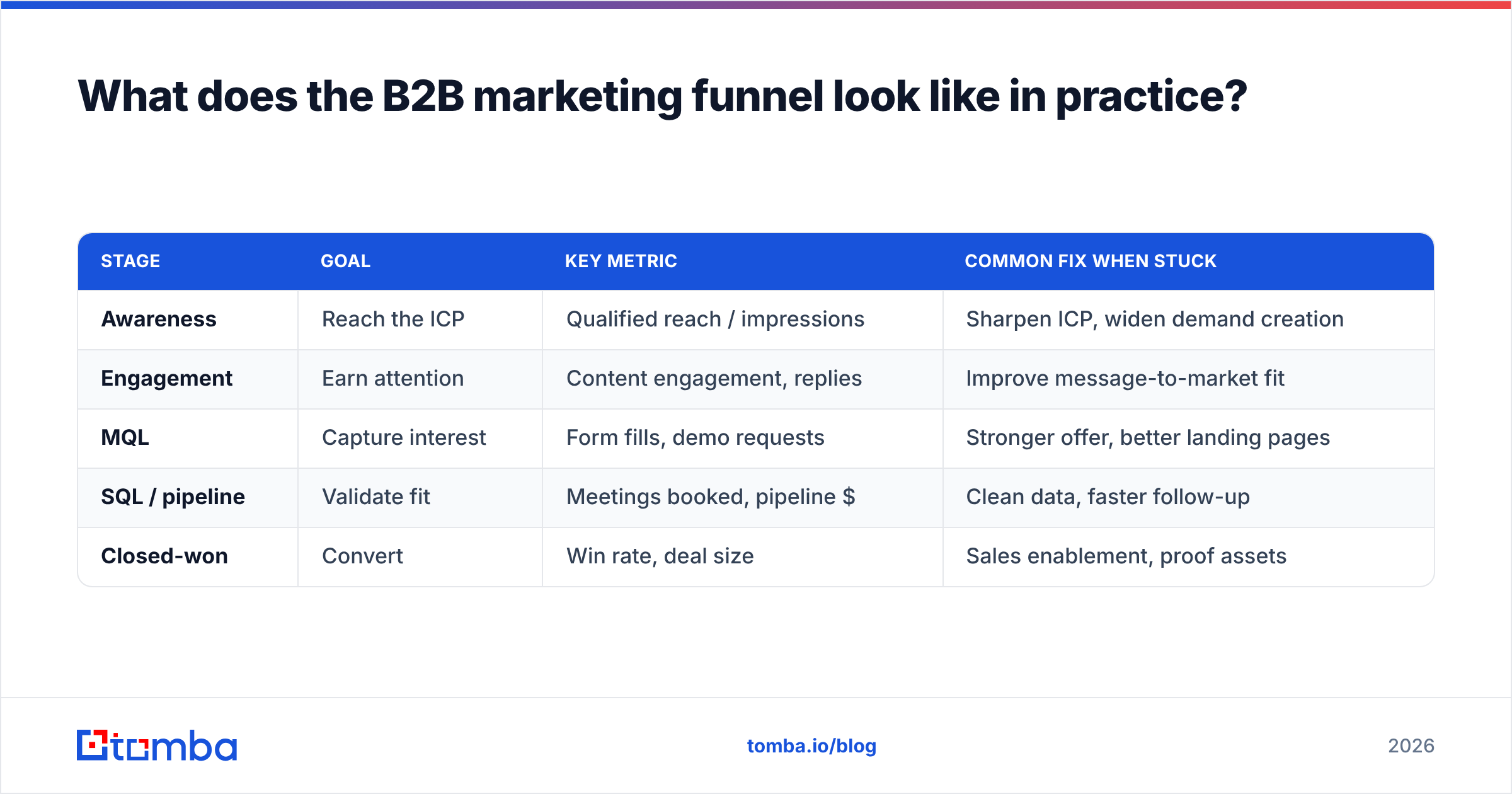
Map your strategy to a funnel so you know which lever to pull when a number drops. A simplified, measurable version:
| Stage | Goal | Key metric | Common fix when stuck |
|---|---|---|---|
| Awareness | Reach the ICP | Qualified reach / impressions | Sharpen ICP, widen demand creation |
| Engagement | Earn attention | Content engagement, replies | Improve message-to-market fit |
| MQL | Capture interest | Form fills, demo requests | Stronger offer, better landing pages |
| SQL / pipeline | Validate fit | Meetings booked, pipeline $ | Clean data, faster follow-up |
| Closed-won | Convert | Win rate, deal size | Sales enablement, proof assets |
The discipline is to measure stage-to-stage conversion, not vanity totals. If awareness is high but engagement is low, your targeting is fine but your message isn't landing. If engagement is healthy but MQLs are thin, your offer or your follow-up is the bottleneck. A documented funnel turns "marketing isn't working" into a specific, fixable diagnosis. For the relationship between effort and outcome, watch your response rate by segment — it exposes which accounts deserve more weight.
How do you measure ROI on a B2B marketing strategy?#
Tie every program to pipeline and revenue, not activity. The metrics that earn budget in 2026:
- Pipeline influenced — total deal value that touched a marketing program.
- Customer acquisition cost (CAC) — fully loaded cost to win one customer, by channel.
- CAC payback period — months to recover that cost; under 12 is healthy for most B2B.
- Win rate by source — which channels produce deals that actually close.
- Marketing-sourced revenue — the share of closed-won that originated in marketing.
The mistake to avoid is reporting on what's easy (impressions, clicks, follower growth) instead of what's true (pipeline and revenue). Leadership funds outcomes. According to HubSpot's research, the teams that consistently win budget are the ones that connect activity to revenue in a single, repeatable report. Build that report early — even a rough version beats a beautiful dashboard that stops at clicks.
What's a 90-day plan to launch or fix your strategy?#
You don't need a year. You need a focused quarter.
- Days 1–30 — Foundation. Lock the ICP, build the named account list, and clean the data. Verify contacts, enrich gaps, and stand up basic pipeline reporting in your CRM.
- Days 31–60 — Launch. Ship one demand-creation channel (SEO or LinkedIn) and one demand-capture channel (outbound email or paid search). Keep messaging consistent across both. Instrument every stage of the funnel.
- Days 61–90 — Optimize. Read the funnel data, double down on the channel with the best CAC payback, cut what isn't converting, and re-validate the list. Report pipeline influenced to leadership.
The point of the timeline is momentum. A narrow strategy executed cleanly beats a sprawling one that never ships. Tighten the ICP, prove one channel pair, then expand from evidence rather than opinion.
Get the data layer right first#
Every pillar above depends on knowing exactly who to reach. The fastest way to turn your ICP into a working pipeline is to build a verified contact list for your target accounts — names, roles, and emails you can actually trust. The Tomba Email Finder does exactly that: find professional email addresses by domain, name, or company, then verify them before you send. Start free with 25 searches a month, and when you're ready to scale, Tomba pricing runs from $49/mo (Starter) to $99/mo (Growth) — a small line item against the pipeline a clean, well-targeted strategy generates. Define the account, find the people, and let your strategy meet a list that's actually right.
Ready to find emails that actually work?
Join 150,000+ professionals who stopped guessing and started sending. Free credits on signup — no credit card required.
Get the Tomba newsletter
Practical outbound tactics and product updates — once every two weeks.
About the author