Buy B2B Data in 2026: Costs, Risks, and Smarter Options
Thinking of buying B2B data in 2026? Here's what lists actually cost, where vendors get records, the accuracy traps to avoid, and when building beats buying.
You can buy a B2B data list in an afternoon. Whether that list still works in ninety days is a different question entirely — and it's the question most buyers skip until the bounces start rolling in.
This guide walks through what "buy B2B data" actually means in 2026: how vendors price records, where they get them, the accuracy and compliance landmines, and when purchasing a static list is the wrong move compared with pulling fresh contacts on demand.
TL;DR#
- Buying B2B data means paying for contact and company records — names, emails, phone numbers, firmographics — either as a one-time list or an ongoing subscription.
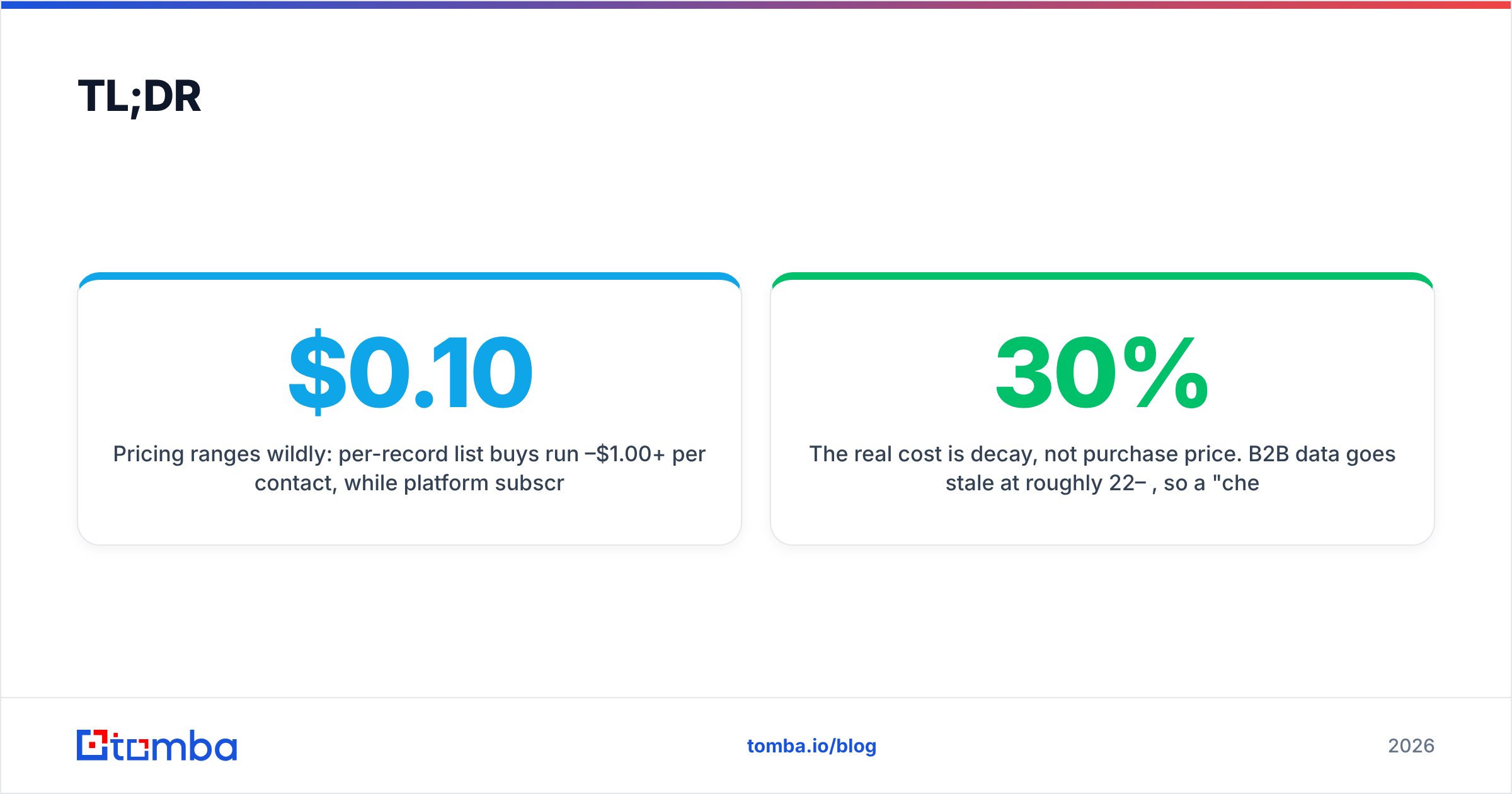
- Pricing ranges wildly: per-record list buys run $0.10–$1.00+ per contact, while platform subscriptions run $1,000–$25,000+/year depending on seats and credits.
- The real cost is decay, not purchase price. B2B data goes stale at roughly 22–30% per year, so a "cheap" list can be half-dead before you finish your first campaign.
- Compliance is non-negotiable under GDPR, CAN-SPAM, and CCPA — purchased lists with no lawful basis or opt-out are a liability, not an asset.
- On-demand finding often beats bulk buying. Tools that find and verify contacts at the moment you need them avoid paying for records you'll never touch.
What does it mean to buy B2B data?#
Buying B2B data means purchasing structured information about businesses and the people who work at them, so your sales and marketing teams can reach prospects without researching each one by hand.
Think of it like buying produce. You can grab a pre-packed salad (a static list — fast, convenient, already wilting) or pick ingredients fresh when you cook (on-demand lookup — a little more effort, far better quality). Both fill the bowl; only one tastes good a week later.
A typical B2B data record bundles several layers:
- Contact identity — full name, job title, seniority, department.
- Contact channels — work email, direct dial or mobile, LinkedIn URL.
- Firmographics — company name, size, revenue, industry, location.
- Technographics — the software and infrastructure a company runs.
- Intent signals — behavioral data suggesting a company is in-market.
The more layers you want, the more you pay, and the faster the data decays. A company's headcount band changes slowly; a VP's direct dial changes the moment they switch jobs.
Where do B2B data vendors actually get their data?#
Vendors assemble records from a mix of sources, and the source mix is the single biggest driver of quality. Ask any provider this question before you pay them — if they dodge it, that's your answer.
Common sourcing methods:
- Public web crawling — scraping company sites, directories, press releases, and team pages.
- User contributions / contact networks — data shared (sometimes unknowingly) by users who install browser extensions or sync their inboxes.
- Data partnerships and licensing — buying or trading datasets with other providers.
- Self-reported profiles — professional network and directory listings.
- SMTP and pattern verification — confirming an email exists by checking it against the mail server, or inferring it from a company's known format.
The legitimate, transparent providers publish their methodology. Tomba, for example, documents where Tomba gets data and how records are verified rather than treating sourcing as a black box. When you're spending real budget, that transparency is worth more than a slightly bigger record count.
How much does it cost to buy B2B data in 2026?#
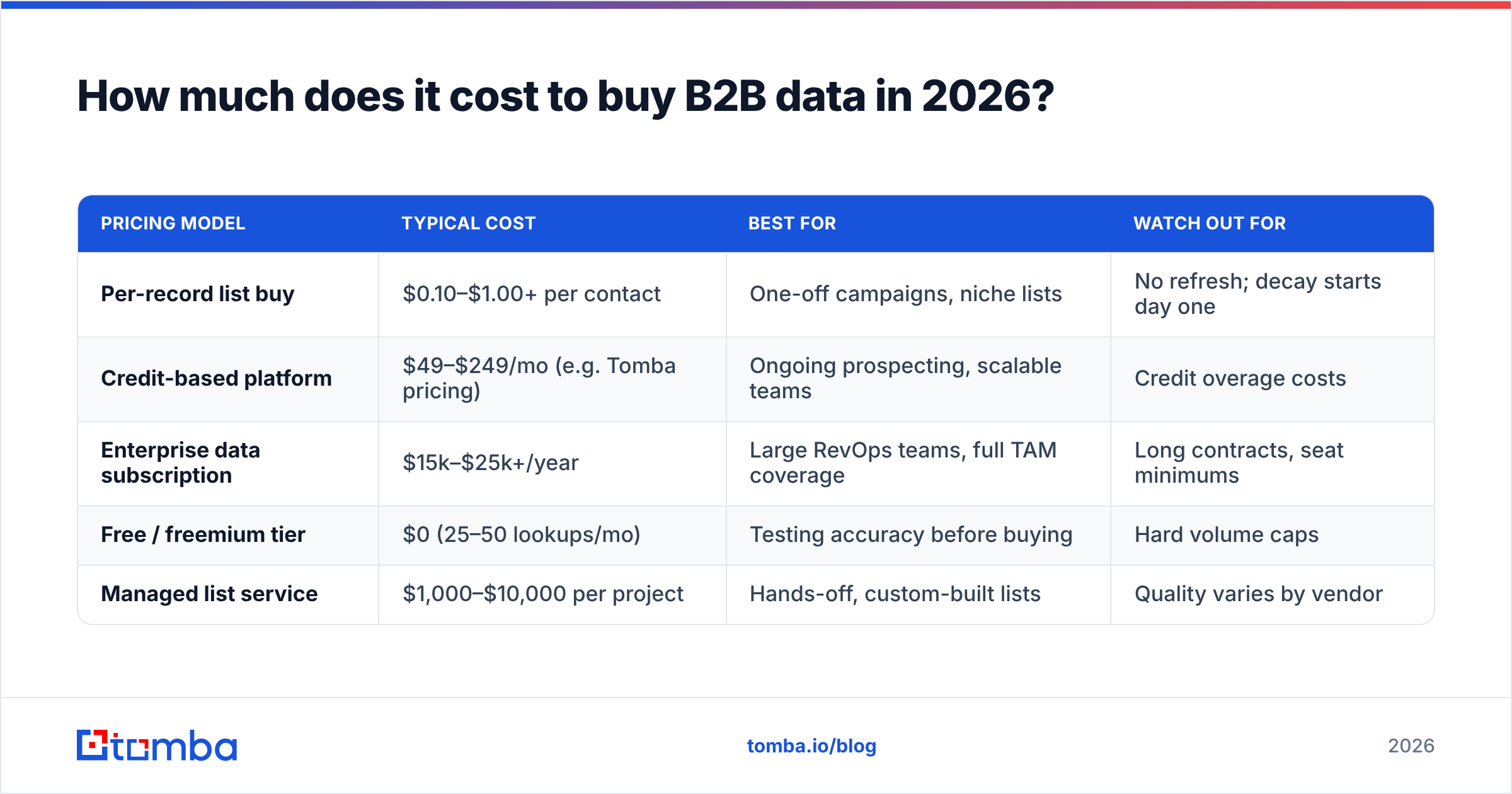
B2B data costs fall into two buckets: per-record list buys (you own a file) and subscriptions (you rent ongoing access). Here's how the common models compare.
| Pricing model | Typical cost | Best for | Watch out for |
|---|---|---|---|
| Per-record list buy | $0.10–$1.00+ per contact | One-off campaigns, niche lists | No refresh; decay starts day one |
| Credit-based platform | $49–$249/mo (e.g. Tomba pricing) | Ongoing prospecting, scalable teams | Credit overage costs |
| Enterprise data subscription | $15k–$25k+/year | Large RevOps teams, full TAM coverage | Long contracts, seat minimums |
| Free / freemium tier | $0 (25–50 lookups/mo) | Testing accuracy before buying | Hard volume caps |
| Managed list service | $1,000–$10,000 per project | Hands-off, custom-built lists | Quality varies by vendor |
A few realities the price tags hide:
- Per-record list buys look cheapest and age worst. A $0.20 contact that bounces costs you infinity per usable contact.
- Subscriptions amortize verification. Platforms re-check data continuously, so you're paying for freshness, not just volume.
- "Unlimited" usually isn't. Read the fair-use clause; throttling and export caps are common.
For most teams under 50 reps, a credit-based platform in the $49–$99/month range hits the sweet spot: enough volume to prospect seriously, without the enterprise contract lock-in.
Is it better to buy a list or find contacts on demand?#
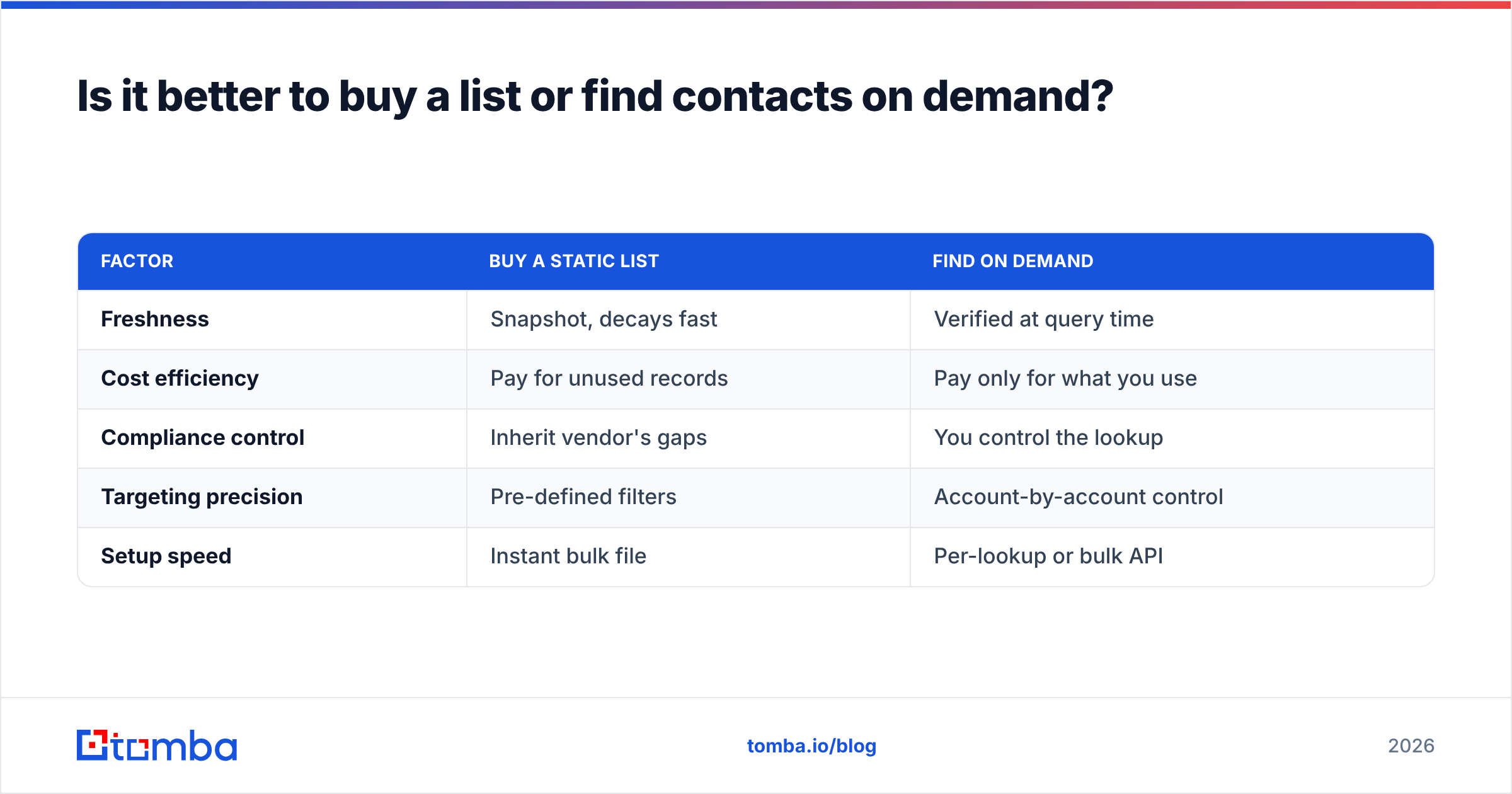
Find contacts on demand whenever you can — it sidesteps the biggest weakness of bought lists, which is that they start dying the second they're created.
A purchased list is a photograph. An on-demand finder is a live feed. When a rep is looking at a target account today, pulling that decision-maker's verified email right now beats querying a CSV that was assembled last quarter.
| Factor | Buy a static list | Find on demand |
|---|---|---|
| Freshness | Snapshot, decays fast | Verified at query time |
| Cost efficiency | Pay for unused records | Pay only for what you use |
| Compliance control | Inherit vendor's gaps | You control the lookup |
| Targeting precision | Pre-defined filters | Account-by-account control |
| Setup speed | Instant bulk file | Per-lookup or bulk API |
This is where a tool like the Tomba Email Finder changes the math: instead of buying 50,000 contacts and hoping 30,000 are still valid, you find and verify emails for the exact accounts in your pipeline, then enrich them as deals progress. For bulk needs, the bulk email finder processes lists without committing you to a static, decaying file you bought sight unseen.

How do you judge B2B data quality before you buy?#
Judge quality on a sample, never on the vendor's marketing claims. "95% accuracy" means nothing until you've tested it against contacts you can independently verify.
Run this checklist before any purchase:
- Request a sample of 50–100 records in your exact target segment, not a curated demo file.
- Verify a random subset yourself — run the emails through a free email checker and spot-check phone numbers and titles on LinkedIn.
- Measure the catch-all rate. A list stuffed with catch-all domains hides unverifiable addresses; a real catch-all verifier tells you what's actually deliverable.
- Check recency metadata. When was each record last verified? "Last seen 2026" beats "added 2026."
- Confirm match rates on enrichment, not just raw counts — a million records you can't append to your CRM is dead weight.
The accuracy benchmark that matters most for cold outreach is bounce rate. Industry guidance from email service providers puts a healthy bounce rate under 2%; above that, your sender reputation and inbox placement start to suffer. A bought list that pushes you past that line costs far more than its sticker price in lost email deliverability.
Is buying B2B data legal and compliant?#
Buying B2B data is legal in most markets, but using it for outreach is governed by privacy and anti-spam laws — and that's where buyers get burned. The list being for sale doesn't mean your use of it is compliant.
The frameworks you have to respect in 2026:
- GDPR (EU/UK) — you need a lawful basis (usually legitimate interest for B2B) and must honor data-subject rights, including erasure. Buying a list does not transfer consent. Read the official GDPR text before running EU campaigns.
- CAN-SPAM (US) — commercial email must include a valid physical address and a working opt-out; purchased lists are allowed but the sending rules still apply. The FTC's CAN-SPAM guidance is the authoritative source.
- CCPA/CPRA (California) — consumers can opt out of data sale; B2B contacts now fall under its scope.
Practical safeguards:
- Buy only from vendors who document lawful sourcing and offer suppression/opt-out handling.
- Keep proof of where each record came from.
- Suppress against your own unsubscribe and known do-not-contact lists before every send.
- Prefer business contact data (work email, work phone) over personal identifiers.
Reputable platforms publish compliance documentation and let you handle data enrichment in a way you can audit. If a vendor can't tell you how to fulfill a deletion request, walk away — you're inheriting their risk.
What's the smartest way to buy B2B data in 2026?#
The smartest approach is hybrid: stop thinking "buy a giant list" and start thinking "build a repeatable pipeline that produces verified contacts when you need them."
Here's the workflow that consistently outperforms one-time bulk buys:
- Define your ICP tightly — industry, size, geography, role. Precision beats volume every time.
- Use domain search to map target accounts — pull the right people from companies already in your pipeline instead of buying everyone.
- Verify before you send — every address through verification so bounce rate stays under 2%.
- Enrich as deals progress — add phone numbers and firmographics only for accounts worth the credit.
- Refresh continuously — re-verify quarterly rather than re-buying annually.
This is cheaper, more compliant, and far more accurate than a bulk file, because you never pay for records you don't use and nothing in your active set is more than a few weeks old.
Quick decision guide#
- Need 200 hyper-targeted contacts for a campaign? Find on demand. Don't buy a list.
- Building a 50,000-account TAM database? Use a credit-based platform with bulk and API access, not a static file.
- One-off niche list you can't source yourself? A managed list service may be worth it — but sample-test it hard first.
- Just testing accuracy? Start on a free tier before spending a dollar.
Frequently asked questions#
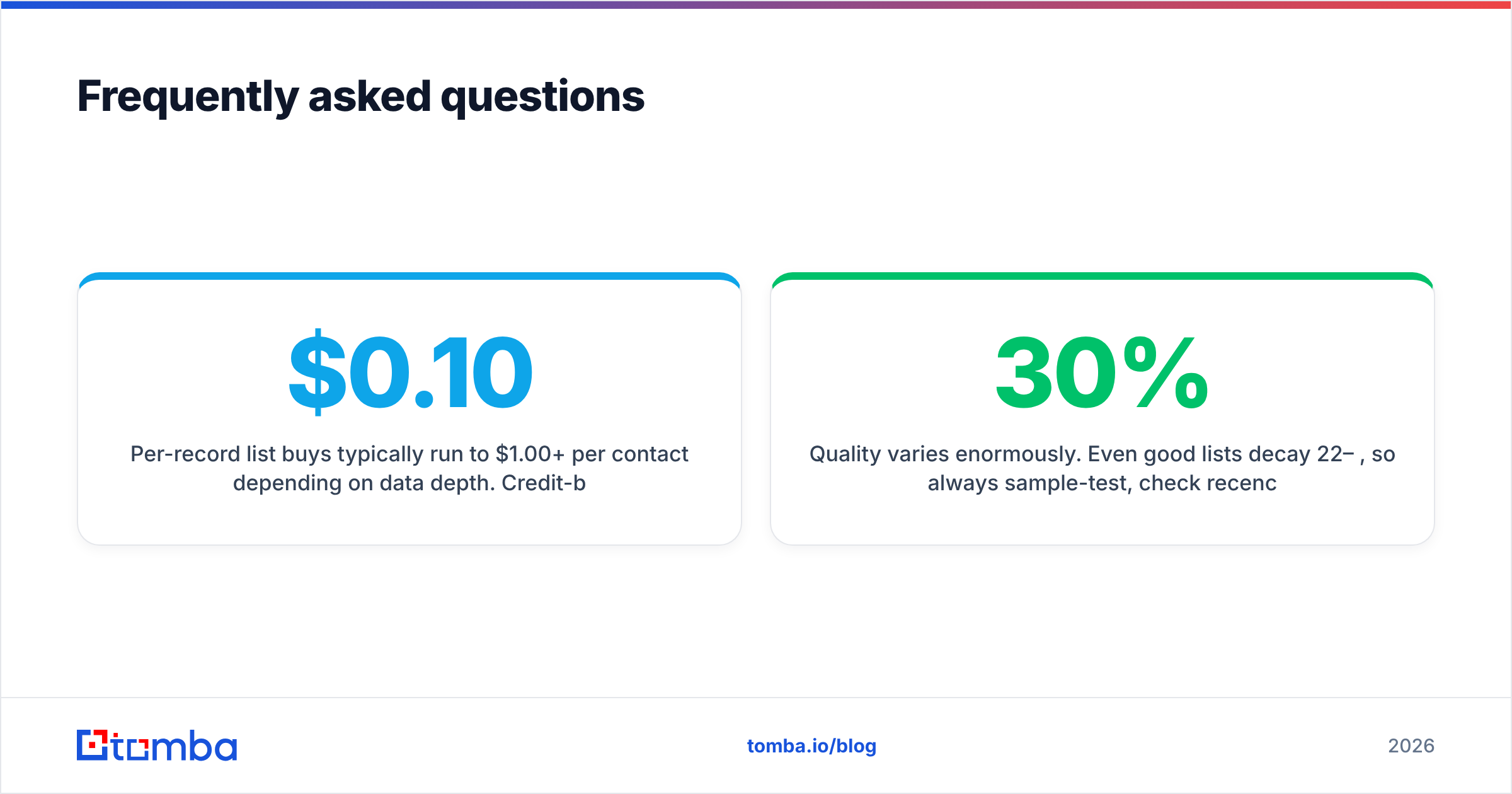
How much does B2B data cost per contact? Per-record list buys typically run $0.10 to $1.00+ per contact depending on data depth. Credit-based platforms work out cheaper per usable contact because records are continuously verified and you only spend on what you pull.
Is purchased B2B data accurate? Quality varies enormously. Even good lists decay 22–30% per year, so always sample-test, check recency metadata, and verify a subset yourself before buying. Accuracy at purchase is meaningless without ongoing verification.
Can I use bought B2B data for cold email? Yes, where law allows — but you must follow CAN-SPAM, GDPR, and CCPA: valid sender address, working opt-out, lawful basis, and suppression. The list being for sale does not make your outreach compliant.
What's better than buying a list? Finding and verifying contacts on demand for the specific accounts in your pipeline. It avoids decay, controls cost, and keeps compliance in your hands.
Start finding instead of buying#
If your team is weighing a five-figure data contract, run the cheaper experiment first. Point the Tomba Email Finder at the accounts already in your pipeline, verify the results, and compare the deliverability against any list a vendor wants to sell you. You'll likely find that fresh, on-demand, verified contacts beat a bulk file on accuracy and cost — without the contract lock-in or the compliance hangover. Start on the free tier, scale into a plan when the numbers prove themselves, and stop paying for records that were dead before you opened the file.
// get started
Find, verify and enrich your first contacts today
Start on the free plan with 25 searches a month, then scale when your team is ready.
Free plan · No credit card required · GDPR & CCPA
// about the author