Buy Business Leads in 2026: A Practical Buyer's Guide
Thinking about where to buy business leads in 2026? Compare prebuilt lists, data platforms, and self-sourced contacts on cost, accuracy, compliance, and real ROI before you spend a dollar.
Buy Business Leads in 2026: A Practical Buyer's Guide
You can buy business leads in about five minutes. Whether you should, and where you should buy them from, is the harder question — and getting it wrong burns budget, tanks your sender reputation, and stuffs your CRM with contacts who left their jobs two years ago.
This guide breaks down the real options for buying B2B leads in 2026, what each actually costs, where the data comes from, and when self-sourcing beats buying outright.
TL;DR#
- "Buying leads" means three different things: prebuilt static lists, subscription data platforms, and pay-as-you-go contact discovery. They differ wildly on freshness and price.
- Static lead lists are the cheapest and the worst. Resold, stale, and often non-compliant. Expect 20–40% bounce rates.
- Data platforms and self-sourcing tools win on accuracy because they pull or verify contacts in real time instead of selling you a year-old CSV.
- The cheapest viable path for most teams is targeted self-sourcing: find and verify only the contacts that match your ICP, paying per result.
- Compliance is not optional. GDPR and CAN-SPAM apply the moment you email a purchased contact, regardless of who sold it to you.

What does "buy business leads" actually mean?#
The phrase hides three very different products, and conflating them is the single most common buyer mistake.
- Prebuilt lead lists — A vendor sells you a fixed CSV or spreadsheet: names, companies, emails, sometimes phone numbers. You pay once, you own the file. The data was collected at some unknown point in the past and is frequently resold to dozens of other buyers.
- Subscription data platforms — Tools like ZoomInfo, Apollo, or Cognism give you seat-based access to a large contact database with filters. You "buy" leads by exporting them against a monthly credit allowance.
- Pay-as-you-go discovery and enrichment — Instead of a static dump, you find and verify contacts on demand: search by company domain, enrich a list you already have, or pull the exact role you need. You pay per successful lookup, so you only spend on data you actually use.
The first is a product you buy. The second and third are capabilities you rent. That distinction drives everything else — cost, freshness, and risk.
Where can you buy business leads in 2026?#
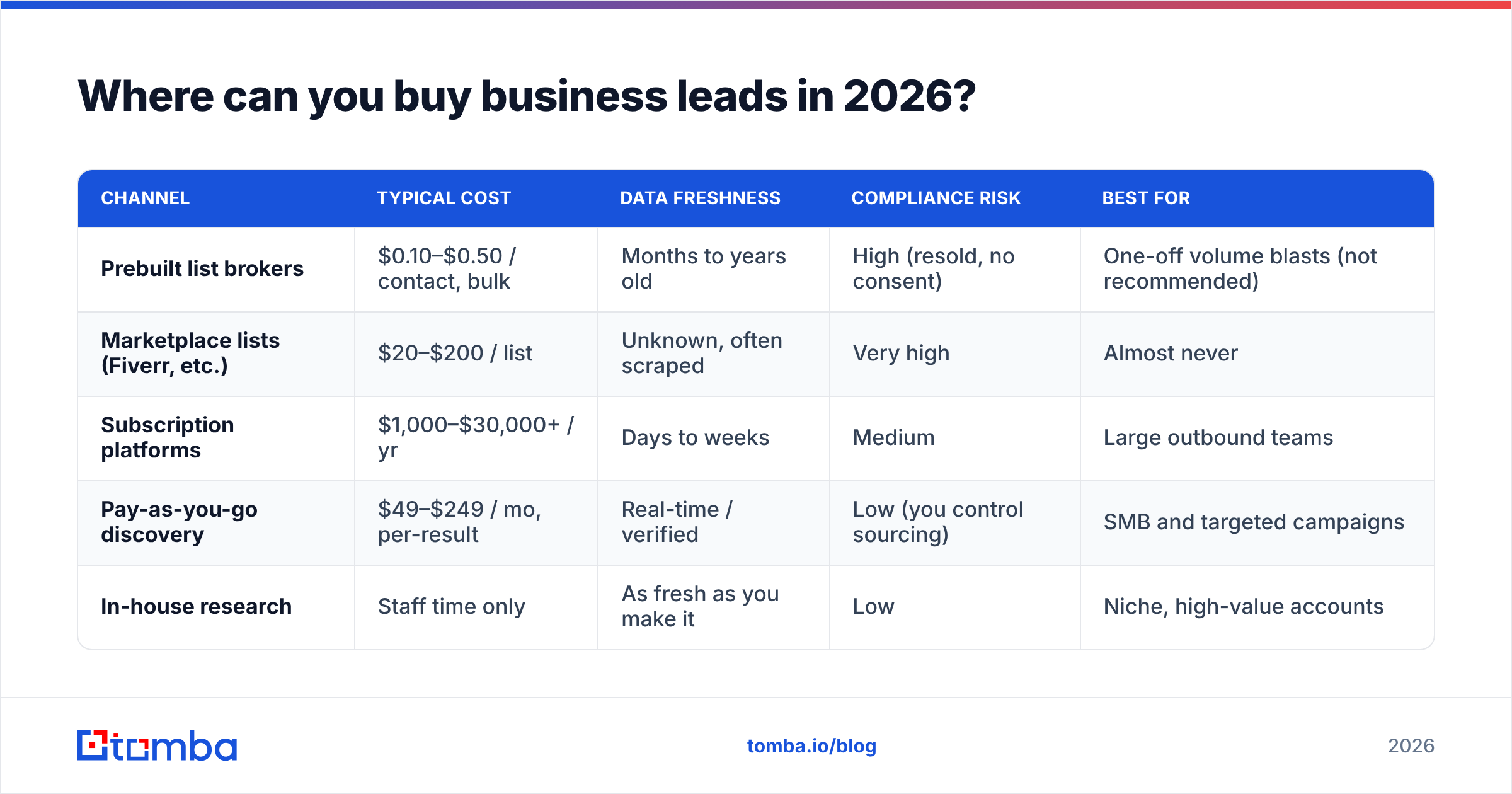
Here's how the main channels stack up on the attributes that decide ROI.
| Channel | Typical cost | Data freshness | Compliance risk | Best for |
|---|---|---|---|---|
| Prebuilt list brokers | $0.10–$0.50 / contact, bulk | Months to years old | High (resold, no consent) | One-off volume blasts (not recommended) |
| Marketplace lists (Fiverr, etc.) | $20–$200 / list | Unknown, often scraped | Very high | Almost never |
| Subscription platforms | $1,000–$30,000+ / yr | Days to weeks | Medium | Large outbound teams |
| Pay-as-you-go discovery | $49–$249 / mo, per-result | Real-time / verified | Low (you control sourcing) | SMB and targeted campaigns |
| In-house research | Staff time only | As fresh as you make it | Low | Niche, high-value accounts |
The pattern is consistent: the cheaper and more "instant" the bulk list, the older and riskier the data. The channels that feel like more work — platforms and pay-as-you-go discovery — give you contacts that are actually reachable.
Why are cheap bought lead lists usually a trap?#
Because you're not the first buyer, and the data was never verified for you.
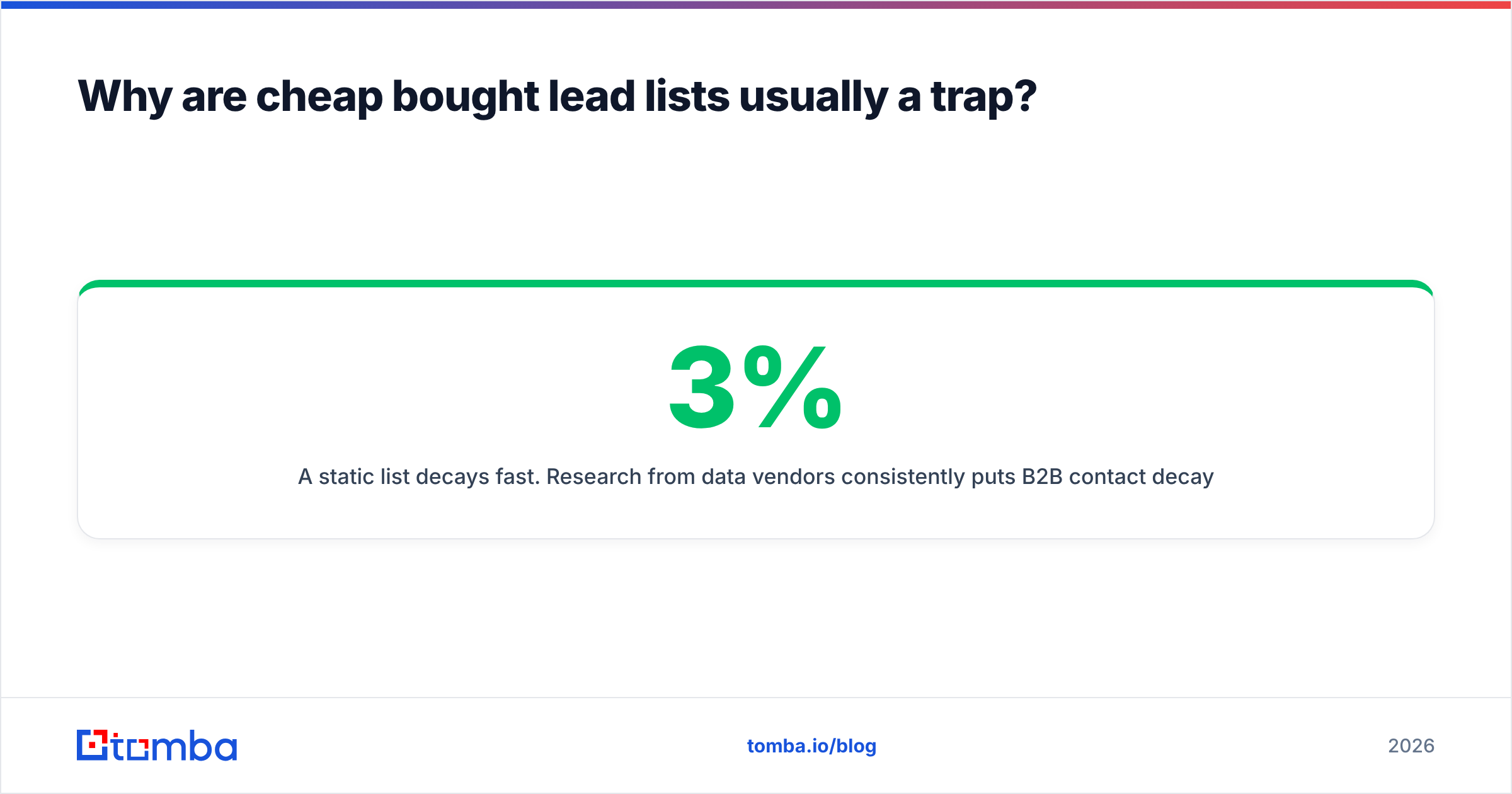
A static list decays fast. Research from data vendors consistently puts B2B contact decay at roughly 2–3% per month — people change jobs, companies rebrand, domains migrate. A list compiled 12 months ago can be 25–30% wrong before you send a single email. According to HubSpot, marketing databases degrade by about 22.5% every year on their own.
The damage compounds:
- Hard bounces wreck deliverability. Mailbox providers read a spike in bounces as a spam signal. A few bad sends and your good emails start landing in spam too. This is why email deliverability collapses faster than most buyers expect.
- Spam traps poison your domain. Resold lists are riddled with recycled and pristine spam-trap addresses. Hit enough and you land on a blacklist.
- Consent is missing. Under GDPR and similar laws, a broker's "consent" rarely transfers to you. The GDPR text on legitimate interest puts the accountability on the sender — that's you, not the list seller.
If a price looks too good for the volume, you're buying a liability, not a pipeline.
Is buying leads better than building them?#
It depends on your motion — but for most teams, building targeted leads beats buying generic ones.
Buying makes sense when you need broad reach fast, have a forgiving channel (ads retargeting, not cold email), and can tolerate low accuracy. Building — or more precisely, self-sourcing on demand — wins when reply rate, sender reputation, and CRM hygiene matter.
The middle path most modern teams use: define a tight ICP, then find and verify only those contacts. You skip the bloated subscription and skip the stale CSV. You pay per real, deliverable contact.
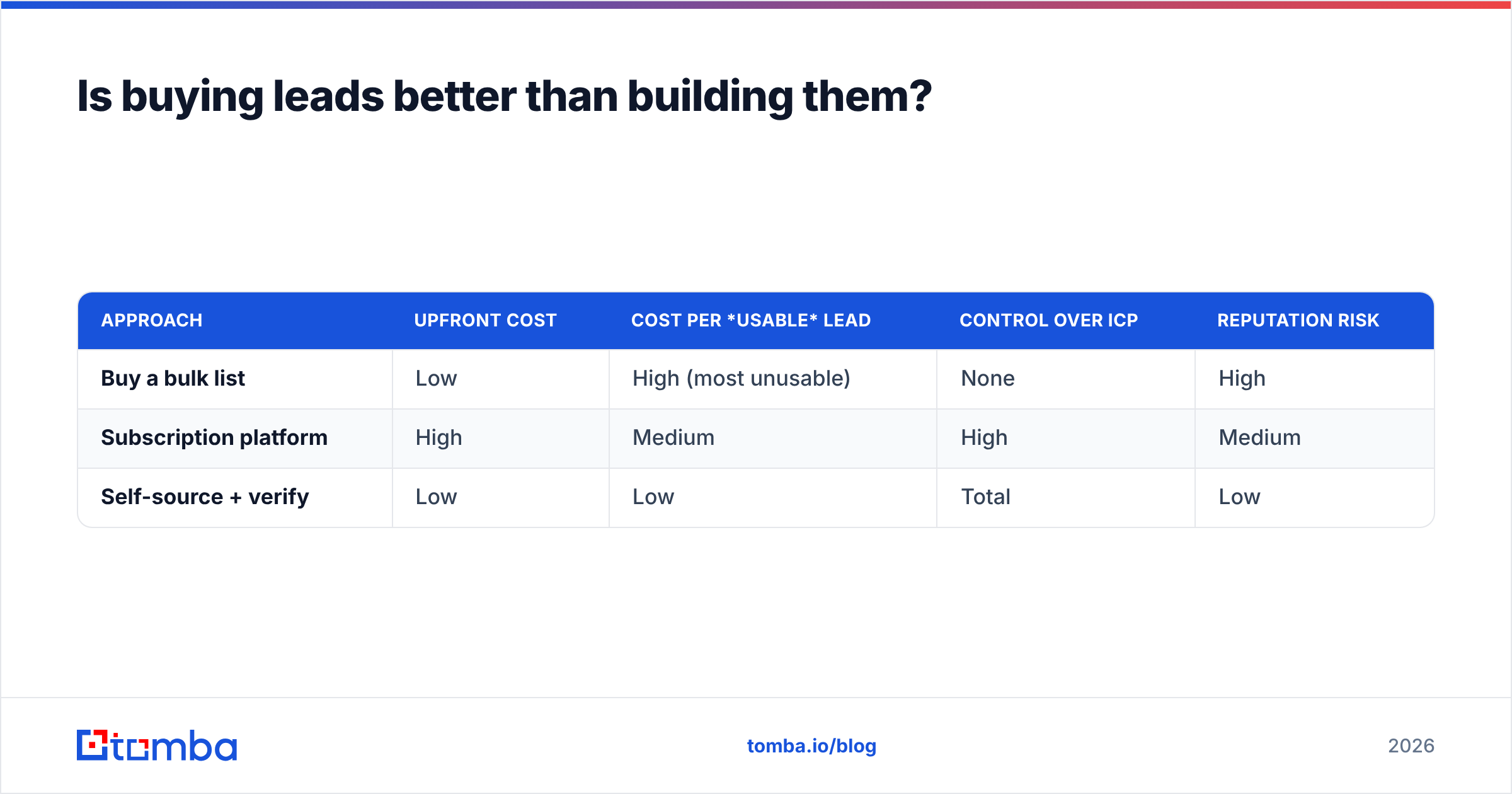
| Approach | Upfront cost | Cost per usable lead | Control over ICP | Reputation risk |
|---|---|---|---|---|
| Buy a bulk list | Low | High (most unusable) | None | High |
| Subscription platform | High | Medium | High | Medium |
| Self-source + verify | Low | Low | Total | Low |
When you self-source, every contact is collected against your criteria and checked before it enters a sequence. That's the difference between a 2% reply rate and a 12% one.
How do you buy business leads without burning your domain?#
Treat every purchased or sourced contact as guilty until verified. A repeatable workflow:
- Define the ICP precisely. Industry, company size, role, geography, tech stack. The narrower the target, the higher the conversion — and the less you waste paying for contacts you'd never email.
- Source by domain, not by bulk dump. Use a domain search to pull the real people at companies you've already qualified, instead of buying a generic industry list. You control who enters the funnel.
- Verify before you send. Run every address through an email verifier to strip invalids, catch-alls, and traps. This single step is what protects your sender reputation.
- Enrich for relevance. Add firmographics and role data so your messaging is specific. A verified email plus a real reason to reach out is the actual product.
- Warm up and pace. Don't blast a fresh list from a cold domain. Ramp volume gradually and monitor bounces.
How much should you pay to buy business leads?#
Price per contact is a vanity metric. Price per meeting booked is the number that matters.
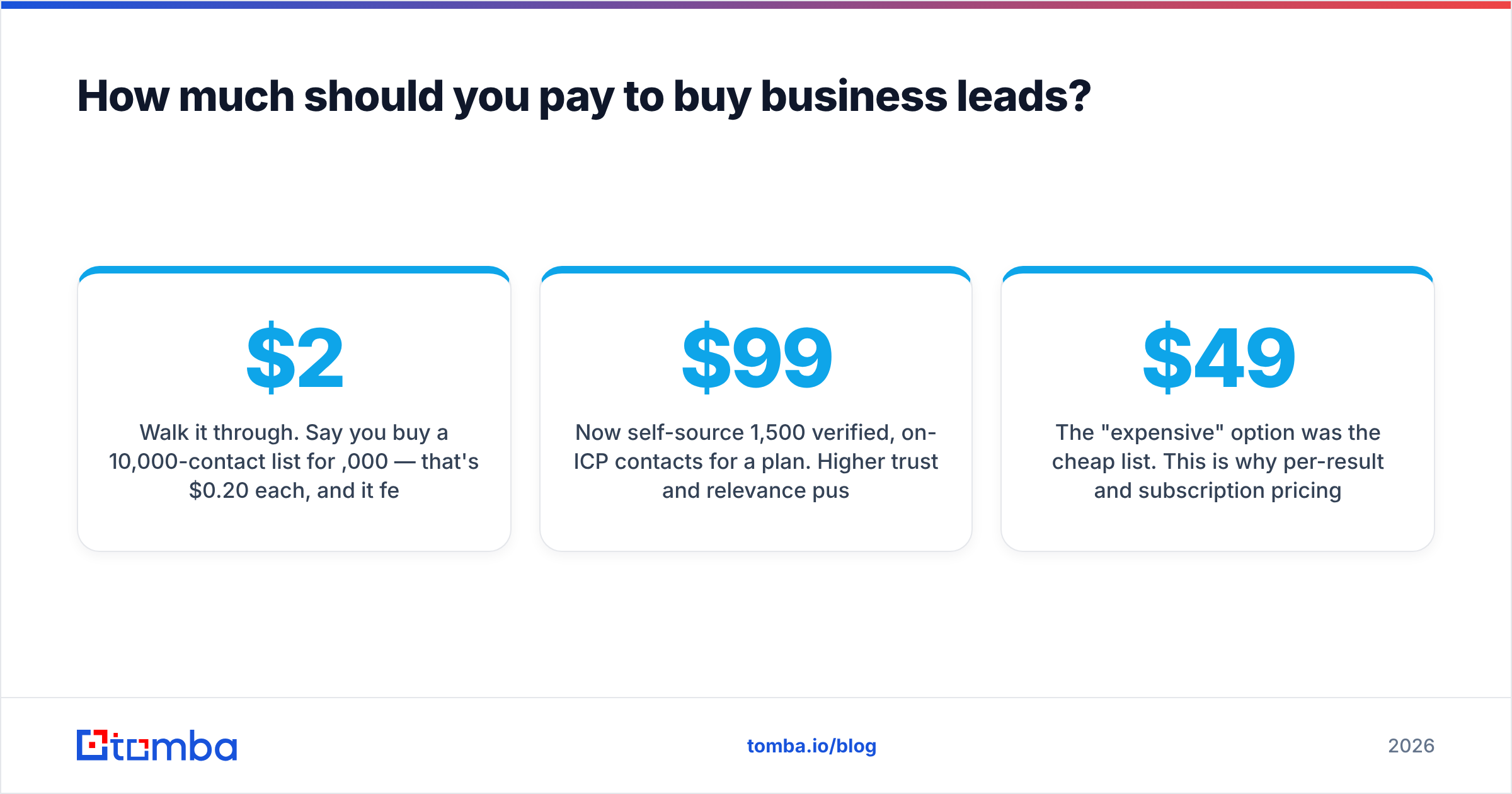
Walk it through. Say you buy a 10,000-contact list for $2,000 — that's $0.20 each, and it feels cheap. But if 30% bounce and another 40% are wrong-fit, you have ~3,000 usable contacts. At a 1% reply-to-meeting rate on a low-trust list, you book 30 meetings. Real cost: ~$67 per meeting, before the deliverability damage.
Now self-source 1,500 verified, on-ICP contacts for a $99/month plan. Higher trust and relevance push reply-to-meeting toward 3–4%. You book 45–60 meetings for $99. Real cost: under $2 per meeting.
The "expensive" option was the cheap list. This is why per-result and subscription pricing models — where you pay for verified, targeted data — almost always beat bulk brokers on true cost. You can compare tiers on the Tomba pricing page; the Starter plan runs $49/mo and Growth $99/mo, both priced around searches you actually use rather than a dumped file.
For independent reviews of any vendor you're considering, check G2 before you commit — pay attention to comments about data accuracy and refund policies, not just star averages.
What about compliance when you buy business leads?#
You own the compliance risk the moment you hit send, full stop.
A few non-negotiables for 2026:
- CAN-SPAM (US): Every email needs accurate headers, a real physical address, and a working unsubscribe. Buying the list doesn't exempt you.
- GDPR (EU/UK): You need a lawful basis to process personal data. "A broker said they had consent" is not a defense. Legitimate interest can apply to B2B outreach, but only with a documented assessment and easy opt-out.
- CASL (Canada): Among the strictest — generally requires express or implied consent before the first message.
Practical protection: keep your sourcing auditable. When you find contacts through a tool that documents where its data comes from, you can actually answer "how did you get my email?" — a question you will eventually be asked.
Which option is right for your team?#
- Solo founder / small SMB: Skip lists and big subscriptions. Self-source and verify on a per-result plan. Lowest cost, lowest risk.
- Scaling outbound team: A subscription platform or a high-volume pay-as-you-go workflow, depending on whether you value database breadth or per-contact precision.
- Enterprise ABM: Combine a data platform for coverage with on-demand verification so your few hundred target accounts are always accurate.
- Anyone tempted by a $50 marketplace list: Don't. The cleanup, bounces, and reputation hit cost more than the list ever saves.
For most readers, the honest answer is that "buying leads" should mean buying the ability to find and verify the right leads, not buying someone else's recycled spreadsheet.
The bottom line#
The cheapest way to buy business leads — a big static list — is almost always the most expensive once you count bounces, lost deliverability, and compliance exposure. The durable play is targeted self-sourcing: define a tight ICP, pull real contacts by domain, verify every address, and pay only for data you'll actually use.
If you want to do that without renting a five-figure platform, start with the Tomba Email Finder. Search by company domain, name, or role; every result is checked for deliverability, and the free tier gives you 25 searches a month to test the data quality against any list you're thinking of buying. Build a clean, verified pipeline instead of inheriting someone else's stale one — and protect the sender reputation your whole outbound program depends on.
// get started
Find, verify and enrich your first contacts today
Start on the free plan with 25 searches a month, then scale when your team is ready.
Free plan · No credit card required · GDPR & CCPA
// about the author