Buyer Decision Making Process: A 2026 B2B Sales Guide
The buyer decision making process has five predictable stages. Here's how B2B buyers move from problem to purchase in 2026 — and exactly how to sell at each step.
You can't shorten a sales cycle you don't understand. The buyer decision making process is the sequence of mental and organizational steps a customer moves through before they hand over budget — and in B2B, that sequence is rarely a straight line. Map it correctly and your outreach lands when buyers are actually receptive. Guess at it, and you're pitching pricing to someone who hasn't admitted they have a problem yet.
TL;DR#
- The buyer decision making process has five core stages: problem recognition, information search, evaluation of alternatives, purchase decision, and post-purchase behavior.
- B2B buying differs sharply from B2C — more stakeholders, longer cycles, and a typical buying group of 6–10 people, per Gartner research.
- Most deals stall in the evaluation and purchase decision stages, not at first contact.
- Each stage needs a different sales motion: educate early, differentiate in the middle, de-risk at the close.
- Accurate contact data and timing — knowing who to reach and when — is what separates teams that ride the process from teams that fight it.
What is the buyer decision making process?#
The buyer decision making process is the structured path a person or organization follows from first sensing a need to deciding whether the purchase was worth it. The classic five-stage model dates back to economist John Dewey's 1910 work on how people reason through problems, and marketers have used it ever since because it holds up: buyers almost always recognize a problem before they shop, and almost always evaluate options before they buy.
Think of it like booking a contractor for a leaking roof. You don't start by comparing quotes — you start when you notice the water stain (problem recognition). Then you search, you compare, you pick, and afterward you decide whether you'd hire them again. B2B purchases follow the same emotional and logical arc; they just involve more people, more money, and more steps where a deal can quietly die.
The reason this matters for revenue teams is simple: your message only works if it matches the stage the buyer is in. Send a feature comparison to someone still in problem recognition and you sound irrelevant. Send a "why act now" nudge to someone who hasn't evaluated alternatives and you sound pushy.
What are the 5 stages of the buyer decision making process?#
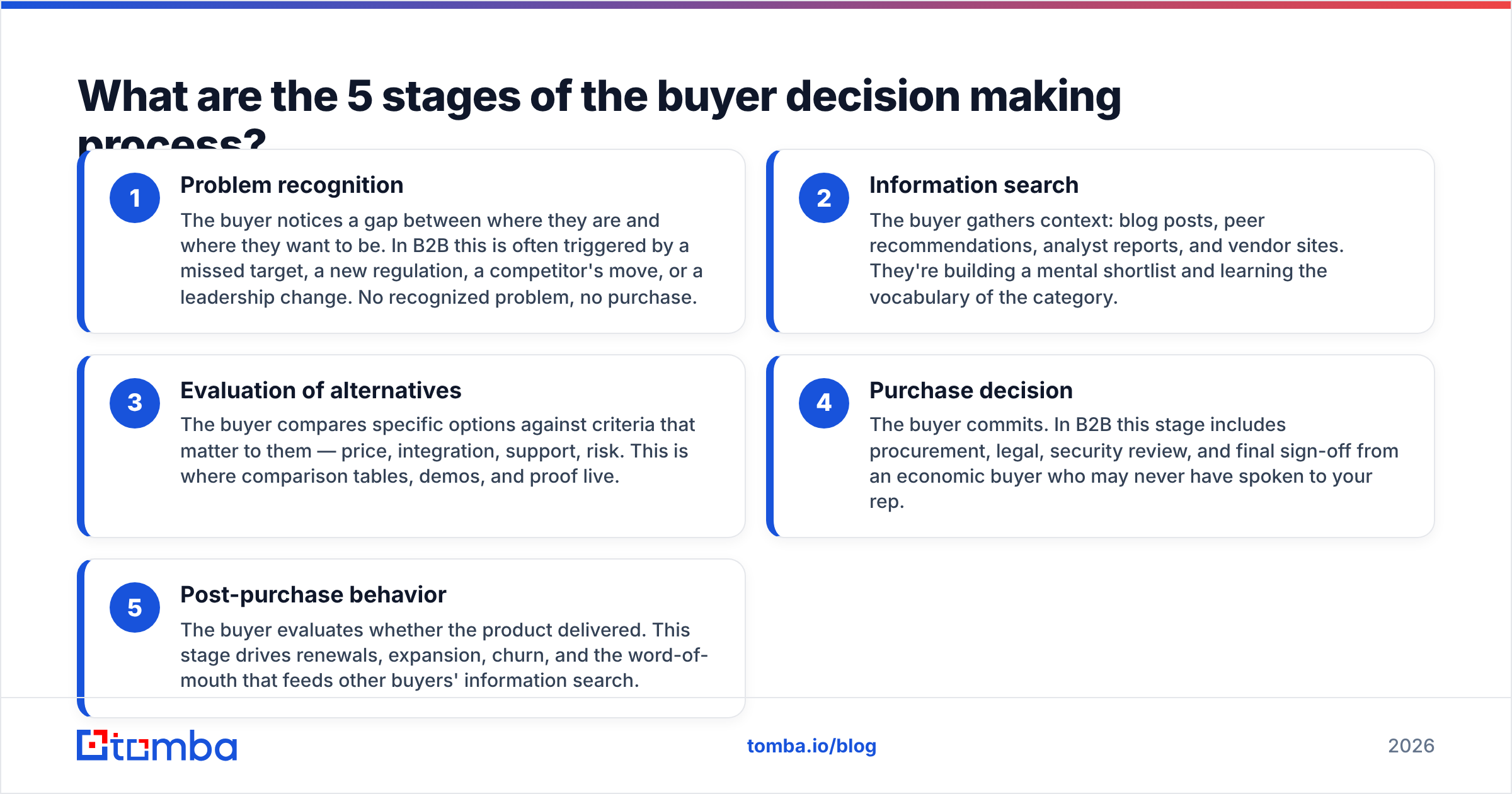
Here is the core model, with what's actually happening inside the buyer's head — and the organization — at each step.
- Problem recognition — The buyer notices a gap between where they are and where they want to be. In B2B this is often triggered by a missed target, a new regulation, a competitor's move, or a leadership change. No recognized problem, no purchase.
- Information search — The buyer gathers context: blog posts, peer recommendations, analyst reports, and vendor sites. They're building a mental shortlist and learning the vocabulary of the category.
- Evaluation of alternatives — The buyer compares specific options against criteria that matter to them — price, integration, support, risk. This is where comparison tables, demos, and proof live.
- Purchase decision — The buyer commits. In B2B this stage includes procurement, legal, security review, and final sign-off from an economic buyer who may never have spoken to your rep.
- Post-purchase behavior — The buyer evaluates whether the product delivered. This stage drives renewals, expansion, churn, and the word-of-mouth that feeds other buyers' information search.
Most reps treat the process as a funnel that ends at stage four. The teams that compound revenue treat stage five as the start of the next cycle — a happy customer is a marketing qualified lead generator for their entire network.
How is the B2B buyer decision making process different from B2C?#
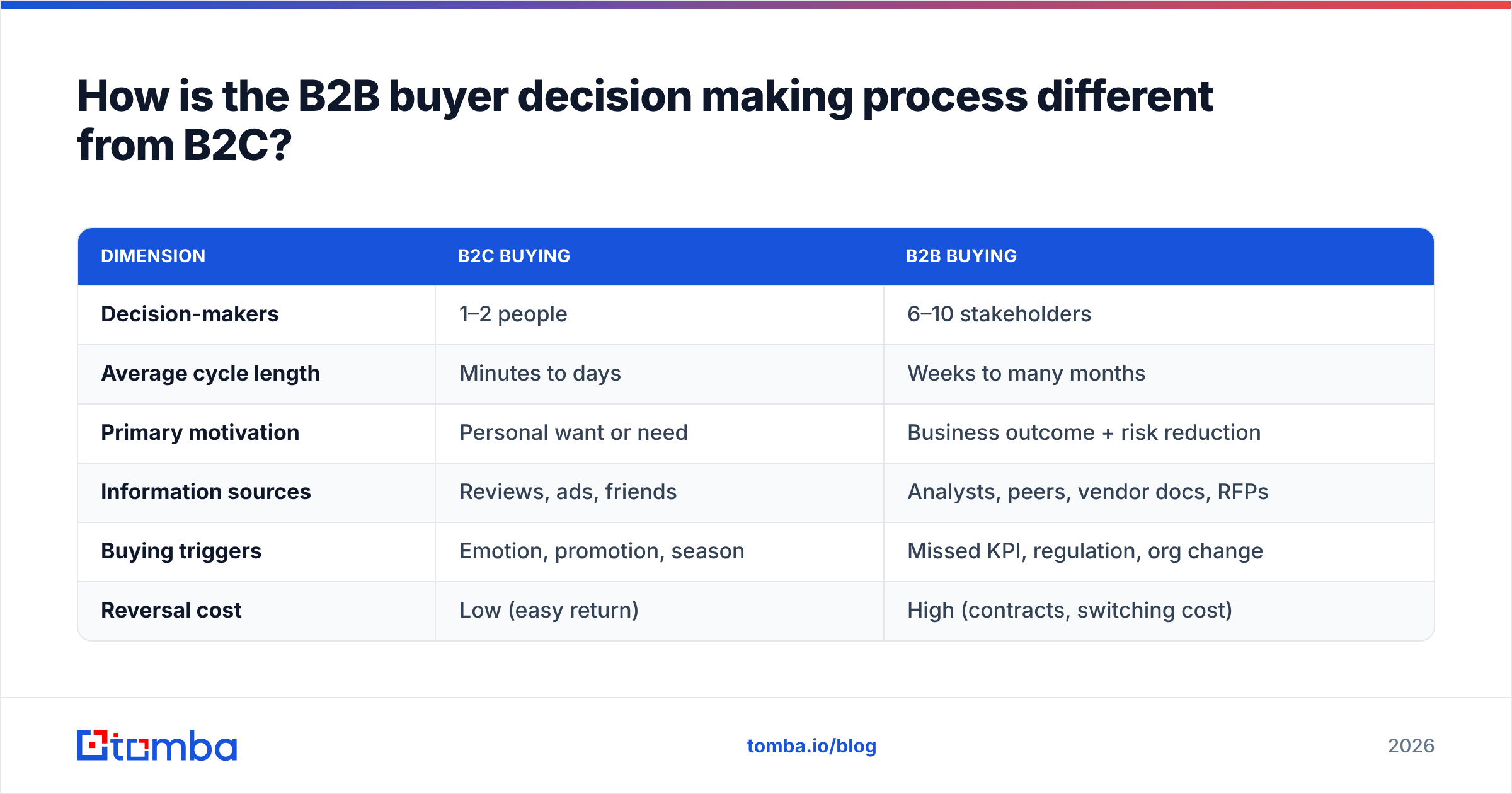
The five stages are universal, but the mechanics change completely once you move from a single shopper to a buying committee. According to Gartner, the typical B2B buying group involves six to ten decision-makers, each armed with their own research and often pulling in different directions.
| Dimension | B2C buying | B2B buying |
|---|---|---|
| Decision-makers | 1–2 people | 6–10 stakeholders |
| Average cycle length | Minutes to days | Weeks to many months |
| Primary motivation | Personal want or need | Business outcome + risk reduction |
| Information sources | Reviews, ads, friends | Analysts, peers, vendor docs, RFPs |
| Buying triggers | Emotion, promotion, season | Missed KPI, regulation, org change |
| Reversal cost | Low (easy return) | High (contracts, switching cost) |
The practical takeaway: in B2C you persuade a person; in B2B you equip a champion to persuade a committee on your behalf. That means your content, your proof, and your contact strategy all have to reach more than one human. A single direct line into the org isn't enough — you need the economic buyer, the technical evaluator, and the end user, which is where a reliable email finder and accurate org mapping earn their keep.
Why do most B2B deals stall in the buyer decision making process?#
Deals rarely die at hello. They stall in the messy middle — evaluation of alternatives and the purchase decision — where complexity peaks and momentum evaporates.
Gartner calls this the "buyer enablement" gap: buyers spend only about 17% of their total purchase time actually meeting with potential suppliers, and when three or four vendors are in play, any single rep gets roughly 5–6% of the buyer's attention. The rest is internal — buyers wrestling with their own consensus, budget, and risk.
Three patterns cause the stall:
- No consensus. The champion is sold but the committee isn't aligned. The deal freezes while internal politics resolve.
- Unaddressed risk. Security, legal, or procurement raises a flag nobody on the sales side anticipated.
- Lost timing. The trigger event that created urgency fades, and the problem slips back below the priority line.
You can't manufacture urgency that isn't there, but you can position yourself to catch buyers exactly when a trigger fires — a funding round, a new VP, a tech-stack change. That's a data and timing problem as much as a selling problem.
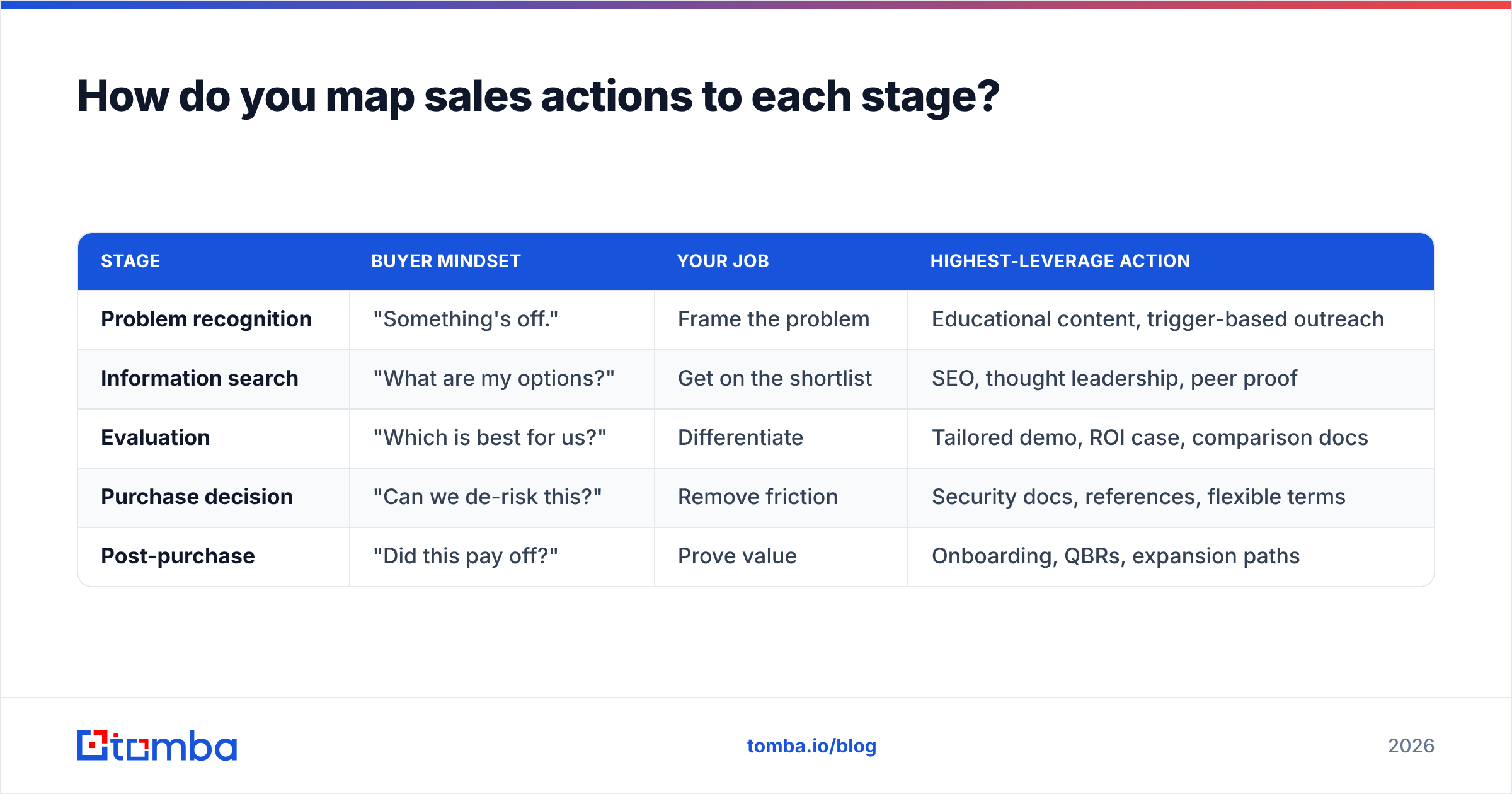
How do you map sales actions to each stage?#
The goal is to match your motion to the buyer's mindset. Pushing the wrong action at the wrong stage is the single most common reason good products lose to worse ones. Here's the alignment most high-performing B2B teams use.
| Stage | Buyer mindset | Your job | Highest-leverage action |
|---|---|---|---|
| Problem recognition | "Something's off." | Frame the problem | Educational content, trigger-based outreach |
| Information search | "What are my options?" | Get on the shortlist | SEO, thought leadership, peer proof |
| Evaluation | "Which is best for us?" | Differentiate | Tailored demo, ROI case, comparison docs |
| Purchase decision | "Can we de-risk this?" | Remove friction | Security docs, references, flexible terms |
| Post-purchase | "Did this pay off?" | Prove value | Onboarding, QBRs, expansion paths |
Notice that only one of these five rows is a "pitch." The other four are about being useful, present, and credible at the moment the buyer is doing their own work. Sales-process discipline means knowing which row a given account sits in before you decide what to send.
A quick note on instrumentation: you can only map a buyer to a stage if your CRM reflects reality. Stale contacts, missing stakeholders, and unverified emails make stage-mapping guesswork. Enriching records — title, seniority, department, validated contact — turns a flat list of names into a buying-committee map you can actually sell to.
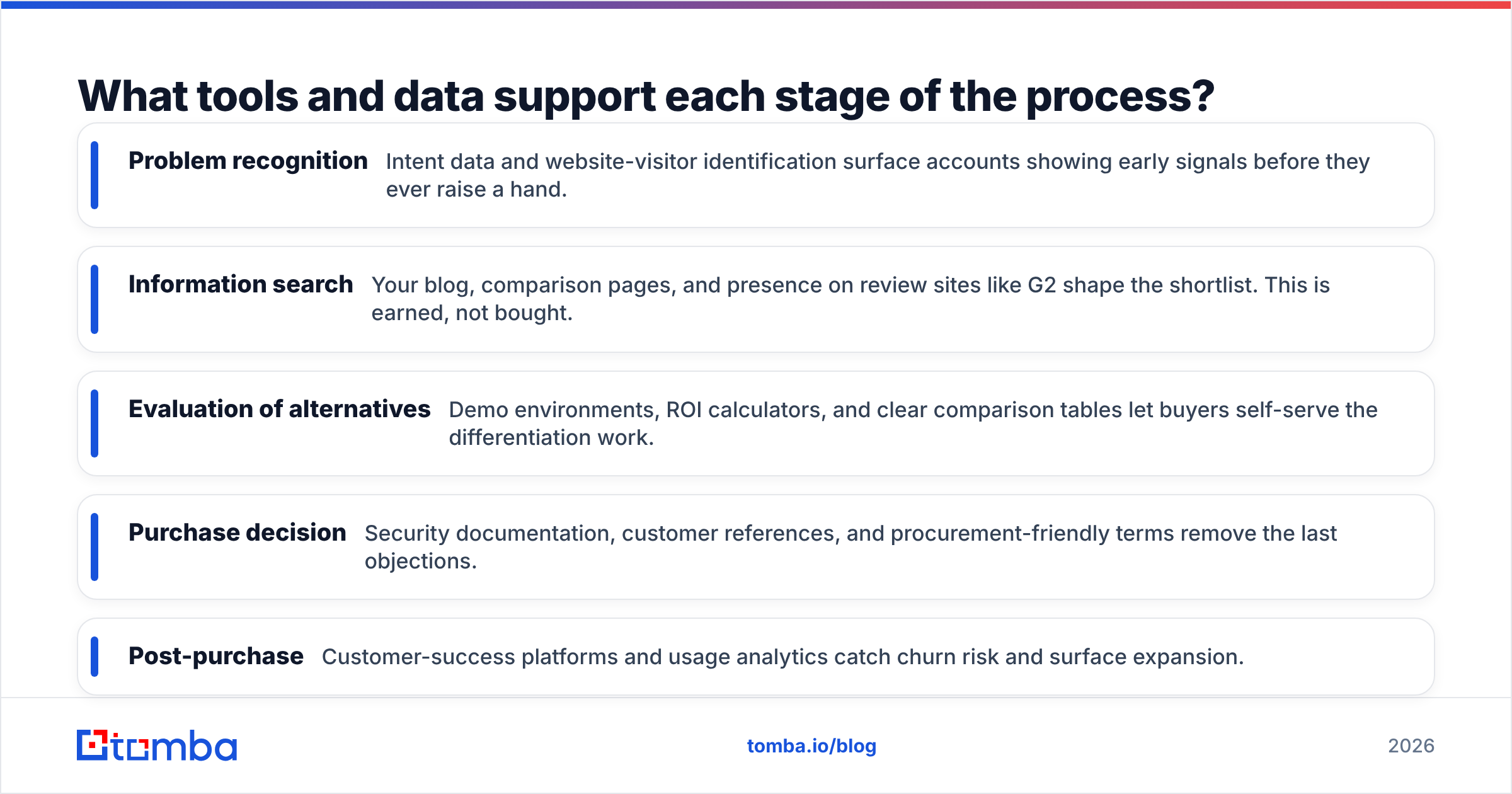
What tools and data support each stage of the process?#
Tooling should follow the process, not the other way around. Below is how the categories line up, and where contact-data accuracy quietly underpins everything.
- Problem recognition — Intent data and website-visitor identification surface accounts showing early signals before they ever raise a hand.
- Information search — Your blog, comparison pages, and presence on review sites like G2 shape the shortlist. This is earned, not bought.
- Evaluation of alternatives — Demo environments, ROI calculators, and clear comparison tables let buyers self-serve the differentiation work.
- Purchase decision — Security documentation, customer references, and procurement-friendly terms remove the last objections.
- Post-purchase — Customer-success platforms and usage analytics catch churn risk and surface expansion.
Underneath all five, two things stay constant: you need to know who the stakeholders are, and you need a way to reach them that doesn't bounce. That's why teams pair their process with reliable data enrichment and verified email discovery. A buying group of eight is only reachable if you can find and validate eight real inboxes — and re-find them every time someone changes roles, which in B2B is constantly.
This is also where vendor consolidation helps. HubSpot's research on buyer behavior consistently shows that buyers reward suppliers who make the process easier, not the ones who add steps. Fewer disjointed tools, cleaner data, and tighter timing beat a bloated stack every time.
How long does the buyer decision making process take in 2026?#
It depends on deal size and stage friction, but the direction of travel is clear: cycles are getting longer and more committee-driven, not shorter. More stakeholders means more parallel evaluations and more internal alignment time. The counterintuitive lesson is that speed comes from removing steps for the buyer, not from chasing them harder.
Three levers actually compress the cycle:
- Reach the full committee early. A champion working alone is slow; a champion with air cover from peers moves faster.
- Pre-empt the risk review. Hand procurement and security what they need before they ask, and you delete a multi-week stall.
- Time the trigger. Outreach tied to a real event — a hire, a raise, an expansion — rides existing urgency instead of inventing it.
Each lever is data-dependent. You can't reach the committee without accurate contacts, can't pre-empt risk without knowing the org, and can't time triggers without monitoring them. Process plus data is the whole game.
Common mistakes that break the process#
A few patterns reliably sabotage otherwise solid teams:
- Pitching before problem recognition. If the buyer hasn't named the pain, your features are noise.
- Single-threading. Betting the deal on one contact who can stall, leave, or go quiet.
- Ignoring post-purchase. Treating the signed contract as the finish line instead of the start of expansion and referral.
- Dirty data. Mapping a buyer to a stage using contacts that bounce or stakeholders you never identified.
Each of these is fixable, and most of the fixes start with the same foundation: knowing exactly who you're selling to and being able to reach them reliably across the entire process.
Put the buyer decision making process to work#
The buyer decision making process isn't an academic model — it's a checklist you can run against every open deal. Where is this account right now? Who in the committee is missing? What does the buyer need to take the next step themselves? Answer those, and your pipeline stops feeling random.
To do that at scale, you need the contact data underneath it to be accurate. Tomba's Email Finder helps you find and verify the right stakeholders across an entire buying group — by name, company, or domain — so you can multi-thread, time your outreach to real triggers, and meet buyers at the exact stage they're in. Start free with 25 searches a month, then scale on the Starter plan at $49/mo when your process is dialed in. Check the full Tomba pricing to match a plan to your pipeline. Map the process, fuel it with clean data, and let the buyer's own journey carry your deals forward.
// get started
Find, verify and enrich your first contacts today
Start on the free plan with 25 searches a month, then scale when your team is ready.
Free plan · No credit card required · GDPR & CCPA
// about the author