Buyer Enablement in 2026: The Complete B2B Sales Guide
Buyers now do 70% of their research before talking to sales. Here is how buyer enablement helps modern B2B teams equip the buying committee, shorten deals, and win.
Your buyers are doing most of the work without you. By the time a B2B buying committee finally books a call, it has already read your pricing page, three competitor comparisons, two Reddit threads, and a G2 grid. Buyer enablement is the discipline of making that self-guided journey easier — so the buyer reaches a confident "yes" instead of stalling out in "no decision."
TL;DR#
- Buyer enablement means giving buyers the information, tools, and confidence they need to complete a purchase — not just arming your own reps.
- Gartner research shows B2B buyers spend only about 17% of the buying journey with any sales rep, and far less with any single vendor.
- It is different from sales enablement: sales enablement points inward (reps), buyer enablement points outward (the buying committee).
- The highest-leverage tactic is removing friction: prescriptive content, ROI tools, mutual action plans, and fast, accurate contact data.
- Teams that enable buyers report shorter cycles and higher win rates — but only when the data feeding outreach and personalization is clean.
What is buyer enablement?#
Buyer enablement is the practice of providing prospective buyers with the content, tools, and guidance that help them complete the jobs they must finish to make a purchase. Think of it like a self-checkout that actually works: the store does not follow you around the aisles, but it makes sure every sign, price tag, and kiosk is clear enough that you can buy confidently on your own.
Gartner, which popularized the term, frames the B2B purchase as a set of "jobs" buyers must complete — problem identification, solution exploration, requirements building, supplier selection, validation, and consensus creation. Buyer enablement is about making each of those jobs easier, especially the messy, non-linear ones that happen when no salesperson is in the room.
The shift matters because the buying committee has grown. A typical complex B2B deal now involves six to ten decision-makers, each arriving with their own information, biases, and internal politics. Your champion is not just buying from you — they are selling your solution internally, often without your help. Buyer enablement equips that champion to win those internal conversations.
)
How is buyer enablement different from sales enablement?#
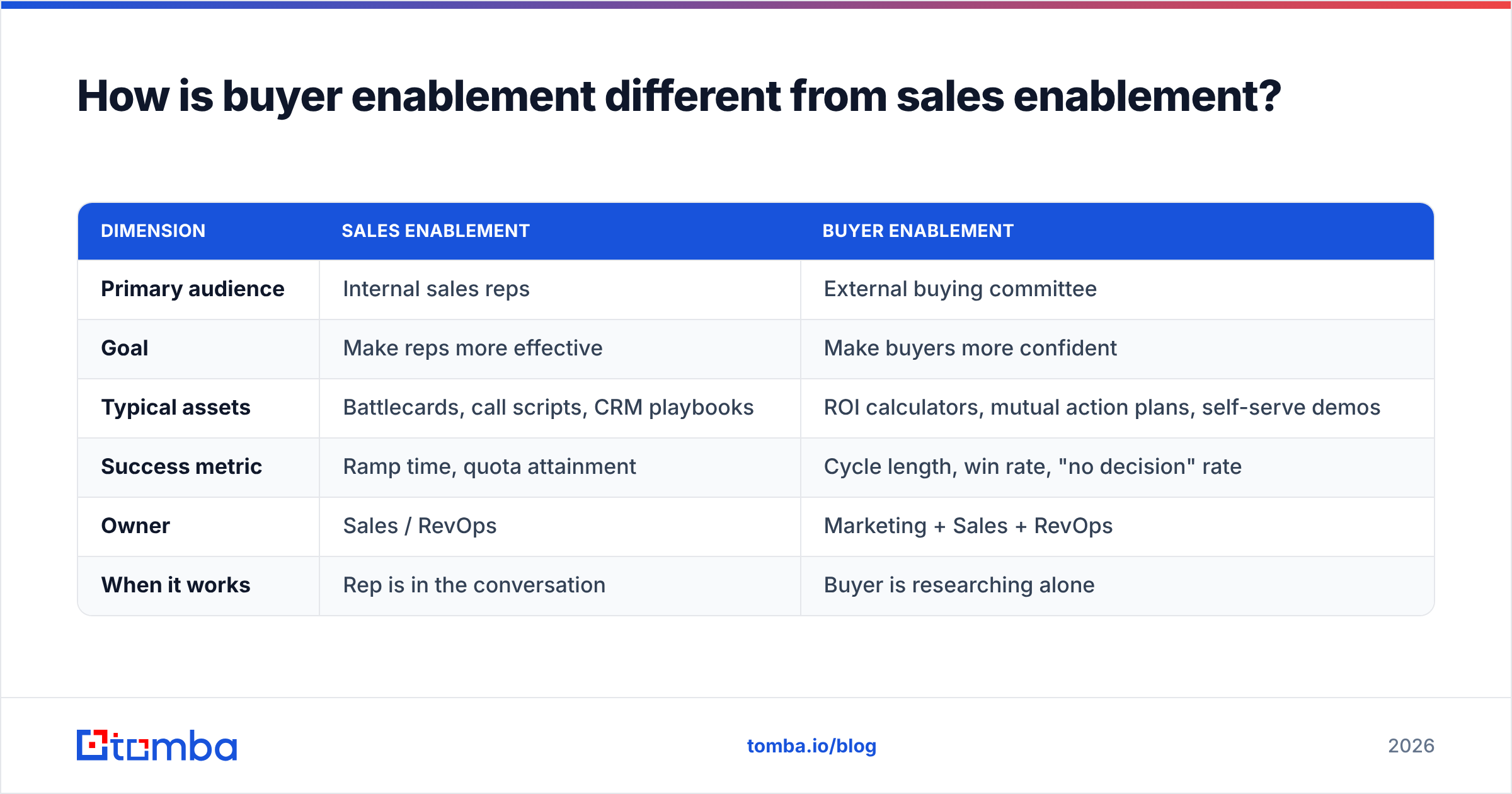
The simplest way to remember it: sales enablement faces your reps; buyer enablement faces your buyers. They are complementary, not competing — but the audience, the content, and the success metric all change.
| Dimension | Sales Enablement | Buyer Enablement |
|---|---|---|
| Primary audience | Internal sales reps | External buying committee |
| Goal | Make reps more effective | Make buyers more confident |
| Typical assets | Battlecards, call scripts, CRM playbooks | ROI calculators, mutual action plans, self-serve demos |
| Success metric | Ramp time, quota attainment | Cycle length, win rate, "no decision" rate |
| Owner | Sales / RevOps | Marketing + Sales + RevOps |
| When it works | Rep is in the conversation | Buyer is researching alone |
Sales enablement assumes a rep is present to deliver the message. Buyer enablement assumes — correctly, most of the time — that they are not. The content has to stand on its own. That is why a generic 40-slide deck fails as a buyer-enablement asset: it needs a narrator. A one-page mutual action plan does not.
If you want a deeper taxonomy of the surrounding terms, the sales automation and revenue operations entries in the Tomba glossary are a useful primer on how these functions connect.
Why does buyer enablement matter in 2026?#
Because the buyer's behavior changed faster than most sales orgs did. Three forces make enablement non-optional this year.
- Self-serve is the default. Buyers research independently and only invite vendors in late. If your information is hard to find or hard to trust, you are eliminated before a rep ever knows the deal existed.
- Committees are bigger and more cautious. More stakeholders means more chances for a deal to stall into "no decision," which Forrester and others repeatedly cite as a bigger threat than losing to a competitor. Enablement reduces the friction that causes paralysis.
- AI raised the bar on personalization. Buyers now expect content tailored to their role, industry, and stage. Generic gating and one-size emails feel obsolete. That personalization runs on accurate data — which is where prospecting and enrichment quietly become part of enablement.
The throughline: buyers want to buy on their terms, and the vendor that makes that easiest usually wins. Speed and clarity beat persistence.
What are the core components of a buyer enablement strategy?#
A working program has five moving parts. Treat each as a job you are helping the buyer finish.
- Prescriptive content. Don't just inform — recommend. Tell buyers what to evaluate, what questions to ask internally, and what "good" looks like. Buyers who get prescriptive advice report far higher purchase ease.
- Interactive tools. ROI calculators, configurators, assessment quizzes, and self-serve demos let buyers test fit without booking a call. These convert passive readers into self-qualified leads.
- Mutual action plans (MAPs). A shared, dated checklist of every step to close — from technical review to legal to signature. MAPs turn a vague deal into a project plan both sides own.
- Internal-selling assets. One-pagers, short videos, and business-case templates your champion can forward to the CFO without editing. If your champion has to rebuild your pitch, you have failed them.
- Clean contact and account data. None of the above reaches the right person if your data is stale. Reaching the actual economic buyer — not a gatekeeper or a left-the-company contact — depends on accurate emails and direct numbers.
That last point is where most programs quietly leak value. You can build a beautiful ROI calculator, but if your outbound list routes it to bounced addresses, the enablement never happens. Accurate data enrichment and verified contact details are the plumbing under the whole strategy.
)
How do you build a buyer enablement process step by step?#
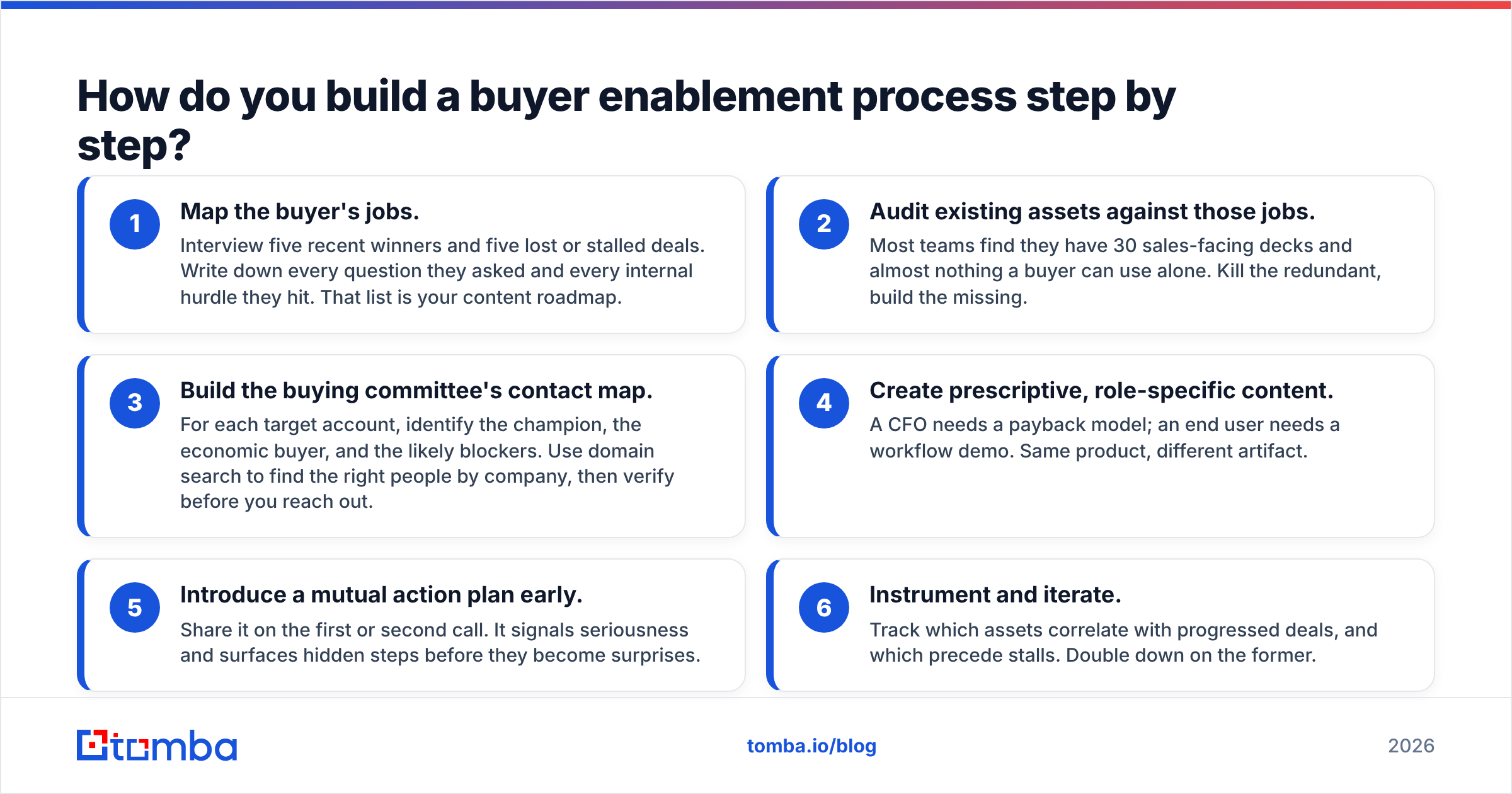
Here is a practical sequence you can run this quarter without a six-month overhaul.
- Map the buyer's jobs. Interview five recent winners and five lost or stalled deals. Write down every question they asked and every internal hurdle they hit. That list is your content roadmap.
- Audit existing assets against those jobs. Most teams find they have 30 sales-facing decks and almost nothing a buyer can use alone. Kill the redundant, build the missing.
- Build the buying committee's contact map. For each target account, identify the champion, the economic buyer, and the likely blockers. Use domain search to find the right people by company, then verify before you reach out.
- Create prescriptive, role-specific content. A CFO needs a payback model; an end user needs a workflow demo. Same product, different artifact.
- Introduce a mutual action plan early. Share it on the first or second call. It signals seriousness and surfaces hidden steps before they become surprises.
- Instrument and iterate. Track which assets correlate with progressed deals, and which precede stalls. Double down on the former.
The third step is the one teams skip and regret. Personalized enablement is only personalized if it reaches the actual human. Building that contact map at scale is where a fast bulk email finder earns its keep — you map the committee once and feed every downstream play.
What tools support buyer enablement?#
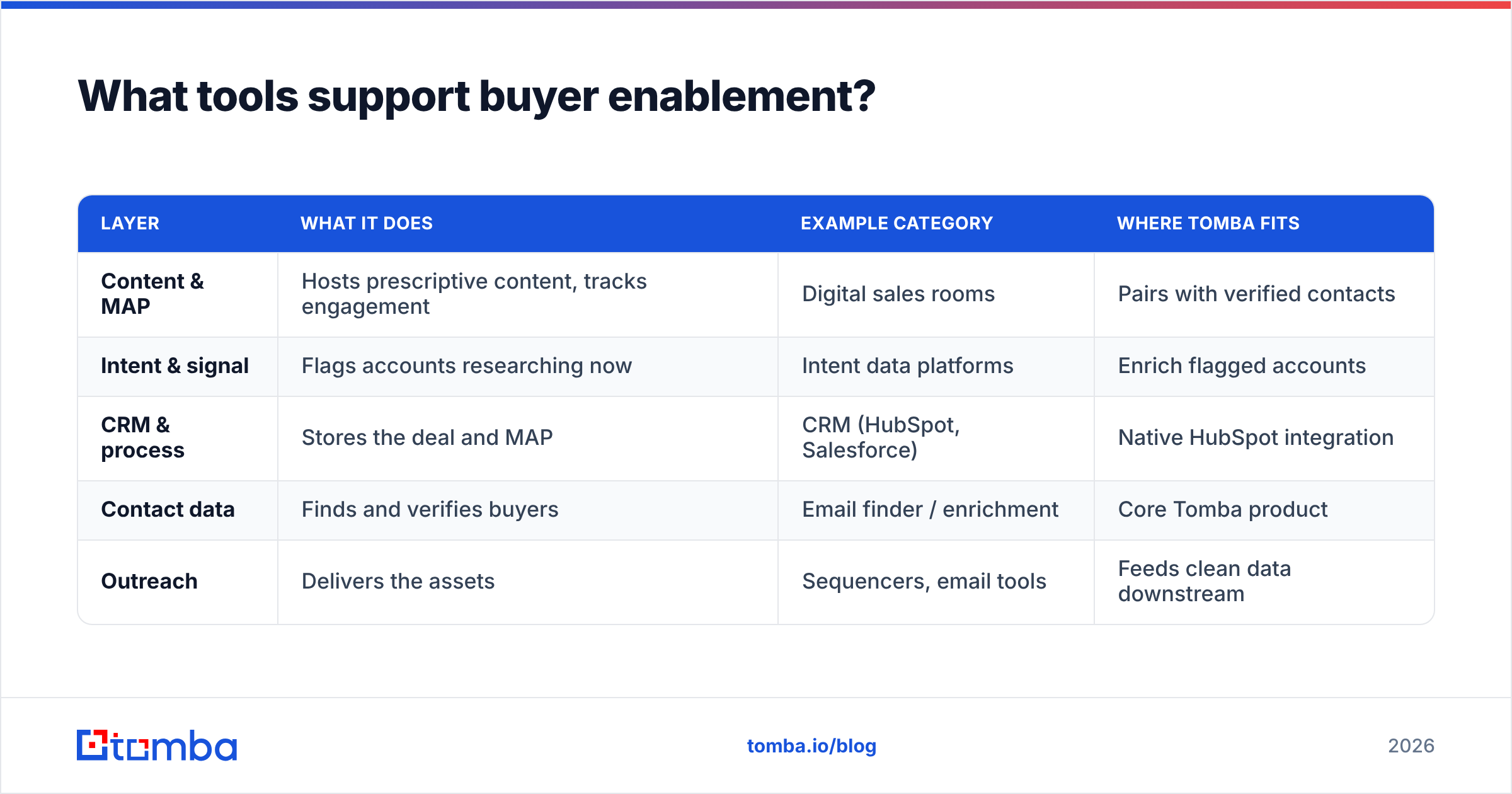
You do not need a new platform category. You need a stack that covers content, signal, and data. Here is how the layers compare.
| Layer | What it does | Example category | Where Tomba fits |
|---|---|---|---|
| Content & MAP | Hosts prescriptive content, tracks engagement | Digital sales rooms | Pairs with verified contacts |
| Intent & signal | Flags accounts researching now | Intent data platforms | Enrich flagged accounts |
| CRM & process | Stores the deal and MAP | CRM (HubSpot, Salesforce) | Native HubSpot integration |
| Contact data | Finds and verifies buyers | Email finder / enrichment | Core Tomba product |
| Outreach | Delivers the assets | Sequencers, email tools | Feeds clean data downstream |
Notice that contact data sits underneath every other layer. A digital sales room is useless if you invite the wrong stakeholder. Intent data is noise if you can't reach the account it flags. This is the unglamorous foundation buyer enablement runs on, and it is exactly where an accurate email finder and reliable email verifier pay off — fewer bounces, fewer dead ends, more of your enablement content landing with real humans.
For teams that want their stack to be neutral and best-of-breed, vendor-comparison resources like G2 are a sane starting point before you commit budget.
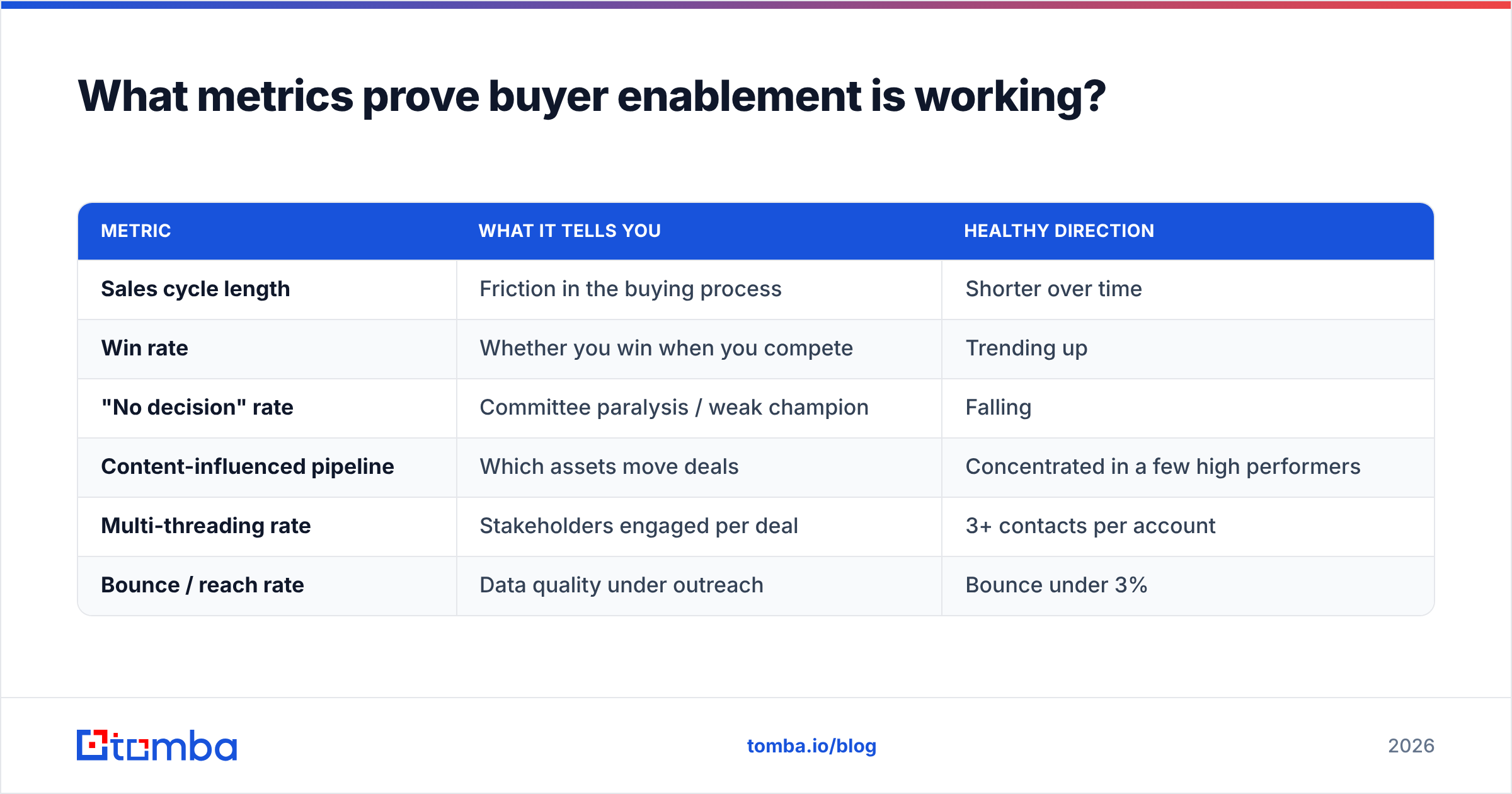
What metrics prove buyer enablement is working?#
Watch outcome metrics, not vanity ones. Downloads feel good; closed revenue pays the bills.
| Metric | What it tells you | Healthy direction |
|---|---|---|
| Sales cycle length | Friction in the buying process | Shorter over time |
| Win rate | Whether you win when you compete | Trending up |
| "No decision" rate | Committee paralysis / weak champion | Falling |
| Content-influenced pipeline | Which assets move deals | Concentrated in a few high performers |
| Multi-threading rate | Stakeholders engaged per deal | 3+ contacts per account |
| Bounce / reach rate | Data quality under outreach | Bounce under 3% |
Multi-threading rate is the underrated one. Deals with a single contact are fragile — one job change and the deal dies. Engaging three or more stakeholders per account is the single best insurance against a stalled deal, and it depends entirely on being able to find and verify those extra contacts. That is why your reach rate and your win rate are quietly correlated.
What are common buyer enablement mistakes?#
- Repackaging sales decks as buyer content. If it needs a narrator, it is not buyer enablement.
- Gating everything. Forcing a form before any value pushes self-serve buyers to a competitor with an open door.
- Single-threading. Betting the whole deal on one champion who might leave or lose internal support.
- Ignoring data hygiene. Personalized outreach to a bounced or outdated address is worse than no outreach — it burns sender reputation. Keep lists clean and check email deliverability basics before you scale.
- Measuring activity, not progress. Tracking opens instead of cycle length tells you nothing about whether buyers are actually buying.
Avoid these five and you are ahead of most B2B teams, who are still optimizing for rep talk-time in a world where buyers barely want to talk.
How does data quality power buyer enablement?#
Buyer enablement is downstream of knowing who the buyer is. Every prescriptive asset, every mutual action plan, every multi-threaded touch assumes you can actually reach the right person at the right account. When your contact data is stale, the entire strategy degrades into spray-and-pray.
This is the practical reason an email-finding and enrichment layer belongs in any modern enablement conversation. You build the buying-committee map, verify each contact, enrich it with role and company context, and only then deliver the tailored content that makes buying easy. Skip the data step and your beautifully designed enablement program quietly misfires.
Get the contact data your buyer enablement depends on#
Buyer enablement starts with reaching the right people — the champion, the economic buyer, and every stakeholder who can stall or sign. Tomba Email Finder lets you build accurate buying-committee maps fast: find professional emails by name, company, or domain, then verify them before a single piece of enablement content goes out. Pair it with Tomba's data enrichment and you have the clean foundation every play in this guide assumes.
Start free with 25 searches a month, scale to the Starter plan at $49/mo, or check full Tomba pricing to match your pipeline. Arm your buyers — and make sure your enablement actually reaches them. Try the Tomba Email Finder today.
Ready to find emails that actually work?
Join 150,000+ professionals who stopped guessing and started sending. Free credits on signup — no credit card required.
Get the Tomba newsletter
Practical outbound tactics and product updates — once every two weeks.
About the author