Buyer Intent Data in 2026: The Complete B2B Playbook
Buyer intent data tells you which accounts are researching a solution like yours right now. Here's how the signals work, what they cost, and how to act on them in 2026.
TL;DR
- Buyer intent data is behavioral evidence — content consumption, search activity, and site visits — that shows which accounts are actively researching a solution like yours.
- There are three flavors: first-party (your own properties), second-party (a review site like G2), and third-party (a publisher co-op network). Each has different accuracy and cost.
- Intent data only pays off when it's wired into routing, scoring, and timing — buying a feed and dumping it in a spreadsheet wastes the spend.
- Accuracy depends entirely on the underlying contact and company data. Stale records turn a hot signal into a bounced email.
- For most mid-market teams, the smart 2026 stack is a focused intent source plus reliable enrichment and verification — not a six-figure platform you'll use at 10% capacity.
What is buyer intent data?#
Buyer intent data is the digital equivalent of watching which shoppers keep circling the same aisle. Technically, it's a collection of behavioral signals — articles read, keywords searched, competitor pages visited, pricing pages loaded — that, in aggregate, predict an account is in an active buying cycle.
The core promise is timing. Most B2B deals are lost not because your product was wrong but because you showed up too early or too late. According to Gartner, B2B buyers spend only about 17% of their journey talking to suppliers, and they're often 70% through their research before they ever raise a hand. Intent data is an attempt to detect that hidden research phase and reach the buyer while the window is open.
A signal on its own is just noise. "Acme Corp read three articles about data warehousing" only becomes actionable when you can answer: which person, what email, which territory, and is this spike above their normal baseline? That last part — the baseline — is what separates real intent platforms from glorified web analytics.
What are the types of buyer intent signals?#
Not all intent is created equal. The single biggest mistake teams make is treating a third-party keyword surge the same as someone filling out a demo form on their own site. Here's how the categories actually stack up.
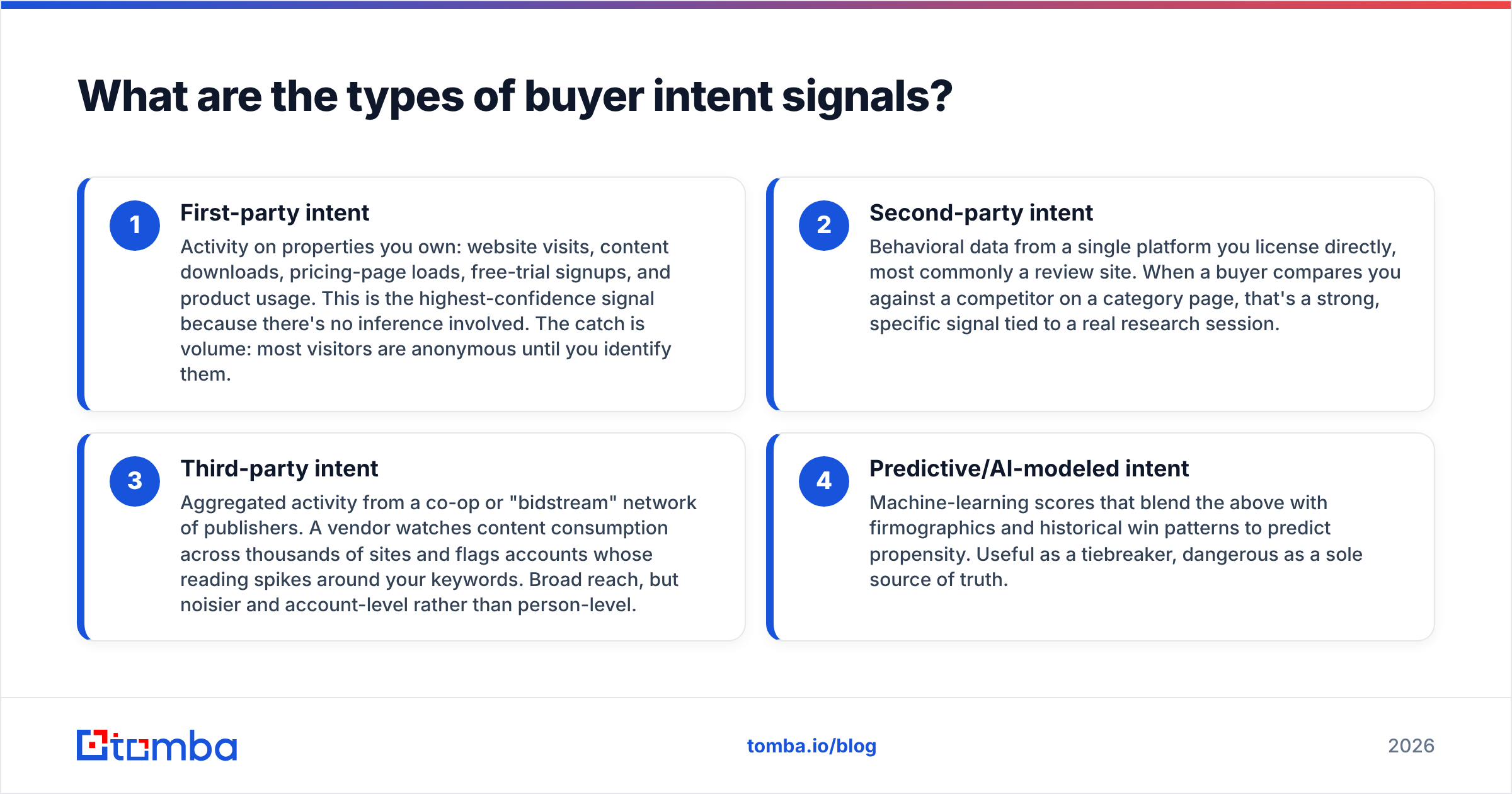
- First-party intent — Activity on properties you own: website visits, content downloads, pricing-page loads, free-trial signups, and product usage. This is the highest-confidence signal because there's no inference involved. The catch is volume: most visitors are anonymous until you identify them.
- Second-party intent — Behavioral data from a single platform you license directly, most commonly a review site. When a buyer compares you against a competitor on a category page, that's a strong, specific signal tied to a real research session.
- Third-party intent — Aggregated activity from a co-op or "bidstream" network of publishers. A vendor watches content consumption across thousands of sites and flags accounts whose reading spikes around your keywords. Broad reach, but noisier and account-level rather than person-level.
- Predictive/AI-modeled intent — Machine-learning scores that blend the above with firmographics and historical win patterns to predict propensity. Useful as a tiebreaker, dangerous as a sole source of truth.
The practical rule: weight first-party highest, use second-party for sales triggers, and use third-party for top-of-funnel account prioritization — never the reverse.
First-party vs third-party intent data: which should you prioritize?#
Lead with first-party, because it's yours and it's accurate. Third-party fills the gap before a buyer ever lands on your site. The two are complements, not substitutes — but if budget forces a choice, the data you generate on your own properties wins almost every time.
The problem first-party data leaves unsolved is the anonymity gap. The majority of your site traffic never converts and never identifies itself. That's where website visitor reveal and account-level de-anonymization come in: they turn "an unknown visitor from a logistics company in Ohio" into a named account you can route. Pair that with data enrichment and a single page view becomes a contactable buying committee.
How do buyer intent data vendors compare in 2026?#
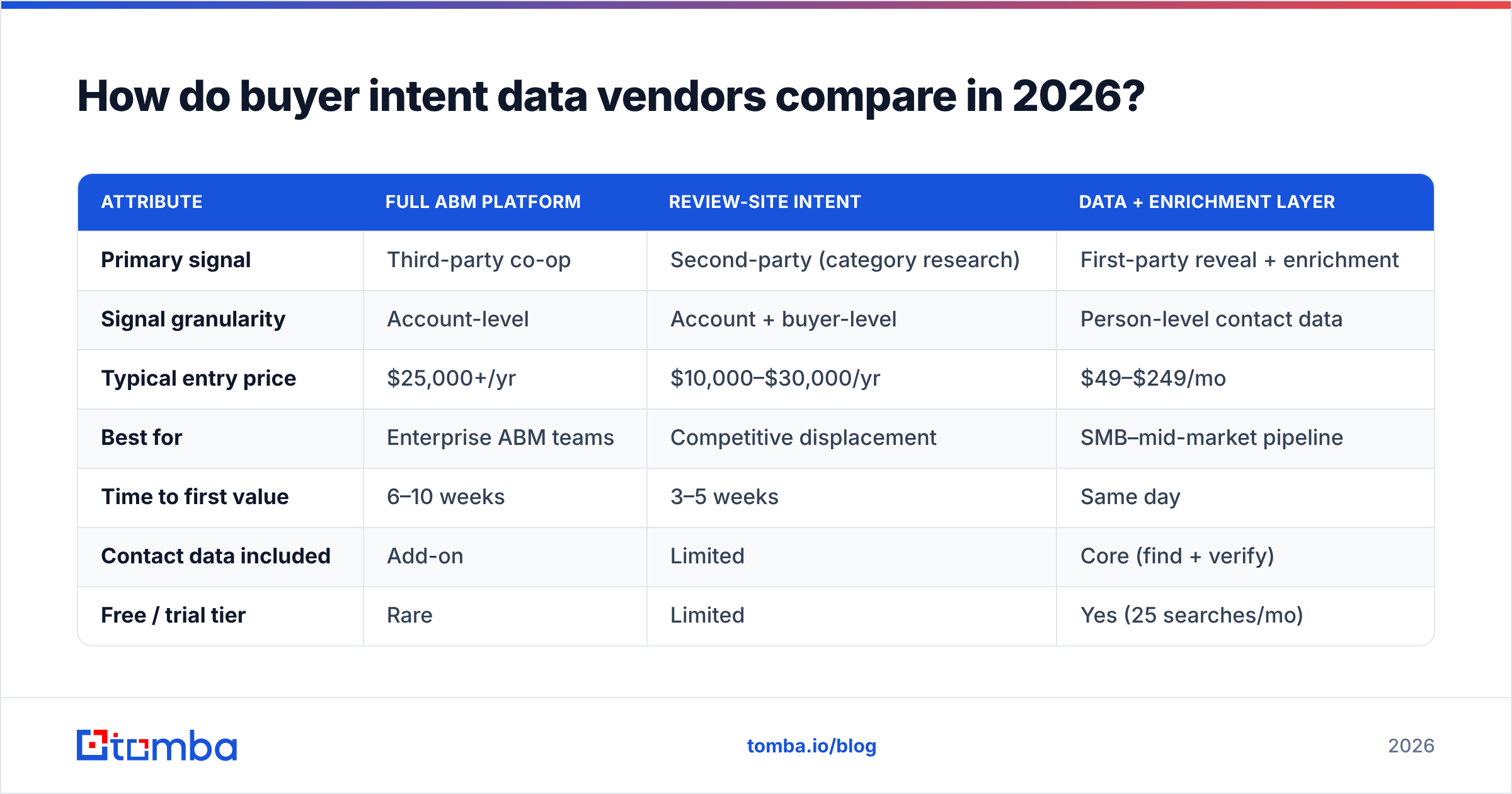
The market splits into three tiers: full ABM platforms (broad, expensive, third-party heavy), review-site signals (precise, mid-cost), and data-layer tools that make intent actionable through enrichment and verification. Here's a side-by-side of representative options and where they fit.
| Attribute | Full ABM Platform | Review-Site Intent | Data + Enrichment Layer |
|---|---|---|---|
| Primary signal | Third-party co-op | Second-party (category research) | First-party reveal + enrichment |
| Signal granularity | Account-level | Account + buyer-level | Person-level contact data |
| Typical entry price | $25,000+/yr | $10,000–$30,000/yr | $49–$249/mo |
| Best for | Enterprise ABM teams | Competitive displacement | SMB–mid-market pipeline |
| Time to first value | 6–10 weeks | 3–5 weeks | Same day |
| Contact data included | Add-on | Limited | Core (find + verify) |
| Free / trial tier | Rare | Limited | Yes (25 searches/mo) |
The lesson isn't "buy the cheapest." It's that intent signals are only as good as your ability to act on them, and acting requires verified contact data underneath. A $30k third-party feed that hands you a company name still needs an email finder and a verifier before a rep can send anything. Many teams discover the data layer was the expensive part all along — which is why pairing a lean intent source with Tomba pricing at $49–$249/mo often beats a single monolithic contract.
You can pressure-test any vendor's claims on G2 and Capterra before signing — look specifically for reviews mentioning signal accuracy and false-positive rate, not just "great support."
How accurate is buyer intent data?#
Honest answer: third-party intent accuracy is probabilistic, not deterministic, and you should treat vendor "match rate" claims with skepticism. Independent benchmarks consistently show third-party intent identifying the account correctly far more often than it identifies the right buyer or the right timing. A surge can reflect a student, an analyst, or a competitor doing research — not a buyer.
What you can control is the accuracy of everything downstream of the signal. This is where most pipelines leak:
- Wrong contact — The account is real, but the person you reach isn't in the buying committee.
- Stale email — The contact left six months ago and your message bounces, hurting sender reputation.
- No verification — You blast the whole company, trip spam filters, and burn the domain.
The fix is unglamorous but decisive: enrich the revealed account into named decision-makers, then run every address through an email verifier before the first send. Intent tells you when; verified contact data determines whether your when ever reaches a human inbox. A 90%-confidence signal with a 40%-bounce list nets you almost nothing.
How do you turn buyer intent data into pipeline?#
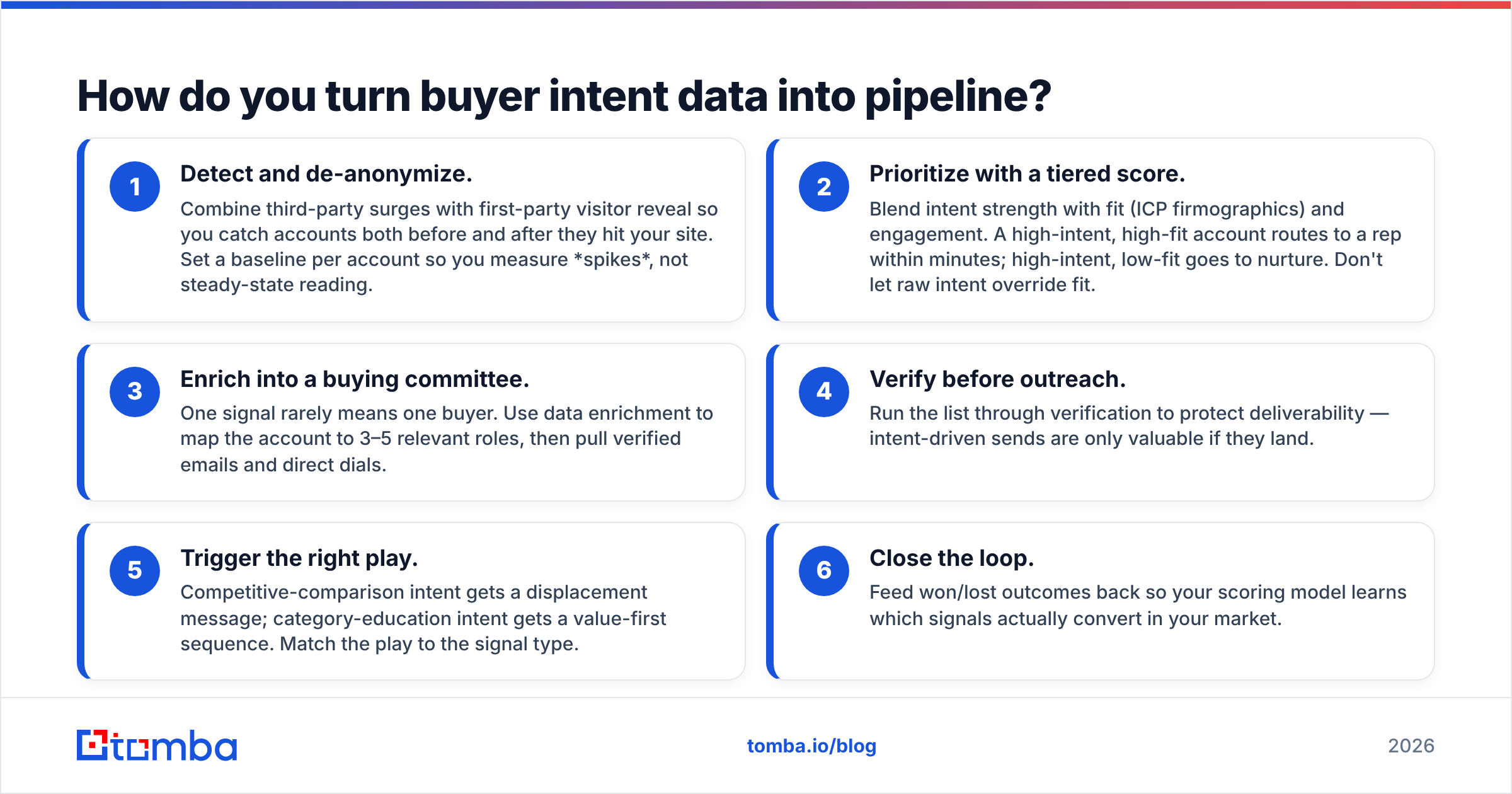
Buying a feed is step zero. The teams that see ROI operationalize intent into three connected motions — detect, prioritize, act — and instrument each one.
- Detect and de-anonymize. Combine third-party surges with first-party visitor reveal so you catch accounts both before and after they hit your site. Set a baseline per account so you measure spikes, not steady-state reading.
- Prioritize with a tiered score. Blend intent strength with fit (ICP firmographics) and engagement. A high-intent, high-fit account routes to a rep within minutes; high-intent, low-fit goes to nurture. Don't let raw intent override fit.
- Enrich into a buying committee. One signal rarely means one buyer. Use data enrichment to map the account to 3–5 relevant roles, then pull verified emails and direct dials.
- Verify before outreach. Run the list through verification to protect deliverability — intent-driven sends are only valuable if they land.
- Trigger the right play. Competitive-comparison intent gets a displacement message; category-education intent gets a value-first sequence. Match the play to the signal type.
- Close the loop. Feed won/lost outcomes back so your scoring model learns which signals actually convert in your market.
A real example of the gap this closes: HubSpot's research on lead response time shows conversion odds drop sharply within the first hour. An intent signal that sits in a queue overnight has already decayed. Automation that routes hot, enriched, verified contacts to a rep the same day is where the compounding returns live.
What does buyer intent data cost in 2026?#
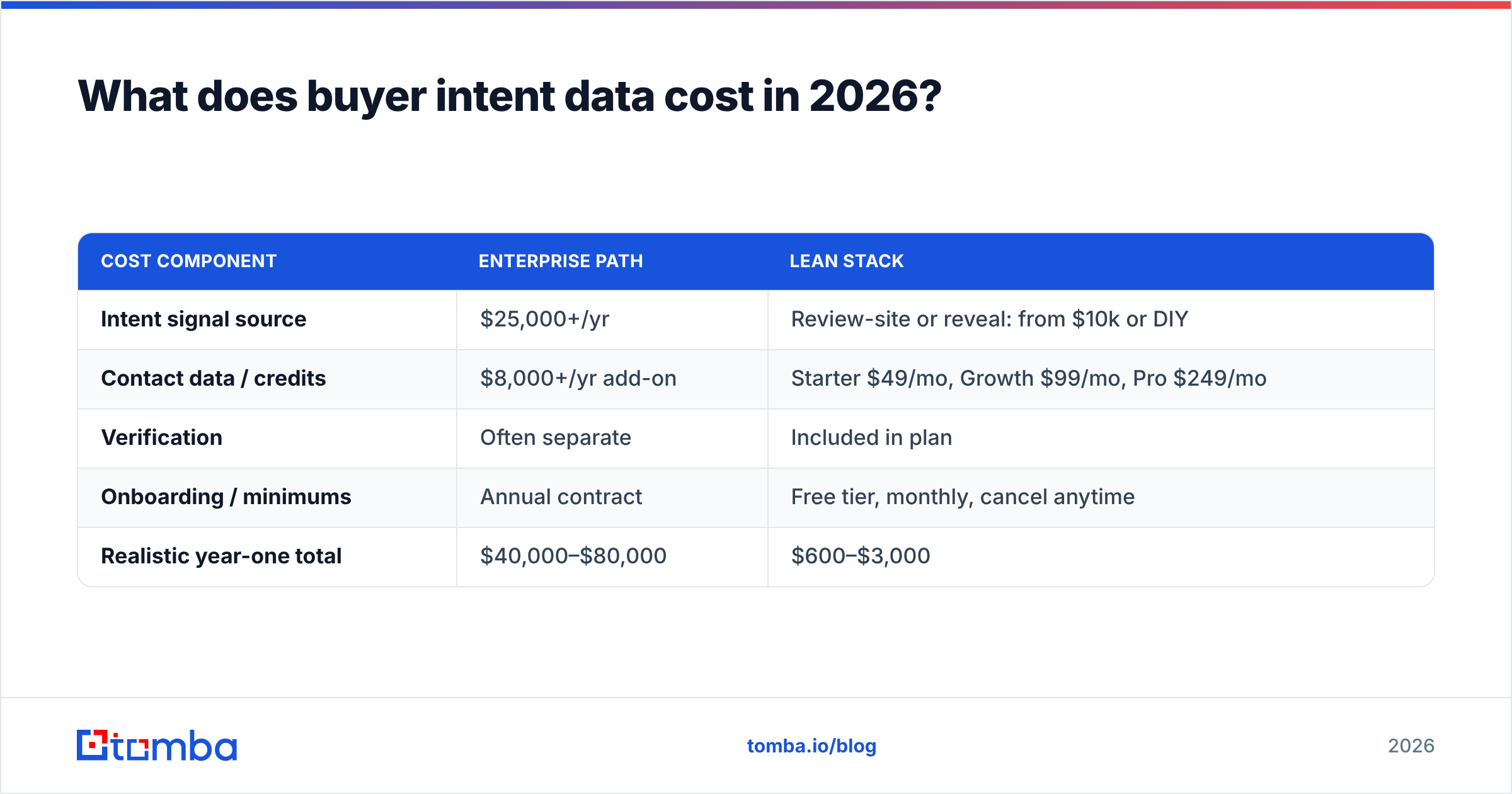
Pricing spans two orders of magnitude, and the headline number is rarely the real number. Enterprise ABM platforms anchor at $25k–$60k+ per year before you add contact-data credits. Review-site intent runs $10k–$30k annually. The data-and-enrichment layer that makes any of it usable starts far lower.
| Cost component | Enterprise path | Lean stack |
|---|---|---|
| Intent signal source | $25,000+/yr | Review-site or reveal: from $10k or DIY |
| Contact data / credits | $8,000+/yr add-on | Starter $49/mo, Growth $99/mo, Pro $249/mo |
| Verification | Often separate | Included in plan |
| Onboarding / minimums | Annual contract | Free tier, monthly, cancel anytime |
| Realistic year-one total | $40,000–$80,000 | $600–$3,000 |
For enterprise teams running formal ABM across thousands of target accounts, the platform spend can be justified. For everyone else — startups, SMBs, and most mid-market sales orgs — the lean stack captures the majority of the value at a fraction of the cost, because the expensive bottleneck was never the signal. It was turning that signal into verified, contactable people.
How do you build a buyer intent stack without overpaying?#
Start with the action, not the signal. Decide what a rep will do with a hot account, then buy only the components that motion requires. For most teams that's: a way to reveal anonymous demand, a way to enrich it into named buyers, and a way to find and verify their contact details.
That's exactly the layer Tomba is built for. You can reveal account-level demand, enrich it into a full buying committee from the B2B database, find every decision-maker's address with the email finder, and verify the list before a single send — without an annual contract or a six-week onboarding. Intent platforms tell you a door is open; this is what gets you through it with a message that actually arrives.
If you're ready to turn intent signals into pipeline that closes, start with the Tomba Email Finder. Spin up the free tier (25 searches a month, no card), point it at the accounts your intent data flags as hot, and watch how much faster a verified, enriched contact list moves than a raw account name ever did. When you're ready to scale, plans run $49–$249/mo — a rounding error next to the deals that good timing wins.
// get started
Find, verify and enrich your first contacts today
Start on the free plan with 25 searches a month, then scale when your team is ready.
Free plan · No credit card required · GDPR & CCPA
// about the author