Buyer Intent Signals in 2026: How to Find and Act on Them
Buyer intent signals tell you who is ready to buy before they fill out a form. Here's how to capture, score, and act on them in 2026.
Most reps still treat prospecting like a cold-weather forecast: guess, hope, and dress for whatever happens. Buyer intent signals replace the guess with a read on who is actually moving toward a purchase right now. Get them right and you stop interrupting people who don't care and start reaching the 3% of your market that is in-cycle this quarter.
TL;DR#
- Buyer intent signals are behavioral and contextual data points that indicate a person or account is researching a solution and moving toward a buying decision.
- They split into first-party (your own site, product, and CRM), second-party (review sites like G2), and third-party (the wider web) sources.
- Intent without contact data is useless — you need a name, a verified email, and ideally a phone number to act on the signal before it goes cold.
- The teams that win in 2026 score signals, route the hot ones fast, and pair them with relevant, timely outreach rather than blasting everyone.
- A practical stack: an intent source + an enrichment and email finder layer + a sequencing tool, all wired into your CRM.
What are buyer intent signals?#
A buyer intent signal is any observable behavior that suggests someone is closer to buying than the average stranger. Think of it like a kitchen timer for a deal: the signal tells you the dish is nearly done and it's time to act, instead of opening the oven every five minutes to check.
Concretely, signals range from a prospect downloading your pricing PDF, to a target account spiking searches for "data enrichment API," to a VP of Sales updating their LinkedIn title at a company you sell to. Each one shifts the probability that an outreach attempt lands at the right moment.
The reason intent data matters is timing. Research from Gartner has long shown that B2B buyers spend the majority of their journey researching independently before they ever talk to a vendor. If you only hear about a deal when a form gets filled, you're arriving late to a conversation that's been happening for weeks. Intent signals pull that conversation forward.
)
What are the main types of buyer intent signals?#
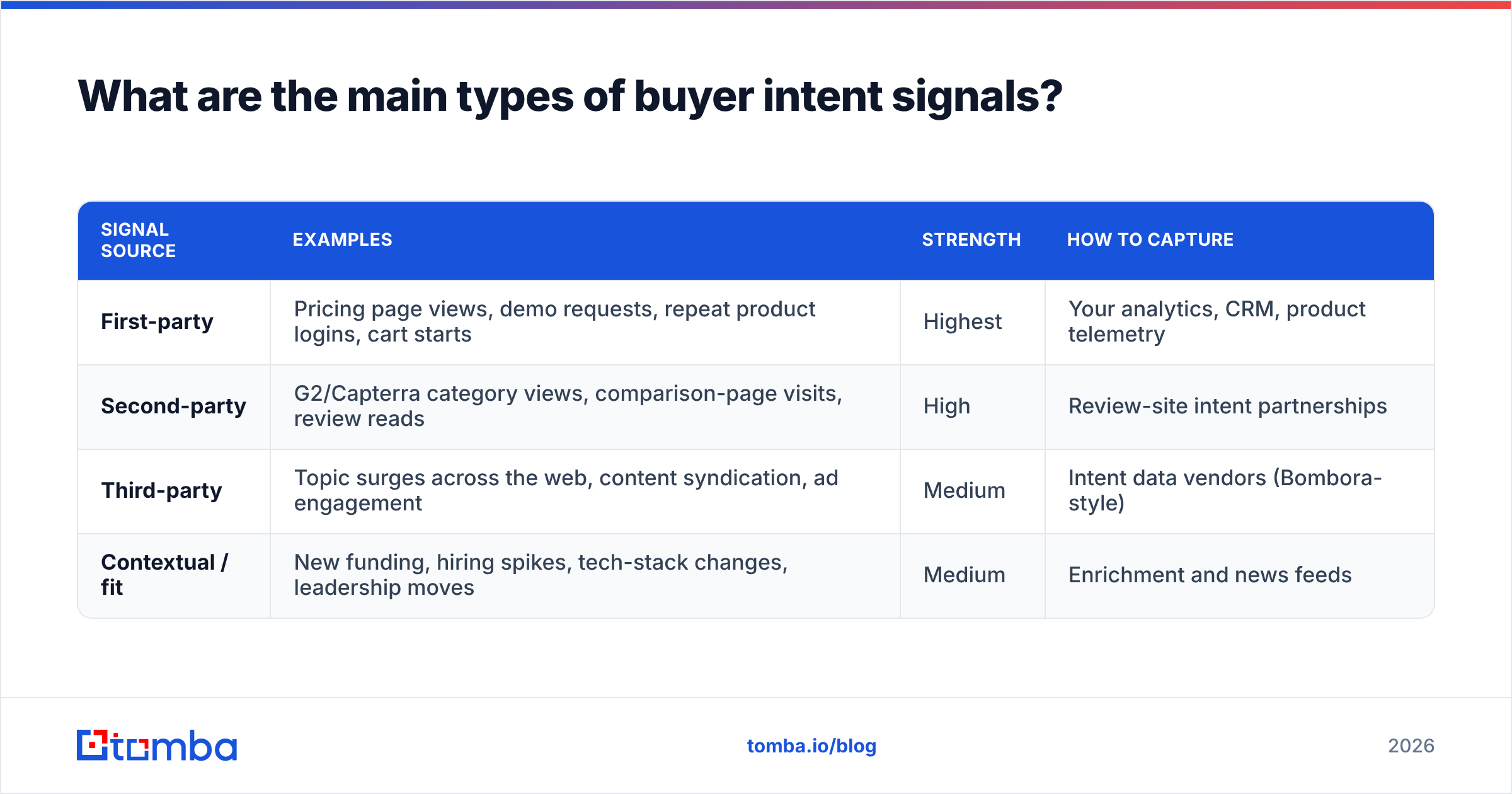
Not all signals are equal, and confusing a casual blog reader with a ready buyer is how teams waste a quarter. The cleanest way to organize them is by source and by strength.
| Signal source | Examples | Strength | How to capture |
|---|---|---|---|
| First-party | Pricing page views, demo requests, repeat product logins, cart starts | Highest | Your analytics, CRM, product telemetry |
| Second-party | G2/Capterra category views, comparison-page visits, review reads | High | Review-site intent partnerships |
| Third-party | Topic surges across the web, content syndication, ad engagement | Medium | Intent data vendors (Bombora-style) |
| Contextual / fit | New funding, hiring spikes, tech-stack changes, leadership moves | Medium | Enrichment and news feeds |
First-party signals are the gold standard because they happen on surfaces you own and they reflect direct interest in you. Third-party topic surges are broader and noisier — they tell you an account is in-market for a category, not that they want your product specifically. The art is layering them: a third-party surge plus a first-party pricing-page visit is a near-certain buying window.
A simple way to rank signal intent#
- Active evaluation — demo requests, pricing views, free-trial signups. Act within hours.
- Solution research — comparison pages, "alternative to" searches, review reads. Act within a day.
- Problem awareness — top-of-funnel blog reads, topic surges. Nurture, don't pounce.
- Fit triggers — funding, hiring, new tooling. Use as a reason to reach out, not proof of intent.
- Relationship signals — a champion changing jobs, an existing user expanding. Warm, prioritize.
If you only build one thing this quarter, build the rule that moves tier-1 signals to a human within the hour. Speed-to-lead remains one of the most reliable predictors of conversion in B2B.
Why do buyer intent signals fail without good contact data?#
Here's the trap nobody warns you about: a signal is a doorbell, not a door. You can know an account is hot, but if you can't reach the right decision-maker with a deliverable message, the intent evaporates.
Say your intent platform flags that Acme Corp is surging on "lead enrichment." Great — but Acme has 400 employees. Who do you contact? You need the VP of Demand Gen's name, a verified email that won't bounce, and ideally a direct phone line. Without that, your hot signal becomes a generic info@ email and a 0.4% reply rate.
This is why the modern intent stack is really two layers: a signal layer and a reach layer. The reach layer is where tools like a domain search and an email verifier earn their keep — they turn "Acme is interested" into "email maria.chen@acme.com, verified, here's the pattern." Skip this layer and you're paying for intelligence you can't operationalize.
)
How do you turn buyer intent signals into pipeline?#
The workflow that consistently produces meetings looks like a relay race: capture, enrich, score, route, reach. Each handoff has to be clean or the baton drops.
Step 1 — Capture the signal. Wire first-party events (pricing views, trials) into your CRM and subscribe to a third-party intent feed for category surges. Don't over-engineer; start with the three signals most correlated with your closed-won deals.
Step 2 — Resolve the account to people. A surging domain isn't actionable until it's a list of humans in the buying committee. Use a bulk email finder to convert flagged domains into named, verified contacts at scale, rather than researching each one by hand.
Step 3 — Score and prioritize. Combine signal strength with fit (ICP match, company size, region). A weak signal at a perfect-fit account can outrank a strong signal at a bad-fit one. Many teams formalize this as a marketing qualified lead threshold.
Step 4 — Route fast. Tier-1 to AEs within the hour, tier-2 to a nurture sequence, tier-3 to marketing. Automate this so no signal sits in a queue overnight.
Step 5 — Reach with relevance. Reference the actual trigger. "Saw your team is scaling SDRs — congrats on the Series B" beats "Hope this email finds you well" every time. Intent gives you the hook; use it.
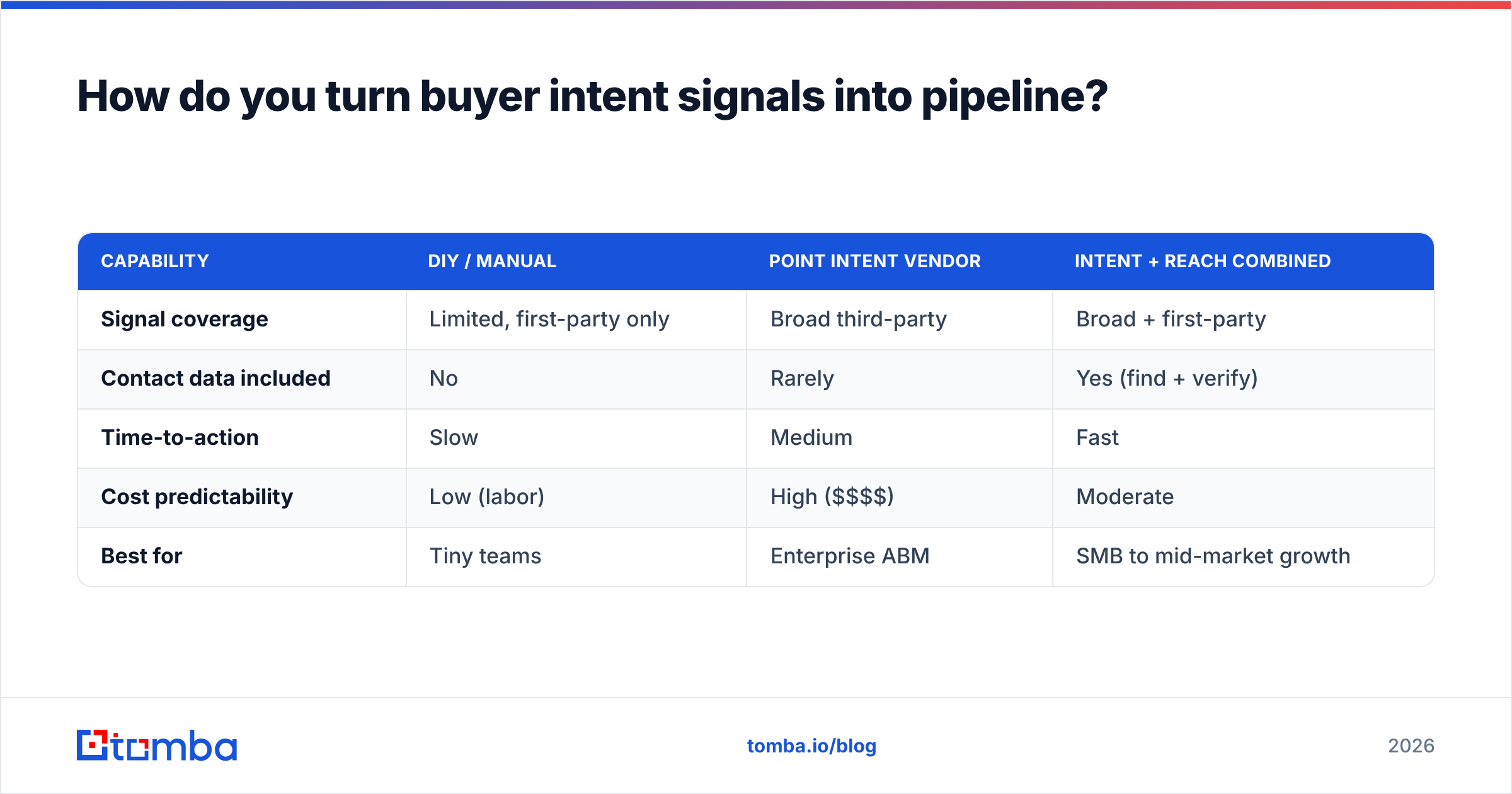
Intent stack: build vs. buy at a glance#
| Capability | DIY / manual | Point intent vendor | Intent + reach combined |
|---|---|---|---|
| Signal coverage | Limited, first-party only | Broad third-party | Broad + first-party |
| Contact data included | No | Rarely | Yes (find + verify) |
| Time-to-action | Slow | Medium | Fast |
| Cost predictability | Low (labor) | High ($$$$) | Moderate |
| Best for | Tiny teams | Enterprise ABM | SMB to mid-market growth |
The combined approach wins for most teams under a few hundred reps because it collapses two procurement cycles and two integrations into one workflow. You don't want to discover, six months in, that your pricey intent feed has no way to give you a working email address.
What buyer intent signals actually move the needle in 2026?#
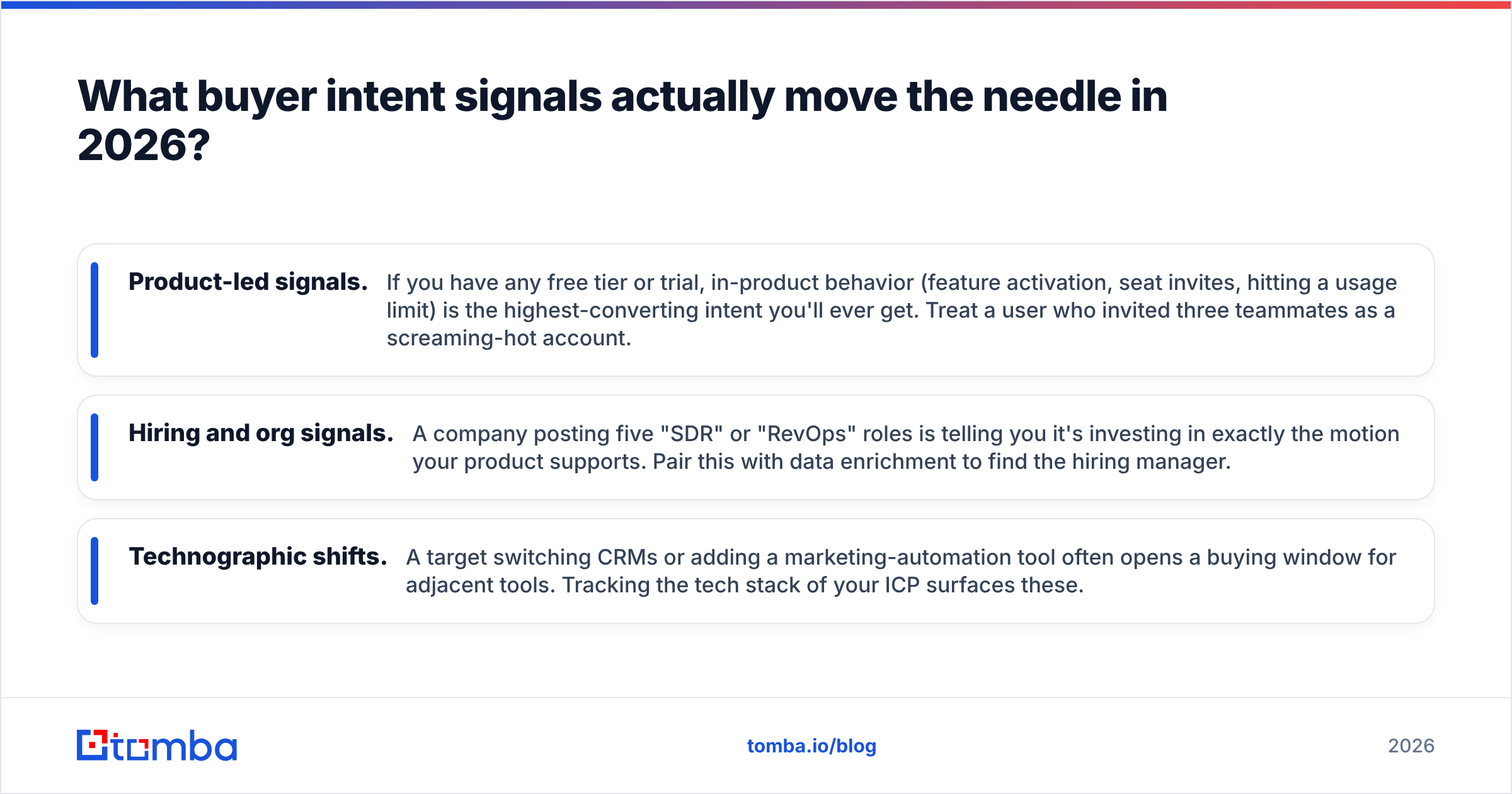
The signal landscape has shifted. Cookie deprecation and tighter privacy rules made some classic third-party tracking less reliable, which pushed smart teams back toward first-party and consent-based second-party data. Three categories are worth your attention this year.
- Product-led signals. If you have any free tier or trial, in-product behavior (feature activation, seat invites, hitting a usage limit) is the highest-converting intent you'll ever get. Treat a user who invited three teammates as a screaming-hot account.
- Hiring and org signals. A company posting five "SDR" or "RevOps" roles is telling you it's investing in exactly the motion your product supports. Pair this with data enrichment to find the hiring manager.
- Technographic shifts. A target switching CRMs or adding a marketing-automation tool often opens a buying window for adjacent tools. Tracking the tech stack of your ICP surfaces these.
According to buyer-behavior research summarized by HubSpot, referrals and timely, relevant outreach consistently outperform cold volume — and intent data is what makes outreach timely and relevant at scale. The takeaway: chase fewer, better signals rather than subscribing to every feed on the market.
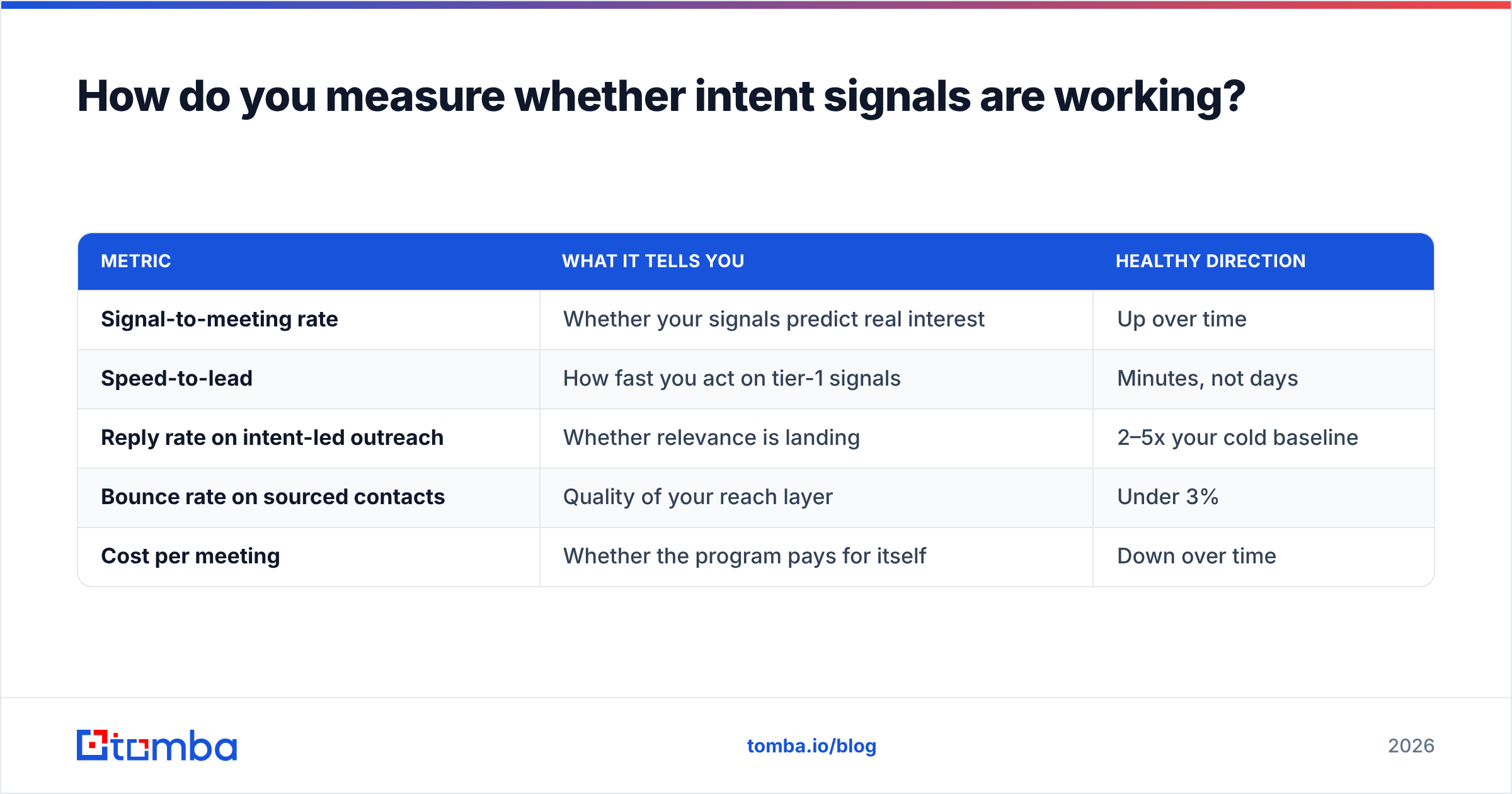
How do you measure whether intent signals are working?#
Treat your intent program like an experiment, not a faith. The metrics that tell the truth:
| Metric | What it tells you | Healthy direction |
|---|---|---|
| Signal-to-meeting rate | Whether your signals predict real interest | Up over time |
| Speed-to-lead | How fast you act on tier-1 signals | Minutes, not days |
| Reply rate on intent-led outreach | Whether relevance is landing | 2–5x your cold baseline |
| Bounce rate on sourced contacts | Quality of your reach layer | Under 3% |
| Cost per meeting | Whether the program pays for itself | Down over time |
That bounce-rate row is the quiet killer. If you're sourcing contacts off intent but a chunk of them bounce, you're torching sender reputation and hurting email deliverability on every other campaign. Verifying before you send isn't optional — it protects the whole channel. Review platforms like G2 are also useful here for benchmarking how prospects evaluate categories before they ever raise a hand.
What's a realistic starter playbook?#
If you're starting from zero, resist the urge to buy the biggest intent platform on day one. A lean version proves value first:
- Instrument three first-party signals (pricing page, demo, trial) and pipe them to Slack and your CRM.
- For every flagged domain, run it through a find emails by domain workflow to get named, verified contacts.
- Score on signal tier × ICP fit; route tier-1 to a human within the hour.
- Send trigger-specific outreach that names the signal.
- Measure signal-to-meeting weekly and cut the signals that don't convert.
Once that loop is humming and you trust the numbers, layer in third-party topic surges and a formal scoring model. The discipline of starting small is what keeps intent data from becoming an expensive dashboard nobody opens. For budgeting, compare what you'd spend on labor against transparent Tomba pricing for the reach layer before committing to an enterprise contract.
Turn signals into conversations#
Buyer intent signals tell you when and who. They don't tell you the email address, confirm it's deliverable, or hand you the direct line — and that last mile is where most intent programs quietly fail. The fix is to pair your signal source with a reach layer that finds and verifies contacts the moment an account heats up.
That's exactly where the Tomba Email Finder fits. When an account surges, point Tomba at the domain, get verified emails for the buying committee in seconds, and act on the signal while it's still warm — not after a competitor already booked the meeting. Start on the free tier (25 searches a month) to test it against your own intent data, then scale up as the pipeline proves itself. Intelligence is only as good as your ability to act on it; give your signals a way to become conversations.
// get started
Find, verify and enrich your first contacts today
Start on the free plan with 25 searches a month, then scale when your team is ready.
Free plan · No credit card required · GDPR & CCPA
// about the author