Buyer Intent Tools in 2026: Top Picks, Pricing & Setup
Buyer intent tools tell you which accounts are researching a solution like yours right now. Here's how they work, what they cost, and how to act on the signals in 2026.
Buyer intent tools promise to end the worst part of outbound: spraying a list of cold contacts who have zero interest in what you sell. Instead of guessing who might be in-market, intent platforms watch for the digital footprints buyers leave while they research — and surface those accounts before your competitors notice.
This guide breaks down what buyer intent tools actually do, the three signal types that matter, a side-by-side comparison of leading platforms, and how to turn a raw signal into a booked meeting.
TL;DR#
- Buyer intent tools detect which companies are actively researching a product category, so you can prioritize accounts that are already in-market instead of cold-prospecting everyone.
- There are three signal layers: first-party (your own site and product), second-party (review sites like G2), and third-party (content consumption across publisher networks).
- Accuracy varies wildly. Account-level intent is reliable; person-level intent is harder and often inferred. Treat vendor "confidence scores" with healthy skepticism.
- Pricing ranges from a few hundred dollars a month for visitor-reveal tools to five figures a year for enterprise intent clouds like 6sense or Bombora.
- A signal is worthless without contact data and fast follow-up. Pair intent with an accurate email finder so a hot account doesn't go cold while you hunt for the right person's address.
What are buyer intent tools?#
Buyer intent tools are software that identifies prospects showing purchase signals — the behavioral breadcrumbs that suggest a company is evaluating a solution. Think of it like a store clerk who notices you've walked past the laptop aisle four times today: the repeated, focused attention is the tell, not a single glance.
Technically, these platforms aggregate behavioral data — pages viewed, search terms, content downloaded, review-site comparisons, ad engagement — and map it back to a company (and sometimes a specific person). When that activity spikes above a baseline for topics relevant to your product, the account gets flagged as "showing intent."
The payoff is timing. According to research summarized by Gartner, the majority of a B2B buying decision happens before a prospect ever talks to a vendor. Intent data lets you insert your team into that earlier window instead of arriving after the shortlist is set.
)
How do buyer intent signals actually work?#
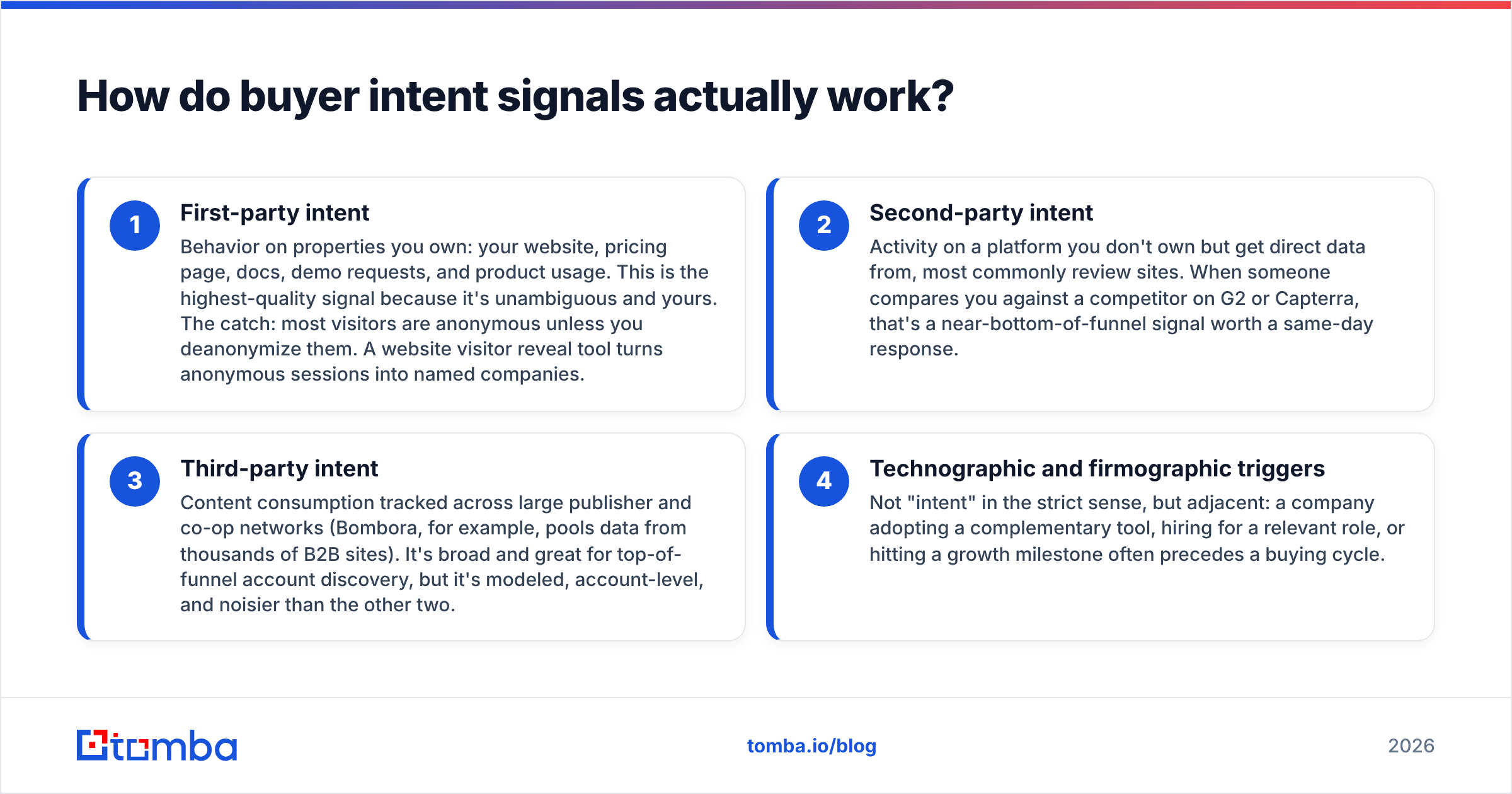
Not all intent is created equal. The three layers below differ in how close they sit to a real purchase decision and how much you can trust them.
- First-party intent — Behavior on properties you own: your website, pricing page, docs, demo requests, and product usage. This is the highest-quality signal because it's unambiguous and yours. The catch: most visitors are anonymous unless you deanonymize them. A website visitor reveal tool turns anonymous sessions into named companies.
- Second-party intent — Activity on a platform you don't own but get direct data from, most commonly review sites. When someone compares you against a competitor on G2 or Capterra, that's a near-bottom-of-funnel signal worth a same-day response.
- Third-party intent — Content consumption tracked across large publisher and co-op networks (Bombora, for example, pools data from thousands of B2B sites). It's broad and great for top-of-funnel account discovery, but it's modeled, account-level, and noisier than the other two.
- Technographic and firmographic triggers — Not "intent" in the strict sense, but adjacent: a company adopting a complementary tool, hiring for a relevant role, or hitting a growth milestone often precedes a buying cycle.
The practical rule: the closer the signal is to your own funnel, the more you should trust it and the faster you should act. Third-party topic surges tell you who to research; first- and second-party signals tell you who to call today.
What's the difference between account-level and person-level intent?#
Most third-party intent is account-level — it tells you "someone at Acme Corp researched CRM migration this week," but not who. That's still useful for prioritizing target accounts, but you then have to find the right contact and a verified email yourself.
Person-level intent claims to tie behavior to an individual. It's far more valuable and far harder to get right. Outside of your own first-party data (where you can use cookies and form fills), person-level signals are usually probabilistic — inferred from IP, device graphs, or login data — and the accuracy drops accordingly.
A reliable workflow looks like this: use account-level intent to build the list, then use data enrichment and a domain-level company email search to identify and verify the actual decision-makers. Intent narrows the field; contact data lets you reach the people on it.
Which buyer intent tools are best in 2026?#
The market splits into a few categories: enterprise intent clouds, mid-market signal aggregators, and lightweight visitor-reveal tools. Here's how representative options compare on the attributes that decide fit.
| Tool / Category | Primary signal type | Granularity | Starting price | Best for |
|---|---|---|---|---|
| 6sense | Third-party + predictive AI | Account-level | ~$40k/yr (custom) | Enterprise ABM teams |
| Bombora | Third-party co-op network | Account-level | ~$15k/yr+ | Topic-based account discovery |
| G2 Buyer Intent | Second-party (review site) | Account-level | ~$10k/yr+ | Bottom-funnel, competitor comparisons |
| Demandbase | Third-party + advertising | Account-level | Custom (high) | Integrated ABM + ad targeting |
| Visitor-reveal tools | First-party deanonymization | Company-level | $100–$800/mo | SMB/mid-market website traffic |
| Tomba (enrichment layer) | Contact data on flagged accounts | Person-level email/phone | Free tier; $49/mo Starter | Turning signals into reachable contacts |
A few honest caveats. Enterprise platforms like 6sense and Demandbase are powerful but priced for teams with dedicated RevOps headcount — and onboarding takes months. Review-site intent from G2 is the cleanest bottom-funnel signal you can buy, but only covers categories where you have review presence. Lightweight reveal tools are cheap and fast to deploy, but they only see the traffic you already attract.
Crucially, none of these are a complete system on their own. Every one of them eventually hands you an account name and expects you to find the human. That handoff is where most intent programs quietly leak pipeline.
)

How much should buyer intent tools cost?#
Budget by the layer you need, not by brand name.
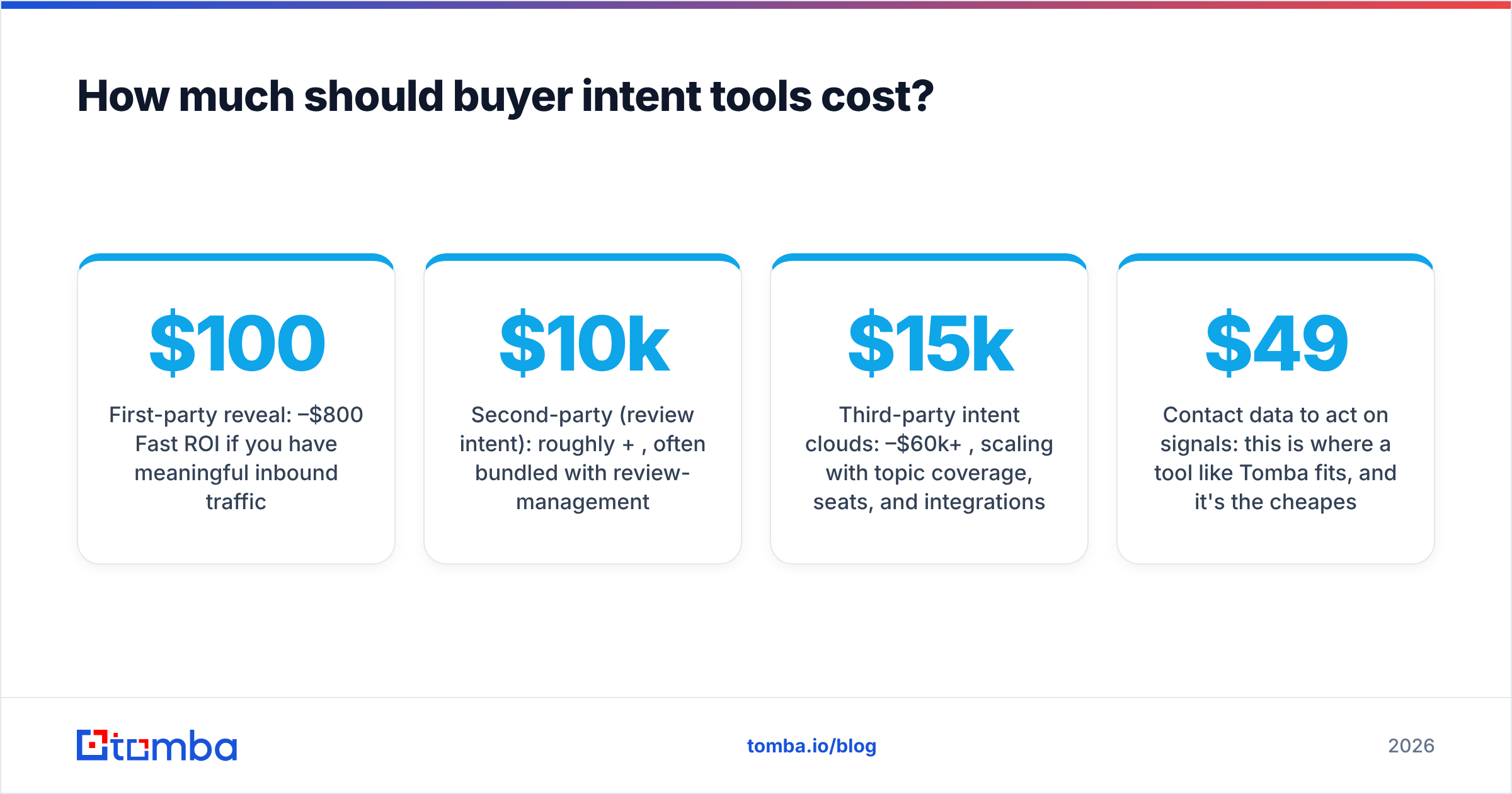
- First-party reveal: $100–$800/mo. Fast ROI if you have meaningful inbound traffic.
- Second-party (review intent): roughly $10k+/yr, often bundled with review-management.
- Third-party intent clouds: $15k–$60k+/yr, scaling with topic coverage, seats, and integrations.
- Contact data to act on signals: this is where a tool like Tomba fits, and it's the cheapest line item by far. Tomba's pricing starts with a free tier (25 searches/mo), then Starter at $49/mo, Growth at $99/mo, and Pro at $249/mo.
The mistake teams make is over-indexing on the expensive intent layer and under-investing in the cheap data layer that operationalizes it. A $40k intent platform that feeds reps unverified guesses at email addresses delivers a fraction of its value. Spending a few hundred dollars a month on accurate contact discovery protects the larger investment.
How do you turn an intent signal into pipeline?#
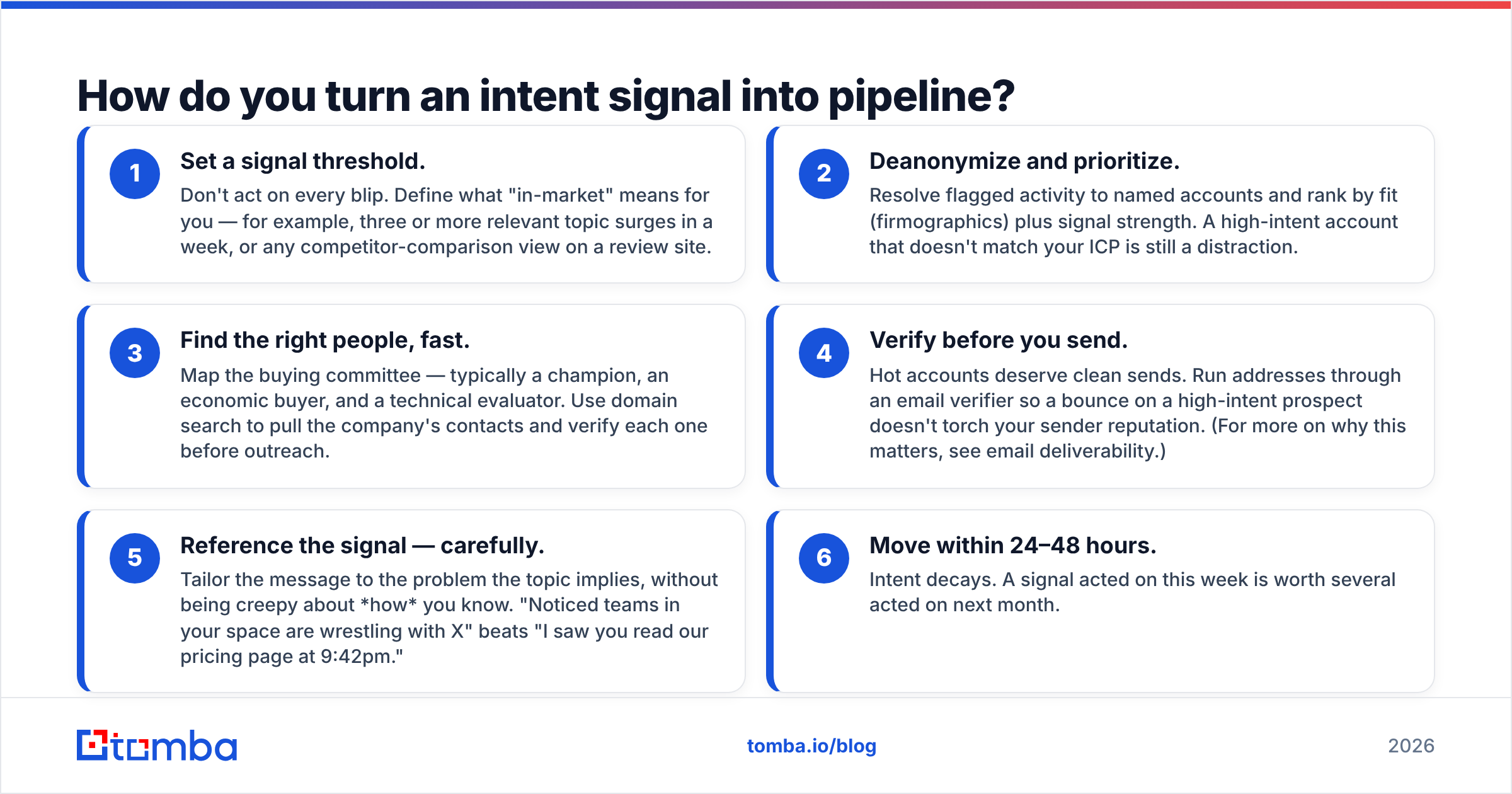
Buying the tool is the easy part. Here's a repeatable play that consistently converts signals into meetings.
- Set a signal threshold. Don't act on every blip. Define what "in-market" means for you — for example, three or more relevant topic surges in a week, or any competitor-comparison view on a review site.
- Deanonymize and prioritize. Resolve flagged activity to named accounts and rank by fit (firmographics) plus signal strength. A high-intent account that doesn't match your ICP is still a distraction.
- Find the right people, fast. Map the buying committee — typically a champion, an economic buyer, and a technical evaluator. Use domain search to pull the company's contacts and verify each one before outreach.
- Verify before you send. Hot accounts deserve clean sends. Run addresses through an email verifier so a bounce on a high-intent prospect doesn't torch your sender reputation. (For more on why this matters, see email deliverability.)
- Reference the signal — carefully. Tailor the message to the problem the topic implies, without being creepy about how you know. "Noticed teams in your space are wrestling with X" beats "I saw you read our pricing page at 9:42pm."
- Move within 24–48 hours. Intent decays. A signal acted on this week is worth several acted on next month.
The unglamorous truth: speed and contact accuracy beat signal sophistication. A mid-tier intent feed paired with same-day, well-targeted outreach outperforms a best-in-class platform whose signals sit in a queue for a week.
What are the limits of buyer intent data?#
Set expectations before you sign a contract.
- It's directional, not deterministic. Third-party intent says "elevated research activity," not "ready to buy from you." Plenty of flagged accounts are doing competitive analysis, academic research, or browsing with no budget.
- Attribution is fuzzy. Co-op networks model behavior to companies via IP and content metadata; expect false positives.
- Person-level claims oversell. Be skeptical of vendors promising individual-level intent outside your own properties.
- Garbage contact data nullifies good signals. If your CRM is full of stale or wrong emails, the best intent feed in the world just routes reps to dead ends. This is why pairing intent with fresh data enrichment isn't optional — it's the difference between a signal and a sale.
Used honestly, intent data is a prioritization engine, not a crystal ball. It tells you where to spend attention, and that alone is worth a lot.
How do you build a buyer intent stack on a budget?#
You don't need a $50k platform to start. A lean, effective stack looks like this:
- Signal source: a visitor-reveal tool for first-party traffic, plus G2 intent if you have review presence. Add a third-party feed only once you've proven you can act on the cheaper signals.
- Resolution + enrichment: turn flagged companies into named, verified contacts. Tomba's bulk email finder handles whole account lists, and the Tomba API wires discovery directly into your CRM or workflow.
- CRM + sequencing: route enriched, verified contacts into your outreach tool with the signal attached so reps know why an account surfaced.
Start narrow, prove the conversion lift on your highest-intent tier, then expand coverage. Teams that scale intent before they've nailed the act-on-it motion usually just buy a more expensive list of accounts they still don't follow up with.
The bottom line#
Buyer intent tools are one of the highest-leverage additions to a modern outbound motion — but only when the signal connects to a person you can actually reach. The platform tells you who is in-market; verified contact data tells you how to start the conversation. Skip the second half and you've paid for awareness you can't use.
That's exactly the gap Tomba fills. When an intent tool flags an account, the Tomba Email Finder finds the decision-maker's professional email by domain, name, or company — and verifies it before you hit send — so a hot signal becomes a booked meeting instead of a bounce. Start free with 25 searches a month, then scale to the Starter plan at $49/mo as your pipeline grows. Pair your intent data with accurate, deliverable contacts, and stop letting in-market accounts slip away.
// get started
Find, verify and enrich your first contacts today
Start on the free plan with 25 searches a month, then scale when your team is ready.
Free plan · No credit card required · GDPR & CCPA
// about the author