The B2B Buyer Journey in 2026: Stages, Maps, and Plays
Map the modern B2B buyer journey stage by stage, see where deals stall, and learn the data plays that move buyers from anonymous research to signed contract.
The buyer journey is the path a person or buying committee takes from "we might have a problem" to "we signed the contract" — and in 2026 most of that path happens before a prospect ever talks to your sales team. If you still treat the journey as a tidy funnel you control, you are planning for a buyer who no longer exists.
This guide breaks the modern B2B buyer journey into concrete stages, shows you how to map it against your own data, and gives you the plays that actually move deals forward. No abstractions — just what each stage looks like, what the buyer is doing, and what you should be doing in response.
TL;DR#
- The buyer journey has five working stages: awareness, consideration, evaluation, decision, and post-purchase — not the three-step funnel most decks still show.
- Roughly 70% of the journey is self-directed; buyers research anonymously long before they raise a hand.
- Modern B2B deals involve a buying committee of 6–10 people, so "the buyer" is really a group with competing priorities.
- Mapping the journey means tying each stage to a trigger, a buyer question, and a measurable signal you can act on.
- The biggest revenue leak is timing: reaching out with the wrong message for the buyer's current stage. Clean contact data and stage-aware outreach fix most of it.
What is the buyer journey?#
The buyer journey is the full sequence of steps a prospect moves through while solving a problem with a purchase — framed from their perspective, not yours. Your sales process is what you do; the buyer journey is what they do. The two should mirror each other, but they are not the same thing, and confusing them is where a lot of pipeline dies.
Think of it like booking a trip. You do not walk into a travel agency the moment you feel like a vacation. You daydream, read articles, compare destinations, check reviews, ask friends, and only then talk to someone who can sell you tickets. By the time you reach the counter, you have already made most of the real decisions. B2B buyers behave exactly the same way, and according to Gartner research, they spend only a small fraction of their journey actually talking to any vendor's sales reps.
That single fact reshapes everything. Your content, your data, and your outreach all have to work during the long stretch when the buyer is invisible to you.
)
What are the stages of the B2B buyer journey?#
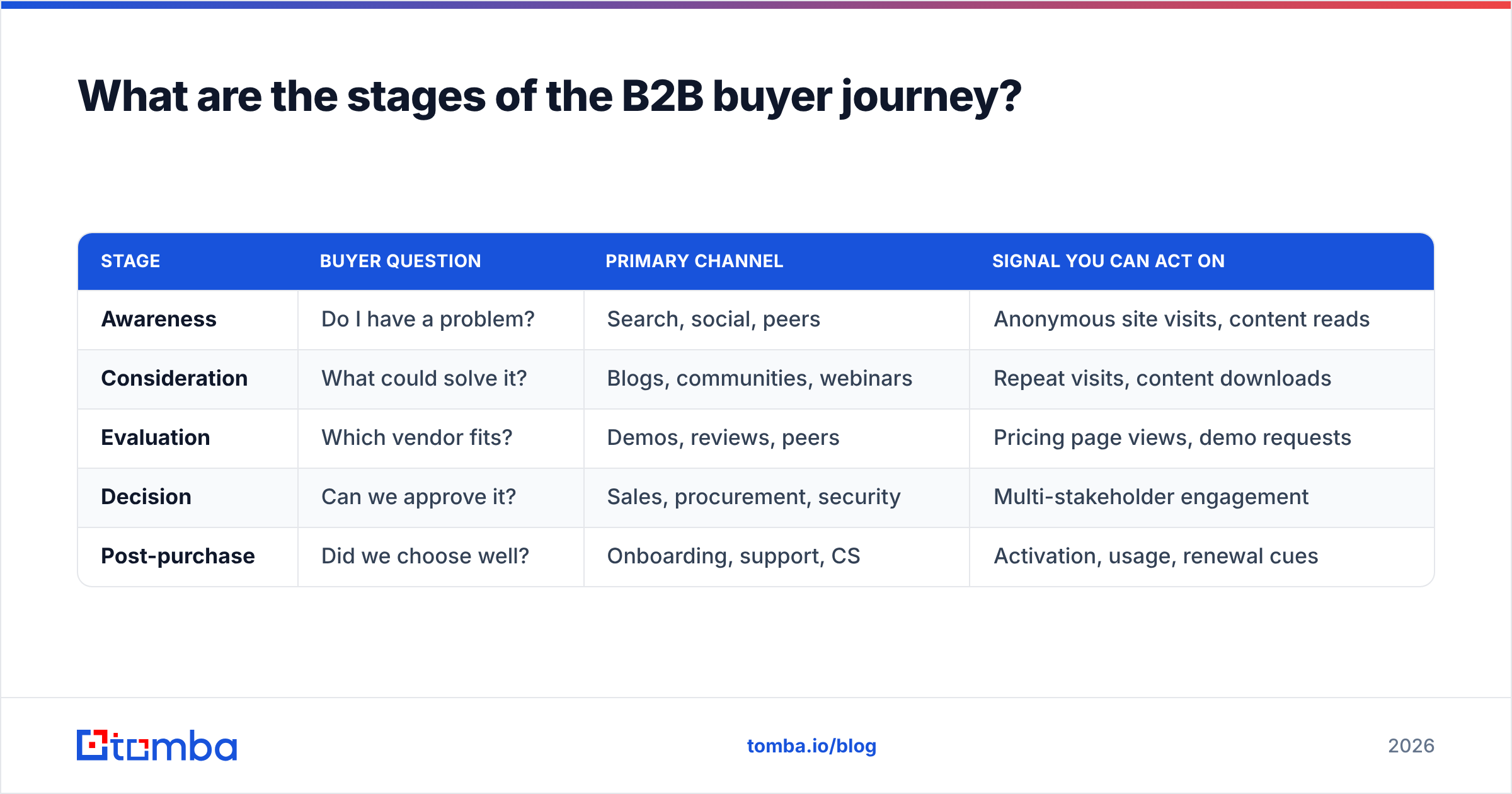
Most teams inherit a three-stage model — top, middle, bottom of funnel. It is too coarse to act on. Here is the five-stage version that maps to real buyer behavior, with the question the buyer is silently asking at each step.
- Awareness — "Do I even have a problem worth solving?" The buyer notices a symptom: churn creeping up, reps missing quota, data going stale. They are not looking for vendors yet; they are naming the pain.
- Consideration — "What approaches could fix this?" Now they research categories and methods. They read comparison posts, watch explainers, and build a mental shortlist of solution types, not brands.
- Evaluation — "Which specific vendors fit?" The buyer builds a shortlist, requests demos, reads reviews on G2, and pulls colleagues into the decision. This is where a buying committee forms.
- Decision — "Can we justify and approve this?" Pricing, security review, procurement, and internal champions matter more than features here. Deals stall on consensus, not on product gaps.
- Post-purchase — "Did we make the right call?" Onboarding, first value, and renewal risk live here. In a subscription world, this stage is where most lifetime revenue is won or lost.
| Stage | Buyer question | Primary channel | Signal you can act on |
|---|---|---|---|
| Awareness | Do I have a problem? | Search, social, peers | Anonymous site visits, content reads |
| Consideration | What could solve it? | Blogs, communities, webinars | Repeat visits, content downloads |
| Evaluation | Which vendor fits? | Demos, reviews, peers | Pricing page views, demo requests |
| Decision | Can we approve it? | Sales, procurement, security | Multi-stakeholder engagement |
| Post-purchase | Did we choose well? | Onboarding, support, CS | Activation, usage, renewal cues |
The table above is your working map. Notice the last column — every stage produces a signal. If you cannot see the signal, you cannot meet the buyer where they are, and you fall back to spraying the same message at everyone.
Why has the buyer journey changed so much?#
The journey changed because information moved from the seller to the buyer. Two shifts drive it.
First, self-service research is the default. Buyers can find pricing, comparisons, and unfiltered peer opinions without ever filling out a form. By the time they contact you, they have often decided 70% of what they want. Your job shifts from informing to differentiating and de-risking.
Second, buying is now a committee sport. A typical B2B purchase pulls in 6–10 stakeholders — the economic buyer, the end users, IT, security, finance, and a skeptic or two. Each has a different question and a different definition of "good." A message that lands with the end user can be irrelevant or even threatening to procurement. You are not mapping one journey; you are mapping several overlapping journeys that have to converge on a yes.
This is why a clean B2B database of who-is-who inside an account matters more than ever. Reaching one champion is not enough when nine other people quietly hold veto power.
How do you map the buyer journey?#
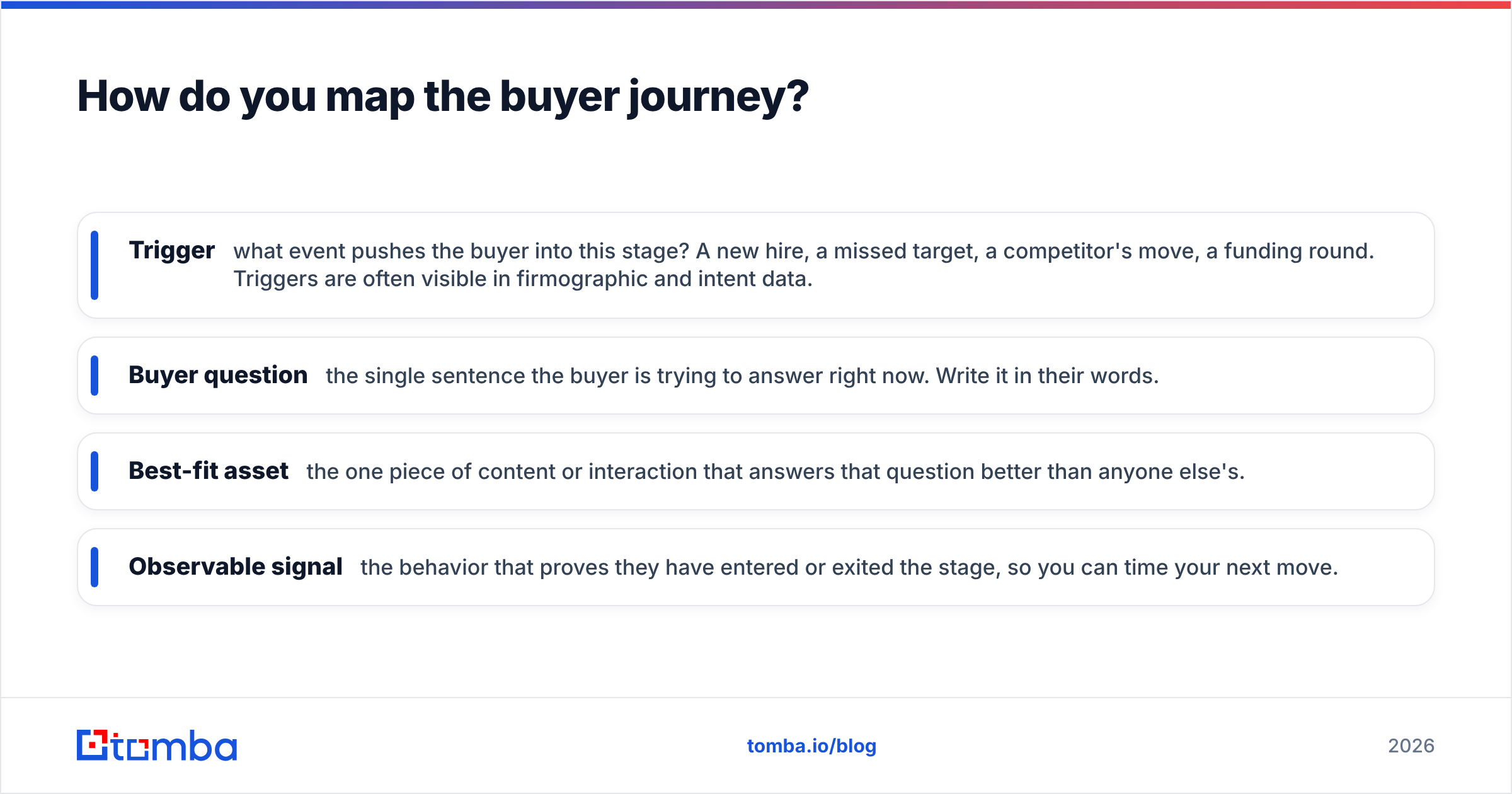
You map the buyer journey by pairing each stage with a trigger, the buyer's question, the content that answers it, and the data signal that tells you they have moved. Mapping is not a poster on the wall — it is an operational table your marketing and sales teams both use.
Work through these four columns for every stage:
- Trigger — what event pushes the buyer into this stage? A new hire, a missed target, a competitor's move, a funding round. Triggers are often visible in firmographic and intent data.
- Buyer question — the single sentence the buyer is trying to answer right now. Write it in their words.
- Best-fit asset — the one piece of content or interaction that answers that question better than anyone else's.
- Observable signal — the behavior that proves they have entered or exited the stage, so you can time your next move.
Here is a practical mistake to avoid: do not map content to your sales stages. Map it to buyer stages. A case study is not "bottom of funnel content" — it is an evaluation-stage answer to "will this work for a company like mine?" When you anchor on the buyer's question, the asset writes itself.
Once the map exists, the gaps jump out. You will usually find a content desert in the consideration stage and a data desert in evaluation, where you know an account is hot but cannot name the actual humans on the committee. That second gap is where an email finder and contact enrichment pay for themselves — they turn an anonymous "Acme is researching us" into a named list of stakeholders you can sequence.
How does outreach fit each stage of the buyer journey?#
Outreach has to change its goal at every stage, or it backfires. The cardinal sin is pitching a decision-stage offer ("book a demo, 20% off this quarter") to an awareness-stage buyer who has not even admitted they have a problem. It reads as noise, and it burns the contact.
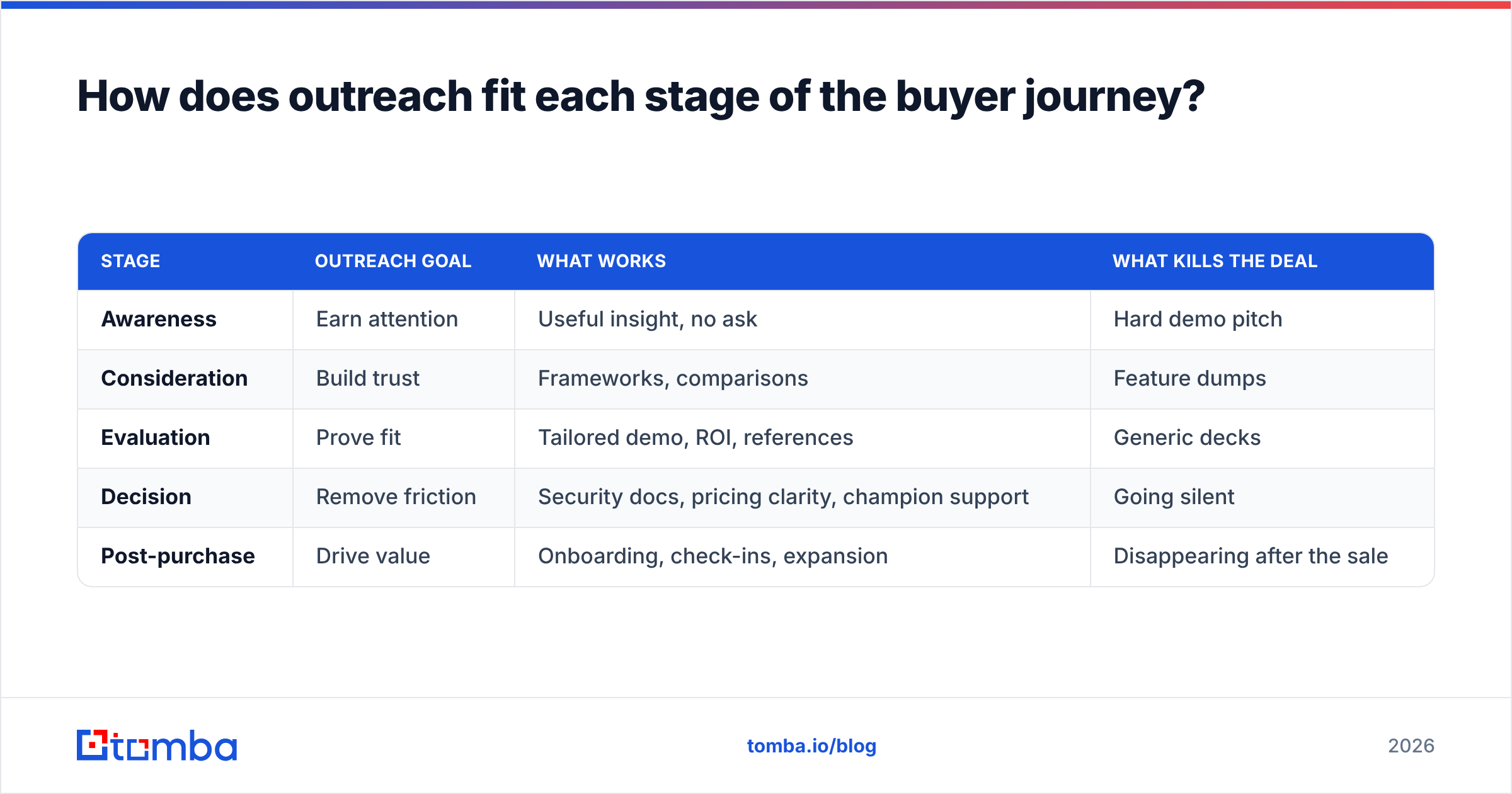
Match the ask to the stage:
| Stage | Outreach goal | What works | What kills the deal |
|---|---|---|---|
| Awareness | Earn attention | Useful insight, no ask | Hard demo pitch |
| Consideration | Build trust | Frameworks, comparisons | Feature dumps |
| Evaluation | Prove fit | Tailored demo, ROI, references | Generic decks |
| Decision | Remove friction | Security docs, pricing clarity, champion support | Going silent |
| Post-purchase | Drive value | Onboarding, check-ins, expansion | Disappearing after the sale |
Stage-aware outreach depends on two things you control: knowing which stage the account is in, and being able to reach the right person once you do. The first comes from signals — site behavior, intent data, website visitor reveal. The second comes from accurate contact data. A perfectly timed evaluation-stage message sent to a bounced or wrong address is worth exactly nothing, which is why running addresses through an email verifier before a sequence is non-negotiable for serious teams.
)
Who is on the B2B buying committee?#
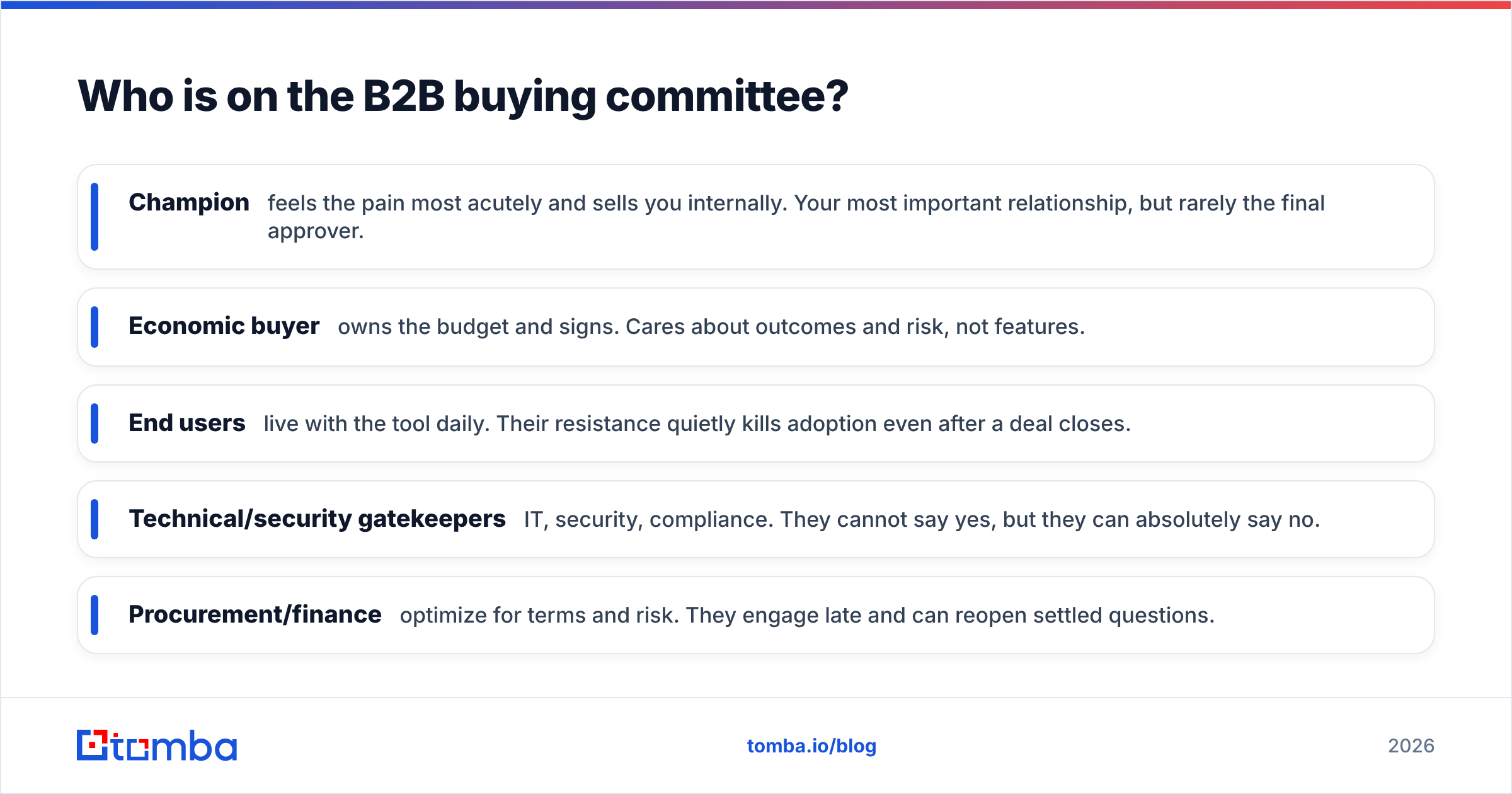
The buying committee is the group of stakeholders who collectively approve a B2B purchase, and mapping it is half the battle in any complex deal. Treating "the company" as one buyer is why deals mysteriously stall — an invisible stakeholder said no.
The common roles:
- Champion — feels the pain most acutely and sells you internally. Your most important relationship, but rarely the final approver.
- Economic buyer — owns the budget and signs. Cares about outcomes and risk, not features.
- End users — live with the tool daily. Their resistance quietly kills adoption even after a deal closes.
- Technical/security gatekeepers — IT, security, compliance. They cannot say yes, but they can absolutely say no.
- Procurement/finance — optimize for terms and risk. They engage late and can reopen settled questions.
Your job is to identify each role inside a target account and arm your champion to navigate the rest. That starts with knowing who they are. A domain search surfaces the people and email patterns inside a company; enrichment fills in titles and seniority so you can tell the economic buyer from an end user. Without that, you are guessing — and guessing at the committee level is how forecasts miss.
How do you measure the buyer journey?#
You measure the buyer journey with stage-conversion rates and velocity, not vanity totals. The two questions that matter: what share of buyers advance from each stage to the next, and how long do they sit in each stage? Together they tell you exactly where deals leak and where they drag.
Track these per stage:
- Conversion rate — percentage advancing to the next stage. A cliff between consideration and evaluation usually means a content or data gap.
- Velocity — average days in stage. A stage that suddenly slows is an early warning before it shows up in closed-won.
- Stage entry volume — how many accounts enter each stage. Thin awareness numbers mean a top-of-journey demand problem no sales heroics will fix.
Tie these metrics back to your CRM and your response rate data so you can connect outreach quality to journey progression. The point is not a prettier dashboard — it is knowing which single stage, if improved 10%, would move revenue the most.
How is AI changing the buyer journey in 2026?#
AI is compressing the research stages and raising the bar on personalization. Buyers now use AI assistants to summarize comparisons, draft requirements, and pre-screen vendors — which means they arrive at the evaluation stage more informed and less patient with generic pitches. The awareness-to-consideration stretch is getting faster and more invisible.
For sellers, the same tools cut both ways. AI can enrich accounts, predict stage transitions from behavioral signals, and personalize outreach at scale. But it amplifies whatever data you feed it. Personalization built on stale or wrong contact data just produces confident, well-written messages sent to the wrong people. The teams winning in 2026 pair AI-driven personalization with a disciplined data foundation: verified emails, accurate titles, and current committee maps. Garbage in, fluent garbage out.
Buyer journey vs. sales funnel vs. customer journey#
These three terms get used interchangeably and they should not be. Quick distinctions:
- Buyer journey — the buyer's perspective, from problem to purchase. Stage-based, buyer-controlled.
- Sales funnel — your perspective, from lead to close. Process-based, seller-controlled.
- Customer journey — the full lifecycle including everything after purchase: onboarding, support, renewal, advocacy.
The buyer journey and your sales funnel should be two views of the same reality. When they drift apart — when your "stage 3" does not match the buyer's actual evaluation behavior — your forecasts get unreliable and your reps push when they should nurture. Aligning them is the practical payoff of all this mapping.
Putting it into practice#
Start small. Pick your last 10 closed-won deals and reconstruct each buyer journey backward: what triggered awareness, who joined the committee and when, where it slowed, and which message unlocked the next stage. Patterns appear fast. Then build the four-column map, find your worst-converting stage, and fix one thing there.
None of it works without the ability to reach the right humans at the right moment. Map the journey all you want — if you cannot find and verify the contacts on the buying committee, your beautiful map stays theoretical. That is the gap Tomba Email Finder closes: give it a company domain and it returns the verified professional emails of the people who actually decide, so your stage-aware outreach lands in real inboxes instead of bouncing. Pair it with Tomba's pricing free tier to test it on your top accounts, then scale into the journey-mapped motion above. Find the emails behind your buyer journey and start meeting buyers where they actually are.
// get started
Find, verify and enrich your first contacts today
Start on the free plan with 25 searches a month, then scale when your team is ready.
Free plan · No credit card required · GDPR & CCPA
// about the author