Buyer Journey Example: A Real B2B Walkthrough for 2026
See a concrete, stage-by-stage B2B buyer journey example — from anonymous research to closed deal — plus templates and a comparison table you can copy in 2026.
TL;DR
- A buyer journey example is most useful when it follows one real persona through every stage — not an abstract awareness-consideration-decision diagram.
- The modern B2B journey is non-linear: buyers self-educate, loop back, and pull in a committee before they ever talk to sales.
- This walkthrough follows "Dana," a RevOps lead at a 200-person SaaS company, from an anonymous blog click to a signed contract.
- Each stage maps to a trigger, a buyer question, the content that answers it, and the data your team needs to act.
- Mapping the journey only pays off when you can identify and reach the buyer — that is where contact data and enrichment turn a map into a pipeline.
What is a buyer journey, and why does an example beat a diagram?#
A buyer journey is the full path a prospect takes from realizing they have a problem to choosing — and renewing — a solution. The textbook version has three tidy stages: awareness, consideration, decision. The problem is that real buyers do not move in a straight line.
Think of it like planning a kitchen renovation. You do not wake up, pick a contractor, and sign. You notice the cabinets are failing, you watch a dozen videos, you argue with your partner about budget, you get three quotes, you stall for two months, then a leak forces your hand. B2B buying works the same way — messy, stop-start, and driven by triggers you do not control.
That is why a single worked buyer journey example teaches more than another funnel graphic. According to Gartner research, the typical buying group for a complex B2B solution involves six to ten decision-makers, each armed with their own stack of independently gathered information. A diagram hides that chaos. A narrative exposes it.
)
What does a complete buyer journey example look like, stage by stage?#
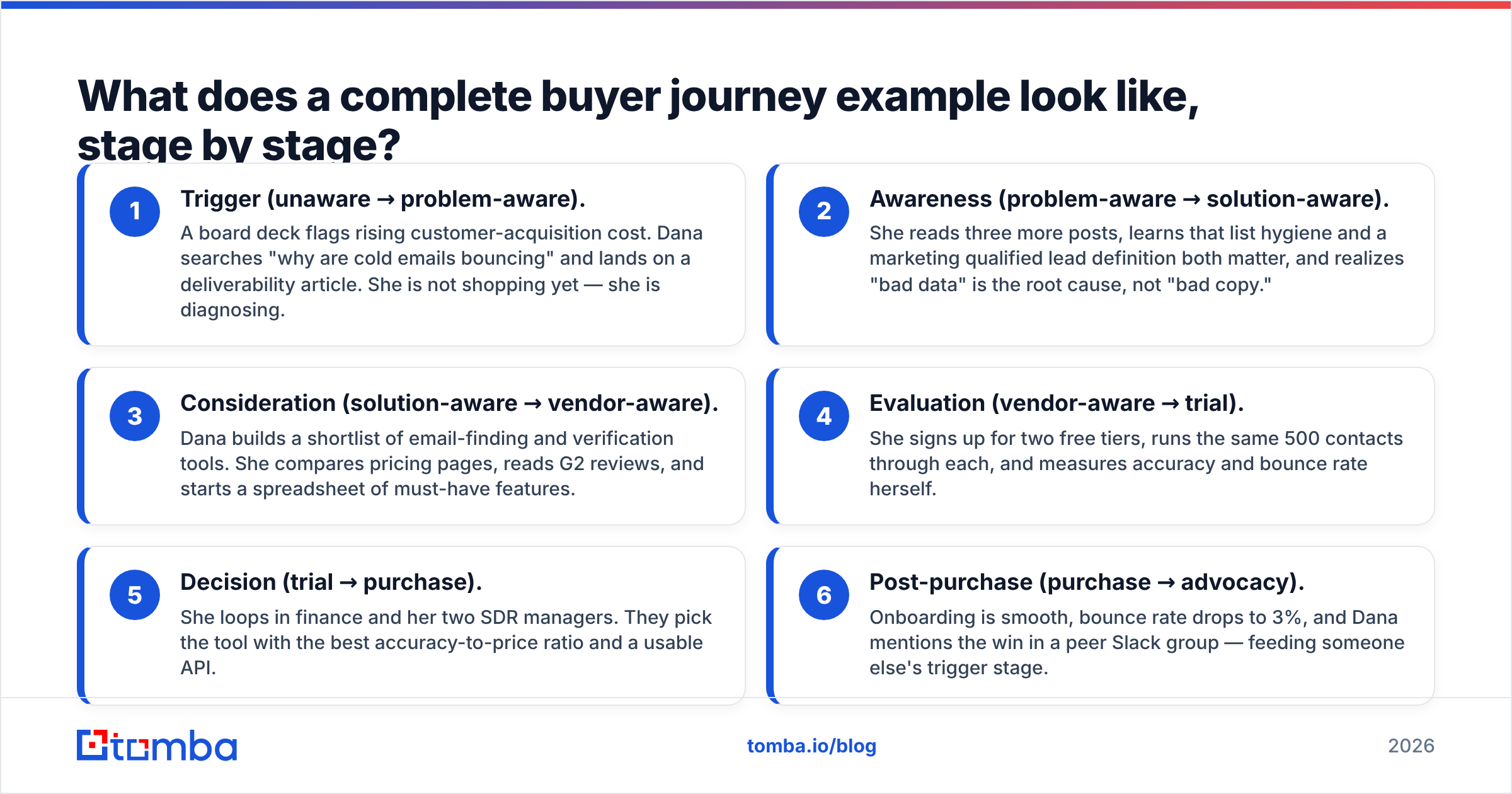
Meet Dana. She runs revenue operations at a 200-person SaaS company. Her outbound team is burning through a contact list with a 28% bounce rate, and her VP just asked why pipeline is flat. Here is her journey through buying a new data and outreach stack.
- Trigger (unaware → problem-aware). A board deck flags rising customer-acquisition cost. Dana searches "why are cold emails bouncing" and lands on a deliverability article. She is not shopping yet — she is diagnosing.
- Awareness (problem-aware → solution-aware). She reads three more posts, learns that list hygiene and a marketing qualified lead definition both matter, and realizes "bad data" is the root cause, not "bad copy."
- Consideration (solution-aware → vendor-aware). Dana builds a shortlist of email-finding and verification tools. She compares pricing pages, reads G2 reviews, and starts a spreadsheet of must-have features.
- Evaluation (vendor-aware → trial). She signs up for two free tiers, runs the same 500 contacts through each, and measures accuracy and bounce rate herself.
- Decision (trial → purchase). She loops in finance and her two SDR managers. They pick the tool with the best accuracy-to-price ratio and a usable API.
- Post-purchase (purchase → advocacy). Onboarding is smooth, bounce rate drops to 3%, and Dana mentions the win in a peer Slack group — feeding someone else's trigger stage.
Notice that sales did not enter until stage four or five. By then Dana had already formed strong opinions. Your content and your data have to do the selling long before a rep says hello.
How do the buyer journey stages map to questions, content, and data?#
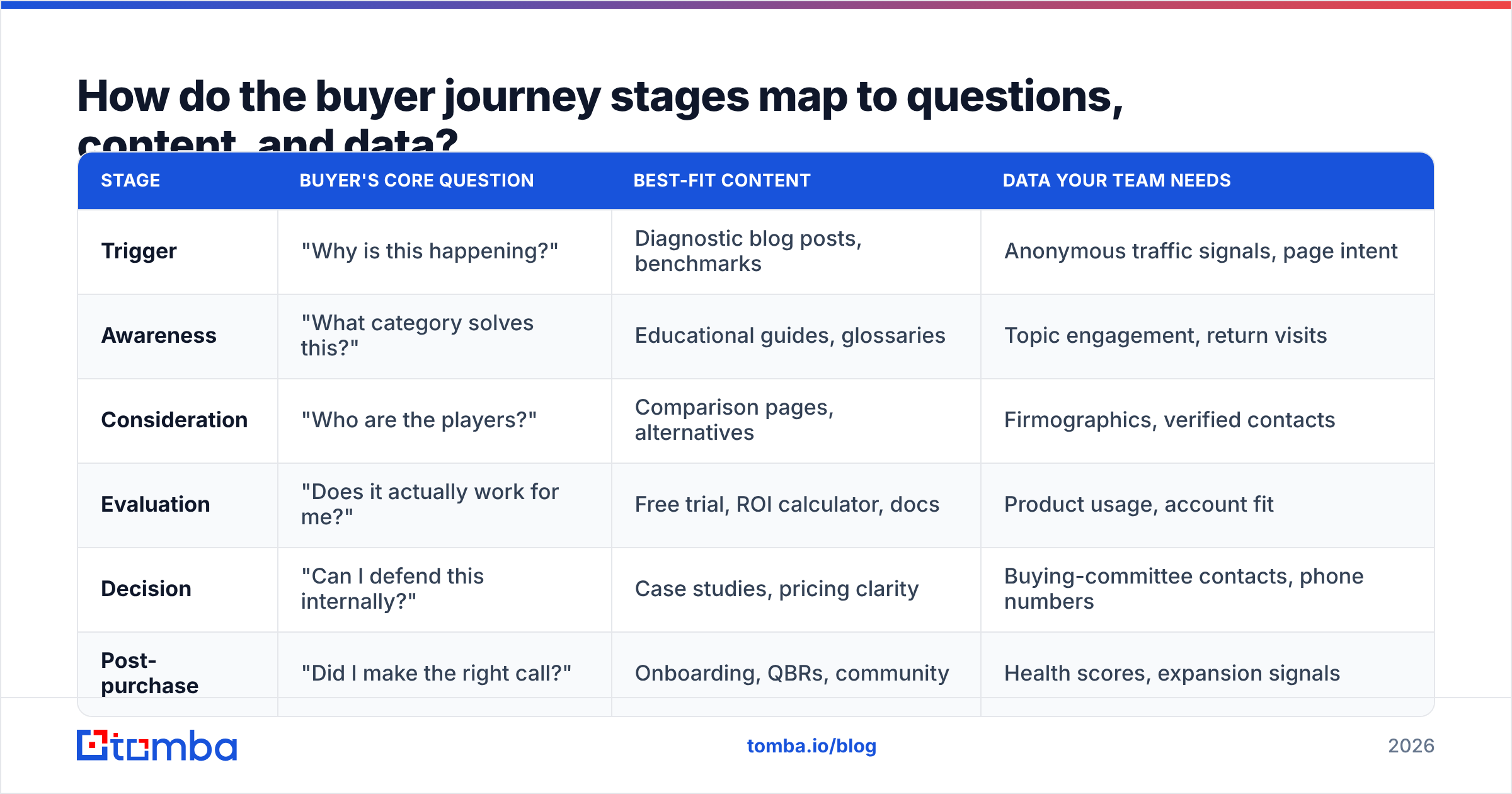
The fastest way to operationalize a buyer journey example is to line up four columns: the buyer's question, the emotion or trigger behind it, the content that answers it, and the data your team needs to respond. Here is Dana's journey in that format.
| Stage | Buyer's core question | Best-fit content | Data your team needs |
|---|---|---|---|
| Trigger | "Why is this happening?" | Diagnostic blog posts, benchmarks | Anonymous traffic signals, page intent |
| Awareness | "What category solves this?" | Educational guides, glossaries | Topic engagement, return visits |
| Consideration | "Who are the players?" | Comparison pages, alternatives | Firmographics, verified contacts |
| Evaluation | "Does it actually work for me?" | Free trial, ROI calculator, docs | Product usage, account fit |
| Decision | "Can I defend this internally?" | Case studies, pricing clarity | Buying-committee contacts, phone numbers |
| Post-purchase | "Did I make the right call?" | Onboarding, QBRs, community | Health scores, expansion signals |
This table is the heart of the exercise. If you can answer the right question with the right asset at the right stage — and you have the data to know which stage a prospect is in — you compress months of indecision into weeks.
Why is the modern B2B buyer journey non-linear?#
Because buyers control the pace now, not vendors. HubSpot's research on the buyer's journey shows most B2B buyers complete a large share of their research before contacting a single salesperson. They jump from your pricing page back to a competitor's review, then to a Reddit thread, then to your changelog.
A useful buyer journey example has to account for three realities:
- Loops, not lines. Dana moved from evaluation back to awareness when she discovered catch-all domains were skewing her test. New information resets the stage.
- A committee, not a contact. The person reading your blog rarely signs the check. Dana's CFO and two managers never visited your site until the final week.
- Dark research. Much of the journey happens where you cannot track it — private Slack groups, peer calls, podcasts. You see the entrance and the exit, not the middle.
The practical takeaway: stop forcing prospects down a linear nurture sequence. Instead, build content and data triggers that meet them wherever they re-enter.
)
How do you turn a buyer journey map into actual pipeline?#
A map is a wall decoration until you can identify and reach the people in it. This is where most journey exercises quietly fail — teams document beautiful stages, then have no way to act on them because their contact data is stale or missing.
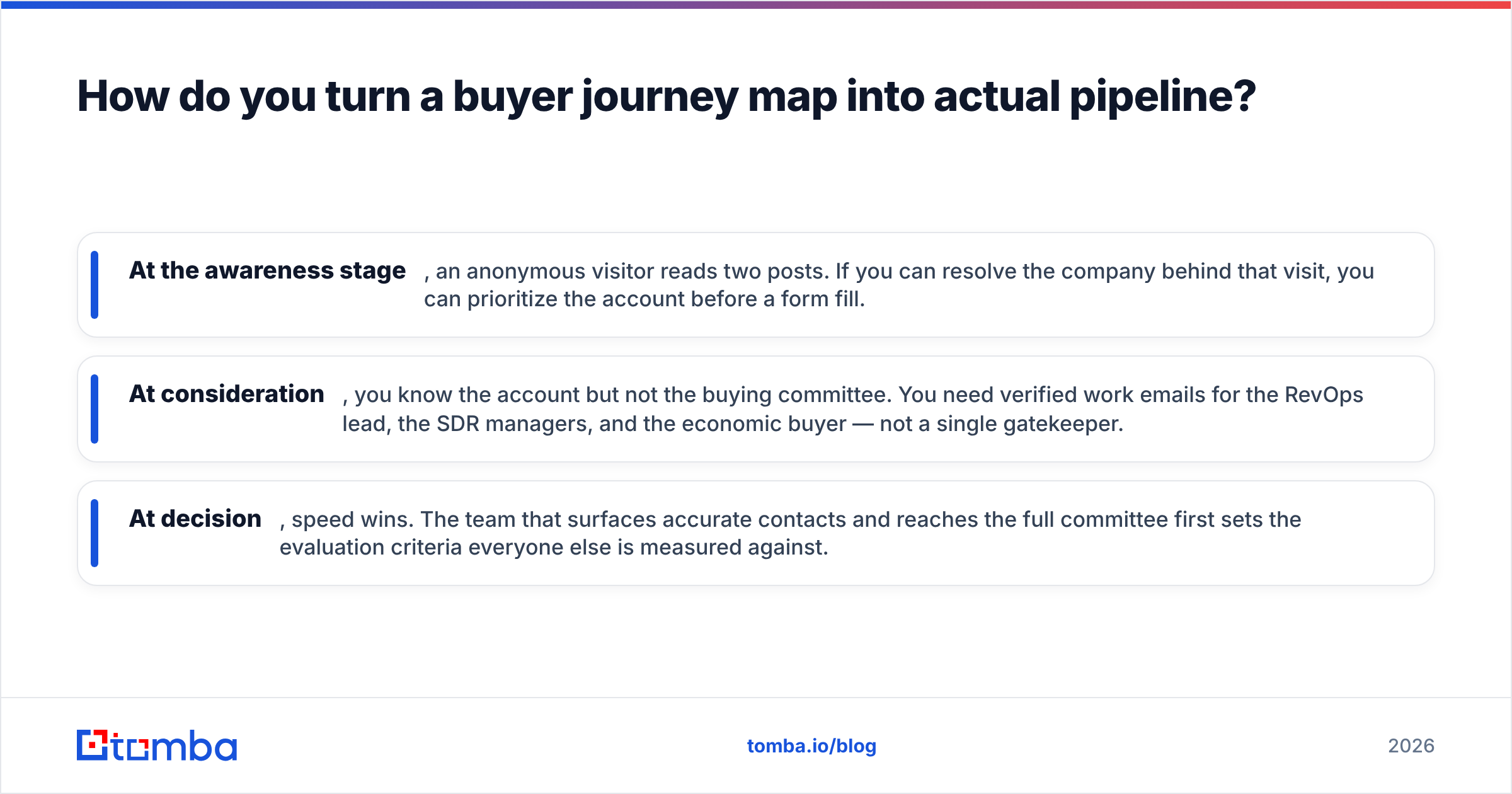
Walk it back through Dana's journey from the seller's side:
- At the awareness stage, an anonymous visitor reads two posts. If you can resolve the company behind that visit, you can prioritize the account before a form fill.
- At consideration, you know the account but not the buying committee. You need verified work emails for the RevOps lead, the SDR managers, and the economic buyer — not a single gatekeeper.
- At decision, speed wins. The team that surfaces accurate contacts and reaches the full committee first sets the evaluation criteria everyone else is measured against.
That is the difference between a journey map and a revenue engine: clean, current contact data at each handoff. A precise email finder turns "we know this account is interested" into "here are the five verified people to contact today." Layering in data enrichment fills the firmographic and role context your stage table depends on, so an SDR knows whether they are talking to a champion or a blocker.
Which tools fit which stage of the buyer journey?#
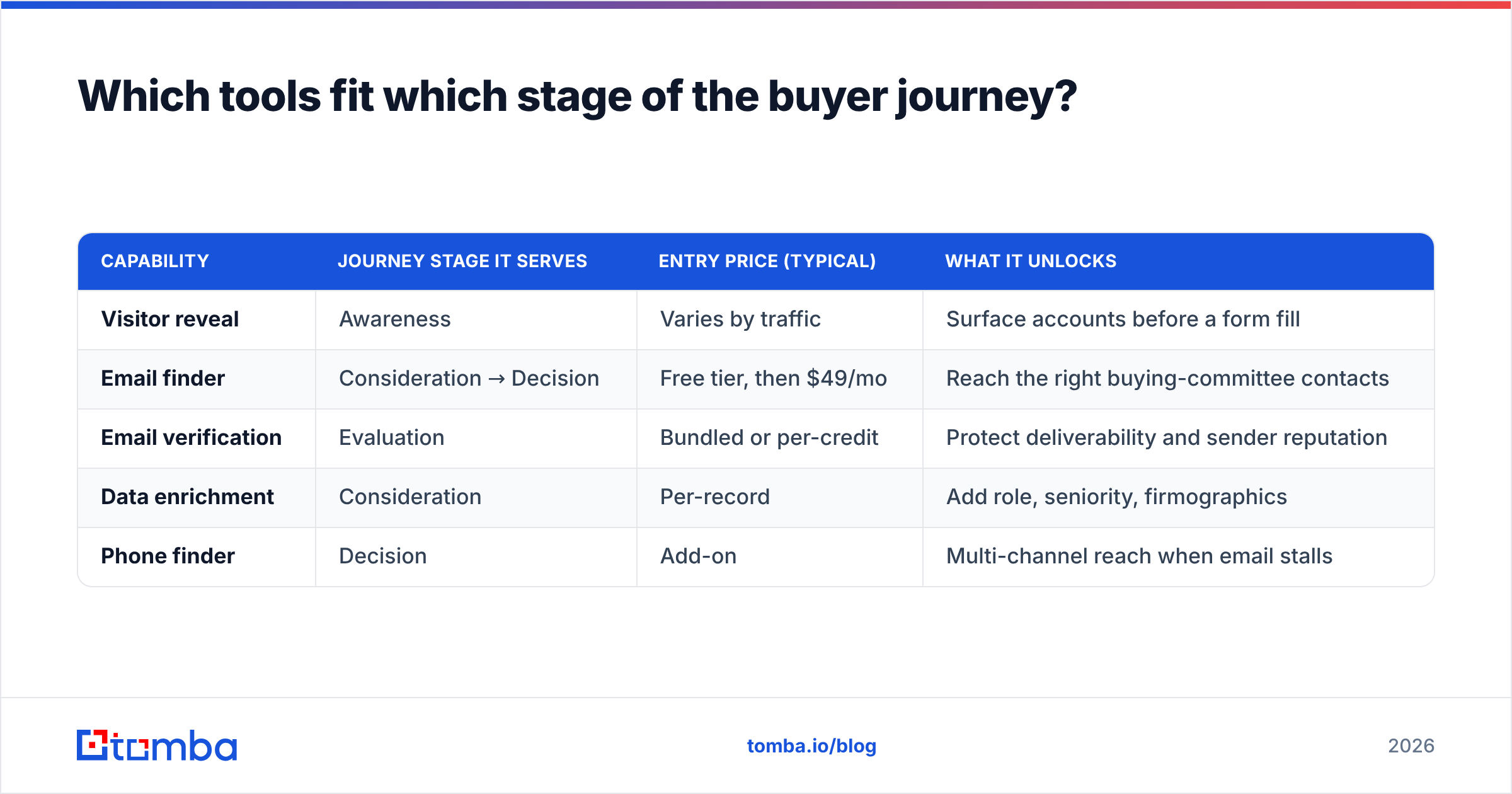
Not every tool belongs at every stage. Matching the job to the stage keeps your stack lean and your costs honest. Here is how common capabilities line up against Dana's journey, with rough monthly entry pricing for context.
| Capability | Journey stage it serves | Entry price (typical) | What it unlocks |
|---|---|---|---|
| Visitor reveal | Awareness | Varies by traffic | Surface accounts before a form fill |
| Email finder | Consideration → Decision | Free tier, then $49/mo | Reach the right buying-committee contacts |
| Email verification | Evaluation | Bundled or per-credit | Protect deliverability and sender reputation |
| Data enrichment | Consideration | Per-record | Add role, seniority, firmographics |
| Phone finder | Decision | Add-on | Multi-channel reach when email stalls |
For Tomba specifically, the pricing ladder is straightforward: a Free tier with 25 searches a month, Starter at $49/mo, Growth at $99/mo, Pro at $249/mo, and custom Enterprise. That free tier matters for the evaluation stage — Dana could run her real test data through it before spending a dollar, exactly the self-serve behavior modern buyers expect. Salesforce's own State of Sales reporting underscores the same point: reps win when they spend less time hunting for data and more time on the conversations that move deals.
What are the common mistakes in building a buyer journey example?#
Four traps show up again and again:
- Mapping your process, not their journey. If your stages are named "demo booked" and "proposal sent," you mapped your CRM, not the buyer's experience. Stages must describe what the buyer is thinking and feeling.
- Ignoring the committee. A journey built around one persona collapses the moment procurement or security enters. Map the group, and capture contacts for each role.
- Stale data at the handoff. A perfect map with a 28% bounce rate still fails. Verify contacts before outreach so deliverability does not sabotage the stage you worked to reach.
- Treating the journey as finished at purchase. Renewal and advocacy feed the next person's trigger stage. Dana's Slack comment is someone else's awareness moment.
Avoid these and your buyer journey example stops being a slide and starts being the operating manual for your go-to-market motion.
Where should you start mapping your own buyer journey?#
Start with one real won deal and one real lost deal. Reconstruct what actually happened at each stage — the triggers, the questions, the people, the data gaps. You will learn more from two true stories than from any generic template, and the pattern across a handful of deals becomes your repeatable model.
Then close the data gap that almost every team discovers in the exercise: you know which accounts are interested, but not who to contact or whether their details are accurate. That is exactly the bottleneck the Tomba Email Finder is built to remove. Find verified professional emails by domain, name, or company, enrich each contact with the role context your stage map needs, and hand your reps a clean list instead of a guess. Map the journey, then go reach the people in it — start free with 25 searches and see how fast a well-mapped journey turns into booked meetings.
Ready to find emails that actually work?
Join 150,000+ professionals who stopped guessing and started sending. Free credits on signup — no credit card required.
Get the Tomba newsletter
Practical outbound tactics and product updates — once every two weeks.
About the author