Buyer Journey Funnel: Map Stages to Pipeline in 2026
The buyer journey funnel shows how prospects move from first touch to signed deal. Here are the stages, the metrics that matter, and how to map them to your real pipeline in 2026.
TL;DR
- The buyer journey funnel is the path a prospect travels from first realizing they have a problem to choosing a vendor and buying — mapped as a narrowing funnel so you can measure drop-off at each step.
- It is not the same as your sales funnel. The buyer journey is what the customer experiences; the sales funnel is what your team does in response. Aligning the two is where revenue leaks get fixed.
- Most B2B funnels lose the most volume at two joints: awareness-to-consideration (you never get found) and evaluation-to-decision (you get shortlisted but lose the deal).
- Stage-by-stage conversion rates, velocity, and cost-per-stage are the only metrics worth obsessing over — vanity traffic numbers hide the real problem.
- Accurate contact data at the consideration and decision stages is the cheapest leverage you have. Reaching the right person at the right moment beats more top-of-funnel spend almost every time.
What is a buyer journey funnel?#
A buyer journey funnel is a model of how a person moves from "I might have a problem" to "I'll buy this solution," drawn as a funnel because fewer people remain at each step. Think of it like a hiking trail with checkpoints: everyone starts at the trailhead, but only some reach the summit, and you want to know exactly which checkpoint people quit at — and why.
The funnel framing matters because it forces a number onto every transition. If 1,000 people read your comparison article but only 40 request a demo, you have a 4% awareness-to-consideration rate, and now you can argue about whether that is good. Without the funnel, you just have "we get traffic" and "we get some demos" with no line connecting them.
The classic shape has three macro-zones — top, middle, and bottom of funnel (TOFU, MOFU, BOFU) — but the useful version breaks those into five behavioral stages. Buyers do not think in your marketing acronyms; they think in questions. Each stage is really a different question the buyer is trying to answer.
What are the stages of the buyer journey funnel?#
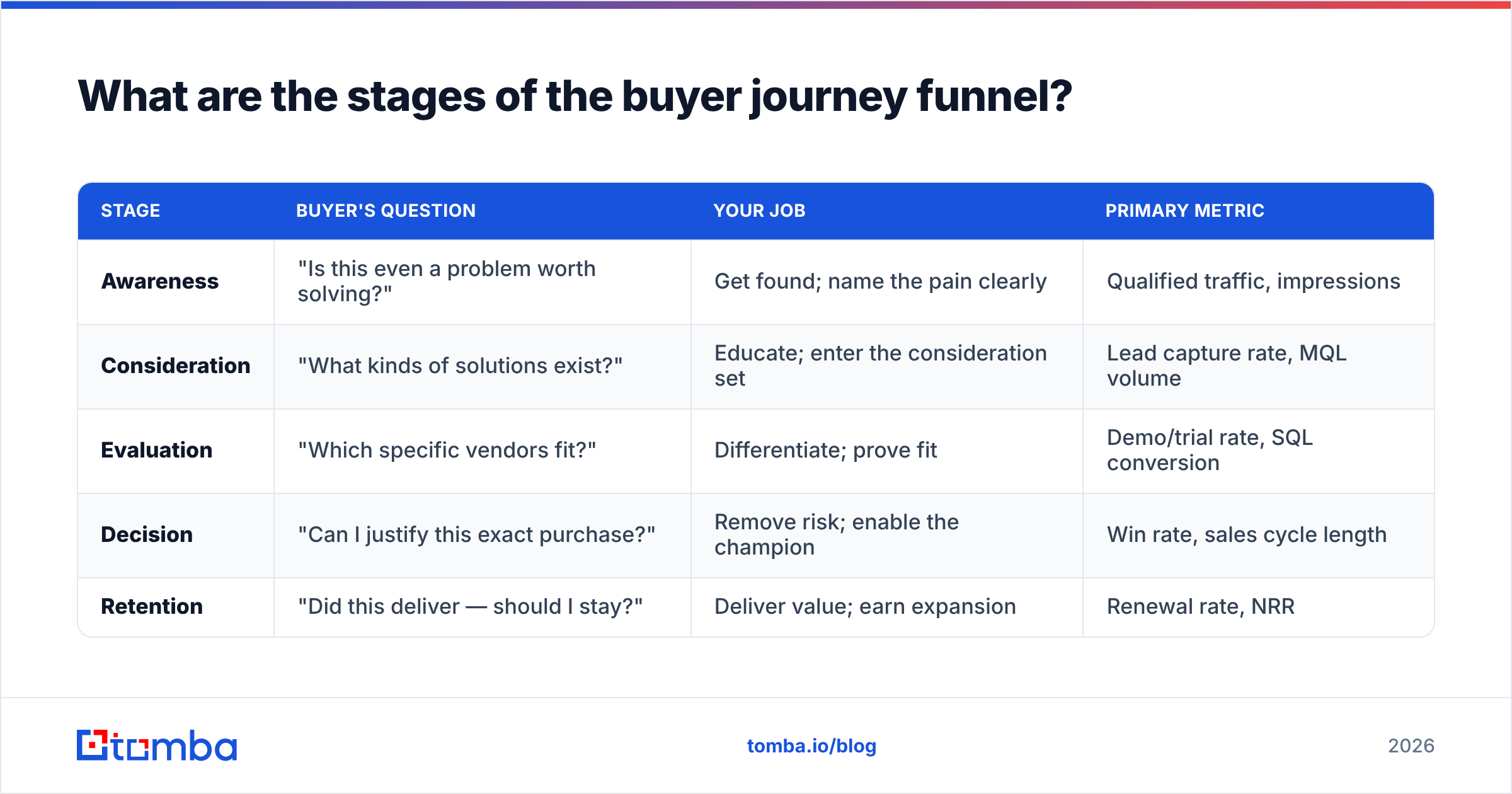
Here is the five-stage version most B2B teams actually run, with the buyer's underlying question and the conversion job at each step:
| Stage | Buyer's question | Your job | Primary metric |
|---|---|---|---|
| Awareness | "Is this even a problem worth solving?" | Get found; name the pain clearly | Qualified traffic, impressions |
| Consideration | "What kinds of solutions exist?" | Educate; enter the consideration set | Lead capture rate, MQL volume |
| Evaluation | "Which specific vendors fit?" | Differentiate; prove fit | Demo/trial rate, SQL conversion |
| Decision | "Can I justify this exact purchase?" | Remove risk; enable the champion | Win rate, sales cycle length |
| Retention | "Did this deliver — should I stay?" | Deliver value; earn expansion | Renewal rate, NRR |
A few things worth calling out. First, the funnel does not end at the sale. Retention and expansion are where B2B economics are actually won, and treating closed-won as the finish line is how you build a leaky bucket that needs ever-more top-of-funnel spend to stay full.
Second, buyers do not move through these stages in a clean line. Someone can jump from awareness straight to evaluation because a peer recommended you, or loop back from evaluation to consideration when a new requirement appears. The funnel is a measurement frame, not a literal description of one person's path. Gartner's research describes B2B buying as a set of "jobs" buyers revisit in loops rather than steps they climb once — design your funnel to tolerate that.
The Drake-meme version of this whole article: spraying a generic message at a purchased list is the rejected panel. Reaching a verified, role-matched contact at the evaluation stage is the approved one. Same effort, very different funnel math.
How is the buyer journey funnel different from a sales funnel?#
The buyer journey funnel describes the customer's experience; the sales funnel describes your internal process. They are two views of the same deal, and the gap between them is where forecasts go wrong.
- The buyer journey is owned by the buyer. It exists whether or not you do anything. Stages are defined by the buyer's mental state: aware, considering, evaluating, deciding.
- The sales funnel (or pipeline) is owned by you. Stages are defined by your actions and CRM fields: lead created, MQL, SQL, opportunity, proposal, closed.
- The marketing funnel is a third, narrower view focused on the demand-gen stages before sales gets involved.
Why does the distinction matter in practice? Because misalignment between the two produces a specific, recognizable failure: a deal sits in "proposal sent" in your CRM while the buyer is actually back at the consideration stage, quietly re-evaluating whether they need this category at all. Your stage says you are close. Their stage says you are not. The rep who maps both wins more often because they sell to where the buyer actually is, not where the pipeline field claims they are.
A simple alignment exercise: for every sales-funnel stage in your CRM, write down which buyer-journey stage it should correspond to, then audit ten recent deals to see whether reality matches. The mismatches are your highest-ROI process fixes.
Where do most buyers drop off in the funnel?#
Drop-off concentrates at two joints, and knowing which one is yours changes everything about where you spend.
The awareness-to-consideration joint is a visibility problem. Buyers have the problem but never encounter you while researching, so you are not in the consideration set at all. This is a content, SEO, and demand-creation issue. If your demo requests are low relative to your traffic, but your traffic itself is thin, you are losing here. The fix is upstream — more qualified reach, better positioning around the buyer's actual search language.
The evaluation-to-decision joint is a conviction problem. Buyers shortlist you, then stall or pick a competitor. This shows up as opportunities that reach "proposal" and die, long sales cycles, and "we decided to hold off." The fix is downstream — tighter qualification, better proof, champion enablement, and crucially, reaching the right people. Many BOFU deals stall not because the buyer said no but because the champion could not get the economic buyer and the security reviewer into the room.
That second joint is where contact data quietly decides outcomes. A deal needs three to seven stakeholders in most B2B purchases. If your champion is your only contact and they go quiet, the deal is dead — unless you can independently reach the VP of Finance or the IT lead. Being able to find email addresses and direct lines for the rest of the buying committee is not a top-of-funnel growth hack; it is decision-stage insurance.
How do you map the buyer journey funnel to your pipeline?#
Map it by defining an exit criterion for each stage — a specific, observable buyer action that proves they have actually moved, not just that time has passed.
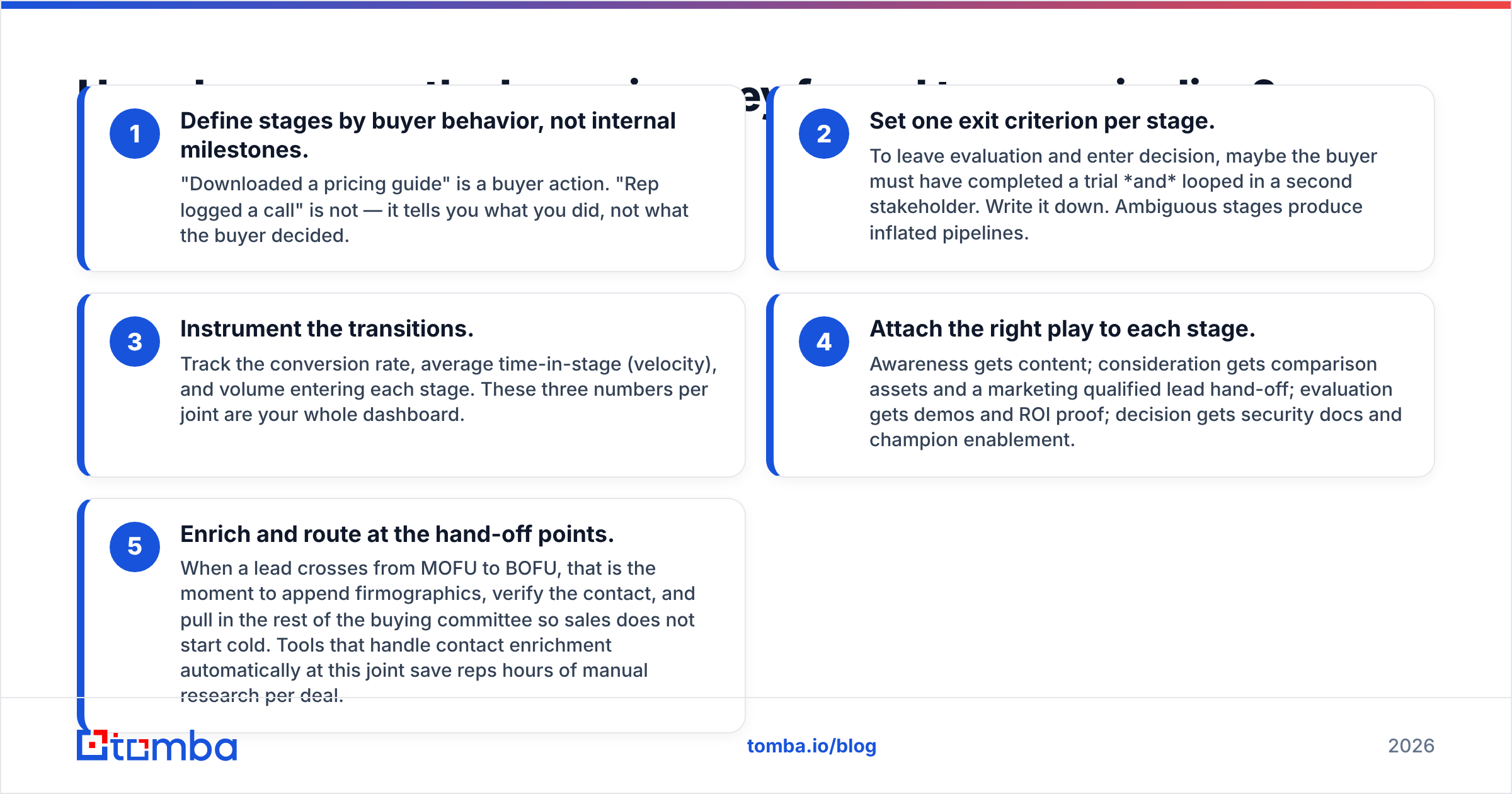
Use this five-step build:
- Define stages by buyer behavior, not internal milestones. "Downloaded a pricing guide" is a buyer action. "Rep logged a call" is not — it tells you what you did, not what the buyer decided.
- Set one exit criterion per stage. To leave evaluation and enter decision, maybe the buyer must have completed a trial and looped in a second stakeholder. Write it down. Ambiguous stages produce inflated pipelines.
- Instrument the transitions. Track the conversion rate, average time-in-stage (velocity), and volume entering each stage. These three numbers per joint are your whole dashboard.
- Attach the right play to each stage. Awareness gets content; consideration gets comparison assets and a marketing qualified lead hand-off; evaluation gets demos and ROI proof; decision gets security docs and champion enablement.
- Enrich and route at the hand-off points. When a lead crosses from MOFU to BOFU, that is the moment to append firmographics, verify the contact, and pull in the rest of the buying committee so sales does not start cold. Tools that handle contact enrichment automatically at this joint save reps hours of manual research per deal.
The discipline of exit criteria is what separates a funnel you can forecast from a funnel that is really just a wish list with stage labels. HubSpot's lifecycle-stage model is a reasonable off-the-shelf starting structure if you do not want to design stages from scratch — adapt the criteria to your sales motion rather than adopting the defaults blindly.
The temptation in the meme is the right one to give in to. The rep is supposed to be loyal to the old purchased cold list; the head-turn toward verified, current data is the upgrade every BOFU stage actually needs.
What metrics should you track at each funnel stage?#
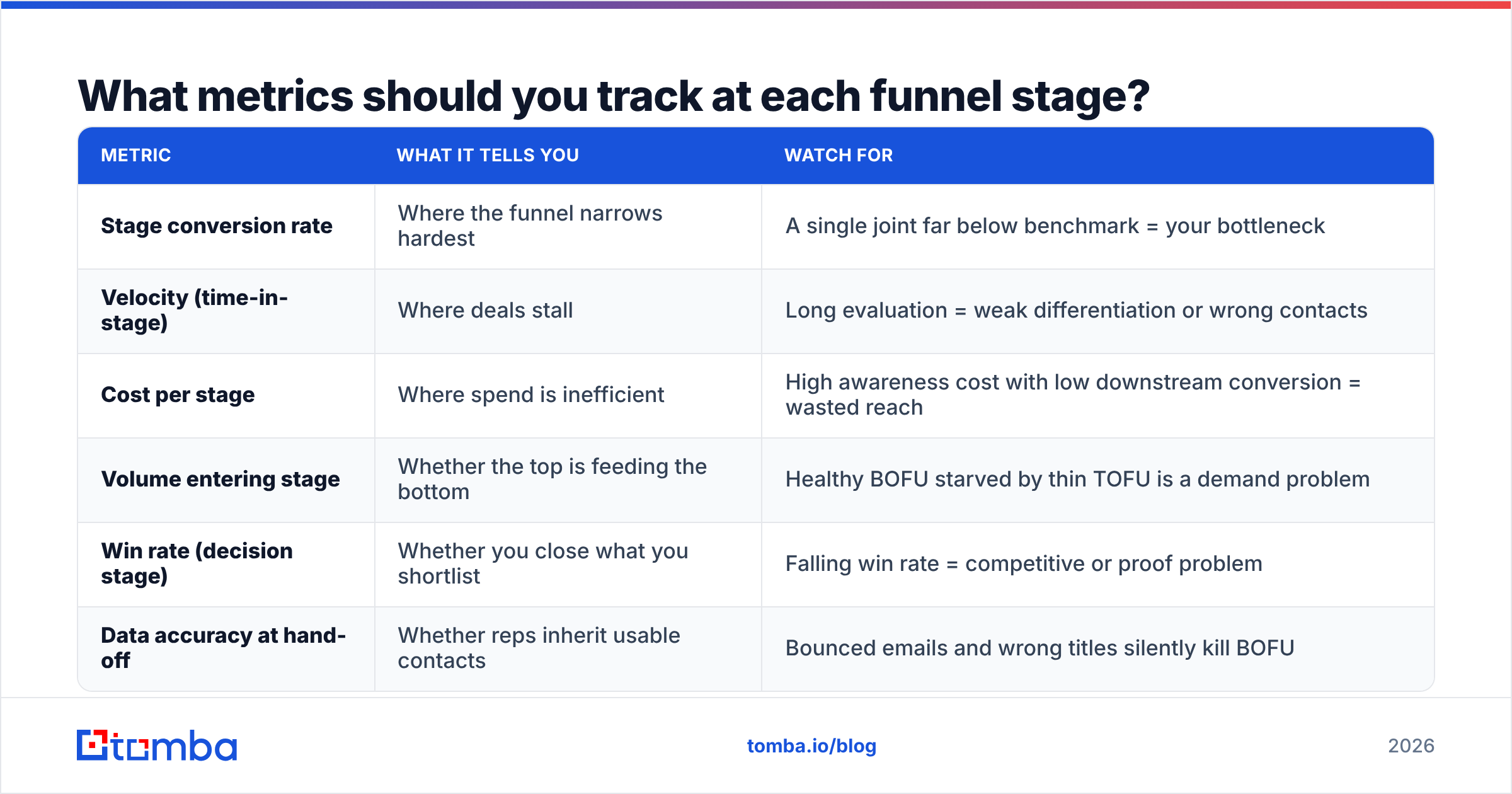
Track conversion rate, velocity, and cost — per stage, not just end-to-end. End-to-end numbers ("we close 2% of leads") average away the exact information you need.
| Metric | What it tells you | Watch for |
|---|---|---|
| Stage conversion rate | Where the funnel narrows hardest | A single joint far below benchmark = your bottleneck |
| Velocity (time-in-stage) | Where deals stall | Long evaluation = weak differentiation or wrong contacts |
| Cost per stage | Where spend is inefficient | High awareness cost with low downstream conversion = wasted reach |
| Volume entering stage | Whether the top is feeding the bottom | Healthy BOFU starved by thin TOFU is a demand problem |
| Win rate (decision stage) | Whether you close what you shortlist | Falling win rate = competitive or proof problem |
| Data accuracy at hand-off | Whether reps inherit usable contacts | Bounced emails and wrong titles silently kill BOFU |
That last row is underrated. If 20% of the contacts handed to sales bounce or have stale titles, your evaluation-to-decision rate will sag no matter how good the reps are — and the dashboard will blame the reps. Verifying contacts before the hand-off, ideally with a real-time email verifier, removes a failure mode that otherwise hides inside your conversion numbers and gets misdiagnosed as a sales-skill issue.
A practical rule: benchmark each stage against your own trailing three-month average, not against published industry numbers. Industry benchmarks vary wildly by deal size and motion, and peer-review aggregators like G2 show how differently a "good" funnel looks across categories. Your own historical baseline is the honest comparison.
How do you optimize a buyer journey funnel?#
Optimize the single worst joint first, then re-measure before touching anything else. Funnels tempt you to improve everything at once, which makes it impossible to learn what actually worked.
The sequence that works:
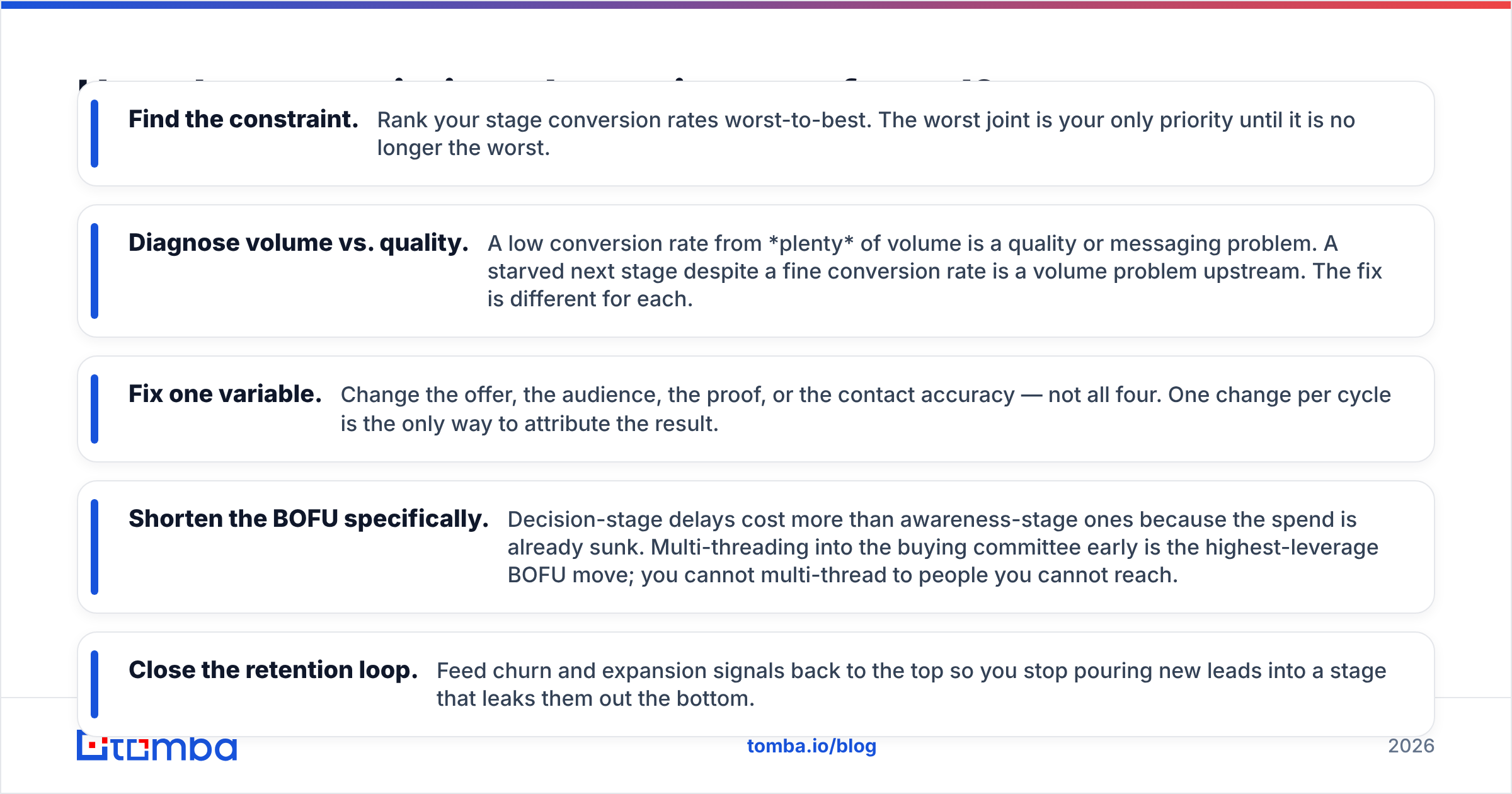
- Find the constraint. Rank your stage conversion rates worst-to-best. The worst joint is your only priority until it is no longer the worst.
- Diagnose volume vs. quality. A low conversion rate from plenty of volume is a quality or messaging problem. A starved next stage despite a fine conversion rate is a volume problem upstream. The fix is different for each.
- Fix one variable. Change the offer, the audience, the proof, or the contact accuracy — not all four. One change per cycle is the only way to attribute the result.
- Shorten the BOFU specifically. Decision-stage delays cost more than awareness-stage ones because the spend is already sunk. Multi-threading into the buying committee early is the highest-leverage BOFU move; you cannot multi-thread to people you cannot reach.
- Close the retention loop. Feed churn and expansion signals back to the top so you stop pouring new leads into a stage that leaks them out the bottom.
Notice how many of these come back to data. You can write better content and run cleaner demos, but if reps are working from guessed email patterns and outdated org charts, the evaluation and decision stages stay broken under everything else you fix. Clean, current, verified contact data is the boring layer that makes the exciting optimizations actually land.
Frequently asked questions#
Is the buyer journey funnel the same as AIDA? No, but they rhyme. AIDA (Attention, Interest, Desire, Action) is a century-old advertising model; the buyer journey funnel is a B2B-specific, measurable version with explicit stage exit criteria and a retention stage AIDA lacks.
How many stages should my funnel have? As many as map to distinct buyer behaviors you can observe and act on differently — usually four to six. More stages than you have plays for is just busywork in your CRM.
Does the funnel still apply when buying is non-linear? Yes, as a measurement frame. Buyers loop and skip, but you still need stage definitions to count drop-off. Treat the funnel as a scoreboard, not a script.
Where does contact data fit in the funnel? Everywhere, but it pays off most at evaluation and decision, where reaching the full buying committee with verified details directly moves win rate and cycle length.
Put accurate data behind every funnel stage#
A funnel is only as strong as the contacts moving through it. You can design perfect stages and still lose at the decision joint if your reps inherit bounced emails, missing stakeholders, and guessed job titles. That is the cheapest leak to plug and the one most teams ignore.
Tomba's Email Finder gives your funnel the data layer it needs: find verified professional emails by name, company, or domain, enrich the rest of the buying committee when a deal hits BOFU, and stop losing winnable evaluations to contacts you simply could not reach. Start free with 25 searches a month, then scale on the $49/mo Starter plan as your pipeline grows — review the full Tomba pricing to match a tier to your funnel volume. Map your stages, find your worst joint, and make sure data is never the reason a deal stalls.
// get started
Find, verify and enrich your first contacts today
Start on the free plan with 25 searches a month, then scale when your team is ready.
Free plan · No credit card required · GDPR & CCPA
// about the author