Buyer Motivation in 2026: What Actually Drives B2B Buyers
Buyer motivation is the real reason deals close or stall. Learn the emotional and rational triggers behind B2B purchases, how to map them, and how to act on them in 2026.
Most lost deals are not lost on price. They are lost because the seller never understood why the buyer was buying in the first place. Buyer motivation — the underlying mix of fear, ambition, status, and cold business logic that pushes someone to sign — is the single most useful thing you can know about a prospect, and the most commonly ignored.
This guide breaks down what buyer motivation actually is, the forces behind it, and how to map and act on it without turning your pipeline into a guessing game.
TL;DR#
- Buyer motivation is the combination of rational and emotional drivers that make a prospect act now instead of later (or never).
- Every B2B purchase has at least two motives: the business case (ROI, risk, efficiency) and the personal case (career safety, status, reduced stress).
- Motivation shifts by buying stage — awareness, consideration, decision — so the same message rarely works twice.
- You can infer motivation from observable signals: job changes, funding, tech adoption, content engagement, and timing.
- Tools that surface accurate contact and company data let you reach motivated buyers while the trigger is still fresh.
What is buyer motivation?#
Buyer motivation is the why behind a purchase — the reason a prospect moves money and political capital to solve a problem at a specific moment. Think of it like the difference between being hungry and standing in a restaurant. Plenty of people are hungry; only some walk in and order. The trigger that turns a vague need into a concrete action is motivation.
In B2B, that trigger is almost never one thing. A VP of Sales does not buy a prospecting platform because "it finds emails." They buy because their team missed quota last quarter, their CRO is asking hard questions, and a competitor just raised a round. The product is the vehicle; the motivation is the fuel.
Crucially, motivation is not the same as need. A company can need better data hygiene for years and do nothing. Need is chronic; motivation is acute. Your job in sales is to find prospects whose need has just become acute — and to frame your offer against the specific pressure they feel right now.
What are the main types of buyer motivation?#
B2B buyers run on two parallel tracks at once. The mistake is selling to only one of them.
- Rational / business motivation — Measurable outcomes the buyer can defend in a meeting: revenue lift, cost reduction, time saved, risk avoided, compliance met. This is what goes in the business case.
- Emotional / personal motivation — What the buyer privately wants: to look competent, to avoid blame, to reduce stress, to get promoted, to stop firefighting. This is what actually gets the deal prioritized.
- Social / status motivation — The desire to align with peers and category leaders ("companies like ours use this") or to be seen as innovative ahead of them.
- Loss-aversion motivation — The fear of falling behind, losing customers, or being the team that got breached. Behavioral research consistently shows losses loom larger than equivalent gains, which is why "what you'll lose by waiting" often outperforms "what you'll gain by buying."
The strongest pitches stack these. You give the champion a clean ROI story for the committee (rational) while quietly solving the thing that keeps them up at night (emotional). For a deeper academic grounding on how these drivers interact, the Harvard Business Review framework on the elements of B2B value is a useful reference.
How does buyer motivation change across the buying journey?#
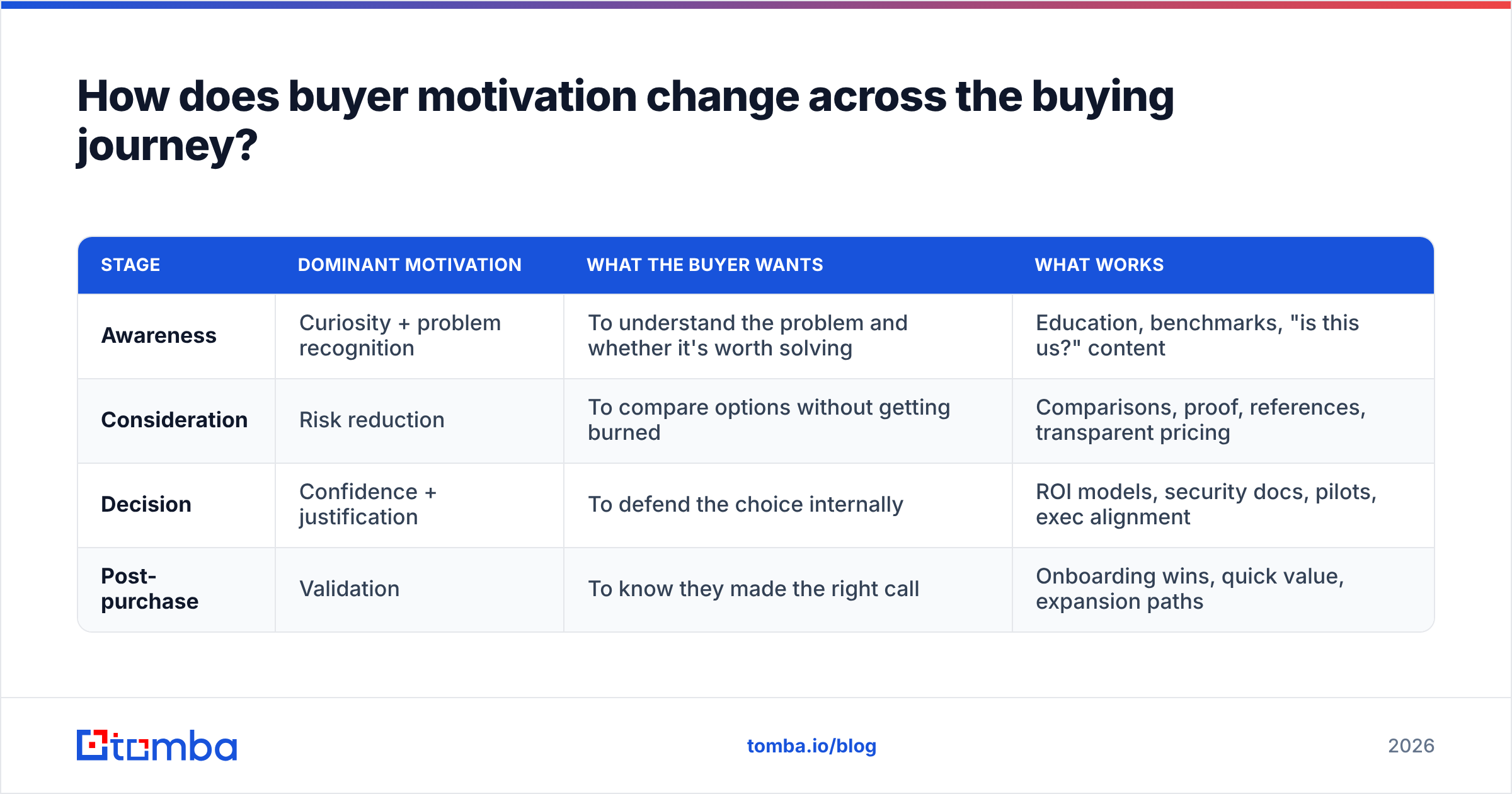
Motivation is not static. The same buyer wants different things at each stage, and pitching the decision-stage message to an awareness-stage prospect is the fastest way to get ignored.
| Stage | Dominant motivation | What the buyer wants | What works |
|---|---|---|---|
| Awareness | Curiosity + problem recognition | To understand the problem and whether it's worth solving | Education, benchmarks, "is this us?" content |
| Consideration | Risk reduction | To compare options without getting burned | Comparisons, proof, references, transparent pricing |
| Decision | Confidence + justification | To defend the choice internally | ROI models, security docs, pilots, exec alignment |
| Post-purchase | Validation | To know they made the right call | Onboarding wins, quick value, expansion paths |
Notice the shift: early on, buyers are motivated to learn; later, they are motivated to justify. If your outreach treats a curious researcher like a ready buyer, you create friction. Matching your message to the stage is the entire game, and it depends on knowing where the prospect actually is — which is where signal data comes in.
How do you identify what motivates a specific buyer?#
You rarely get to ask "what motivates you?" directly — and even if you did, buyers often can't articulate it. So you infer it from signals. Motivation leaves fingerprints.
- Job changes — A new VP in their first 90 days is motivated to make a visible impact. New leaders buy.
- Funding and growth events — A fresh raise creates pressure to deploy capital and hit aggressive targets fast.
- Hiring patterns — Ten new SDR reqs signal a motivation to scale outbound now.
- Tech-stack changes — Adopting a new CRM or sequencer hints at a broader GTM overhaul in motion.
- Content engagement — Repeated visits to a pricing page or a comparison post are loud intent signals.
- Trigger timing — Quarter-end, fiscal-year planning, and post-earnings windows all spike urgency.
Each signal is a hypothesis about motivation, not proof. But stacked together, they tell you who to call and what to lead with. A company that just raised a Series B and posted twelve sales roles is motivated by scale and speed — so you lead with how fast they can ramp, not with a granular feature tour.
To act on these signals you need accurate contact data fast, before the trigger goes cold. That's where an email finder and data enrichment turn a "this company looks motivated" hunch into an actual conversation with the right decision-maker. Layering in B2B phone numbers gives you a second channel when email alone isn't landing.
Rational vs. emotional motivation: which one closes the deal?#
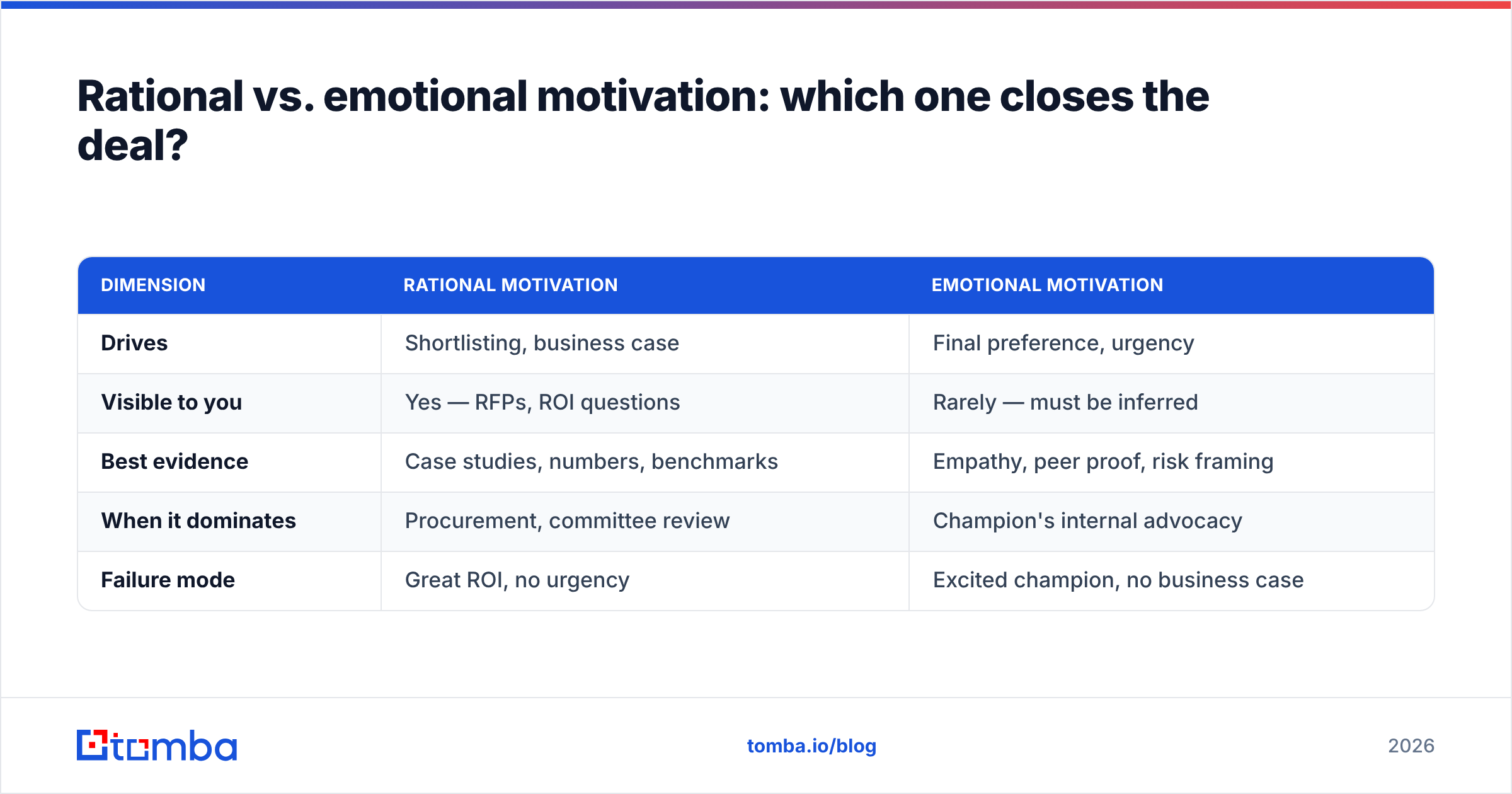
Both — but in a specific order. The emotional motive usually decides; the rational motive justifies. Buyers feel their way to a shortlist, then build the spreadsheet to defend the choice they already prefer.
| Dimension | Rational motivation | Emotional motivation |
|---|---|---|
| Drives | Shortlisting, business case | Final preference, urgency |
| Visible to you | Yes — RFPs, ROI questions | Rarely — must be inferred |
| Best evidence | Case studies, numbers, benchmarks | Empathy, peer proof, risk framing |
| When it dominates | Procurement, committee review | Champion's internal advocacy |
| Failure mode | Great ROI, no urgency | Excited champion, no business case |
The practical takeaway: arm your champion with rational ammunition for the committee, but win them emotionally first. A deal with a strong business case and a lukewarm champion stalls in legal forever. A deal with a fired-up champion and a thin business case dies in procurement. You need both, sequenced correctly.
This is also why response rates jump when your first touch names the buyer's specific pressure instead of your feature list. You are speaking to the emotional driver before the rational one has even been asked to engage.
How can you use buyer motivation in cold outreach?#
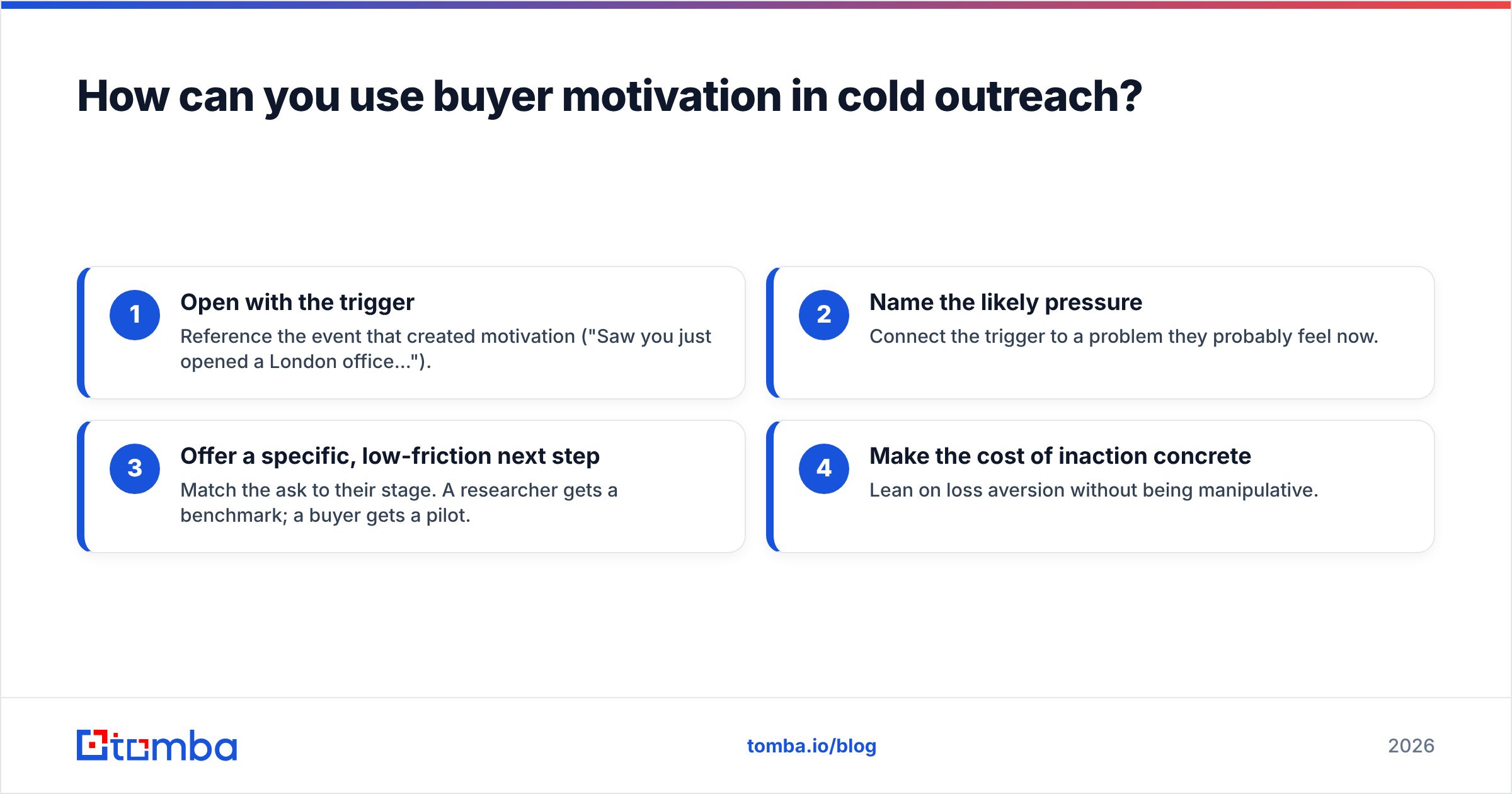
Generic outreach fails because it addresses an average buyer who doesn't exist. Motivation-led outreach addresses this buyer's current pressure. The structure is simple:
- Open with the trigger — Reference the event that created motivation ("Saw you just opened a London office...").
- Name the likely pressure — Connect the trigger to a problem they probably feel now.
- Offer a specific, low-friction next step — Match the ask to their stage. A researcher gets a benchmark; a buyer gets a pilot.
- Make the cost of inaction concrete — Lean on loss aversion without being manipulative.
The bottleneck is almost never the message — it's reaching the right person while the motivation is hot. A perfect motivation-led email sent to a generic info@ address, or to someone who left the company six months ago, converts nobody. Accurate, verified contact data is the difference between a timely, relevant touch and a bounced guess. Run your list through an email verifier before you send so your motivation-led copy actually lands in a real inbox and your sender reputation stays intact.
For the channel mechanics around all of this, the Gartner B2B buying research is worth reading — it documents how buyers now spend most of their journey not talking to vendors, which makes catching the motivation window even more important.
Tomba vs. generic prospecting: acting on motivation#
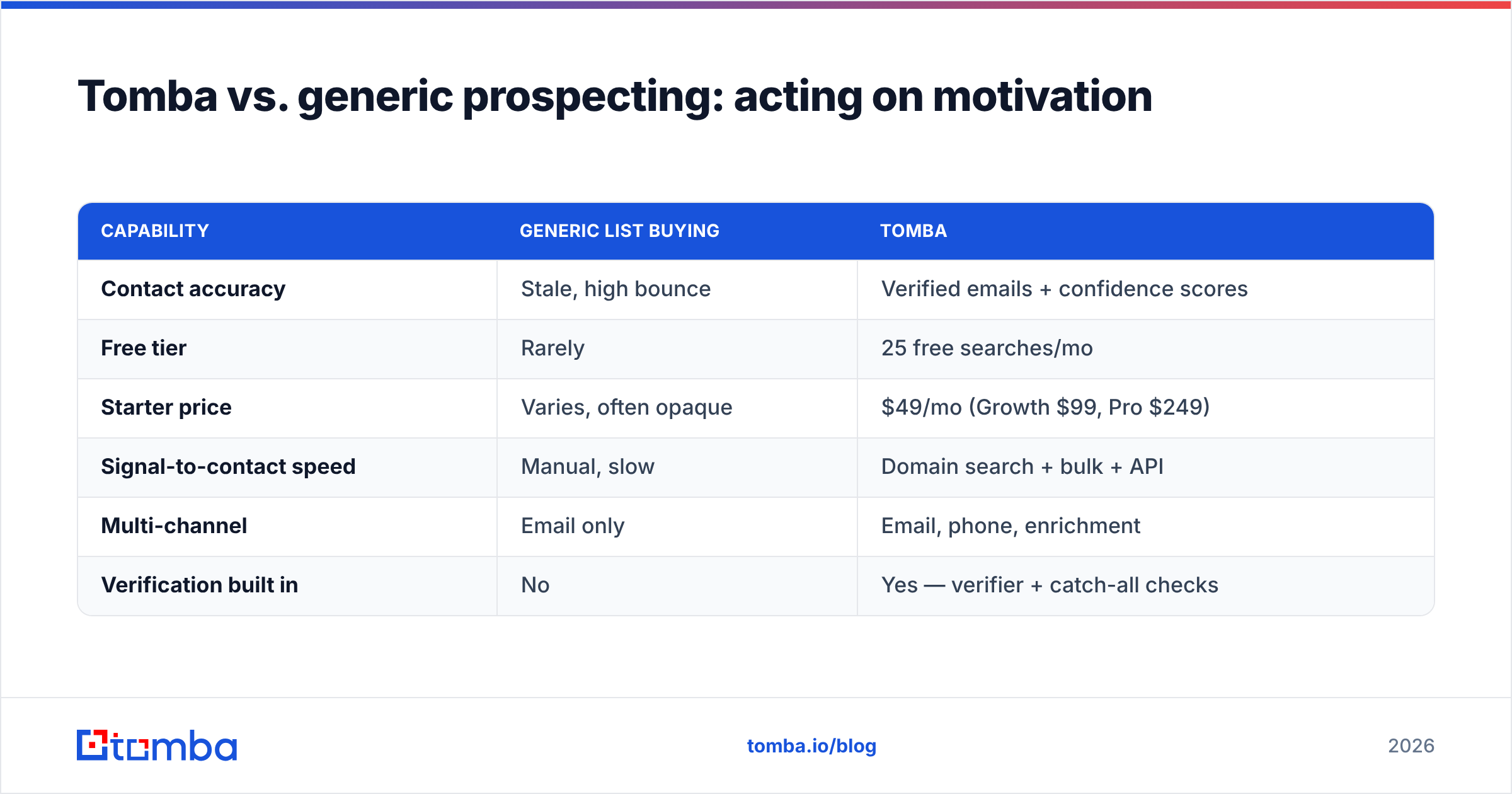
Knowing buyer motivation is useless if you can't reach the motivated buyer quickly. Here's how a data-led approach compares with the spray-and-pray default.
| Capability | Generic list buying | Tomba |
|---|---|---|
| Contact accuracy | Stale, high bounce | Verified emails + confidence scores |
| Free tier | Rarely | 25 free searches/mo |
| Starter price | Varies, often opaque | $49/mo (Growth $99, Pro $249) |
| Signal-to-contact speed | Manual, slow | Domain search + bulk + API |
| Multi-channel | Email only | Email, phone, enrichment |
| Verification built in | No | Yes — verifier + catch-all checks |
The point is not that data tools create motivation — they don't. They let you act on motivation that already exists, before a competitor does. You can review full Tomba pricing to match a plan to your outreach volume.
What are the most common mistakes with buyer motivation?#
- Assuming everyone is motivated. Most of your list isn't ready. Prioritize the few with active triggers.
- Selling features instead of pressure relief. Buyers don't want a product; they want their problem gone.
- Ignoring the personal motive. The business case alone rarely creates urgency.
- Treating motivation as permanent. Triggers decay. A 90-day-old funding event is far weaker than a 9-day-old one.
- Reaching out with bad data. The best message dies on a bounced or wrong contact.
Avoid these and your conversion math changes. You stop sending more to compensate for low relevance, and start sending less to people who actually want to hear from you.
Frequently asked questions#
Is buyer motivation the same as buyer intent? No. Intent is observable behavior (research, page visits) that signals motivation. Motivation is the underlying reason. Intent data is how you detect motivation at scale.
Can you create buyer motivation? You can amplify and surface it, but you can't manufacture it from nothing. Marketing and outreach reframe existing pressure and raise the cost of inaction — they rarely invent a need that wasn't latent.
How many motivations does a typical B2B deal have? At least two — a business case and a personal case — and in committee deals, often one set per stakeholder. Multi-threading exists precisely because motivations differ across the buying group.
Turn motivation into pipeline#
Buyer motivation is the highest-leverage thing you can understand about a prospect, but understanding it only pays off if you reach the right person while the trigger is still warm. That's a data problem as much as a messaging one.
The Tomba Email Finder lets you go from "this company just showed a buying signal" to a verified, ready-to-contact decision-maker in seconds — with a free tier of 25 searches a month and paid plans from $49/mo. Pair it with the email verifier to keep your sends clean, and spend your energy on the message instead of chasing dead addresses. Start with the free tier, find ten motivated buyers this week, and let your reply rate make the case.
Ready to find emails that actually work?
Join 150,000+ professionals who stopped guessing and started sending. Free credits on signup — no credit card required.
Get the Tomba newsletter
Practical outbound tactics and product updates — once every two weeks.
About the author