Buyer Persona Development: A Step-by-Step B2B Guide (2026)
Most B2B buyer personas are fiction. Here is a data-backed framework for buyer persona development that actually sharpens targeting, messaging, and pipeline in 2026.
TL;DR
- Buyer persona development is the process of turning real research into a small set of decision-making profiles your whole revenue team can act on — not a stock photo with a made-up name.
- Most B2B personas fail because they are built from internal opinion instead of interviews, CRM data, and verified contact behavior.
- A usable persona answers three things: who signs off, what triggers them to buy, and what objection kills the deal.
- Validate personas against closed-won and closed-lost data every quarter, or they rot.
- Personas are only as good as the contact data behind them — enrich and verify before you segment.
What is buyer persona development?#
Buyer persona development is the work of building semi-fictional profiles of your ideal buyers, grounded in real research, so that marketing, sales, and product can target the same person with the same message. Think of it like a casting brief for a film: the director does not just say "find an actor," they specify age, motivation, backstory, and the exact scene the character has to carry. A good persona does the same for your pipeline — it tells a rep who to call and why that person picks up.
The distinction that matters in B2B: you are rarely selling to one person. You are selling to a buying committee. Gartner has repeatedly found that a typical B2B purchase involves six to ten decision-makers, each armed with their own information. So "buyer persona development" in 2026 means profiling a set of roles — the economic buyer, the champion, the technical evaluator, the blocker — not a single avatar.
A persona is not your ideal customer profile. The ICP describes the company (industry, size, tech stack, revenue). The persona describes the human inside that company. You need both, and you build the persona second.
Why do most B2B buyer personas fail?#
They fail because they are invented in a conference room. Someone opens a slide template, types "Marketing Mary, age 38, likes yoga and data-driven decisions," and ships it. That persona has never been tested against a real conversation, so it predicts nothing.
Here are the failure modes I see most often:
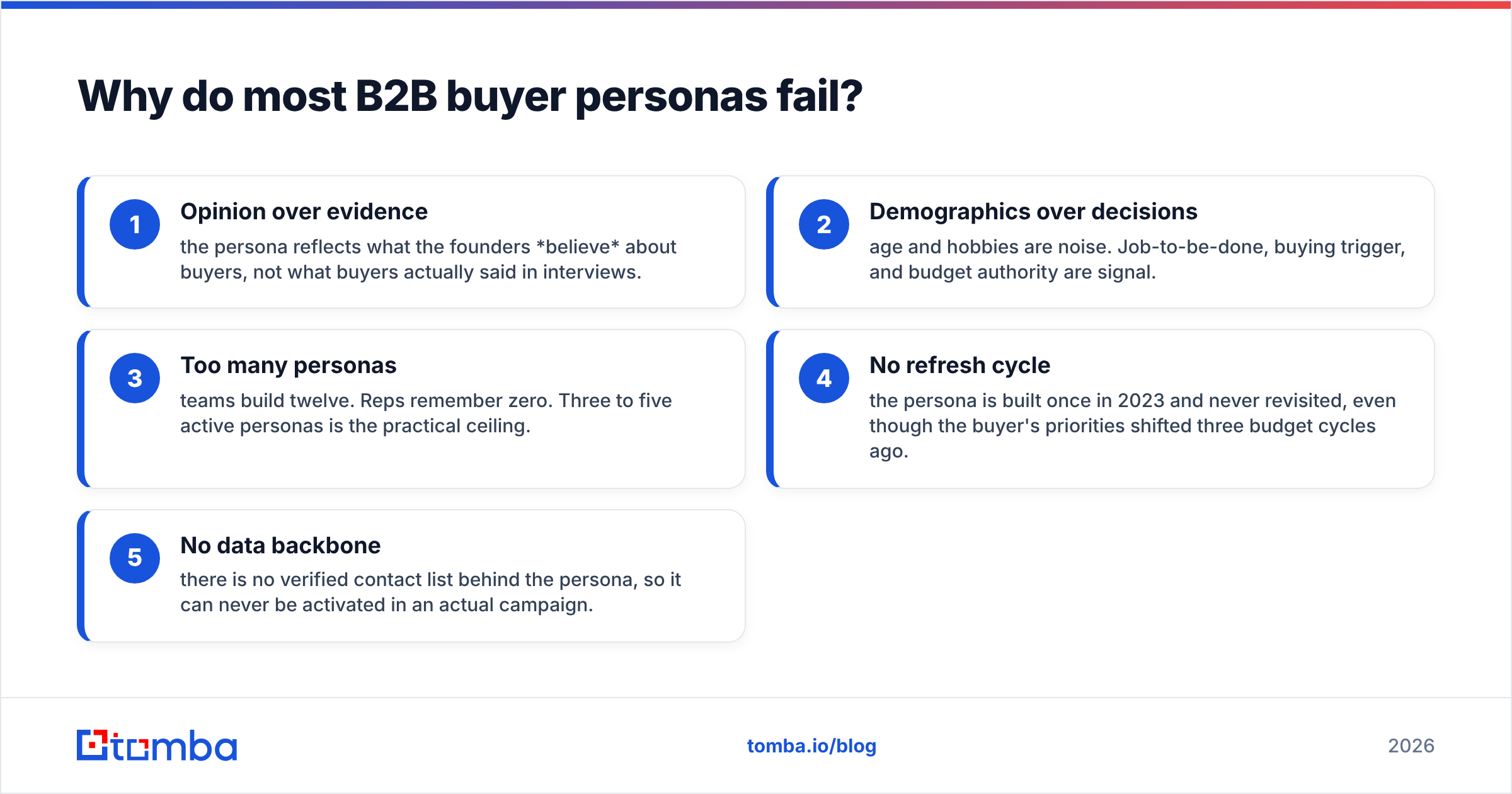
- Opinion over evidence — the persona reflects what the founders believe about buyers, not what buyers actually said in interviews.
- Demographics over decisions — age and hobbies are noise. Job-to-be-done, buying trigger, and budget authority are signal.
- Too many personas — teams build twelve. Reps remember zero. Three to five active personas is the practical ceiling.
- No refresh cycle — the persona is built once in 2023 and never revisited, even though the buyer's priorities shifted three budget cycles ago.
- No data backbone — there is no verified contact list behind the persona, so it can never be activated in an actual campaign.
That last point is where most persona projects quietly die. A persona document is useless if you cannot find and reach the people it describes. This is why persona work and contact data work belong in the same workflow: you define the role, then you use a domain search to pull the real people who hold that role at your target accounts.
What goes into a strong buyer persona?#
A persona should fit on one screen and answer the questions a rep actually asks before a call. Padding it with favorite-coffee trivia just buries the useful parts. Use a structured block like this:
- Role & seniority — exact titles, where they sit in the org, who they report to.
- Primary goal — the business outcome they are measured on this year.
- Buying trigger — the event that moves them from "fine" to "I need a solution now."
- Decision power — can they sign, recommend, or only veto?
- Objections — the two or three reasons they say no, in their words.
- Watering holes — where they actually learn (Slack communities, specific newsletters, LinkedIn, peer Slack groups) — not "the internet."
- Preferred channel — email, LinkedIn, phone, or a mix, with the format they tolerate.
Notice that none of those fields are guessable from a job title alone. Every one comes out of research, which is the next section.
How do you research buyer personas with real data?#
Conclusion first: combine qualitative interviews with quantitative CRM and contact data, then look for where they agree. Neither source is trustworthy alone — interviews are vivid but biased toward whoever agreed to talk, and CRM data is broad but mute on motivation.
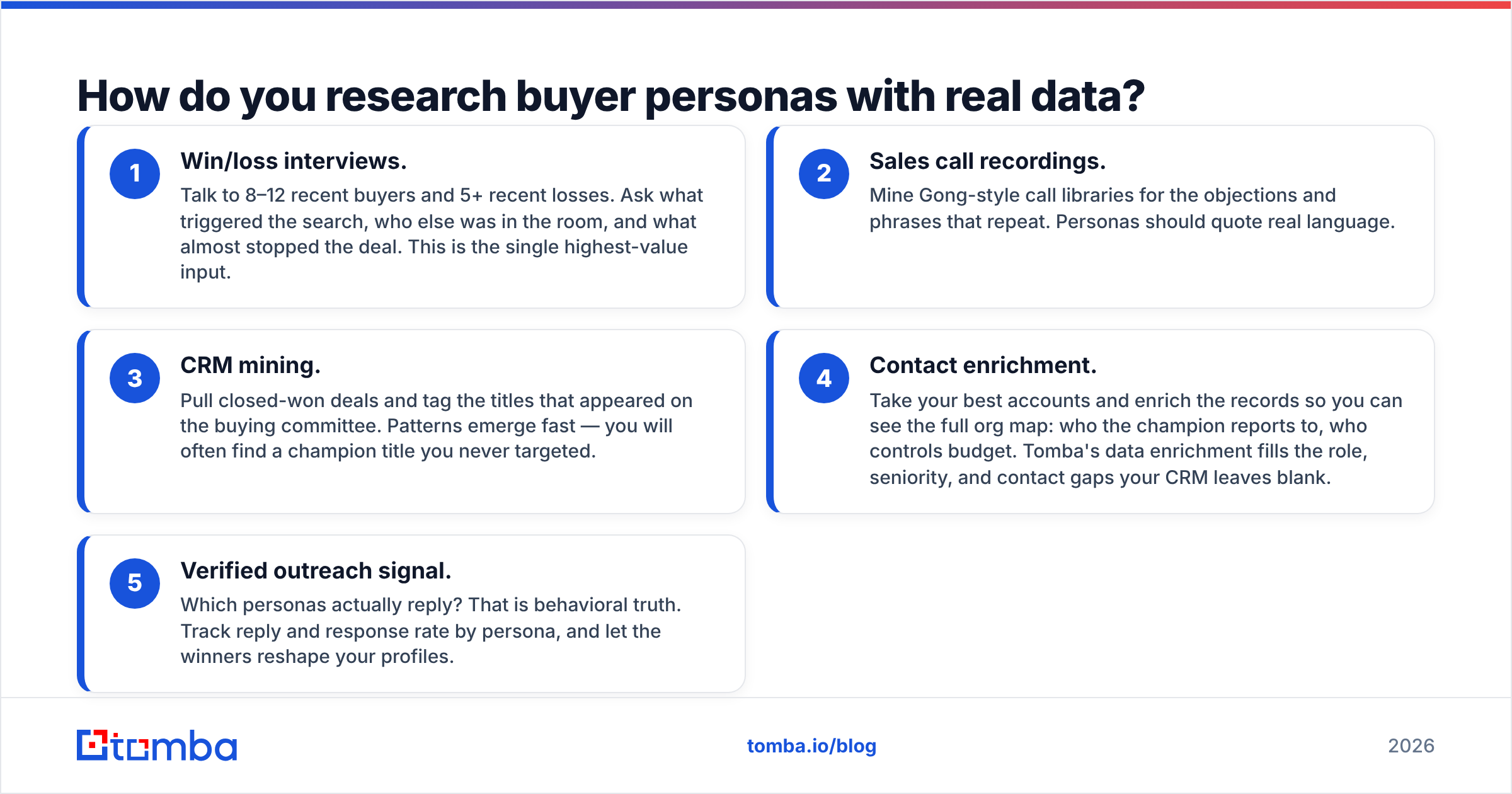
Run these five inputs in parallel:
- Win/loss interviews. Talk to 8–12 recent buyers and 5+ recent losses. Ask what triggered the search, who else was in the room, and what almost stopped the deal. This is the single highest-value input.
- Sales call recordings. Mine Gong-style call libraries for the objections and phrases that repeat. Personas should quote real language.
- CRM mining. Pull closed-won deals and tag the titles that appeared on the buying committee. Patterns emerge fast — you will often find a champion title you never targeted.
- Contact enrichment. Take your best accounts and enrich the records so you can see the full org map: who the champion reports to, who controls budget. Tomba's data enrichment fills the role, seniority, and contact gaps your CRM leaves blank.
- Verified outreach signal. Which personas actually reply? That is behavioral truth. Track reply and response rate by persona, and let the winners reshape your profiles.
The fifth input is the one teams skip, and it is the most honest. A persona that no one in that segment ever replies to is a hypothesis your market has already rejected.
How is buyer persona development different from ICP and segmentation?#
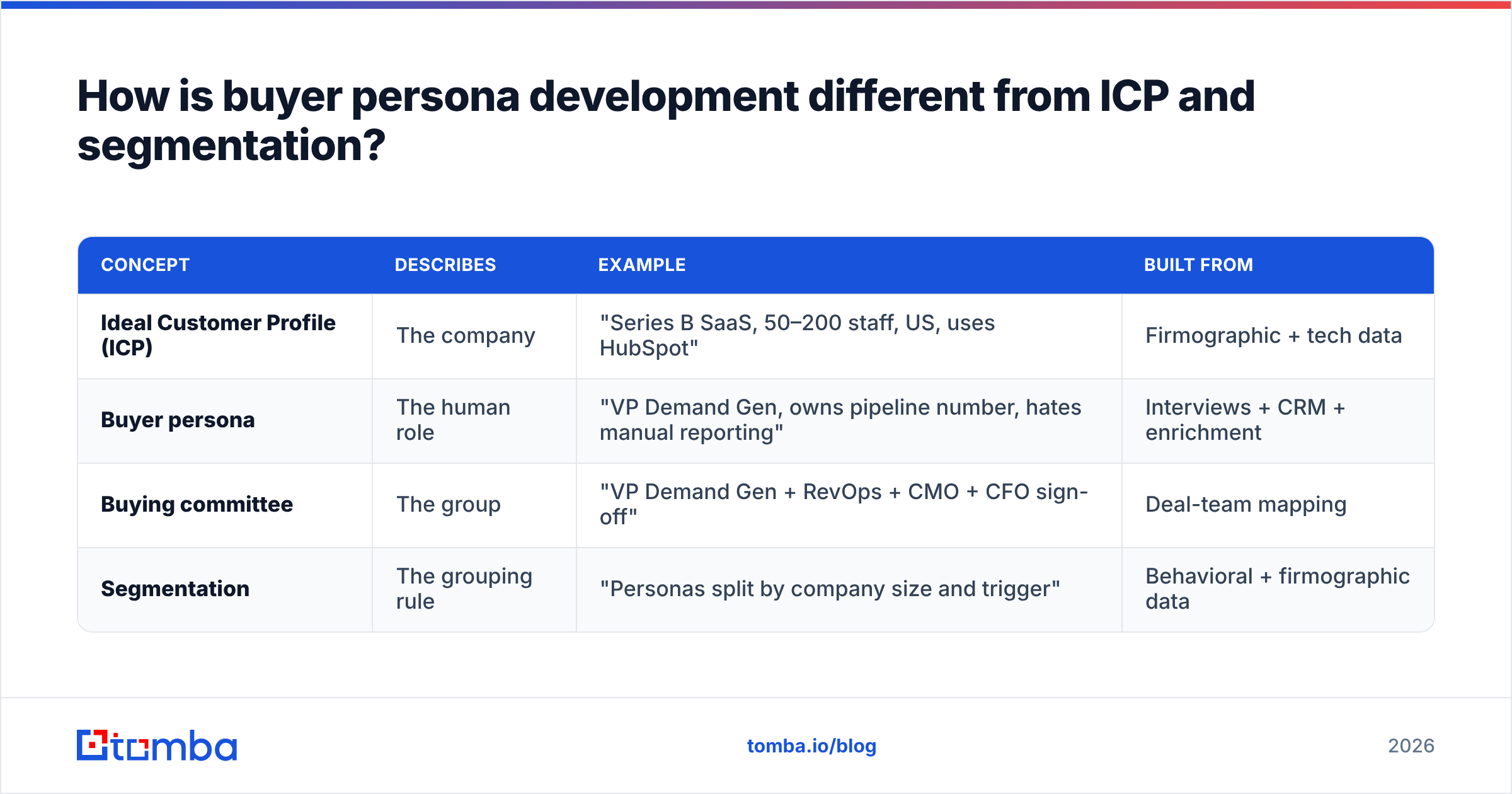
These three terms get used interchangeably and they should not be. Here is the clean separation:
| Concept | Describes | Example | Built from |
|---|---|---|---|
| Ideal Customer Profile (ICP) | The company | "Series B SaaS, 50–200 staff, US, uses HubSpot" | Firmographic + tech data |
| Buyer persona | The human role | "VP Demand Gen, owns pipeline number, hates manual reporting" | Interviews + CRM + enrichment |
| Buying committee | The group | "VP Demand Gen + RevOps + CMO + CFO sign-off" | Deal-team mapping |
| Segmentation | The grouping rule | "Personas split by company size and trigger" | Behavioral + firmographic data |
The workflow runs top to bottom: define the ICP, identify the personas inside it, map how those personas form a committee, then segment your outreach so each role gets a message tuned to them. Skip a layer and your messaging blurs — you end up sending the CFO a pitch written for the end user.
Buyer persona development: tools and pricing compared#
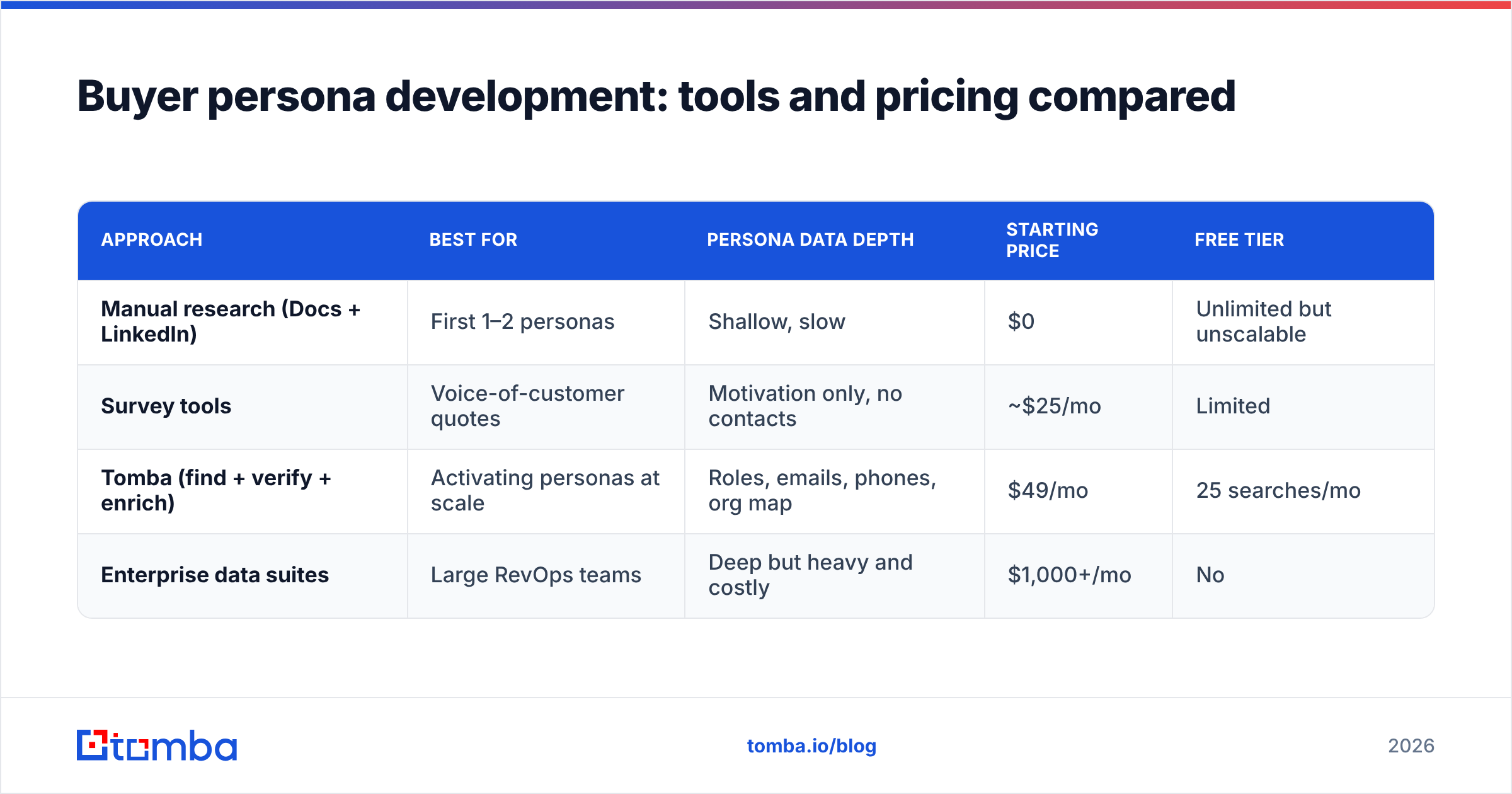
You can build personas in a Google Doc, but activating them — finding, enriching, and reaching the real people — needs tooling. Here is how common approaches compare for the data layer that sits under your personas:
| Approach | Best for | Persona data depth | Starting price | Free tier |
|---|---|---|---|---|
| Manual research (Docs + LinkedIn) | First 1–2 personas | Shallow, slow | $0 | Unlimited but unscalable |
| Survey tools | Voice-of-customer quotes | Motivation only, no contacts | ~$25/mo | Limited |
| Tomba (find + verify + enrich) | Activating personas at scale | Roles, emails, phones, org map | $49/mo | 25 searches/mo |
| Enterprise data suites | Large RevOps teams | Deep but heavy and costly | $1,000+/mo | No |
Tomba sits where most B2B teams actually operate: you need verified contact data behind every persona without an enterprise contract. The Tomba pricing tiers — Free (25 searches/mo), Starter $49/mo, Growth $99/mo, and Pro $249/mo — let you start small and scale persona activation as your account list grows. Compared with the $1,000+/mo enterprise suites, you get the find-verify-enrich loop without the procurement cycle.
A quick reality check on cost: if a persona project stalls because you cannot reach the people it describes, the cheapest research in the world produced zero pipeline. The data layer is not the place to cut.
How do you turn a persona into pipeline?#
A persona earns its keep only when it changes what a rep does on Monday. Here is the activation loop:
- Map the persona to real accounts. Take your ICP account list and, for each account, find the people who match each persona role. A bulk email finder turns a list of 500 target companies into a list of named, reachable champions and economic buyers.
- Verify before you send. Bounces destroy sender reputation and waste the persona work. Run the list through an email verifier so your carefully-targeted message actually lands.
- Write per-persona, not per-blast. The CFO message leads with risk and ROI; the practitioner message leads with time saved. Same product, two angles, because two personas.
- Sequence by channel preference. If the persona research said this role ignores email and lives on LinkedIn, route them through a LinkedIn finder and reach them where they read.
- Feed results back. Tag every reply and meeting by persona. After 60 days you will know which personas convert and which were wishful thinking.
This loop is also where personas stop being a marketing artifact and become a shared revenue asset. When SDRs, AEs, and demand gen all pull from the same persona definitions and the same verified data, your messaging stops contradicting itself across the funnel.
How often should you update buyer personas?#
Review lightly every quarter, rebuild every 12–18 months, and trigger an immediate refresh whenever a major signal changes. Personas are perishable — markets move, budget owners change, and a buying trigger that was urgent last year can become irrelevant after one economic shift.
Use these as forced refresh triggers:
- Win rate drops in a segment that used to convert — the persona's assumptions may be stale.
- A new title keeps appearing in closed-won committees that no persona covers.
- A product change opens a new use case and therefore a new buyer.
- Reply rates fall for a persona despite the same messaging — the role's priorities likely shifted.
Tie the refresh to data you already collect. If you track win rate and response rate by persona, the system tells you which profiles are decaying without you having to guess. That is the difference between personas as a living model and personas as a slide that gets copied forward every year unchanged.
What does a finished buyer persona look like?#
Short, specific, and quotable. Here is a compressed example for a single role:
- Persona: "RevOps Rachel" — Director of Revenue Operations
- Goal: Clean pipeline data and accurate forecasting; measured on forecast accuracy.
- Trigger: A blown forecast in front of the board, or a CRM migration.
- Power: Recommends and shortlists; CFO signs.
- Objection: "We already have too many tools — why another one?"
- Channel: Email first, then LinkedIn; ignores cold calls.
- Message angle: Consolidation and data accuracy, not feature lists.
Every field there came from research and can be acted on tomorrow. Compare that to "Rachel, 41, enjoys hiking" — one drives a campaign, the other drives nothing.
Putting it into practice#
Strong buyer persona development is a loop, not a document: research real buyers, build a tight set of role-based profiles, activate them against verified contact data, measure which ones convert, and refresh on signal. Skip the data layer and even brilliant personas stay theoretical.
If you are ready to turn your personas into reachable, verified contacts, start with the Tomba Email Finder. Define the role, pull the real people who hold it at your target accounts, verify the addresses, and feed them straight into outreach — the missing bridge between a persona slide and actual pipeline. The free tier gives you 25 searches to test it against your own ICP before you commit. Build the persona, then go find the person.
Ready to find emails that actually work?
Join 150,000+ professionals who stopped guessing and started sending. Free credits on signup — no credit card required.
Get the Tomba newsletter
Practical outbound tactics and product updates — once every two weeks.
About the author