Buyer Persona Examples: 7 B2B Templates That Convert in 2026
Real B2B buyer persona examples you can copy today — templates for SaaS, agencies, and sales teams, plus how to build data-backed personas that actually drive pipeline.
TL;DR
- A buyer persona is a semi-fictional profile of your ideal customer, built from real data — not a vibe you invented in a meeting.
- This guide gives you 7 copy-ready buyer persona examples for B2B SaaS, agencies, and sales-led teams, plus a fill-in template.
- The difference between a persona that drives pipeline and one that gathers dust is data: firmographics, job signals, and verified contact details.
- Personas without contact data are wall art. Pair each persona with enriched, verified records so your team can actually reach the people you described.
- Use the framework at the end to build your own in under an hour, then validate it against your closed-won deals.
What is a buyer persona, and why do most of them fail?#
A buyer persona is a research-based profile of the person who makes or influences the decision to buy your product. Think of it like a casting brief for a film: before you write a single line of outreach, you decide exactly who you're casting in the "buyer" role — their job, their pressures, their budget, and the words they actually use. Technically, it's a structured summary of firmographic, demographic, and psychographic attributes that represents a segment of your market.
Most personas fail for one reason: they're fiction with no data behind them. A team spends an afternoon inventing "Marketing Mary, 34, likes yoga and hates spreadsheets," pins it to Notion, and never looks at it again. It doesn't tell a rep who to call, doesn't tell marketing which list to build, and doesn't map to anything in the CRM.
A good persona does the opposite. It's specific enough that you can build a target list from it, and it's grounded in patterns from your real customers. According to HubSpot's research on personas, the strongest personas combine interview insights with hard account data — exactly the inputs B2B teams already have sitting in their pipeline.
)
What goes into a B2B buyer persona?#
Before the examples, here's the anatomy. A persona that a sales or growth team can actually use has six layers:
- Role and seniority — exact job titles, decision-making power, and where they sit in the buying committee (champion, economic buyer, blocker).
- Firmographics — company size, industry, revenue band, tech stack, and growth stage. This is what makes a B2B persona different from a B2C one.
- Goals and KPIs — what this person is measured on. A VP of Sales is graded on win rate; a RevOps lead is graded on data hygiene and forecast accuracy.
- Pains and triggers — the problem that pushes them to evaluate a tool, and the event (new funding, a bad quarter, a tooling migration) that starts the search.
- Objections and buying process — how they evaluate, who signs off, and the reasons they say no.
- Where to reach them — channels, communities, and the verified contact details (email, phone, LinkedIn) that let you act on everything above.
That last layer is where personas usually break. You can describe "Demand-Gen Dana" in perfect detail, but if you can't find Dana's email or direct dial, the persona is decoration. This is why pairing personas with data enrichment and a reliable email finder turns a profile into a prospecting list.
What are some real buyer persona examples?#
Here are seven persona examples across common B2B motions. Each is condensed to the fields that matter for targeting. Copy the structure, swap in your own data.
Example 1 — "Scaling Sam," VP of Sales at a Series B SaaS company#
- Role: VP of Sales / CRO, owns the number, reports to CEO.
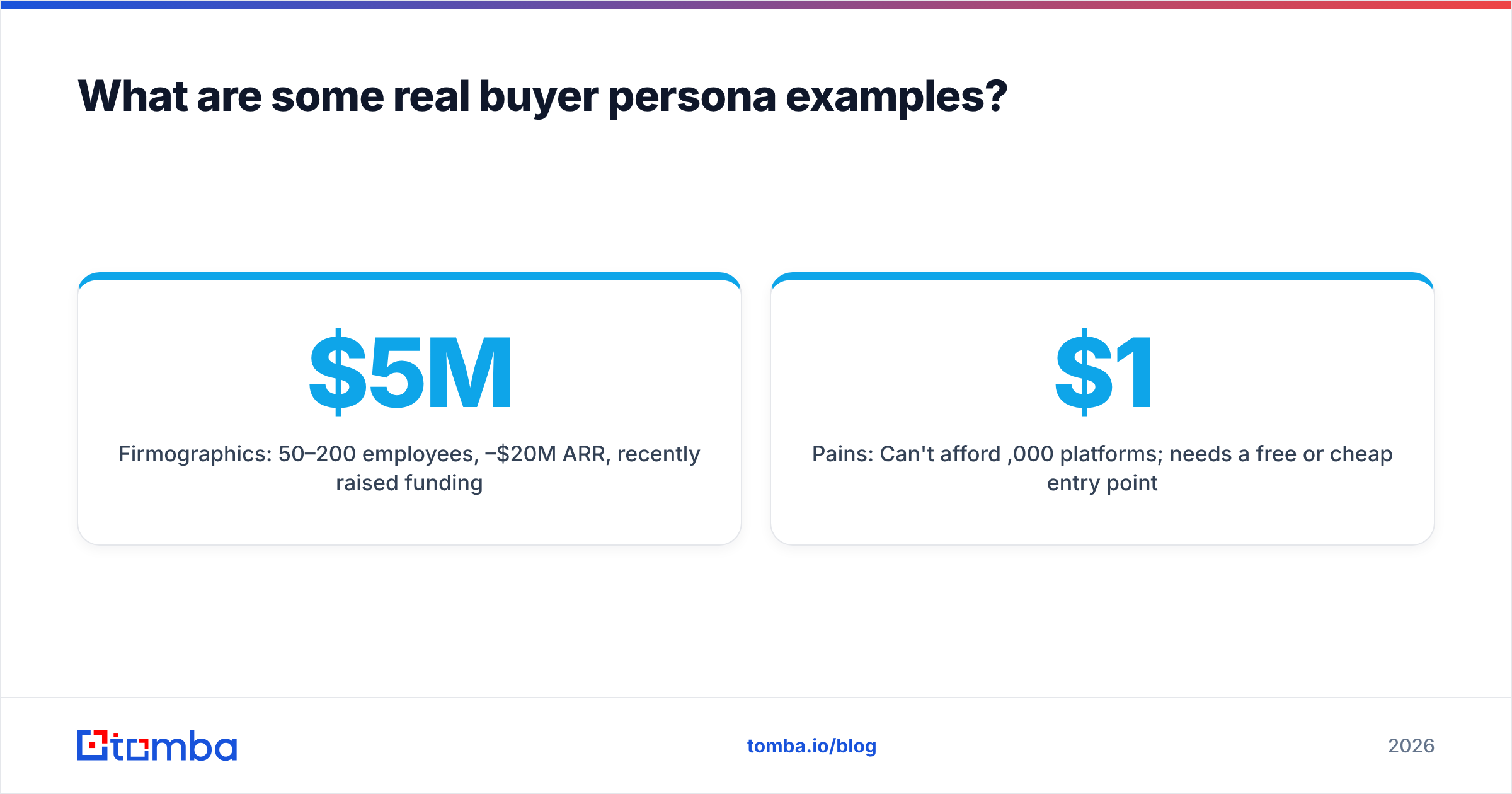
- Firmographics: 50–200 employees, $5M–$20M ARR, recently raised funding.
- Goals: Hit aggressive new-logo targets, ramp reps faster, improve win rate.
- Pains: Reps waste hours on bad data; pipeline coverage is thin; forecasts slip.
- Trigger: New funding round or a missed quarter.
- Reach: LinkedIn, sales communities (Pavilion, RevGenius), direct email and mobile.
Example 2 — "RevOps Riley," Revenue Operations Manager#
- Role: RevOps / Sales Ops, influences tooling, owns CRM hygiene.
- Firmographics: 100–500 employees, mature GTM stack.
- Goals: Clean data, accurate routing, fewer tools that don't talk to each other.
- Pains: Duplicate records, decayed contacts, manual enrichment.
- Trigger: CRM migration, a new VP demanding better forecasts.
- Reach: Email, Slack communities, revenue operations forums.
Example 3 — "Agency Alex," Founder of a 10-person lead-gen agency#
- Role: Owner/operator, buys tools that affect margin directly.
- Firmographics: Sub-25 employees, services multiple clients, price-sensitive.
- Goals: Deliver more qualified leads per client without growing headcount.
- Pains: Per-seat pricing, credit limits, juggling tools across client accounts.
- Trigger: Onboarding a new client or losing one to poor results.
- Reach: Twitter/X, agency Slack groups, cold email.
Example 4 — "Recruiter Robin," Talent Acquisition Lead#
- Role: In-house recruiter or staffing-firm sourcer.
- Firmographics: Any size, high-volume hiring teams.
- Goals: Reach passive candidates faster than competitors.
- Pains: LinkedIn InMail limits, missing personal contact info.
- Trigger: A hard-to-fill role or a hiring spike.
- Reach: LinkedIn, candidate email and phone via a phone finder.
Example 5 — "Founder Fran," Early-stage bootstrapped SaaS founder#
- Role: CEO who is also head of sales for now.
- Firmographics: 1–10 employees, pre–Series A, no budget for enterprise tools.
- Goals: Book first 50 customers, validate ICP, keep costs low.
- Pains: Can't afford $1,000/mo platforms; needs a free or cheap entry point.
- Trigger: Launch, or running out of warm intros.
- Reach: Indie Hackers, X, direct outreach.
Example 6 — "Enterprise Erin," Director of Demand Generation#
- Role: Demand gen leader at a large org, part of a buying committee.
- Firmographics: 1,000+ employees, formal procurement.
- Goals: Feed MQLs to sales, prove ROI, scale ABM.
- Pains: Data privacy/compliance, integrating tools with Salesforce.
- Trigger: Annual budget cycle, a new ABM mandate.
- Reach: Webinars, Gartner/Forrester reports, gated content.
Example 7 — "Skeptic Steve," IT/Security gatekeeper#
- Role: Not the buyer — the blocker. Reviews data sourcing and compliance.
- Firmographics: Mid-market and up.
- Goals: Avoid risk; ensure any vendor handles data responsibly.
- Pains: Shadow IT, unvetted data vendors, GDPR exposure.
- Trigger: A security review triggered by a new tool request.
- Reach: Won't respond to cold outreach — address in your messaging instead.
How do these buyer persona examples compare?#
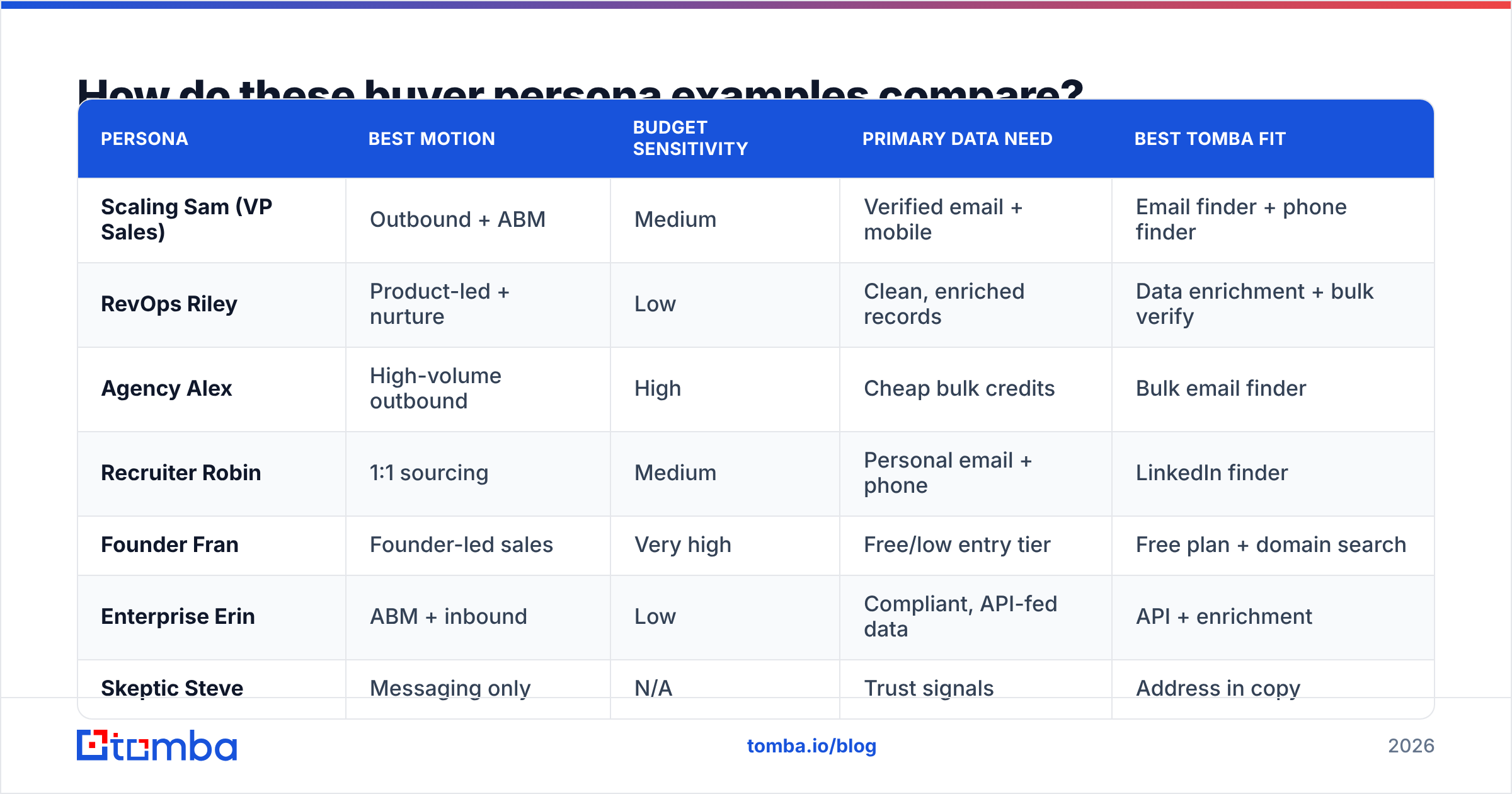
Not every persona deserves the same play. Here's how the seven map to motion, budget, and the data you need to reach them.
| Persona | Best motion | Budget sensitivity | Primary data need | Best Tomba fit |
|---|---|---|---|---|
| Scaling Sam (VP Sales) | Outbound + ABM | Medium | Verified email + mobile | Email finder + phone finder |
| RevOps Riley | Product-led + nurture | Low | Clean, enriched records | Data enrichment + bulk verify |
| Agency Alex | High-volume outbound | High | Cheap bulk credits | Bulk email finder |
| Recruiter Robin | 1:1 sourcing | Medium | Personal email + phone | LinkedIn finder |
| Founder Fran | Founder-led sales | Very high | Free/low entry tier | Free plan + domain search |
| Enterprise Erin | ABM + inbound | Low | Compliant, API-fed data | API + enrichment |
| Skeptic Steve | Messaging only | N/A | Trust signals | Address in copy |
The pattern is clear: the persona defines the play, and the play defines the data you need to source. A founder on a budget needs a free tier and a fast domain search; an enterprise demand-gen lead needs an email finder API that pipes verified records straight into Salesforce.
)
How do you build your own buyer persona from data?#
Conclusion first: start from your closed-won deals, not your imagination. Your best customers already tell you who to target — you just have to read the pattern.
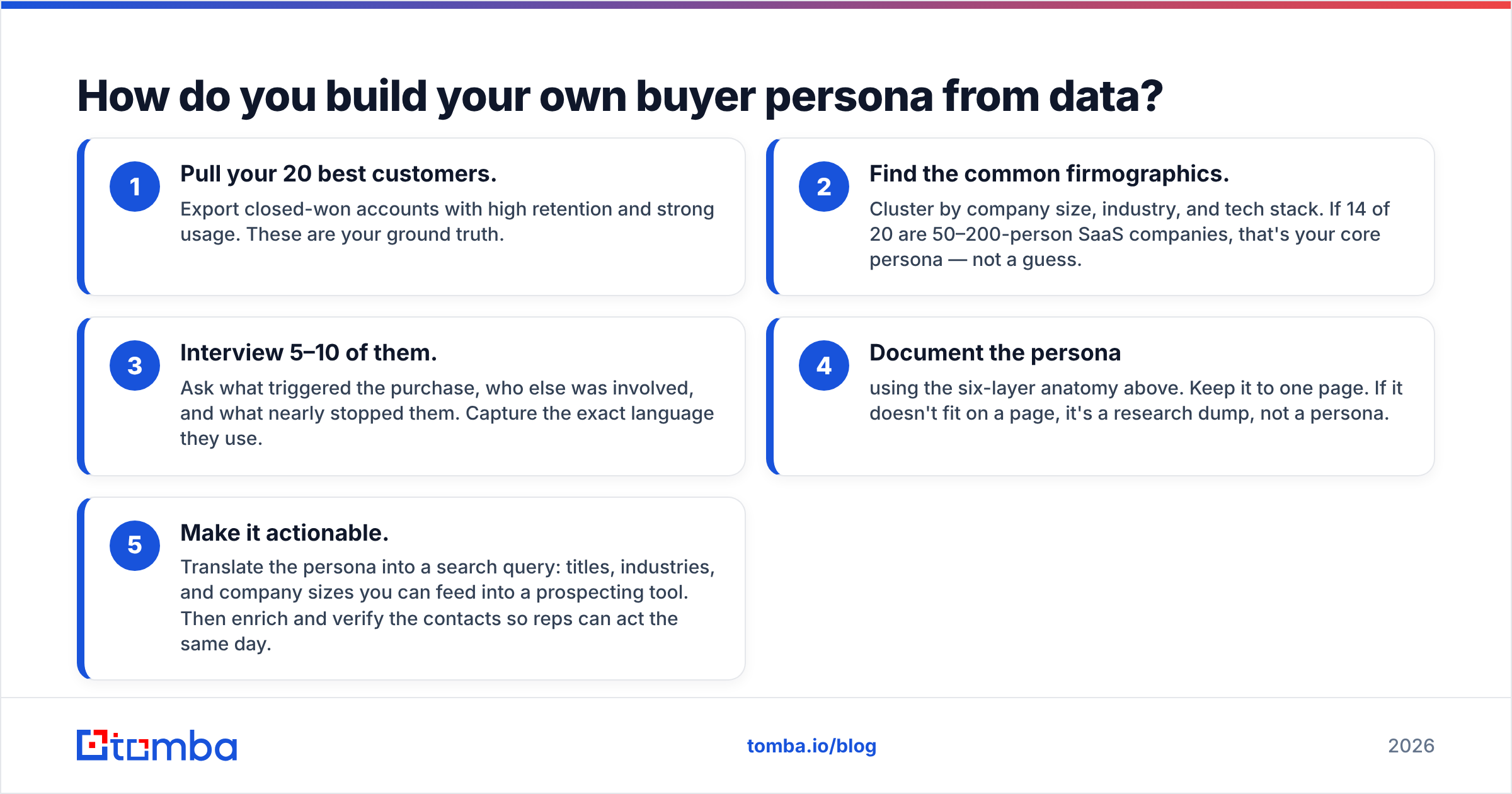
Here's the five-step framework:
- Pull your 20 best customers. Export closed-won accounts with high retention and strong usage. These are your ground truth.
- Find the common firmographics. Cluster by company size, industry, and tech stack. If 14 of 20 are 50–200-person SaaS companies, that's your core persona — not a guess.
- Interview 5–10 of them. Ask what triggered the purchase, who else was involved, and what nearly stopped them. Capture the exact language they use.
- Document the persona using the six-layer anatomy above. Keep it to one page. If it doesn't fit on a page, it's a research dump, not a persona.
- Make it actionable. Translate the persona into a search query: titles, industries, and company sizes you can feed into a prospecting tool. Then enrich and verify the contacts so reps can act the same day.
Step 5 is where teams stall. You've defined "RevOps Riley at a 100–500-person SaaS company," but now you need a list of actual Rileys with working emails. That's a domain search across target accounts, followed by email verification so you're not burning sender reputation on dead addresses. Industry reviewers on G2 consistently flag data accuracy as the dividing line between tools that work and tools that waste credits — your persona is only as good as the contacts behind it.
How many buyer personas should you have?#
Fewer than you think. Most B2B teams need three to five personas, not fifteen. Gartner's research on B2B buying shows the typical purchase involves six to ten decision-makers, so a single deal already spans multiple personas — a champion, an economic buyer, and at least one blocker. You don't need a persona for every job title; you need one for each distinct buying behavior.
A practical split:
- One primary persona — the champion who feels the pain most and starts the search.
- One economic buyer — who signs off, even if they never demo the product.
- One or two influencers — RevOps, IT, or a power user who can accelerate or kill the deal.
If you find yourself writing a tenth persona, you're probably describing a feature preference, not a buyer. Merge it.
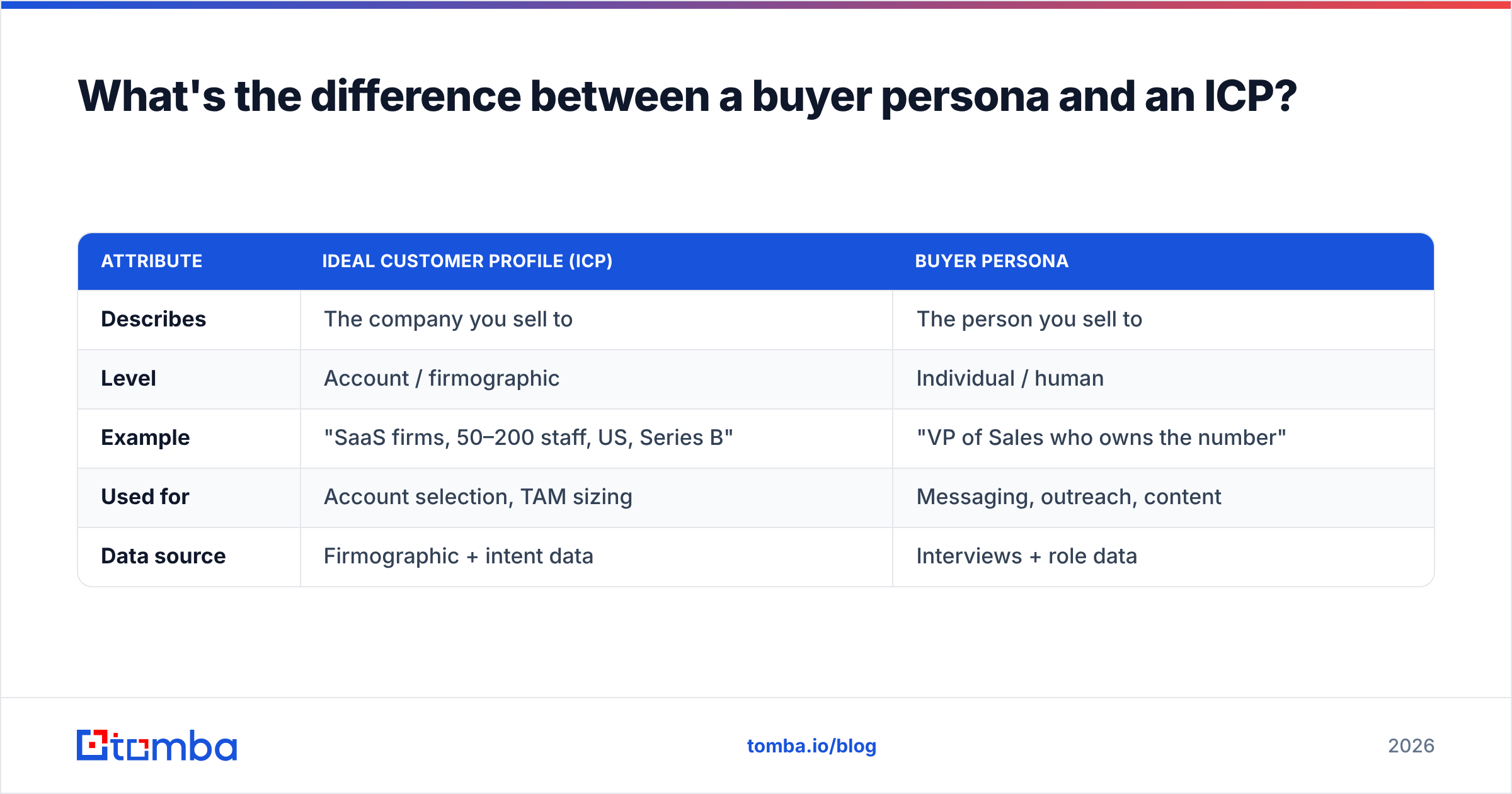
What's the difference between a buyer persona and an ICP?#
They're related but not the same — and mixing them up costs you targeting precision.
| Attribute | Ideal Customer Profile (ICP) | Buyer Persona |
|---|---|---|
| Describes | The company you sell to | The person you sell to |
| Level | Account / firmographic | Individual / human |
| Example | "SaaS firms, 50–200 staff, US, Series B" | "VP of Sales who owns the number" |
| Used for | Account selection, TAM sizing | Messaging, outreach, content |
| Data source | Firmographic + intent data | Interviews + role data |
Your ICP tells you which doors to knock on. Your persona tells you who answers and what to say. You need both: an ICP without personas gives you a list of companies and no idea who to email; personas without an ICP give you vivid characters scattered across companies that will never buy. Together they define exactly which humans to enrich, verify, and contact.
Buyer persona example template (copy this)#
Use this skeleton for every persona. Keep it to one page.
| Field | Your input |
|---|---|
| Persona name | e.g. "Scaling Sam" |
| Job titles | VP Sales, CRO, Head of Revenue |
| Company size / revenue | 50–200 employees, $5M–$20M ARR |
| Industry / tech stack | B2B SaaS, uses Salesforce + Outreach |
| Goals / KPIs | Win rate, new logos, rep ramp |
| Pains | Bad data, thin pipeline, slipping forecast |
| Buying trigger | New funding, missed quarter |
| Objections | Price, switching cost, data accuracy |
| Where to reach | LinkedIn, email, mobile |
| Data needed | Verified email + direct dial |
Fill this out for your top three personas, then validate each against five real closed-won accounts. If the persona doesn't match your actual buyers, fix the persona — not the data.
Turn your buyer personas into a real prospect list#
A persona is a hypothesis about who will buy. The only way to test it is to reach those people — which means going from "VP of Sales at a Series B SaaS company" to a verified list of names, emails, and phone numbers you can act on this week. That's exactly what Tomba's Email Finder is built for: search by company domain, find the decision-makers that match your persona, and get verified professional emails you can trust. Pair it with email verification and data enrichment so every record in your list is current, complete, and safe to send to.
Start free with 25 searches a month, and scale up on the Starter plan at $49/mo once your personas start converting. Build the persona, then go find the people in it — and let your pipeline tell you whether you got it right.
// get started
Find, verify and enrich your first contacts today
Start on the free plan with 25 searches a month, then scale when your team is ready.
Free plan · No credit card required · GDPR & CCPA
// about the author