Buyer Persona vs Target Audience: The 2026 Guide
Buyer persona vs target audience confuses most go-to-market teams. Here's the real difference, when to use each, and how to build both without wasting budget.
TL;DR
- A target audience is the broad group you market to (a segment); a buyer persona is a detailed, semi-fictional profile of one specific person inside that group.
- Target audience answers "who is roughly in our market?" Buyer persona answers "who exactly makes the decision, and what do they care about?"
- You need both: the audience scopes your budget and channels, the persona sharpens your message, offers, and outreach copy.
- Personas without data are just guesses. Ground them in firmographic and contact data, not vibes.
- In B2B, the practical payoff is targeting accuracy — fewer wasted touches, higher reply rates, and cleaner lead scoring.
If you have ever sat in a planning meeting where one person says "our audience is mid-market SaaS" and another says "no, our buyer is the VP of Sales who just got a new number" — you have watched the buyer persona vs target audience confusion in real time. They are not the same thing, and treating them as interchangeable quietly wrecks your targeting.
This guide draws a hard line between the two, shows you when each one earns its keep, and walks through how to build both with real data instead of brainstorm-room fiction.
What is a target audience?#
Your target audience is the broad segment of people or companies most likely to buy what you sell. It is defined by shared characteristics, not by individual identity.
In B2C, a target audience might be "women aged 28–45 interested in home fitness." In B2B, it is usually firmographic: industry, company size, region, revenue band, and tech stack. For example, "Series A–C B2B SaaS companies in North America with 50–500 employees running an outbound sales motion."
A target audience is a scoping tool. It tells you:
- How big the addressable market is (your TAM and SAM).
- Which channels are worth paying for (LinkedIn vs Google vs trade events).
- Roughly how much budget the opportunity justifies.
- Which accounts belong in your CRM in the first place.
What it does not tell you is who, specifically, opens the email or signs the contract. A segment of 40,000 companies still contains hundreds of thousands of individual humans with different jobs, fears, and buying triggers. That is where personas come in.

What is a buyer persona?#
A buyer persona is a semi-fictional, research-based profile of a specific decision-maker inside your target audience. Where the audience is a crowd, the persona is one named, fleshed-out character — "Sales-Leader Sara" or "RevOps Ravi."
A solid B2B persona captures:
- Role and seniority — job title, who they report to, team size.
- Goals — the metric they are measured on (pipeline, win rate, CAC payback).
- Pain points — what keeps them from hitting that metric.
- Buying behavior — how they research, who else is in the buying committee, common objections.
- Watering holes — communities, newsletters, and tools they already trust.
Notice that none of these are firmographic. Two companies can sit in the exact same target audience yet contain completely different personas — a hands-on founder at one, a layered committee at the other. Personas exist to make your message land, which is why they sit close to your email copywriting and templates and your sales scripts rather than your media plan.
A good rule of thumb: if a detail would change who you reach, it belongs to the audience. If it would change what you say, it belongs to the persona.
Buyer persona vs target audience: what's the actual difference?#
Here is the side-by-side that usually ends the meeting argument.
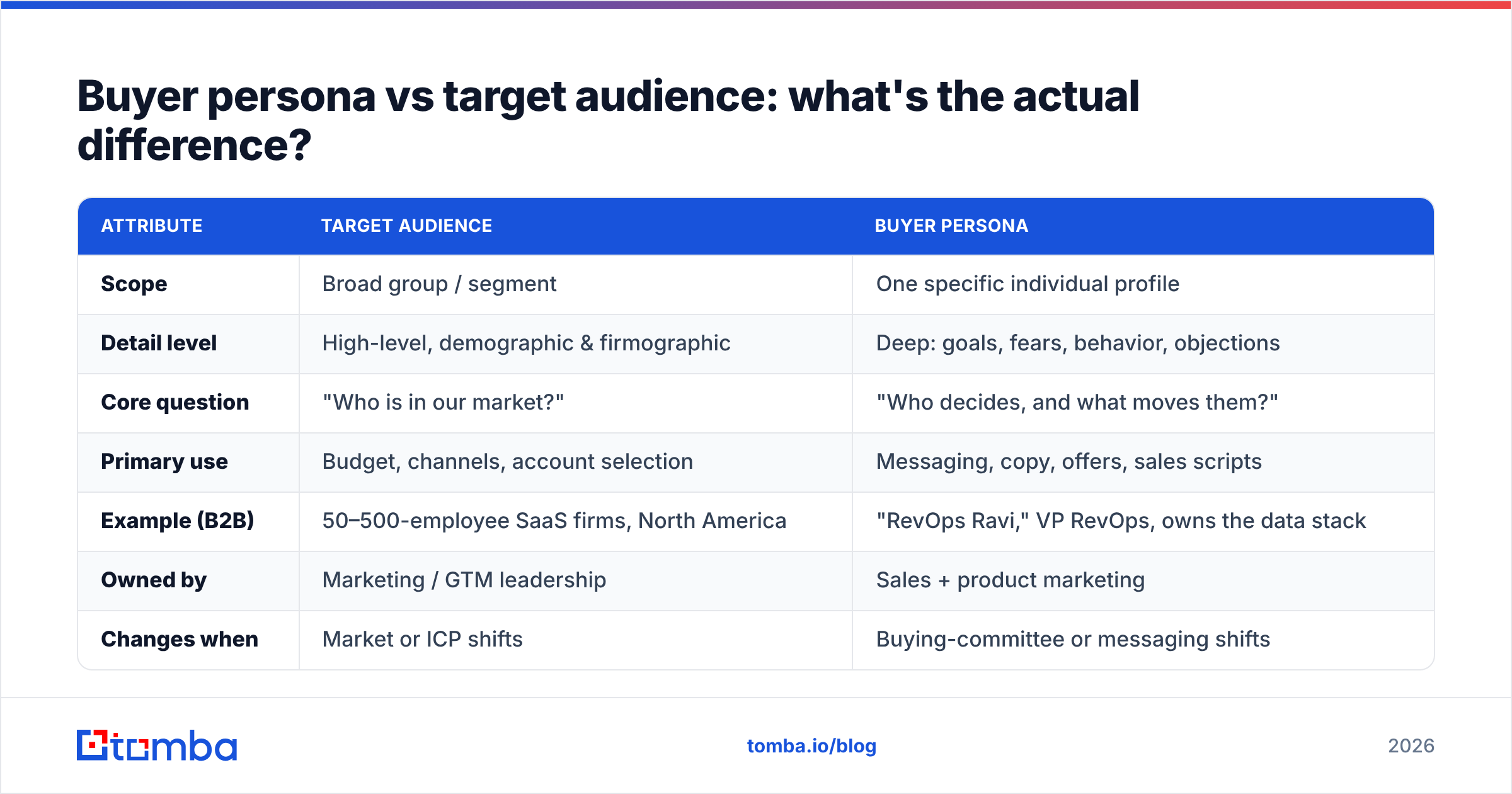
| Attribute | Target Audience | Buyer Persona |
|---|---|---|
| Scope | Broad group / segment | One specific individual profile |
| Detail level | High-level, demographic & firmographic | Deep: goals, fears, behavior, objections |
| Core question | "Who is in our market?" | "Who decides, and what moves them?" |
| Primary use | Budget, channels, account selection | Messaging, copy, offers, sales scripts |
| Example (B2B) | 50–500-employee SaaS firms, North America | "RevOps Ravi," VP RevOps, owns the data stack |
| Owned by | Marketing / GTM leadership | Sales + product marketing |
| Changes when | Market or ICP shifts | Buying-committee or messaging shifts |
| Count | Usually 1–3 segments | 3–6 personas per segment |
The relationship is nested, not parallel. Personas live inside the target audience. You pick the audience first to decide where to play, then build personas to decide how to win the people inside it. Skipping either layer creates a predictable failure mode:
- Audience, no personas → you reach the right companies with generic copy that speaks to no one.
- Personas, no audience → you write beautiful, specific messaging and blast it at companies that will never buy.
- Both, but no data → you optimize confidently in the wrong direction.
That third failure is the most common and the most expensive, which is the next problem to solve.
Why does the distinction matter for B2B revenue teams?#
Because targeting is multiplicative, not additive. The wrong audience caps your ceiling; the wrong persona caps your conversion. Get both right and the gains compound.
Concretely, the distinction drives three things every revenue operations team cares about:
- Lead scoring. Audience fit (firmographics) and persona fit (title, seniority) are two separate scoring axes. A company can be a perfect audience match with the wrong contact, or the right contact at an out-of-segment company. Collapsing them into one score hides both errors. This is foundational to good lead management and scoring.
- Channel and spend allocation. Audience tells paid media where to bid. Persona tells creative what to say once it wins the impression. HubSpot's own research on buyer personas shows persona-aligned content consistently outperforms generic content on engagement.
- Outreach reply rates. A cold email that names the persona's exact pain ("your reps are burning the first hour of every day on manual list-building") beats a segment-level pitch ("we help SaaS companies grow") every time.
According to Gartner research on B2B buying, a typical purchase now involves six to ten decision-makers — which means one target audience routinely contains several personas you must address in parallel. Map them, or lose the deal in the committee.
How do you build a target audience (with data, not guesses)?#
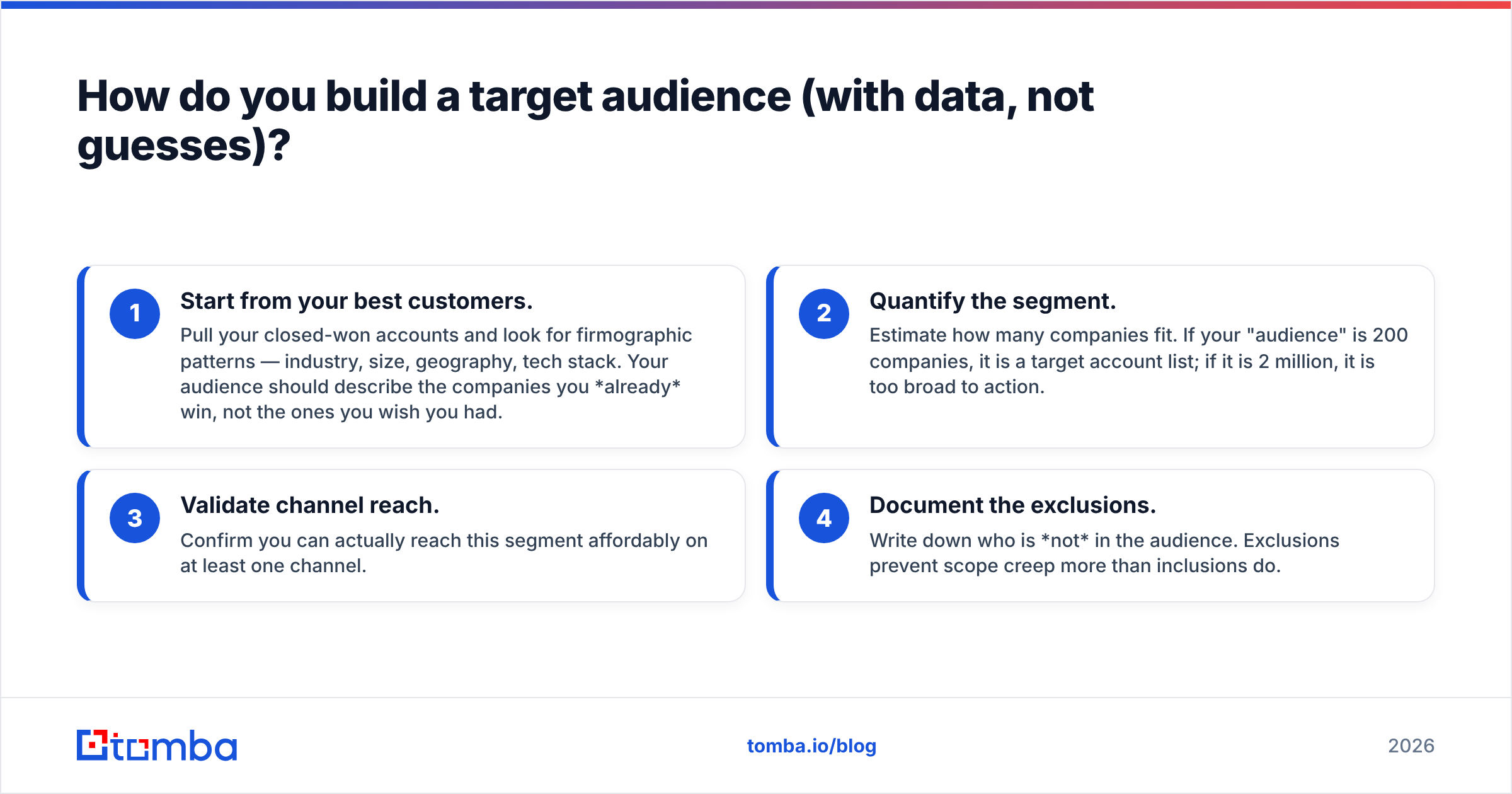
Work top-down, narrowing from the whole market to a defensible segment.
- Start from your best customers. Pull your closed-won accounts and look for firmographic patterns — industry, size, geography, tech stack. Your audience should describe the companies you already win, not the ones you wish you had.
- Quantify the segment. Estimate how many companies fit. If your "audience" is 200 companies, it is a target account list; if it is 2 million, it is too broad to action.
- Validate channel reach. Confirm you can actually reach this segment affordably on at least one channel.
- Document the exclusions. Write down who is not in the audience. Exclusions prevent scope creep more than inclusions do.
Once the segment is defined, you populate it with real companies. A domain search lets you pull every reachable contact at a target company, and a B2B database filtered by firmographics turns an abstract segment into an actionable account list. That is the bridge from "mid-market SaaS" to a spreadsheet of accounts you can work.
How do you build a buyer persona that isn't fiction?#
Personas fail when they are invented in a conference room. Build them bottom-up, from evidence.
- Interview real buyers. Five to ten conversations with recent customers (and recent losses) will tell you more than any template. Ask what triggered the search, who else was involved, and what almost stopped the deal.
- Mine your CRM and call recordings. Common objections and repeated phrases are persona gold.
- Identify the buying committee. For each persona, note whether they are the economic buyer, the champion, the technical evaluator, or the blocker. Each needs different messaging.
- Enrich with firmographic and contact data. Attach real titles, seniority, and reporting lines. Tools like data enrichment append the structured attributes that turn a narrative persona into a filterable, scorable record.
- Keep it to one page. A persona nobody reads is worse than no persona. One page: goals, pains, objections, and the single line of copy that makes them lean in.
The trap to avoid: do not confuse a persona with a target audience by stuffing firmographics into it. "VP of Sales at a 200-person SaaS company" is half audience, half persona. Split it — the company attributes are audience, the role and motivations are persona.
For a deeper look at how the underlying contact data quality affects persona accuracy, see Tomba's notes on data accuracy and sources.
Can you have a target audience without buyer personas (or vice versa)?#
Technically yes, practically no — at least not if you want efficient growth.
- Early-stage startup: You may legitimately start with a target audience and one rough persona, then refine as you learn. That is fine, as long as you treat the persona as a hypothesis to test, not a fact.
- Enterprise / ABM motion: You need both, in detail. Account-based marketing is literally the discipline of mapping multiple personas inside a tightly-defined audience of named accounts.
- High-velocity SMB sales: Audience matters most here because volume is the game, but even a lightweight persona lifts reply rates enough to justify the hour it takes to write.
The honest answer is that the two are a system. The audience makes your spend efficient; the persona makes your conversion efficient. Drop either and you leave money on the table — you just lose it in a different place.
Buyer persona vs target audience vs ICP: how do they fit together?#
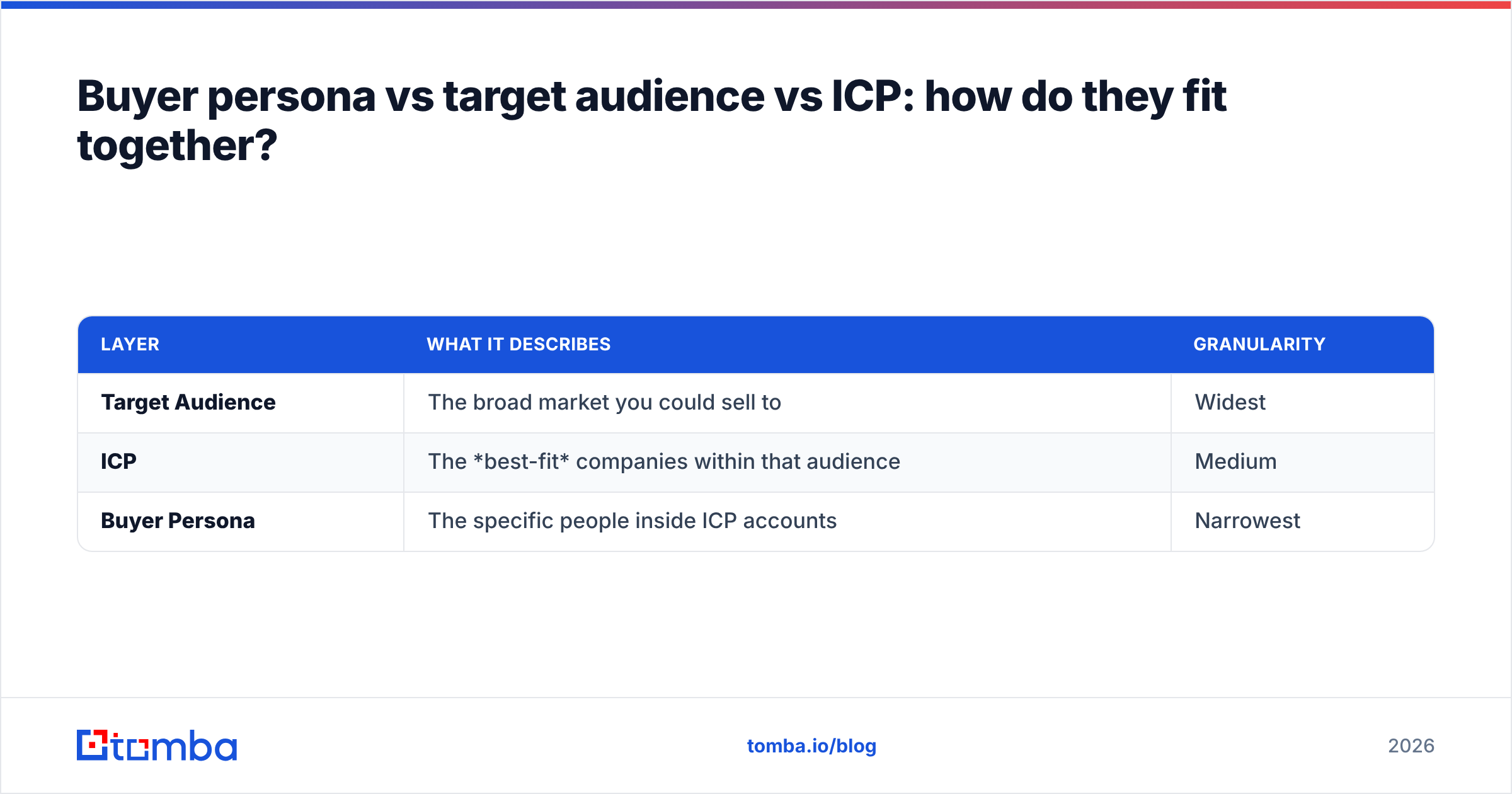
One more term causes confusion: the Ideal Customer Profile (ICP). Here is the clean hierarchy:
| Layer | What it describes | Granularity |
|---|---|---|
| Target Audience | The broad market you could sell to | Widest |
| ICP | The best-fit companies within that audience | Medium |
| Buyer Persona | The specific people inside ICP accounts | Narrowest |
Think of it as a funnel of focus: target audience → ICP → persona. The audience is everyone you could reach. The ICP is the slice worth prioritizing — the accounts most likely to buy, stay, and expand. The personas are the humans inside those accounts you actually talk to. Many teams use "target audience" and "ICP" loosely as synonyms; they are not, but the ICP is close enough to the audience that the persona remains the sharpest distinction worth defending.
Putting it to work: from segment to sent email#
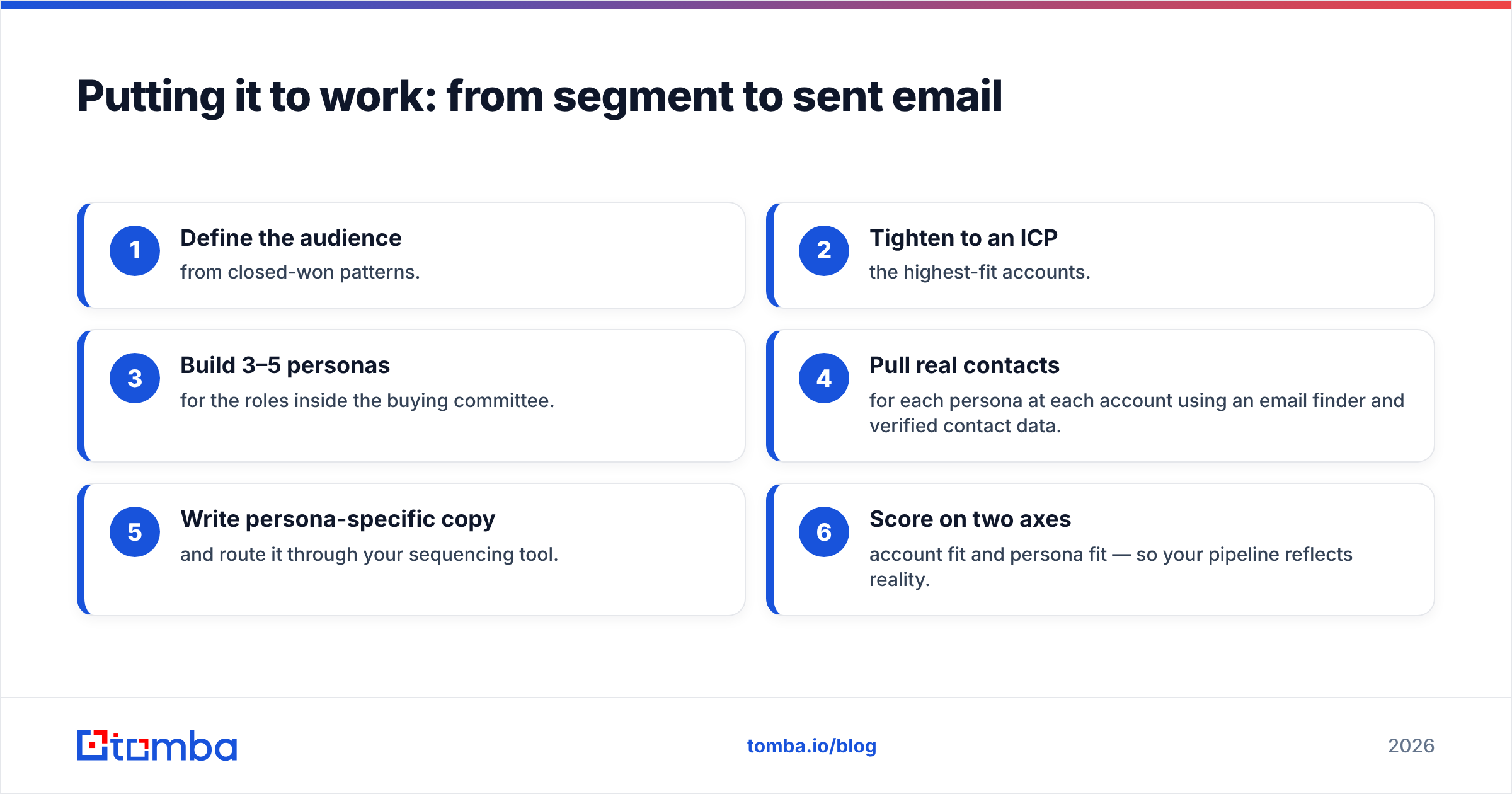
A workable sequence for a B2B team in 2026 looks like this:
- Define the audience from closed-won patterns.
- Tighten to an ICP — the highest-fit accounts.
- Build 3–5 personas for the roles inside the buying committee.
- Pull real contacts for each persona at each account using an email finder and verified contact data.
- Write persona-specific copy and route it through your sequencing tool.
- Score on two axes — account fit and persona fit — so your pipeline reflects reality.
Step 4 is where most teams stall, because a beautiful persona is useless without a real, verified email address attached to a real person at a real in-segment account.
Final takeaway and where to start#
The difference is simple once you hold it still: target audience is the crowd, buyer persona is the character. One scopes your market and budget; the other sharpens your message and conversion. Build the audience top-down from your best customers, build personas bottom-up from real interviews and enriched data, and never let firmographics sneak into a persona or motivations sneak into an audience.
When you are ready to turn personas into pipeline, the bottleneck is always the same: finding the right person's verified contact details at the right company. Tomba's Email Finder does exactly that — search by name, role, or domain to pull verified professional emails for the personas you have defined, then enrich them into scorable CRM records. Start on the free tier (25 searches a month), and scale through Tomba's pricing plans — Starter at $49/mo and Growth at $99/mo — once your targeting is dialed in. Get the audience and personas right first; let Tomba handle the part where strategy becomes a sent email.
// get started
Find, verify and enrich your first contacts today
Start on the free plan with 25 searches a month, then scale when your team is ready.
Free plan · No credit card required · GDPR & CCPA
// about the author