Buyer Readiness Signals: How to Spot Ready Buyers in 2026
Most reps chase leads that will never buy. Learn the buyer readiness signals that separate real pipeline from polite tire-kickers — and how to act on them in 2026.
TL;DR
- Buyer readiness signals are behavioral, firmographic, and intent cues that tell you a prospect is moving toward a purchase decision — not just browsing.
- The highest-converting signals combine who the account is (fit) with what they are doing right now (intent), then layer in who is engaging (the actual buying committee).
- Reps who act on a signal within 24-48 hours book dramatically more meetings than reps working a cold, static list.
- You can capture most signals with tools you already pay for: your CRM, website analytics, product usage logs, and an enrichment layer to fill in contacts.
- The goal is not more leads. It is fewer, better-timed conversations with accounts that are already raising their hand.
What are buyer readiness signals?#
Buyer readiness signals are observable behaviors and attributes that indicate a prospect or account is approaching a buying decision. Think of them like the body language of a deal. A person who crosses their arms and checks their watch is telling you something without saying a word — and a company that suddenly visits your pricing page three times, hires two new SDRs, and downloads a competitor comparison is doing exactly the same thing.
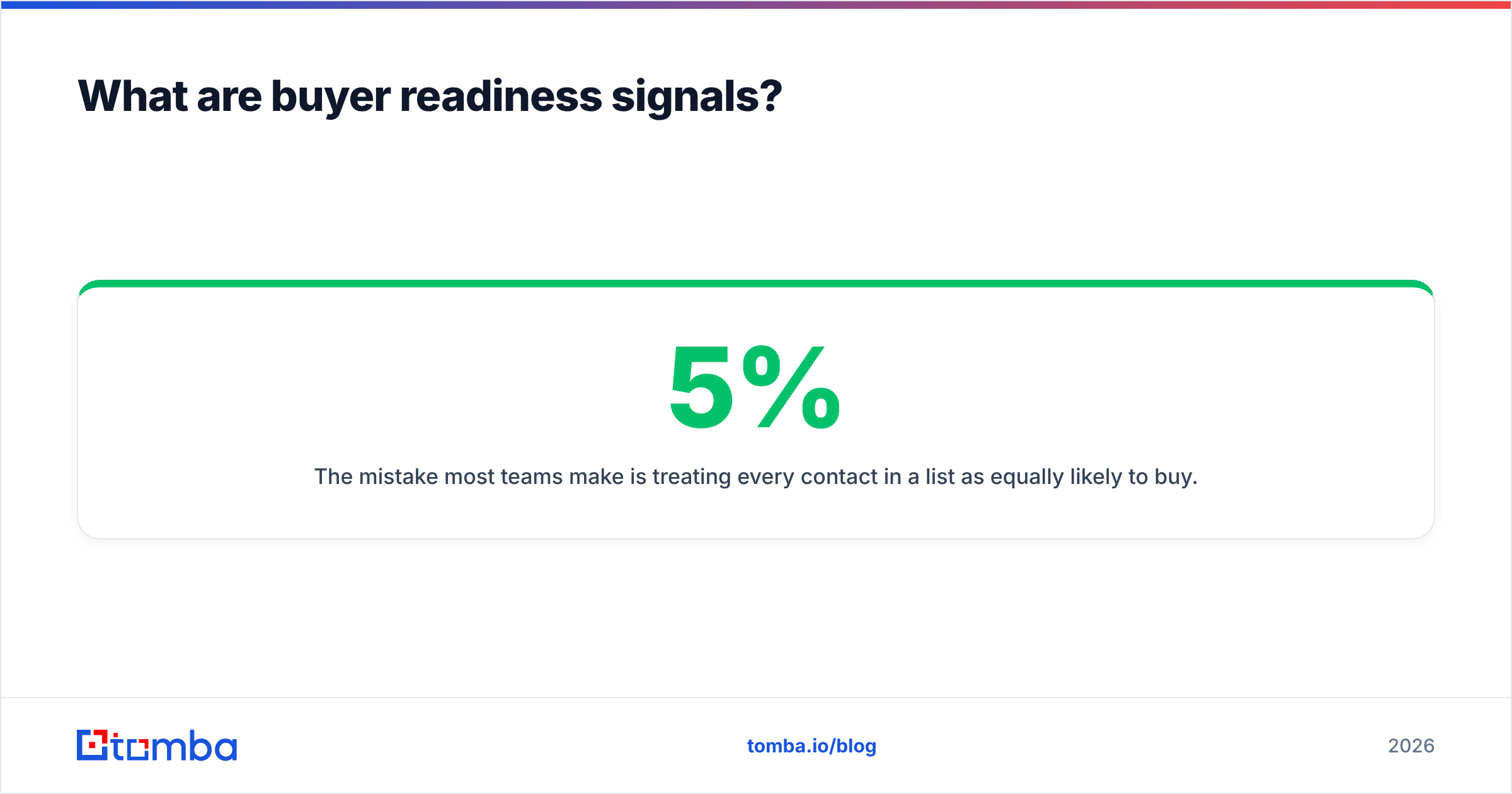
The mistake most teams make is treating every contact in a list as equally likely to buy. They are not. At any given moment, research from the B2B Institute and the Ehrenberg-Bass Institute suggests only about 5% of your market is actively in-market, while the other 95% are not ready to do anything. Buyer readiness signals are how you find that 5% before your competitors do.
Signals fall into three broad buckets, and the strongest plays use all three together:
- Fit signals (who they are) — firmographics like company size, industry, tech stack, funding stage, and geography. These tell you whether an account should buy from you, even if they are not active yet.
- Intent signals (what they are doing) — content downloads, pricing page visits, demo requests, review-site activity on G2, third-party intent spikes, and competitor research.
- Engagement signals (who is involved) — which job titles are interacting, how many people from one account are engaging, and whether a senior decision-maker has entered the conversation.
When fit, intent, and engagement line up at the same time, you are looking at a ready buyer. When only one fires, you are looking at a maybe.
Why do buyer readiness signals matter more in 2026?#
Two things changed. First, buyers now complete most of their research before they ever talk to a vendor — often 70% or more of the journey happens in anonymous, self-directed mode. By the time someone fills out a form, they have a shortlist. If you wait for the form, you are late.
Second, budgets got tighter and inboxes got noisier. Spraying a generic sequence across 5,000 contacts no longer works; it just burns your domain reputation and your team's morale. Precision beats volume. A timely, relevant message to an account showing real readiness will out-convert a hundred cold touches.
This is also why intent-led prospecting has moved from "nice to have" to table stakes. The teams winning in 2026 are not the ones with the biggest lists — they are the ones who notice a marketing qualified lead heating up and reach the right person while the interest is fresh.
What are the most reliable buyer readiness signals?#
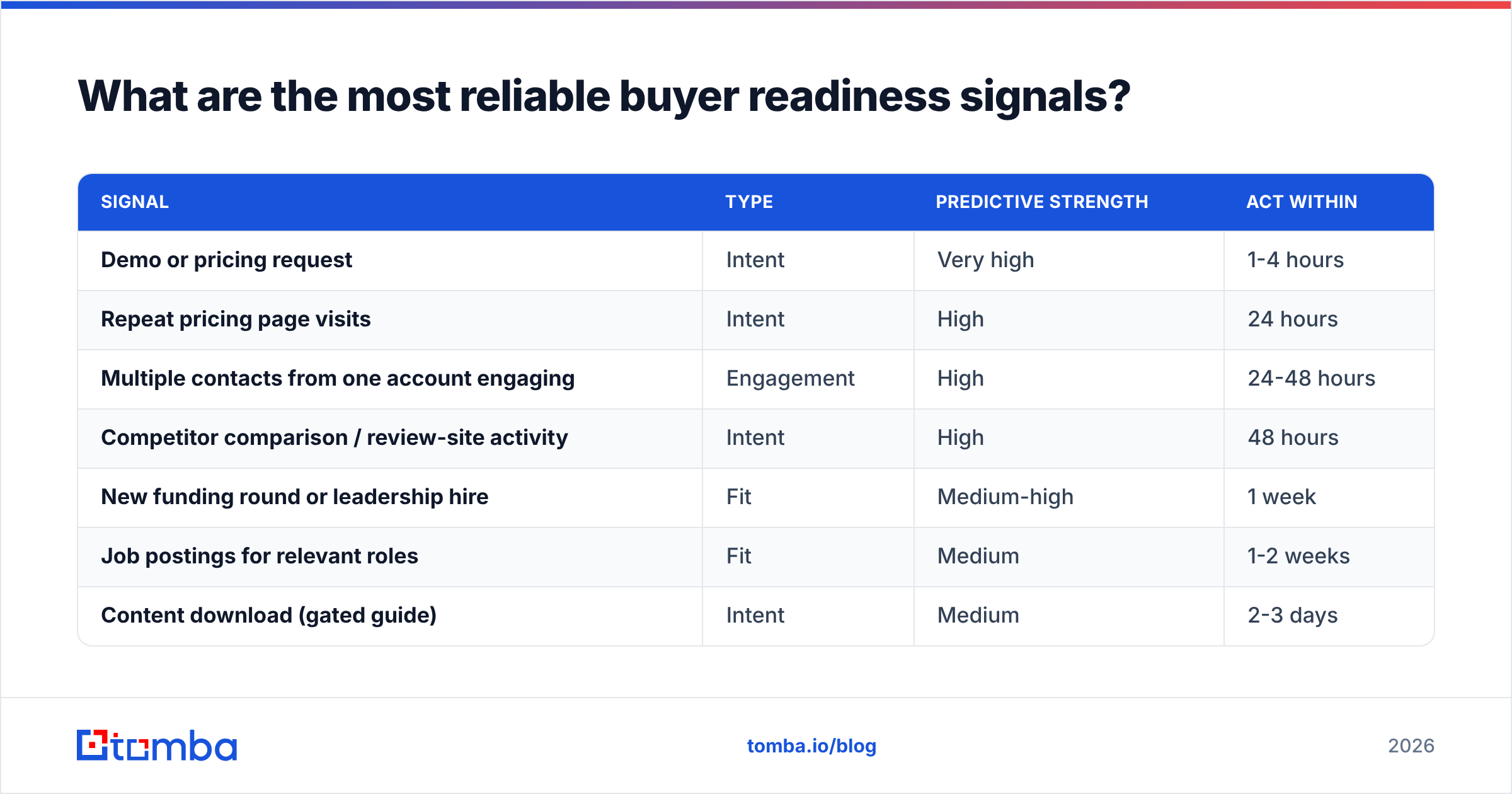
Not all signals carry the same weight. A pricing page visit means far more than a single blog read. Here is how the common signals stack up by predictive strength and how quickly you should act.
| Signal | Type | Predictive strength | Act within |
|---|---|---|---|
| Demo or pricing request | Intent | Very high | 1-4 hours |
| Repeat pricing page visits | Intent | High | 24 hours |
| Multiple contacts from one account engaging | Engagement | High | 24-48 hours |
| Competitor comparison / review-site activity | Intent | High | 48 hours |
| New funding round or leadership hire | Fit | Medium-high | 1 week |
| Job postings for relevant roles | Fit | Medium | 1-2 weeks |
| Content download (gated guide) | Intent | Medium | 2-3 days |
| Newsletter open or single blog visit | Intent | Low | Nurture only |
The pattern is clear: bottom-of-funnel behavioral signals demand near-immediate action, while top-of-funnel and firmographic signals belong in a slower nurture or account-prioritization motion. Speed-to-lead is not a vanity metric — it is the difference between catching a buyer in the consideration window and reaching them after they have signed with someone else.
A practical rule: the more specific and effortful the action, the hotter the signal. Anyone can open an email. Far fewer people will study your pricing tiers twice in one week.
How do you capture these signals without buying ten new tools?#
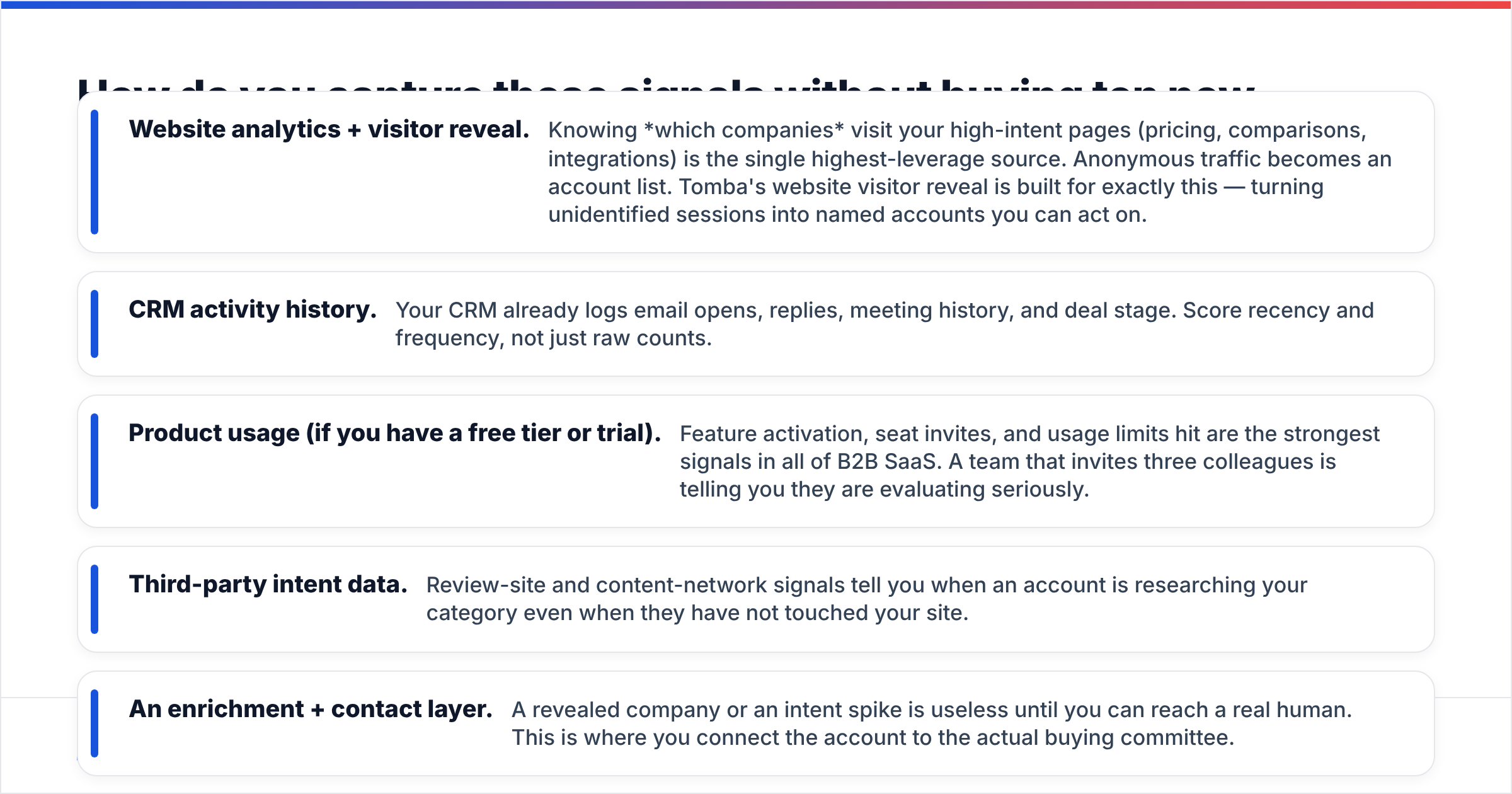
You probably already generate most of these signals — you just are not collecting them in one place. Here is the minimum viable signal stack, in priority order:
- Website analytics + visitor reveal. Knowing which companies visit your high-intent pages (pricing, comparisons, integrations) is the single highest-leverage source. Anonymous traffic becomes an account list. Tomba's website visitor reveal is built for exactly this — turning unidentified sessions into named accounts you can act on.
- CRM activity history. Your CRM already logs email opens, replies, meeting history, and deal stage. Score recency and frequency, not just raw counts.
- Product usage (if you have a free tier or trial). Feature activation, seat invites, and usage limits hit are the strongest signals in all of B2B SaaS. A team that invites three colleagues is telling you they are evaluating seriously.
- Third-party intent data. Review-site and content-network signals tell you when an account is researching your category even when they have not touched your site.
- An enrichment + contact layer. A revealed company or an intent spike is useless until you can reach a real human. This is where you connect the account to the actual buying committee.
That last point is where pipelines stall. You identify a hot account, then waste two days hunting for the right person's email. A data enrichment layer closes that gap instantly — feed it a domain or a name, and get back verified contact details for the decision-makers who matter, so you can act while the signal is still warm.
How should you score and prioritize buyer readiness signals?#
Don't just collect signals — weight them. A simple, transparent scoring model beats a black-box algorithm your reps don't trust. Start with two axes:
Axis 1 — Fit score (0-50): How closely does the account match your ideal customer profile? Industry, size, tech stack, region. This rarely changes, so calculate it once on enrichment.
Axis 2 — Readiness score (0-50): A decaying sum of recent intent and engagement signals. Recent actions count more than old ones; high-effort actions count more than passive ones. Let scores decay over 14-30 days so a hot account that goes quiet naturally cools off.
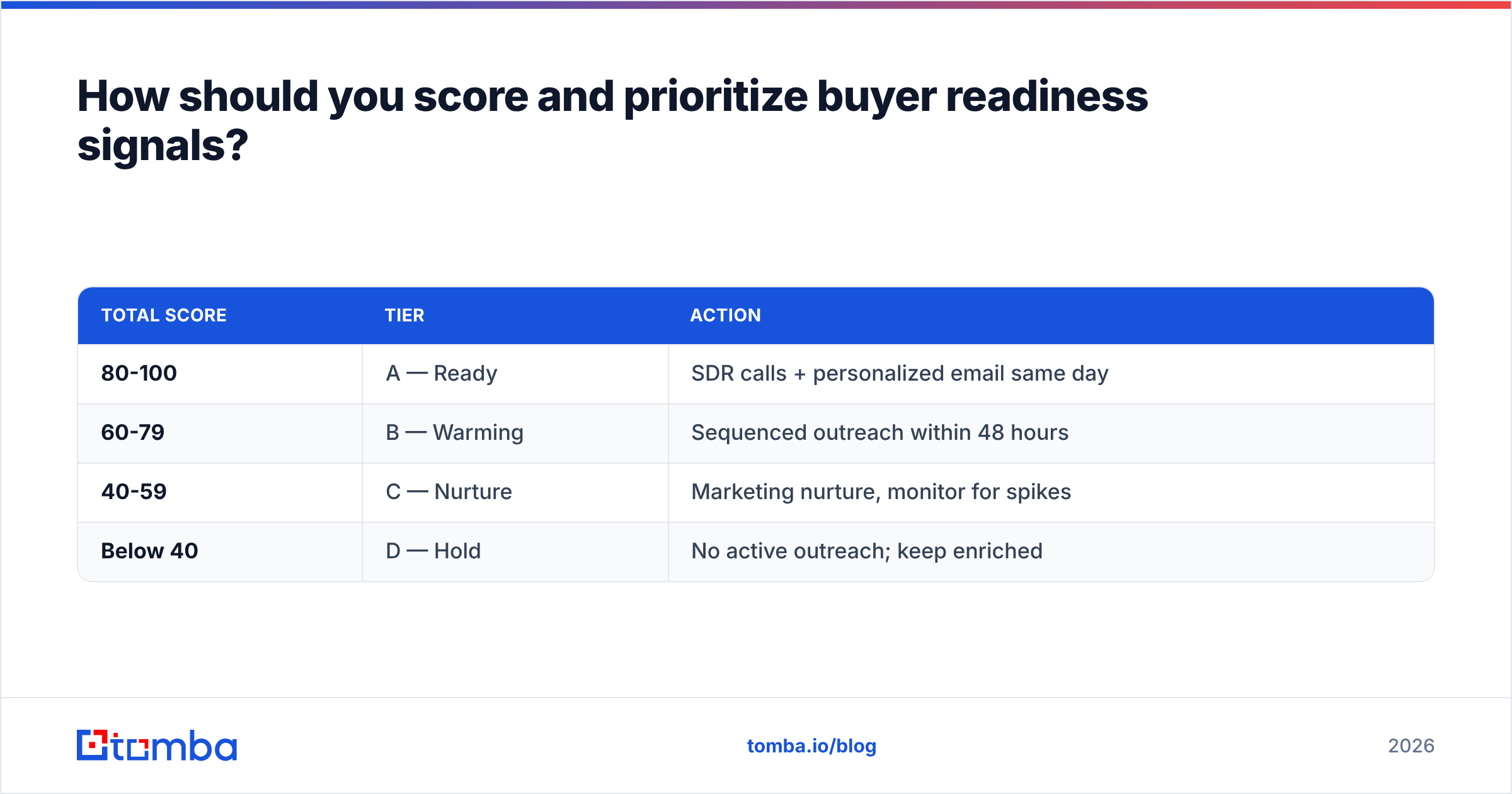
Add them and route by the total:
| Total score | Tier | Action |
|---|---|---|
| 80-100 | A — Ready | SDR calls + personalized email same day |
| 60-79 | B — Warming | Sequenced outreach within 48 hours |
| 40-59 | C — Nurture | Marketing nurture, monitor for spikes |
| Below 40 | D — Hold | No active outreach; keep enriched |
The discipline here matters more than the exact numbers. Pick weights, run them for a quarter, then tune based on which tiers actually converted. Buyer readiness scoring is a living model, not a one-time spreadsheet.
One caution: a high readiness score with a low fit score is a trap. That is a tire-kicker who loves your content but will never buy. Always require both fit and readiness to clear the bar before a human spends time on the account.
What does acting on a signal actually look like?#
A signal is worthless without a fast, relevant response. Compare two reps who both get the same alert — "Acme Corp viewed pricing twice today."
Rep A (signal-blind): Adds Acme to a generic monthly newsletter. Acme buys from a competitor three weeks later.
Rep B (signal-led): Within an hour, pulls the account, uses an email finder to get the VP of Operations' verified address, and sends a two-line message referencing the exact problem Acme's pricing-page behavior implies. Books a call for Thursday.
Same signal. Opposite outcome. The difference is speed, the right contact, and a message that proves you understand the moment.
Good signal-led outreach has three traits:
- It is fast. Hours, not days. Readiness windows are short.
- It is specific. Reference the behavior or the trigger event, not a generic "I wanted to reach out."
- It reaches a real decision-maker. A perfectly timed message to the wrong inbox is still a miss — which is why a verified contact layer is non-negotiable.
How do you avoid the common buyer-signal mistakes?#
Even teams that adopt signals get tripped up. Watch for these:
- Chasing every spike. Not every signal is a buying signal. A competitor's employee researching you, a student, or a job seeker can all trigger "intent." Gate everything behind a fit filter.
- Ignoring signal decay. A pricing visit from 45 days ago is not a hot lead. If your scoring doesn't decay, your A-tier fills with stale accounts and reps stop trusting it.
- Over-automating the response. Signals tell you when and who. The message still needs a human touch for high-value accounts. Automate the detection, personalize the outreach.
- Stopping at the company. Revealing that "Acme is in-market" is step one. Without the right person's verified contact, you are stuck. Connect every account signal to a real contact before you call it actionable.
- No feedback loop. If you never check which signals preceded closed-won deals, you are guessing at your weights. Review quarterly.
Avoid those five, and your signal program will compound — each quarter your scoring gets sharper and your reps spend more time on accounts that actually close.
Frequently asked questions#
What is the difference between a buyer readiness signal and an intent signal? Intent signals are a subset of buyer readiness signals. Intent covers research behavior (content, reviews, pricing visits). Buyer readiness is the fuller picture — intent plus fit (firmographics) plus engagement (who from the account is involved). A complete readiness model uses all three.
How fast do I really need to respond? For bottom-of-funnel signals like a demo or pricing request, within the hour if possible. Studies on speed-to-lead consistently show contact rates and conversion drop sharply after the first hour and fall off a cliff after 24 hours.
Can small teams do this without an expensive intent-data subscription? Yes. Start with what you own: CRM activity, website visitor reveal, and an enrichment layer to find contacts. Third-party intent networks are a force multiplier, not a prerequisite.
Do buyer readiness signals replace lead scoring? They upgrade it. Traditional lead scoring leaned heavily on static demographics. Modern buyer readiness scoring adds real-time behavioral and engagement data on top, so your model reflects what accounts are doing now, not just who they are.
Turn signals into booked meetings with Tomba#
Buyer readiness signals tell you when and which account — but a signal you can't act on is just noise. The moment you spot a hot account, you need the verified email of the person who actually makes the decision, and you need it before the window closes. That is exactly what the Tomba Email Finder delivers: feed it a domain or a name, get back accurate, verified contacts for the buying committee in seconds. Pair it with Tomba's website visitor reveal and data enrichment to go from anonymous signal to a real conversation in minutes — not days. Start free with 25 searches a month, and scale up on the Starter plan at $49/mo when your signal pipeline starts paying for itself. Stop working stale lists. Start working signals.
Ready to find emails that actually work?
Join 150,000+ professionals who stopped guessing and started sending. Free credits on signup — no credit card required.
Get the Tomba newsletter
Practical outbound tactics and product updates — once every two weeks.
About the author