Buying Business Leads in 2026: Costs, Risks, and Alternatives
Buying business leads promises an instant pipeline, but bad data quietly wrecks deliverability and win rates. Here's what lead lists really cost, where they go wrong, and how to build accurate B2B contacts instead.
Buying business leads sounds like the fastest shortcut in B2B: pay a broker, get a spreadsheet of 10,000 contacts, start dialing. The problem is that the shortcut usually loops back on you. Stale records, recycled lists, and unverified emails don't just waste rep hours — they damage the one asset cold outreach depends on, your sending domain.
This guide breaks down what buying business leads actually costs in 2026, where purchased lists go wrong, and when it makes more sense to build a targeted list yourself.
TL;DR#
- Buying business leads is fast but risky — most purchased lists are resold, partially stale, and unverified, which tanks deliverability and reply rates.
- Real cost is higher than sticker price once you factor in bounces, wasted rep time, CRM clutter, and domain reputation damage.
- Compliance matters — GDPR, CAN-SPAM, and CCPA all govern how B2B contact data can be sourced and used.
- Building a list with an email finder + verifier typically beats a bulk-bought list on accuracy and ROI.
- Best practice: define your ICP, pull contacts on demand, verify before sending, and keep the list small and fresh.
What does "buying business leads" actually mean?#
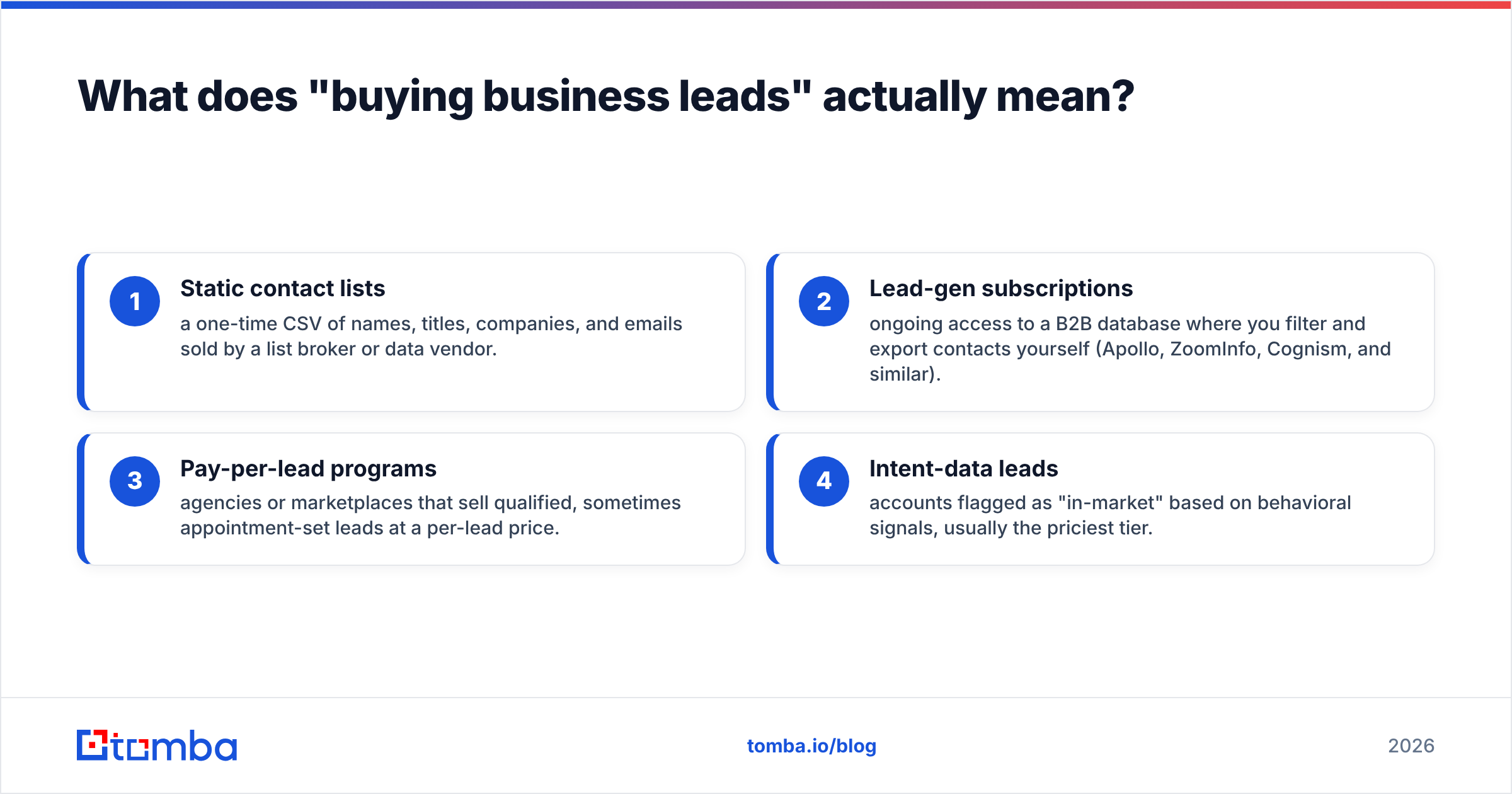
"Buying business leads" covers a few very different transactions that often get lumped together:
- Static contact lists — a one-time CSV of names, titles, companies, and emails sold by a list broker or data vendor.
- Lead-gen subscriptions — ongoing access to a B2B database where you filter and export contacts yourself (Apollo, ZoomInfo, Cognism, and similar).
- Pay-per-lead programs — agencies or marketplaces that sell qualified, sometimes appointment-set leads at a per-lead price.
- Intent-data leads — accounts flagged as "in-market" based on behavioral signals, usually the priciest tier.
The accuracy, price, and risk profile of each is wildly different. A purpose-built B2B database you query against your own ICP is not the same product as a recycled CSV emailed to 200 other buyers — even though both get called "buying leads."

How much does buying business leads cost in 2026?#
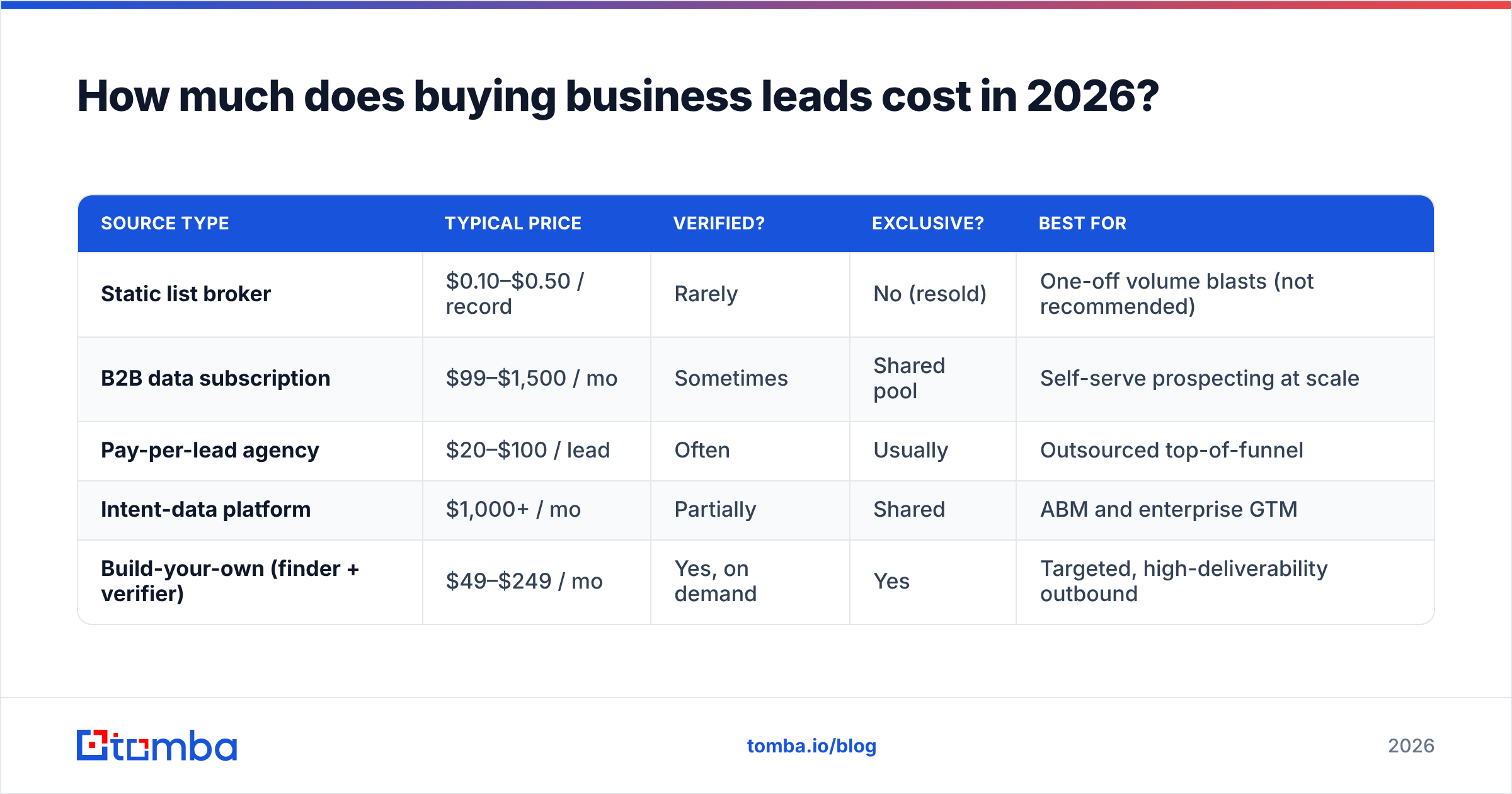
Sticker prices range from a few cents per record to $50+ per qualified lead. But price-per-record is the wrong number to optimize. What matters is cost per usable, contactable lead after you remove duplicates, bounces, and bad fits.
| Source type | Typical price | Verified? | Exclusive? | Best for |
|---|---|---|---|---|
| Static list broker | $0.10–$0.50 / record | Rarely | No (resold) | One-off volume blasts (not recommended) |
| B2B data subscription | $99–$1,500 / mo | Sometimes | Shared pool | Self-serve prospecting at scale |
| Pay-per-lead agency | $20–$100 / lead | Often | Usually | Outsourced top-of-funnel |
| Intent-data platform | $1,000+ / mo | Partially | Shared | ABM and enterprise GTM |
| Build-your-own (finder + verifier) | $49–$249 / mo | Yes, on demand | Yes | Targeted, high-deliverability outbound |
A "cheap" 10,000-record list at $0.20 each costs $2,000. If 30% bounce and another 30% are wrong-fit, you paid $2,000 for roughly 4,000 usable contacts — about $0.50 each — and that's before the deliverability damage. According to Gartner research on sales productivity, reps already spend a large share of their week on non-selling work; feeding them dirty data makes that worse.
Why do purchased lead lists go wrong?#
Bought lists fail for predictable, structural reasons:
- They're resold. A static list sold to you is almost always sold to dozens of others. Your "exclusive" prospects have heard the same pitch ten times this quarter.
- B2B data decays fast. People change jobs constantly. A list that was 95% accurate at collection is materially stale within 6–12 months.
- They're unverified. Brokers optimize for volume, not validity. High bounce rates from unverified addresses are the fastest way to get flagged by mailbox providers.
- They ignore your ICP. A generic list of "marketing managers" includes the wrong company sizes, regions, and seniorities for your offer.
- They create compliance exposure. Lists sourced without a lawful basis can put you on the wrong side of GDPR or CAN-SPAM.
The hidden tax is deliverability. Send to a purchased list with a 25% bounce rate and you signal to inbox providers that you're a spammer. That reputation hit follows your domain into every future campaign — including emails to leads you sourced cleanly. This is why protecting your sender reputation should outrank short-term list volume every time.
Is buying business leads legal?#
Mostly yes, with important conditions — and the rules depend on where your prospects are.
- United States (CAN-SPAM): Buying and emailing B2B contacts is legal, but every message needs accurate headers, a valid physical address, and a working unsubscribe. There's no opt-in requirement for B2B, but deceptive practices are penalized.
- EU/UK (GDPR): You need a lawful basis (usually legitimate interest) to process personal data, even business emails. Buying a list doesn't transfer consent, so due diligence on the source matters.
- California (CCPA/CPRA): Contacts can request access and deletion; you must honor those rights even for purchased data.
None of this makes buying leads impossible — it makes sloppy buying expensive. The safest posture is to source contacts you can justify targeting (clear ICP fit), keep records of where data came from, and always offer an easy opt-out. For a deeper primer, the HubSpot guide to buying email lists is a useful, vendor-neutral read on why blast-buying backfires.
Buying leads vs. building your own list: which wins?#
The honest answer: building a targeted list almost always beats buying a bulk one for cold outbound — and it's no longer slower if you use the right tools.
The old objection to building was time. Manually researching 500 prospects took days. Modern tooling collapses that: you define a company list, run a domain search to pull every relevant contact, then verify before sending. You get exclusivity, ICP precision, and clean data — the three things bought lists lack.

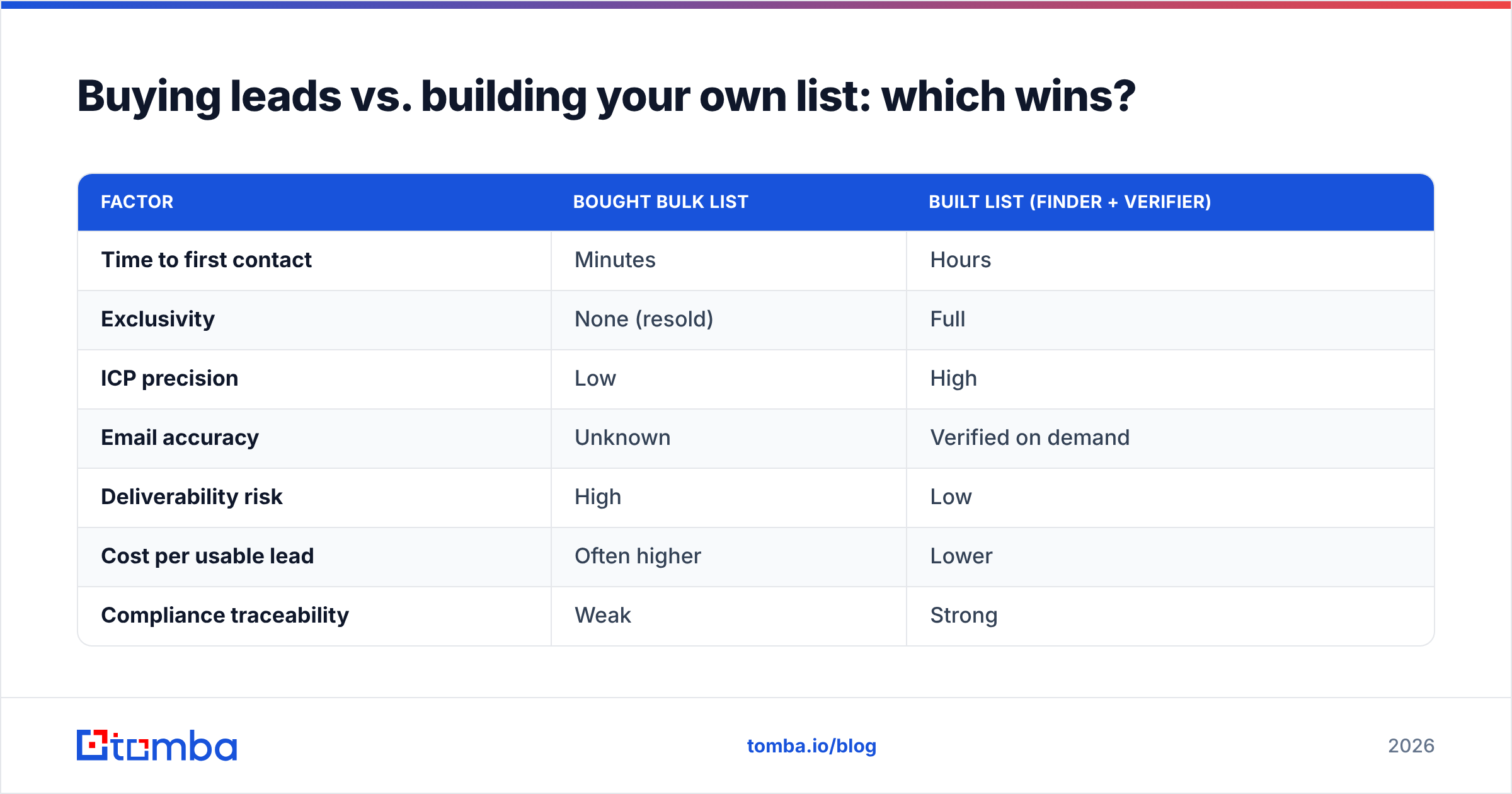
Here's the practical trade-off:
| Factor | Bought bulk list | Built list (finder + verifier) |
|---|---|---|
| Time to first contact | Minutes | Hours |
| Exclusivity | None (resold) | Full |
| ICP precision | Low | High |
| Email accuracy | Unknown | Verified on demand |
| Deliverability risk | High | Low |
| Cost per usable lead | Often higher | Lower |
| Compliance traceability | Weak | Strong |
Buying buys you speed and nothing else. Building buys you everything that actually drives reply rates. For most teams, a hybrid works best: subscribe to a database for breadth, but always run an email verifier as the final gate before anything enters a sequence.
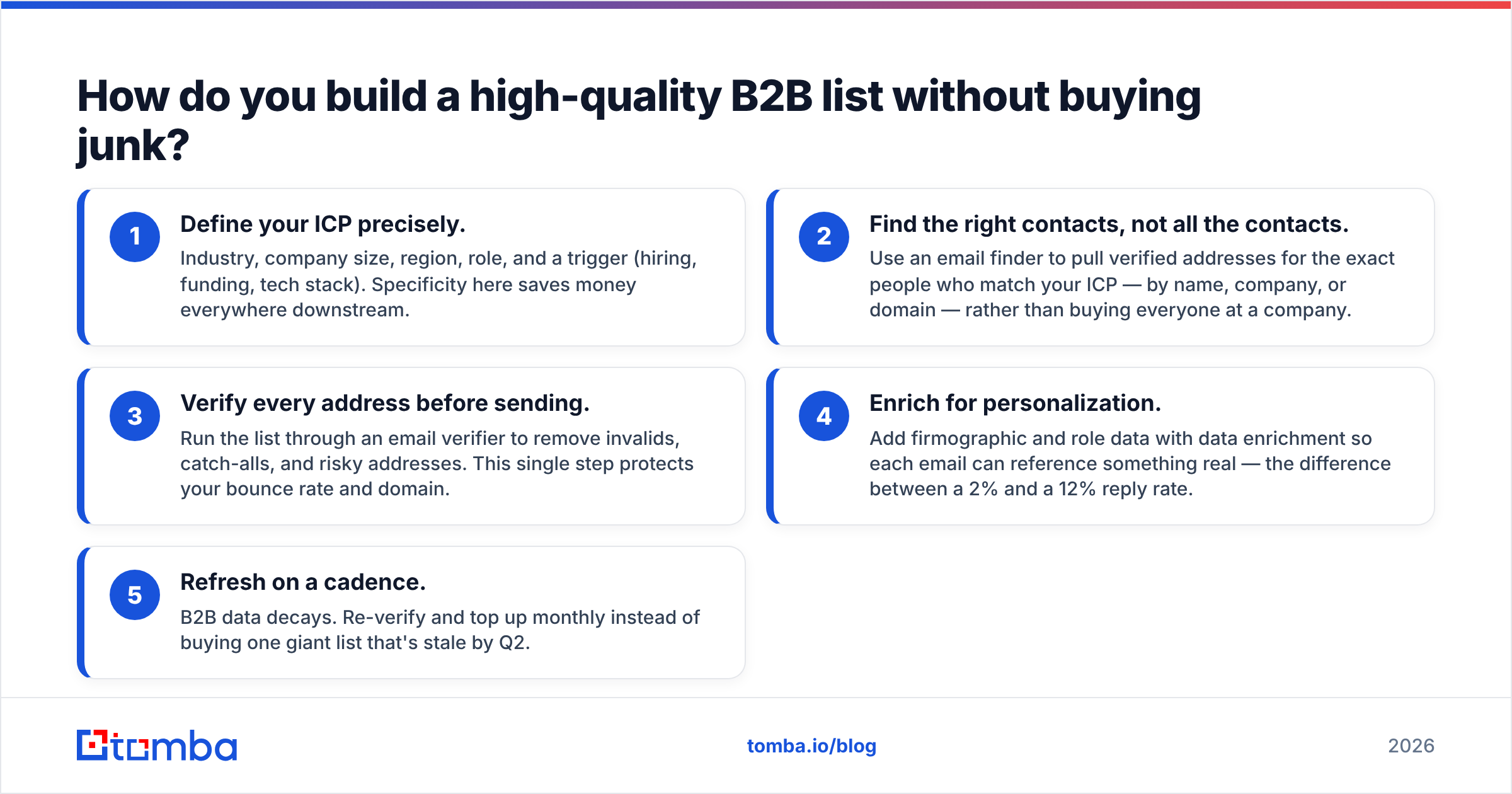
How do you build a high-quality B2B list without buying junk?#
A repeatable workflow beats any one-time purchase. Here's a five-step process that keeps lists fresh and deliverable:
- Define your ICP precisely. Industry, company size, region, role, and a trigger (hiring, funding, tech stack). Specificity here saves money everywhere downstream.
- Find the right contacts, not all the contacts. Use an email finder to pull verified addresses for the exact people who match your ICP — by name, company, or domain — rather than buying everyone at a company.
- Verify every address before sending. Run the list through an email verifier to remove invalids, catch-alls, and risky addresses. This single step protects your bounce rate and domain.
- Enrich for personalization. Add firmographic and role data with data enrichment so each email can reference something real — the difference between a 2% and a 12% reply rate.
- Refresh on a cadence. B2B data decays. Re-verify and top up monthly instead of buying one giant list that's stale by Q2.
For volume, a bulk email finder lets you process hundreds of companies at once while still verifying each result — you get scale without inheriting a stranger's recycled, unverified spreadsheet.
What should you look for in a lead-data provider?#
Whether you buy access or build your own, judge providers on the same criteria. Don't take "millions of contacts" at face value — coverage is meaningless without accuracy.
- Verification built in. Can you verify an email at the moment you pull it, or are you trusting a months-old snapshot?
- Transparent data sources. Reputable vendors explain where data comes from. Read independent reviews on G2 rather than trusting marketing claims.
- Real coverage for your market. Strong US coverage means little if you sell into the DACH region.
- Compliance posture. GDPR/CCPA documentation, opt-out handling, and clear terms of use.
- Fair, predictable pricing. Credit-based models you control beat opaque enterprise contracts with forced annual commits.
- API and workflow fit. Can it slot into your CRM and sequencer, or does it create another manual export step?
On price specifically, watch for the gap between headline cost and usable output. A transparent, credit-based plan — see Tomba pricing — lets you pay for verified results rather than a bloated database dump you'll never fully use.
When does buying business leads actually make sense?#
Buying isn't always wrong. It's a reasonable choice when:
- You're testing a brand-new market and need directional volume fast before investing in a careful build.
- You're running ABM and buying intent data to prioritize accounts you already know you want.
- You outsource top-of-funnel to an agency on a pay-per-qualified-lead basis with a quality SLA.
Even then, treat any purchased data as raw material, not finished product. Run it through verification, dedupe it against your CRM, and trim it to ICP fit before a single email goes out. The teams that get value from bought leads are the ones who refuse to trust them blindly.
The bottom line#
Buying business leads can jump-start a pipeline, but the cheap-CSV version of it quietly costs more than it saves — in bounces, wasted rep hours, compliance risk, and domain reputation. The durable advantage in 2026 belongs to teams that build small, precise, verified lists on demand and refresh them constantly.
If you'd rather own clean, exclusive, ICP-matched contacts than rent a stranger's recycled spreadsheet, start with the Tomba Email Finder. Pull verified business emails by name, company, or domain, confirm them with the built-in verifier, and load only deliverable, on-target contacts into your sequences. The free tier gives you 25 searches a month to test the workflow before you commit — build the list instead of buying the problem.
// get started
Find, verify and enrich your first contacts today
Start on the free plan with 25 searches a month, then scale when your team is ready.
Free plan · No credit card required · GDPR & CCPA
// about the author