B2B Buying Criteria in 2026: The Complete Decision Guide
Buying criteria decide who wins the deal long before pricing comes up. Here is a 2026 framework for mapping, ranking, and selling to the standards buyers actually use.
TL;DR
- Buying criteria are the explicit and hidden standards a buyer uses to judge, rank, and choose between options — they decide deals long before a contract is signed.
- Most lost deals are not lost on price; they are lost because you sold to criteria the buyer did not actually weight heavily.
- B2B buying involves 6–10 stakeholders, each with their own criteria. Winning means mapping them, not guessing.
- A practical framework: surface criteria, rank them by stakeholder, score yourself honestly, then shape the criteria you can credibly influence.
- Clean contact and account data is the foundation — you cannot map criteria for buyers you cannot reach or research.
What are buying criteria?#
Buying criteria are the standards a buyer measures every option against before making a purchase decision. Think of them like a judge's scorecard at a competition: the routine you actually performed matters less than how it scored against the categories the judges care about. In B2B sales, the "judges" are a buying committee, and the scorecard is rarely handed to you.
Criteria fall into two layers. Explicit criteria are the ones buyers will say out loud — price, integrations, security certifications, implementation time. Implicit criteria are the ones that drive the decision but rarely make it into an RFP: trust in your team, fear of internal blame if the project fails, a champion's career ambitions, or simple risk aversion.
The gap between these two layers is where deals are won and lost. A vendor who answers only the explicit checklist competes on features and price. A vendor who reads the implicit criteria sells confidence — and confidence wins.
)
Why do buying criteria matter more in 2026?#
Because buying committees got bigger and buyers got more self-directed. According to Gartner research on the B2B buying journey, a typical purchase now involves six to ten decision-makers, and buyers spend the majority of their journey researching independently before they ever talk to a rep.
That shift has two consequences for criteria:
- More stakeholders means more, often conflicting, criteria. The CFO weights total cost of ownership. The end user weights ease of use. Security weights compliance. IT weights maintenance burden. A single "winning" message no longer exists.
- Self-directed research means criteria are set before you arrive. By the time a buyer books a demo, they have already built a mental scorecard from your website, G2 reviews, peer conversations, and competitor content. If you do not know what is on that scorecard, you are answering questions nobody asked.
The teams that win in 2026 treat criteria discovery as a core sales skill, not an afterthought. They build their pipeline around it. If your sales process and pipeline does not have an explicit stage for surfacing and ranking buyer criteria, you are leaving the most important variable in the deal to chance.
What types of buying criteria should you map?#
Not all criteria carry equal weight, and they are not all the same kind of thing. Mapping them well means sorting them into categories so you can address each deliberately.
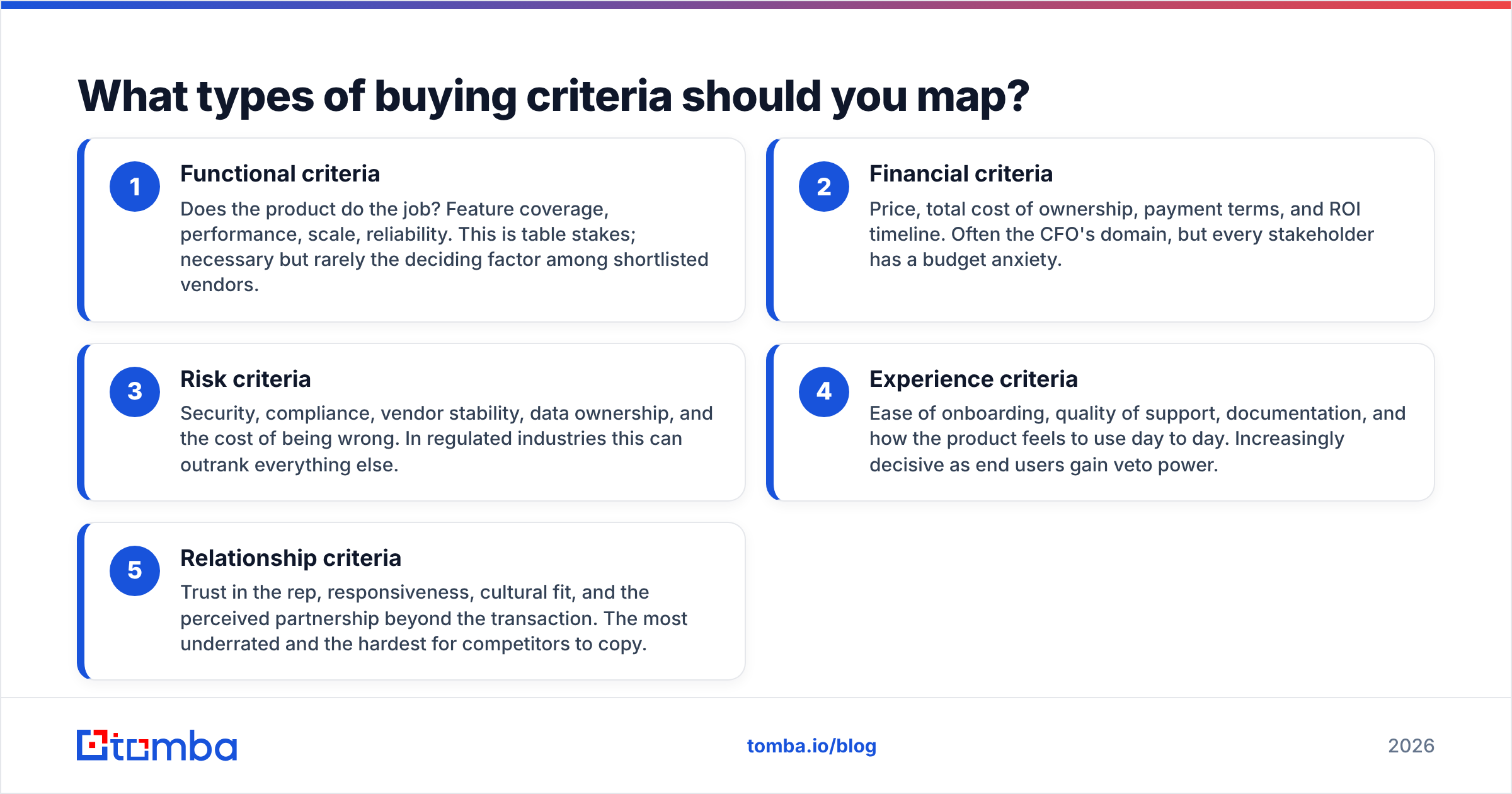
- Functional criteria — Does the product do the job? Feature coverage, performance, scale, reliability. This is table stakes; necessary but rarely the deciding factor among shortlisted vendors.
- Financial criteria — Price, total cost of ownership, payment terms, and ROI timeline. Often the CFO's domain, but every stakeholder has a budget anxiety.
- Risk criteria — Security, compliance, vendor stability, data ownership, and the cost of being wrong. In regulated industries this can outrank everything else.
- Experience criteria — Ease of onboarding, quality of support, documentation, and how the product feels to use day to day. Increasingly decisive as end users gain veto power.
- Relationship criteria — Trust in the rep, responsiveness, cultural fit, and the perceived partnership beyond the transaction. The most underrated and the hardest for competitors to copy.
A strong account plan names the top three criteria for each stakeholder and assigns a credible proof point to each. If you cannot fill in that grid, you do not yet understand the deal.
How do buying criteria differ across stakeholders?#
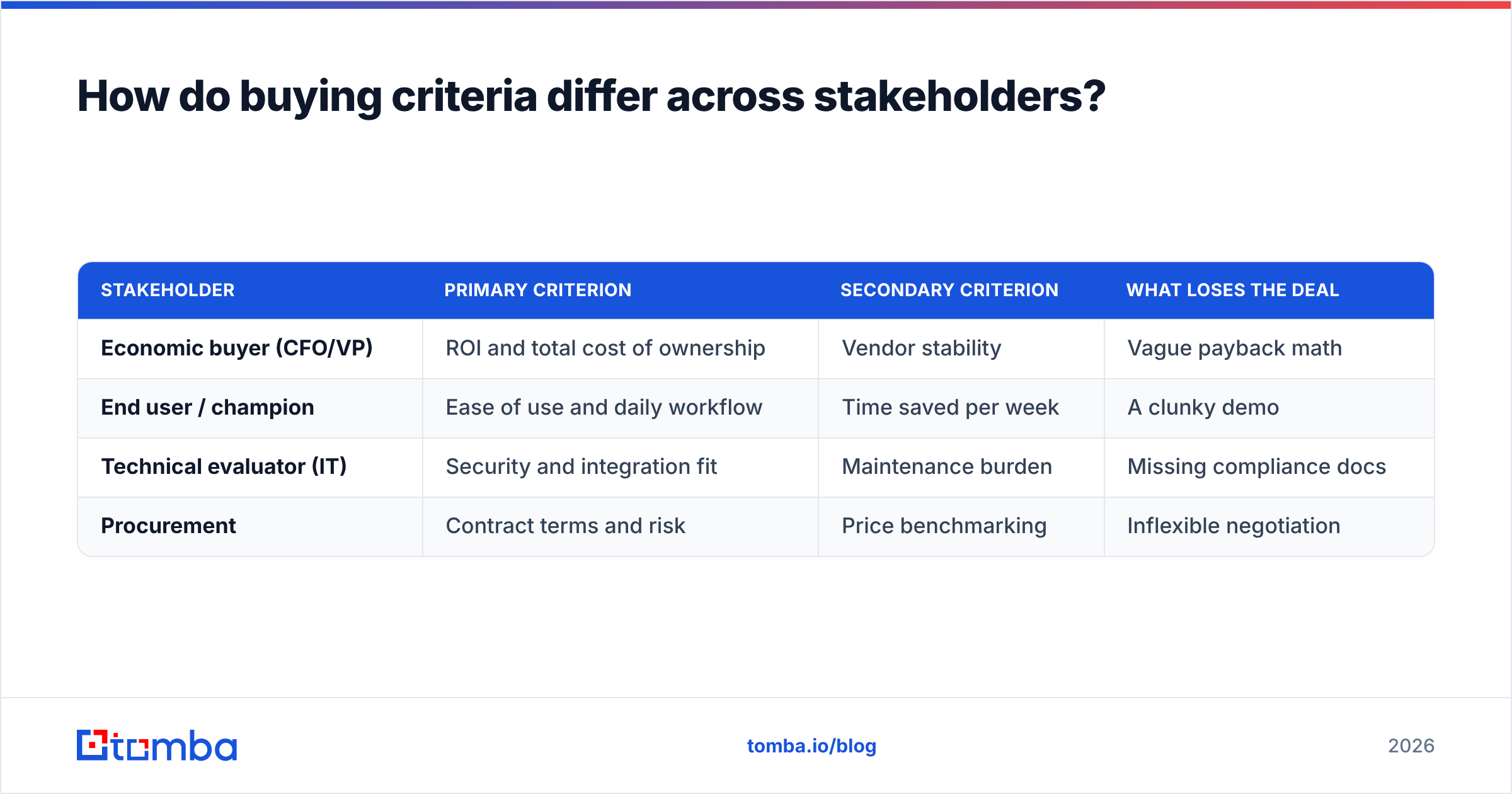
They differ enough that selling to one persona's criteria can actively alienate another. Here is how the same purchase looks from four seats at the table.
| Stakeholder | Primary criterion | Secondary criterion | What loses the deal |
|---|---|---|---|
| Economic buyer (CFO/VP) | ROI and total cost of ownership | Vendor stability | Vague payback math |
| End user / champion | Ease of use and daily workflow | Time saved per week | A clunky demo |
| Technical evaluator (IT) | Security and integration fit | Maintenance burden | Missing compliance docs |
| Procurement | Contract terms and risk | Price benchmarking | Inflexible negotiation |
Notice that the criteria are not just different — they pull in opposite directions. Procurement wants the lowest price; the champion wants the richest capability. Your job is not to pick a side. It is to give each stakeholder the proof they need while helping your champion sell internally to the others.
This is also why single-threaded deals are fragile. If you only know the criteria of one contact, a reorg, a vacation, or a competing priority can sink the whole opportunity. Multi-threading — building relationships and gathering criteria across the committee — is the most reliable defense, and it depends entirely on being able to find and reach those people.
How do you discover a buyer's real criteria?#
You ask, you research, and you cross-check the answers. Buyers will tell you their explicit criteria readily; the implicit ones you have to infer.
Ask directly, but specifically. Replace "What are you looking for in a solution?" with "When your team picks the winner, what will the deciding factor be — and who else has to agree?" The second question surfaces both the criterion and the hidden stakeholder.
Listen for ranking, not just lists. A buyer who names ten requirements has given you a checklist, not criteria. Push for priority: "If you could only get three of those, which three?" The forced trade-off reveals true weighting.
Research the account before you ask. A buyer's criteria are shaped by their industry, their recent funding, their tech stack, and their competitors. Walking in with that context lets you ask sharper questions and earns the right to a real answer. This is where good data enrichment pays off — knowing a prospect's role, company size, and stack before the first call turns generic discovery into targeted diagnosis.
Cross-check what they say against what they do. If a buyer says price is the top criterion but keeps asking about your support SLAs, support is the real concern. Watch the questions, not just the stated priorities.
)
Can you influence buying criteria, or only respond to them?#
You can shape them — and shaping criteria is the highest-leverage move in B2B selling. The catch is that you can only influence criteria you can credibly own.
There are three honest plays:
- Add a criterion the buyer overlooked. If you genuinely lead on data accuracy and competitors do not, teach the buyer why accuracy belongs on the scorecard. You are not manipulating; you are widening their definition of a good decision.
- Re-weight an existing criterion. A buyer fixated on sticker price can be guided toward total cost of ownership — including the cost of bad data, rework, and churn. Re-framing the math changes who wins.
- Reframe a weakness as a trade-off. If you are not the cheapest, make "cheapest" mean "riskiest." Tie low price to hidden costs the buyer will pay later.
What you cannot do is invent strengths you lack. Buyers in 2026 fact-check everything, and a criterion you planted but cannot defend becomes the reason you lose. Influence works only when it is anchored to something real.
What does a buying-criteria framework look like in practice?#
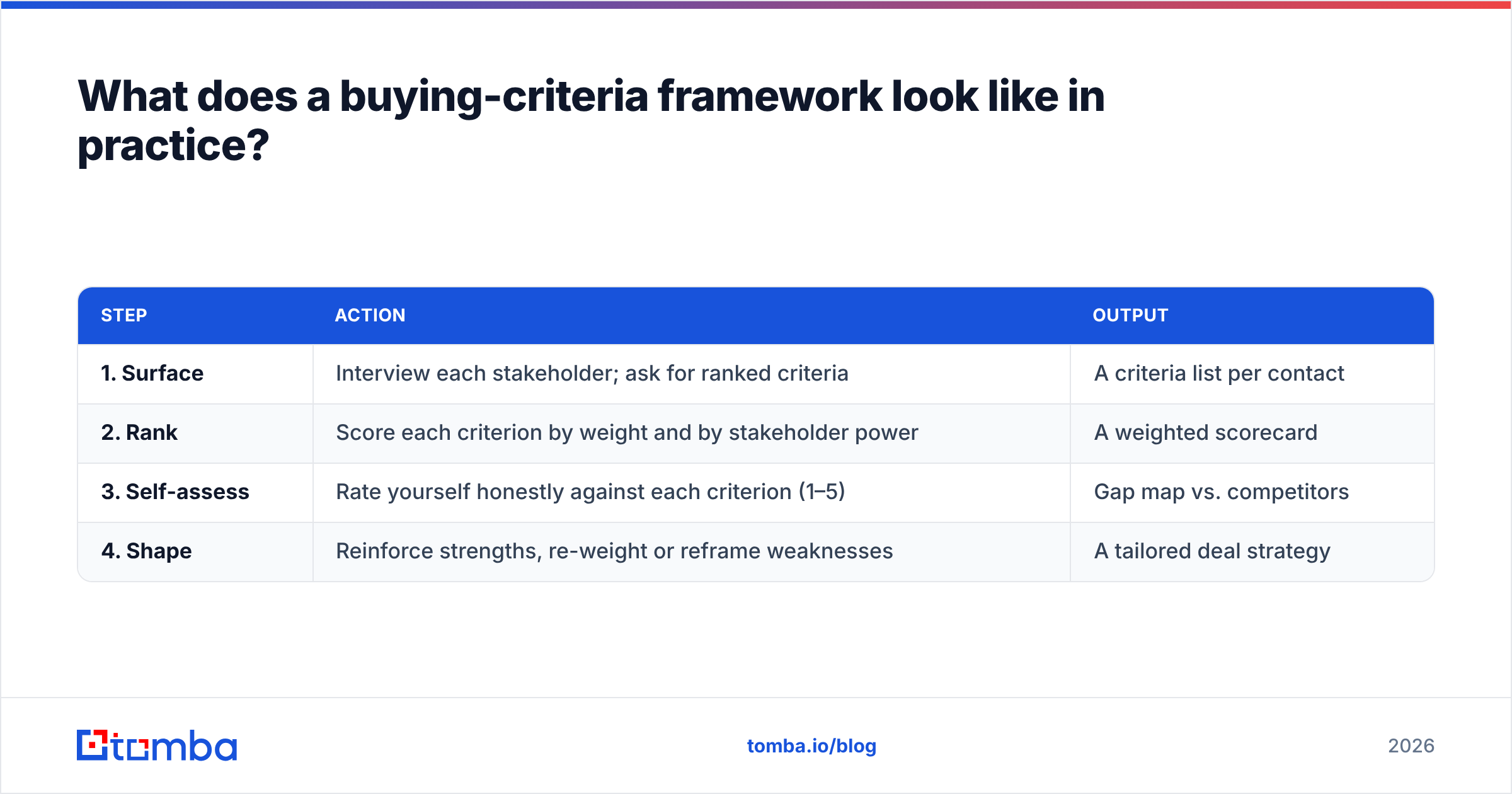
Here is a repeatable four-step loop you can run on any open opportunity.
| Step | Action | Output |
|---|---|---|
| 1. Surface | Interview each stakeholder; ask for ranked criteria | A criteria list per contact |
| 2. Rank | Score each criterion by weight and by stakeholder power | A weighted scorecard |
| 3. Self-assess | Rate yourself honestly against each criterion (1–5) | Gap map vs. competitors |
| 4. Shape | Reinforce strengths, re-weight or reframe weaknesses | A tailored deal strategy |
Run this loop early and revisit it at every stage change. Criteria drift as deals progress — a new executive joins, a budget tightens, a competitor plants a doubt. A scorecard you built at first contact is stale by the proposal stage if you never update it.
The framework also doubles as a qualification tool. If your honest self-assessment shows you losing on the two criteria that carry the most weight with the most powerful stakeholder, you are likely chasing a deal you will not win. Better to know in week one than in week twelve. This is the same discipline behind defining a marketing qualified lead — clear criteria stop you from pouring effort into the wrong opportunities.
How does data quality affect your ability to map criteria?#
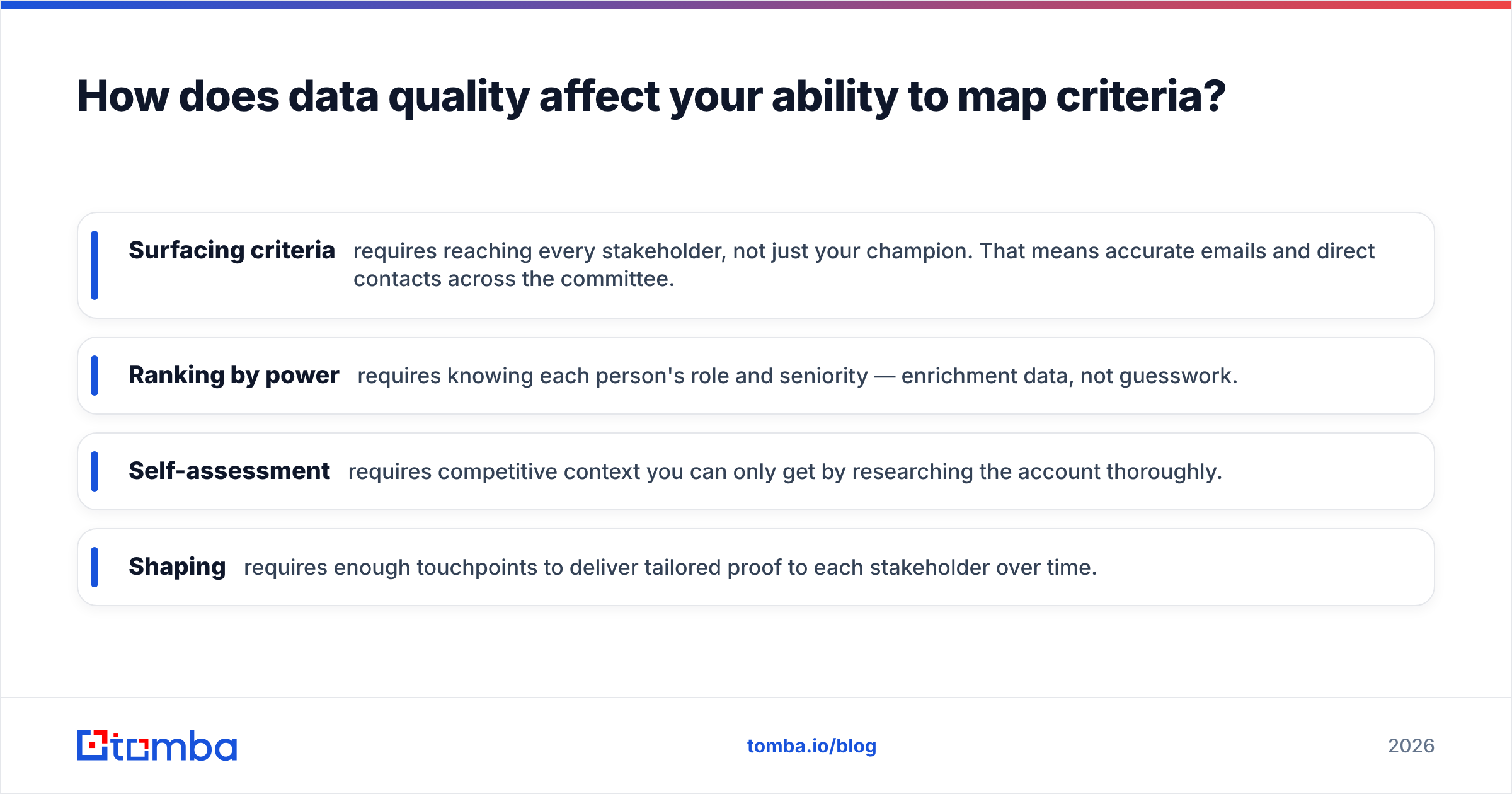
Profoundly — because every step of the framework assumes you can reach and research the right people. You cannot interview a stakeholder you cannot identify. You cannot multi-thread a committee whose members you cannot find. You cannot research an account on stale contact data.
Consider the chain of dependencies:
- Surfacing criteria requires reaching every stakeholder, not just your champion. That means accurate emails and direct contacts across the committee.
- Ranking by power requires knowing each person's role and seniority — enrichment data, not guesswork.
- Self-assessment requires competitive context you can only get by researching the account thoroughly.
- Shaping requires enough touchpoints to deliver tailored proof to each stakeholder over time.
Bad data quietly breaks all four. You map criteria for the two people you happened to reach, miss the procurement lead who actually controls the decision, and lose to a vendor who threaded the whole committee. A reliable B2B database and an accurate email finder are not glamorous, but they are the difference between a complete criteria map and a partial one.
What are the most common buying-criteria mistakes?#
Even experienced teams fall into the same traps:
- Selling to your own criteria. You think your best feature is the deciding factor. The buyer disagrees. Their scorecard wins, every time.
- Treating the committee as one buyer. A single deck for six stakeholders satisfies none of them. Tailor or lose.
- Confusing stated criteria with real ones. Buyers often cite price because it is socially safe; the real driver is risk or trust.
- Mapping criteria once. Deals evolve. So do criteria. A static map is a liability.
- Ignoring the silent stakeholder. The person who never joins a call but signs the check is the one whose criteria you most need.
Avoiding these is mostly a matter of discipline: ask better questions, multi-thread deliberately, and keep your scorecard current.
How should you act on buying criteria once you know them?#
Turn the scorecard into a deal plan. For each high-weight criterion, assign a specific proof point — a case study, a benchmark, a reference customer, a security doc — and a specific stakeholder to deliver it to. Sequence them so your champion always has the next piece of ammunition to sell internally.
Then close the loop on qualification: if the weighted scorecard says you are a poor fit, redirect that energy to a winnable deal. The goal of mapping criteria is not to win every opportunity — it is to win the right ones efficiently and to stop investing in the wrong ones early.
The teams that operationalize this — building criteria discovery into their CRM stages, enriching every account before outreach, and multi-threading by default — consistently out-convert teams that rely on intuition. Buying criteria are not a soft skill. They are the structure underneath every B2B decision.
Start with the data that makes criteria mapping possible#
You cannot map what you cannot reach. Before you score a single stakeholder, you need accurate contacts across the whole buying committee — the champion, the economic buyer, procurement, and the silent signer. Tomba Email Finder gives you verified professional emails by name, domain, or company, so you can multi-thread every deal and build a complete criteria map instead of a partial one. Pair it with enrichment to know each stakeholder's role and weight before your first call. Plans start free with 25 searches a month, with paid tiers from $49/mo — see Tomba pricing and start mapping the criteria that actually decide your deals.
// get started
Find, verify and enrich your first contacts today
Start on the free plan with 25 searches a month, then scale when your team is ready.
Free plan · No credit card required · GDPR & CCPA
// about the author