Buying Cycle in 2026: Stages, Examples & How to Win Deals
The buying cycle is the path a B2B buyer takes from problem-aware to signed contract. Here are the six stages, real examples, and how to shorten yours in 2026.
TL;DR
- The buying cycle is the repeatable journey a buyer takes from realizing they have a problem to signing a contract and renewing — not the same thing as your internal sales process.
- Most B2B deals move through six stages: awareness, interest, consideration, evaluation, decision, and post-purchase. Each stage needs a different message.
- B2B buying cycles are getting longer and more crowded — Gartner reports a typical buying group now includes 6 to 10 stakeholders.
- You shorten the cycle by reaching the right people early with accurate contact data, not by emailing harder.
- Map your content, outreach, and CRM stages to where the buyer actually is — misaligned timing is the single biggest reason deals stall.
What is the buying cycle?#
The buying cycle is the sequence of stages a person or company moves through before, during, and after a purchase. Think of it like dating before marriage: nobody proposes on the first coffee. There is curiosity, comparison, a few awkward questions, a decision, and then the long relationship that follows. Skip a step and the whole thing collapses.
In a B2B context, the buying cycle describes how a buyer goes from "we have a problem" to "we bought a solution" to "we're renewing." It is buyer-centric — it tracks what the customer is thinking and doing, not what your reps are doing. That distinction matters because your sales process should mirror the buying cycle, not fight it.
The confusion usually starts here: people use "buying cycle," "sales cycle," and "customer journey" interchangeably. They overlap, but they are not the same lens on the same deal.
Buying cycle vs sales cycle vs customer journey#
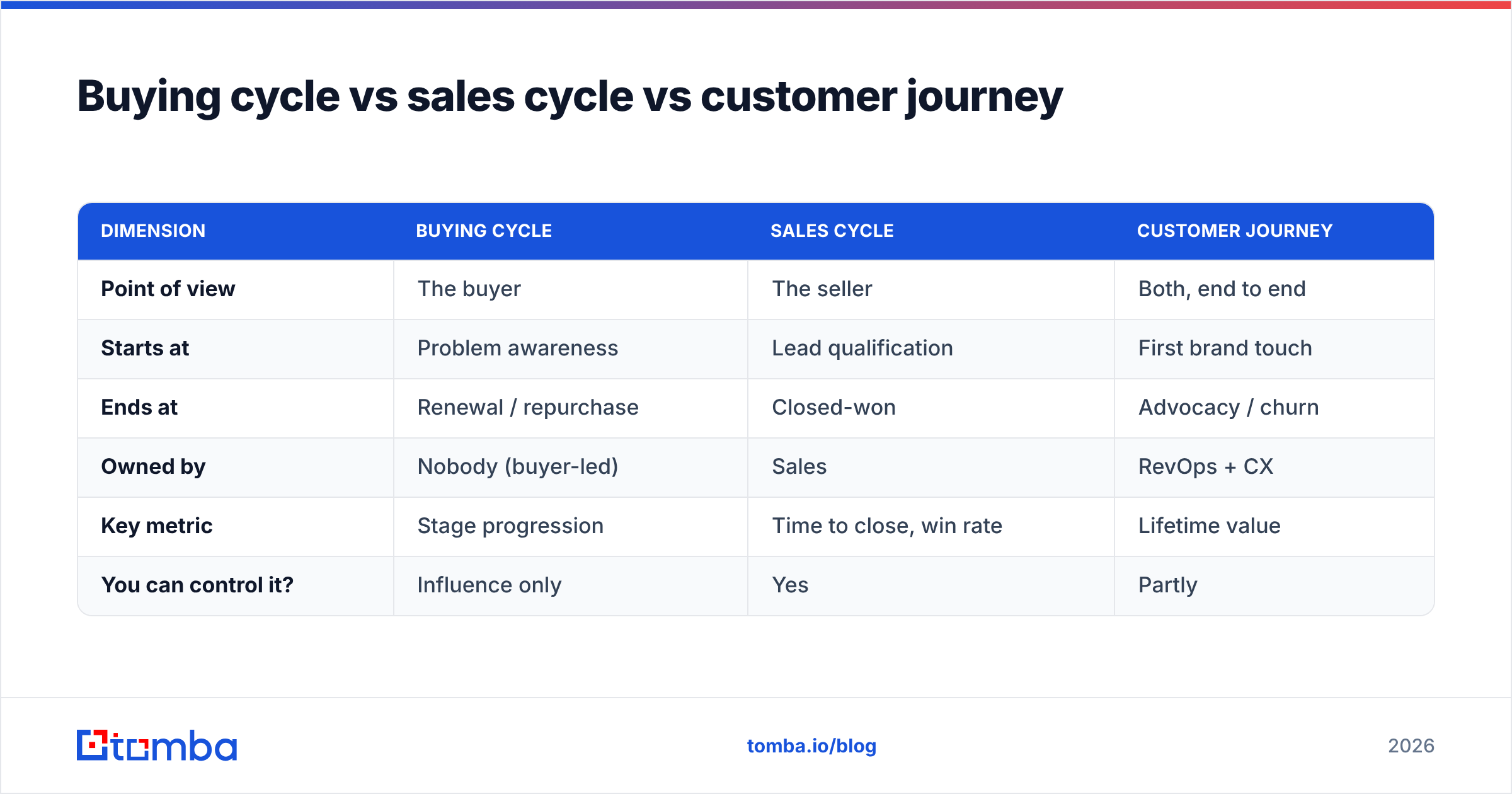
Here is the cleanest way to keep the three terms straight:
- Buying cycle — The buyer's perspective. Stages defined by the buyer's mindset (problem-aware, comparing options, ready to decide). You don't control it; you respond to it.
- Sales cycle — Your perspective. The internal steps your team runs to close a deal (qualify, demo, proposal, negotiate, close). It is measured in time-to-close and win rate.
- Customer journey — The widest lens. Every touchpoint across marketing, sales, product, and support, including the stages after the sale that drive retention and expansion.
- Sales funnel — A volume model layered on top, showing how many prospects survive each stage. It is the math, not the experience.
| Dimension | Buying cycle | Sales cycle | Customer journey |
|---|---|---|---|
| Point of view | The buyer | The seller | Both, end to end |
| Starts at | Problem awareness | Lead qualification | First brand touch |
| Ends at | Renewal / repurchase | Closed-won | Advocacy / churn |
| Owned by | Nobody (buyer-led) | Sales | RevOps + CX |
| Key metric | Stage progression | Time to close, win rate | Lifetime value |
| You can control it? | Influence only | Yes | Partly |
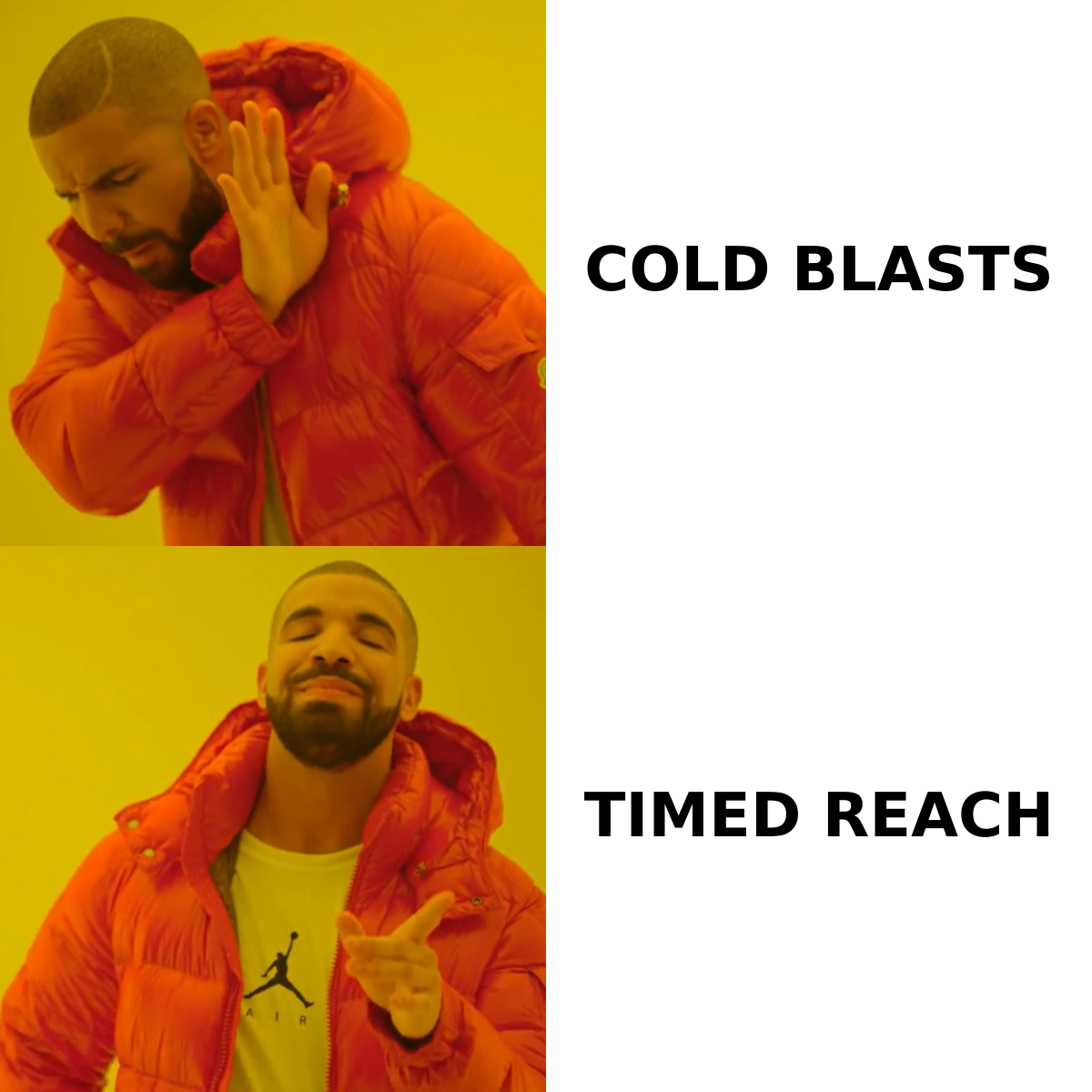
If your sales cycle and the buyer's buying cycle drift out of sync — you're pushing a proposal while they're still defining the problem — deals stall. Most "the lead went cold" stories are really timing mismatches.
What are the stages of the buying cycle?#
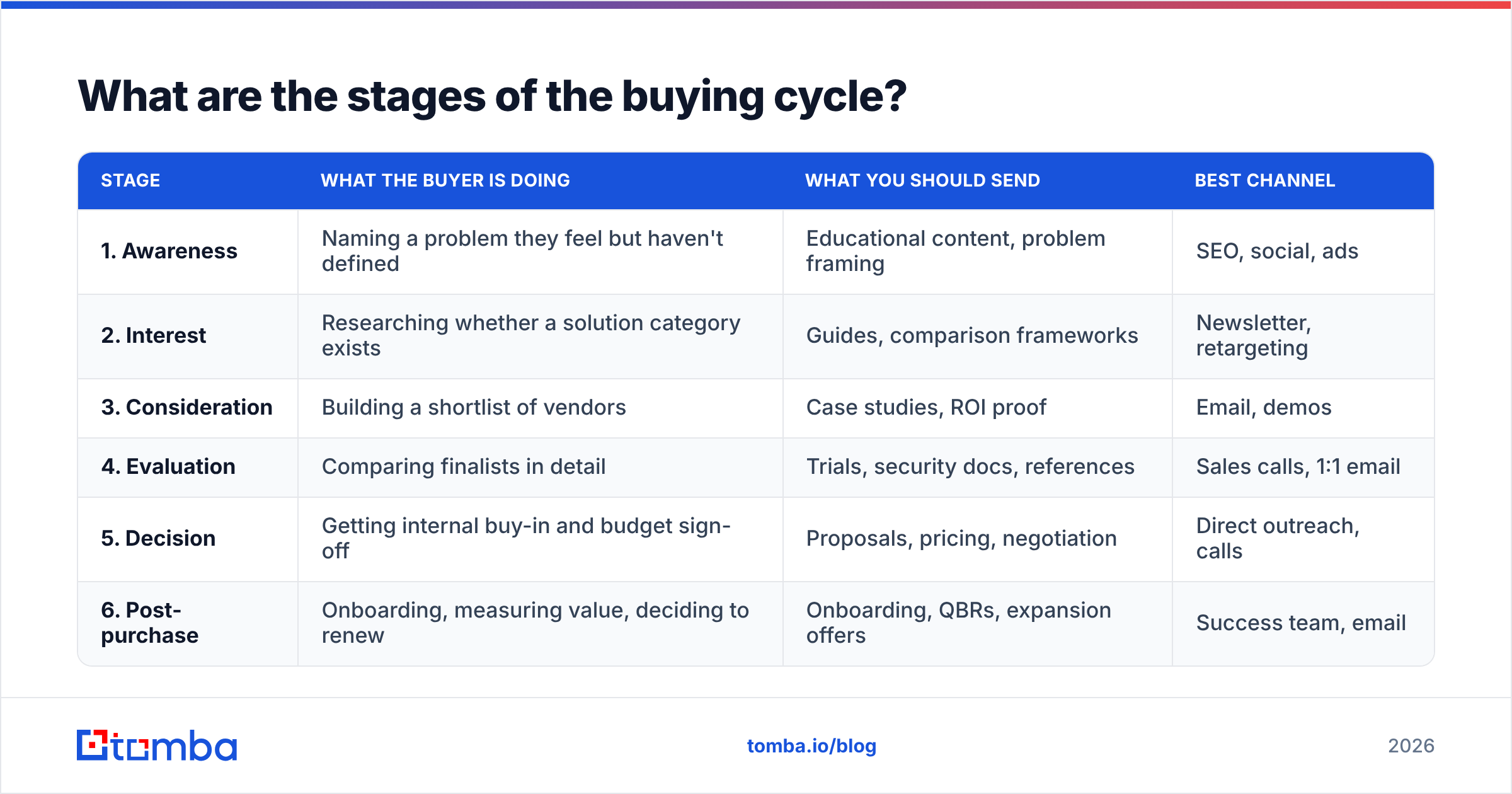
Different frameworks slice this differently (HubSpot's flywheel model reframes the funnel entirely), but a practical six-stage version covers most B2B deals.
| Stage | What the buyer is doing | What you should send | Best channel |
|---|---|---|---|
| 1. Awareness | Naming a problem they feel but haven't defined | Educational content, problem framing | SEO, social, ads |
| 2. Interest | Researching whether a solution category exists | Guides, comparison frameworks | Newsletter, retargeting |
| 3. Consideration | Building a shortlist of vendors | Case studies, ROI proof | Email, demos |
| 4. Evaluation | Comparing finalists in detail | Trials, security docs, references | Sales calls, 1:1 email |
| 5. Decision | Getting internal buy-in and budget sign-off | Proposals, pricing, negotiation | Direct outreach, calls |
| 6. Post-purchase | Onboarding, measuring value, deciding to renew | Onboarding, QBRs, expansion offers | Success team, email |
The hard truth: stages 1 and 2 happen largely without you. Buyers complete a big chunk of their research before they ever talk to a vendor. By the time someone fills out your demo form, they may already be at stage 4 with two competitors. That is why early, accurate outreach beats waiting for inbound — and why your contact data has to be right the first time.
A worked example#
Say you sell a payroll platform. A 40-person agency's finance lead notices payroll takes three full days each month (awareness). She searches "how to automate agency payroll" and reads two guides (interest). She bookmarks four tools and skims G2 reviews (consideration). She books demos with two of them and loops in the COO and an ops manager (evaluation). The group debates price and integration with their accounting stack (decision). Three weeks after signing, your onboarding email decides whether they expand to time-tracking next year (post-purchase).
Notice the buying group grew from one person to three. That is the modern reality.
Why is the B2B buying cycle getting longer?#
Short answer: more people, more proof, more caution. Three forces are stretching the cycle.
- Larger buying groups. Gartner's research on the B2B buying journey puts the typical buying group at 6 to 10 stakeholders, each with their own information and biases. Every added decision-maker adds delay.
- More self-serve research. Buyers spend the majority of the cycle in independent research — reading, comparing, watching — long before contacting sales. Your influence at this stage is your content, not your reps.
- Higher scrutiny on spend. Budgets get reviewed harder. Security, procurement, and finance now sit in deals that used to be a single champion's call.
The implication for your team: you cannot wait for the buyer to surface. You have to identify the full buying group early and reach the right contacts with a relevant message — which means knowing who they are and how to contact them accurately.
This is where prospecting data quality directly shapes cycle length. If half your outreach bounces or hits the wrong person, you are not influencing the buying cycle at all; you are talking to a wall. Using a reliable email finder to reach verified decision-makers early compresses the gap between "buyer is researching" and "buyer is talking to you."
How do you map outreach to each buying-cycle stage?#
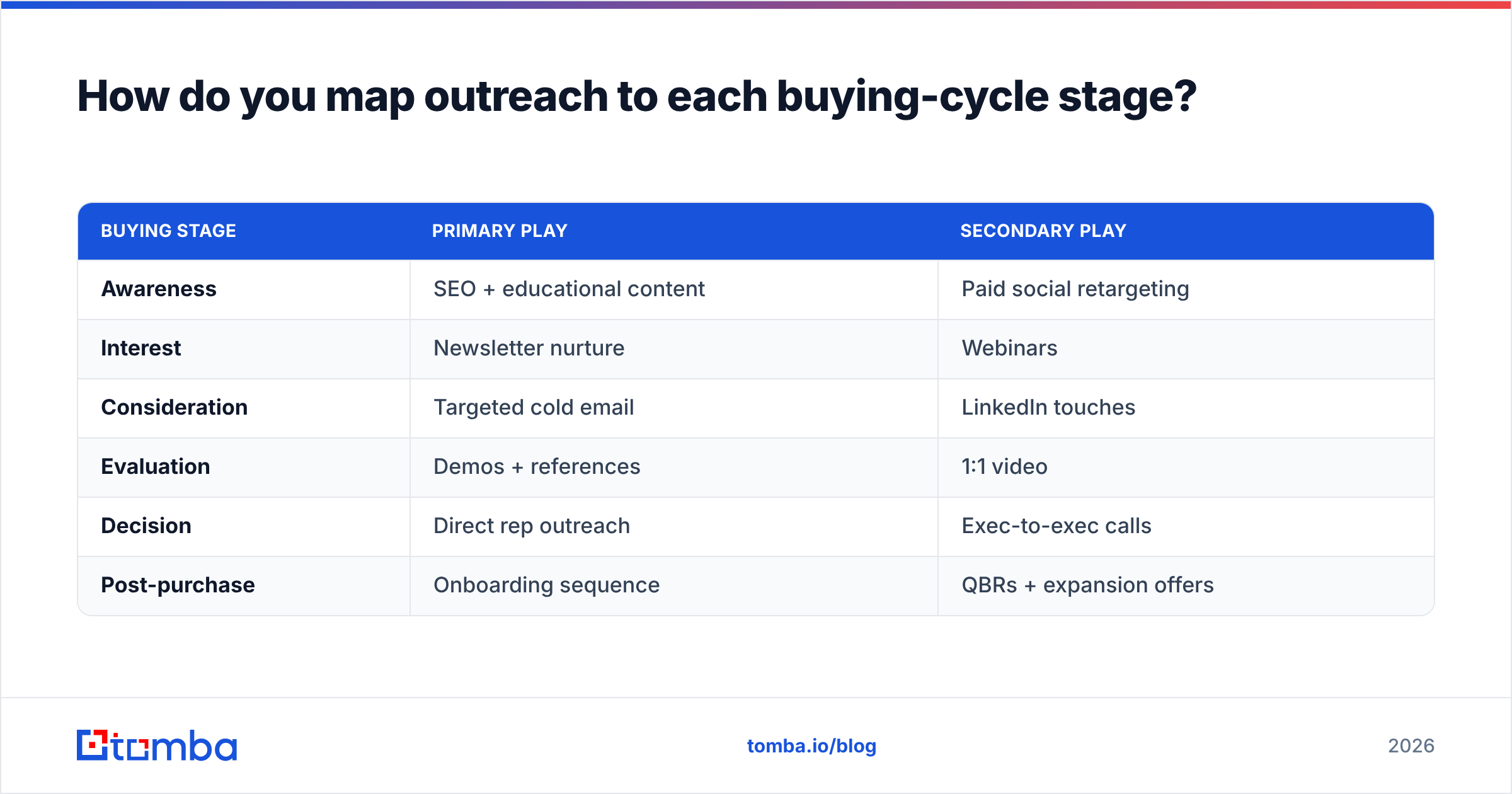
The goal is message-to-stage fit. Sending a hard pricing pitch to an awareness-stage buyer is like proposing on date one. Here is how to align effort.
Early stages (awareness, interest) — Lead with education and zero pressure. Your job is to be findable and useful. Publish content that names the buyer's problem, and capture intent signals. If you do reach out, anchor the message to the problem, not your product.
Middle stages (consideration, evaluation) — Now relevance and proof win. This is where targeted outbound earns its keep: a precise, personalized email to the right stakeholder, backed by a case study, moves deals. Build accurate lists with domain search to find every relevant contact at a target account, then enrich them so your message lands with context. Pairing outreach with data enrichment lets you personalize at scale instead of guessing.
Late stages (decision, post-purchase) — Speed and trust matter most. Make it easy to say yes: clear pricing, fast answers, references on demand. After the sale, onboarding quality predicts renewal. Don't go quiet the moment the contract is signed.
A quick channel-by-stage cheat sheet:
| Buying stage | Primary play | Secondary play |
|---|---|---|
| Awareness | SEO + educational content | Paid social retargeting |
| Interest | Newsletter nurture | Webinars |
| Consideration | Targeted cold email | LinkedIn touches |
| Evaluation | Demos + references | 1:1 video |
| Decision | Direct rep outreach | Exec-to-exec calls |
| Post-purchase | Onboarding sequence | QBRs + expansion offers |
For deeper background on how outreach mechanics fit the broader motion, the sales automation entry in Tomba's glossary is a useful primer.
How do you measure and shorten the buying cycle?#
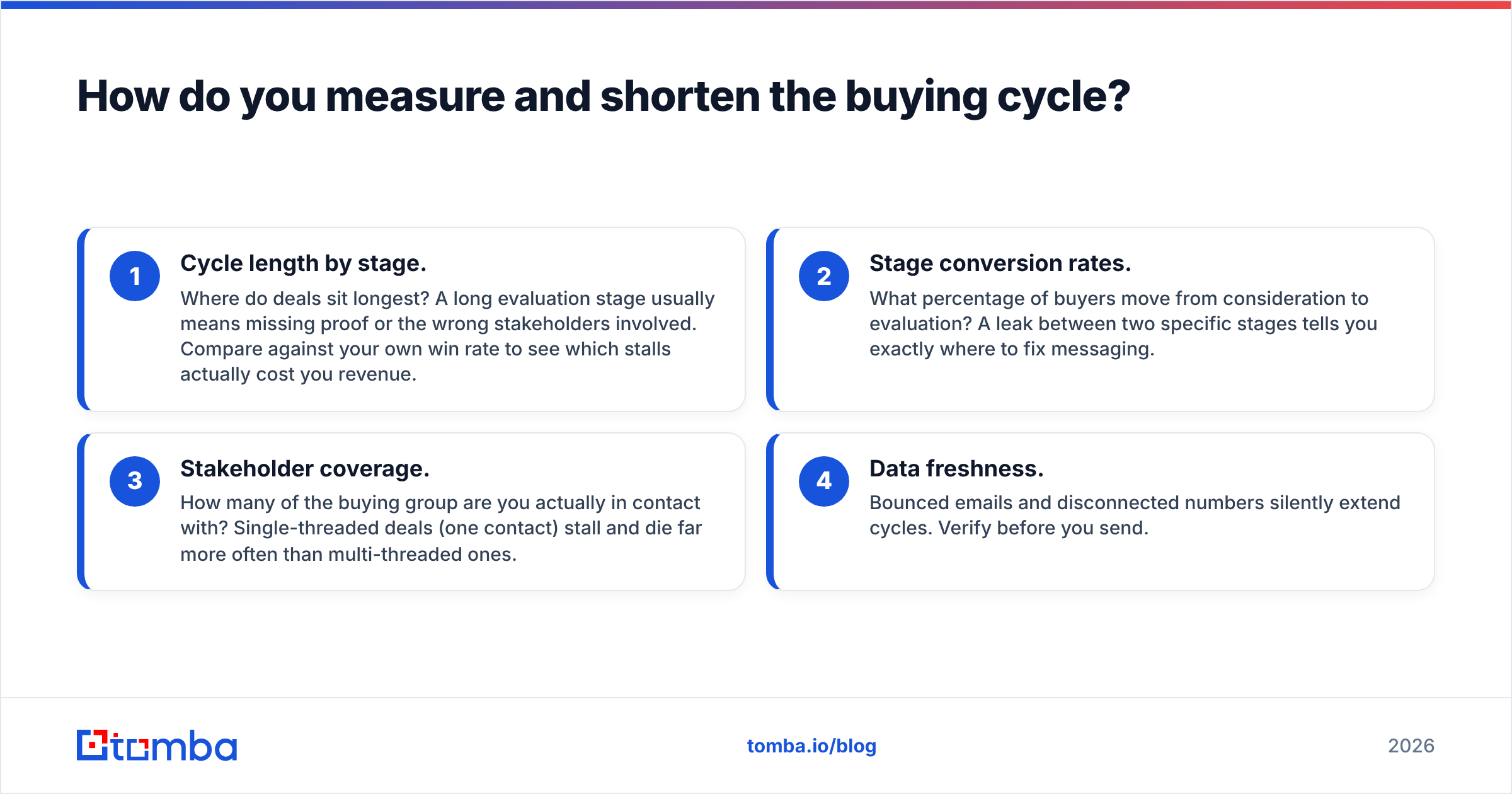
You can't shorten what you don't measure. Track these four things first:
- Cycle length by stage. Where do deals sit longest? A long evaluation stage usually means missing proof or the wrong stakeholders involved. Compare against your own win rate to see which stalls actually cost you revenue.
- Stage conversion rates. What percentage of buyers move from consideration to evaluation? A leak between two specific stages tells you exactly where to fix messaging.
- Stakeholder coverage. How many of the buying group are you actually in contact with? Single-threaded deals (one contact) stall and die far more often than multi-threaded ones.
- Data freshness. Bounced emails and disconnected numbers silently extend cycles. Verify before you send.
Now the levers that actually shorten the cycle:
- Reach the full buying group early. Multi-thread from the start. Find the economic buyer, the champion, and the blockers before evaluation, not during it.
- Remove friction at the decision stage. Pre-empt procurement and security questions. Have the docs ready.
- Keep data accurate. Verify contacts before outreach so reps spend time selling, not chasing bounces. An email verifier step before any campaign protects both deliverability and sender reputation.
- Match content to stage. Stop sending bottom-funnel pitches to top-funnel buyers. Map every asset to a stage.
- Follow up post-sale. Renewal is part of the cycle. Treat onboarding as a revenue stage, not an afterthought.
A useful mental model: every day a deal sits in a stage, ask "what does the buyer need to move forward, and have I given it to them?" If the answer is "they need to talk to a stakeholder I haven't reached," that is a data and prospecting problem you can fix today.
How does data quality affect the buying cycle?#
Bad data lengthens every stage at once. If your contact list is wrong, awareness outreach bounces, consideration emails reach the wrong person, and evaluation stalls because you never engaged the real decision-maker. Salesforce's State of Sales research repeatedly ties rep productivity to data quality and tooling — reps lose a large share of their week to non-selling work, much of it caused by bad or missing data.
Concretely, accurate data does three things for the buying cycle:
- Compresses time-to-first-contact — you reach buyers while they're still researching, not after a competitor has them.
- Enables multi-threading — you can find and verify every stakeholder in the buying group, not just the one who happened to fill a form.
- Protects deliverability — verified sends keep your domain reputation healthy so your messages actually land during the critical consideration window.
If you're choosing tools to support this, weigh accuracy and verification first, then coverage, then price. You can compare full Tomba pricing against your volume needs — the free tier (25 searches/month) is enough to test data quality before committing, with Starter at $49/mo and Growth at $99/mo as you scale outreach.
Common buying-cycle mistakes to avoid#
- Treating the buying cycle as linear. Buyers loop backward — a new stakeholder enters at evaluation and drags the deal back to consideration. Build for loops, not a straight line.
- Single-threading. Betting the whole deal on one champion. If they leave or go quiet, you start over.
- Pitching too early. Hard selling at awareness burns trust and trains buyers to ignore you.
- Ignoring post-purchase. The cheapest revenue is expansion and renewal. Going silent after close forfeits it.
- Letting data rot. A contact list decays roughly 2–3% per month as people change jobs. Stale data quietly extends every cycle.
The bottom line#
The buying cycle is the buyer's journey, not yours — and your job is to meet them at each stage with the right message, the right proof, and the right timing. The teams that win in 2026 aren't emailing harder; they're reaching the right people earlier with data they can trust, then staying aligned to where the buyer actually is.
That alignment starts with knowing who to contact and how to reach them accurately. Tomba's email finder helps you identify and verify the full buying group early — so your outreach lands during the research window when it actually moves a deal forward, not after the cycle has already passed you by. Start free with 25 searches and see how much shorter your cycle gets when the data is right the first time.
// get started
Find, verify and enrich your first contacts today
Start on the free plan with 25 searches a month, then scale when your team is ready.
Free plan · No credit card required · GDPR & CCPA
// about the author