Buying Group Personas: The 2026 B2B Committee Playbook
B2B deals are won by committees, not individuals. Learn how to map buying group personas, the roles that matter, and how to reach every stakeholder in 2026.
Buying Group Personas: The 2026 B2B Committee Playbook
You closed the champion. You lost the deal anyway. The reason is almost always the same: you sold to one person when six were quietly voting. Buying group personas are how modern revenue teams fix that — by mapping every role inside the committee instead of betting the quarter on a single contact.
TL;DR#
- B2B purchases are committee decisions. Gartner pegs the typical buying group at 6–10 stakeholders, so a single-persona strategy leaves most of the room unaddressed.
- Buying group personas ≠ buyer personas. A buyer persona describes one ideal individual; buying group personas describe the set of roles that must align for a deal to close.
- Six core roles repeat across deals: Champion, Economic Buyer, Decision Maker, Technical/Evaluator, End User, and Blocker. Each needs different proof.
- Coverage beats charisma. Deals stall when you have zero contacts in a role, not when your pitch is weak.
- You need contact data for the whole group, not just the lead who filled out the form — which is where a reliable email finder earns its keep.
What are buying group personas?#
Buying group personas are role-based profiles of every stakeholder who influences a single B2B purchase decision. Think of a buying group like a jury, not a judge. You can win over one juror with a brilliant argument, but the verdict still requires the whole panel. Buying group personas are your map of who sits in each seat and what evidence each one needs to vote "yes."
This is a different exercise from the classic buyer persona. A buyer persona ("Marketing Mary, 34, SaaS, hates manual reporting") describes one idealized individual. Buying group personas describe the relationships and roles in a real account: who controls budget, who will use the product daily, who can quietly kill the deal, and who carries your case to the executive team.
The shift matters because B2B buying has fundamentally changed. According to Gartner, the average enterprise purchase involves 6 to 10 decision-makers, each armed with their own research. Sell to one, and you're hoping that person can re-sell internally on your behalf. Usually they can't — not because they don't want to, but because they don't have the language each peer needs to hear.
)
Why does a single buyer persona fail in 2026?#
Because the person who replies to your cold email is rarely the person who signs the contract. A self-serve $20/month tool can be sold to one user. A $40,000 platform cannot. The more strategic and expensive the purchase, the larger and more cautious the committee — and the more ways the deal can quietly die.
Three failure modes show up again and again:
- Single-threading. Your entire deal lives in one inbox. That champion changes jobs, goes on leave, or gets overruled, and your pipeline evaporates overnight.
- Mismatched proof. You send an ROI deck to an engineer who wanted an API doc, or security questionnaires to a VP who wanted a business case. Right content, wrong persona.
- Invisible blockers. Someone you never spoke to — a security lead, a procurement gatekeeper, an incumbent-vendor loyalist — vetoes you in a meeting you weren't in.
Buying group personas attack all three. They force you to ask, before the deal stalls: which roles do I have covered, and which are dark? That coverage question is the single best predictor of whether a complex deal will close.
What are the six core buying group personas?#
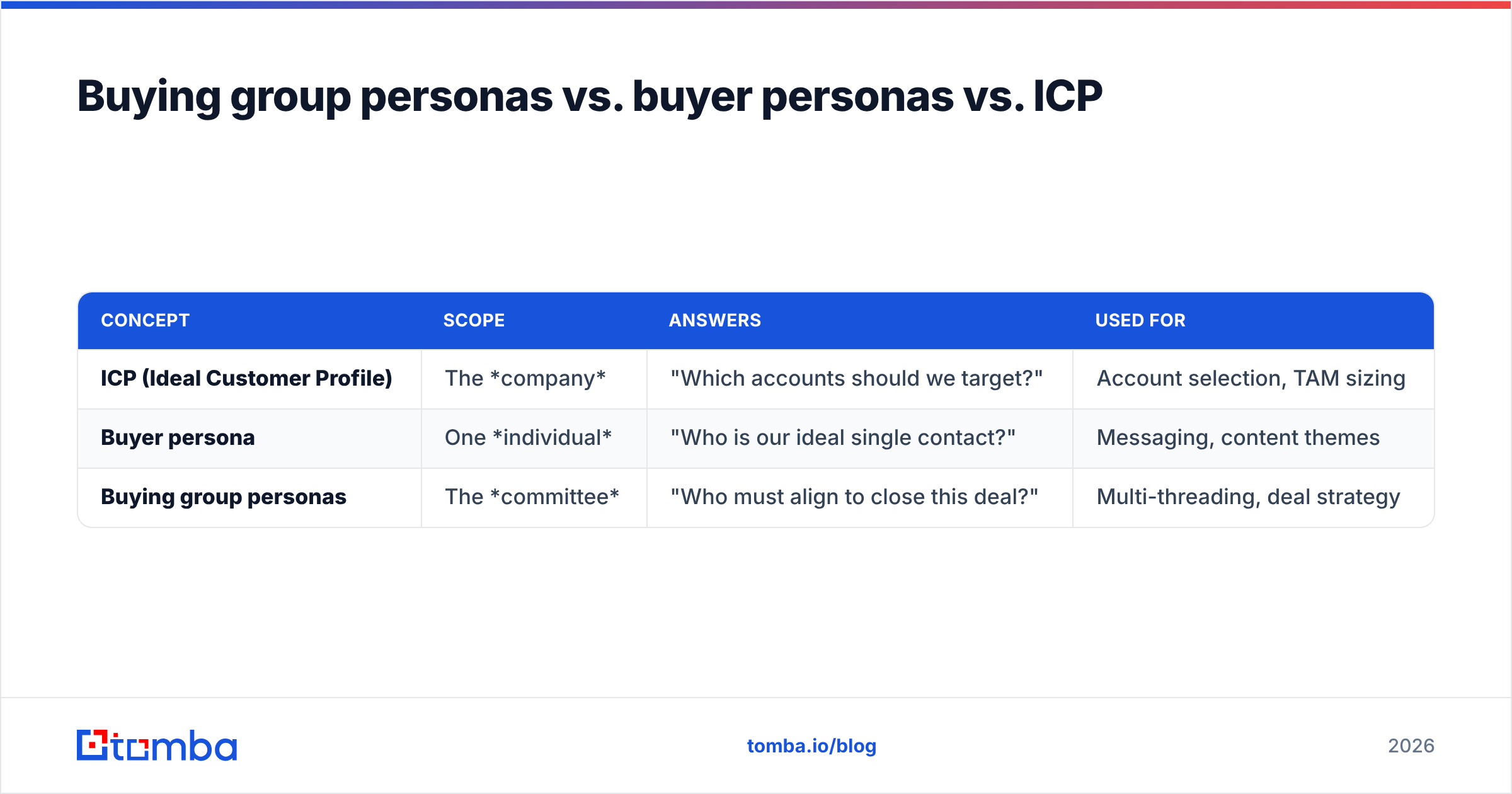
Most committees, regardless of industry, contain the same six functional roles. People can hold more than one role, and large enterprises split each into several humans — but the functions are remarkably stable.
| Persona | Primary question they ask | What convinces them | Worst thing you can do |
|---|---|---|---|
| Champion | "How does this make me look good?" | A clear internal win, easy-to-share assets | Make them do your selling alone |
| Economic Buyer | "Is this worth the money?" | ROI, payback period, risk reduction | Lead with features, not business outcomes |
| Decision Maker | "Does this fit our strategy?" | Vision alignment, references, peer proof | Skip them until contract stage |
| Technical Evaluator | "Will this actually work here?" | Docs, security posture, integration depth | Hand-wave the implementation details |
| End User | "Will this make my day easier or worse?" | UX, onboarding, time saved | Ignore them — they'll quietly resist |
| Blocker | "What could go wrong?" | Compliance, references, exit options | Pretend they don't exist |
A few field notes on each:
- The Champion is your inside seller. Your job is to arm them, not replace them. Give them a one-page business case they can forward without editing.
- The Economic Buyer rarely cares about your feature list. They care about a number and a date. Translate everything into payback period and downside protection.
- The Decision Maker is often an executive who appears late but can override everyone. Build a reference story and peer logos early so the champion can name-drop them.
- The Technical Evaluator can't say a final "yes," but can absolutely say "no." Earn their trust with honest documentation and a real conversation about edge cases. The Tomba API and CLI exist precisely because evaluators want to test before they trust.
- The End User is the most underrated persona. Even after signature, low adoption gets you churned at renewal. Win them during evaluation, not after.
- The Blocker is not the enemy — they're a risk manager doing their job. Engage them directly, with references and compliance answers, before they engage you in front of an executive.
How do you map a buying group for a real account?#
Mapping is a repeatable, four-step loop you run per target account.
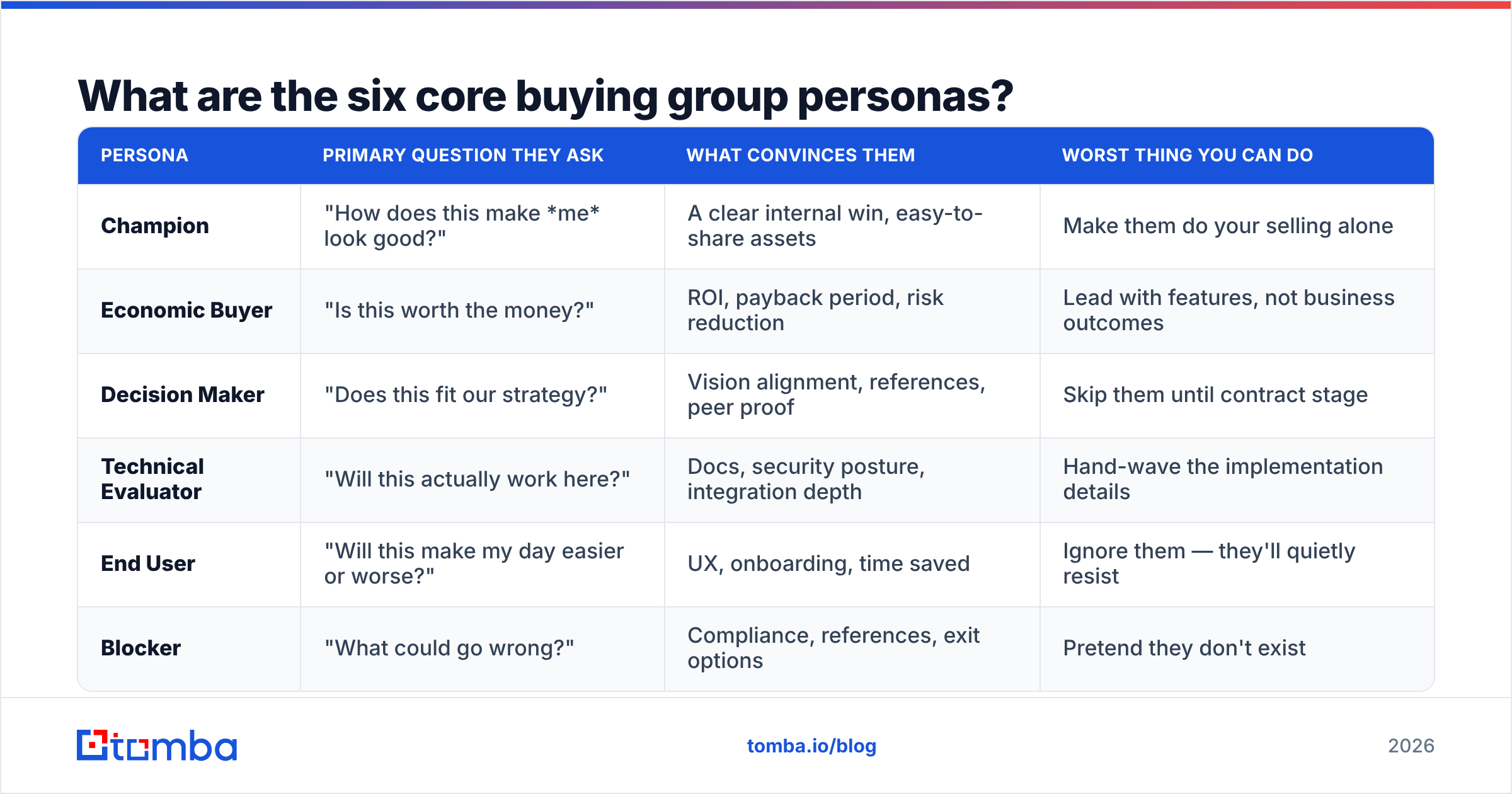
- Start from the org, not the lead. Pull the company's structure for the relevant department. A domain search returns the verified email patterns and named contacts at a company, so you begin with the actual roster instead of guessing.
- Assign roles to names. Tag each known contact against the six personas. Empty seats are your priority list — a role with zero contacts is a coverage gap, and coverage gaps are where deals die.
- Fill the gaps with verified contact data. For each missing role, find and verify the right person before you reach out. Bouncing emails to a CFO is worse than not emailing at all. Run candidates through an email verifier so your first impression isn't a bounce.
- Multi-thread with role-specific messaging. Reach at least three personas in parallel, each with proof tailored to their question from the table above. Never send the same email to the engineer and the economic buyer.
)
Buying group personas vs. buyer personas vs. ICP#
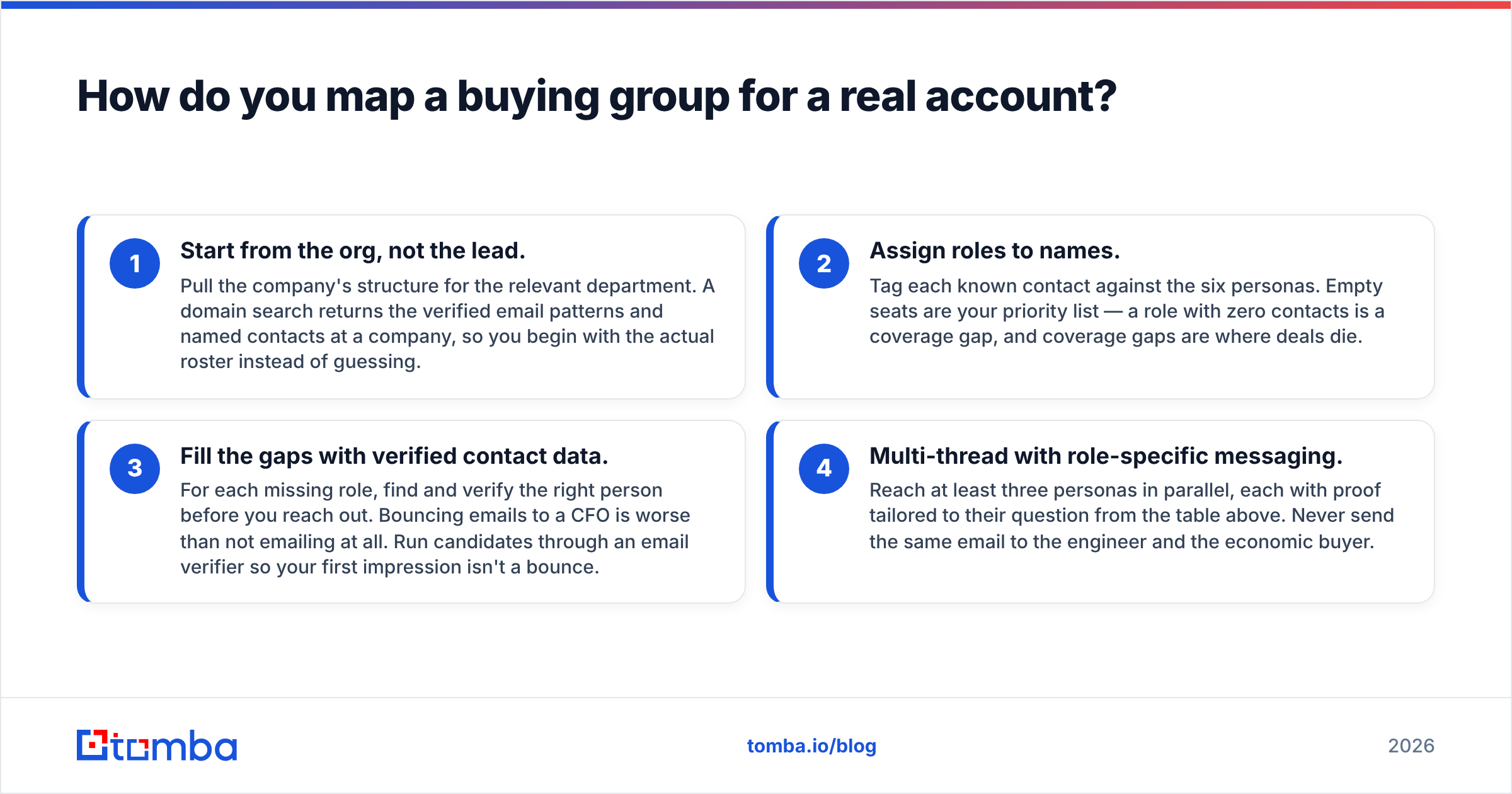
These three concepts are often used interchangeably, which causes real confusion in go-to-market planning. They operate at different altitudes.
| Concept | Scope | Answers | Used for |
|---|---|---|---|
| ICP (Ideal Customer Profile) | The company | "Which accounts should we target?" | Account selection, TAM sizing |
| Buyer persona | One individual | "Who is our ideal single contact?" | Messaging, content themes |
| Buying group personas | The committee | "Who must align to close this deal?" | Multi-threading, deal strategy |
Your ICP tells you which doors to knock on. Buyer personas tell you how to talk to one person behind a door. Buying group personas tell you that there are six people behind the door and that you need a plan for each. A mature revenue operations motion uses all three together rather than treating them as competing frameworks.
How does this change your outbound and content?#
Once you think in buying groups, three parts of your motion change.
Outbound sequencing. Instead of one sequence to one title, you build parallel tracks — a champion track, an economic-buyer track, a technical track — that reference each other. When the engineer hears "your VP asked us to scope integration effort," the message lands with internal credibility.
Content production. You stop writing generic "ultimate guides" and start producing one asset per persona: an ROI calculator for the economic buyer, a security one-pager for the blocker, a five-minute setup video for the end user, a forwardable business case for the champion. The cold email templates you use should branch by role, not by industry alone.
Data operations. Buying-group selling is data-hungry. You need verified contacts across multiple roles per account, refreshed as people change jobs. This is where automation matters: a bulk email finder plus enrichment lets you populate an entire committee in one pass instead of hand-researching each name. For ABM teams, syncing that data into the CRM through a HubSpot integration keeps the committee map live as the deal moves.
What does "good coverage" actually look like?#
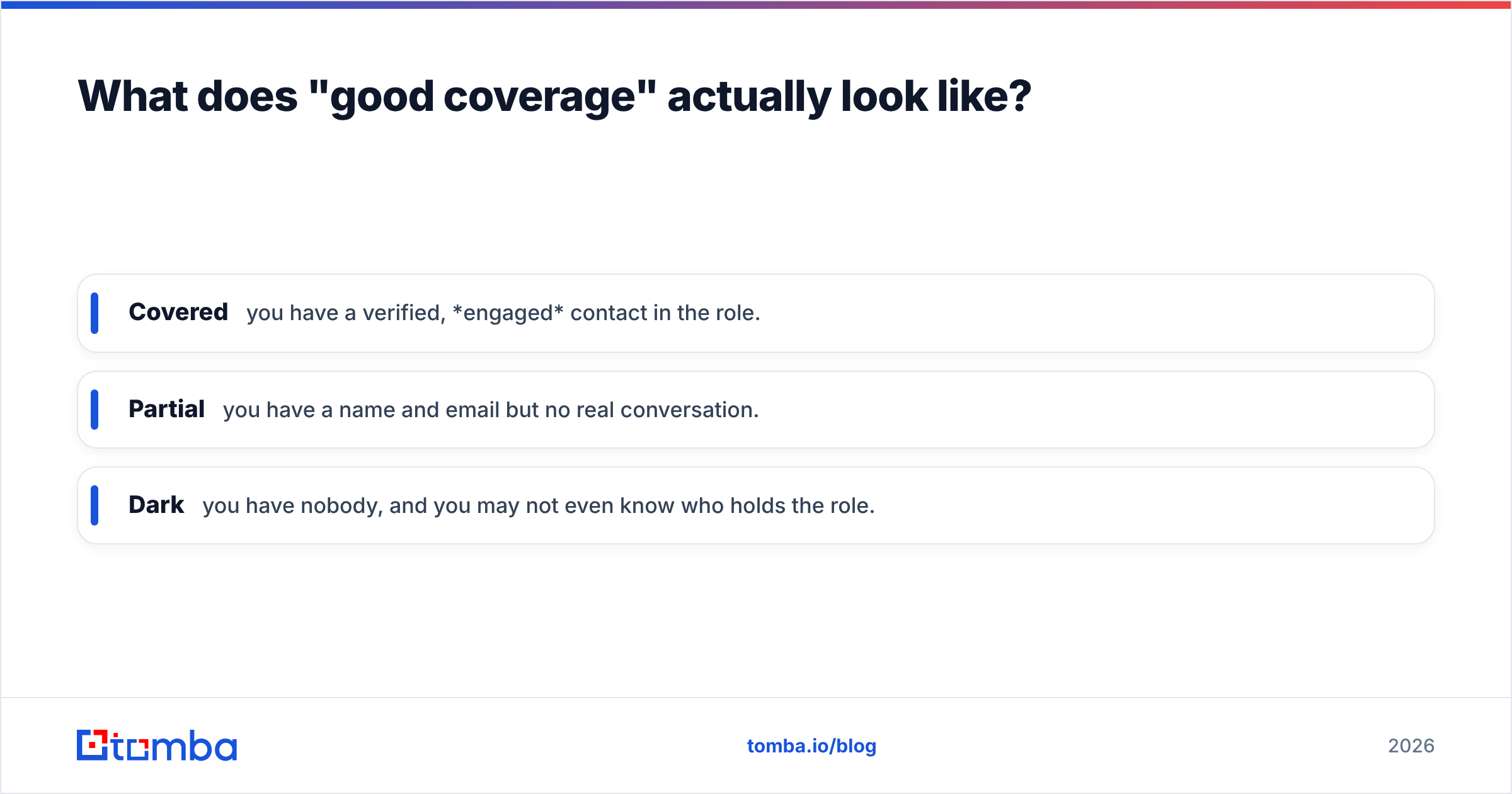
A practical scorecard beats a feeling. For any deal above your average contract value, grade each persona as covered, partial, or dark:
- Covered — you have a verified, engaged contact in the role.
- Partial — you have a name and email but no real conversation.
- Dark — you have nobody, and you may not even know who holds the role.
A healthy late-stage enterprise deal should be Covered on the Champion, Economic Buyer, and Technical Evaluator, and at least Partial on the Decision Maker, End User, and Blocker. If your biggest deal of the quarter is dark on the economic buyer, you don't have a deal — you have a conversation. Reviewing this scorecard in pipeline meetings turns vague "it's looking good" optimism into an honest, role-based forecast, which is exactly what a disciplined sales process is supposed to surface.
Common mistakes when working with buying group personas#
- Over-engineering the map. You don't need 14 personas. The six core roles cover the vast majority of deals. Add nuance only where a specific market demands it.
- Confusing title with role. A "Director of IT" might be your champion in one account and your blocker in another. Map by behavior and question, not by job title.
- Treating the champion as the buyer. The champion advocates; they rarely control budget. Loving you is not the same as paying you.
- Going dark on the blocker. Avoiding the skeptic doesn't remove them — it just guarantees their objection surfaces when you're not in the room to answer it.
- Skipping verification. A committee map built on stale or guessed emails collapses on first contact. Validate before you send.
Frequently asked questions#
How many people are really in a B2B buying group? Research from Gartner consistently puts it at 6 to 10 for considered purchases, and larger for enterprise platform deals. Smaller, low-cost tools may have just one or two, which is exactly why the buying-group framework scales with deal complexity.
Can one person hold multiple personas? Yes, often. In a small company a founder may be champion, economic buyer, and decision maker at once. The roles are functional, not headcount — map the questions being asked, then attach names.
Where do I get contact data for the whole group? Start with a domain search to see the verified roster at the company, fill role gaps with an email finder, and verify everything before outreach. Keeping the committee map enriched in your CRM is what separates teams that multi-thread from teams that single-thread by accident.
Put your buying group on the map#
You can't sell to a committee you can't see. The fastest way to go from one champion to full committee coverage is to populate every persona with a real, verified contact — then message each one with the proof their role demands. Tomba's Email Finder gives you verified professional emails by name, company, or domain, so you can fill the dark seats in your buying group before a competitor does. Start free with 25 searches, and see Tomba's pricing when you're ready to map committees at scale.
// get started
Find, verify and enrich your first contacts today
Start on the free plan with 25 searches a month, then scale when your team is ready.
Free plan · No credit card required · GDPR & CCPA
// about the author