Buying Intent in 2026: How to Spot Ready-to-Buy B2B Leads
Buying intent data tells you which accounts are researching a solution like yours right now. Here's how to read the signals, score them, and act before competitors do.
TL;DR
- Buying intent is the set of behavioral signals that show an account is actively researching a purchase — so you can reach out while the need is hot, not months later.
- Intent splits into first-party (your own site, product, and email activity) and third-party (research happening across the wider web). You need both.
- Raw signals are noise until you score and route them. A simple weighted model beats an expensive black box you don't trust.
- Intent without contact data is a dead end. The play is: detect intent → identify the account → enrich the right people → reach out.
- Treat vendor "intent scores" with healthy skepticism. Validate against closed-won data before you let them drive your pipeline.
What is buying intent?#
Buying intent is the signal that someone is moving toward a purchase decision — and in B2B, that signal is almost always behavioral, not stated. Nobody fills out a form that says "we will buy in 45 days." Instead they binge your pricing page, download a comparison guide, spike their searches for a category term, or quietly add three colleagues to a demo invite.
Think of it like a restaurant host reading the room. A table that's flagging down the waiter, stacking empty plates, and reaching for coats is "ready for the check" — no one announced it, but the signals are unmistakable. Buying intent data is the same read, applied to accounts instead of dinner tables: a cluster of behaviors that, together, mean "this account is in-market now."
Technically, buying intent is captured as intent signals — discrete events (a page view, a search, a content download, a review-site visit) that you collect, weight, and aggregate into an account-level score. The higher and fresher the score, the more likely the account is in an active buying cycle.
The reason this matters in 2026: buyers do the majority of their research before they ever talk to sales. By the time a lead raises a hand, they've often already built a shortlist. Intent data lets you enter the conversation earlier — while you can still shape the criteria instead of just answering an RFP.
Wait — that image reference should be plain. Let me restate the visual cleanly below.
What are the main types of buying intent signals?#
There are two families of intent data, and confusing them is the most common mistake teams make.
First-party intent is activity you observe directly: visits to your website, repeat views of your pricing page, demo requests, free-trial usage, email engagement, and webinar attendance. It's the highest-quality intent you can get because it's about your solution specifically — but it only covers accounts that already know you exist.
Third-party intent is research happening off your property: an account reading category articles, comparing vendors on review sites, or spiking searches for terms you care about, captured across publisher networks and data co-ops. It's lower fidelity (you're inferring interest from topic activity) but it surfaces accounts that haven't touched your site yet — the top of your funnel.
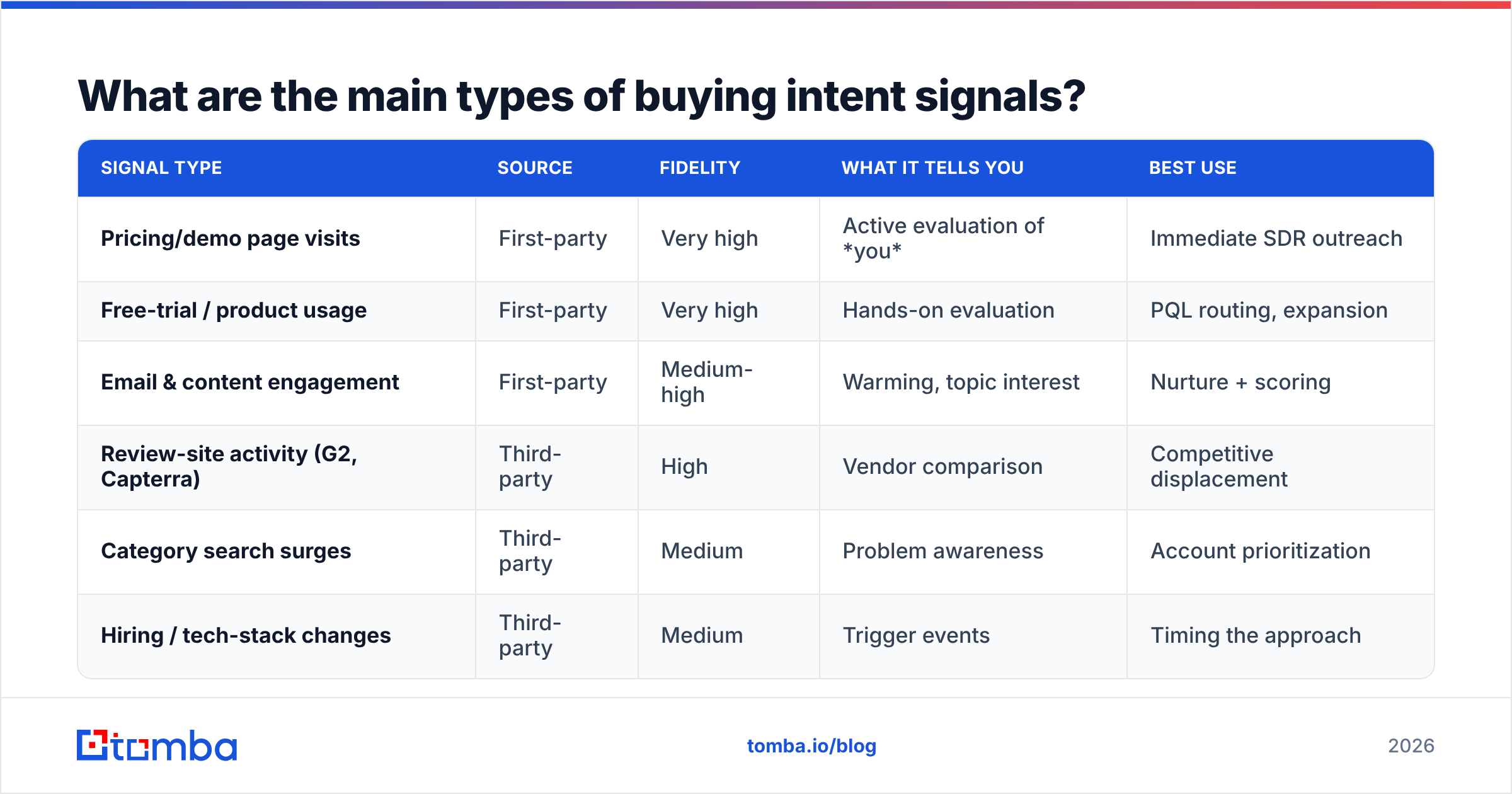
Here's how the major signal types compare:
| Signal type | Source | Fidelity | What it tells you | Best use |
|---|---|---|---|---|
| Pricing/demo page visits | First-party | Very high | Active evaluation of you | Immediate SDR outreach |
| Free-trial / product usage | First-party | Very high | Hands-on evaluation | PQL routing, expansion |
| Email & content engagement | First-party | Medium-high | Warming, topic interest | Nurture + scoring |
| Review-site activity (G2, Capterra) | Third-party | High | Vendor comparison | Competitive displacement |
| Category search surges | Third-party | Medium | Problem awareness | Account prioritization |
| Hiring / tech-stack changes | Third-party | Medium | Trigger events | Timing the approach |
A practical rule: first-party intent decides who to call today; third-party intent decides which accounts to put on the list this quarter. According to Gartner research on B2B buying, purchase groups now involve six to ten stakeholders, so a single signal rarely means much. You're looking for clusters of activity across multiple people at the same account.
How do you measure and score buying intent?#
You score buying intent by assigning weights to signals, decaying them over time, and aggregating to the account level. The output is a single, sortable number your reps can act on — not a wall of raw events.
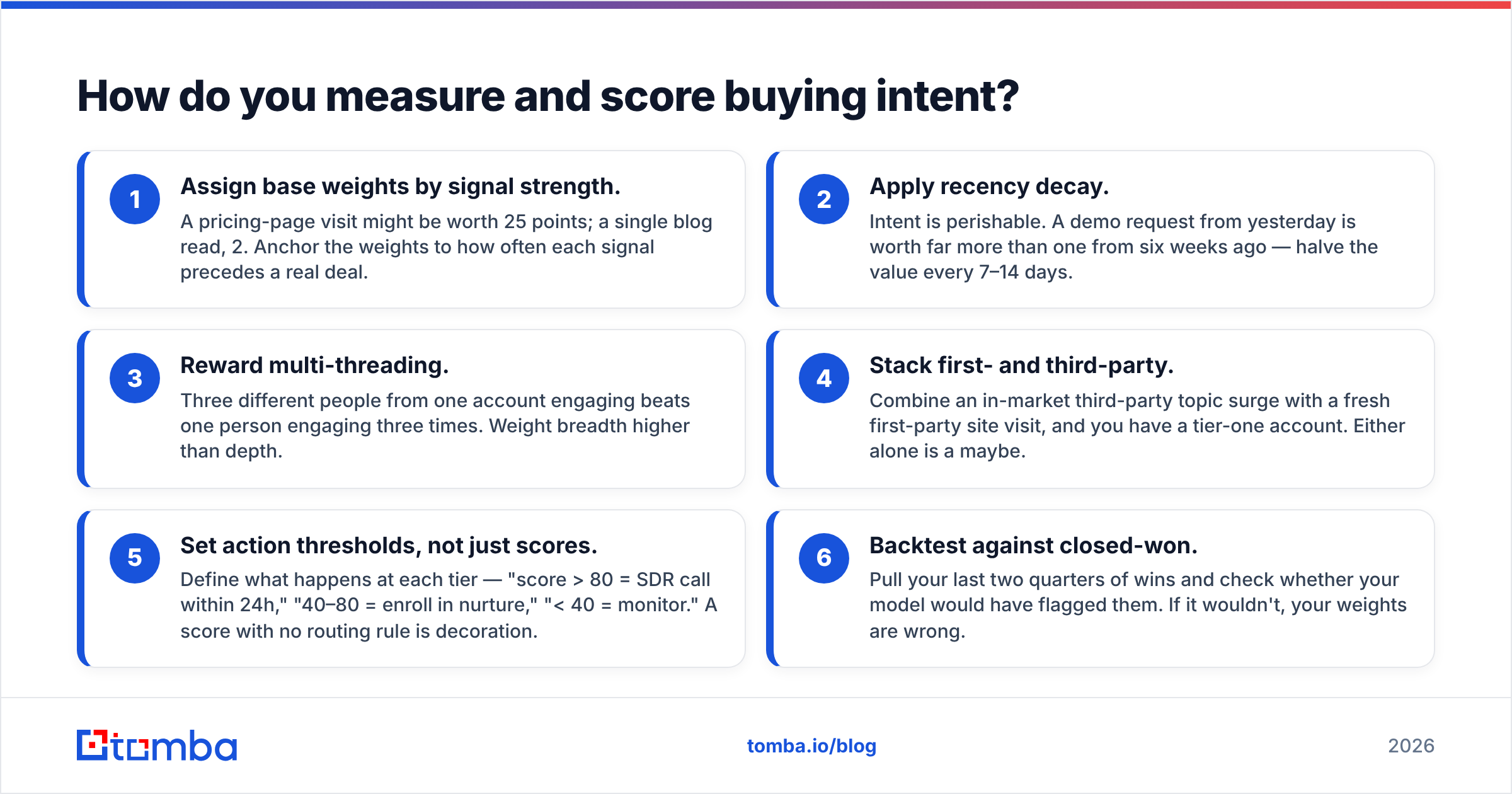
Don't overcomplicate the first version. A transparent weighted model you can explain in a sentence will outperform an opaque vendor score your team ignores. Here's a starter framework:
- Assign base weights by signal strength. A pricing-page visit might be worth 25 points; a single blog read, 2. Anchor the weights to how often each signal precedes a real deal.
- Apply recency decay. Intent is perishable. A demo request from yesterday is worth far more than one from six weeks ago — halve the value every 7–14 days.
- Reward multi-threading. Three different people from one account engaging beats one person engaging three times. Weight breadth higher than depth.
- Stack first- and third-party. Combine an in-market third-party topic surge with a fresh first-party site visit, and you have a tier-one account. Either alone is a maybe.
- Set action thresholds, not just scores. Define what happens at each tier — "score > 80 = SDR call within 24h," "40–80 = enroll in nurture," "< 40 = monitor." A score with no routing rule is decoration.
- Backtest against closed-won. Pull your last two quarters of wins and check whether your model would have flagged them. If it wouldn't, your weights are wrong.
This is where many teams stall: they buy an intent feed, never validate it, and quietly lose faith in it. Tie your scoring into your lead management and scoring workflow so intent isn't a separate dashboard nobody opens — it should change which lead sits at the top of a rep's queue tomorrow morning.
Why does buying intent fail without contact data?#
Intent tells you which account is in-market; it almost never hands you the people to contact. That gap is where most intent investments quietly die.
Picture it: your third-party feed lights up — a 2,000-person manufacturer is surging on "warehouse automation software," your exact category. Great. Now what? You have a company name and a topic. You don't have the VP of Operations' email, the procurement lead's direct line, or any way to reach the buying committee. The signal cools while you scramble.
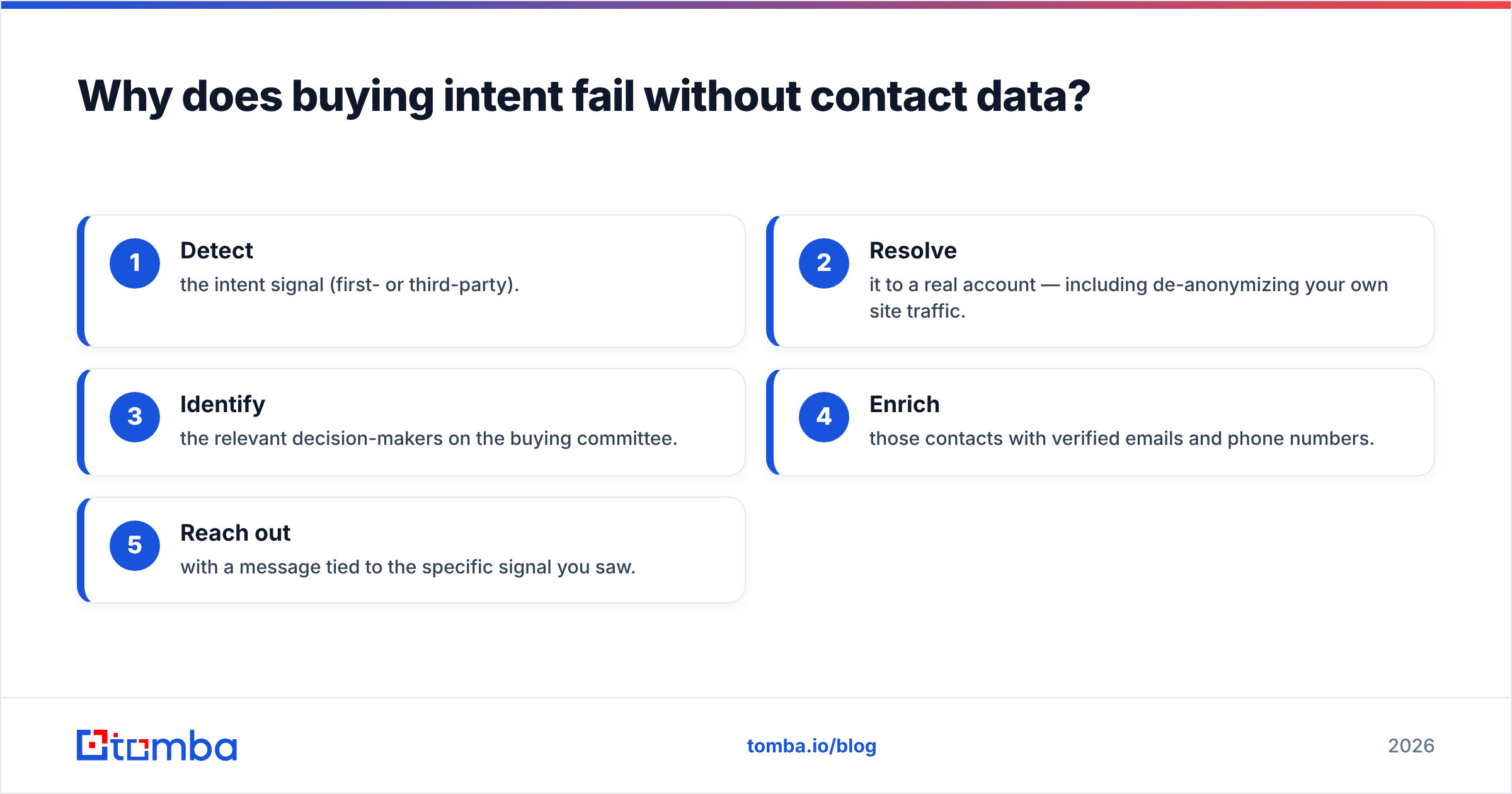
This is the unglamorous truth of intent-based selling: a signal is only as good as your ability to act on it within hours. The workflow that actually generates pipeline looks like this:
- Detect the intent signal (first- or third-party).
- Resolve it to a real account — including de-anonymizing your own site traffic.
- Identify the relevant decision-makers on the buying committee.
- Enrich those contacts with verified emails and phone numbers.
- Reach out with a message tied to the specific signal you saw.
Steps 2–4 are a data problem, and it's exactly where a lead-enrichment platform earns its keep. Tomba's website visitor reveal turns anonymous first-party traffic into named accounts, while data enrichment and the B2B database fill in the verified contacts so a hot signal becomes an actual conversation. Skip this layer and intent data is just a more expensive way to feel informed.
How does buying intent data compare across approaches?#
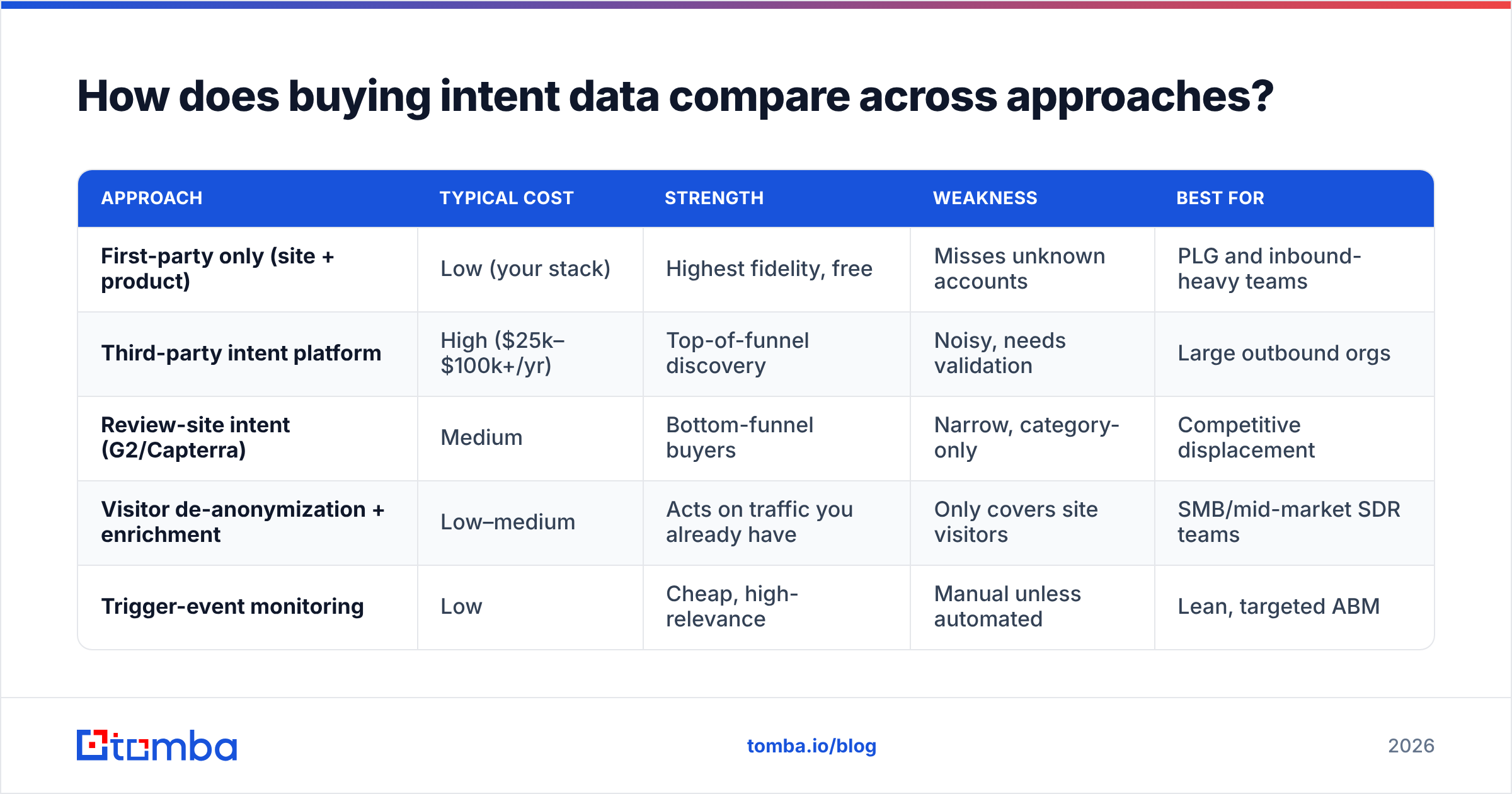
Not every team needs a six-figure intent platform. The right approach depends on your motion, your team size, and how much of your funnel is inbound versus outbound. Here's an honest comparison:
| Approach | Typical cost | Strength | Weakness | Best for |
|---|---|---|---|---|
| First-party only (site + product) | Low (your stack) | Highest fidelity, free | Misses unknown accounts | PLG and inbound-heavy teams |
| Third-party intent platform | High ($25k–$100k+/yr) | Top-of-funnel discovery | Noisy, needs validation | Large outbound orgs |
| Review-site intent (G2/Capterra) | Medium | Bottom-funnel buyers | Narrow, category-only | Competitive displacement |
| Visitor de-anonymization + enrichment | Low–medium | Acts on traffic you already have | Only covers site visitors | SMB/mid-market SDR teams |
| Trigger-event monitoring | Low | Cheap, high-relevance | Manual unless automated | Lean, targeted ABM |
The pragmatic 2026 stack for most mid-market teams isn't the most expensive option — it's first-party signals + visitor reveal + on-demand enrichment. You start by squeezing every signal out of traffic you already pay to acquire, resolve it to accounts, and enrich contacts only when a signal fires. That keeps credit spend tied to genuine intent instead of bulk-buying lists you'll never work.
If you do invest in a third-party platform, validate it with a paid pilot before committing. Cross-check a sample of "high-intent" accounts on G2 and against your own CRM history. As HubSpot's research on buyer behavior consistently shows, relevance and timing drive reply rates far more than volume — so a smaller list of genuinely in-market accounts beats a bigger list of maybes.
How do you turn buying intent into pipeline?#
You operationalize buying intent by wiring detection, enrichment, and outreach into a single fast loop — ideally automated end to end. Speed is the whole game: intent decays in days, sometimes hours.
A workflow that works in practice:
- Centralize signals. Pipe first-party events and any third-party feed into one place (CRM or a lightweight ops layer). Scattered signals never get acted on.
- Auto-resolve and enrich on trigger. When an account crosses your intent threshold, automatically identify the committee and pull verified contacts — don't make a rep do manual research while the signal cools. Tools like Tomba's API let you fire enrichment the moment a threshold trips.
- Match message to signal. Reference the actual behavior: "Saw your team's been comparing automation platforms" lands far better than a generic intro. Specificity is the payoff for all this data work.
- Route by tier, not by gut. High-intent goes to a live rep within a day; medium-intent enters a sequence; low stays in monitoring. Make routing automatic so nothing falls through.
- Close the loop. Feed outcomes back into your scoring. If "pricing page x3" converts at 4x your average, weight it higher. Your model should get smarter every quarter.
The teams that win with intent in 2026 aren't the ones with the fanciest data — they're the ones who shortened the distance between "signal detected" and "relevant message sent" to near-zero. Everything else is detail.
Frequently asked questions#
Is buying intent data accurate? First-party intent is highly accurate because it's a direct observation of behavior. Third-party intent is probabilistic — it infers interest from topic activity, so expect noise. Always validate any third-party feed against your own closed-won data before trusting it to drive outreach.
What's the difference between buying intent and lead scoring? Lead scoring blends fit (firmographics) with engagement; buying intent focuses specifically on timing — is this account in-market right now? The strongest models combine both: fit tells you who's a good customer, intent tells you when to call.
Can small teams use buying intent without a big budget? Yes. Start with first-party signals you already collect, add visitor de-anonymization, and enrich contacts on demand instead of buying bulk lists. This covers most of the value of an enterprise platform at a fraction of the cost.
How fresh does intent data need to be? Very. Intent is perishable — a signal loses much of its value within one to two weeks. Build recency decay into your scoring and prioritize acting within 24–48 hours of a strong first-party signal.
Turn intent signals into real conversations#
Buying intent only pays off when a signal becomes a message in the right inbox before your competitor gets there. That last mile — resolving an account to the actual decision-makers and reaching them with verified contact data — is where pipeline is won or lost.
That's exactly what the Tomba Email Finder is built for: the moment an account shows intent, find and verify the emails of the people who matter, then reach out while the need is hot. Pair it with visitor reveal and enrichment, start free with 25 searches a month, and scale on the Starter plan at $49/mo when intent turns into volume. Stop admiring signals on a dashboard — act on them.
// get started
Find, verify and enrich your first contacts today
Start on the free plan with 25 searches a month, then scale when your team is ready.
Free plan · No credit card required · GDPR & CCPA
// about the author