Buying Signals Data in 2026: A Practical B2B Playbook
Buying signals data tells you which accounts are ready to buy right now. Here's how to collect it, score it, and act on it before your competitors do.
TL;DR
- Buying signals data is observable evidence that an account is moving toward a purchase — hiring spikes, tech changes, funding, content engagement, or site visits.
- Signals beat firmographics alone because they tell you when to reach out, not just who to reach.
- The highest-converting plays combine a signal (timing) with enriched contact data (the right person and a verified email).
- You don't need a $60k intent platform to start — many signals are public, and a good enrichment layer turns them into contactable pipeline.
- This guide covers signal types, sources, a scoring model, a tool comparison, and the mistakes that quietly waste budget.
What is buying signals data?#
Buying signals data is any observable behavior or event that suggests a company — or a person inside it — is more likely to buy right now than they were last month.
Think of it like a smoke detector for revenue. Firmographic data (industry, headcount, revenue) tells you a building exists and roughly how big it is. A buying signal is the wisp of smoke that says something is happening in there this week. Technically, a signal is a timestamped, attributable data point you can tie to an account and act on before your competitors notice the same smoke.
The shift over the last few years is simple: static lists got commoditized. Every team can buy the same B2B database of companies in a given segment. What separates teams now is timing. According to Gartner, B2B buyers spend only a sliver of the buying cycle talking to any vendor, so showing up in the narrow window when a need is active is worth more than blasting a bigger list.
What are the main types of buying signals?#
Signals fall into two broad camps, and you want both. First-party signals come from your own properties (your site, your emails, your product). Third-party signals come from the outside world (the open web, review sites, news, hiring boards).
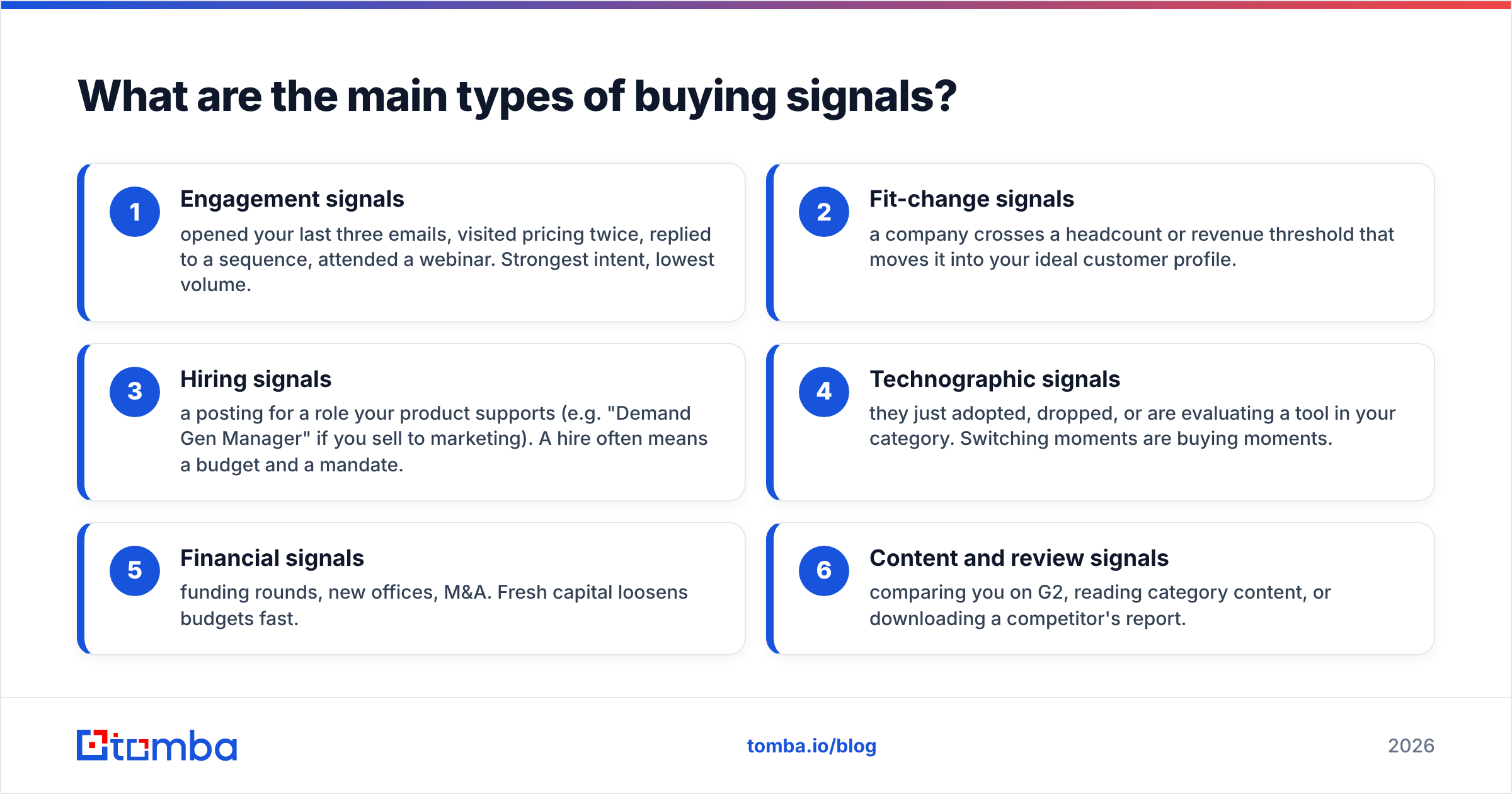
Here is the practical breakdown most revenue teams use:
- Engagement signals — opened your last three emails, visited pricing twice, replied to a sequence, attended a webinar. Strongest intent, lowest volume.
- Fit-change signals — a company crosses a headcount or revenue threshold that moves it into your ideal customer profile.
- Hiring signals — a posting for a role your product supports (e.g. "Demand Gen Manager" if you sell to marketing). A hire often means a budget and a mandate.
- Technographic signals — they just adopted, dropped, or are evaluating a tool in your category. Switching moments are buying moments.
- Financial signals — funding rounds, new offices, M&A. Fresh capital loosens budgets fast.
- Content and review signals — comparing you on G2, reading category content, or downloading a competitor's report.
The trap is treating all six as equal. They are not. A pricing-page visit from a named contact is worth more than a Series B announcement, because one is a person taking an action and the other is a company-level event you share with every other vendor reading the same news.
Why does buying signals data matter more in 2026?#
Because attention is the scarce resource, not contact records. Reps can find anyone now. What they can't do is email everyone without torching their domain and their quota.
Signals fix three expensive problems at once:
- Prioritization. A rep with 2,000 accounts and 40 hours a week needs an order of operations. Signals provide it.
- Timing. The same message lands very differently the week after someone gets promoted into a buying role versus a random Tuesday.
- Relevance. A signal gives you a reason to reach out that isn't "I noticed you're a VP." Referencing a real trigger lifts reply rates because it reads as research, not spray.
This is also why signals and contact data are complementary, not competing, purchases. A signal without a contact is a rumor. A contact without a signal is a guess. You need the event and the verified person to turn it into a booked meeting — which is exactly where an enrichment and email finder layer earns its keep.
How do you turn a signal into a contactable lead?#
A signal usually arrives as a company-level event — "Acme is hiring a RevOps lead." That is not yet something a rep can action. The gap between the signal and the send is where most teams lose the value they paid for.
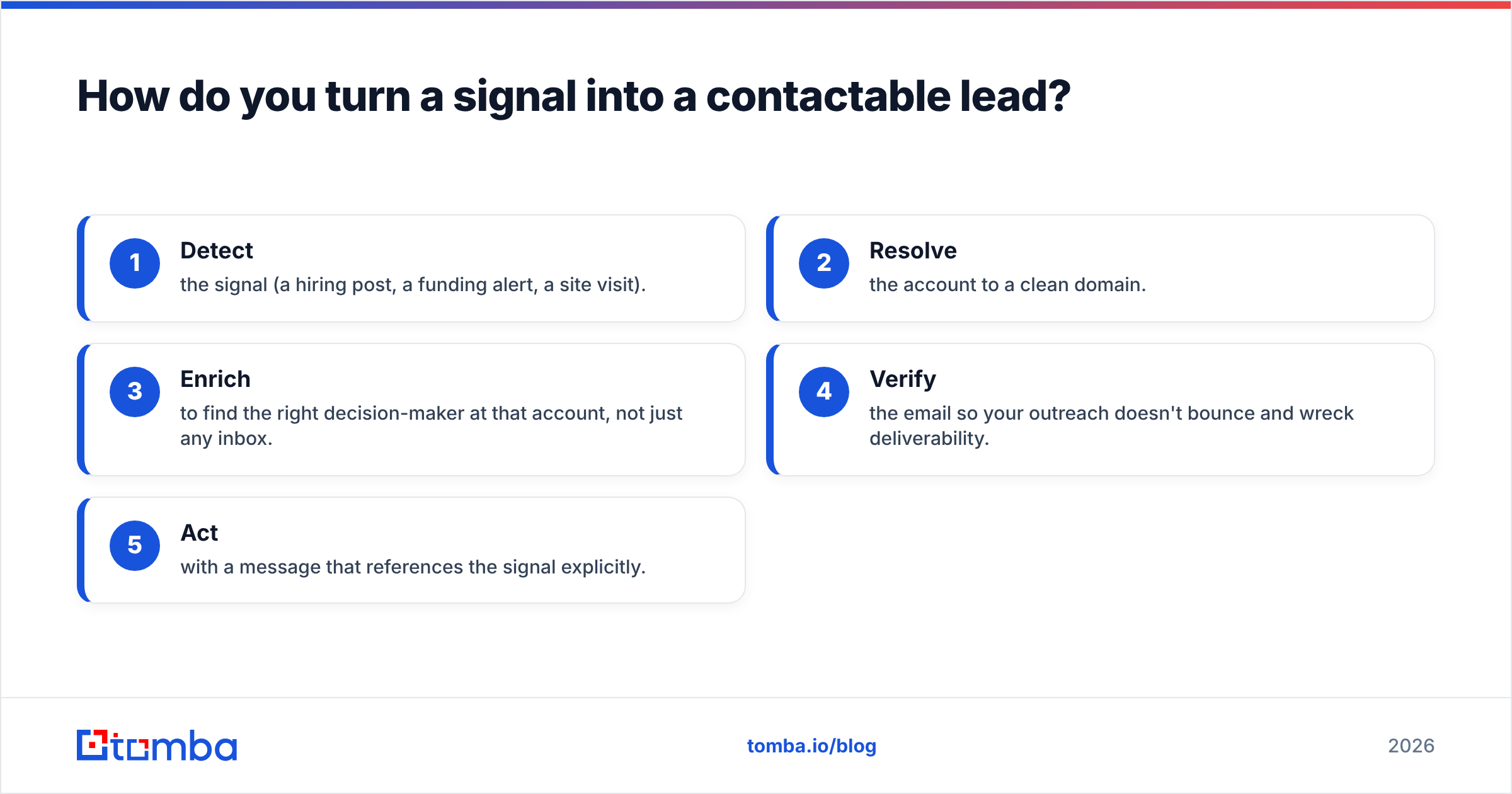
Here is the workflow that closes that gap:
- Detect the signal (a hiring post, a funding alert, a site visit).
- Resolve the account to a clean domain.
- Enrich to find the right decision-maker at that account, not just any inbox.
- Verify the email so your outreach doesn't bounce and wreck deliverability.
- Act with a message that references the signal explicitly.
Steps 3 and 4 are where tooling matters. If you only have a company name and a trigger, you still need to map that to a person and a deliverable address. Tools like domain search take a company domain and return the people and email patterns behind it, while data enrichment fills in title, seniority, and verified contact details so your scoring model has something to grade. If you're working from an inbound signal where you only captured an email, a reverse email lookup runs the same play in reverse to identify the person behind it.

What sources give you buying signals data?#
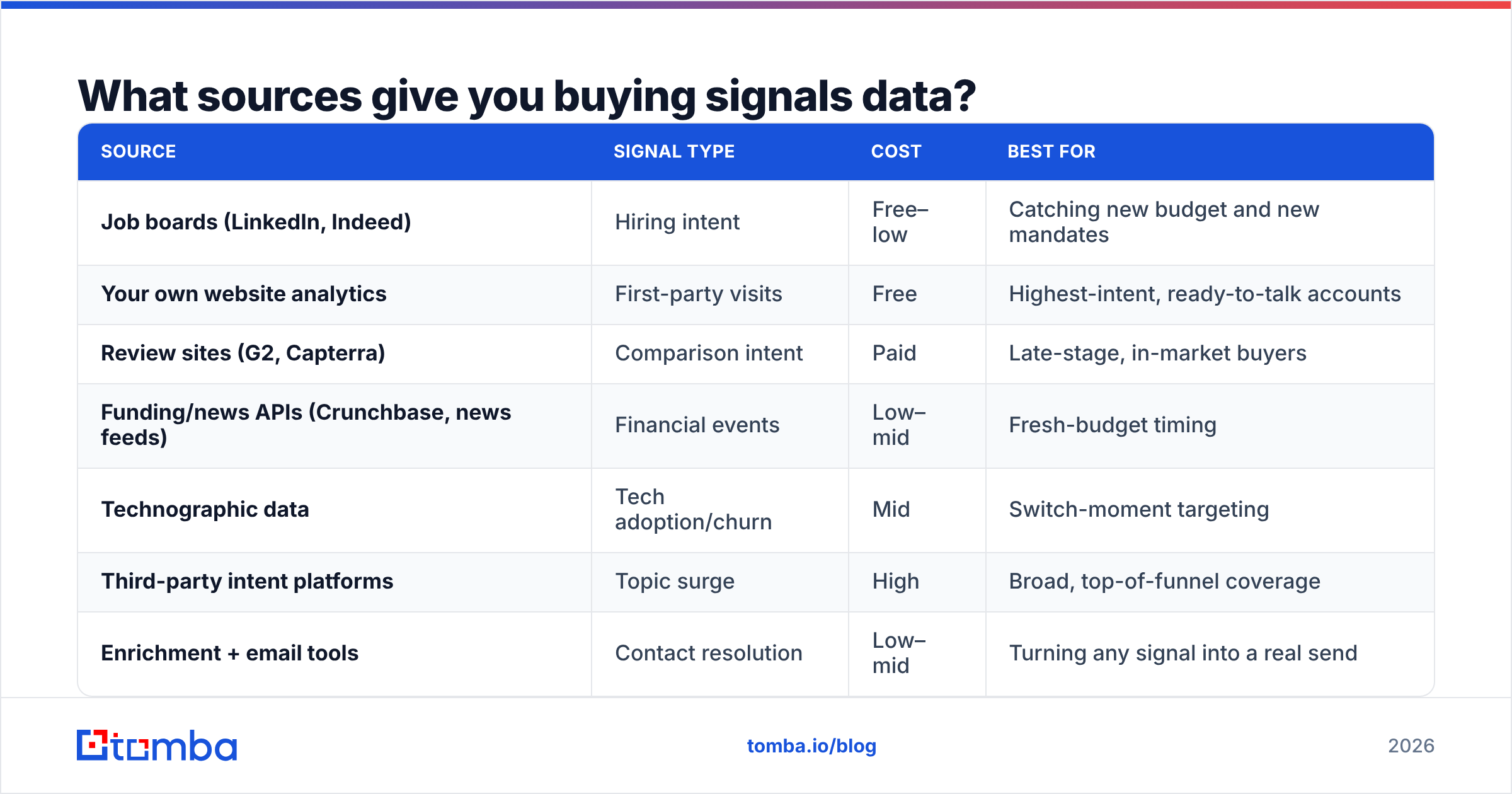
You can assemble a strong signal stack from a mix of free and paid sources. Don't start by buying the most expensive platform — start by wiring up the signals you can already see.
| Source | Signal type | Cost | Best for |
|---|---|---|---|
| Job boards (LinkedIn, Indeed) | Hiring intent | Free–low | Catching new budget and new mandates |
| Your own website analytics | First-party visits | Free | Highest-intent, ready-to-talk accounts |
| Review sites (G2, Capterra) | Comparison intent | Paid | Late-stage, in-market buyers |
| Funding/news APIs (Crunchbase, news feeds) | Financial events | Low–mid | Fresh-budget timing |
| Technographic data | Tech adoption/churn | Mid | Switch-moment targeting |
| Third-party intent platforms | Topic surge | High | Broad, top-of-funnel coverage |
| Enrichment + email tools | Contact resolution | Low–mid | Turning any signal into a real send |
Notice the bottom row. No matter which signal source you pick, you eventually need to resolve it to a person and a verified email. That layer is the connective tissue, and it's far cheaper than another intent subscription.
How should you score buying signals?#
Score on two axes: intent strength and fit. A signal only matters if it comes from an account you can actually sell to.
A simple, defensible model that a team can build in a spreadsheet or CRM this week:
- Fit score (0–50): how closely the account matches your ICP — industry, size, geography, tech stack. Anchor this in your definition of a marketing qualified lead so sales and marketing grade the same way.
- Intent score (0–50): weight by signal type. First-party engagement (40–50), hiring/technographic (25–35), funding/news (10–20), topic surge (5–15).
- Recency decay: halve the intent score every 14 days. A signal from six weeks ago is mostly noise.
Add the two. Route 80+ to reps immediately, nurture 50–79, and let the rest sit in marketing automation. The exact numbers matter less than the discipline: a written rule beats a rep's gut, and it makes your pipeline reviewable instead of mysterious.
Buying signals data vs. traditional lead lists: which wins?#
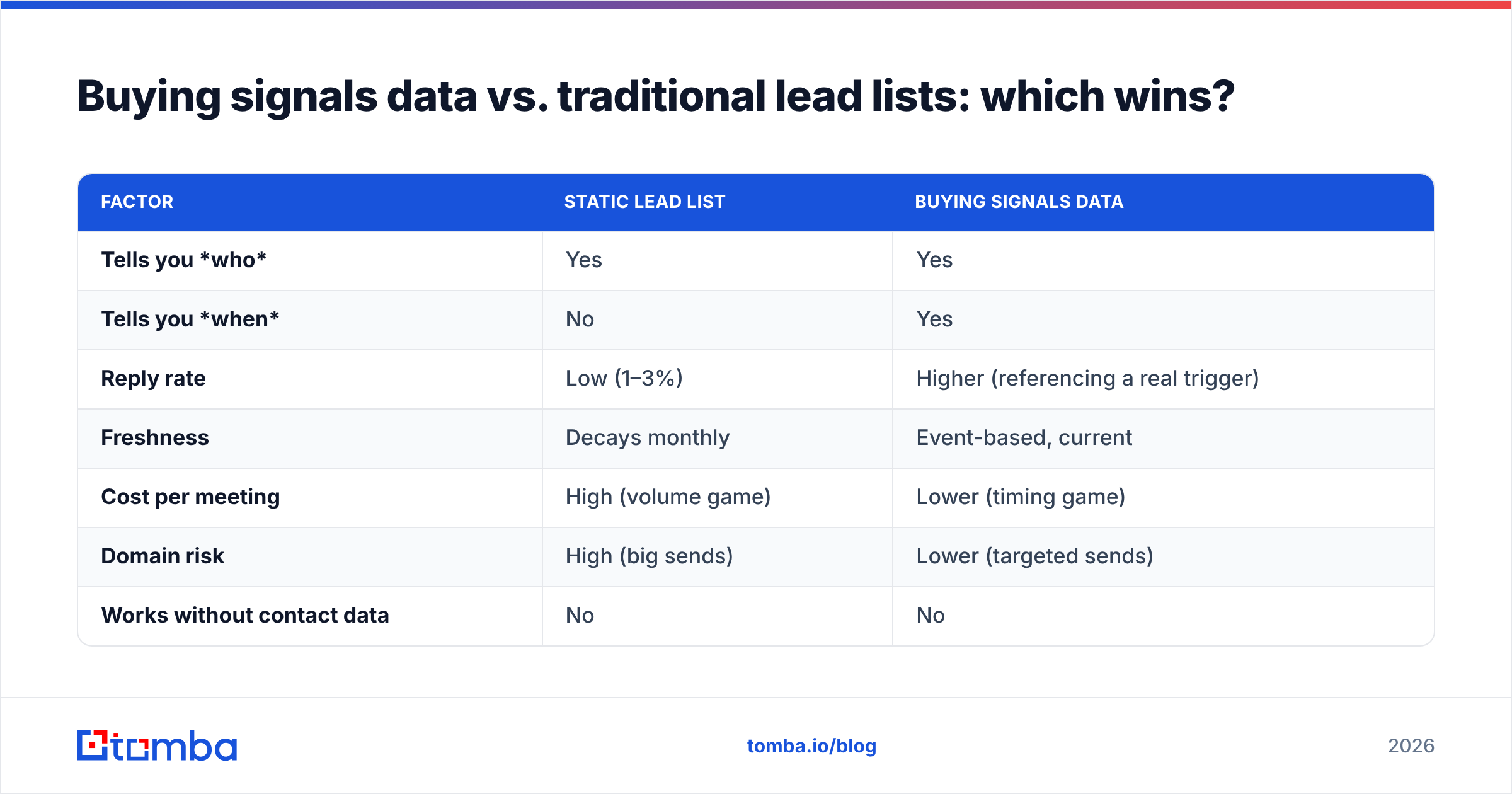
Signals win on conversion, lists win on volume — and the right answer is to use lists as the universe and signals as the filter.
| Factor | Static lead list | Buying signals data |
|---|---|---|
| Tells you who | Yes | Yes |
| Tells you when | No | Yes |
| Reply rate | Low (1–3%) | Higher (referencing a real trigger) |
| Freshness | Decays monthly | Event-based, current |
| Cost per meeting | High (volume game) | Lower (timing game) |
| Domain risk | High (big sends) | Lower (targeted sends) |
| Works without contact data | No | No |
The last row is the point this whole article keeps returning to. Neither approach works if you can't reach the human. A buying signal that you can't connect to a verified inbox is a missed quarter, which is why teams pair their signal source with a bulk email finder to resolve a batch of triggered accounts into contactable, deliverable leads in one pass.
What mistakes waste buying signals data?#
Most teams buy signal data and then quietly throw away its value. The four common failures:
- Acting on company-level signals as if they were person-level. "Acme raised a round" is not permission to email the receptionist. Resolve to the actual buyer first.
- Ignoring recency. A 60-day-old surge topic is not intent; it's archaeology. Decay your scores.
- Skipping verification. Triggered accounts make reps eager, and eager reps send to unverified addresses. Bounces from a burst of new sends are exactly what spam filters watch for. Run every triggered list through an email verifier before the first send.
- No message tie-back. If your email doesn't reference the signal, you've paid for timing and thrown away relevance. Name the trigger in the first line.
Avoid those four and an average signal stack outperforms an expensive one that nobody operationalizes. The teams that win aren't the ones with the most data — they're the ones who close the loop from signal to verified send to booked meeting, fast.
For deeper benchmarks on contact accuracy and where signal-driven data comes from, vendor transparency pages like Tomba's data sources and independent directories on HubSpot's sales blog are worth reading before you commit budget.
How do you build a buying-signals workflow this quarter?#
Start small and prove the loop before you scale spend. A 30-day rollout:
- Week 1: pick two signal sources you already have access to (site visits + hiring posts).
- Week 2: wire enrichment so every triggered account resolves to a named contact with a verified email.
- Week 3: build the two-axis score and set routing thresholds.
- Week 4: ship a signal-referencing sequence and measure reply and meeting rates against your old cold list.
By the end of the month you'll have a number — cost per meeting from signal-driven outreach versus list-driven — and that number ends the debate internally far better than any blog post can.
Where Tomba fits#
Buying signals tell you which account and when. Tomba tells you who and how to reach them. Once a signal fires, the Tomba Email Finder turns a company domain into the verified decision-maker's email in seconds, with domain search, enrichment, and bulk processing alongside it — so your triggered accounts become deliverable, contactable pipeline instead of a list of rumors. Plans start free (25 searches/month) and scale to Starter at $49/mo and Growth at $99/mo; see full Tomba pricing to match a tier to your signal volume. Start with the free tier, run your first triggered list through it this week, and let the reply rate make the case.
// get started
Find, verify and enrich your first contacts today
Start on the free plan with 25 searches a month, then scale when your team is ready.
Free plan · No credit card required · GDPR & CCPA
// about the author