Buying Signals Follow Up: The 2026 Playbook to Close Faster
A buying signal is only worth as much as your follow-up speed. Here is a 2026 playbook for spotting intent, timing your reply, and turning signals into booked meetings.
TL;DR
- A buying signal is an action that shows a prospect is moving toward a purchase — and its value decays by the hour, so follow-up speed beats follow-up volume.
- The teams that win in 2026 detect signals, enrich the contact, and reply inside the first hour with a message tied to the specific trigger.
- Most reps lose deals not because the signal was weak, but because the follow-up was slow, generic, or sent to the wrong person.
- A repeatable playbook has four parts: capture the signal, qualify it, route it to a real contact, and respond with context.
- Tools like website visitor reveal, data enrichment, and a fast email finder turn an anonymous signal into a ready-to-send outreach in minutes.
What is a buying signal, and why does follow-up timing matter so much?#
A buying signal is any action a prospect takes that suggests intent to purchase. Think of it like a doorbell: when someone rings it, you have a short window to answer before they assume nobody is home and walk away. A pricing-page visit, a demo request, a competitor-comparison search, a new role posted on a target account — each is a ring of that doorbell.
The hard truth is that signals are perishable. Research popularized by Harvard Business Review found that companies contacting a lead within an hour were roughly seven times more likely to have a meaningful conversation than those who waited even a few hours. The signal didn't change. The prospect's attention did.
So buying signals follow up is not a single email — it's a system. The system has to do three things faster than your competitors: notice the signal, attach it to a real human you can reach, and respond with a message that proves you noticed.
)
What are the most reliable buying signals in 2026?#
Not all signals carry the same weight. A newsletter open is weak; a request for a security questionnaire is strong. The skill is ranking them so your team spends its first hour on the rings that actually mean someone is home.
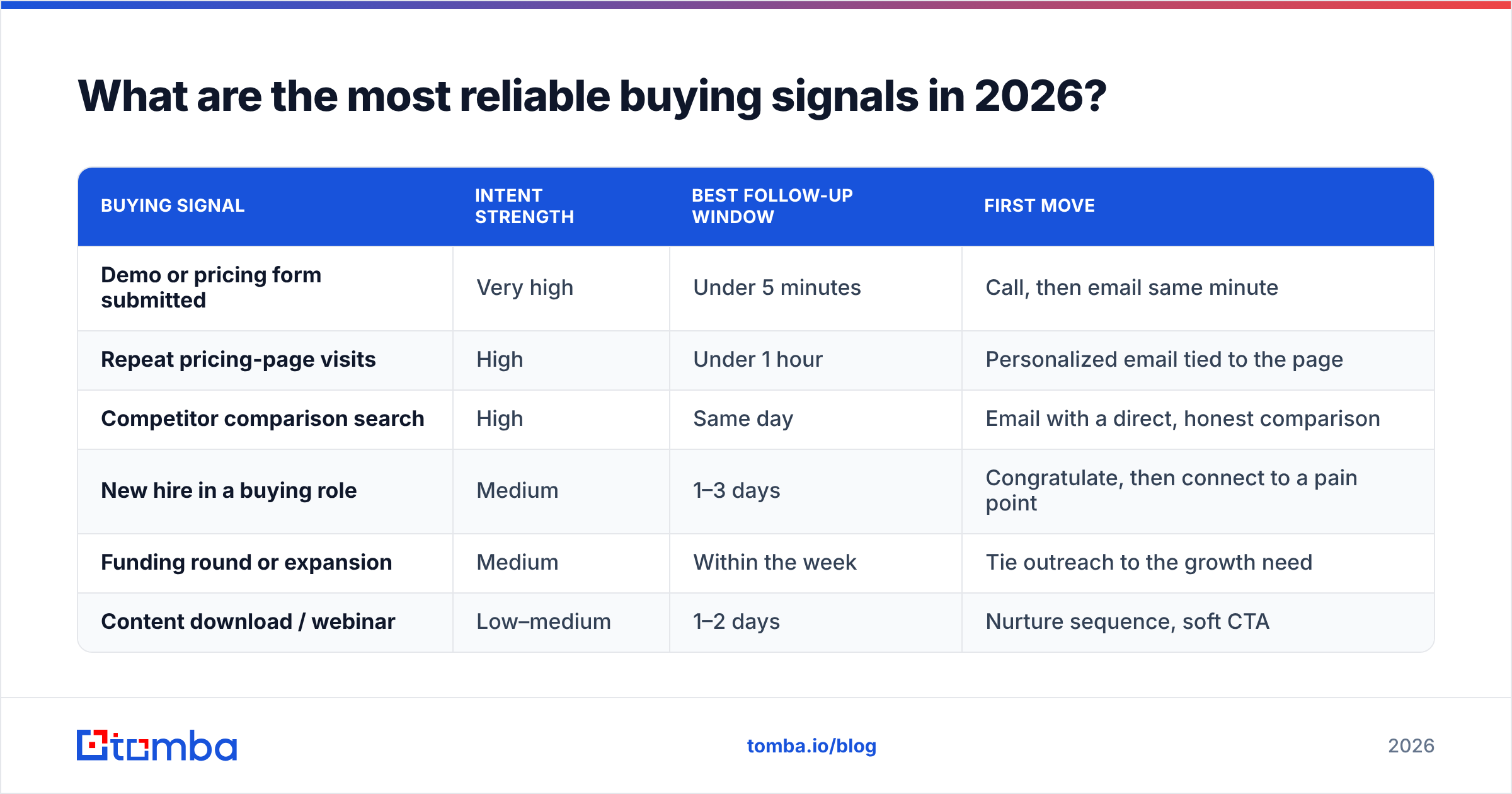
Here is how the common signals stack up by intent strength and ideal follow-up window:
| Buying signal | Intent strength | Best follow-up window | First move |
|---|---|---|---|
| Demo or pricing form submitted | Very high | Under 5 minutes | Call, then email same minute |
| Repeat pricing-page visits | High | Under 1 hour | Personalized email tied to the page |
| Competitor comparison search | High | Same day | Email with a direct, honest comparison |
| New hire in a buying role | Medium | 1–3 days | Congratulate, then connect to a pain point |
| Funding round or expansion | Medium | Within the week | Tie outreach to the growth need |
| Content download / webinar | Low–medium | 1–2 days | Nurture sequence, soft CTA |
Two changes define 2026. First, intent data is no longer a luxury — anonymous website reveal and third-party intent feeds are mainstream, so more signals arrive before a form is ever filled out. Second, buyers expect the seller to already know the context. A generic "just following up" reply now reads as proof you weren't paying attention.
How do you build a buying signals follow-up playbook?#
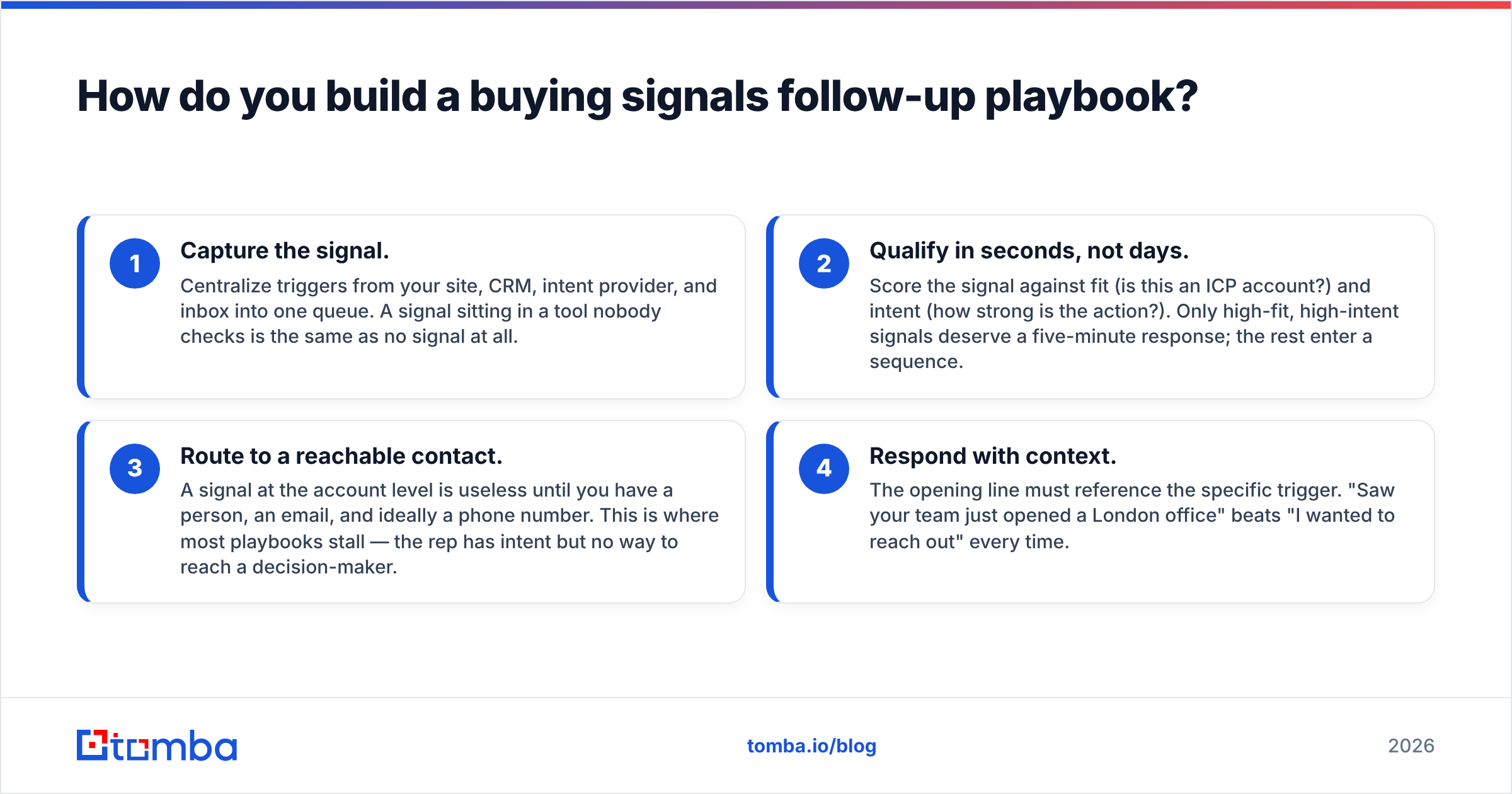
A playbook turns a scramble into a routine. The goal is that any rep, on any signal, knows the next four moves without asking. Here is the structure that holds up across teams:
- Capture the signal. Centralize triggers from your site, CRM, intent provider, and inbox into one queue. A signal sitting in a tool nobody checks is the same as no signal at all.
- Qualify in seconds, not days. Score the signal against fit (is this an ICP account?) and intent (how strong is the action?). Only high-fit, high-intent signals deserve a five-minute response; the rest enter a sequence.
- Route to a reachable contact. A signal at the account level is useless until you have a person, an email, and ideally a phone number. This is where most playbooks stall — the rep has intent but no way to reach a decision-maker.
- Respond with context. The opening line must reference the specific trigger. "Saw your team just opened a London office" beats "I wanted to reach out" every time.
That third step — turning an account signal into a contact you can actually message — is the bottleneck worth automating. When a visitor reveal flags an anonymous account browsing your pricing, you can pipe it straight into data enrichment to append the right decision-maker, their verified email, and a direct line. The signal becomes an outreach in the time it used to take to look someone up on LinkedIn.
How fast is fast enough for follow-up?#
Conclusion first: aim for under five minutes on your strongest signals and under one hour on everything else. Speed is the single most controllable lever in your conversion rate, and it is also the one most teams quietly ignore.
The reason speed wins is psychological, not technical. When a buyer takes a high-intent action, they're in an active research state — multiple tabs open, comparing options. Your reply lands while you're still the option they're thinking about. An hour later, they've moved on to a meeting, and you're now interrupting instead of helping. The same words convert very differently depending on the minute they arrive.
A practical benchmark from Gartner research on buyer behavior is that B2B buyers spend only a sliver of their journey actually talking to any vendor. That makes each window you do get disproportionately valuable. Miss the first one and you may not get another for a quarter.
Speed does not mean spam. The fastest teams aren't sending more — they're sending sooner and sharper. Tracking your response rate by follow-up speed will usually reveal a steep cliff: replies sent within the hour convert at multiples of those sent the next day.
)
What does a great signal-based follow-up message look like?#
A strong follow-up has three ingredients: the trigger, the relevance, and one clear ask. Drop any one and it reads like a template.
- Name the trigger. "I noticed your team viewed our pricing twice this week" or "Congrats on the Series B." This earns the next sentence.
- Connect it to a problem you solve. Don't pivot to your feature list. Tie the trigger to an outcome they likely care about right now.
- Make one specific ask. "Worth a 15-minute call Thursday?" outperforms "Let me know if you're interested." Vague asks get vague non-replies.
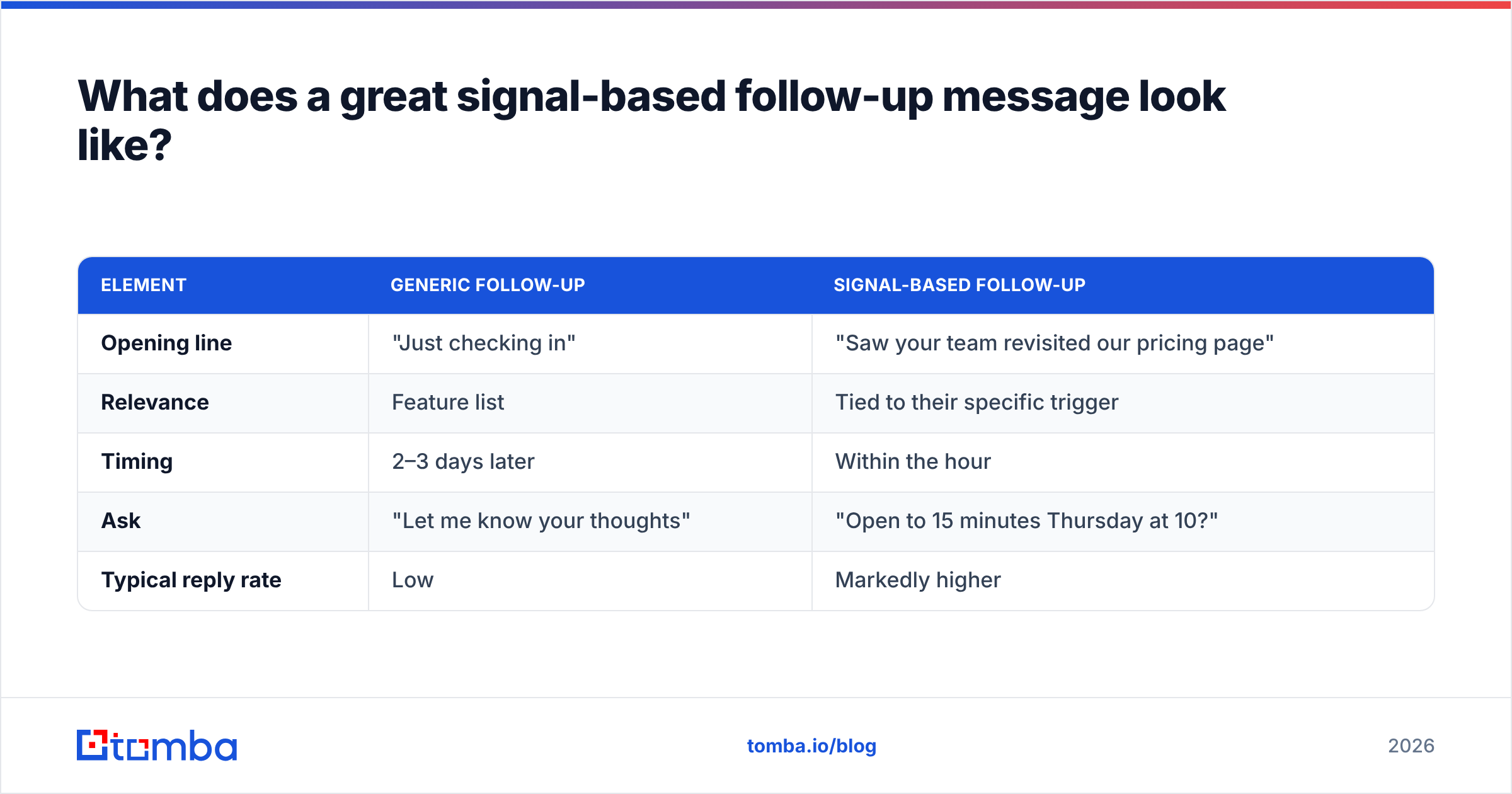
Compare the two approaches directly:
| Element | Generic follow-up | Signal-based follow-up |
|---|---|---|
| Opening line | "Just checking in" | "Saw your team revisited our pricing page" |
| Relevance | Feature list | Tied to their specific trigger |
| Timing | 2–3 days later | Within the hour |
| Ask | "Let me know your thoughts" | "Open to 15 minutes Thursday at 10?" |
| Typical reply rate | Low | Markedly higher |
If you need to reach the prospect by phone for your highest-intent signals — demo requests and pricing inquiries — pairing the email with a quick call lifts connection rates sharply. A phone finder closes that gap when the CRM only has an email on file. The point is to match the channel to the signal's strength, not to blast every trigger the same way.
Which tools do you actually need for signal follow-up?#
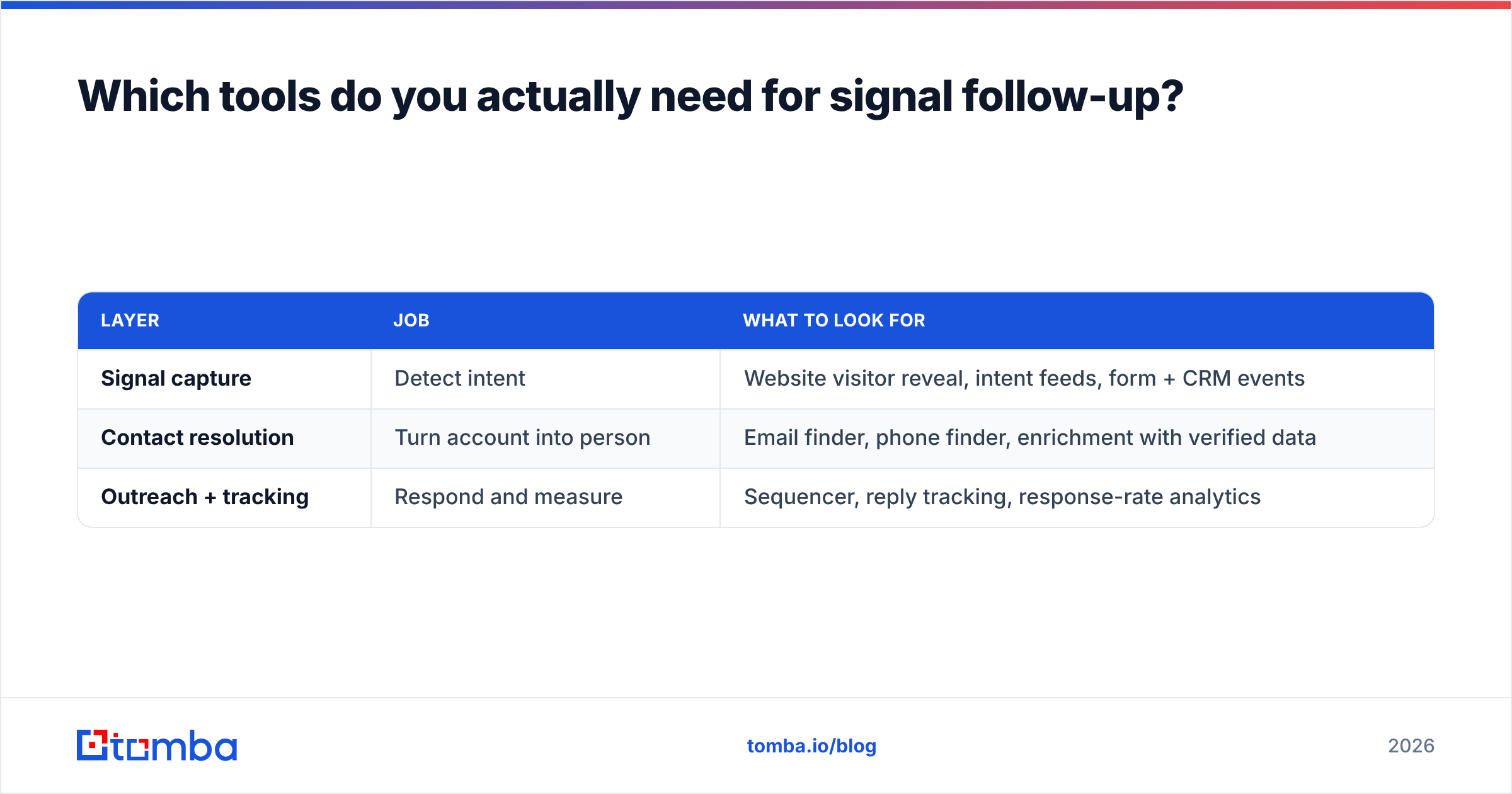
You need three capabilities working together, and you can assemble them without a bloated stack. Here is how the layers compare:
| Layer | Job | What to look for |
|---|---|---|
| Signal capture | Detect intent | Website visitor reveal, intent feeds, form + CRM events |
| Contact resolution | Turn account into person | Email finder, phone finder, enrichment with verified data |
| Outreach + tracking | Respond and measure | Sequencer, reply tracking, response-rate analytics |
The capture layer is increasingly served by intent platforms and visitor identification — Tomba's website visitor reveal is one way to surface accounts browsing your site before they ever fill out a form. The contact-resolution layer is where deals are won or lost on speed, because an anonymous account is worthless until you have a verified, reachable human attached to it. Independent reviews on G2 are a useful gut-check when you're weighing accuracy and data freshness across providers.
A note on data quality: a fast follow-up sent to a bounced email is worse than no follow-up, because it quietly burns your sender reputation. Verify before you send. The whole signal advantage evaporates if half your perfectly timed messages never land.
How do you measure whether your follow-up is working?#
Track three numbers and you'll know if the playbook is real or theater:
- Speed-to-first-touch. Median minutes from signal to first contact. If this is measured in hours, fix it before anything else.
- Signal-to-meeting rate. Of qualified signals, what share become booked meetings? This tells you if your message and routing are sound.
- Reply rate by signal type. Break it out so you stop over-investing in weak signals and double down on the strong ones.
Watch for the common failure mode: a team celebrates a high volume of signals while speed-to-touch quietly creeps up because nobody owns the queue. Volume without speed is just a longer to-do list. Assign ownership, set an SLA (for example, all high-intent signals contacted within 30 minutes during business hours), and review the median weekly.
One more guardrail. Don't let automation make your follow-up feel robotic. The tools should buy your reps time to write a sharper first line, not replace the line with a merge tag. The combination that wins is machine speed on detection and routing, plus human judgment on the message.
What is the simplest way to start this week?#
Start narrow. Pick your single strongest signal — usually a pricing-page visit or a demo request — and build the four-step loop around just that one. Capture it, qualify it, resolve the contact, and respond within the hour. Measure speed-to-touch for two weeks, then add the next signal type.
You don't need to boil the ocean or buy five new platforms. You need one reliable way to turn a signal into a verified, reachable contact, and the discipline to reply while the doorbell is still ringing.
That contact-resolution step is exactly what Tomba is built for. When a buying signal points you at an account, the Tomba Email Finder gives you the decision-maker's verified professional email in seconds — so your perfectly timed message reaches a real inbox instead of a bounce. Plans start free with 25 searches a month and scale from the $49/mo Starter tier; you can review the full Tomba pricing and wire it into your signal workflow today. Detect the signal, find the person, and reply before your competitor finishes loading their CRM.
// get started
Find, verify and enrich your first contacts today
Start on the free plan with 25 searches a month, then scale when your team is ready.
Free plan · No credit card required · GDPR & CCPA
// about the author