Buying Signals for Outbound: The 2026 Sales Playbook
Spray-and-pray is dead. Learn how to find, score, and act on buying signals for outbound so your reps reach prospects at the exact moment they're ready to buy.
Outbound stopped working the way it used to. Inboxes are crowded, sequences look identical, and a generic "I noticed your company is growing" opener gets ignored in under a second. The teams still booking meetings aren't sending more email — they're sending it at the right moment, to the right person, with a reason. That reason is a buying signal.
This guide breaks down how buying signals for outbound actually work in 2026: what counts as a signal, how to score them so reps chase the right ones, and the end-to-end workflow that turns a trigger into a reply.
TL;DR#
- Buying signals are observable events that suggest an account or person is moving toward a purchase — a new hire, a funding round, a job posting, a website visit, a competitor switch.
- Not all signals are equal. Rank them by intent strength and recency; a same-week trigger beats a stale firmographic match every time.
- The workflow is detect → enrich → score → personalize → send. Skip enrichment and you have a signal with no one to email.
- Tooling matters less than timing. A mediocre message sent within 48 hours of a real trigger outperforms a perfect message sent cold.
- Start small: pick three signal types, wire them to contact data, and measure reply rate against your baseline before scaling.
What are buying signals for outbound?#
A buying signal is any data point that indicates an account is more likely to buy right now than it was last week. Think of it like fishing: cold outbound is casting into open ocean and hoping. Signal-based outbound is watching for the birds diving — the surface activity that tells you fish are feeding right there. You still have to cast well, but you're casting where the action is.
In practice, signals fall into two broad buckets. Fit signals tell you whether an account should care: industry, headcount, tech stack, revenue. Intent signals tell you whether they care now: a leadership change, a funding event, a spike in research activity, a visit to your pricing page. Fit gets you the list. Intent tells you who to call first.
The shift in 2026 is that intent data is no longer a luxury reserved for enterprise RevOps teams. Between public hiring data, news triggers, website de-anonymization, and product-led signals, even a two-person SDR team can run a credible signal-driven motion. According to G2's research on buyer behavior, most B2B buyers are already deep into their evaluation before they ever talk to a vendor — which means the window where outbound can still influence the deal is short and signal-dependent.

Which buying signals actually matter?#
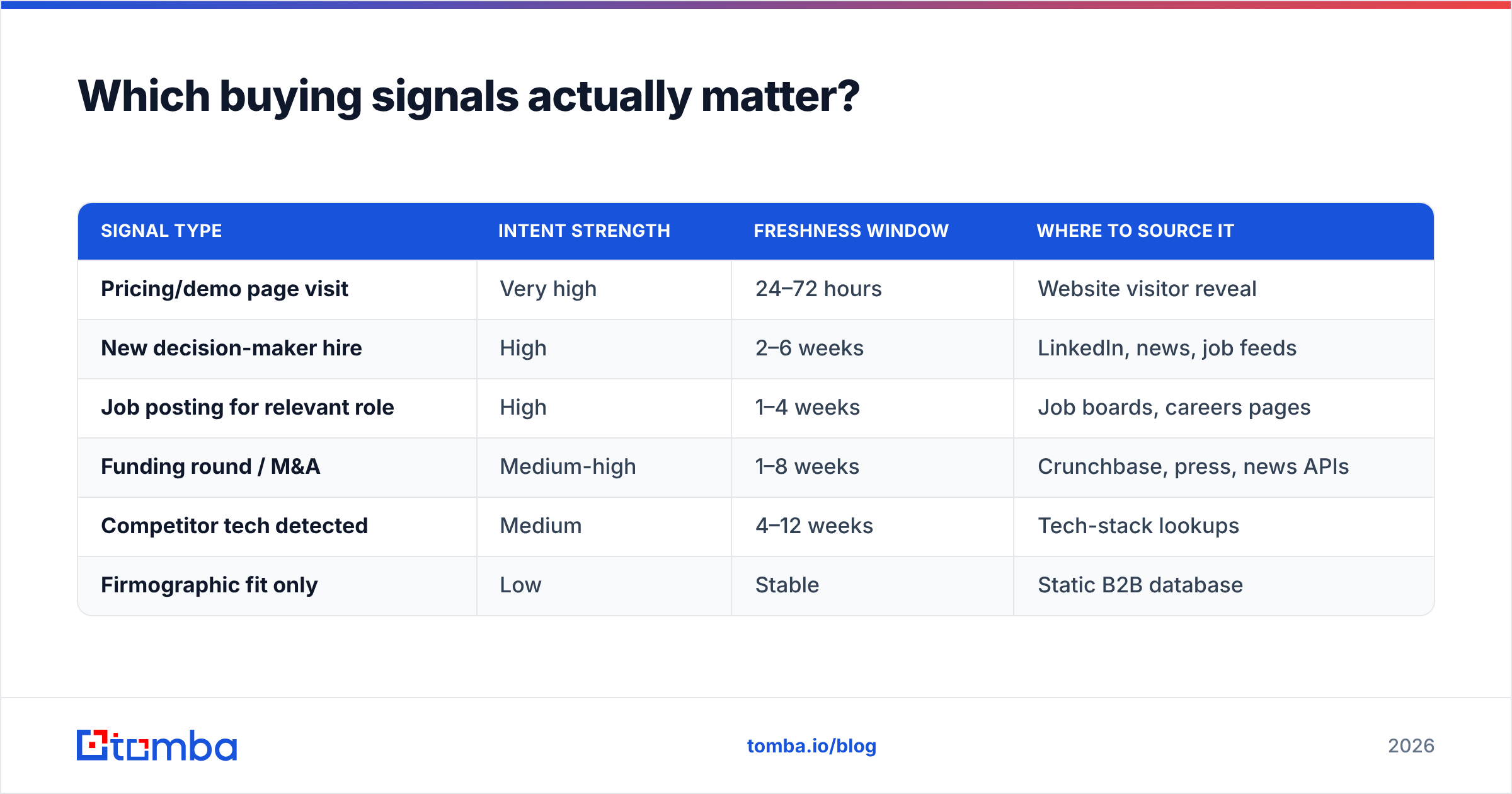
Here's the uncomfortable truth: most "signals" sold to you are noise. A company adding a generic blog post is not a buying signal. Below is how the high-value signal types stack up by intent strength, how fresh they need to be, and how to source them.
| Signal type | Intent strength | Freshness window | Where to source it |
|---|---|---|---|
| Pricing/demo page visit | Very high | 24–72 hours | Website visitor reveal |
| New decision-maker hire | High | 2–6 weeks | LinkedIn, news, job feeds |
| Job posting for relevant role | High | 1–4 weeks | Job boards, careers pages |
| Funding round / M&A | Medium-high | 1–8 weeks | Crunchbase, press, news APIs |
| Competitor tech detected | Medium | 4–12 weeks | Tech-stack lookups |
| Firmographic fit only | Low | Stable | Static B2B database |
Read the table top to bottom and a pattern jumps out: the strongest signals are also the most perishable. A prospect researching your pricing page today is gone tomorrow. A funding round gives you weeks. Firmographic fit never expires, which is exactly why it's the weakest trigger — everyone in your ICP matches it, so it tells you nothing about timing.
The practical move is to combine one intent signal with one fit signal. "Series B fintech" (fit) plus "just posted three RevOps roles" (intent) is a reason to reach out today. Either one alone is a guess.
How do you score buying signals for outbound?#
Scoring keeps your reps from drowning. When ten signals fire on a Monday, the team needs to know which three to act on before lunch. A simple weighted model beats a complicated one nobody uses.
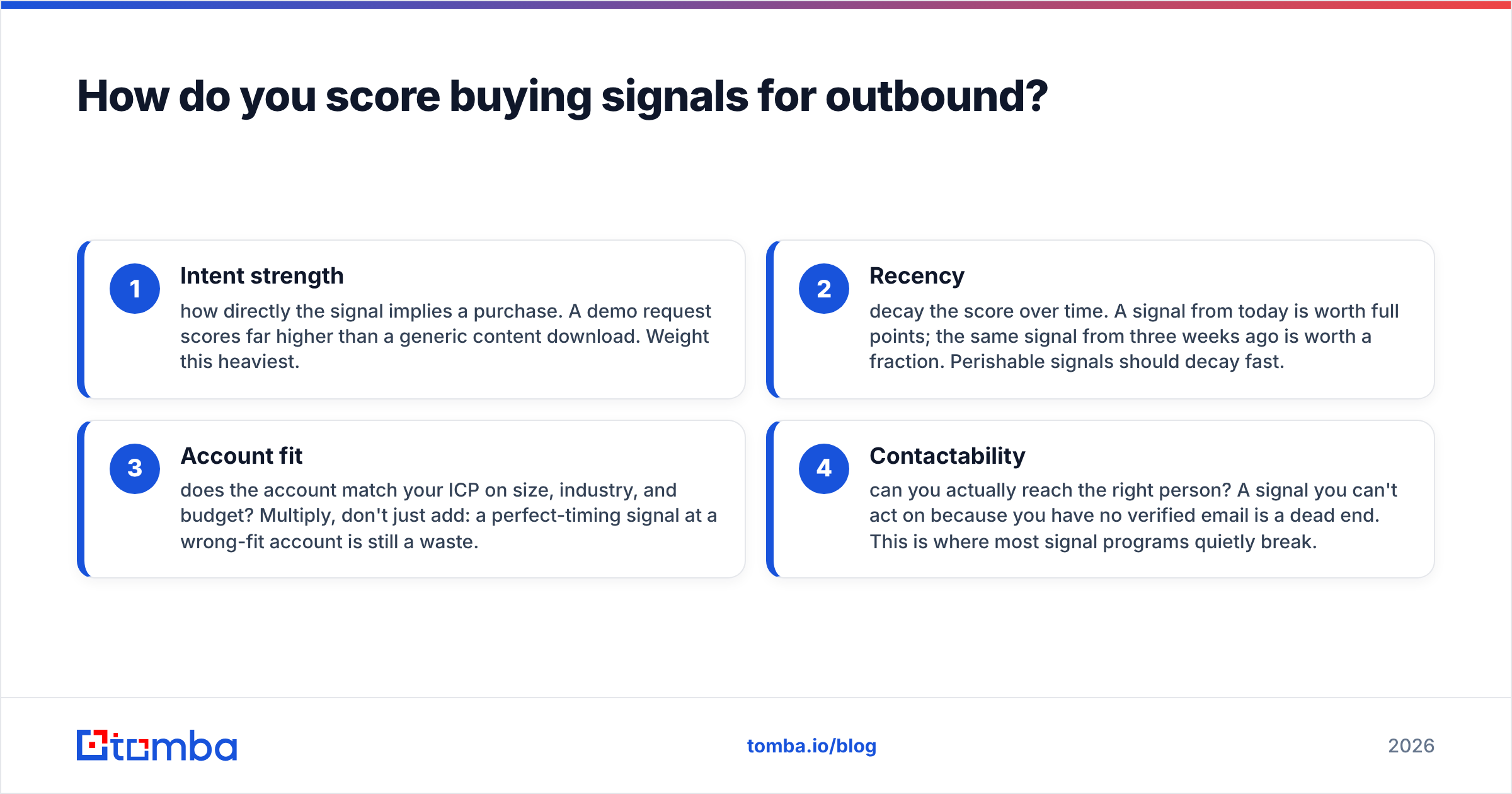
Build your score from four inputs:
- Intent strength — how directly the signal implies a purchase. A demo request scores far higher than a generic content download. Weight this heaviest.
- Recency — decay the score over time. A signal from today is worth full points; the same signal from three weeks ago is worth a fraction. Perishable signals should decay fast.
- Account fit — does the account match your ICP on size, industry, and budget? Multiply, don't just add: a perfect-timing signal at a wrong-fit account is still a waste.
- Contactability — can you actually reach the right person? A signal you can't act on because you have no verified email is a dead end. This is where most signal programs quietly break.
That fourth input is the one teams forget. You can detect a perfect trigger and still fail because you're missing a verified contact for the actual decision-maker. Pairing your signal feed with reliable data enrichment and a verified email finder is what turns a score into a sent message. If you want the deeper mechanics of intent and qualification language, the B2B glossary is a useful reference for aligning sales and marketing on what "qualified" means.
A workable formula looks like this: score = (intent_weight × recency_factor) × fit_multiplier × contactable_flag. Anything that lands above your threshold goes into the rep's morning queue. Everything else waits or gets nurtured.
What does a signal-based outbound workflow look like?#
The whole point is repeatability. A signal that nobody routes is just trivia. Here's the five-stage pipeline that turns triggers into replies.
Stage 1 — Detect. Aggregate your chosen signals into one place. This can be as lightweight as a few saved searches and a website de-anonymization tool, or as built-out as a RevOps data warehouse. Tools like website visitor reveal surface accounts already on your site — arguably the warmest signal you'll ever get, because they came to you.
Stage 2 — Enrich. A signal usually names an account, not a person. Enrichment fills in the decision-maker, their role, and a verified email or phone number. Without this stage you have a company name and no way to reach anyone inside it.
Stage 3 — Score. Run the account through the model above. Route only what clears the threshold; let the rest decay or feed nurture.
Stage 4 — Personalize. Tie the opener to the signal. "Saw you're hiring two SDRs — most teams scaling that fast hit a contact-data wall around month two" beats any template. The signal is the personalization; you don't have to invent relevance, you just have to name what you already know.
Stage 5 — Send and measure. Deliver via email, phone, or LinkedIn, then track reply rate by signal type so you learn which triggers actually convert for your market. For multichannel timing, HubSpot's research on sales follow-up cadence is a solid baseline to test against.

Signal-based outbound vs. spray-and-pray: is it worth it?#
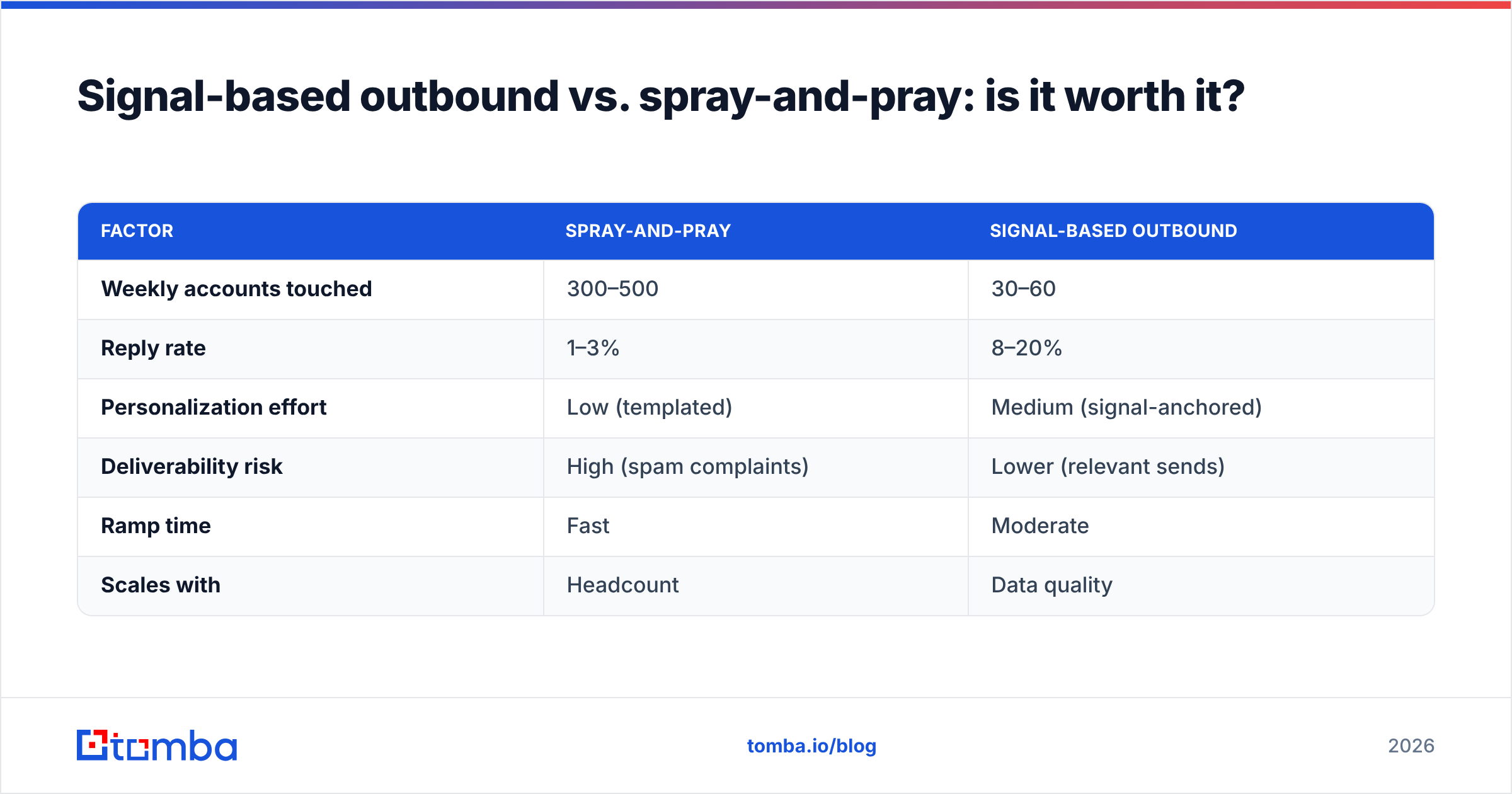
The objection is always volume. Spray-and-pray lets a rep "touch" 500 accounts a week. Signal-based outbound might surface 40. So why is the smaller number better?
| Factor | Spray-and-pray | Signal-based outbound |
|---|---|---|
| Weekly accounts touched | 300–500 | 30–60 |
| Reply rate | 1–3% | 8–20% |
| Personalization effort | Low (templated) | Medium (signal-anchored) |
| Deliverability risk | High (spam complaints) | Lower (relevant sends) |
| Ramp time | Fast | Moderate |
| Scales with | Headcount | Data quality |
Run the math. Five hundred sends at a 2% reply rate is ten conversations. Fifty sends at a 12% reply rate is six conversations — for a tenth of the volume, a tenth of the deliverability risk, and far less wasted rep time. Then layer in that signal-based replies are qualified replies: the prospect actually had a reason to respond, so they convert to meetings at a higher rate too.
There's a deliverability dividend that rarely makes the spreadsheet. High-volume cold blasting torches your sender reputation, which quietly drags down every email your domain sends — including the good ones. Sending fewer, more relevant messages keeps complaint rates low and inboxes open. As Gartner's analysis of B2B buying has noted for years, buyers reward relevance and punish noise, and the email gatekeepers have built that preference into their spam filters.
How do you find the contact behind a signal?#
This is the make-or-break step, and it deserves its own section because it's where most signal programs die. You can have the world's best intent feed and still send zero emails if you can't connect "Acme Corp is hiring RevOps leaders" to "email the VP of Revenue Operations at a verified address."
Three things have to happen fast:
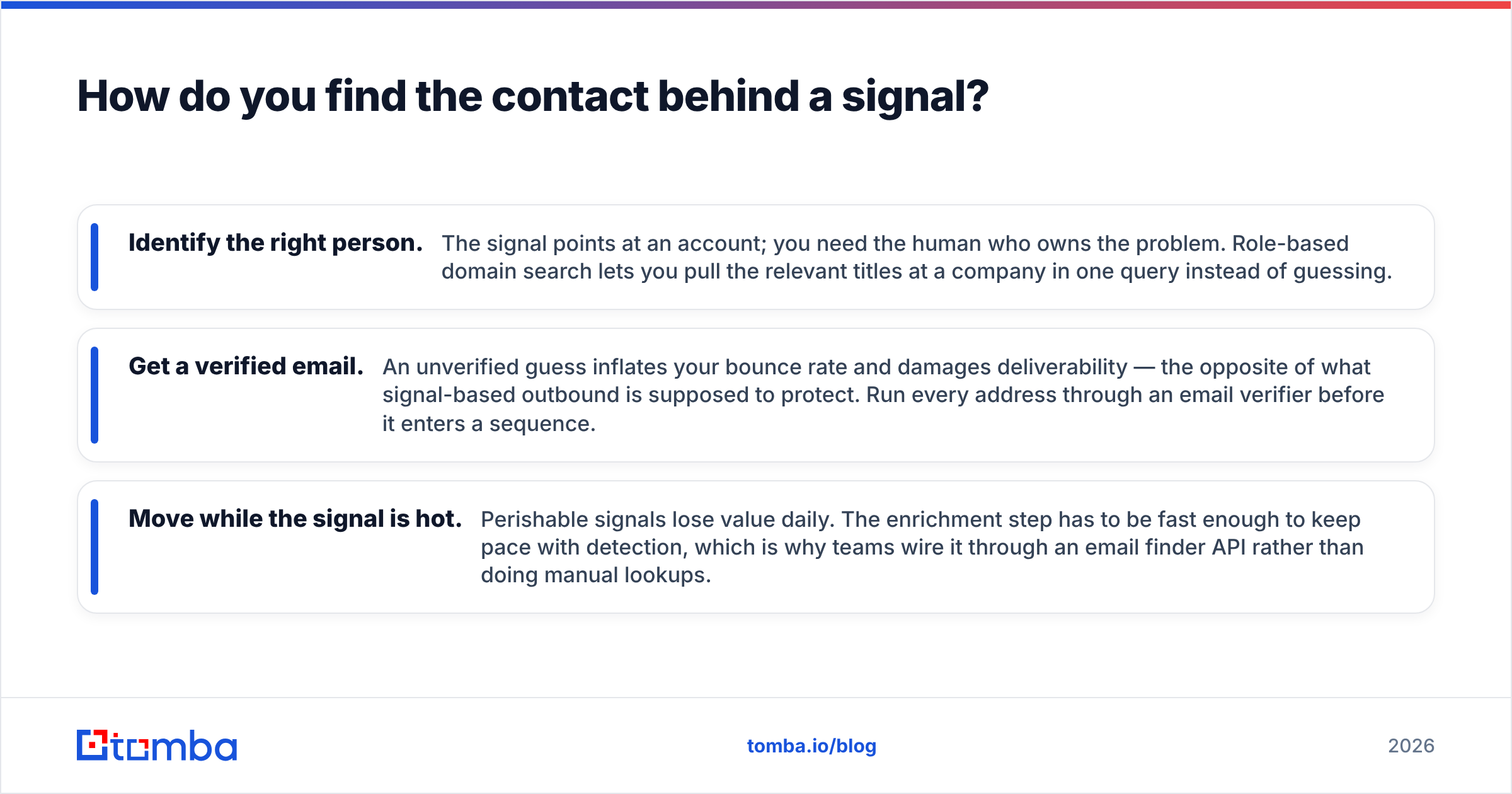
- Identify the right person. The signal points at an account; you need the human who owns the problem. Role-based domain search lets you pull the relevant titles at a company in one query instead of guessing.
- Get a verified email. An unverified guess inflates your bounce rate and damages deliverability — the opposite of what signal-based outbound is supposed to protect. Run every address through an email verifier before it enters a sequence.
- Move while the signal is hot. Perishable signals lose value daily. The enrichment step has to be fast enough to keep pace with detection, which is why teams wire it through an email finder API rather than doing manual lookups.
The teams that win at this treat contact data as part of the signal pipeline, not a separate afterthought. The moment a trigger fires, enrichment runs automatically, the verified contact lands in the rep's queue with the signal attached, and the rep writes one sentence of context before sending. Detection, enrichment, and verification aren't three tools bolted together — they're one motion.
What mistakes kill signal-based outbound?#
Even good programs trip over the same few things:
- Chasing weak signals. A LinkedIn like is not intent. If a signal doesn't change the probability of a purchase, drop it from the model — it just adds noise to the queue.
- Skipping verification. Acting on unverified emails to "move fast" backfires within a week as bounces pile up and your domain reputation tanks. Speed without verification is just faster failure.
- Generic openers on great signals. If you detected a funding round but opened with "Hope you're doing well," you wasted the signal. Name the trigger in the first line or you've learned nothing the prospect can feel.
- No feedback loop. If you don't measure reply rate by signal type, you can't tell which triggers are worth your reps' time. Track it from day one.
- Over-tooling before proving the motion. You don't need a six-figure intent platform to start. Three signal types, a contact-data source, and a spreadsheet will tell you whether this works for your market.
How do you start in the next 30 days?#
Keep it deliberately small. Pick three signal types from the table above — ideally one very-high-intent (pricing visits), one high-intent (relevant job postings), and one fit anchor (your firmographic ICP). Wire each to a contact-data source so detection automatically produces a verified, reachable person. Set one scoring threshold. Then run it for four weeks and compare reply rate against your current cold baseline.
You're not trying to build the perfect system in month one. You're trying to prove that timing beats volume — and once the reply-rate numbers come in, the rest of the team will pull the motion toward themselves. For ongoing prospecting tactics that pair with this, the work on LinkedIn outreach is a good companion channel to test alongside email.
Turn signals into booked meetings with Tomba#
A buying signal is only as good as your ability to act on it — and acting means reaching a real, verified person before the moment passes. That's exactly the gap Tomba's Email Finder closes: feed it the account behind any signal and get the decision-maker's verified professional email in seconds, then run it straight into your sequence. Pair it with the email verifier and data enrichment and your detection feed becomes a sending pipeline. Start free with 25 searches a month, or scale on the Starter plan at $49/mo — see full Tomba pricing to match a plan to your outbound volume. Stop spraying. Start sending when the signal is hot.
// get started
Find, verify and enrich your first contacts today
Start on the free plan with 25 searches a month, then scale when your team is ready.
Free plan · No credit card required · GDPR & CCPA
// about the author