Bytemine Pricing in 2026: Plans, Real Costs & Alternatives
Bytemine pricing can be hard to pin down. Here's a plain breakdown of plans, real costs, and cheaper alternatives for B2B prospecting in 2026.
Bytemine Pricing in 2026: What It Really Costs
Choosing a B2B data tool usually comes down to one ugly question: what will this actually cost once you scale past the demo? Bytemine markets itself as an AI-driven lead intelligence and prospecting platform, but like a lot of "talk to sales" products, its pricing is not always obvious from the homepage. This guide breaks down how Bytemine pricing tends to work, where the hidden costs hide, and which alternatives give you more predictable spend.
TL;DR#
- Bytemine uses quote-based, sales-led pricing for most of its lead intelligence tiers, so the public number you see rarely matches the number you sign.
- Credits, seats, and data exports are the three levers that move your real bill — watch all three, not just the headline plan.
- Annual contracts and minimum seat counts are common in this category, which raises the true entry cost for small teams.
- Transparent, usage-based alternatives like Tomba start at a flat Tomba pricing of $49/mo with a free tier, so you can model spend before you commit.
- If your core need is finding and verifying work emails, a dedicated email finder is usually cheaper and more accurate than a broad intelligence suite.
What is Bytemine and who is it for?#
Bytemine is positioned as a B2B prospecting and lead-intelligence platform: you describe an ideal customer, and the tool surfaces matching companies and contacts, often with AI scoring and enrichment layered on top. That puts it in the same broad bucket as Apollo, ZoomInfo, and Clearbit-style data vendors rather than single-purpose email tools.
The honest summary: Bytemine targets outbound sales teams and growth marketers who want a database plus workflow, not just an email lookup. That's a real category with real value. But it also means you're paying for a suite — and suites are where pricing gets fuzzy.
I want to be upfront here. Bytemine publishes limited public pricing, and quote-based vendors change numbers frequently. So instead of inventing exact dollar figures I can't verify, this article focuses on how the pricing model works, what drives cost, and how to pressure-test any quote you receive. Always confirm current numbers on the vendor's own site before you buy.
How does Bytemine pricing actually work?#
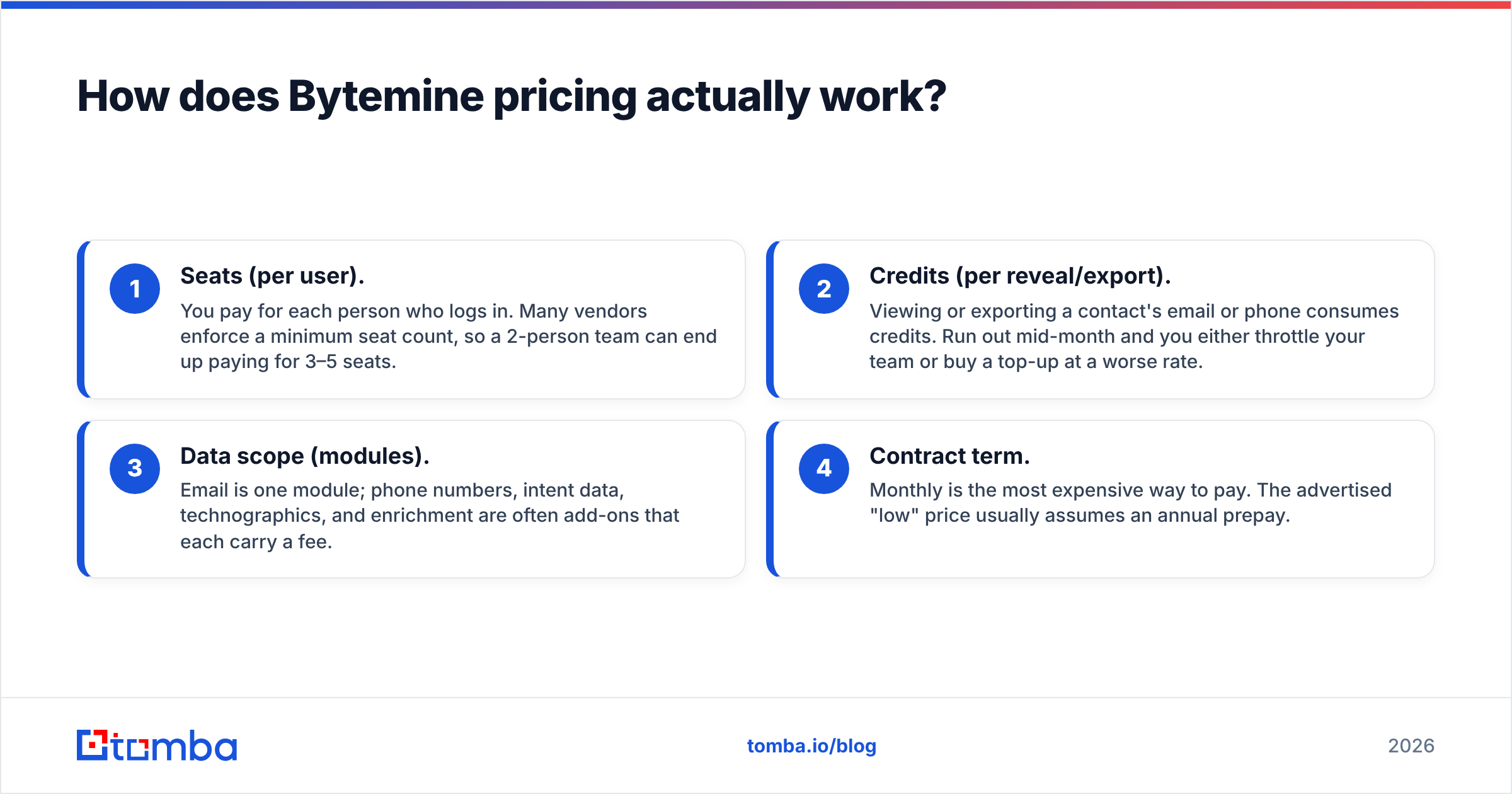
Most lead-intelligence platforms in Bytemine's class price along the same four axes. Understanding these matters more than memorizing any single plan name, because this is what your invoice is really built from.
- Seats (per user). You pay for each person who logs in. Many vendors enforce a minimum seat count, so a 2-person team can end up paying for 3–5 seats.
- Credits (per reveal/export). Viewing or exporting a contact's email or phone consumes credits. Run out mid-month and you either throttle your team or buy a top-up at a worse rate.
- Data scope (modules). Email is one module; phone numbers, intent data, technographics, and enrichment are often add-ons that each carry a fee.
- Contract term. Monthly is the most expensive way to pay. The advertised "low" price usually assumes an annual prepay.
Here's the trap: a quote can look reasonable on seats alone, then double once you add the credit pack and the phone module you actually need. Always ask the rep to itemize all four axes before comparing.
A quick framework for reading any data-tool quote#
- Cost per usable contact, not cost per credit. Factor in bounces and stale records.
- Overage rate, not just the included pool. This is where budgets blow up.
- Cancellation terms. Annual lock-in with no proration is common.
- Verification quality. Cheap data that bounces costs you sender reputation, which is far more expensive than the subscription. If you're unsure how to protect that, see email deliverability.
Is Bytemine worth it compared to alternatives?#
It depends entirely on whether you need a full intelligence suite or mainly accurate contact data. If you're running a large outbound motion with intent signals, scoring, and CRM-deep workflows, a suite can justify its price. If you mostly need to find and verify business emails and push them into your sequencer, you're likely overpaying for modules you'll never open.
That's the central tradeoff. Suites bundle breadth; focused tools win on price-per-result and predictability. For email-led teams, a dedicated finder plus a verifier almost always beats a generalist platform on cost.
Bytemine pricing vs. transparent alternatives#
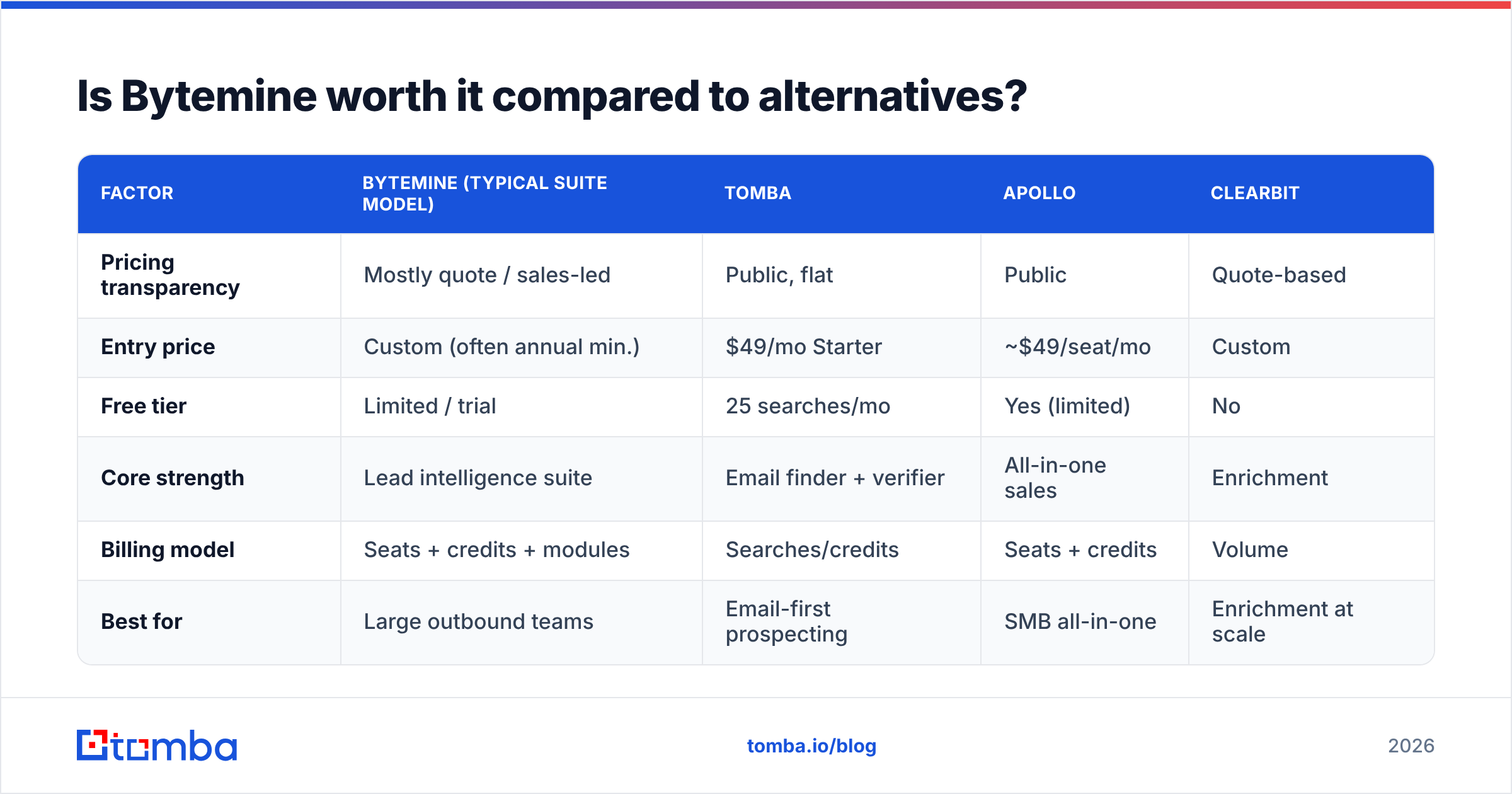
The table below compares the model, not invented exact figures for Bytemine (whose pricing is quote-based). Tomba and the other public vendors list real numbers you can verify today.
| Factor | Bytemine (typical suite model) | Tomba | Apollo | Clearbit |
|---|---|---|---|---|
| Pricing transparency | Mostly quote / sales-led | Public, flat | Public | Quote-based |
| Entry price | Custom (often annual min.) | $49/mo Starter | ~$49/seat/mo | Custom |
| Free tier | Limited / trial | 25 searches/mo | Yes (limited) | No |
| Core strength | Lead intelligence suite | Email finder + verifier | All-in-one sales | Enrichment |
| Billing model | Seats + credits + modules | Searches/credits | Seats + credits | Volume |
| Best for | Large outbound teams | Email-first prospecting | SMB all-in-one | Enrichment at scale |
A few takeaways. First, transparency itself has value: with Tomba plans you can model annual spend in five minutes. Second, the free tier matters for testing accuracy on your domains before paying. Third, "best for" is the real decision driver — match the tool to your motion, not to the longest feature list.
For deeper side-by-side context on how data tools stack up, vendor-neutral marketplaces like G2 and Capterra collect verified user reviews on pricing fairness and data accuracy.

What hidden costs should you watch for?#
The sticker price is rarely the whole story with sales-led tools. Budget for these before you sign.
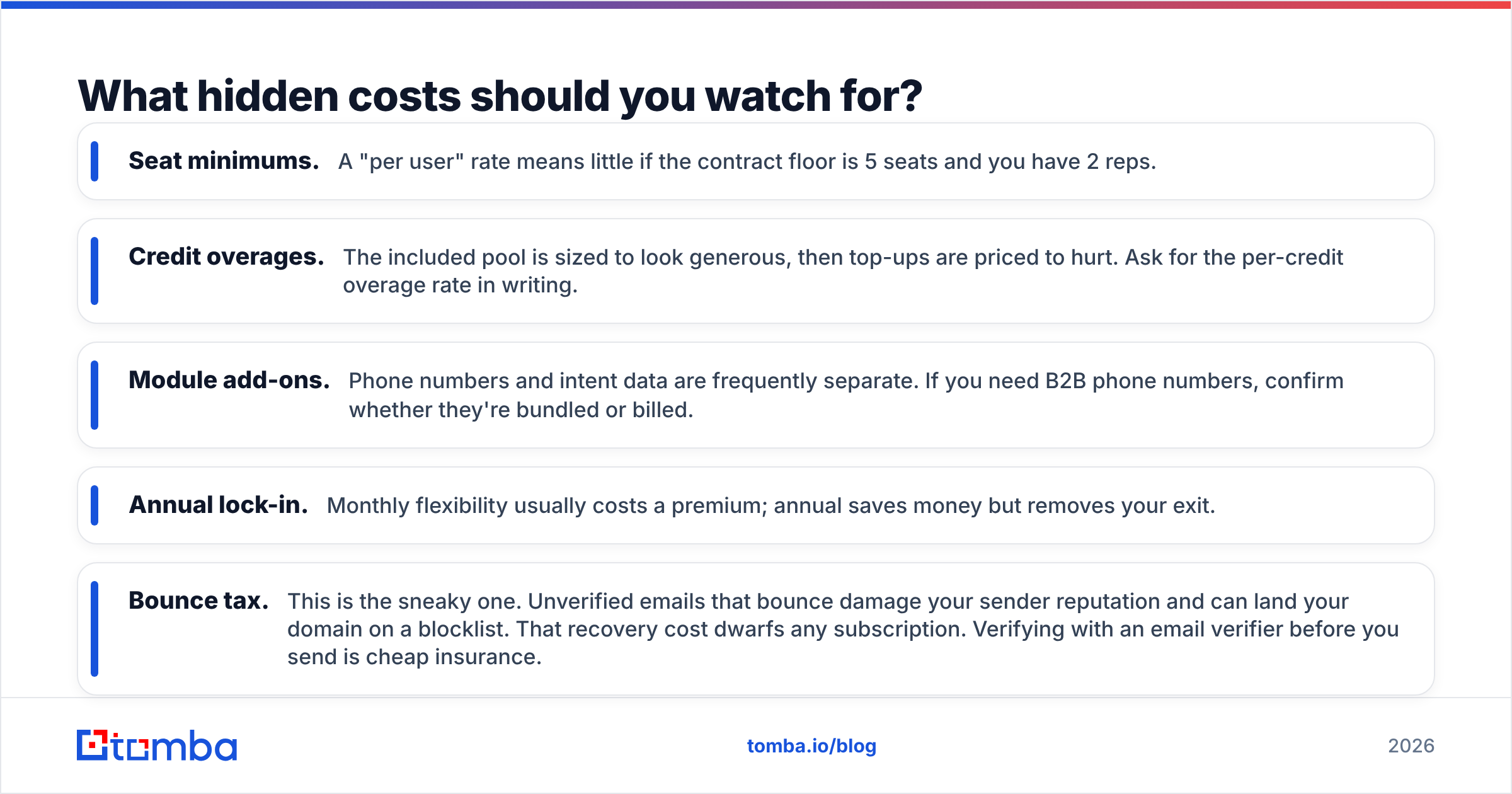
- Seat minimums. A "per user" rate means little if the contract floor is 5 seats and you have 2 reps.
- Credit overages. The included pool is sized to look generous, then top-ups are priced to hurt. Ask for the per-credit overage rate in writing.
- Module add-ons. Phone numbers and intent data are frequently separate. If you need B2B phone numbers, confirm whether they're bundled or billed.
- Annual lock-in. Monthly flexibility usually costs a premium; annual saves money but removes your exit.
- Bounce tax. This is the sneaky one. Unverified emails that bounce damage your sender reputation and can land your domain on a blocklist. That recovery cost dwarfs any subscription. Verifying with an email verifier before you send is cheap insurance.
How does Tomba pricing compare for email-first teams?#
If your job is to get verified work emails into a sequencer, Tomba's model is built for exactly that, and the numbers are public. Here's the full lineup so you can compare apples to apples against any Bytemine quote.
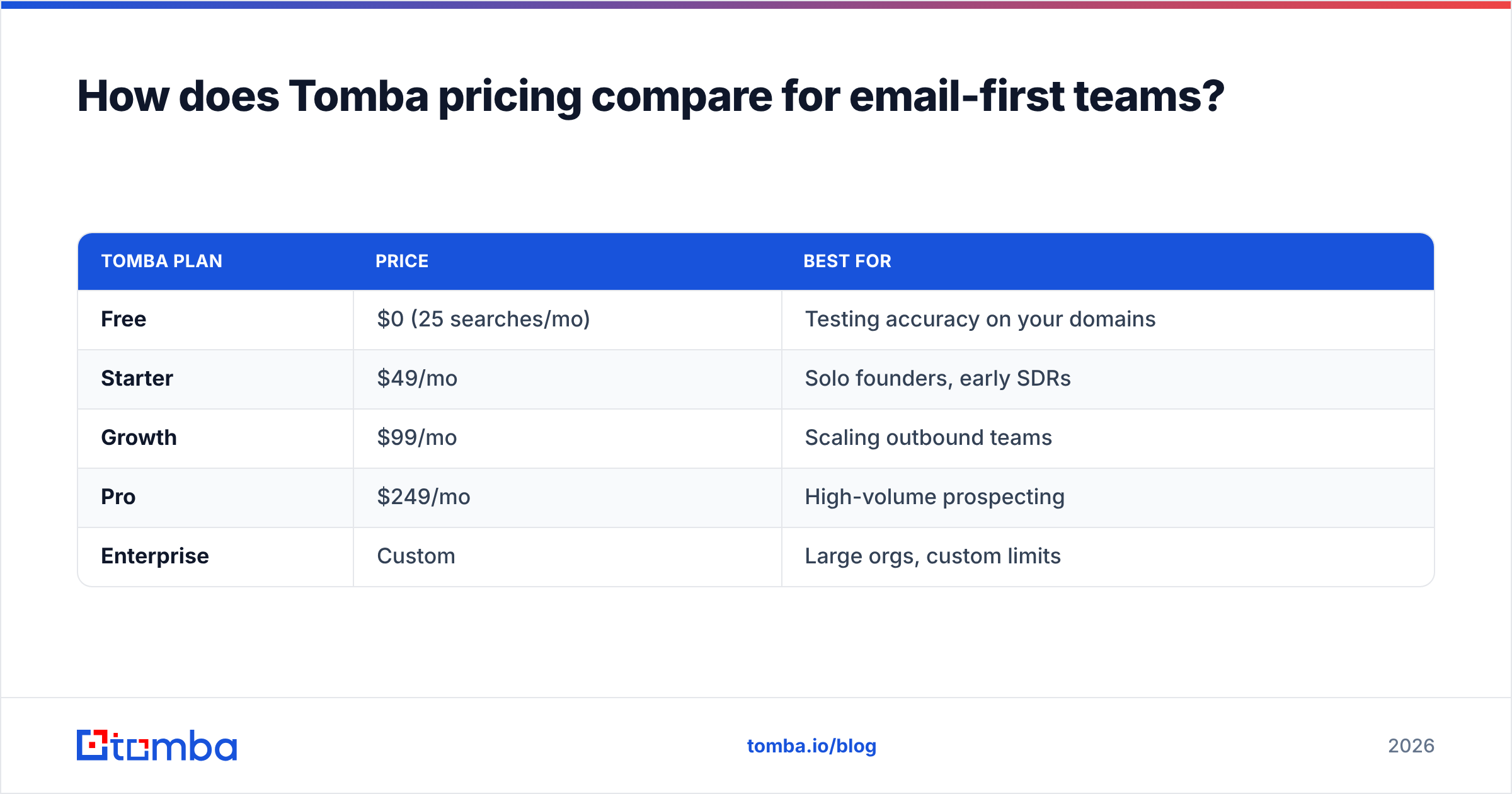
| Tomba plan | Price | Best for |
|---|---|---|
| Free | $0 (25 searches/mo) | Testing accuracy on your domains |
| Starter | $49/mo | Solo founders, early SDRs |
| Growth | $99/mo | Scaling outbound teams |
| Pro | $249/mo | High-volume prospecting |
| Enterprise | Custom | Large orgs, custom limits |
What you get across those tiers isn't just a finder. The platform pairs the find email addresses workflow with verification, domain search for mapping whole companies, catch-all handling, and data enrichment — the same building blocks a suite charges module-by-module, without the quote dance.
Three practical advantages for email-led teams:
- Predictability. You know the bill on day one. No surprise overage call.
- A real free tier. 25 searches a month is enough to benchmark accuracy before paying a cent.
- Verification built in. Finding and verifying live in the same place, which protects deliverability without a second vendor.
For teams replacing a heavier platform, Tomba also publishes direct comparison pages — for example its Apollo alternative and Clearbit alternative breakdowns — so you can see exactly where the tradeoffs land.

How do you choose between a suite and a focused tool?#
Run this quick decision check before you commit to any annual contract.
- Do you need intent data and scoring, or just contacts? If it's contacts, skip the suite.
- How many seats actually log in weekly? Be honest. Idle seats are pure waste.
- What's your monthly contact volume? Map it to credits and overage rates, not the headline pool.
- Can you test on your own domains first? If a vendor won't let you verify accuracy before paying, that's a signal.
- What happens to deliverability? Whatever you pick, verify before you send. A clean list beats a big list every time.
The pattern most small and mid-size teams land on: a focused email finder for the top of funnel, a verifier to protect the domain, and a CRM or sequencer to run the plays. You only graduate to a full intelligence suite when intent data and account scoring become the bottleneck — not before.
Frequently asked questions#
Does Bytemine publish public pricing? Pricing is largely quote-based, so the most reliable figure is the one a rep gives you for your seat count, credits, and modules. Always confirm on the vendor's official site and get the overage rate in writing.
Is there a free version of Bytemine? Free access in this category is typically a limited trial rather than a permanent free tier. If a standing free tier matters to you, Tomba's free plan offers 25 searches per month indefinitely.
What's the cheapest way to find verified work emails? For most teams, a flat-rate finder with built-in verification — like Tomba at $49/mo — beats a suite when email is the core need. You avoid module add-ons and credit-overage surprises.
Will cheap data hurt my campaigns? It can. Unverified contacts bounce, and bounces damage sender reputation. Run every list through verification before sending; it's the highest-ROI step in outbound.
The bottom line#
Bytemine pricing follows the familiar sales-led, seat-plus-credit-plus-module pattern, which can be the right call for large outbound teams that genuinely use intent data and scoring. But if your real need is verified work emails flowing into a sequencer, a focused tool wins on cost, transparency, and deliverability.
Want to model your spend before you sign anything? Start with the Tomba email finder — test accuracy on your own domains with the free tier, then scale on flat, public pricing that won't surprise you at renewal. Your pipeline (and your finance team) will thank you.
// get started
Find, verify and enrich your first contacts today
Start on the free plan with 25 searches a month, then scale when your team is ready.
Free plan · No credit card required · GDPR & CCPA
// about the author