Bytemine Reviews 2026: Features, Pricing, and Top Alternatives
An honest, hype-free look at Bytemine in 2026 — what it does well, where it falls short on data accuracy and pricing, and the alternatives worth testing before you commit budget.
You are evaluating Bytemine because someone on your team flagged it as a way to find B2B contacts faster, and now you need to know whether it's worth a credit card. This review cuts through the marketing copy and looks at what Bytemine actually delivers in 2026 — accuracy, pricing, workflow fit — and where a different tool would serve you better.
TL;DR#
- Bytemine is a B2B lead-generation and contact-data platform aimed at sales and marketing teams who want emails, company data, and list-building in one place.
- Its strongest selling point is breadth: company filters and list exports in a single dashboard. Its weakest point is per-record accuracy and opaque pricing at the entry tier.
- For teams whose core need is verified email discovery, a focused email finder usually returns higher hit rates at a lower cost per valid contact.
- Run a head-to-head test on the same 100 prospects before committing — accuracy claims only matter on your target accounts.
- Best-fit verdict: Bytemine for broad list-building experiments; a verification-first tool when bounce rate and deliverability are what you're graded on.
What is Bytemine?#
Bytemine is a B2B data and prospecting tool that lets you search for companies and contacts, pull email addresses, and export lists for outreach. Think of it as a digital rolodex with a search engine bolted on: you describe the kind of account you want — industry, size, location, role — and it returns matching contacts with enrichment fields attached.
That category is crowded. Tools like Apollo, RocketReach, Lusha, and ZoomInfo all promise some version of "find anyone's email and phone number." Bytemine competes on being approachable and reasonably priced for smaller teams that find enterprise platforms like ZoomInfo overkill. The question every buyer actually has is narrower: does the data hold up, and does the price scale sanely?
Before you trust any vendor's marketing numbers, it helps to understand how this kind of data gets assembled, because that's where quality lives or dies.
How does Bytemine find contact data?#
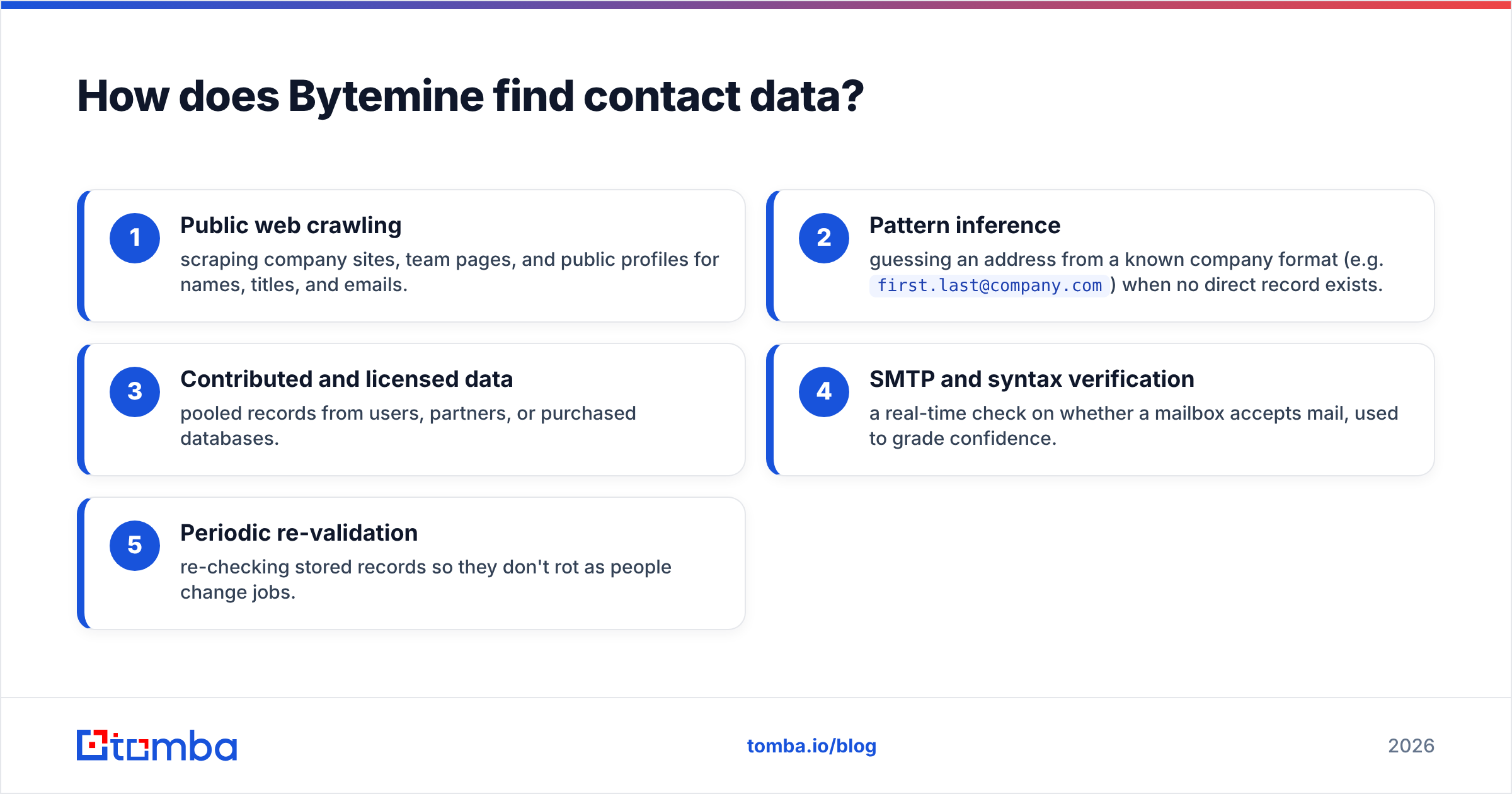
Most B2B data platforms, Bytemine included, build their datasets from a blend of sources. The mix typically looks like this:
- Public web crawling — scraping company sites, team pages, and public profiles for names, titles, and emails.
- Pattern inference — guessing an address from a known company format (e.g.
first.last@company.com) when no direct record exists. - Contributed and licensed data — pooled records from users, partners, or purchased databases.
- SMTP and syntax verification — a real-time check on whether a mailbox accepts mail, used to grade confidence.
- Periodic re-validation — re-checking stored records so they don't rot as people change jobs.
The accuracy of any tool comes down to how seriously it treats steps 4 and 5. A platform that leans heavily on pattern inference (step 2) without aggressive verification will hand you plenty of addresses — and a painful bounce rate. This is the single biggest differentiator between vendors, and it's where Bytemine reviews tend to split: people happy with raw volume rate it well, and people who track deliverability are more cautious. If you want the mechanics in depth, our breakdown of where contact data comes from covers each source and its failure modes.
What do Bytemine reviews say about accuracy?#
The honest answer: it's a mixed bag, and it depends heavily on your geography and target roles. Patterns that show up consistently across user feedback on sites like G2 and Capterra:
- North American mid-market data tends to be the strongest segment.
- Niche industries, EU contacts, and senior-but-not-C-suite roles are weaker — more guesses, more catch-alls.
- Bounce rates on un-verified exports frustrate users who push lists straight into cold email without a second verification pass.
That last point matters more than any headline accuracy percentage. A vendor can advertise "95% accuracy" measured on its easiest records, but your campaign lives and dies on the addresses you actually email. The fix is non-negotiable regardless of source: run every list through a dedicated email verifier before the first send. According to HubSpot's research on email marketing, list hygiene is one of the clearest levers on sender reputation — and a dirty list will sink an otherwise good campaign.
How much does Bytemine cost?#
Pricing is where buyers get the most surprised. Like many tools in this space, Bytemine uses a credit-based model where a "search," an "export," and a "verification" can each consume credits differently — which makes the sticker price and the real cost diverge. Always confirm what one usable, verified contact costs you, not just the monthly headline.
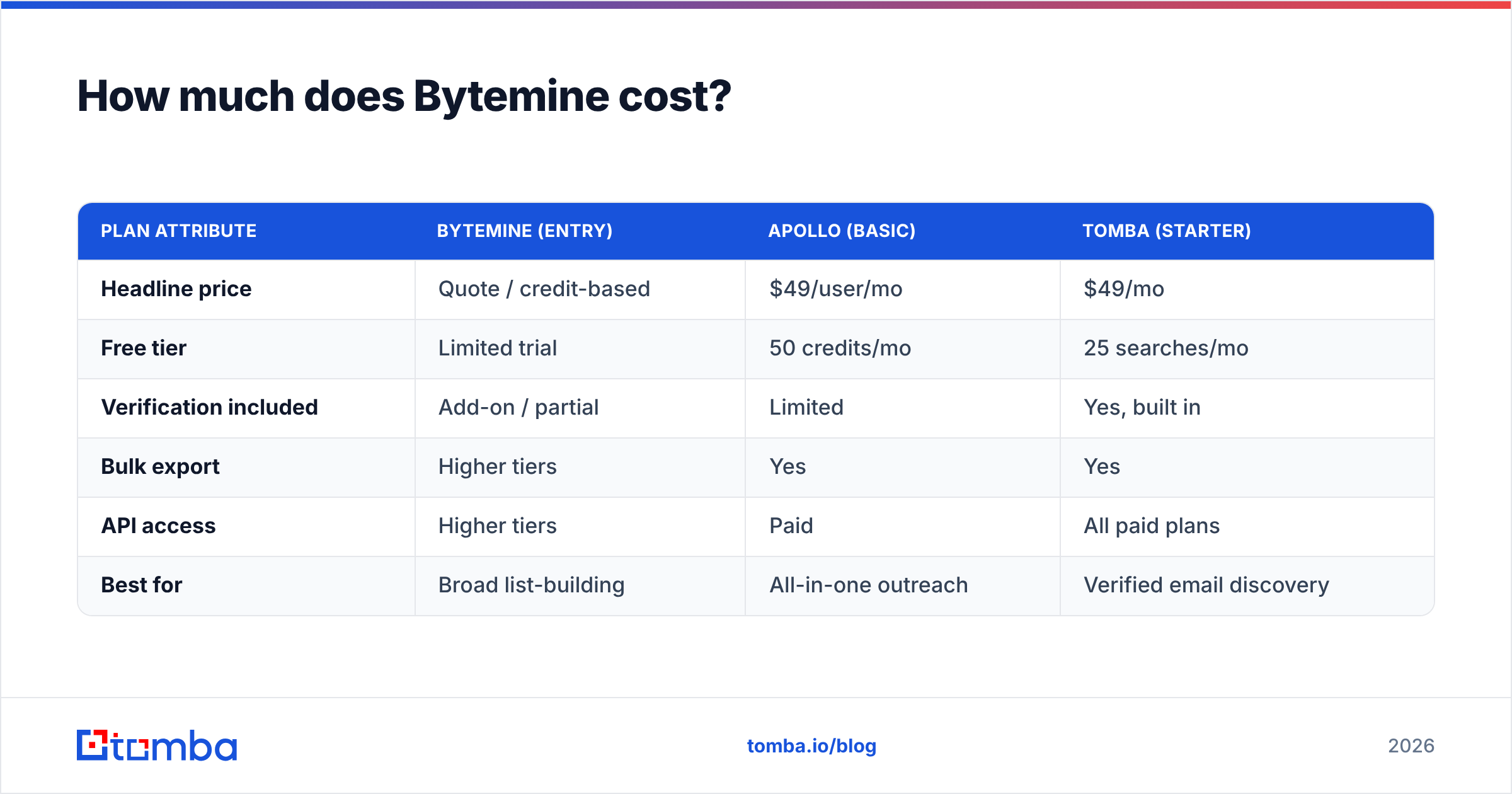
Here's how a representative entry-to-mid tier comparison looks across the category. Treat competitor numbers as directional — always check current vendor pages — but the shape is the point:
| Plan attribute | Bytemine (entry) | Apollo (Basic) | Tomba (Starter) |
|---|---|---|---|
| Headline price | Quote / credit-based | $49/user/mo | $49/mo |
| Free tier | Limited trial | 50 credits/mo | 25 searches/mo |
| Verification included | Add-on / partial | Limited | Yes, built in |
| Bulk export | Higher tiers | Yes | Yes |
| API access | Higher tiers | Paid | All paid plans |
| Best for | Broad list-building | All-in-one outreach | Verified email discovery |
The takeaway isn't that one number wins. It's that a credit model rewards you for reading the fine print. If 30% of a Bytemine export bounces, your effective cost per usable contact is 43% higher than the credit math suggests. A platform that verifies inline — so you only keep deliverable records — often wins on real cost even when the monthly fee looks similar. You can compare a flat, predictable structure on the Tomba pricing page.
Is Bytemine better than the alternatives?#
Better at what? That's the only useful framing. Bytemine is a generalist, and generalists win on convenience and lose on depth. Break your need into the job you're actually hiring a tool to do:
- You need broad list-building across many filters → a generalist platform (Bytemine, Apollo) is a reasonable fit.
- You need the highest hit rate on a specific set of domains → a focused domain search tool will usually beat a generalist.
- You need deliverability you can defend to your boss → verification-first wins, full stop.
- You need phone numbers and multichannel → check coverage explicitly; this varies wildly by region.
Bytemine pros and cons at a glance#
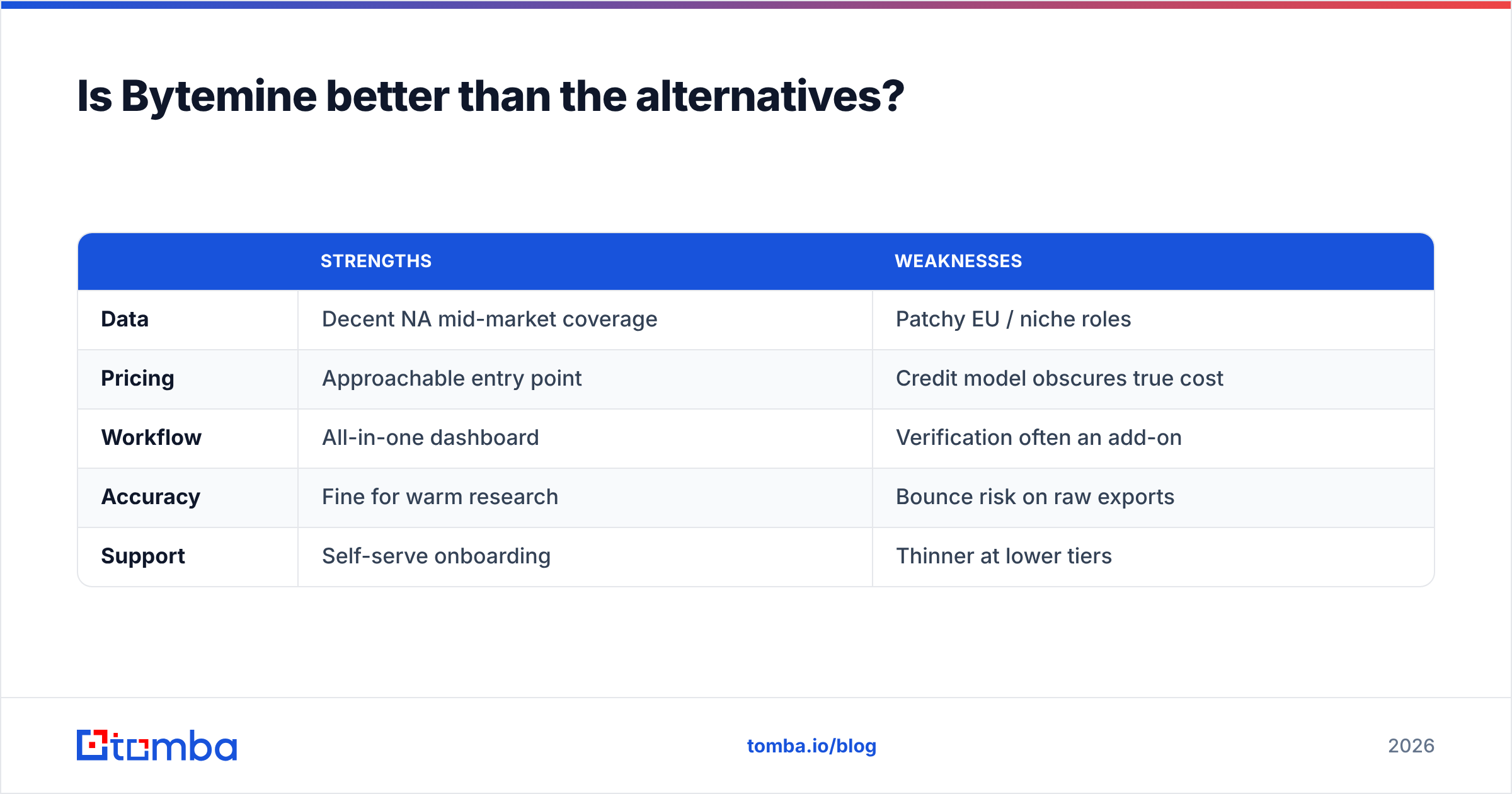
| Strengths | Weaknesses | |
|---|---|---|
| Data | Decent NA mid-market coverage | Patchy EU / niche roles |
| Pricing | Approachable entry point | Credit model obscures true cost |
| Workflow | All-in-one dashboard | Verification often an add-on |
| Accuracy | Fine for warm research | Bounce risk on raw exports |
| Support | Self-serve onboarding | Thinner at lower tiers |
None of this makes Bytemine a bad tool. It makes it a generalist tool — and whether that's right for you depends entirely on whether your bottleneck is breadth or precision.
Who should actually use Bytemine?#
Bytemine fits you if you're an early-stage team doing exploratory prospecting, you value a single dashboard over best-in-class accuracy, and you're disciplined enough to verify lists before sending. It's a fine "first serious tool" when you're still figuring out your ideal customer profile and want to cast wide.
It fits you poorly if email deliverability is a KPI you're measured on, if you operate heavily outside North America, or if your motion is high-volume cold outreach where every percentage point of bounce rate compounds into spam-folder placement. In those cases, the convenience of one dashboard isn't worth the downstream cleanup.
What are the best Bytemine alternatives in 2026?#
If Bytemine's accuracy or pricing gives you pause, here's how the most common alternatives stack up by primary strength:

- Tomba — verification-first email discovery; strong when your KPI is deliverable, valid contacts rather than raw record count. Built-in email verification means fewer bounces out of the box.
- Apollo — all-in-one outreach plus database; good if you want sequencing and data in one seat, at the cost of data depth in narrower segments. See Apollo alternatives for the trade-offs.
- RocketReach — wide contact coverage, popular for recruiter and partnership use; pricing climbs at scale. Compare on the RocketReach alternative page.
- Clearbit / enrichment-first tools — best when your need is enriching records you already have rather than net-new discovery.

How to run a fair head-to-head test#
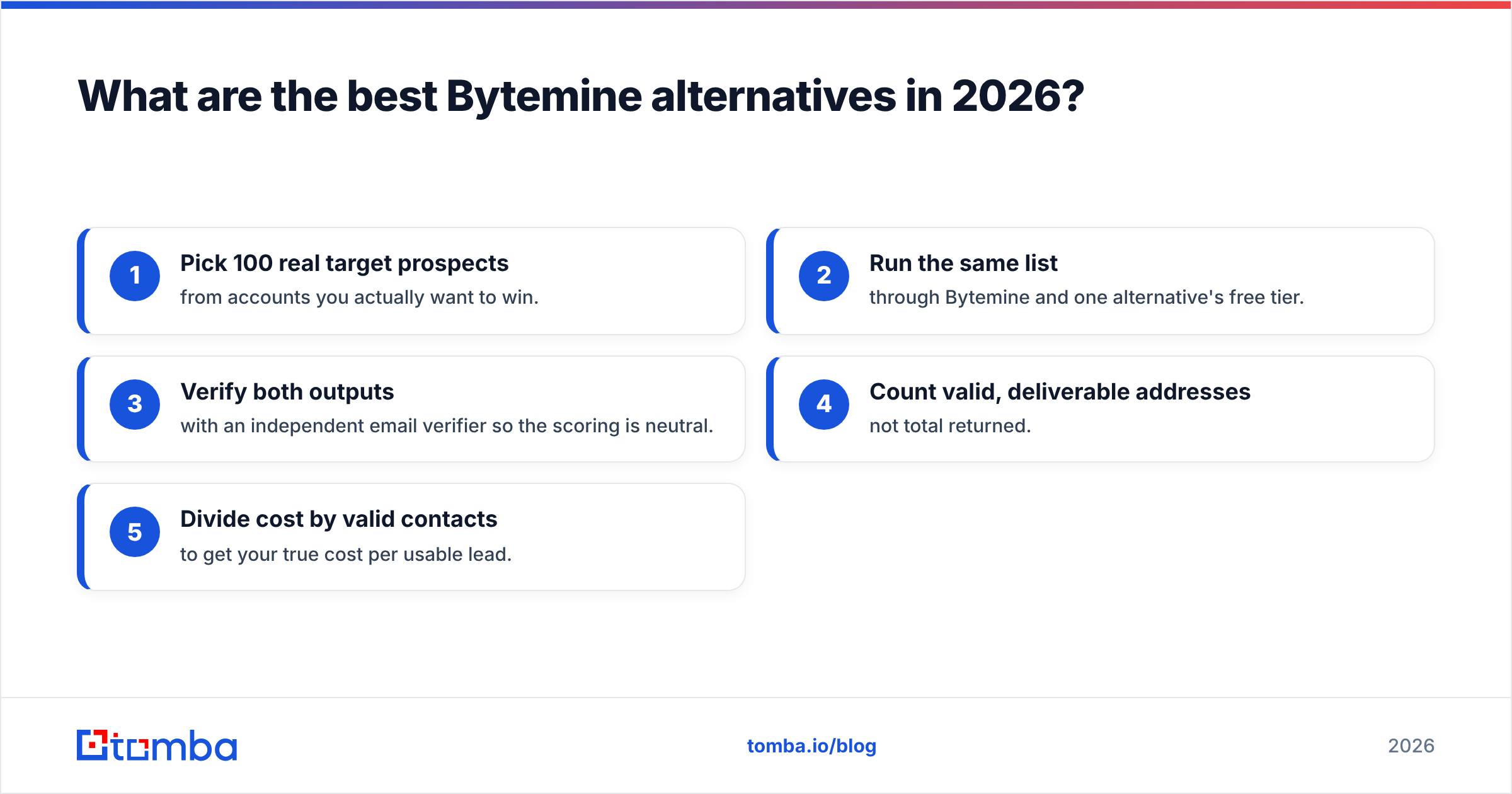
Don't trust any review — including this one — over your own data. Run this 20-minute test before you buy anything:
- Pick 100 real target prospects from accounts you actually want to win.
- Run the same list through Bytemine and one alternative's free tier.
- Verify both outputs with an independent email verifier so the scoring is neutral.
- Count valid, deliverable addresses — not total returned.
- Divide cost by valid contacts to get your true cost per usable lead.
Whichever tool wins that number on your accounts is your answer. Accuracy benchmarks published by vendors are measured on their best-case data; your ICP is the only benchmark that pays your salary.
Frequently asked questions#
Is Bytemine accurate enough for cold email? Only if you verify every export first. Raw exports from any generalist platform carry bounce risk, and unverified sends damage sender reputation faster than any single campaign can repay.
Does Bytemine offer a free trial? It offers a limited trial rather than a permanent free tier. If a standing free allowance matters to you, tools like Tomba (25 searches/month) and Apollo (50 credits/month) let you test indefinitely at low volume.
Is Bytemine cheaper than Apollo or Tomba? At the headline level it can look competitive, but its credit model makes true cost-per-valid-contact harder to predict. Calculate cost after verification, not before.
What's the best Bytemine alternative for email finding specifically? If your core job is discovering verified business emails, a focused finder with built-in verification will generally beat a generalist on cost-per-deliverable-contact. Test both on the same 100 prospects to confirm.
The bottom line#
Bytemine is a competent generalist that suits exploratory, North-America-heavy prospecting when you're disciplined about verifying lists. It struggles where precision and deliverability are the whole game. If your team is judged on reply rates and clean sender reputation rather than raw list size, lead with accuracy.
That's exactly the gap the Tomba Email Finder is built to close: find professional emails by domain, name, or company, with verification baked in so the contacts you export are contacts you can actually reach. Start free with 25 searches a month, run the 100-prospect test above against your current tool, and let cost-per-valid-contact — not marketing copy — make the call.
// get started
Find, verify and enrich your first contacts today
Start on the free plan with 25 searches a month, then scale when your team is ready.
Free plan · No credit card required · GDPR & CCPA
// about the author