Bytemine vs Apollo.io 2026: Which Lead Data Tool Wins?
Bytemine vs Apolloio compared on data accuracy, pricing, email finding, and workflow fit — plus where a focused email finder beats both for cold outreach in 2026.
The Bytemine vs Apolloio choice comes down to one question. Do you want an all-in-one sales engagement suite? Or do you want clean, accurate contact data you can plug into the stack you already trust? This guide breaks down both tools on the things that actually move pipeline. We cover data accuracy, pricing, database depth, and how each fits a real outbound workflow in 2026.
TL;DR#
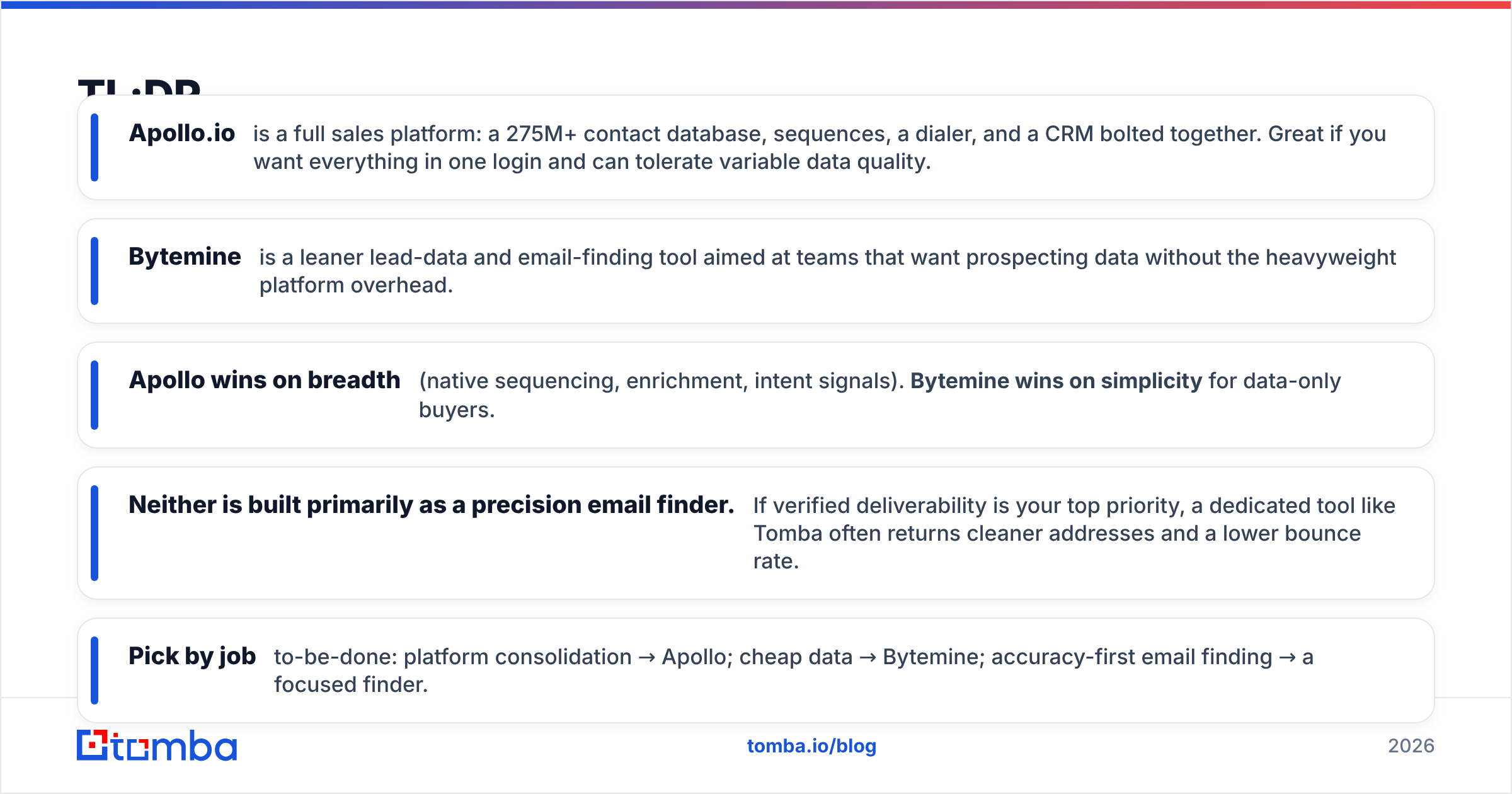
- Apollo.io is a full sales platform: a 275M+ contact database, sequences, a dialer, and a CRM bolted together. Great if you want everything in one login and can tolerate variable data quality.
- Bytemine is a leaner lead-data and email-finding tool aimed at teams that want prospecting data without the heavyweight platform overhead.
- Apollo wins on breadth (native sequencing, enrichment, intent signals). Bytemine wins on simplicity for data-only buyers.
- Neither is built primarily as a precision email finder. If verified deliverability is your top priority, a dedicated tool like Tomba often returns cleaner addresses and a lower bounce rate.
- Pick by job-to-be-done: platform consolidation → Apollo; cheap data → Bytemine; accuracy-first email finding → a focused finder.
What is Bytemine and what is Apollo.io?#
Think of it like buying a kitchen. Apollo.io is the full fitted kitchen — counters, appliances, dishwasher, all pre-installed and wired together. Bytemine is more like a quality set of knives — focused, lighter, and meant to slot into a kitchen you already own.
Apollo.io is a sales intelligence and engagement platform. It pairs a large B2B contact database with outbound tooling: email sequences, a built-in dialer, LinkedIn tasks, deal management, and AI assistants. The pitch is consolidation — replace three or four point tools with one subscription. You can read their feature set on the official Apollo.io site.
Bytemine positions itself further down the stack as a lead-generation and email-finding tool. The focus is on pulling contact records and email addresses for prospecting, without the full engagement suite. That makes it lighter and usually cheaper. But it leans on your existing CRM and sending tools to actually run campaigns.
The core distinction in one line: Apollo sells a workflow; Bytemine sells data. Which matters more to you decides most of this comparison.
How do Bytemine and Apollo.io compare on features and pricing?#
Here is the head-to-head on the attributes buyers ask about most.
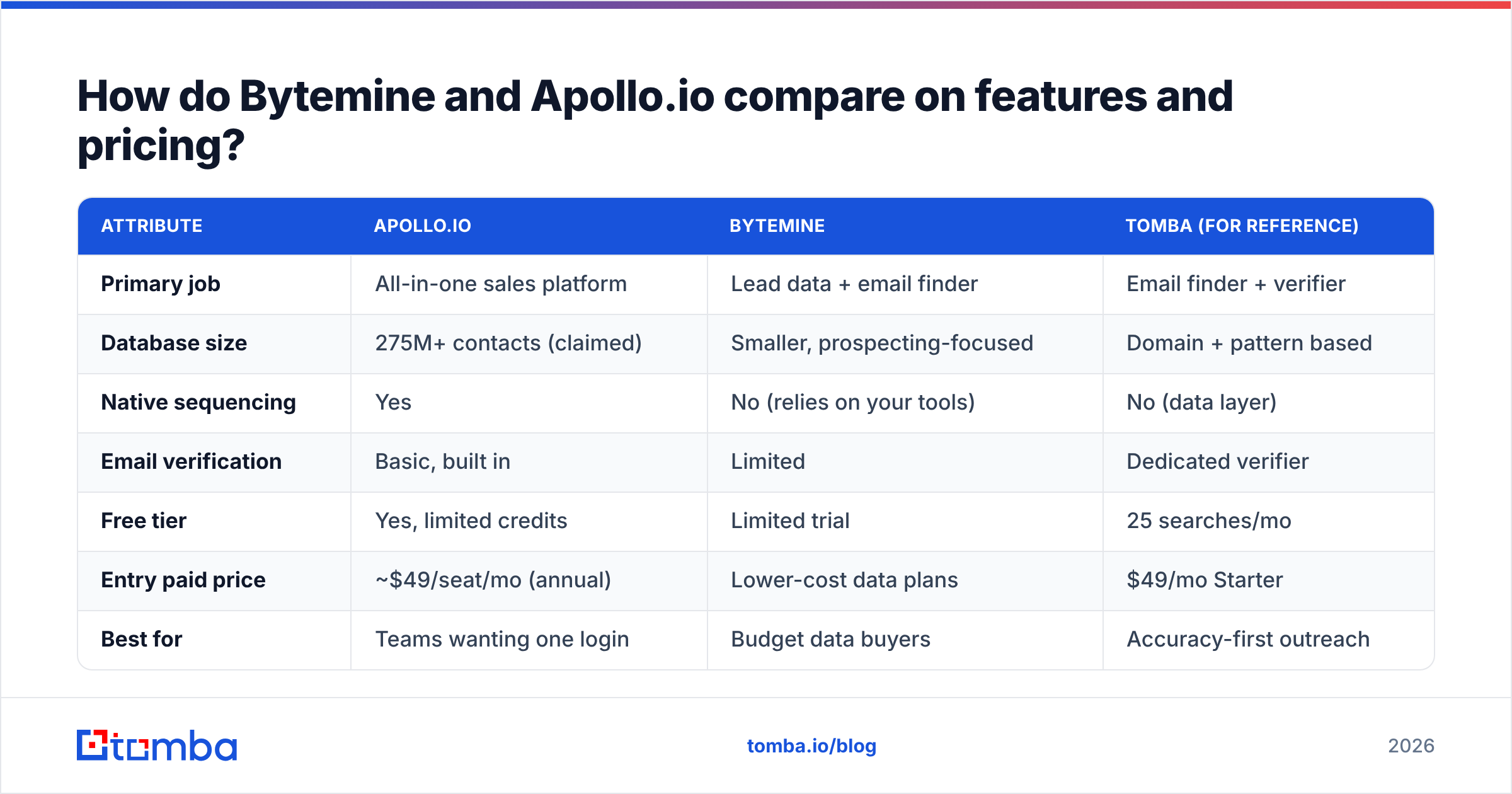
| Attribute | Apollo.io | Bytemine | Tomba (for reference) |
|---|---|---|---|
| Primary job | All-in-one sales platform | Lead data + email finder | Email finder + verifier |
| Database size | 275M+ contacts (claimed) | Smaller, prospecting-focused | Domain + pattern based |
| Native sequencing | Yes | No (relies on your tools) | No (data layer) |
| Email verification | Basic, built in | Limited | Dedicated verifier |
| Free tier | Yes, limited credits | Limited trial | 25 searches/mo |
| Entry paid price | ~$49/seat/mo (annual) | Lower-cost data plans | $49/mo Starter |
| Best for | Teams wanting one login | Budget data buyers | Accuracy-first outreach |
| API access | Yes | Limited | Full email finder API |
A few honest caveats. Apollo's 275M number is the total database. It is not the count of records with a verified, deliverable email. Those are different things, and the gap is where bounce rates come from. Bytemine's smaller footprint can help in narrow verticals, where a giant generic database mostly returns noise. Pricing on both tools shifts with credit caps and annual-vs-monthly terms. So price your real monthly volume, not the sticker tier.
Where each tool genuinely wins#
- Apollo wins on consolidation. If you want prospecting, sequencing, dialing, and basic CRM in one tab, nothing in this comparison matches it. One bill, one onboarding.
- Apollo wins on intent and enrichment signals. Buying-intent topics, job-change alerts, and auto-enrichment are baked in at higher tiers.
- Bytemine wins on cost for data-only teams. If you already run Instantly, Smartlead, or your own sender, you don't need Apollo's engagement layer — and Bytemine won't make you pay for it.
- Bytemine wins on simplicity. Fewer features means a shorter learning curve and less seat sprawl.
- Both lose to a dedicated finder on raw email accuracy — covered next.
Which has better data accuracy for cold email?#
Accuracy is the metric that quietly decides your sender reputation, and it's where both platforms show their seams. A big database is only useful if the emails inside it are real and current. Apollo's scale is a strength for coverage but a weakness for freshness. Large crowdsourced databases drift as people change jobs. A stale address becomes a hard bounce. Bytemine is smaller, so coverage gaps are the risk rather than staleness.

For cold outreach, the number that matters is bounce rate, because mailbox providers read bounces as a spam signal. A 3-5% bounce rate from a "good enough" database can quietly throttle your whole domain. So many teams run a two-step stack. First, pull contacts from a broad platform. Then re-verify every address through a dedicated email verifier before the first send. It costs a few cents per contact. And it protects an asset — your sending domain — that is far more expensive to repair than to protect.
Say your main need is finding and confirming a specific person's work email. A purpose-built finder that works from the company domain and verified patterns will usually beat a general platform. Tools like Tomba run an SMTP-level check and expose a confidence score per result, plus a catch-all verifier for the domains that accept everything and tell you nothing. Neither Apollo nor Bytemine treats verification as the headline feature — for them it's a checkbox, not the product.
Is Apollo.io worth it over a cheaper data tool like Bytemine?#
Apollo is worth the premium only if you'll actually use the engagement layer. Run the math honestly. Apollo's value is bundling. If you replace a sequencing tool, a dialer, and a data tool with one Apollo seat, the price is justified and often a saving. If you only ever export contacts to your own sender, you're paying for rooms in the kitchen you never cook in — and Bytemine (or a focused finder) is the rational call.
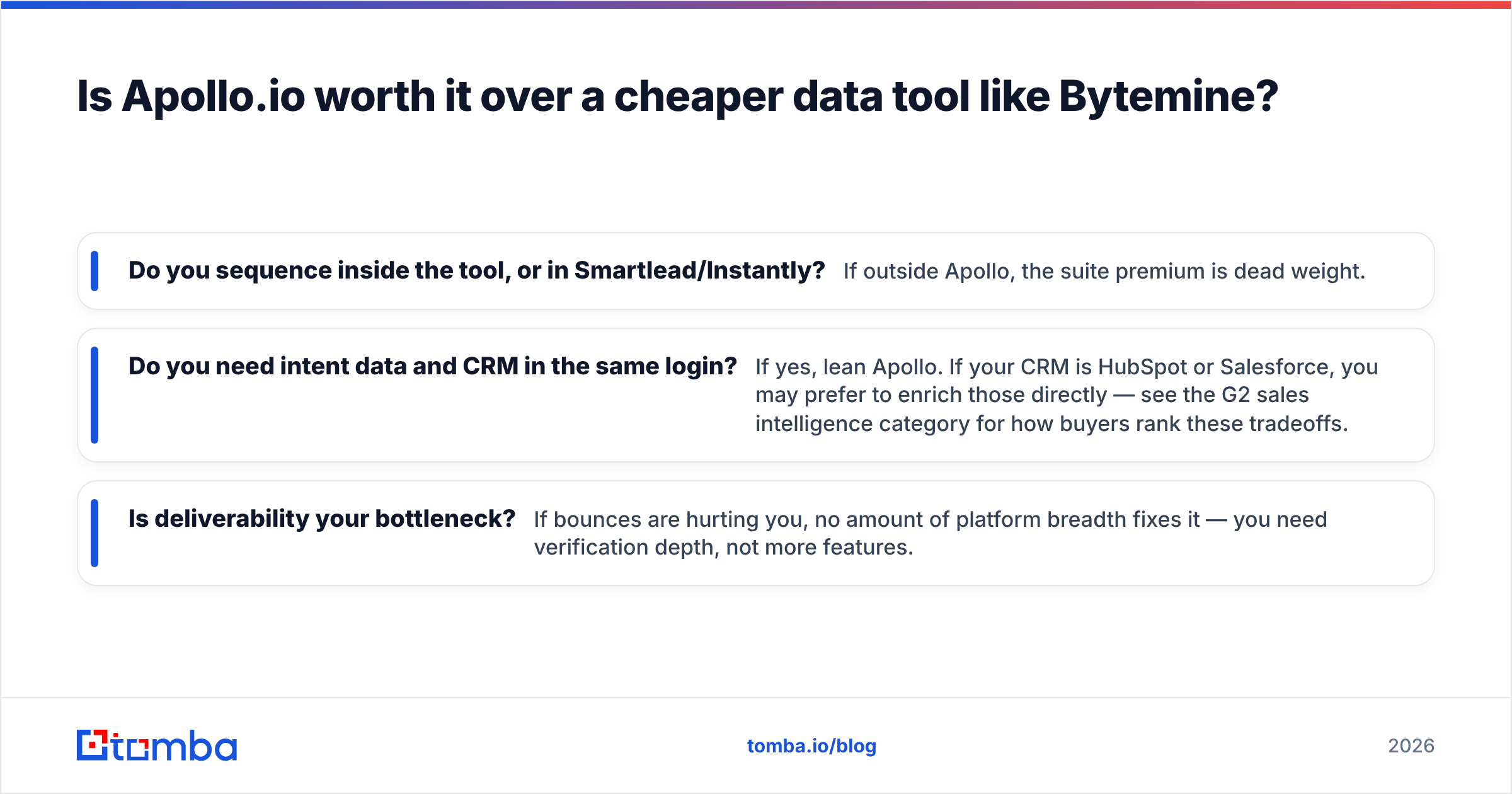
Three questions settle it:
- Do you sequence inside the tool, or in Smartlead/Instantly? If outside Apollo, the suite premium is dead weight.
- Do you need intent data and CRM in the same login? If yes, lean Apollo. If your CRM is HubSpot or Salesforce, you may prefer to enrich those directly — see the G2 sales intelligence category for how buyers rank these tradeoffs.
- Is deliverability your bottleneck? If bounces are hurting you, no amount of platform breadth fixes it — you need verification depth, not more features.
That last point is why so many "Apollo alternative" searches end at a data-plus-verification combo rather than another mega-suite. If Apollo is on your shortlist mainly for contact data, compare it directly as an Apollo alternative on cost-per-verified-email, not cost-per-record.
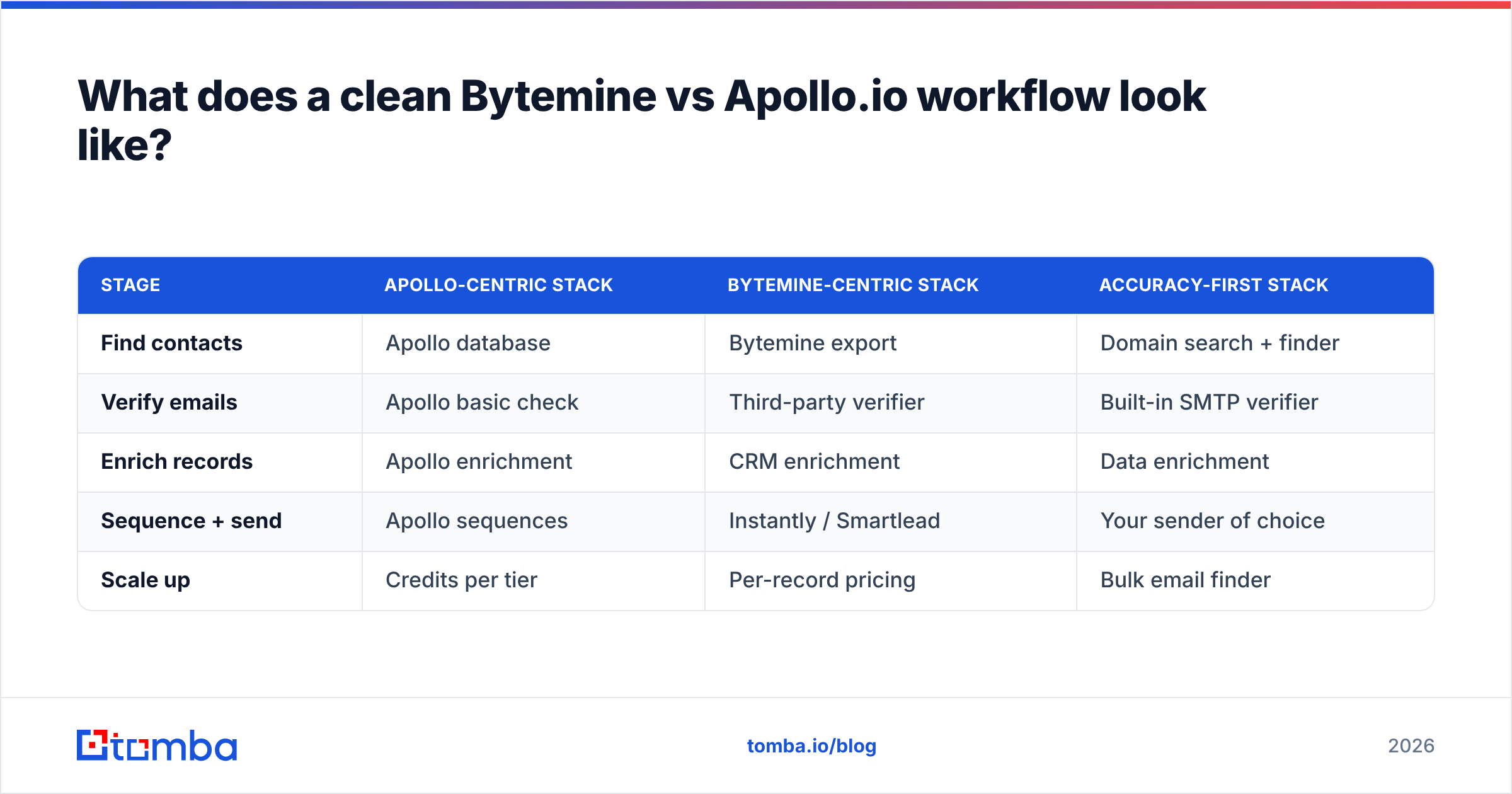
What does a clean Bytemine vs Apolloio workflow look like?#
Here's the practical part. Whichever you pick, the winning pattern is the same: find, verify, then send — and don't let any single tool own all three steps unless it's genuinely best at each.
| Stage | Apollo-centric stack | Bytemine-centric stack | Accuracy-first stack |
|---|---|---|---|
| Find contacts | Apollo database | Bytemine export | Domain search + finder |
| Verify emails | Apollo basic check | Third-party verifier | Built-in SMTP verifier |
| Enrich records | Apollo enrichment | CRM enrichment | Data enrichment |
| Sequence + send | Apollo sequences | Instantly / Smartlead | Your sender of choice |
| Scale up | Credits per tier | Per-record pricing | Bulk email finder |
The accuracy-first column is deliberately modular. You're not married to one vendor's roadmap, and you can swap any stage without ripping out the others. For high-volume prospecting, the bulk step matters most. Run a list of company domains through a bulk finder and verify in the same pass. That typically removes the 3-5% of dead addresses before they ever reach your sequencing tool.
A quick rule for list hygiene: verify on the day you send, not the day you build the list. B2B contact data decays roughly 2-3% per month as people switch roles. So a list verified six weeks ago is already measurably worse than one verified this morning.
Bytemine vs Apolloio: quick verdict by team type#
- Solo founder / small team, tight budget: Bytemine or a focused finder. Skip the suite tax.
- Full-cycle AE team wanting one platform: Apollo. The bundle pays for itself if you use sequencing and dialing.
- High-volume outbound agency: Data tool + dedicated verifier + your own sender. Accuracy and per-record cost win at scale.
- RevOps enriching an existing CRM: Enrichment-first tooling beats either platform's native fields.
- Deliverability-constrained team: Lead with verification. A dedicated finder/verifier is the highest-leverage spend.
Frequently asked questions#
Is Bytemine cheaper than Apollo.io? Generally yes for data-only use, because Bytemine doesn't bundle a sequencing suite or dialer. But compare on cost-per-verified-email, not headline tier price — a cheap record that bounces costs you reputation, which is the expensive currency.
Does Apollo.io verify emails before you send? Apollo includes basic verification, but it isn't the product's core. For cold campaigns at volume, most teams add a dedicated verification pass to keep bounce rates under the ~2% threshold mailbox providers watch.
Can I use Bytemine or Apollo data with my own sending tool? Yes. Both let you export contacts into Instantly, Smartlead, HubSpot, or Salesforce. That portability is exactly why data-only buyers often skip the Apollo engagement layer.
What's the most accurate option for finding a specific person's email? A purpose-built email finder that works from the verified company domain and confirms via SMTP, rather than a broad crowdsourced database. That's the niche where dedicated finders outperform both Bytemine and Apollo.
The bottom line#
In the Bytemine vs Apolloio decision, the two tools solve different problems wearing similar clothing. Apollo sells an all-in-one workflow. Bytemine sells lean data. Pick Apollo if you'll genuinely use the sequencing, dialer, and intent signals. Pick Bytemine if you already own your sending stack and just want records without the suite premium. But if the real bottleneck is deliverability — emails that actually land in the inbox — neither platform leads with the verification depth that fixes it.
That's the gap a focused tool fills. Tomba's Email Finder finds professional addresses by domain, name, or company, runs an SMTP-level verification on every result, and returns a confidence score so you know what's safe to send before you risk your domain. Start free with 25 searches a month, then scale on transparent Tomba pricing from $49/mo — no engagement-suite tax, just clean, deliverable data you can drop into whatever stack you already trust.
// get started
Find, verify and enrich your first contacts today
Start on the free plan with 25 searches a month, then scale when your team is ready.
Free plan · No credit card required · GDPR & CCPA
// about the author