Bytemine vs DiscoverOrg: B2B Data Tools Compared (2026)
A neutral, hands-on breakdown of Bytemine vs DiscoverOrg in 2026 — pricing, data coverage, accuracy, contracts, and which B2B data tool actually fits your team.
You are comparing Bytemine vs DiscoverOrg because you need accurate B2B contact data without overpaying or signing a contract you regret in month two. This guide breaks both down on the criteria that actually move pipeline: data depth, accuracy, pricing structure, contract terms, and integration fit — then shows where a leaner, pay-as-you-grow alternative beats both for most teams.
TL;DR#
- DiscoverOrg (now folded into ZoomInfo) is an enterprise sales-intelligence platform: deep org charts, intent signals, and verified contacts — priced and contracted like enterprise software.
- Bytemine is a lighter B2B data and email-discovery tool aimed at smaller teams that want contacts fast without an annual commitment.
- The real decision is data depth vs. flexibility: DiscoverOrg wins on breadth and firmographics; Bytemine wins on simplicity and cost of entry.
- Both lock value behind their own ecosystems. If you mainly need verified emails by domain or name, a focused email finder often outperforms either on cost-per-valid-contact.
- Below: a feature-by-feature table, accuracy notes, and a decision framework so you stop guessing.
What is DiscoverOrg?#
DiscoverOrg built its reputation on human-verified B2B data — org charts, direct dials, and technographics that sales teams trusted for account-based outreach. In 2019 it merged with ZoomInfo, and the DiscoverOrg product has since been absorbed into the broader ZoomInfo platform. When people say "DiscoverOrg" in 2026, they usually mean the enterprise sales-intelligence tier: large contact database, intent data, and CRM-grade enrichment.
Think of DiscoverOrg as a fully stocked warehouse. Everything is there, catalogued, and quality-checked — but you pay for the whole warehouse whether you use one shelf or fifty, and you sign a lease to get in.
Its strengths are real: deep firmographics, reliable direct-dial coverage in North America, and intent signals that help you time outreach. Its weaknesses are equally real: enterprise pricing, annual contracts, and a learning curve that smaller teams rarely amortize.
What is Bytemine?#
Bytemine is a B2B data and contact-discovery tool positioned for leaner teams. The pitch is straightforward: pull company and contact data, find work emails, and export to your CRM or outreach tool without the enterprise overhead. It competes on simplicity and a lower cost of entry rather than on the sheer size of its database.
If DiscoverOrg is the warehouse, Bytemine is the corner shop — fewer SKUs, but you walk in, grab what you need, and walk out. For a startup or a two-person SDR team, that trade is often worth it.
The catch is depth. Lighter tools typically carry thinner org-chart data, weaker direct-dial coverage, and smaller verified-contact volumes than an enterprise incumbent. Whether that matters depends entirely on your motion: if you sell into mid-market by email, you may never notice the gap; if you run account-based plays into the enterprise, you will.

Bytemine vs DiscoverOrg: how do they compare?#
Here is the head-to-head on the attributes that decide most purchases. Pricing for DiscoverOrg/ZoomInfo is not public and varies by seat count and modules; the figures below reflect commonly reported ranges, not a fixed rate card.
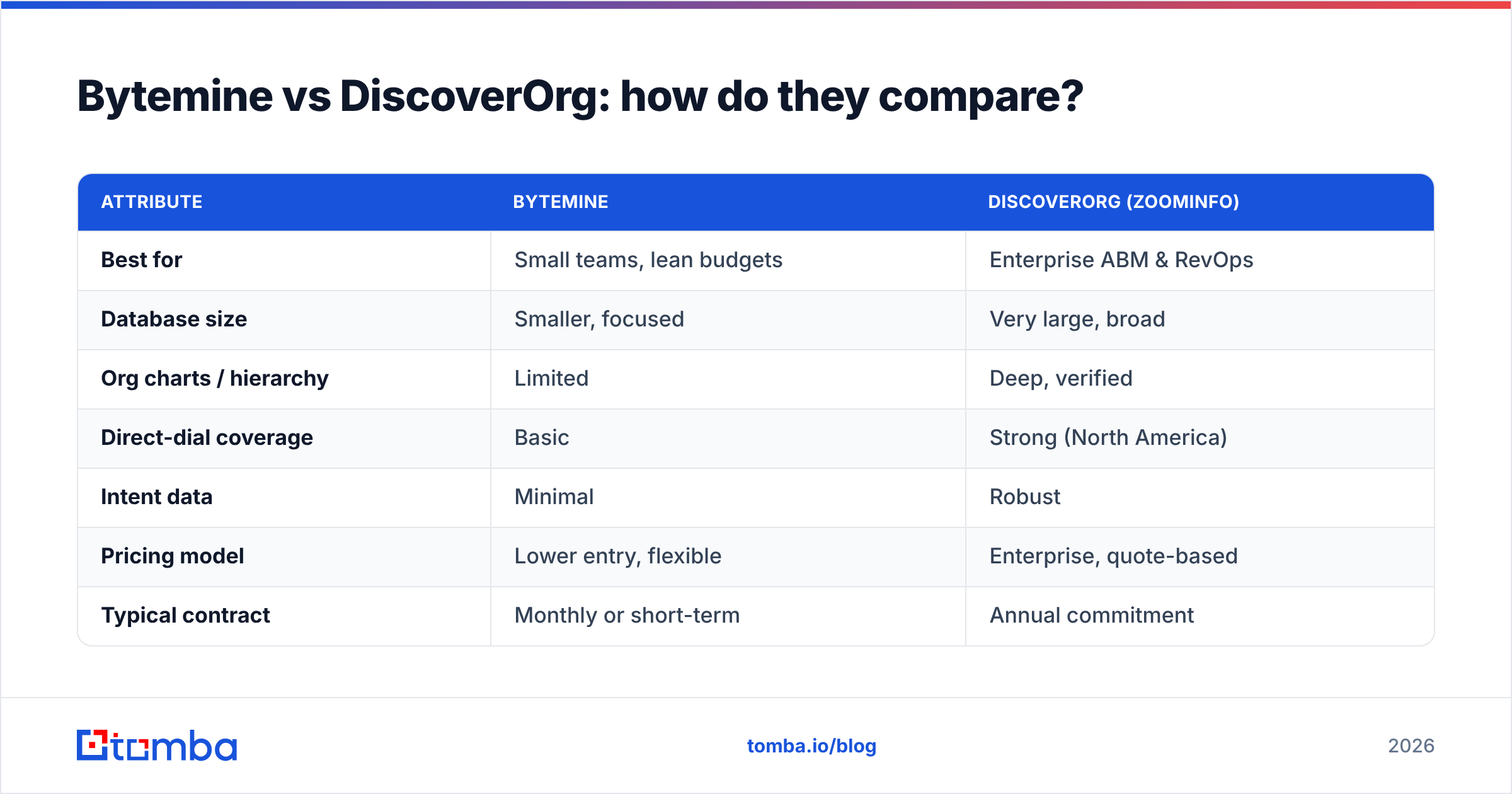
| Attribute | Bytemine | DiscoverOrg (ZoomInfo) |
|---|---|---|
| Best for | Small teams, lean budgets | Enterprise ABM & RevOps |
| Database size | Smaller, focused | Very large, broad |
| Org charts / hierarchy | Limited | Deep, verified |
| Direct-dial coverage | Basic | Strong (North America) |
| Intent data | Minimal | Robust |
| Pricing model | Lower entry, flexible | Enterprise, quote-based |
| Typical contract | Monthly or short-term | Annual commitment |
| Starting cost | Low | Often $15k–$40k+/yr |
| Setup / onboarding | Fast, self-serve | Sales-led, longer ramp |
| CRM integrations | Core CRMs | Extensive, native |
The pattern is consistent: DiscoverOrg trades flexibility for depth, and Bytemine trades depth for flexibility. Neither is "better" in the abstract — the right pick depends on how you actually sell.
Which has more accurate data?#
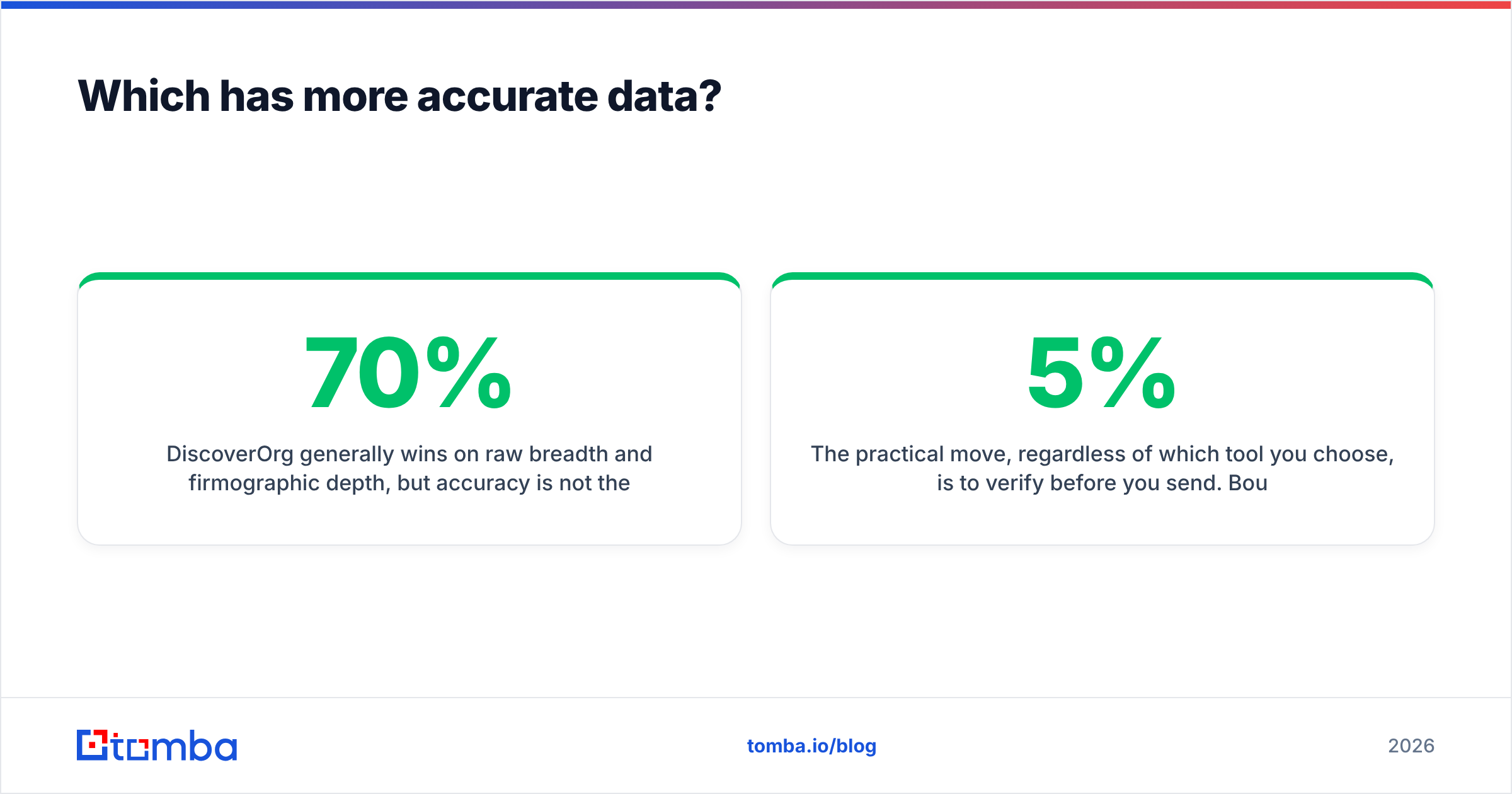
DiscoverOrg generally wins on raw breadth and firmographic depth, but accuracy is not the same as size — and this is where buyers get burned. A database of 100 million contacts that is 70% deliverable produces fewer connections than a smaller database that is 95% deliverable. Decay is the enemy: B2B contact data goes stale at roughly 25–30% per year as people change roles, which means every provider's numbers degrade between refreshes.
DiscoverOrg's human-verification heritage helps here, and ZoomInfo invests heavily in re-verification. Bytemine, like most lean tools, leans more on automated collection, so its freshness can vary by region and seniority.
The practical move, regardless of which tool you choose, is to verify before you send. Bounces above 3–5% hurt your sender reputation and drag down inbox placement for your whole domain. Running exports through a dedicated email verifier — including a proper catch-all verifier for domains that accept everything — protects deliverability no matter where the data originated. Treat any vendor's "accuracy" claim as a starting point, not a guarantee.
For teams that want transparency on where contact data comes from, it is worth checking each vendor's data sources documentation before committing.
How do pricing and contracts compare?#
This is the sharpest difference, and often the deciding one.
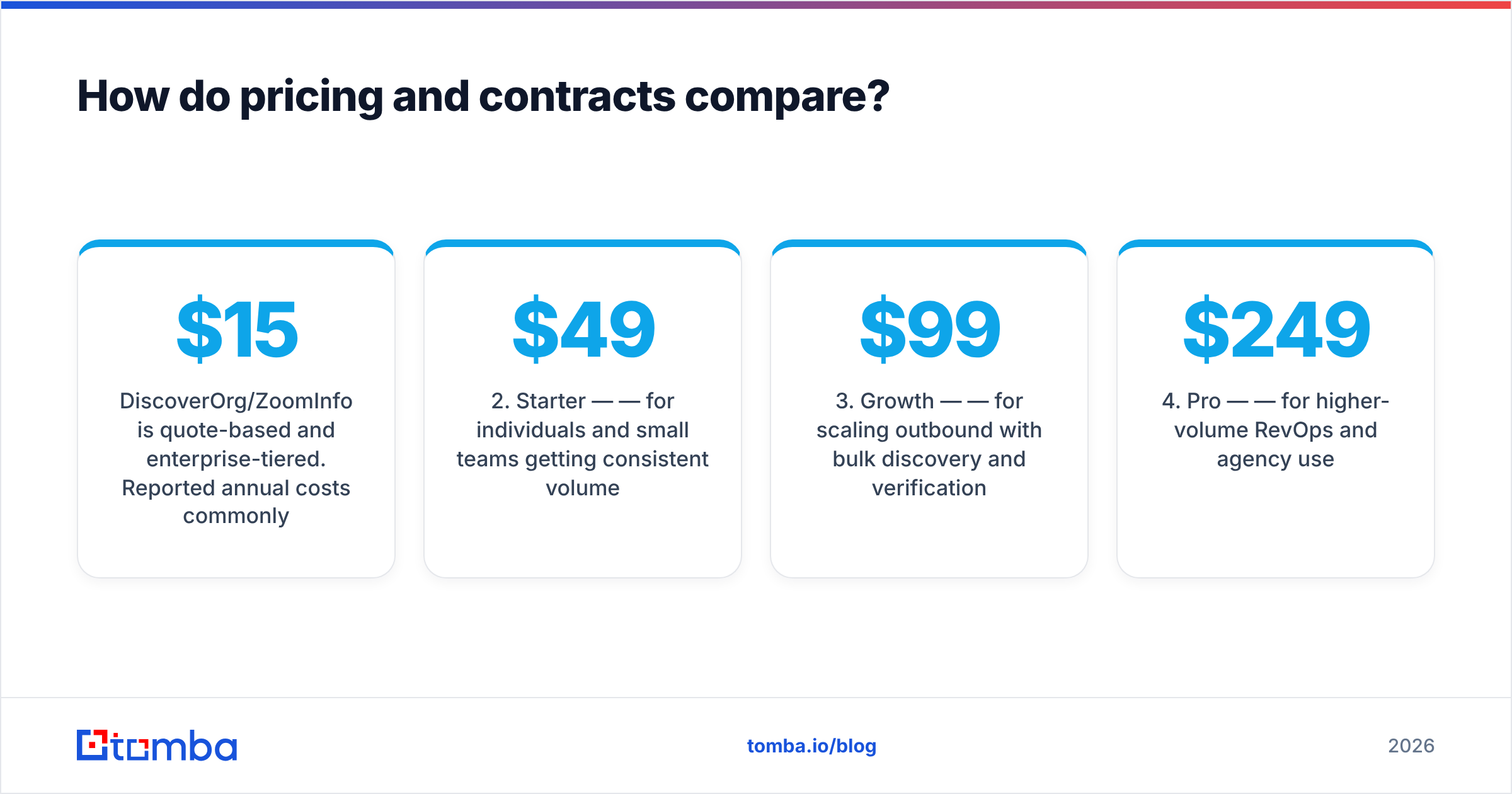
DiscoverOrg/ZoomInfo is quote-based and enterprise-tiered. Reported annual costs commonly land in the $15,000–$40,000+ range depending on seats, credits, and modules (intent, scoops, enrichment). You will talk to a sales rep, negotiate, and almost always sign an annual contract. The value is real for teams that use it daily across many seats — but the floor is high and the commitment is long.
Bytemine sits far lower with a more flexible structure, which is the entire reason smaller teams consider it. You get in cheaply, you are not locked into a year, and you can leave if it underdelivers.
For comparison, here is how a focused, transparent provider prices the same job. Tomba publishes its tiers openly:
- Free — 25 searches/mo, no card, good for testing data quality before you commit.
- Starter — $49/mo — for individuals and small teams getting consistent volume.
- Growth — $99/mo — for scaling outbound with bulk discovery and verification.
- Pro — $249/mo — for higher-volume RevOps and agency use.
- Enterprise — custom — for teams that need volume commitments and SLAs.
You can see the full breakdown on the Tomba pricing page. The point is not that cheaper is automatically better — it is that published, monthly pricing lets you match spend to usage instead of pre-paying for a year of capacity you might not use.

What about integrations and workflow fit?#
DiscoverOrg/ZoomInfo has the edge on native depth: it plugs directly into Salesforce, HubSpot, and major sales-engagement platforms, with enrichment that fires on record creation and keeps fields fresh. For a RevOps team standardizing on one source of truth, that tight coupling is a genuine advantage.
Bytemine covers the core CRMs but with less depth. For many small teams that is fine — they live in a spreadsheet and a single outreach tool, not a 12-app stack.
If integration flexibility is your priority, look at how each tool exposes data programmatically. A clean email finder API, plus connectors for HubSpot, Salesforce, and Pipedrive, often matters more than a long logo wall — because you can wire data into your exact workflow instead of conforming to the vendor's. Bulk needs are worth checking too: a bulk email finder and data enrichment cover most list-building jobs without a six-figure platform.
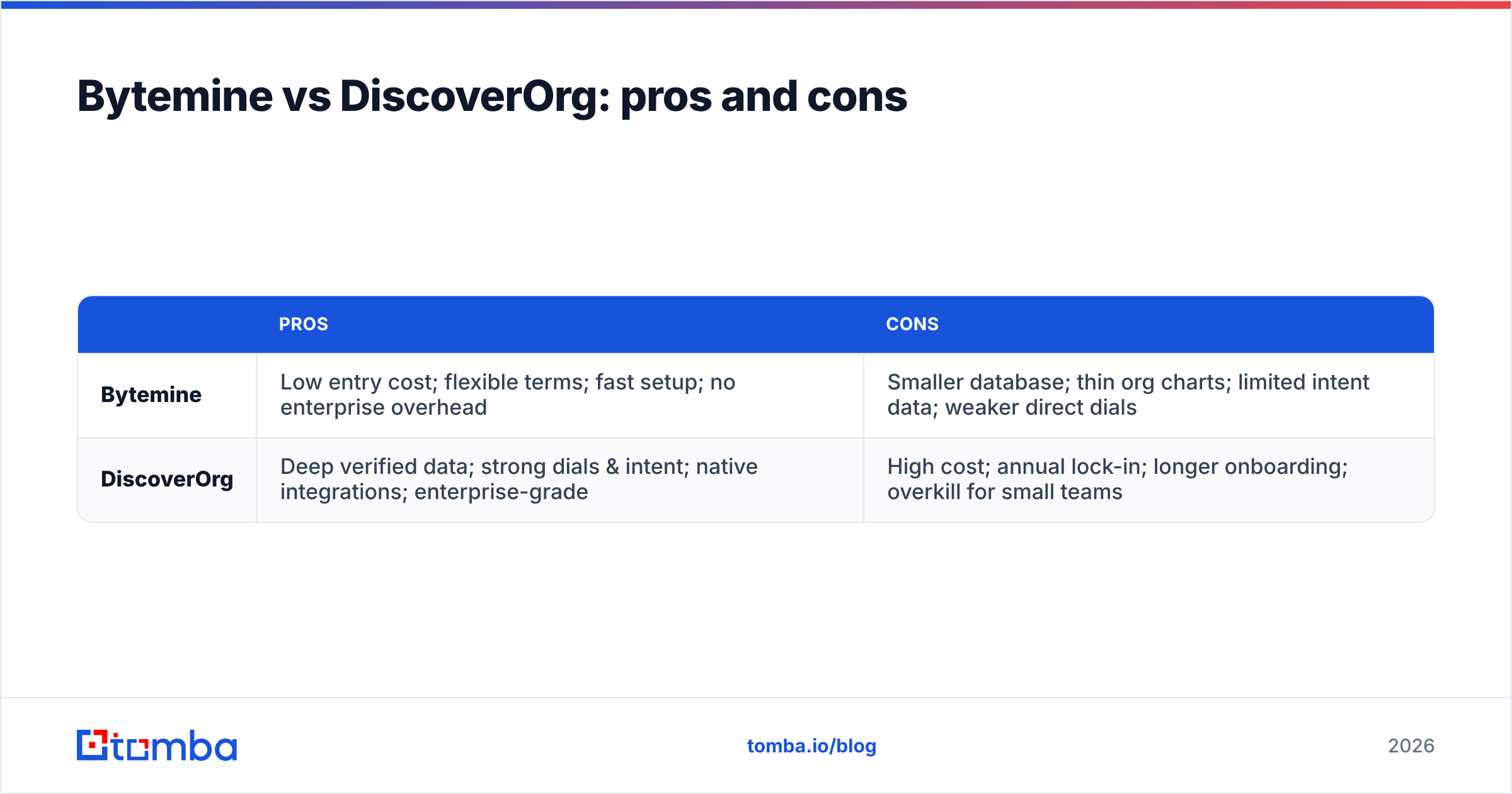
Bytemine vs DiscoverOrg: pros and cons#
A quick scan of the trade-offs:
| Pros | Cons | |
|---|---|---|
| Bytemine | Low entry cost; flexible terms; fast setup; no enterprise overhead | Smaller database; thin org charts; limited intent data; weaker direct dials |
| DiscoverOrg | Deep verified data; strong dials & intent; native integrations; enterprise-grade | High cost; annual lock-in; longer onboarding; overkill for small teams |
Which one should you choose?#
Choose DiscoverOrg/ZoomInfo if you run enterprise account-based motions, need verified org charts and direct dials at scale, rely on intent data to time outreach, and have the budget plus the seat count to justify an annual contract. The depth pays for itself when many reps use it daily.
Choose Bytemine if you are a small team that wants usable B2B contacts quickly, you sell mostly over email, and you refuse to sign a year-long enterprise deal to get started. The lower floor and flexible terms fit a lean motion.
Consider a focused email-finder instead if your core need is simply accurate work emails by name or domain, verified before you send, at a price that scales with usage. Most teams comparing Bytemine vs DiscoverOrg are really trying to solve "get me reliable contacts I can email" — and an enterprise platform is an expensive way to answer that question, while a bare-bones tool can leave you verifying data by hand.
That middle path is where a tool like Tomba fits. You get domain search to map a company's contacts, single and bulk email finder for volume, built-in email verification so you are not sending into the void, and transparent monthly pricing starting at $49/mo with a free tier to test first. If you have outgrown a too-thin tool but cannot stomach enterprise pricing and contracts, that is the gap it fills.
How do I evaluate any B2B data tool?#
Before you sign anything, run the same five-step test on every vendor — including the two here:
- Test deliverability on your real ICP. Pull 100 contacts in your actual target segment, not the vendor's demo accounts, and measure the bounce rate after verification.
- Check coverage where you sell. Many tools are strong in North America and thin elsewhere. Validate your specific regions and seniority levels.
- Read the contract terms. Annual lock-in, credit rollover, and overage fees decide your real cost far more than the headline price.
- Confirm the integration path. Make sure the tool writes to your CRM the way you need, ideally via native integrations or an API you control.
- Verify, always. Whatever the source, run contacts through verification before outreach. Clean lists protect email deliverability and your domain reputation.
Do this and the Bytemine-vs-DiscoverOrg question usually answers itself — because you will see, on your own data, which tool actually produces connectable contacts per dollar.
Verdict#
There is no universal winner. DiscoverOrg is the right call for enterprise teams that need depth, dials, and intent at scale and can justify the contract. Bytemine is the pragmatic pick for small teams that value flexibility and a low entry cost over raw database size. And for the large group in the middle — teams that mostly need verified emails without enterprise overhead — a focused finder-plus-verifier beats both on cost-per-valid-contact.
Start by testing data quality on your own list before you commit a dollar. Spin up the Tomba Email Finder on the free tier, pull contacts for your real target accounts, verify them, and compare the deliverable count against any quote DiscoverOrg gives you or any export Bytemine produces. Let the bounce rate decide — it is the only benchmark that pays your commission.
Ready to find emails that actually work?
Join 150,000+ professionals who stopped guessing and started sending. Free credits on signup — no credit card required.
Get the Tomba newsletter
Practical outbound tactics and product updates — once every two weeks.
About the author