Bytemine vs FullCircl 2026: B2B Data Intelligence Compared
Bytemine vs FullCircl in 2026: a neutral breakdown of data coverage, pricing, compliance fit, and which B2B data intelligence platform suits your GTM motion.
Choosing between Bytemine vs FullCircl comes down to one question: do you need a data science partner that builds custom B2B intelligence around your business, or a packaged customer-lifecycle platform built for regulated industries? Both sell "B2B data," but they solve different problems — and picking the wrong one wastes a year of budget.
TL;DR — Bytemine vs FullCircl#
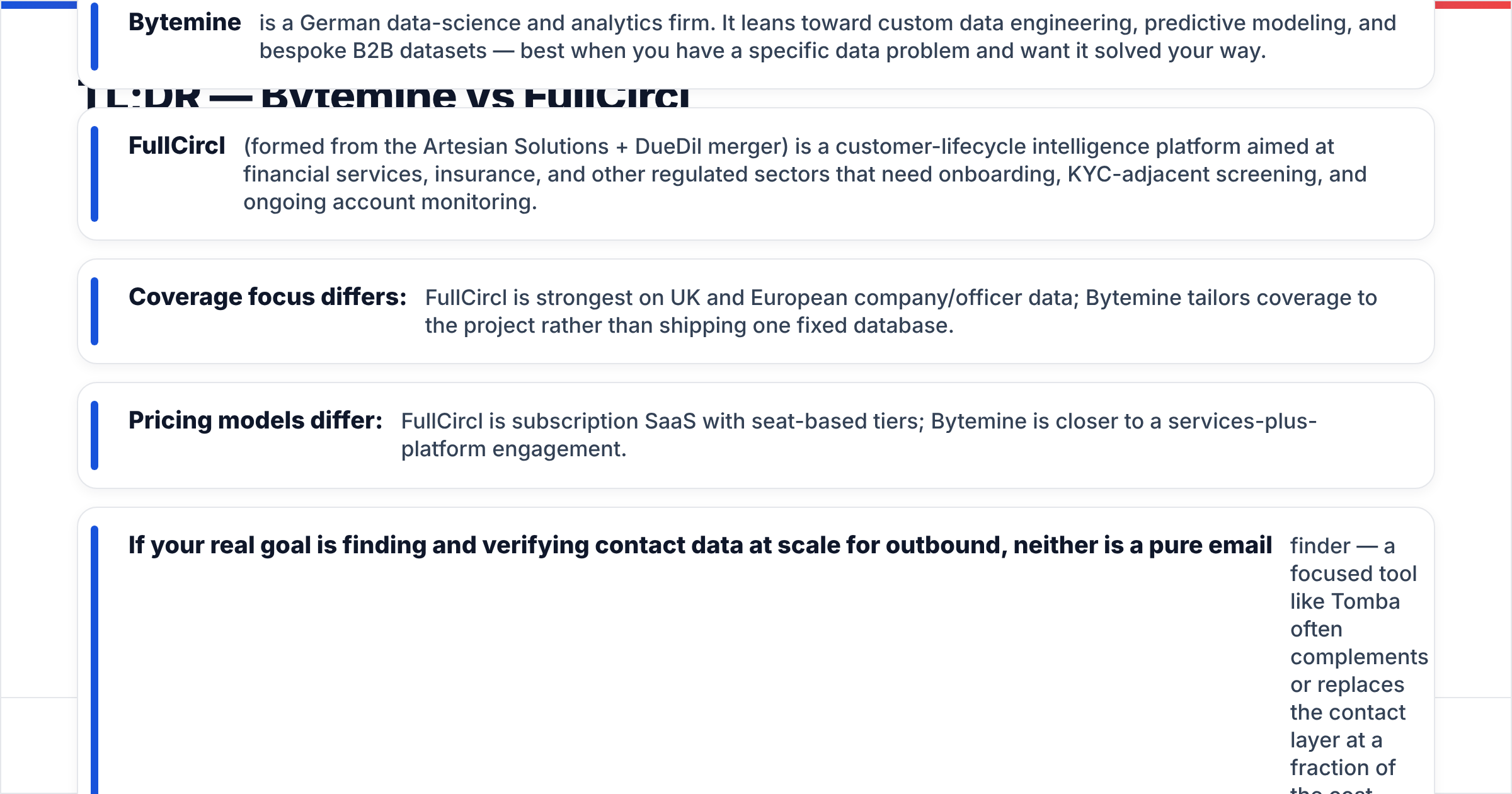
- Bytemine is a German data-science and analytics firm. It leans toward custom data engineering, predictive modeling, and bespoke B2B datasets — best when you have a specific data problem and want it solved your way.
- FullCircl (formed from the Artesian Solutions + DueDil merger) is a customer-lifecycle intelligence platform aimed at financial services, insurance, and other regulated sectors that need onboarding, KYC-adjacent screening, and ongoing account monitoring.
- Coverage focus differs: FullCircl is strongest on UK and European company/officer data; Bytemine tailors coverage to the project rather than shipping one fixed database.
- Pricing models differ: FullCircl is subscription SaaS with seat-based tiers; Bytemine is closer to a services-plus-platform engagement.
- If your real goal is finding and verifying contact data at scale for outbound, neither is a pure email-finder — a focused tool like Tomba often complements or replaces the contact layer at a fraction of the cost.
What is Bytemine?#
Bytemine is a data-driven company out of Germany that positions itself around data science, machine learning, and B2B data products. Instead of selling one rigid database, it tends to work on the problem in front of you: building enrichment pipelines, scoring models, and curated datasets that fit a client's specific go-to-market or analytics need.
That makes Bytemine attractive when your requirement is unusual — a niche industry segment, a custom firmographic model, or a predictive lead-scoring layer you can't buy off the shelf. The trade-off is that bespoke work carries bespoke cost and timelines. You're buying capability and flexibility, not a self-serve dashboard you log into on day one.
Think of Bytemine like hiring a tailor versus buying off the rack. The suit fits perfectly, but you wait for fittings and pay for the craft. If you already know exactly what data shape you need and have the budget to commission it, that fit is worth a lot.
What is FullCircl?#
FullCircl is a customer-lifecycle intelligence (CLI) platform built primarily for regulated industries — banking, insurance, lending, and professional services. It came together when Artesian Solutions merged with DueDil, combining sales-trigger intelligence with company and credit data. The result targets the full arc: find the right accounts, onboard them with the right checks, and monitor them for risk and opportunity afterward.
FullCircl's sweet spot is the moment a regulated business has to know its customer. It surfaces company structures, directors and officers, financials, and change signals, then pushes those into CRM and onboarding workflows. For a commercial insurer or a business lender, that combination of acquisition data plus compliance-grade company intelligence is the whole point.
The flip side: if you're a fast-moving SaaS sales team that just wants accurate contacts and emails for cold outreach, FullCircl is heavier — and priced — for a deeper, compliance-oriented job than you may need.
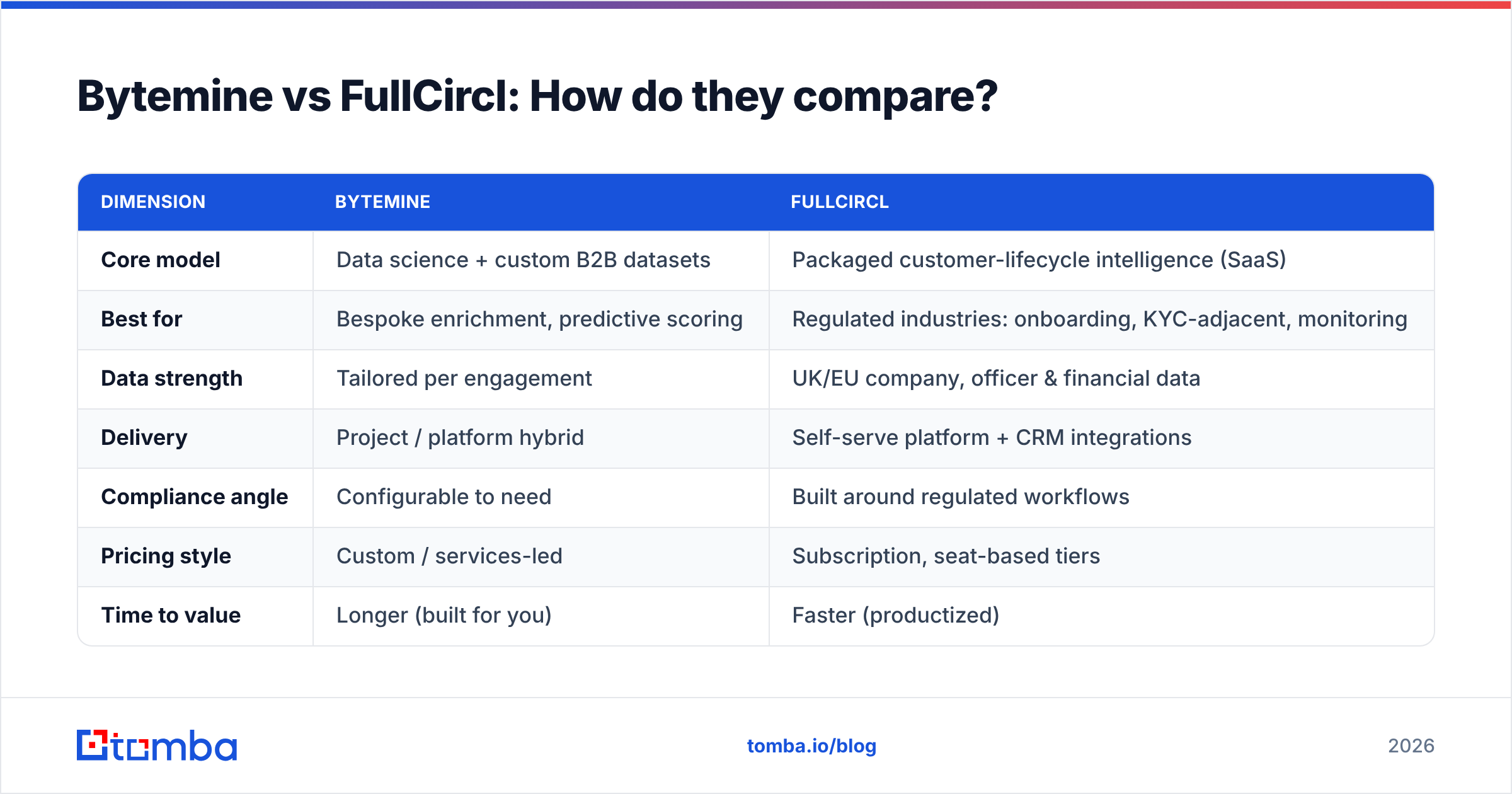
Bytemine vs FullCircl: How do they compare?#
Here's the head-to-head on the dimensions that usually decide the deal. Treat exact figures as directional — both vendors quote based on scope and seats, so confirm current numbers directly.
| Dimension | Bytemine | FullCircl |
|---|---|---|
| Core model | Data science + custom B2B datasets | Packaged customer-lifecycle intelligence (SaaS) |
| Best for | Bespoke enrichment, predictive scoring | Regulated industries: onboarding, KYC-adjacent, monitoring |
| Data strength | Tailored per engagement | UK/EU company, officer & financial data |
| Delivery | Project / platform hybrid | Self-serve platform + CRM integrations |
| Compliance angle | Configurable to need | Built around regulated workflows |
| Pricing style | Custom / services-led | Subscription, seat-based tiers |
| Time to value | Longer (built for you) | Faster (productized) |
| Outbound contact data | Not a primary focus | Not a primary focus |
The pattern is clear: FullCircl is buy-and-go for regulated GTM and risk, while Bytemine is build-with-us for custom data problems. Neither is wrong; they answer different briefs.
Which factors should drive your decision?#
Run your choice through these five questions before you talk to either sales team:
- Is compliance core or incidental? If onboarding, screening, and ongoing monitoring are regulatory requirements, FullCircl's lifecycle design is built for that. If compliance is a side concern, you're paying for depth you won't use.
- Do you need standard or custom data? Off-the-shelf firmographics point you to a productized platform. A unique scoring model or niche dataset points you to Bytemine.
- What's your geography? FullCircl indexes heavily on UK and European company records. Validate coverage for your exact target markets either way.
- How fast do you need it live? Productized SaaS wins on time-to-value; bespoke builds win on fit.
- Where does contact-level data fit? Both are account/company-centric. If your bottleneck is reaching named people by email or phone, you'll likely add a dedicated data enrichment or contact layer regardless.
Is FullCircl better than Bytemine for compliance?#
Yes — for regulated onboarding and monitoring, FullCircl is the more natural fit. It was assembled to serve banks, insurers, and lenders that must verify company identity, understand ownership structures, and watch accounts for material change. That's a workflow, not just a dataset, and FullCircl ships the workflow.
Bytemine can support compliance use cases, but it does so by building toward your requirement rather than handing you a pre-built KYC-style journey. If you want a vendor whose product roadmap is already pointed at regulated GTM, FullCircl is the safer default. If your compliance need is unusual enough that no packaged platform covers it, Bytemine's custom approach becomes the advantage.
A practical note: whatever account intelligence you license, the data still has to land cleanly in your stack. Both vendors integrate with CRMs, but you'll want to confirm how records sync, how often they refresh, and whether contact-level fields (email, direct dial) are included or left for you to source separately.
Where do both tools leave a gap?#
Contacts. Both Bytemine and FullCircl are excellent at company intelligence — who the business is, how it's structured, whether it's a risk or an opportunity. Neither is built primarily to give your reps a verified, deliverable email for the specific decision-maker they need to reach this week.
That's the gap most outbound teams hit. You buy a powerful account-intelligence platform, then discover you're still guessing at email formats, hitting bounces, and burning sender reputation on bad addresses.
This is where a focused contact-data layer earns its keep. Tools like the Tomba Email Finder and email verifier exist to do one job extremely well: turn a company and a name into a verified, deliverable email. You can run a domain search to pull every public address pattern at a target account, then verify before you send.
How does a contact-data layer compare on cost?#
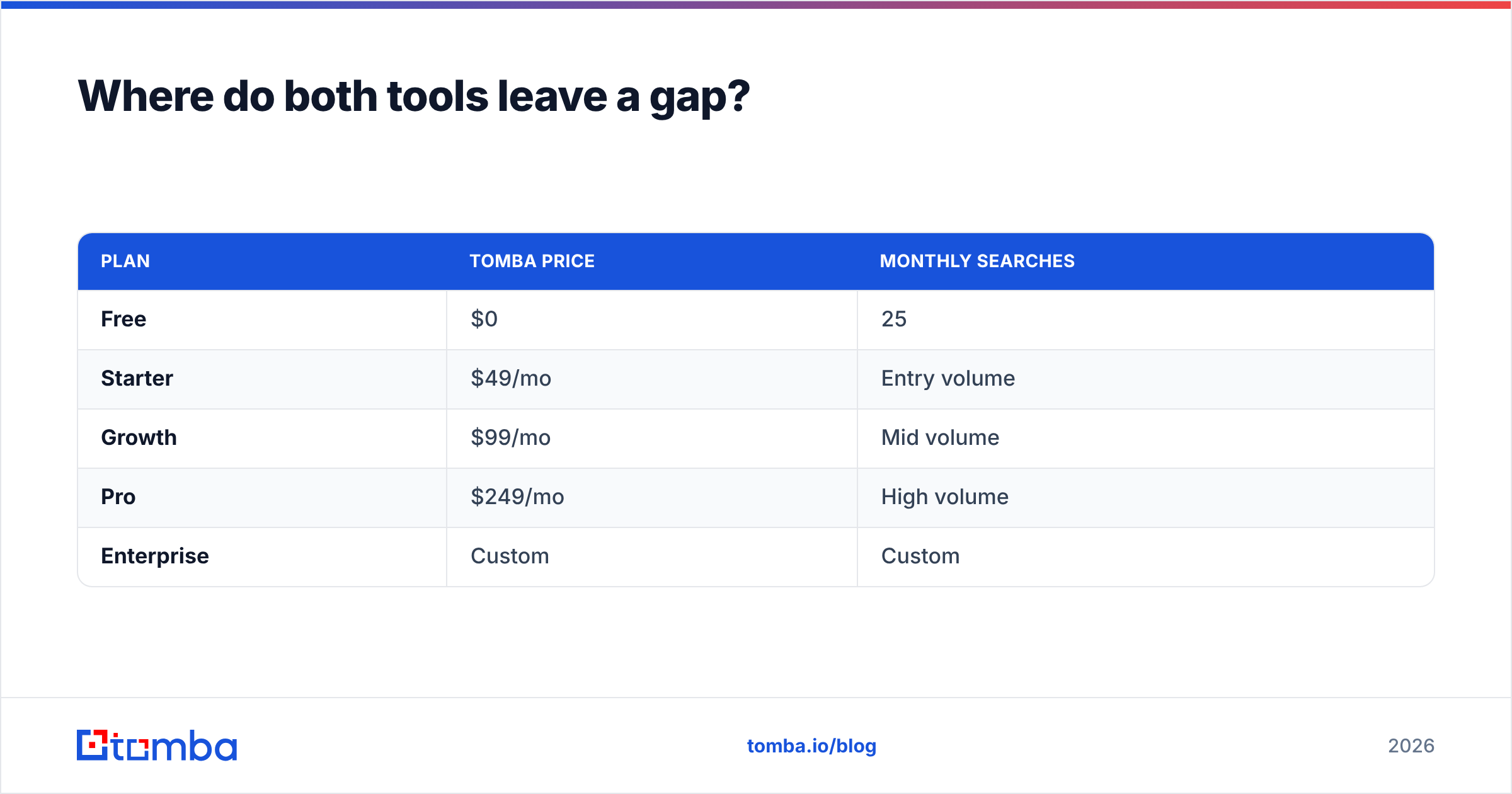
The price gap is the part most buyers underestimate. Enterprise account-intelligence platforms are five- and six-figure annual commitments. A dedicated contact tool is built to be additive and cheap:
| Plan | Tomba price | Monthly searches |
|---|---|---|
| Free | $0 | 25 |
| Starter | $49/mo | Entry volume |
| Growth | $99/mo | Mid volume |
| Pro | $249/mo | High volume |
| Enterprise | Custom | Custom |
You can see full Tomba pricing for current limits. The point isn't that Tomba replaces FullCircl or Bytemine — it's that the contact layer shouldn't cost as much as the intelligence layer, and bolting on a specialist tool is usually cheaper and more accurate than expecting an account-data platform to also nail person-level emails.
How should you actually choose?#
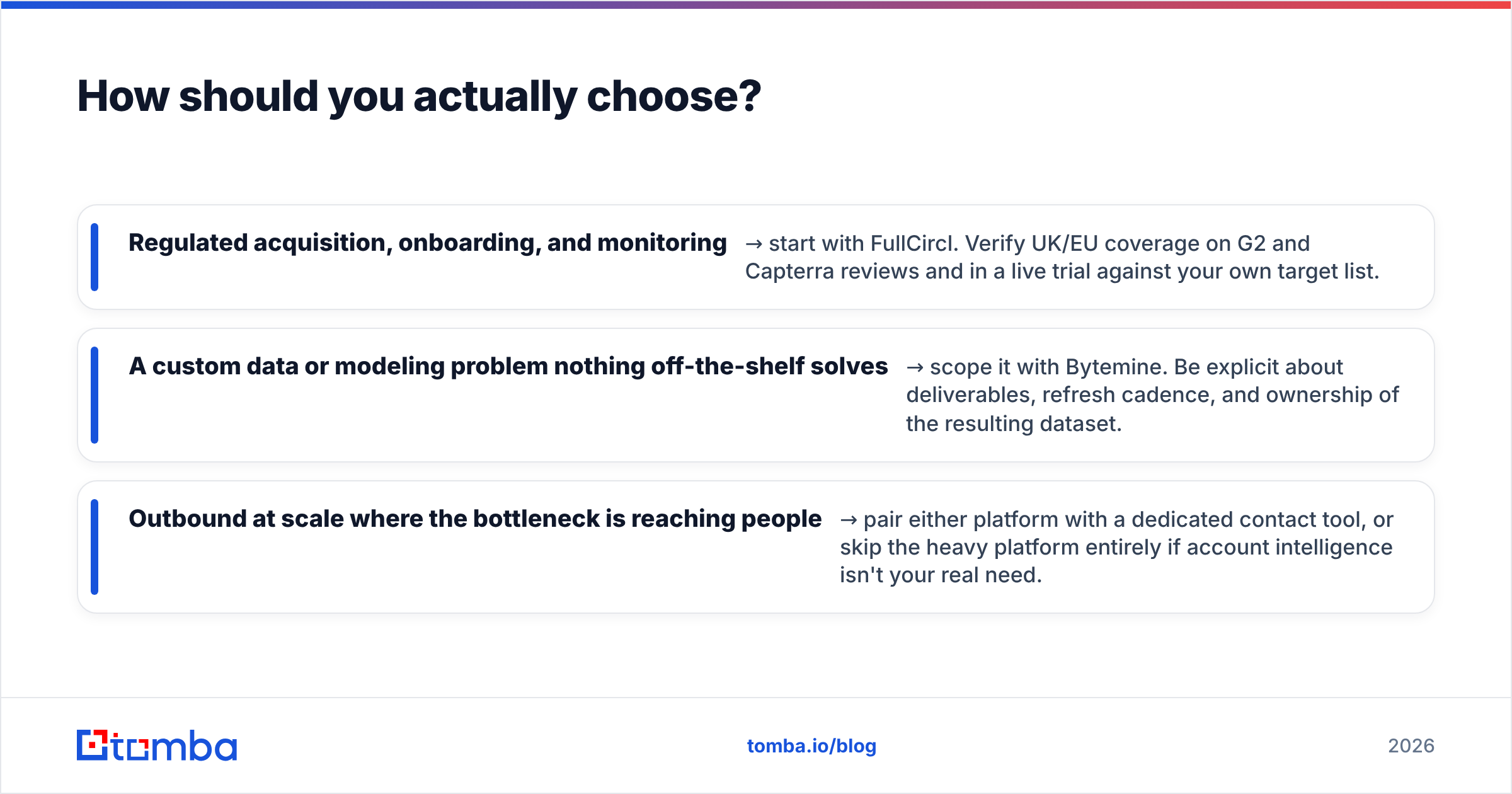
Match the tool to the dominant job, then fill the gaps:
- Regulated acquisition, onboarding, and monitoring → start with FullCircl. Verify UK/EU coverage on G2 and Capterra reviews and in a live trial against your own target list.
- A custom data or modeling problem nothing off-the-shelf solves → scope it with Bytemine. Be explicit about deliverables, refresh cadence, and ownership of the resulting dataset.
- Outbound at scale where the bottleneck is reaching people → pair either platform with a dedicated contact tool, or skip the heavy platform entirely if account intelligence isn't your real need.
Before signing, demand the same proof from both: a sample of your actual target accounts enriched in a trial, a clear data-source explanation, and bounce/accuracy numbers you can verify. Reputable vendors publish how they source data — for reference on what good transparency looks like, see how Tomba documents its data sources. For broader vendor research, Gartner and peer-review sites help you separate marketing from reality.
A quick reality check on accuracy claims#
Every data vendor claims high accuracy. The only number that matters is the one you measure on your segment. Take 100 real target accounts, run them through each platform's trial, then verify the outputs independently. For contact data specifically, run the results through an email verification pass and measure the true bounce rate. A platform that looks 95% accurate in a demo can drop to 70% on a niche industry or geography it doesn't cover well.
Bytemine vs FullCircl: The verdict#
There's no single winner — there's a winner for your job:
- Choose FullCircl if you're in financial services, insurance, or another regulated field and need acquisition plus onboarding plus monitoring in one compliant platform.
- Choose Bytemine if you have a bespoke data or modeling requirement and want a partner to build it rather than a dashboard to rent.
- Choose neither as your contact engine — both are company-intelligence tools, so plan a separate, cheaper contact-data layer for person-level outreach.
If your most painful gap is turning all that account intelligence into actual conversations, that's a contact-data problem, not an account-data problem. Start free with the Tomba Email Finder — get 25 searches a month at no cost, verify deliverability before you send, and add it alongside whichever intelligence platform you pick. It's the fastest way to stop your expensive account data from sitting idle while your reps guess at emails. Spin it up, run your real target list, and measure the bounce rate yourself.
Ready to find emails that actually work?
Join 150,000+ professionals who stopped guessing and started sending. Free credits on signup — no credit card required.
Get the Tomba newsletter
Practical outbound tactics and product updates — once every two weeks.
About the author