Bytemine vs Heybounce: Which Email Tool Wins in 2026?
Bytemine finds leads; Heybounce verifies them. But do you really need two tools? We compare accuracy, pricing, and workflow fit—and show where one platform does both.
Bytemine vs Heybounce: Which Email Tool Wins in 2026?
Choosing between Bytemine and Heybounce is harder than it looks, because the two tools are not actually solving the same problem. One is built to find business contacts. The other is built to verify that the emails you already have will land. Picking the "winner" depends entirely on where the leak in your pipeline is.
TL;DR#
- Bytemine is positioned as a B2B prospecting and email-finding tool — its job is to surface new contacts and company data.
- Heybounce is an email verification service — its job is to scrub lists, catch invalid addresses, and flag risky catch-all domains before you send.
- They are complements, not substitutes: a finder feeds a verifier. Buying one rarely replaces the other.
- If you want both jobs handled by a single platform with transparent pricing, an all-in-one like Tomba covers finding and verification on one bill.
- Decision rule: low reply rates and bounced sends → start with verification; empty pipeline and nothing to send → start with finding.
What is Bytemine?#
Bytemine sits in the lead-generation and email-finder category. The core promise is simple: give it a company, a domain, or a role, and it returns professional contacts and the data points you need to start outreach. That puts it next to tools people compare when they look for an email finder — software that turns a name and a company into a deliverable work address.
Finders live or die on two numbers: coverage (how often they return any email for your target) and accuracy (how often that email is actually correct). A finder with great coverage but weak accuracy just shifts the cleanup cost downstream — which is exactly why so many finder users end up bolting a verifier on top.

What is Heybounce?#
Heybounce is an email verification tool. It does not find new contacts — it inspects the ones you already have. Upload a list, and it pings mail servers, checks syntax and MX records, removes role accounts and known traps, and tells you which addresses are safe to mail.
The hardest part of verification is the catch-all domain — a server configured to accept mail for every address, so a standard SMTP check can't tell a real inbox from a typo. Heybounce's pitch leans heavily on resolving exactly these ambiguous cases. If you care about that problem specifically, it's the same job a dedicated catch-all verifier is built to handle.
Verification matters because deliverability is fragile. Mailbox providers track your bounce rate as a signal of list hygiene, and a spike can drag down your sender reputation for weeks. Keeping bounces under ~2% is the practical floor most senders aim for, and you can't hit that by guessing.
Bytemine vs Heybounce: what's the core difference?#
Here is the cleanest way to think about it: Bytemine adds rows to your list; Heybounce removes bad rows from your list. One grows the database, the other protects the sender.
- Primary job — Bytemine: discover contacts. Heybounce: validate contacts.
- When you reach for it — Bytemine: building a new prospecting list. Heybounce: right before a send, or on an inbound list of unknown quality.
- What it protects — Bytemine: your top-of-funnel volume. Heybounce: your deliverability and domain reputation.
- What it ignores — Bytemine: it isn't a deliverability tool. Heybounce: it won't grow your pipeline by a single contact.
Because they cover different stages, the real question for most teams isn't "which one" — it's "do I need both, and can one vendor do the job for less friction?"
How do Bytemine and Heybounce compare on features?#
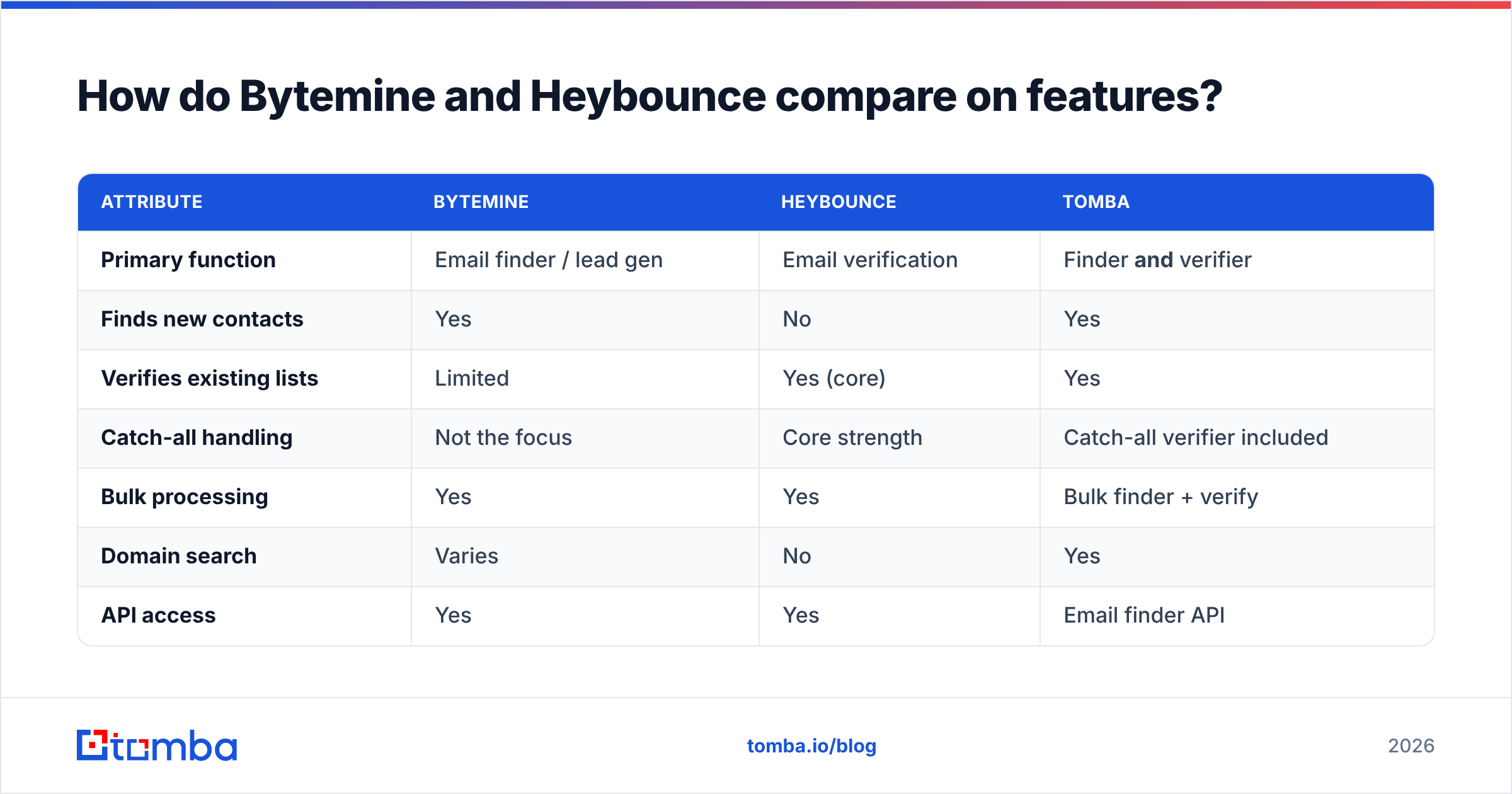
The table below lines up the two tools by the attributes that actually change your buying decision, with Tomba added as the all-in-one reference point.
| Attribute | Bytemine | Heybounce | Tomba |
|---|---|---|---|
| Primary function | Email finder / lead gen | Email verification | Finder and verifier |
| Finds new contacts | Yes | No | Yes |
| Verifies existing lists | Limited | Yes (core) | Yes |
| Catch-all handling | Not the focus | Core strength | Catch-all verifier included |
| Bulk processing | Yes | Yes | Bulk finder + verify |
| Domain search | Varies | No | Yes |
| API access | Yes | Yes | Email finder API |
| Free tier | Trial-based | Trial-based | 25 searches/mo free |
| Best for | Filling the pipeline | Protecting deliverability | Both jobs, one bill |
The pattern is consistent: Bytemine and Heybounce each do their one job well, but neither closes the loop on its own. That gap is the whole reason "finder + verifier bundle" became a buying pattern in 2026.
Is accuracy the real battleground?#
Yes — and it's where the comparison gets interesting, because accuracy means something different for each tool.
For Bytemine, accuracy is finder precision: of the emails it returns, what share are real, deliverable inboxes? A finder that hands you a 70%-valid list has quietly outsourced 30% of the work to whatever verifier you run next.
For Heybounce, accuracy is verdict precision: when it says "valid," does the message actually land, and when it says "invalid," is it really dead? False positives waste good leads; false negatives bounce and hurt your domain.
This is why benchmarking the two in isolation is misleading. The number that matters to your revenue is the end-to-end one: how many of the contacts you discovered turn into emails that deliver. A high-accuracy finder shrinks the verification burden, and tight verification protects whatever the finder produces.

If you're starting from a finder, accuracy at the source is the cheapest place to win. Cleaning a dirty list with a separate verifier costs credits and throws away contacts you paid to discover. The fewer bad addresses your finder produces, the less you spend downstream — which is the quiet economic case for choosing a finder that verifies as it goes.
Which one should you choose?#
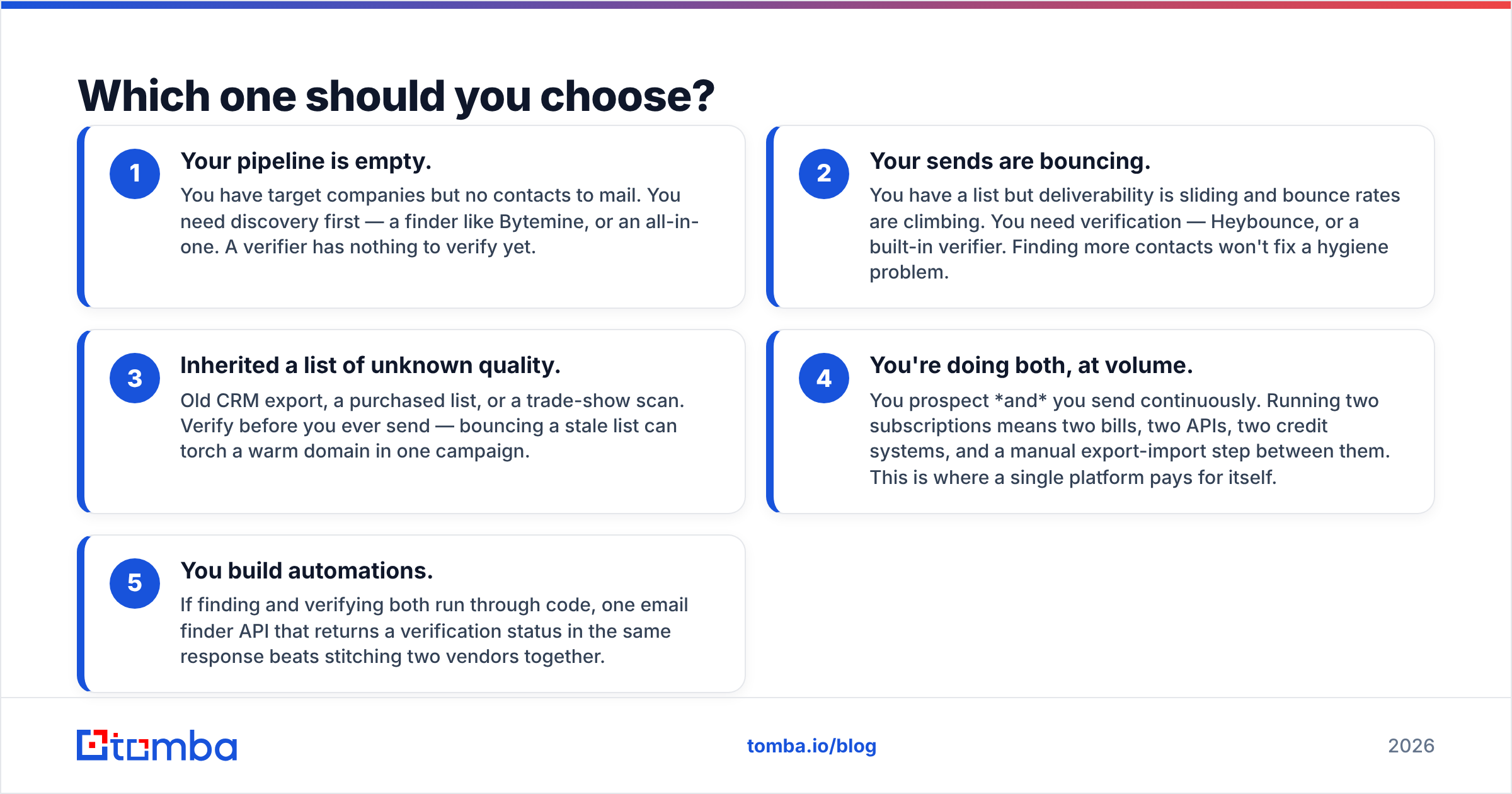
Match the tool to the symptom, not the hype.
- Your pipeline is empty. You have target companies but no contacts to mail. You need discovery first — a finder like Bytemine, or an all-in-one. A verifier has nothing to verify yet.
- Your sends are bouncing. You have a list but deliverability is sliding and bounce rates are climbing. You need verification — Heybounce, or a built-in verifier. Finding more contacts won't fix a hygiene problem.
- Inherited a list of unknown quality. Old CRM export, a purchased list, or a trade-show scan. Verify before you ever send — bouncing a stale list can torch a warm domain in one campaign.
- You're doing both, at volume. You prospect and you send continuously. Running two subscriptions means two bills, two APIs, two credit systems, and a manual export-import step between them. This is where a single platform pays for itself.
- You build automations. If finding and verifying both run through code, one email finder API that returns a verification status in the same response beats stitching two vendors together.

Where does Tomba fit between them?#
Tomba is relevant precisely because the Bytemine-vs-Heybounce question exposes a gap: most teams need both jobs done, and buying them separately adds cost and friction.
Tomba's core product is the email finder, but it ships alongside an email verifier, domain search, catch-all verification, and data enrichment — the finder and verifier sharing one account, one credit pool, and one API. In practice that means you discover a contact and get its deliverability status without exporting to a second tool.
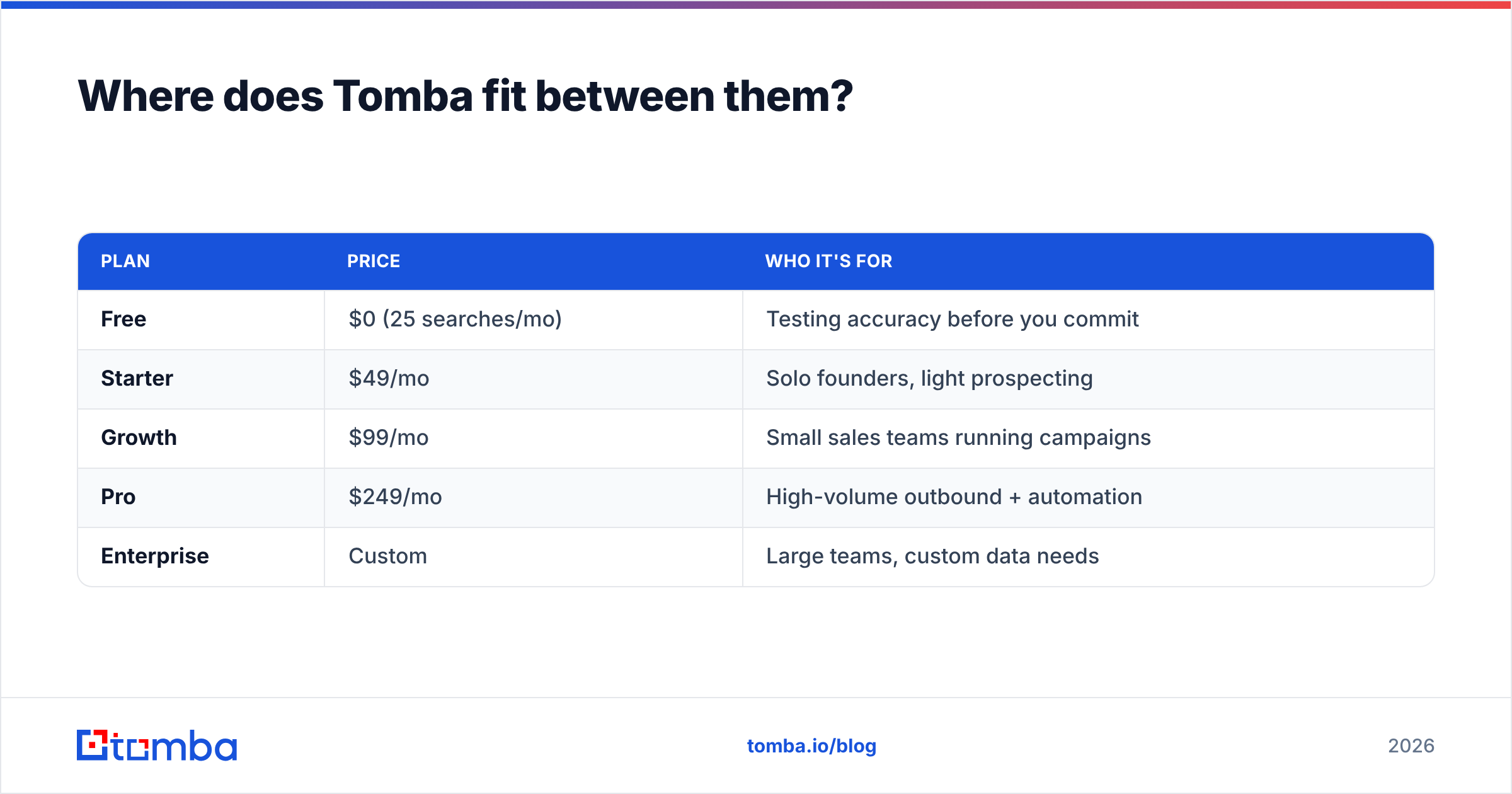
The pricing is straightforward, which matters when you're comparing against two separate trials:
| Plan | Price | Who it's for |
|---|---|---|
| Free | $0 (25 searches/mo) | Testing accuracy before you commit |
| Starter | $49/mo | Solo founders, light prospecting |
| Growth | $99/mo | Small sales teams running campaigns |
| Pro | $249/mo | High-volume outbound + automation |
| Enterprise | Custom | Large teams, custom data needs |
You can see the full breakdown on the Tomba pricing page. The point isn't that Tomba "beats" a dedicated finder or a dedicated verifier on every single edge-case metric — it's that for the common case of needing both, one platform removes a whole class of busywork and a second invoice.
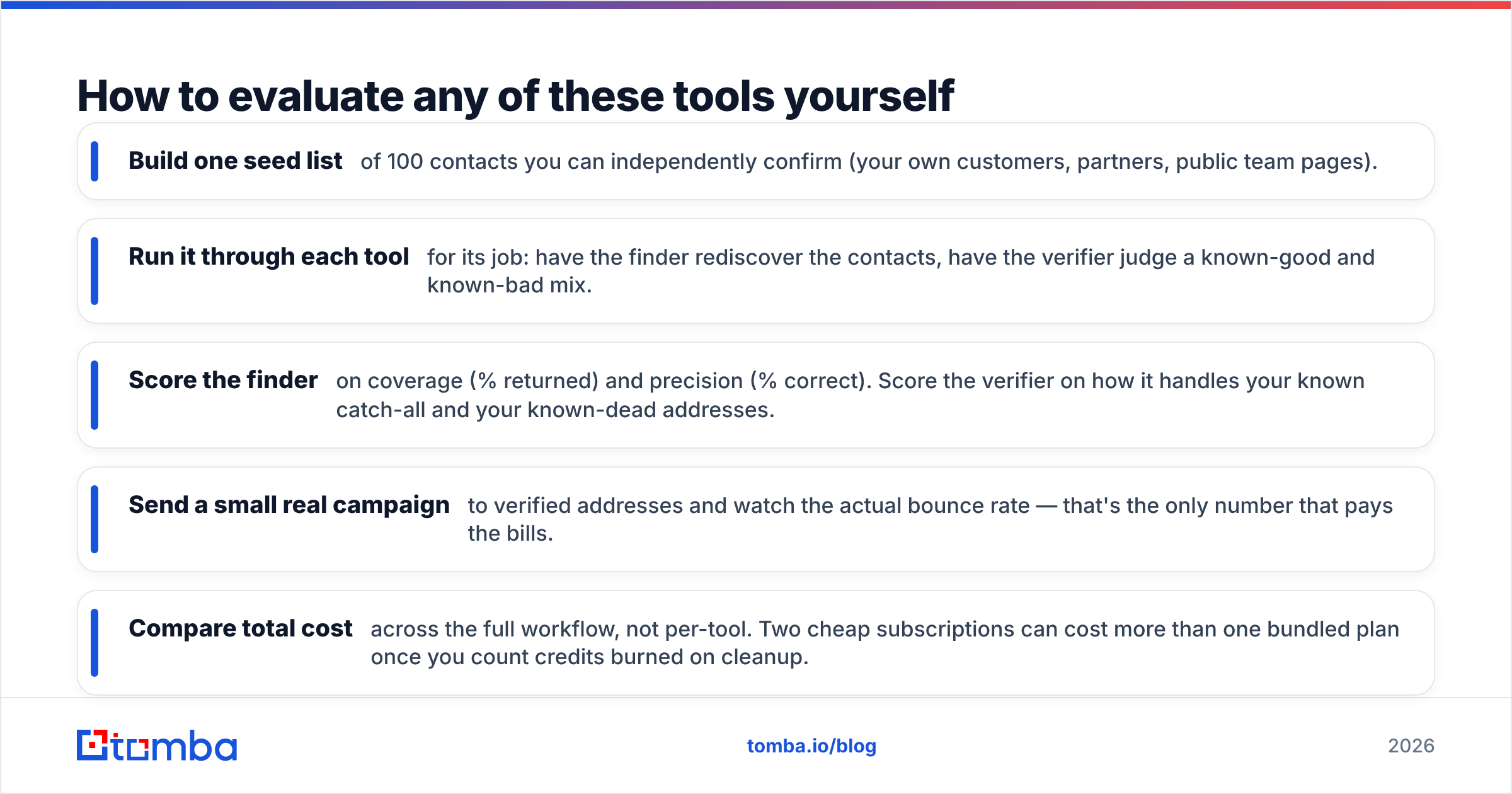
How to evaluate any of these tools yourself#
Don't trust a comparison table — including this one — over your own data. Run a controlled test:
- Build one seed list of 100 contacts you can independently confirm (your own customers, partners, public team pages).
- Run it through each tool for its job: have the finder rediscover the contacts, have the verifier judge a known-good and known-bad mix.
- Score the finder on coverage (% returned) and precision (% correct). Score the verifier on how it handles your known catch-all and your known-dead addresses.
- Send a small real campaign to verified addresses and watch the actual bounce rate — that's the only number that pays the bills.
- Compare total cost across the full workflow, not per-tool. Two cheap subscriptions can cost more than one bundled plan once you count credits burned on cleanup.
For a neutral view of how buyers rate these categories, cross-check vendor claims against reviews on G2 and the deliverability fundamentals documented by mailbox providers and on resources like Wikipedia's bounce message overview. Vendor benchmarks are marketing; your seed-list test is evidence.
Frequently asked questions#
Is Bytemine a competitor to Heybounce? Not directly. Bytemine finds contacts; Heybounce verifies them. They sit at different stages of the same workflow, which is why many teams use a finder and a verifier together rather than choosing one.
Can one tool replace both? Yes — an all-in-one platform with both a finder and a email verifier handles discovery and validation on a single account, which removes the export-import step between two vendors.
What's the most important metric? End-to-end deliverable contacts: how many discovered emails actually land in inboxes. Finder accuracy and verifier precision both feed that single number.
Do I still need verification if my finder is accurate? For ongoing sends, yes. Lists decay roughly 2-3% per month as people change jobs, so even a perfect finder produces a list that needs re-verification over time. Bulk re-checking through a bulk verifier keeps a known-good list healthy.
The bottom line#
Bytemine and Heybounce aren't really rivals — they're two halves of the same job. Bytemine wins if your only problem is an empty pipeline. Heybounce wins if your only problem is bounces and damaged deliverability. But most teams have both problems, and that's the scenario where running two subscriptions starts to feel like a tax.
If you'd rather find and verify from one place, start free with the Tomba Email Finder — 25 searches a month, no card, finder and verifier on the same account. Test it against your own seed list, watch the real bounce rate, and let the numbers decide. That's the only comparison that matters.
Ready to find emails that actually work?
Join 150,000+ professionals who stopped guessing and started sending. Free credits on signup — no credit card required.
Get the Tomba newsletter
Practical outbound tactics and product updates — once every two weeks.
About the author