Bytemine vs Leadsforge: Best Email Finder in 2026?
Bytemine vs Leadsforge compared on accuracy, pricing, and data coverage — plus where a third option quietly beats both on cost-per-valid-email.
Choosing between two email finders usually comes down to one question that the marketing pages never answer directly: how many of the addresses you pay for actually land in an inbox? Bytemine vs Leadsforge is a fair fight on paper — both promise B2B contact data, both wrap it in a slick dashboard — but the differences that matter show up in bounce rates, catch-all handling, and the real cost per valid email, not the sticker price.
This is a neutral breakdown. We'll look at where each tool is strong, where each one quietly leaks money, and where a third option fits if neither feels right.
TL;DR#
- Bytemine leans toward volume and breadth — large database, generous credit packs, weaker built-in verification. Good if you already run your own validation step.
- Leadsforge leans toward workflow — sequences, CRM sync, and enrichment baked in — but you pay platform pricing whether or not you use the extras.
- Accuracy is the real differentiator. A "10M contacts" claim means nothing if 18% bounce. Always benchmark on your target domains before committing.
- Neither is the cheapest path to verified emails. A finder-plus-verifier built on the same engine (like Tomba) often beats both on cost-per-valid-email at the same volume.
- Run a free-tier test on 25–50 of your real prospects before you sign anything. The winner on your list is rarely the winner in a generic review.
What do Bytemine and Leadsforge actually do?#
Both tools sit in the same category: B2B email finders with lead enrichment. You give them a name and a company (or just a domain), and they return a likely work email, often with a confidence score, a job title, and sometimes a phone number or LinkedIn URL.
Where they diverge is philosophy.
- Bytemine — the data warehouse. Positioned around the size of its contact database and bulk lookups. The pitch is "find more, faster." Verification exists but is treated as a secondary feature, which means a meaningful slice of results are guessed patterns (firstname.lastname@domain) that were never SMTP-checked.
- Leadsforge — the workflow suite. Positioned around doing outreach end to end: find the contact, enrich it, drop it into a sequence, sync to your CRM. The data is one ingredient in a larger platform, and you're priced for the whole kitchen.
- The shared weakness — catch-all domains. Roughly 20–30% of B2B domains accept every address at the SMTP layer, so a naive verifier marks them "valid" when they may not be. How each tool labels these is the single biggest driver of your real bounce rate.
If your only job is to get accurate addresses cheaply, a focused email finder paired with a real catch-all verifier usually beats a do-everything platform you're only half-using.

How accurate are Bytemine vs Leadsforge?#
Accuracy is where the marketing copy and the inbox part ways. Database size is a vanity metric; deliverable accuracy is the number that protects your sender reputation.
Here's the honest framing nobody puts on a pricing page:
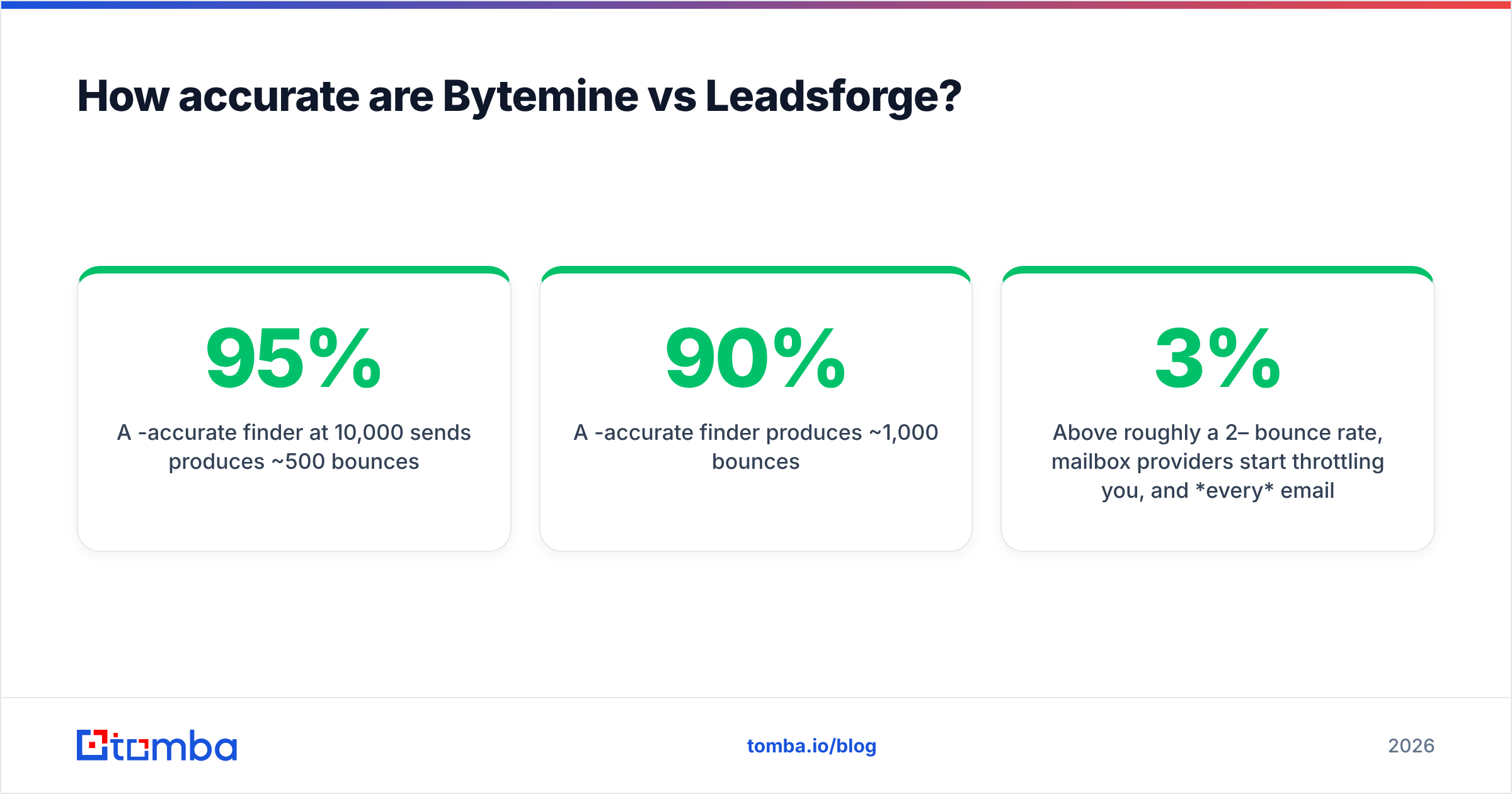
- A 95%-accurate finder at 10,000 sends produces ~500 bounces.
- A 90%-accurate finder produces ~1,000 bounces.
- Above roughly a 2–3% bounce rate, mailbox providers start throttling you, and every email you send — including to valid addresses — suffers.
So a five-point accuracy gap isn't cosmetic. It's the difference between a healthy domain and a sender reputation you spend months repairing.
Bytemine tends to win on raw coverage — it'll return an address for more of your list. But a portion of those are unverified pattern guesses. If you push them straight into a campaign without a verification pass, the coverage advantage turns into a bounce liability.
Leadsforge verifies more aggressively before returning a result, so its addresses bounce less — but it also returns "not found" more often on thin or niche domains, which lowers your usable hit rate. You trade coverage for cleanliness.
The takeaway: neither vendor's self-reported accuracy number should be trusted at face value. Export a sample, run it through an independent email verifier, and measure the valid-rate on your actual targets.
Bytemine vs Leadsforge: side-by-side comparison#
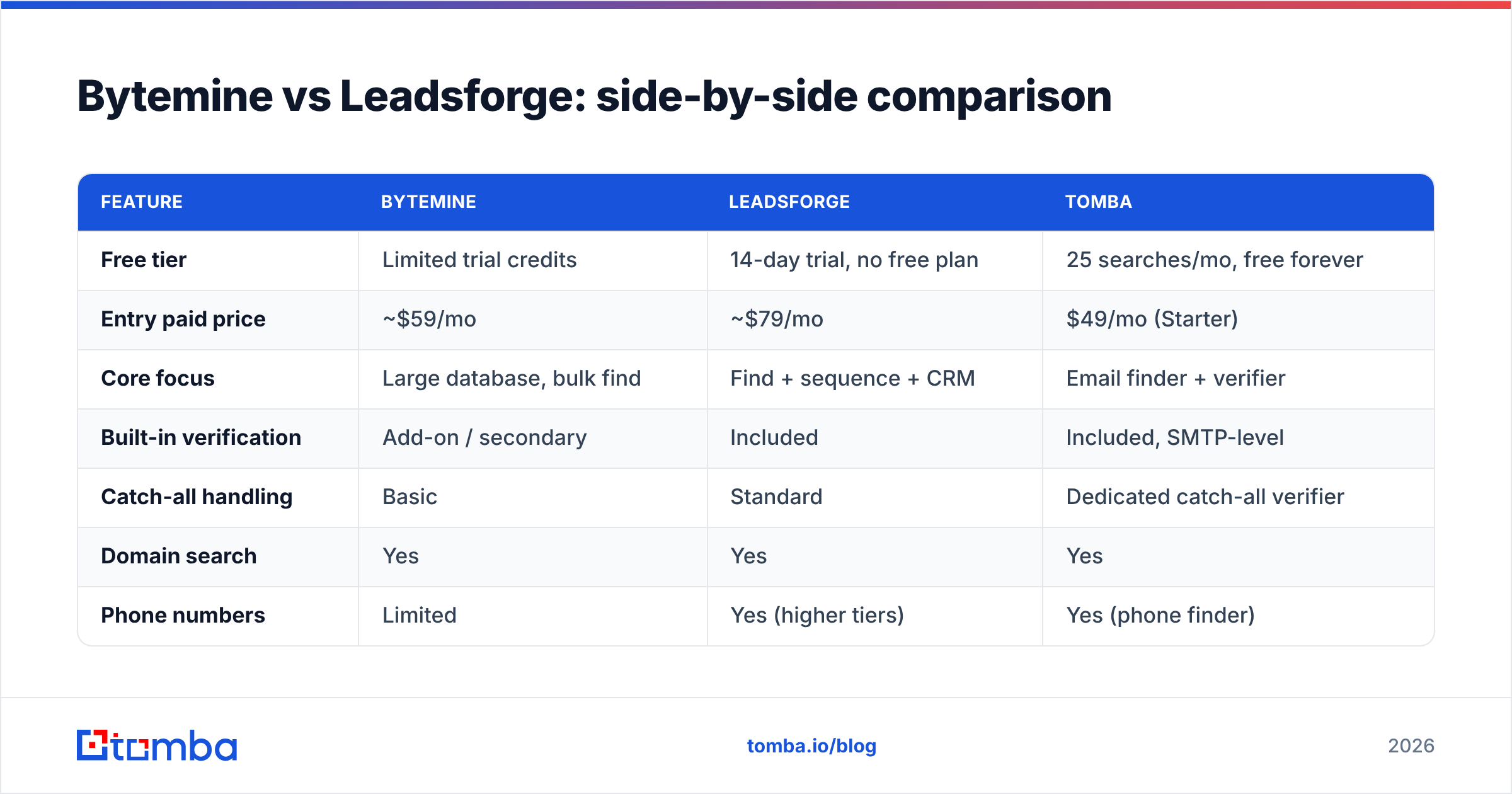
Here's the practical breakdown across the attributes that change your monthly bill and your bounce rate. (Bytemine and Leadsforge values reflect their published positioning at the time of writing — always confirm current pricing on the vendor sites before buying.)
| Feature | Bytemine | Leadsforge | Tomba |
|---|---|---|---|
| Free tier | Limited trial credits | 14-day trial, no free plan | 25 searches/mo, free forever |
| Entry paid price | ~$59/mo | ~$79/mo | $49/mo (Starter) |
| Core focus | Large database, bulk find | Find + sequence + CRM | Email finder + verifier |
| Built-in verification | Add-on / secondary | Included | Included, SMTP-level |
| Catch-all handling | Basic | Standard | Dedicated catch-all verifier |
| Domain search | Yes | Yes | Yes |
| Phone numbers | Limited | Yes (higher tiers) | Yes (phone finder) |
| Bulk processing | Yes | Yes | Yes (bulk finder) |
| Native API | Yes | Limited | Yes, documented REST API |
| Best for | High-volume list builders | Full-stack outbound teams | Cost-per-valid-email buyers |
A few things to read from this table rather than skim past:
- Entry price is the smallest part of the decision. Bytemine's lower coverage-per-credit and Leadsforge's bundled features both change effective cost. Compare credits that yield a verified email, not headline dollars.
- If you already own a sequencer (Instantly, Smartlead, your CRM's native one), Leadsforge's bundled outreach is a feature you're paying for twice.
- If you don't need a full platform, a finder with transparent pricing and a real verification step is the leaner buy.
Which one is better for cold email deliverability?#
For pure cold-email work, the ranking flips toward whichever tool gives you the lowest verified bounce rate per dollar — and that's rarely the one with the biggest database.
Cold email punishes sloppy lists harder than any other channel. Your email deliverability depends on keeping bounces low, spam complaints near zero, and engagement high. That means:
- Verify before you send, every time. A finder that returns unverified guesses (Bytemine's volume mode) needs a mandatory verification layer bolted on, or your bounce rate climbs.
- Treat catch-all domains as "risky," not "valid." Tools that blanket-label catch-alls as deliverable inflate your perceived list quality and your real bounce rate at the same time.
- Warm the sending domain regardless of tool. No finder fixes a cold domain. Use a warmup calculator to set a sane ramp before you scale volume.
Leadsforge's bundled verification gives it an edge here out of the box. Bytemine can match it, but only after you add a verification step — at which point you're paying for two things Leadsforge sells as one, and you should re-run the cost math.
The cleanest setup for most cold-email teams is a finder and verifier from the same engine, so the data is checked once at source. That's the gap Tomba targets: find the address, SMTP-verify it, and flag catch-alls explicitly — before the address ever reaches your sequencer. Industry reviews on G2 and Capterra are a useful sanity check on each vendor's real-world bounce reports, but nothing replaces testing on your own domains.
How much do Bytemine and Leadsforge cost in 2026?#
Pricing comparisons get gamed by credit definitions, so normalize everything to cost per valid email before you decide.
The trap works like this: Vendor A advertises 5,000 credits for $99 and Vendor B advertises 3,000 for $99. A looks cheaper — until you learn A burns a credit on every attempt (including "not found" and unverified guesses) while B only charges for verified results. After bounces, B can be cheaper per usable contact.
Run this quick calculation for each tool:
- Take the monthly price of the plan you'd realistically use.
- Divide by the credits that produce a returned email (not attempts).
- Multiply by the verified-valid rate you measured on your own sample (not the vendor's claim).
- The result is your true cost per inbox-ready contact. Rank the tools on that number.
When you run it, the bundled platform (Leadsforge) often loses on cost-per-valid-email for teams that don't use the sequencing, and the volume tool (Bytemine) often loses once you add the verification it doesn't fully include. For reference, Tomba's plans run Free (25 searches), Starter $49/mo, Growth $99/mo, and Pro $249/mo, with verification included rather than sold separately — which is what tips the cost-per-valid-email math for a lot of buyers.
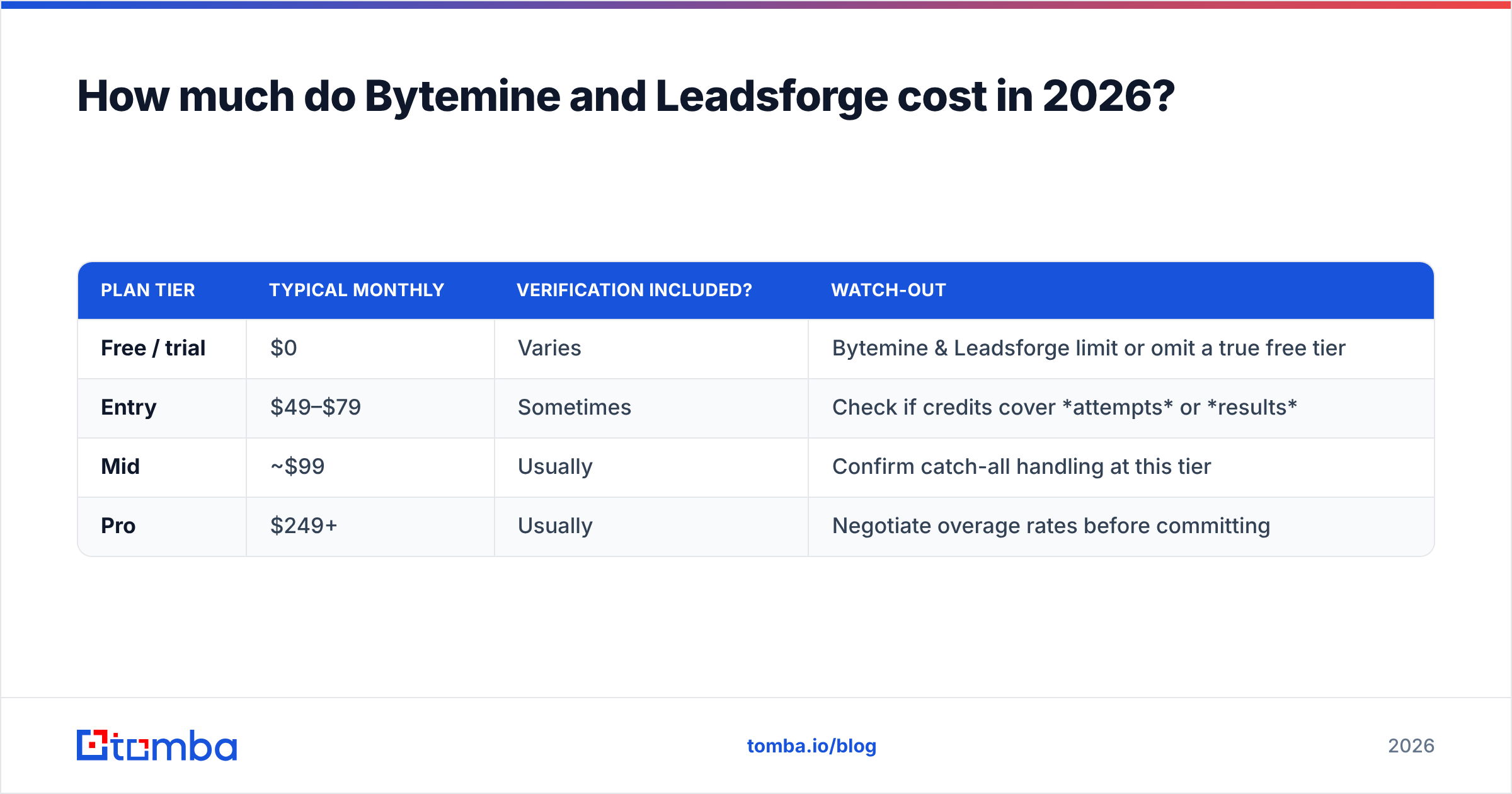
| Plan tier | Typical monthly | Verification included? | Watch-out |
|---|---|---|---|
| Free / trial | $0 | Varies | Bytemine & Leadsforge limit or omit a true free tier |
| Entry | $49–$79 | Sometimes | Check if credits cover attempts or results |
| Mid | ~$99 | Usually | Confirm catch-all handling at this tier |
| Pro | $249+ | Usually | Negotiate overage rates before committing |
Is there a better alternative to both?#
If neither the volume-first nor the platform-first model fits, the third path is a focused finder with verification built in — and it's worth a serious look before you commit budget to either incumbent.
That's the niche Tomba occupies. Instead of out-bundling Leadsforge or out-sizing Bytemine, it concentrates on the thing both tools treat as a sub-feature: returning deliverable addresses and being honest about the ones it can't confirm.
What that looks like in practice:
- Email finder by name + domain, with a confidence score on every result.
- Domain search to pull every public address pattern at a target company in one call.
- Catch-all verifier that flags risky domains explicitly instead of guessing "valid."
- Data enrichment and a documented email finder API for teams that want to wire it into their own stack rather than live in someone else's dashboard.
- A genuine free tier (25 searches/month) so you can benchmark accuracy before paying — something Bytemine and Leadsforge make harder.
None of this means Tomba is automatically right for you. If you genuinely want an all-in-one outbound platform and will use the sequencer, Leadsforge's bundling has real value. If you're a high-volume list builder who already runs a separate, trusted verification pipeline, Bytemine's coverage can be the cheapest raw-data source. Pick the model that matches how you actually work — then verify the numbers on your own list.
How should you run the test?#
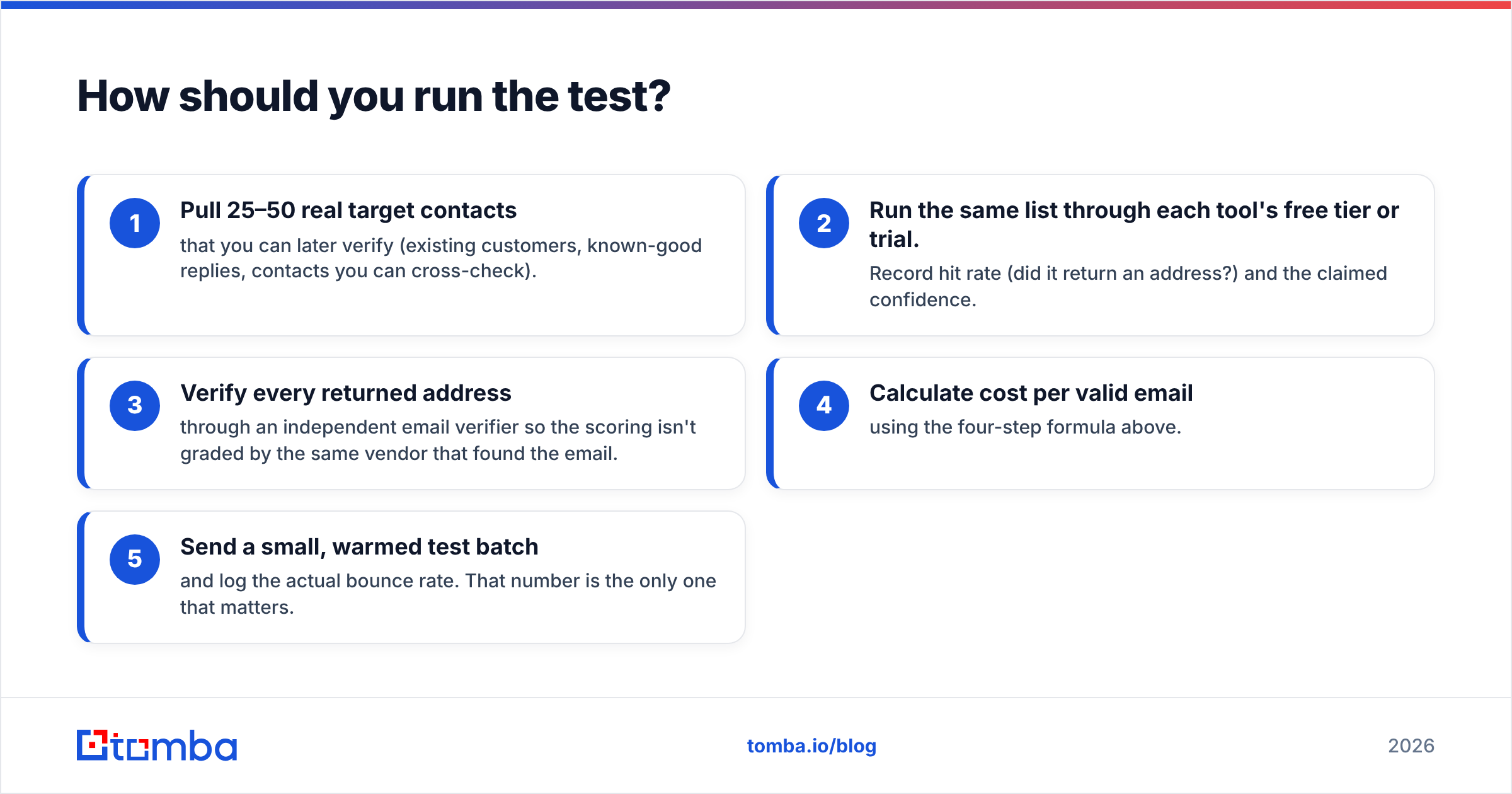
Don't decide from reviews — including this one. Decide from a 30-minute bake-off on your real prospects.
- Pull 25–50 real target contacts that you can later verify (existing customers, known-good replies, contacts you can cross-check).
- Run the same list through each tool's free tier or trial. Record hit rate (did it return an address?) and the claimed confidence.
- Verify every returned address through an independent email verifier so the scoring isn't graded by the same vendor that found the email.
- Calculate cost per valid email using the four-step formula above.
- Send a small, warmed test batch and log the actual bounce rate. That number is the only one that matters.
The tool that wins on your list — your industry, your target company sizes, your geographies — is the one to buy. A generic "Bytemine vs Leadsforge" verdict can't know whether your prospects sit on catch-all domains or obscure subsidiaries; your own test will.
The verdict#
There's no universal winner in Bytemine vs Leadsforge — there's a winner for your workflow. Choose Bytemine if you want maximum coverage and already own verification. Choose Leadsforge if you want find-to-send in one platform and will use the outreach features. But before you pick either, benchmark both against a focused finder-plus-verifier, because cost-per-valid-email — not database size or feature count — is what shows up in your results.
Want to run that benchmark for free? Start with the Tomba Email Finder — find professional emails by name, domain, or company, get SMTP-level verification and explicit catch-all flags on every result, and test 25 searches a month at no cost. Run your own list through it alongside Bytemine and Leadsforge, compare the verified valid-rate, and let the inbox decide.
// get started
Find, verify and enrich your first contacts today
Start on the free plan with 25 searches a month, then scale when your team is ready.
Free plan · No credit card required · GDPR & CCPA
// about the author