Bytemine vs Leadzenai 2026: Which B2B Lead Tool Wins?
Bytemine vs Leadzenai compared on data accuracy, pricing, coverage, and workflow fit — plus where a dedicated email finder like Tomba beats both.
Choosing between Bytemine and Leadzenai usually comes down to one question: do you trust the contact data enough to put your sender reputation behind it? Both promise B2B leads with emails and phone numbers. Neither is the obvious winner for every team. This breakdown cuts through the marketing copy so you can pick the right tool — or decide a focused email finder is the smarter buy.
TL;DR#
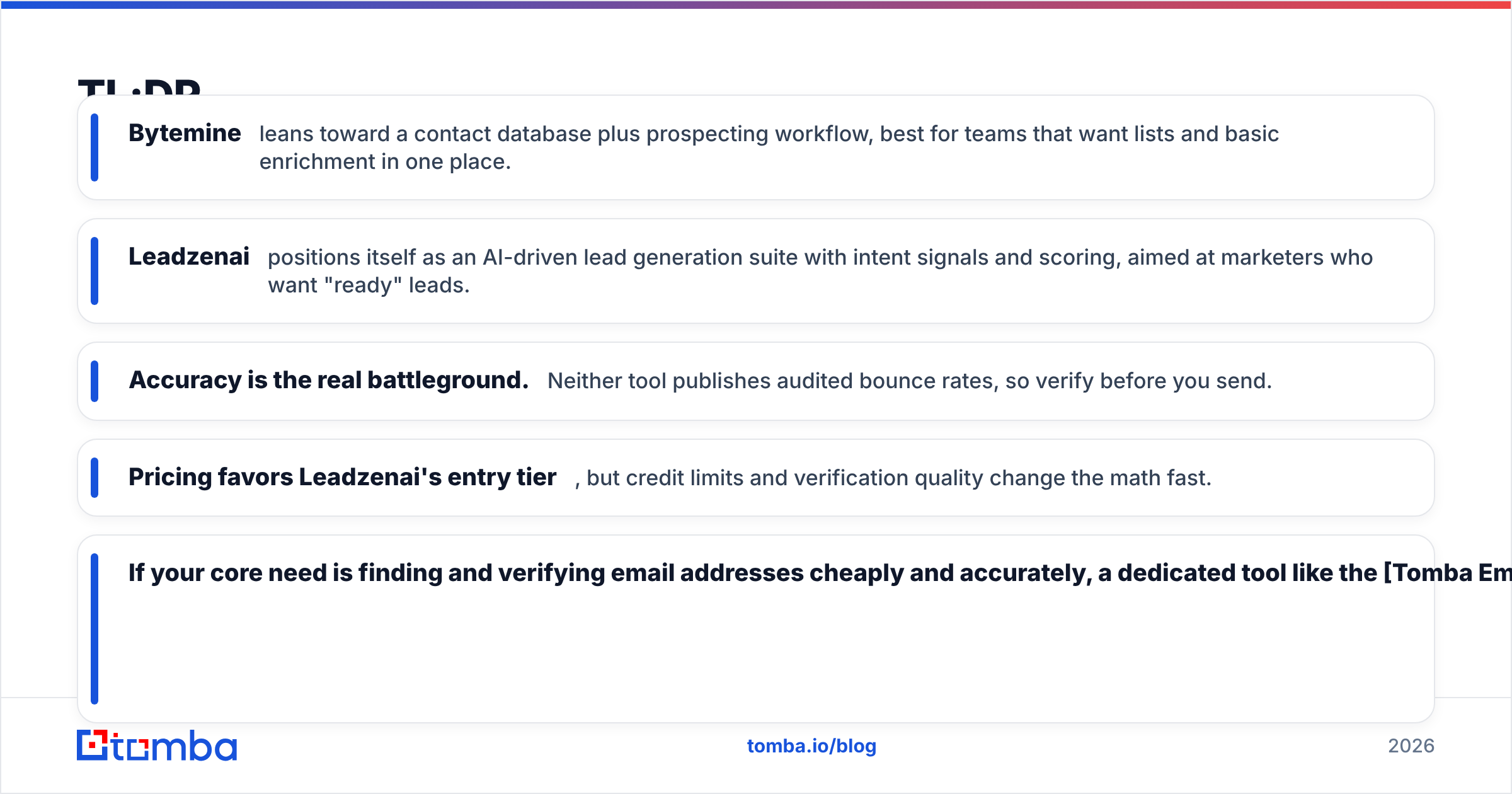
- Bytemine leans toward a contact database plus prospecting workflow, best for teams that want lists and basic enrichment in one place.
- Leadzenai positions itself as an AI-driven lead generation suite with intent signals and scoring, aimed at marketers who want "ready" leads.
- Accuracy is the real battleground. Neither tool publishes audited bounce rates, so verify before you send.
- Pricing favors Leadzenai's entry tier, but credit limits and verification quality change the math fast.
- If your core need is finding and verifying email addresses cheaply and accurately, a dedicated tool like the Tomba Email Finder outperforms both on cost-per-valid-email.
What are Bytemine and Leadzenai?#
Bytemine is a B2B prospecting and contact-data platform. You search by company, role, or industry, then export contacts with emails and, on higher tiers, phone numbers. Its pitch is "find and reach decision-makers" — a self-contained list-building flow rather than a deep enrichment API.
Leadzenai markets itself as an AI lead generation platform. Beyond raw contacts, it layers in lead scoring, intent-style signals, and campaign tooling. The promise is fewer "cold" names and more pre-qualified prospects, which appeals to demand-gen and marketing teams more than pure SDR motions.
The two overlap heavily where it counts: both sell you contact records with email addresses, both gate volume behind credits, and both live or die on data quality. That last point matters more than any feature list, because a cheap lead that bounces costs you sender reputation, not just a credit.

How do Bytemine and Leadzenai compare at a glance?#
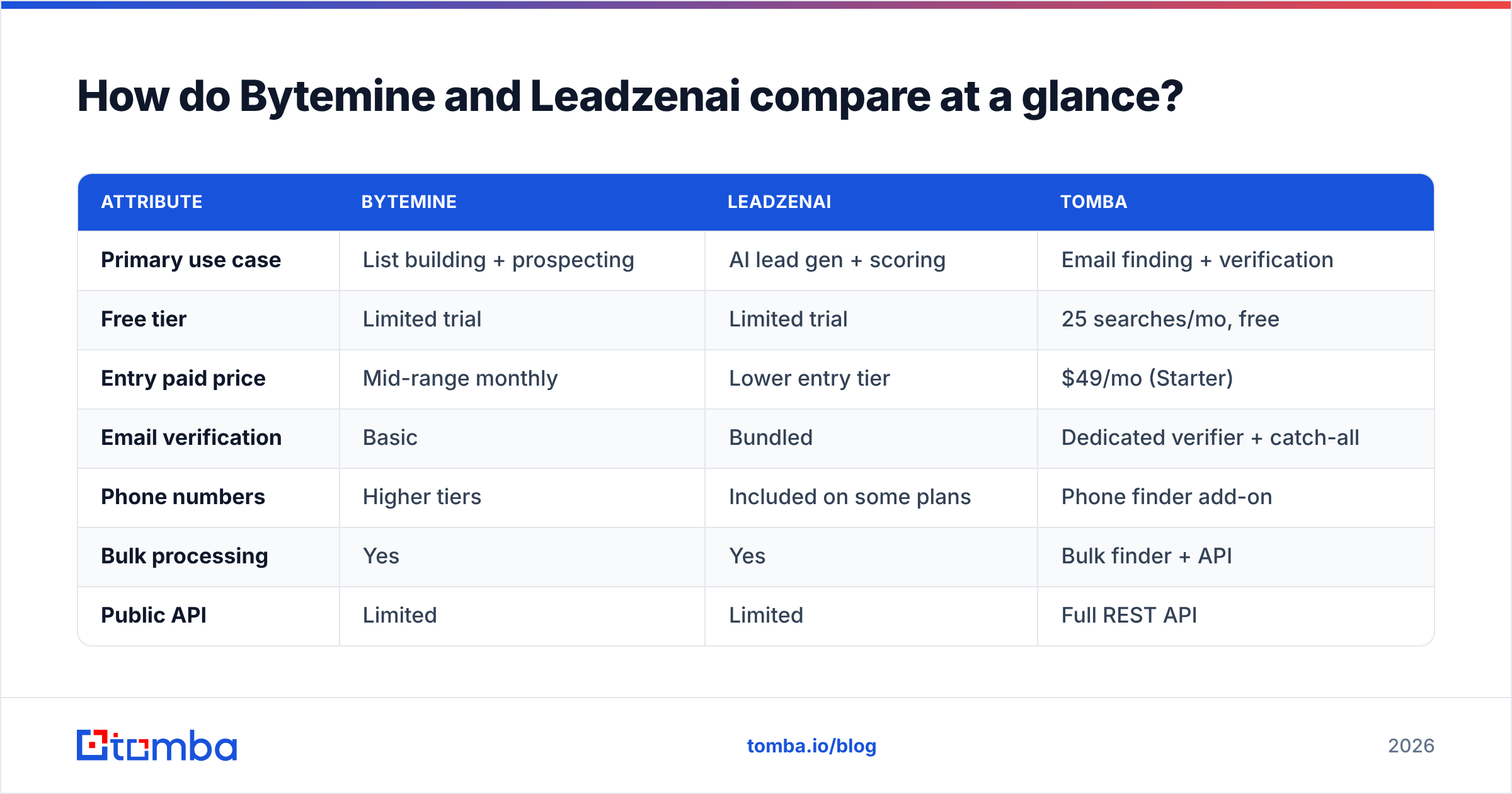
Here is the head-to-head on the attributes that actually drive a buying decision. Treat vendor-stated accuracy with skepticism — always run your own sample before committing budget.
| Attribute | Bytemine | Leadzenai | Tomba |
|---|---|---|---|
| Primary use case | List building + prospecting | AI lead gen + scoring | Email finding + verification |
| Free tier | Limited trial | Limited trial | 25 searches/mo, free |
| Entry paid price | Mid-range monthly | Lower entry tier | $49/mo (Starter) |
| Email verification | Basic | Bundled | Dedicated verifier + catch-all |
| Phone numbers | Higher tiers | Included on some plans | Phone finder add-on |
| Bulk processing | Yes | Yes | Bulk finder + API |
| Public API | Limited | Limited | Full REST API |
| Best for | SMB list builders | Marketing teams | Outbound + dev teams |
The pattern is clear: Bytemine and Leadzenai both bundle "everything" into a prospecting suite, while a focused tool keeps the unit economics tight. If you only need verified emails, you pay for scoring dashboards and intent widgets you will never open.
Which one has better data accuracy?#
Accuracy is where most "vs" articles wave their hands, so let's be concrete about how to judge it.
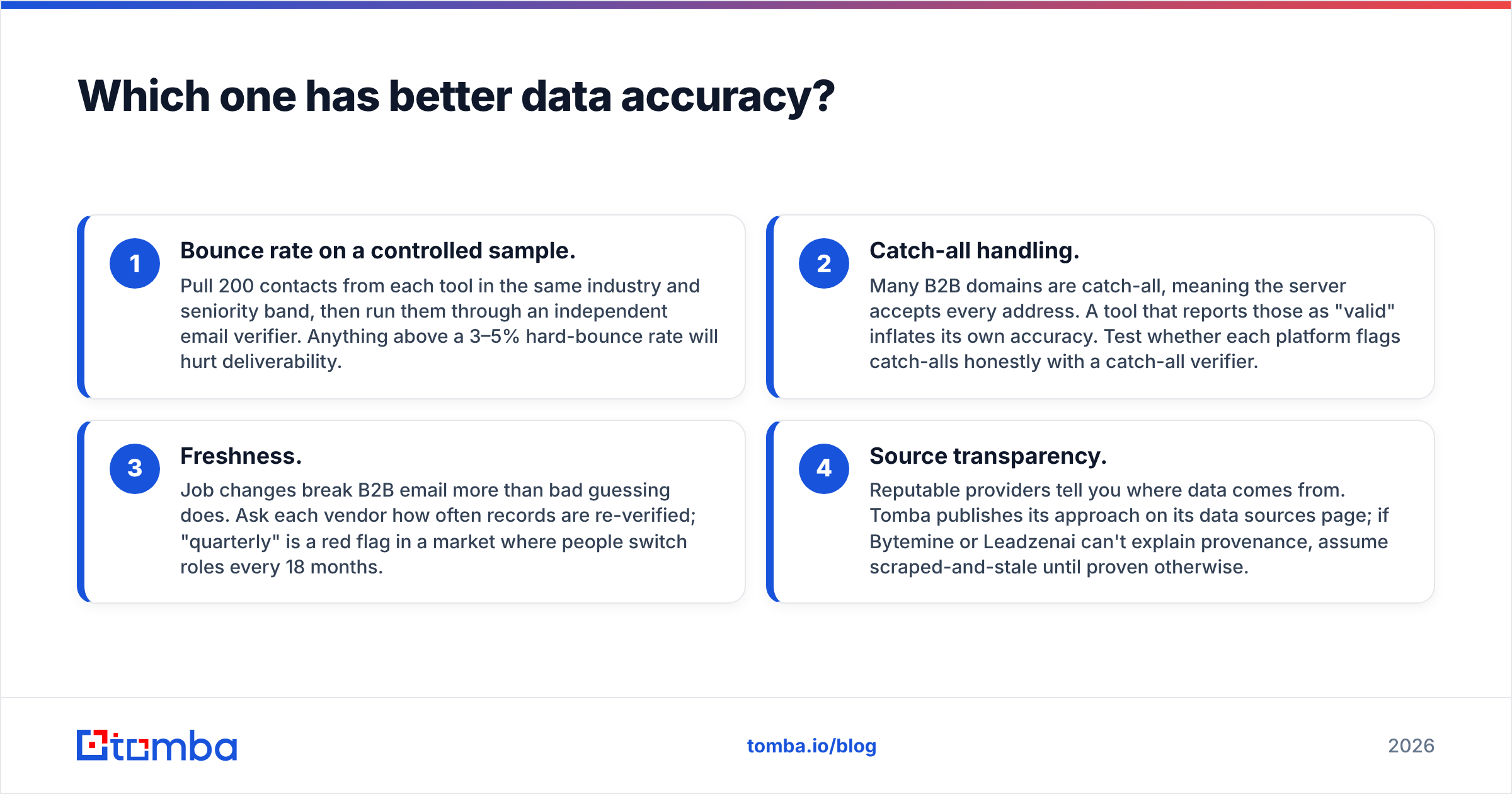
- Bounce rate on a controlled sample. Pull 200 contacts from each tool in the same industry and seniority band, then run them through an independent email verifier. Anything above a 3–5% hard-bounce rate will hurt deliverability.
- Catch-all handling. Many B2B domains are catch-all, meaning the server accepts every address. A tool that reports those as "valid" inflates its own accuracy. Test whether each platform flags catch-alls honestly with a catch-all verifier.
- Freshness. Job changes break B2B email more than bad guessing does. Ask each vendor how often records are re-verified; "quarterly" is a red flag in a market where people switch roles every 18 months.
- Source transparency. Reputable providers tell you where data comes from. Tomba publishes its approach on its data sources page; if Bytemine or Leadzenai can't explain provenance, assume scraped-and-stale until proven otherwise.
In practice, Bytemine tends to win on raw company coverage in North American mid-market, while Leadzenai's scoring can surface relevant accounts faster — but neither consistently beats a dedicated finder-plus-verifier stack on deliverable-email rate. The reason is structural: a suite optimizes for "leads delivered," a verification tool optimizes for "emails that land." Those are different goals.
For deliverability fundamentals behind all of this, the email deliverability primer is worth a read before you scale any list.
Is Bytemine or Leadzenai better for cold outreach?#
For cold outreach, the order of operations matters more than the brand on the dashboard. You need: accurate emails, verification, and a clean handoff to your sequencer.
- Bytemine suits a rep building targeted lists by hand. You search, filter, export, and push into your CRM or cold-email tool. It is a solid "find names fast" workflow, but you'll still want a separate verification pass.
- Leadzenai suits a marketer who wants the platform to prioritize which leads to contact first. The scoring is the selling point. The risk is over-trusting an opaque score and skipping verification because the lead "looks" qualified.
Either way, the non-negotiable step is verification before send. A 10% bounce rate doesn't just waste credits; it signals mailbox providers that you're a spammer, dragging down even your good emails. Run exports through a verifier and warm your domain first — our email warmup calculator shows how long that takes for your volume.
How does pricing compare?#
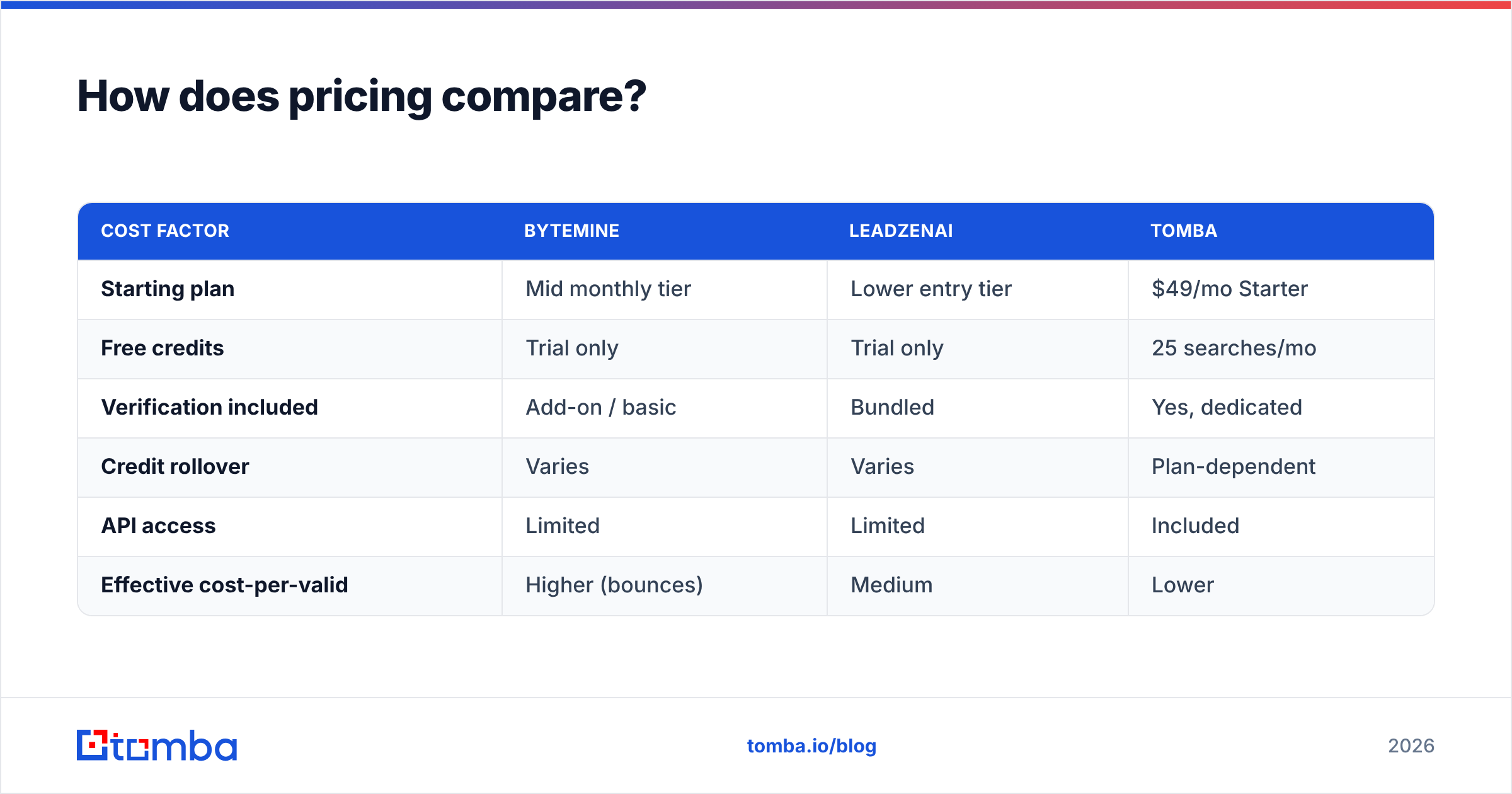
Headline price is a trap. What you care about is cost per valid, deliverable email — credits wasted on bounces and catch-alls are the real expense.
| Cost factor | Bytemine | Leadzenai | Tomba |
|---|---|---|---|
| Starting plan | Mid monthly tier | Lower entry tier | $49/mo Starter |
| Free credits | Trial only | Trial only | 25 searches/mo |
| Verification included | Add-on / basic | Bundled | Yes, dedicated |
| Credit rollover | Varies | Varies | Plan-dependent |
| API access | Limited | Limited | Included |
| Effective cost-per-valid | Higher (bounces) | Medium | Lower |
Leadzenai often wins the sticker-price comparison at the entry level, and Bytemine sits in the middle. But if 15% of a cheaper list bounces or sits in catch-all limbo, your true cost per usable contact can exceed a pricier tool with cleaner data. When you model it out, transparent Tomba pricing — $49/mo Starter, $99/mo Growth, $249/mo Pro — tends to deliver a lower cost-per-deliverable because verification is built in rather than billed separately.
A practical rule: divide each plan's price by the number of verified, non-catch-all emails you actually got from a test batch. That single number beats every feature comparison chart.
What about integrations and scale?#
If you're running outbound at volume, the workflow plumbing decides whether a tool is a daily driver or a one-off list source.
- Bytemine and Leadzenai both export to CSV and offer some CRM connections, but their APIs are limited, which constrains automation.
- For programmatic enrichment — enriching inbound signups, scoring leads on the fly, or appending data inside your own app — you want a real API. The Tomba API and data enrichment endpoints handle that, and there are native HubSpot and Salesforce integrations for teams living in a CRM.
- For one-off bulk jobs, a bulk email finder lets you upload a company or name list and get verified results back without writing code.
Bytemine vs Leadzenai is largely a UI-vs-UI decision. The moment you need automation, the conversation shifts to which tool has the API and integration depth to disappear into your stack.

When should you pick Bytemine?#
Choose Bytemine if:
- You build lists manually and want a clean search-filter-export loop.
- Your ICP is North American mid-market, where its company coverage is strongest.
- You already have a verification step elsewhere in your stack and just need a source of names.
- You don't need an API — the in-app workflow is enough.
Bytemine is the safer pick for a small sales team that values a straightforward interface over automation and is willing to verify exports separately.
When should you pick Leadzenai?#
Choose Leadzenai if:
- You're a marketer, not a pure SDR, and lead prioritization saves you more time than raw volume.
- Intent-style signals and scoring map to how your team decides who to contact.
- Budget is tight at the entry level and you can tolerate doing your own deliverability QA.
- You want campaign tooling bundled rather than stitched together.
Leadzenai rewards teams that will actually use the scoring layer. If you'd ignore it and export everyone anyway, you're paying for a feature you won't touch.
Is there a better alternative to both?#
For most outbound and RevOps teams, the honest answer is: decouple finding from scoring. Use a dedicated, transparent email finder for the data layer and let your CRM or sequencer handle prioritization. That stack is cheaper, more accurate, and more automatable than an all-in-one suite.
That's the case for Tomba. Instead of paying for an opaque scoring dashboard, you get:
- An email finder with domain and name search
- A built-in email verifier and catch-all verifier so you stop guessing
- Domain search to map every contact at a target account
- A full API, plus Chrome, Sheets, and Excel tools for any workflow
You can validate the difference yourself: the free tier gives you 25 searches a month with no card. Run the same accounts through Bytemine, Leadzenai, and Tomba, then verify all three batches and compare deliverable-email counts. The numbers usually settle the debate faster than any review.
For a deeper external benchmark of the category, vendor-neutral marketplaces like G2 and Capterra collect verified user reviews on data accuracy and support that are worth cross-referencing against your own test — and HubSpot's sales statistics research is a solid reality check on outbound benchmarks.
The bottom line on Bytemine vs Leadzenai#
Bytemine wins on hands-on list building; Leadzenai wins on bundled scoring for marketers. But both are suites that ask you to trust their data without showing audited bounce rates — and both bill you for capabilities you may never use. If your real job is getting accurate, verified emails into a sequence without wrecking your sender reputation, lead with verification and a transparent data source.
Start free with the Tomba Email Finder: 25 searches a month, built-in verification, catch-all detection, and a real API — so you pay for deliverable emails, not dashboards. Run your own sample, compare cost-per-valid-email against Bytemine and Leadzenai, and let the data decide.
// get started
Find, verify and enrich your first contacts today
Start on the free plan with 25 searches a month, then scale when your team is ready.
Free plan · No credit card required · GDPR & CCPA
// about the author