Bytemine vs SignalHire (2026): Which Email Finder Wins?
Bytemine vs SignalHire compared on accuracy, data depth, pricing, and phone coverage — plus where a leaner email finder like Tomba beats both on cost per verified contact.
Bytemine vs SignalHire: The Honest 2026 Comparison
Picking between Bytemine and SignalHire usually comes down to one question you can't answer from a pricing page: which one returns real, deliverable contacts for your accounts without burning your budget? Both promise emails, phones, and enrichment. They deliver those things very differently.
TL;DR — Bytemine vs SignalHire at a glance#
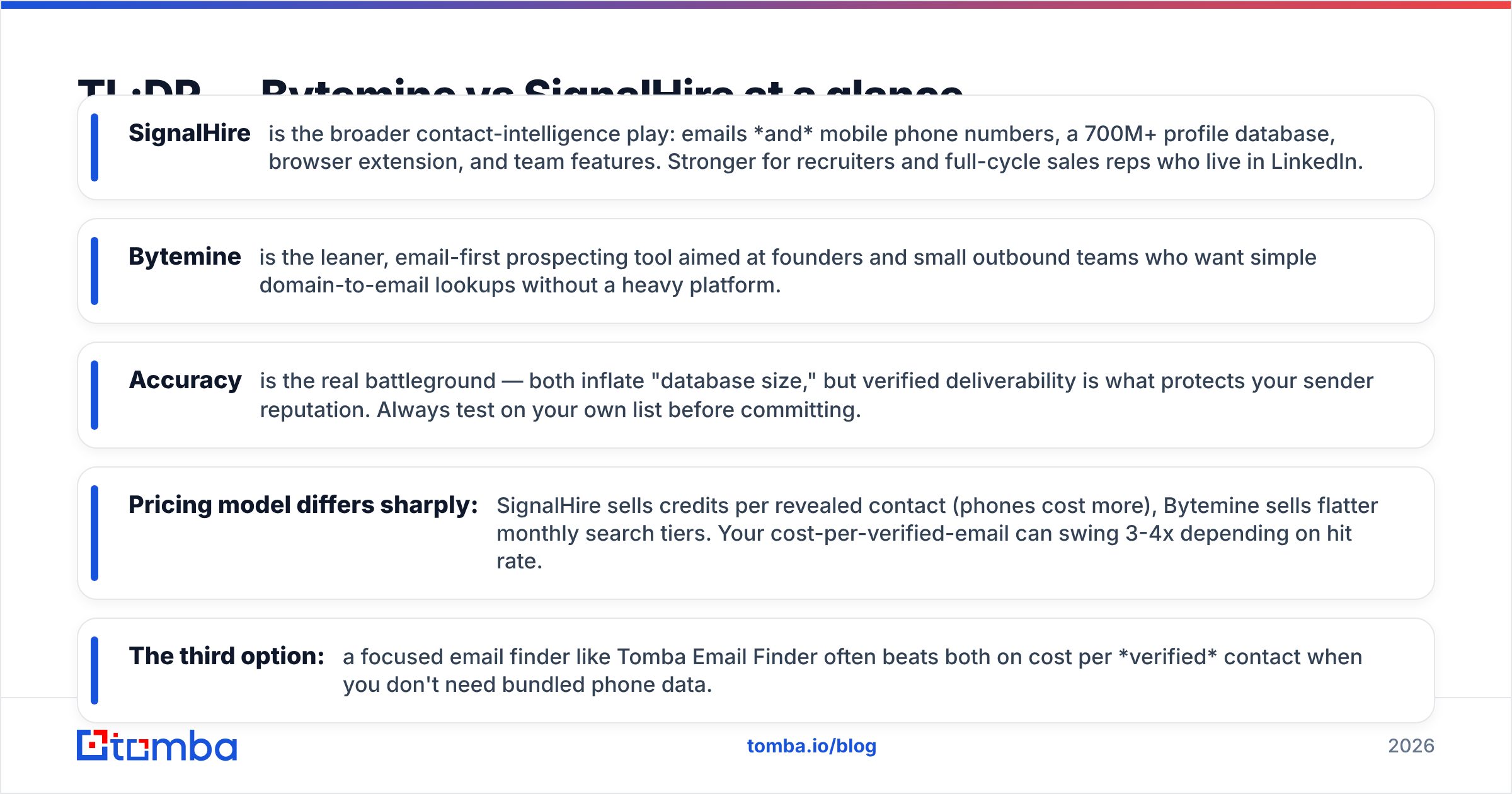
- SignalHire is the broader contact-intelligence play: emails and mobile phone numbers, a 700M+ profile database, browser extension, and team features. Stronger for recruiters and full-cycle sales reps who live in LinkedIn.
- Bytemine is the leaner, email-first prospecting tool aimed at founders and small outbound teams who want simple domain-to-email lookups without a heavy platform.
- Accuracy is the real battleground — both inflate "database size," but verified deliverability is what protects your sender reputation. Always test on your own list before committing.
- Pricing model differs sharply: SignalHire sells credits per revealed contact (phones cost more), Bytemine sells flatter monthly search tiers. Your cost-per-verified-email can swing 3-4x depending on hit rate.
- The third option: a focused email finder like Tomba Email Finder often beats both on cost per verified contact when you don't need bundled phone data.
What is Bytemine and who is it for?#
Bytemine positions itself as a straightforward B2B email finder and lead-generation tool. You feed it a domain, a name, or a company, and it returns likely professional email addresses, often with a confidence indicator. The appeal is simplicity: there's no sprawling CRM-style interface, no sequence builder, no learning curve. Founders, solo SDRs, and small agencies use it to assemble targeted lists quickly.
The trade-off is depth. Bytemine concentrates on email discovery and basic company data. If your workflow needs verified mobile numbers, intent signals, or deep org charts, you'll feel the ceiling fairly fast. It's a scalpel, not a Swiss Army knife — and for a lot of early-stage outbound, a scalpel is exactly right.
What is SignalHire and who is it for?#
SignalHire is a contact-finding and candidate-sourcing platform with a much wider surface area. It surfaces emails, direct and mobile phone numbers, and full social profiles, and it leans heavily on a browser extension that works over LinkedIn, GitHub, and other sites. Its origins in recruiting show: bulk profile reveal, ATS-style features, and team collaboration are first-class.
That makes SignalHire attractive to recruiters and to sales teams that genuinely need phone coverage for cold calling. The cost is complexity and credit math. Phone reveals are pricier than email-only reveals, and a "credit" can mean different things depending on what you unlock. Power comes with a meter running.
Bytemine vs SignalHire: full feature and pricing comparison#
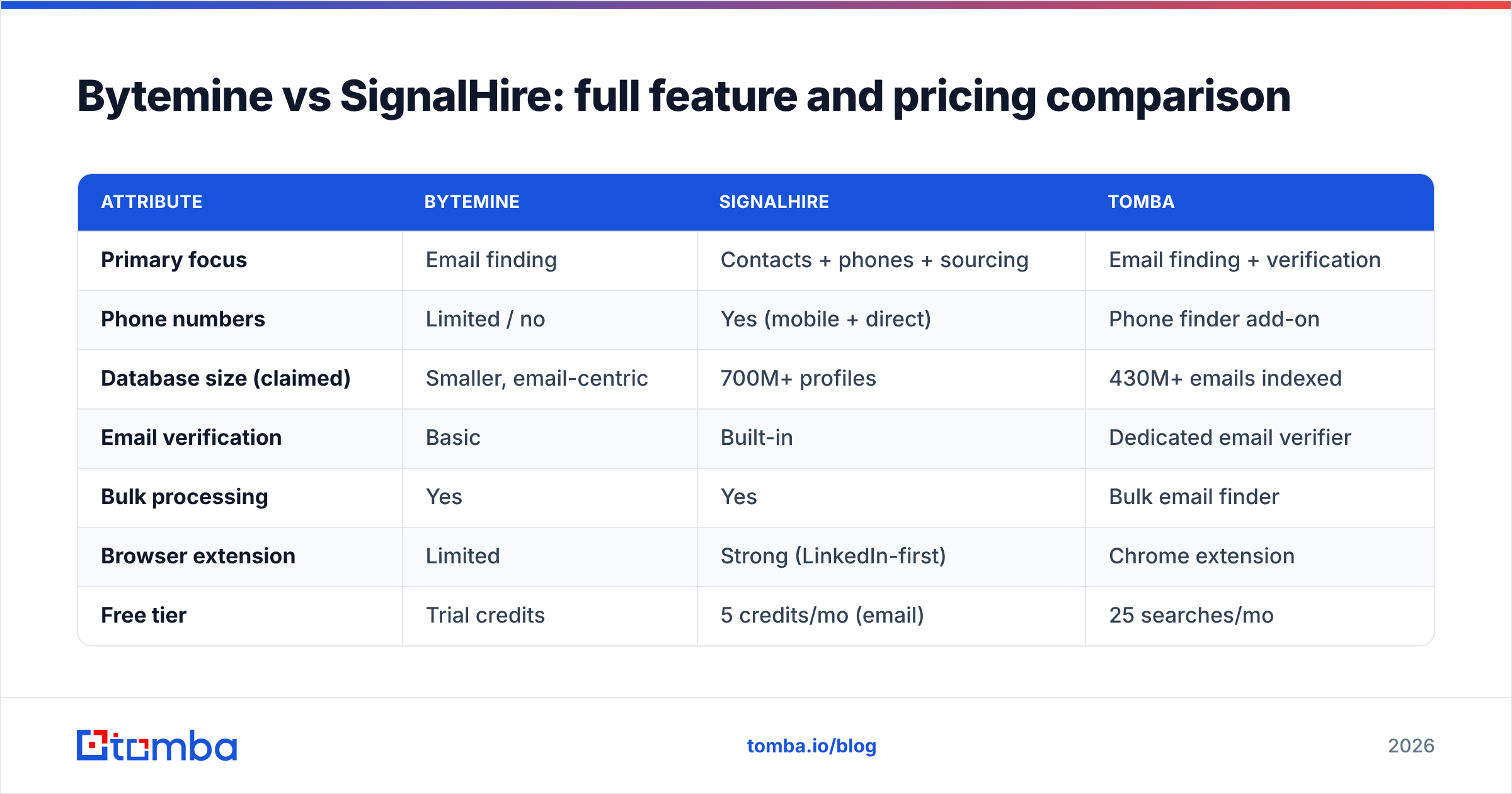
Here's the side-by-side. Treat vendor-published database counts as marketing, not measured coverage — they're directional at best.
| Attribute | Bytemine | SignalHire | Tomba |
|---|---|---|---|
| Primary focus | Email finding | Contacts + phones + sourcing | Email finding + verification |
| Phone numbers | Limited / no | Yes (mobile + direct) | Phone finder add-on |
| Database size (claimed) | Smaller, email-centric | 700M+ profiles | 430M+ emails indexed |
| Email verification | Basic | Built-in | Dedicated email verifier |
| Bulk processing | Yes | Yes | Bulk email finder |
| Browser extension | Limited | Strong (LinkedIn-first) | Chrome extension |
| Free tier | Trial credits | 5 credits/mo (email) | 25 searches/mo |
| Entry paid price | Mid-tier monthly | Credit packs from ~$49 | $49/mo Starter |
| Best for | Founders, small teams | Recruiters, full-cycle sales | Cost-efficient email outbound |
| API access | Limited | Yes | Full API |
A few things to read carefully in that table:
- Phone data is SignalHire's moat. If cold calling is core to your motion, this alone can justify the higher credit cost.
- Bytemine wins on simplicity, not breadth. You're paying for fewer features, so it should cost less per email — confirm that math on your own data.
- Verification is non-negotiable. A "found" email that bounces costs you more than a missing one, because bounces damage your email deliverability and sender reputation.
- Credits vs flat searches change behavior. Credit systems punish exploration; flat tiers let you search freely. Match the model to how messy your prospecting actually is.
Which tool is more accurate?#
Accuracy beats database size every time — a 700M-profile claim means nothing if 30% of the emails it hands you bounce. The only number that matters is verified deliverability on your target accounts, and that varies wildly by region, seniority, and industry.

SignalHire's reveals are generally solid for North American and enterprise contacts, where its data is densest. Bytemine can be competitive on common corporate domains but thins out on smaller companies and non-US regions. Neither is immune to catch-all domains — servers that accept any address, making verification genuinely hard. If a meaningful slice of your list sits behind catch-all servers, a dedicated catch-all verifier saves you from sending into the void.
The practical test: take 100 known-good contacts you can independently confirm, run them through each tool, and measure (a) how many it found and (b) how many actually verify as deliverable. The winner on that score — not the homepage stat — is your tool.
How does pricing really compare?#
On paper, both look reasonable. In practice, your effective cost is price ÷ verified usable contacts, and that ratio is where the gap opens.
SignalHire's credit model means a low hit rate quietly inflates your real cost — you spend credits on reveals that don't pan out, and phone reveals cost more than emails. Bytemine's flatter monthly tiers are more forgiving for high-volume searching, but you may hit feature walls that force an upgrade. Neither publishes the one number you need: cost per verified email at your hit rate.
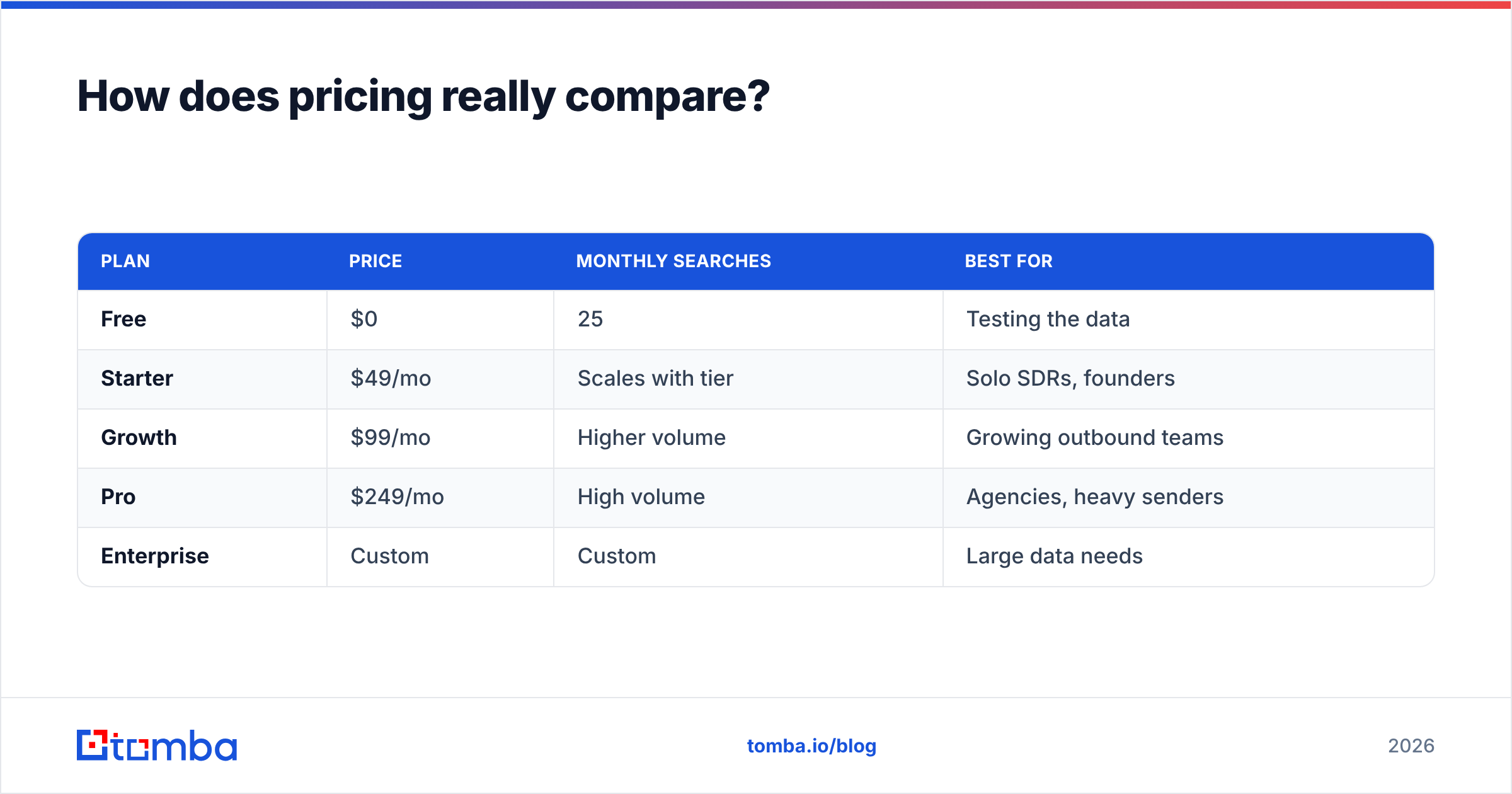
This is where comparing against a transparent baseline helps. Tomba's pricing is a clean reference point:
| Plan | Price | Monthly searches | Best for |
|---|---|---|---|
| Free | $0 | 25 | Testing the data |
| Starter | $49/mo | Scales with tier | Solo SDRs, founders |
| Growth | $99/mo | Higher volume | Growing outbound teams |
| Pro | $249/mo | High volume | Agencies, heavy senders |
| Enterprise | Custom | Custom | Large data needs |
Note the Starter tier is $49/mo — and the free tier gives you 25 real searches to validate accuracy before you spend a cent. Run the same 100-contact test across all three and let cost-per-verified-contact decide.
Is there a better alternative to both?#
Often, yes — if you separate "I need phones" from "I need email." Most outbound teams overbuy. They pay for a bundled phone-and-social platform when 90% of their actual sending is email, and the phone reveals sit unused while the meter runs.
If email is your channel, a focused finder is cheaper and usually more accurate per dollar because the whole product is optimized for one job. Tomba pairs email discovery with a built-in email verifier, domain search for mapping every address at a company, and bulk processing — without charging you for phone credits you won't use.
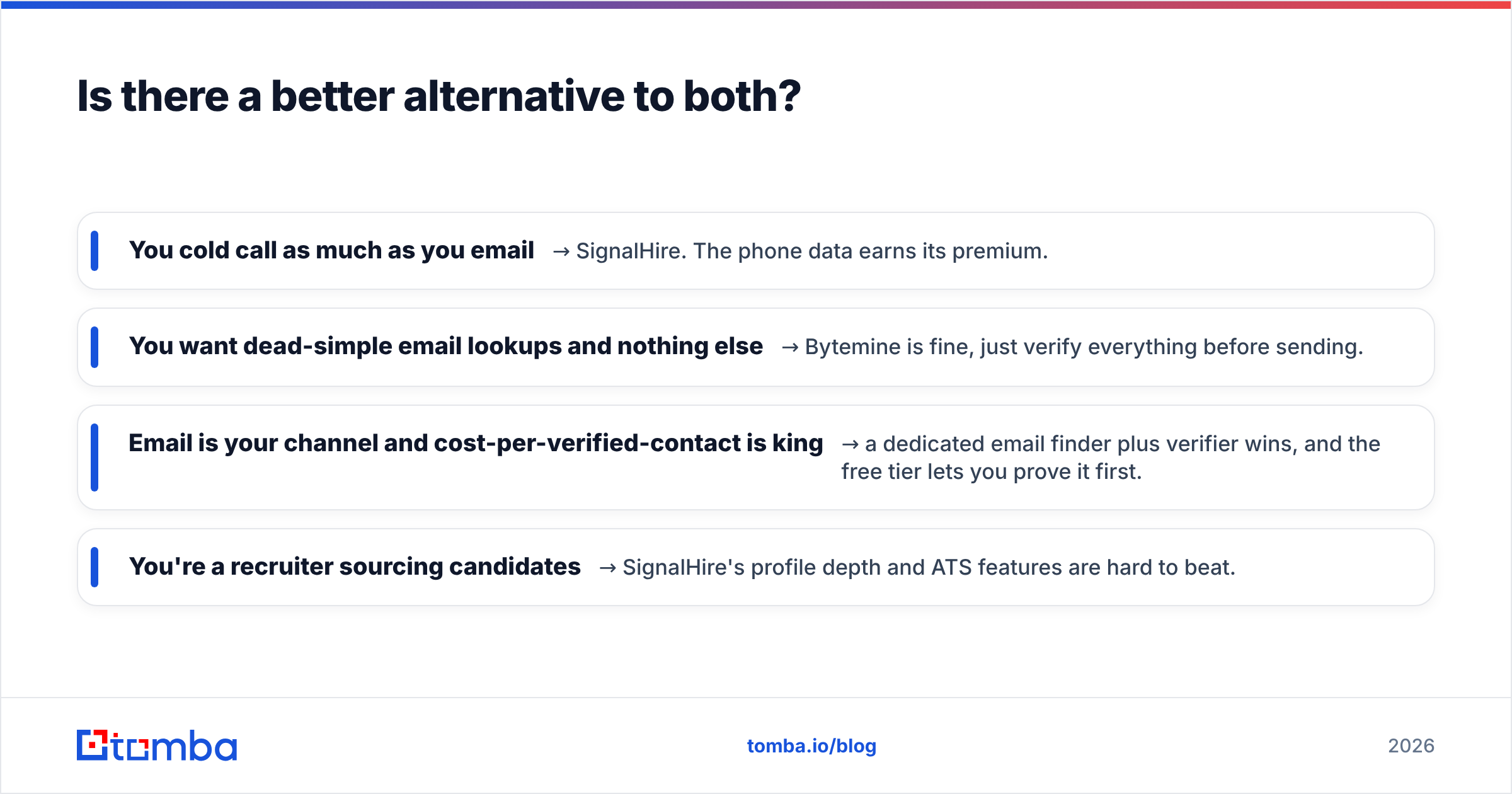
Here's an honest decision tree:
- You cold call as much as you email → SignalHire. The phone data earns its premium.
- You want dead-simple email lookups and nothing else → Bytemine is fine, just verify everything before sending.
- Email is your channel and cost-per-verified-contact is king → a dedicated email finder plus verifier wins, and the free tier lets you prove it first.
- You're a recruiter sourcing candidates → SignalHire's profile depth and ATS features are hard to beat.
What about bulk workflows and integrations?#
For scaled outbound, the bottleneck isn't finding one email — it's processing thousands without your data going stale or your reps living in spreadsheets. All three tools offer bulk uploads, but the experience differs.
SignalHire handles bulk reveal well but watch credit consumption on large jobs; phone-inclusive reveals can drain a pack fast. Bytemine's bulk is simpler and email-focused. If you run lists in the thousands, look closely at how each handles deduplication, verification at scale, and CRM sync — a bulk job that returns 5,000 emails with no dedupe and no verification just moved the work downstream to you.
Integrations matter as much as raw finding. Check whether the tool connects to your stack — Salesforce, HubSpot, your sequencer — natively or only through Zapier. Per-record enrichment that lands clean in your CRM beats a CSV export you have to babysit. Tomba's data enrichment and direct integrations are built for that hand-off; verify the others against your specific CRM before committing.
How should you actually choose?#
Don't choose from this article. Choose from a test. Reputable directories like G2 and Capterra are useful for spotting consistent complaints — billing surprises, stale data, support gaps — but reviews can't tell you the hit rate on your accounts. Only a trial can.
Run this in an afternoon:
- Pull 100 contacts you can independently verify (your existing customers work well).
- Run them through each tool's free or trial tier.
- Score found-rate and verified-deliverable-rate separately.
- Divide each tool's price by its verified count to get true cost per usable contact.
- Factor in whether you genuinely need phones (SignalHire) or just emails (Bytemine or a focused finder).
The tool that wins on cost-per-verified-contact and matches your channel mix is the right answer — and it's frequently not the one with the biggest claimed database. You can read more about how data sourcing affects accuracy on the official sites for SignalHire and Bytemine before you test.
The bottom line#
SignalHire is the stronger pick when phone coverage and recruiter-grade sourcing justify its credit premium. Bytemine is the simpler, email-first option for founders who want lookups without a platform. But if email is your channel and you care about cost per verified contact, a dedicated finder usually beats both — and you shouldn't take that on faith.
Start with the Tomba Email Finder free tier: 25 searches, a built-in verifier so you're measuring deliverable emails not just guesses, and transparent $49/mo pricing if you scale. Run the same 100-contact test against Bytemine and SignalHire, compare the verified hit rates, and let the data — not the marketing — pick your tool.
Ready to find emails that actually work?
Join 150,000+ professionals who stopped guessing and started sending. Free credits on signup — no credit card required.
Get the Tomba newsletter
Practical outbound tactics and product updates — once every two weeks.
About the author