Bytemine vs Tami AI (2026): Which AI SDR Tool Wins?
Bytemine and Tami AI both promise autonomous prospecting, but they solve different problems. Here's an honest 2026 breakdown of features, pricing, data quality, and where each one actually fits.
Choosing between two AI sales agents usually comes down to one uncomfortable question: are you buying automation, or are you buying data? Bytemine and Tami AI both market themselves as AI SDRs that research accounts, write outreach, and book meetings while you sleep. But under the hood they make very different bets, and the wrong choice will cost you a quarter of pipeline before you notice.
This is a neutral, hands-on comparison for 2026 — what each tool does well, where it breaks, what it costs, and which type of team should pick which.
TL;DR — Bytemine vs Tami AI at a glance#
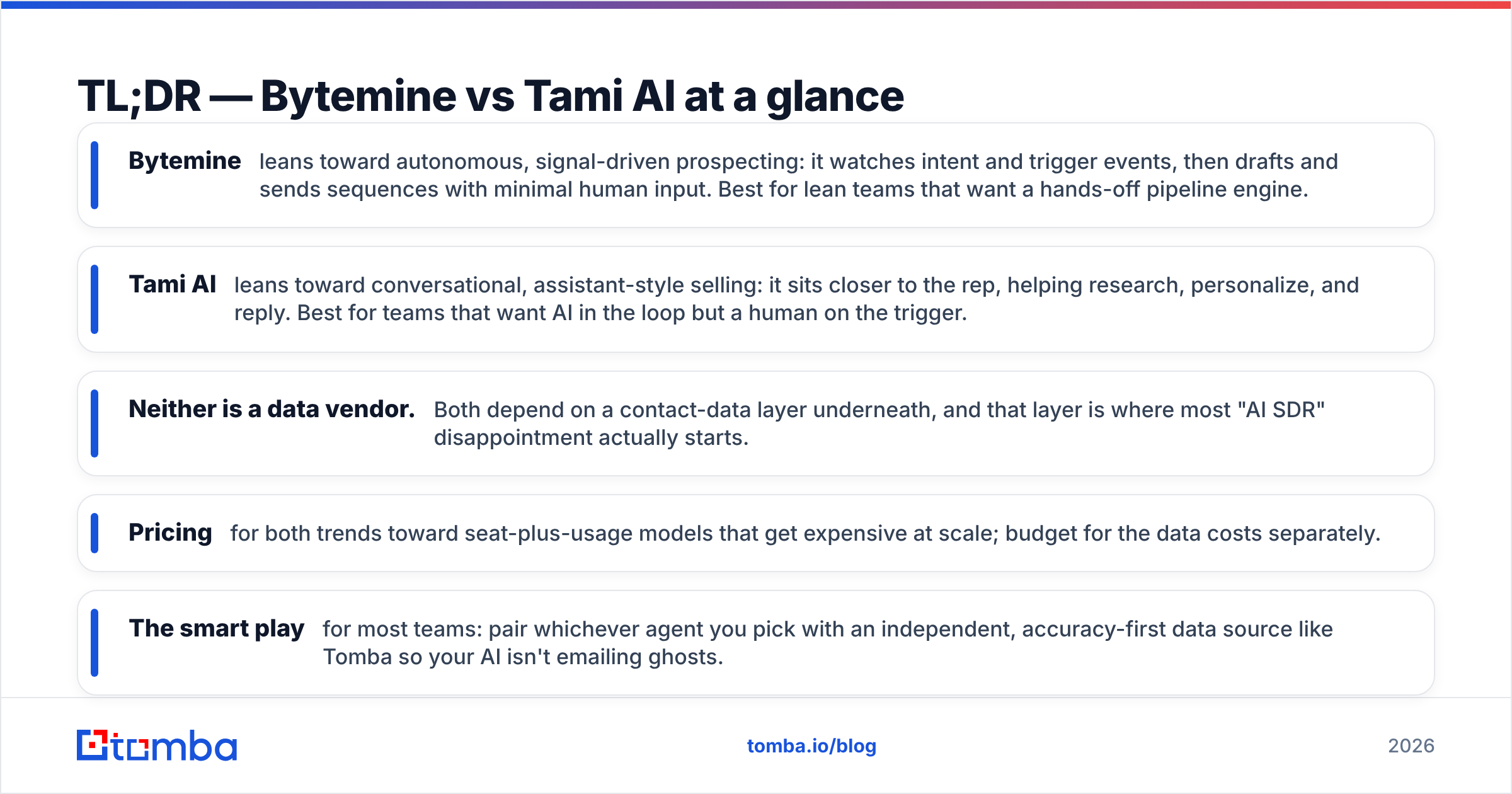
- Bytemine leans toward autonomous, signal-driven prospecting: it watches intent and trigger events, then drafts and sends sequences with minimal human input. Best for lean teams that want a hands-off pipeline engine.
- Tami AI leans toward conversational, assistant-style selling: it sits closer to the rep, helping research, personalize, and reply. Best for teams that want AI in the loop but a human on the trigger.
- Neither is a data vendor. Both depend on a contact-data layer underneath, and that layer is where most "AI SDR" disappointment actually starts.
- Pricing for both trends toward seat-plus-usage models that get expensive at scale; budget for the data costs separately.
- The smart play for most teams: pair whichever agent you pick with an independent, accuracy-first data source like Tomba so your AI isn't emailing ghosts.
)
What is Bytemine?#
Bytemine positions itself as an autonomous AI SDR — software that runs the top of your funnel end to end. You define an ideal customer profile, connect your inbox and CRM, and the system identifies accounts, finds contacts, generates personalized messaging, and pushes multi-step sequences. The pitch is replacement, not assistance: fewer human SDRs, more machine-driven volume.
The strongest part of the Bytemine story is signal orchestration. It tries to time outreach around buying signals — funding events, hiring patterns, tech-stack changes, website activity — so messages land when an account is actually in-market. When the signal layer is accurate, that timing advantage is real and hard to replicate manually.
The weak part is the same as every autonomous system: it is only as good as the contact and company data flowing into it. An agent that confidently emails a stale or guessed address is just automating bounces faster.
What is Tami AI?#
Tami AI takes the assistant route. Instead of fully replacing the rep, it augments them — researching prospects, summarizing accounts, drafting personalized first lines, and suggesting replies inside the rep's existing workflow. Think of it as a very capable junior researcher who never sleeps, rather than a fully autonomous closer.
This design has a clear benefit: a human stays on the trigger, so brand voice, compliance, and judgment calls survive. Reply quality tends to be higher because a person reviews before send. The trade-off is throughput. If your goal is 10,000 touches a week with two people, an assistant model fights you; if your goal is 300 genuinely tailored touches that protect a premium brand, it shines.
Like Bytemine, Tami AI is not a data company. It consumes contact data; it doesn't guarantee it.
How do Bytemine and Tami AI compare on features and pricing?#
Here's the honest side-by-side. Treat specific prices as directional — both vendors run custom and usage-based deals, so confirm with their sales teams.
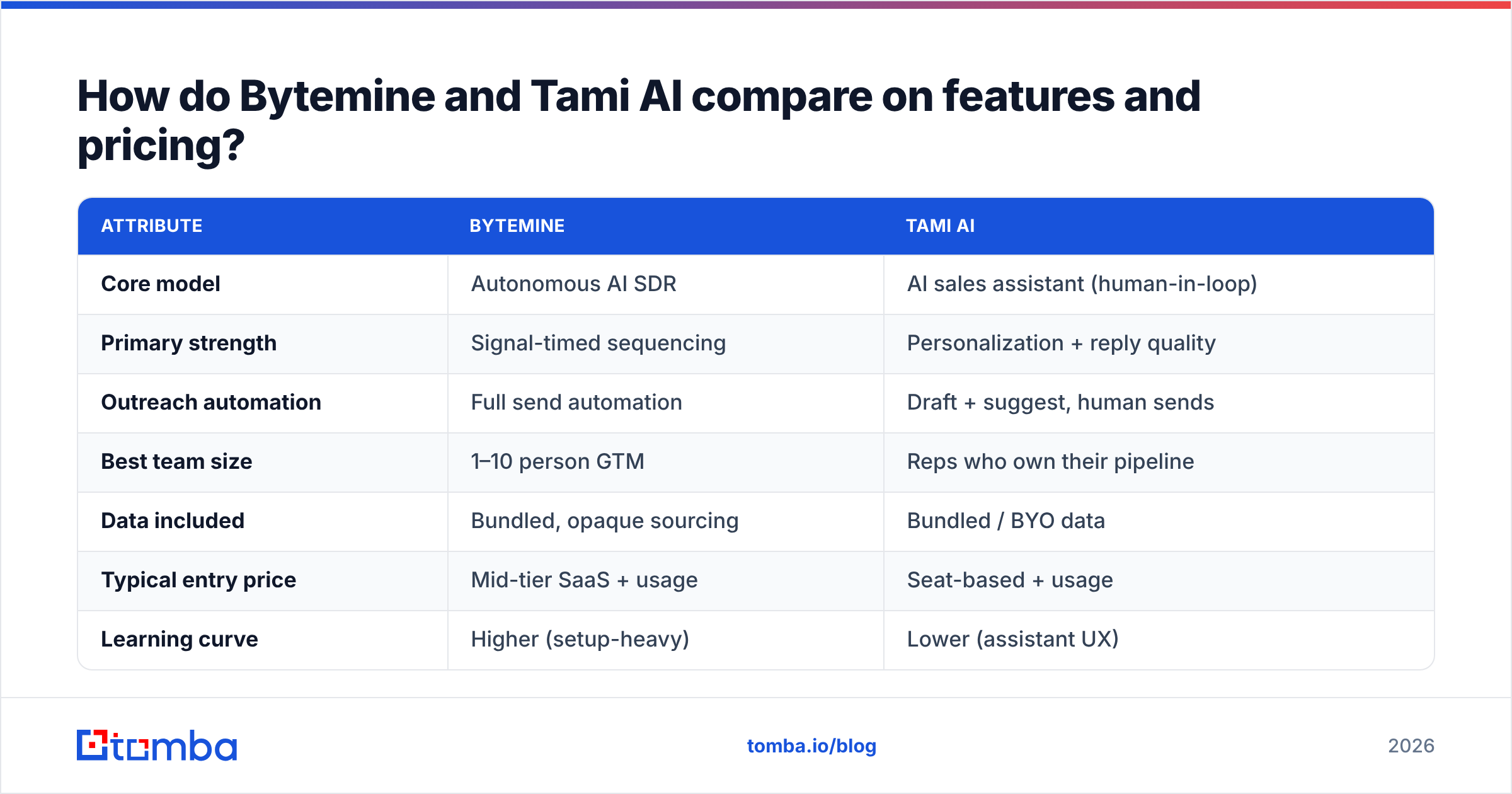
| Attribute | Bytemine | Tami AI |
|---|---|---|
| Core model | Autonomous AI SDR | AI sales assistant (human-in-loop) |
| Primary strength | Signal-timed sequencing | Personalization + reply quality |
| Outreach automation | Full send automation | Draft + suggest, human sends |
| Best team size | 1–10 person GTM | Reps who own their pipeline |
| Data included | Bundled, opaque sourcing | Bundled / BYO data |
| Typical entry price | Mid-tier SaaS + usage | Seat-based + usage |
| Learning curve | Higher (setup-heavy) | Lower (assistant UX) |
| Risk if data is bad | High (auto-sends bounces) | Lower (human catches errors) |
The pattern is consistent: Bytemine optimizes for volume and autonomy, Tami AI optimizes for control and quality. Where they're identical is dependence on an external data foundation — and that's the variable that decides whether either one earns its price.
For a broader view of the category, G2's AI sales assistant listings and HubSpot's sales blog are useful neutral references on how these tools are evaluated by buyers.
Is autonomous prospecting actually better than assisted prospecting?#
It depends entirely on your tolerance for error at scale.
Autonomous tools like Bytemine win on raw efficiency. One operator can run the output of a five-person SDR team. But autonomy compounds mistakes. If 18% of your contact data is wrong — a normal figure for unverified B2B lists — an autonomous agent will cheerfully send to all of it, torching your sender reputation and inflating your bounce rate until your domain lands in spam folders.
Assisted tools like Tami AI add a human checkpoint. That checkpoint catches the obvious "this person left the company two years ago" errors before they cost you deliverability. The price is speed.
The resolution most experienced teams reach: autonomy is fine, as long as the data is verified before it ever reaches the agent. Automation amplifies whatever you feed it. Feed it clean data and autonomy is a superpower. Feed it guesses and you've built a high-speed mistake machine.
Where do both tools fall short?#
Three gaps show up regardless of which you pick:
- Data is a black box. Both bundle contact data, but neither is transparent about freshness, sourcing, or verification method. You don't get to see the data sources or set your own accuracy bar. When emails bounce, you can't tell whether the agent or the data failed.
- Catch-all domains break silently. A huge share of corporate domains are catch-all, meaning the server accepts every address. Most bundled data layers mark these "valid" and your AI sends straight into a void. Without a real catch-all verifier, you're guessing.
- Vendor lock-in on enrichment. Because the data is baked in, you can't easily swap a better source in or run your own verification pass. You're trusting the agent's pipeline blindly.
)
None of these are dealbreakers — they're reasons to keep your data layer independent of your automation layer.
How should you choose between Bytemine and Tami AI?#
Match the tool to how your team actually sells:
- Pick Bytemine if you're a lean, high-volume outbound team that wants to replace manual SDR motion and you're comfortable owning the data-quality risk. Its signal timing is the differentiator — but only pays off when contacts are verified.
- Pick Tami AI if you sell into a premium or high-trust market where every message represents the brand, and you'd rather a rep approve sends. Its personalization-plus-review loop protects quality.
- Pick neither as your data source. This is the part both vendors won't tell you: the agent is the easy 20% to swap later. The data is the 80% that determines whether outreach works at all.
If you're also weighing the bigger all-in-one platforms, it's worth reading how buyers evaluate them — for example, an Apollo alternative breakdown shows the same tension between bundled data and accuracy that Bytemine and Tami AI face.
Why data accuracy decides the winner#
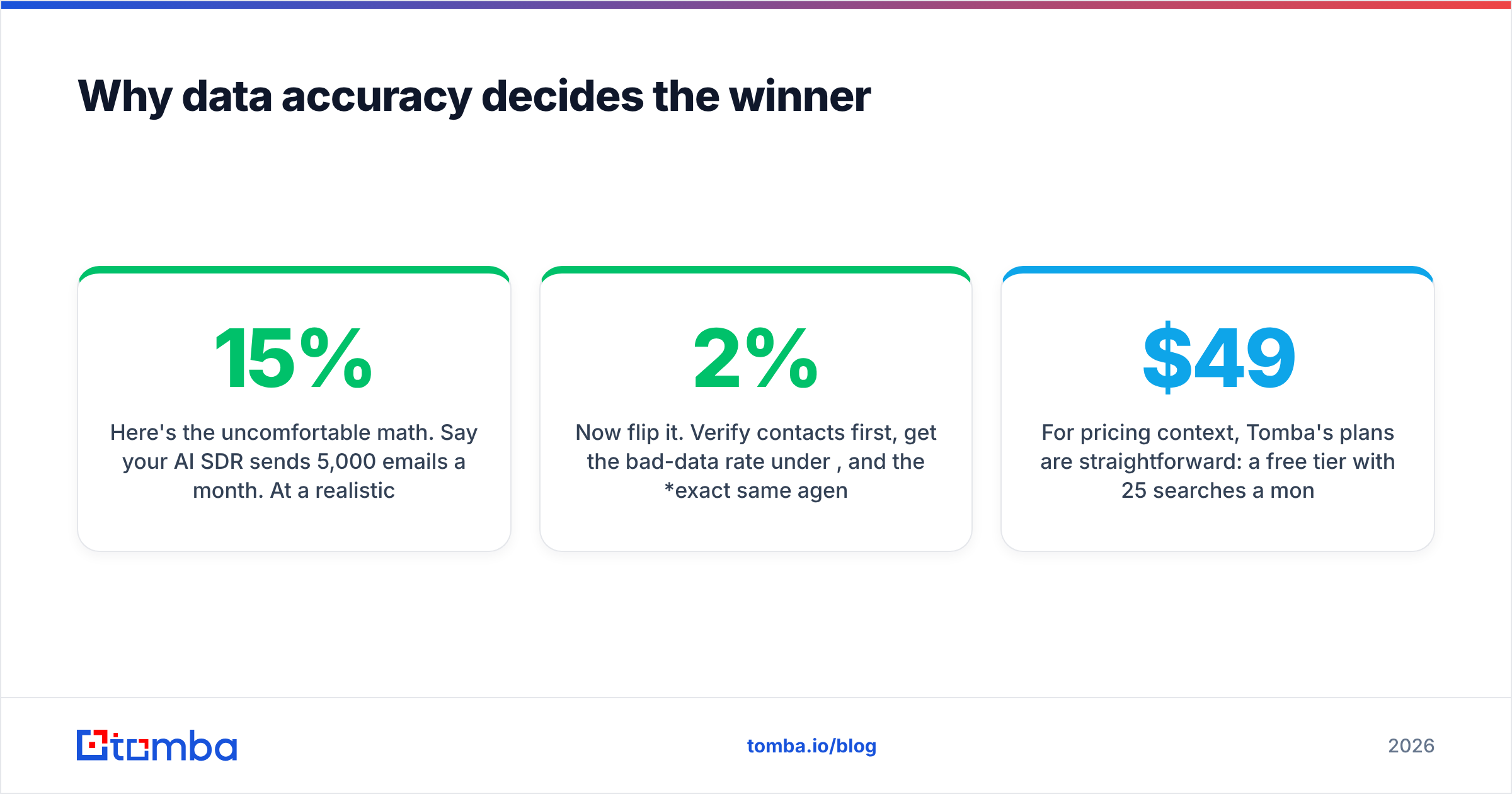
Here's the uncomfortable math. Say your AI SDR sends 5,000 emails a month. At a realistic 15% bad-data rate on unverified lists, that's 750 bounces. Bounce rates above 2–3% start damaging email deliverability; at 15% you're effectively blacklisted within weeks. Your beautiful AI sequences never reach a human inbox.
Now flip it. Verify contacts first, get the bad-data rate under 2%, and the exact same agent with the exact same copy suddenly performs three to five times better — not because the AI got smarter, but because the messages arrive.
This is why pairing your chosen agent with an accuracy-first finder and verifier matters more than the Bytemine-vs-Tami AI decision itself. Tomba's email verifier and email finder exist to be that independent layer: transparent sourcing, real SMTP verification, and catch-all detection, all available through the Tomba API so it slots in front of whichever agent you run. You can also enrich records in bulk via data enrichment before they ever hit the sequence.
For pricing context, Tomba's plans are straightforward: a free tier with 25 searches a month, Starter at $49/mo, Growth at $99/mo, and Pro at $249/mo — see the full Tomba pricing page. That sits independently of whatever your AI SDR seat costs, which is exactly the point: your data layer shouldn't be hostage to your automation vendor.
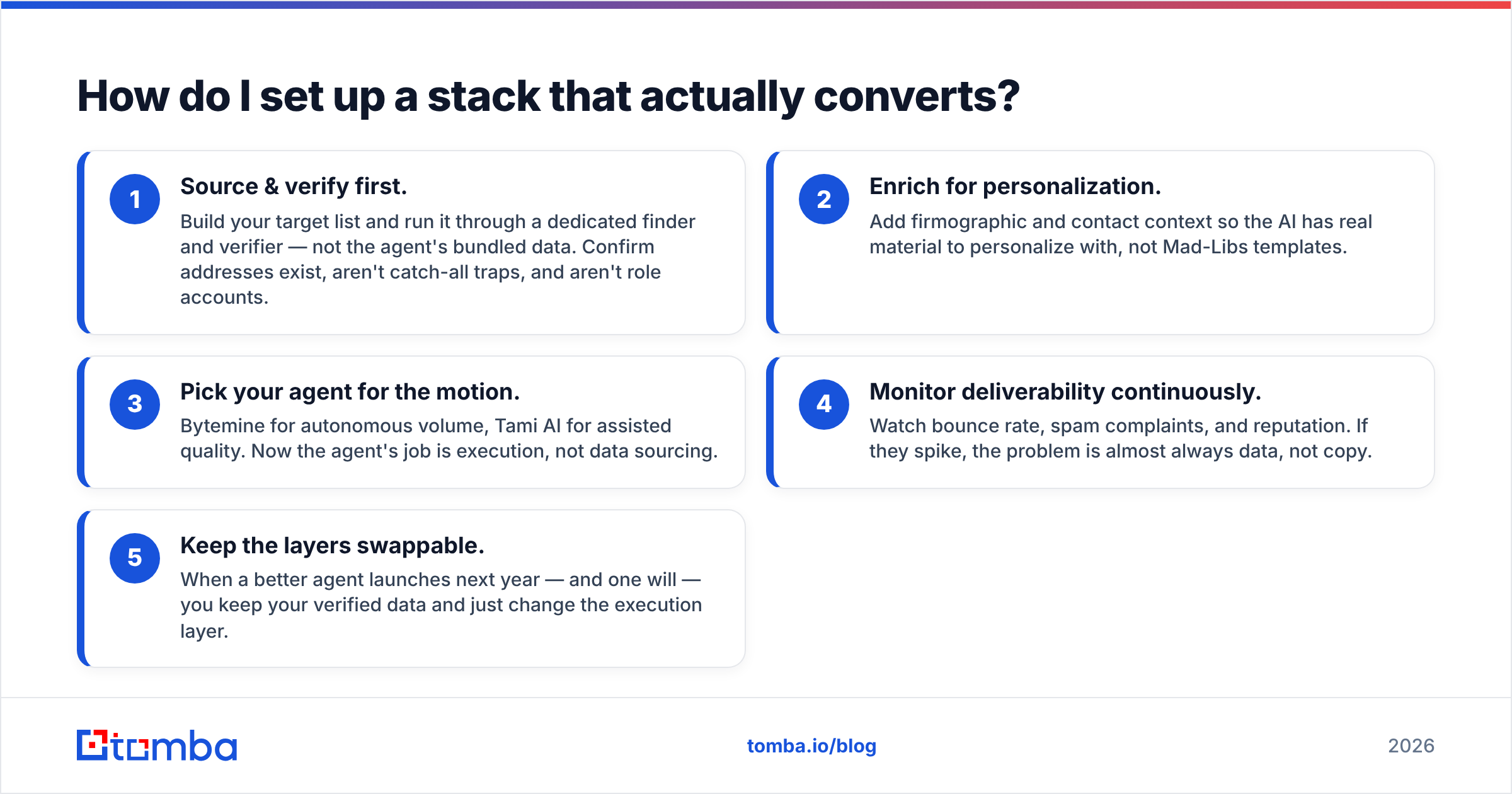
How do I set up a stack that actually converts?#
A clean, vendor-agnostic outbound stack in 2026 looks like this:
- Source & verify first. Build your target list and run it through a dedicated finder and verifier — not the agent's bundled data. Confirm addresses exist, aren't catch-all traps, and aren't role accounts.
- Enrich for personalization. Add firmographic and contact context so the AI has real material to personalize with, not Mad-Libs templates.
- Pick your agent for the motion. Bytemine for autonomous volume, Tami AI for assisted quality. Now the agent's job is execution, not data sourcing.
- Monitor deliverability continuously. Watch bounce rate, spam complaints, and reputation. If they spike, the problem is almost always data, not copy.
- Keep the layers swappable. When a better agent launches next year — and one will — you keep your verified data and just change the execution layer.
This is the same principle Gartner pushes in its sales technology guidance: own your data foundation, treat applications as replaceable. Tools churn; clean contact data compounds.
Frequently asked questions#
Is Bytemine or Tami AI better for a two-person startup? Bytemine, usually — autonomy lets a tiny team punch above its weight. Just pair it with independent verification so you're not auto-sending to bad addresses.
Can Tami AI fully replace an SDR? Not by design. It's an assistant that keeps a human on the send button. If you want full replacement, Bytemine's model is closer, with the data caveats above.
Do either of them guarantee email accuracy? No. Both bundle data without transparent verification. That's why running your own email verification pass is the single highest-ROI step in either stack.
What about phone outreach? Both focus on email-first motions. If calling is part of your play, you'll want a dedicated phone finder feeding verified numbers in.
The bottom line#
Bytemine and Tami AI are both legitimate AI SDR tools — they just sit on opposite ends of the autonomy-versus-control spectrum. Bytemine bets on machine-driven volume and signal timing; Tami AI bets on human-reviewed personalization. Pick based on whether your market rewards reach or finesse.
But don't let the agent decision distract you from the one that actually moves pipeline: your data. Whichever AI you run, it can only email the addresses you give it. Start with verified, transparently sourced contacts and the agent does its job; start with guesses and you've automated failure.
Build your foundation first. Use the Tomba Email Finder to source and verify contacts before they ever touch Bytemine or Tami AI — accurate data in, real meetings out. Spin up a free account, run your target list through verification, and watch your bounce rate drop before you spend a dollar on automation.
Ready to find emails that actually work?
Join 150,000+ professionals who stopped guessing and started sending. Free credits on signup — no credit card required.
Get the Tomba newsletter
Practical outbound tactics and product updates — once every two weeks.
About the author