Bytemine vs UpLead 2026: B2B Data & Email Finder Compared
Bytemine vs UpLead in 2026: an honest, side-by-side breakdown of data accuracy, pricing, coverage, and which B2B lead tool actually fits your outbound stack.
Bytemine vs UpLead: Which B2B Data Tool Should You Buy in 2026?
You are choosing between two B2B data platforms that promise the same thing — clean contact records you can actually email — and you want to know which one wastes less of your budget on bounced sends and stale records. Here is the short version, then the evidence.
TL;DR#
- UpLead is the more mature, self-serve choice: a ~155M+ contact database, real-time email verification at export, and transparent credit pricing starting around $99/mo.
- Bytemine positions itself as a lean B2B prospecting and data tool with firmographic filters and list-building, but it has a smaller public footprint, thinner third-party reviews, and less published accuracy data.
- Accuracy is the whole game. UpLead's verify-on-export model protects your sender reputation better than exporting unverified lists; confirm Bytemine verifies at the point of export before you trust a list.
- Pricing favors UpLead for transparency, but credit-based plans get expensive fast at scale — watch the cost-per-verified-contact, not the sticker price.
- If you mainly need accurate emails at a low entry price, a focused email finder like Tomba ($49/mo Starter) often beats paying for a full database you won't fully use.
What are Bytemine and UpLead?#
Both tools live in the same category: B2B contact and company data platforms that help sales and marketing teams build targeted prospect lists. Think of them as two competing libraries. Both lend you the same kind of book — a contact record with a name, title, company, and email — but they differ in how big the collection is, how often the shelves get re-checked for outdated copies, and how much you pay for a library card.
UpLead is a US-based prospecting platform built around a large company and contact database with firmographic and technographic filters, intent data, and email verification at the moment you export. It is a known quantity on review sites like G2 and Capterra, with thousands of public reviews.
Bytemine markets itself as a B2B data and prospecting tool focused on list-building with company and contact filters. Its public review footprint is much thinner, and it publishes less hard data about database size and verification methodology. That does not make it bad — newer or leaner tools can be excellent value — but it does mean you should validate its claims with a free trial before committing budget.

How do Bytemine and UpLead compare at a glance?#
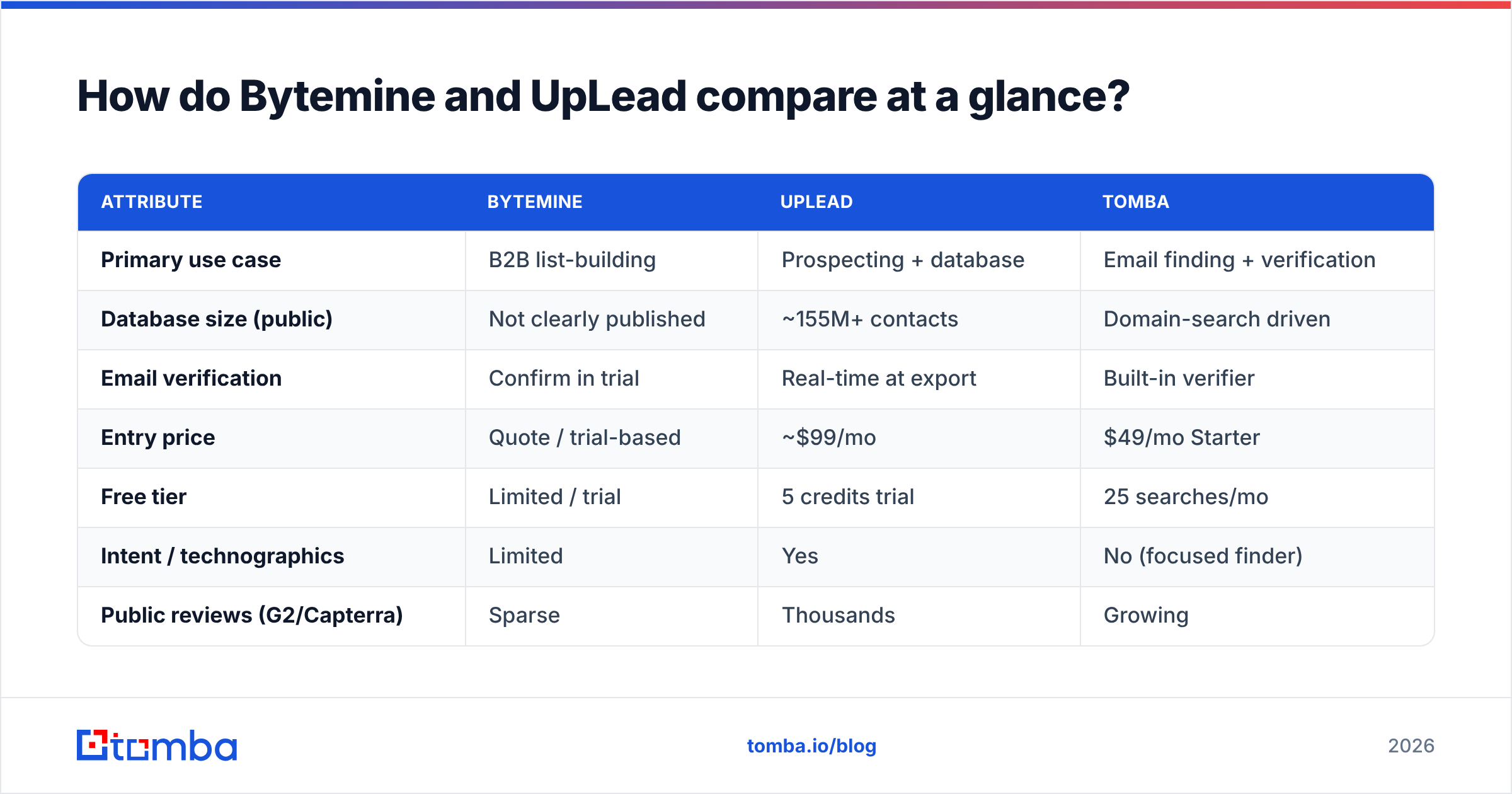
Here is the core-concept comparison. Treat any number a vendor does not publish openly as "verify in trial," not as a strength.
| Attribute | Bytemine | UpLead | Tomba |
|---|---|---|---|
| Primary use case | B2B list-building | Prospecting + database | Email finding + verification |
| Database size (public) | Not clearly published | ~155M+ contacts | Domain-search driven |
| Email verification | Confirm in trial | Real-time at export | Built-in verifier |
| Entry price | Quote / trial-based | ~$99/mo | $49/mo Starter |
| Free tier | Limited / trial | 5 credits trial | 25 searches/mo |
| Intent / technographics | Limited | Yes | No (focused finder) |
| Public reviews (G2/Capterra) | Sparse | Thousands | Growing |
| API access | Check plan | Yes | Yes (REST) |
Two takeaways. First, UpLead wins on transparency and ecosystem maturity — you can read what hundreds of real buyers say before paying. Second, if your actual need is "find and verify emails for a target list" rather than "browse a giant database with intent signals," a dedicated finder is a cheaper, simpler path.
Which has better data accuracy?#
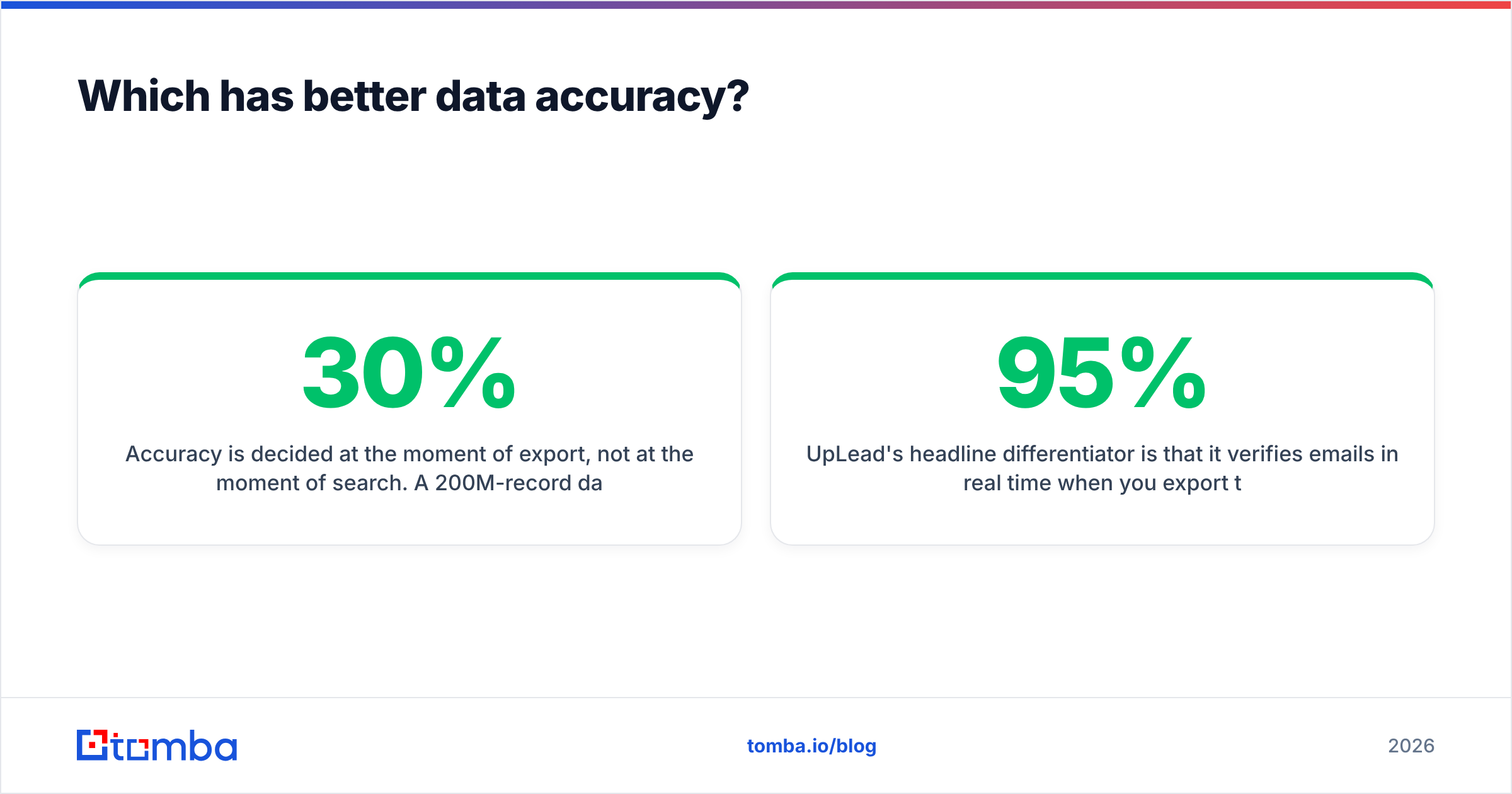
Accuracy is decided at the moment of export, not at the moment of search. A 200M-record database means nothing if 30% of the emails bounce.

UpLead's headline differentiator is that it verifies emails in real time when you export them, and the company has publicly cited a 95% accuracy guarantee. That model is the right one: you only spend a credit on a record that passed a live check, so your bounce rate stays low and your domain reputation stays intact. In practice, no vendor hits 95% on every segment — niche industries, smaller companies, and non-US regions are always weaker — but verify-on-export is structurally safer than exporting a raw list.
Bytemine's accuracy claims are harder to pin down from public sources. Before you trust it for cold outreach, run this test in a trial:
- Export a sample of 100 contacts in your real target segment, not a generic one.
- Run them through an independent email verifier to measure the true valid rate.
- Check the catch-all ratio — catch-all domains accept everything and hide dead inboxes. Use a catch-all verifier to see how many "valid" results are really unknowns.
- Send a small warm batch and watch the actual bounce rate over 48 hours.
Whatever the dashboard claims, your own bounce rate is the only number that matters. If a tool can't survive that 100-contact test, the database size is irrelevant. For context on how providers assemble and refresh records, Tomba documents its data sources openly — ask both Bytemine and UpLead for the same transparency.
How do Bytemine and UpLead pricing compare?#
UpLead uses transparent, credit-based tiers. Bytemine typically routes you through a trial or quote, which makes apples-to-apples comparison harder up front.
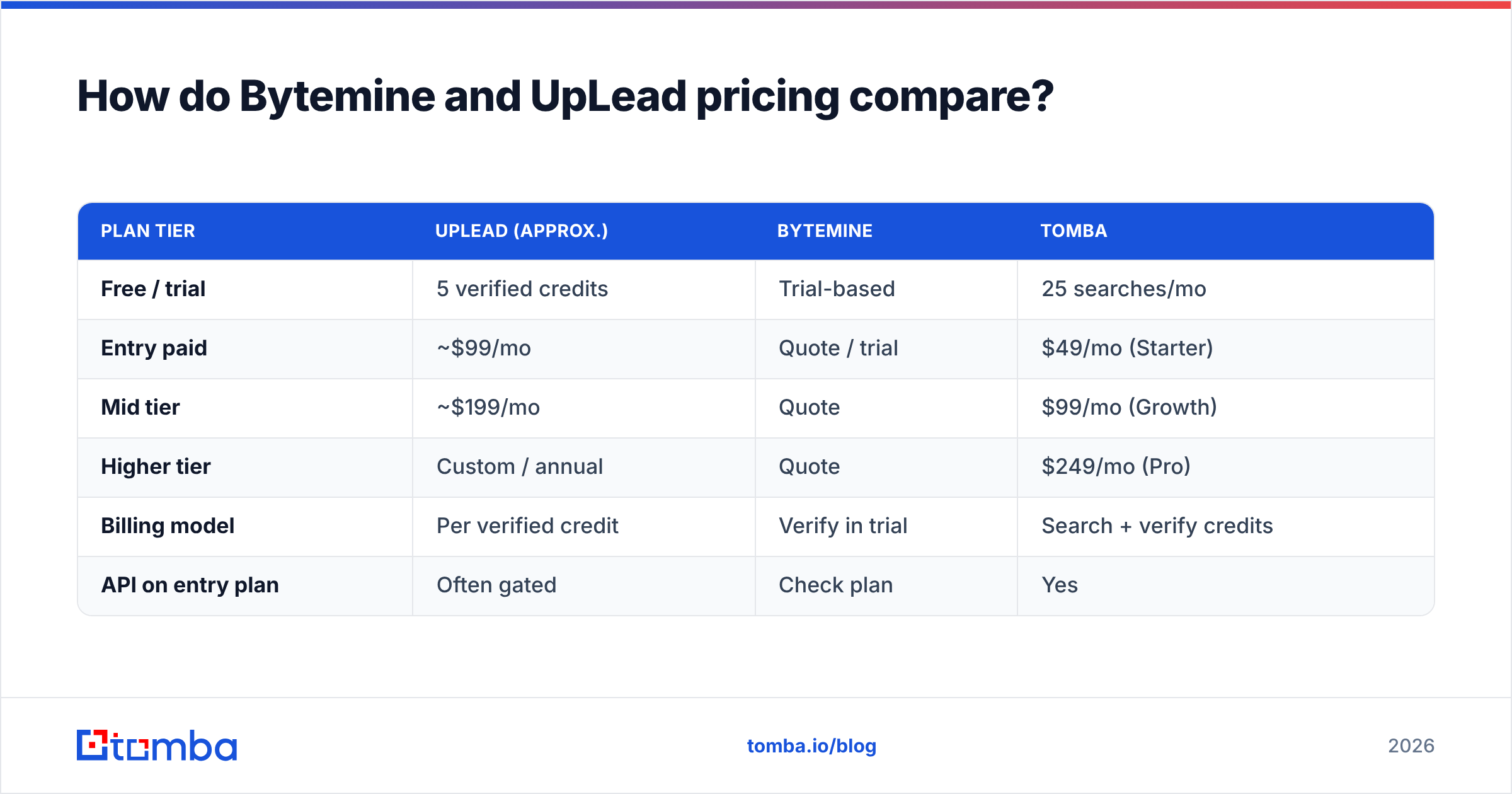
| Plan tier | UpLead (approx.) | Bytemine | Tomba |
|---|---|---|---|
| Free / trial | 5 verified credits | Trial-based | 25 searches/mo |
| Entry paid | ~$99/mo | Quote / trial | $49/mo (Starter) |
| Mid tier | ~$199/mo | Quote | $99/mo (Growth) |
| Higher tier | Custom / annual | Quote | $249/mo (Pro) |
| Billing model | Per verified credit | Verify in trial | Search + verify credits |
| API on entry plan | Often gated | Check plan | Yes |
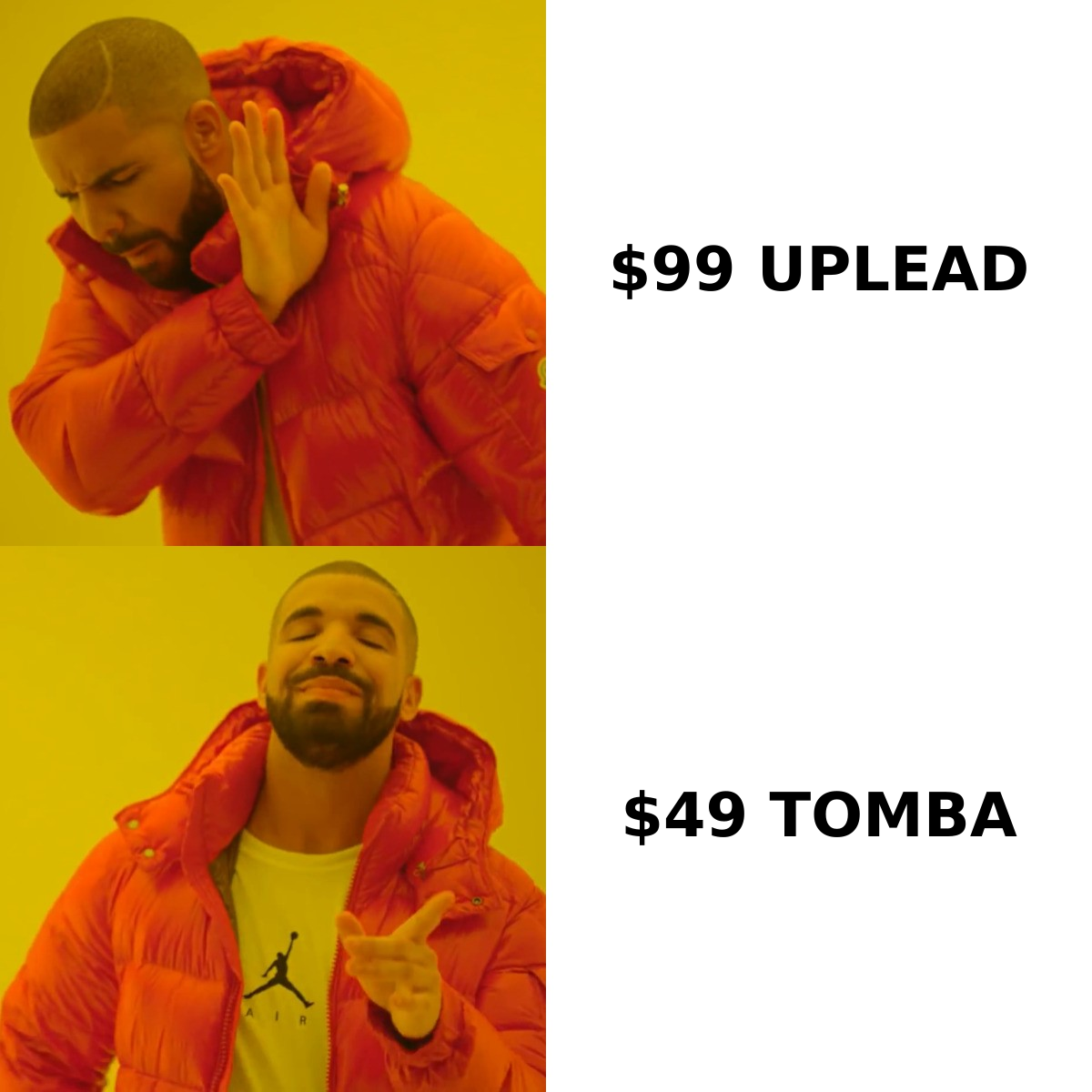
The trap with credit pricing is the cost per usable contact. A $99/mo plan that gives you, say, a few hundred credits can work out to a meaningful per-record cost once you factor out the records you discard. Always divide the monthly price by the number of contacts you will actually email, not the number of credits on paper.
If your monthly need is "a few hundred to a few thousand verified emails," a focused finder priced at $49/mo frequently beats a $99+ database subscription — you pay for finding and verifying emails, not for intent graphs and technographic filters you may never open. Check current Tomba pricing against your real volume before assuming the bigger platform is the better deal.
Which tool fits which team?#
There is no universal winner — there is a best fit for your motion.
- Choose UpLead if you want a self-serve database with intent data, technographics, and a mature ecosystem, and your budget comfortably absorbs $99–$199/mo. It is the safer pick for a team that wants to browse and filter a large universe of accounts.
- Choose Bytemine if its trial proves competitive accuracy in your specific segment at a price that undercuts UpLead. Run the 100-contact test first; do not buy on marketing claims.
- Choose a dedicated email finder if your bottleneck is simply "I have a list of companies and people, I need their verified emails." Tools like Tomba's domain search and email finder solve that directly without the database overhead, and you can pull results into your CRM via the Tomba API or a no-code integration.
A practical hybrid many teams run: use a database tool to discover target accounts, then use a finder-plus-verifier to fill and clean the contact emails before they hit the sequencer. That keeps your bounce rate low without paying enterprise data prices for every record.
What do real buyers say about UpLead and Bytemine?#
Public review volume is itself a signal. UpLead has thousands of reviews across G2 and Capterra, with consistent praise for verification quality and ease of use, and recurring complaints about credit limits and per-seat costs at scale. That density of feedback lets you predict your own experience.
Bytemine's sparse public footprint means you are flying with less instrument data. Lean tools can punch above their weight, but you carry more of the verification burden yourself. Lean on a trial, your own bounce data, and direct questions to their team about database freshness and verification cadence.
How to evaluate either tool in one afternoon#
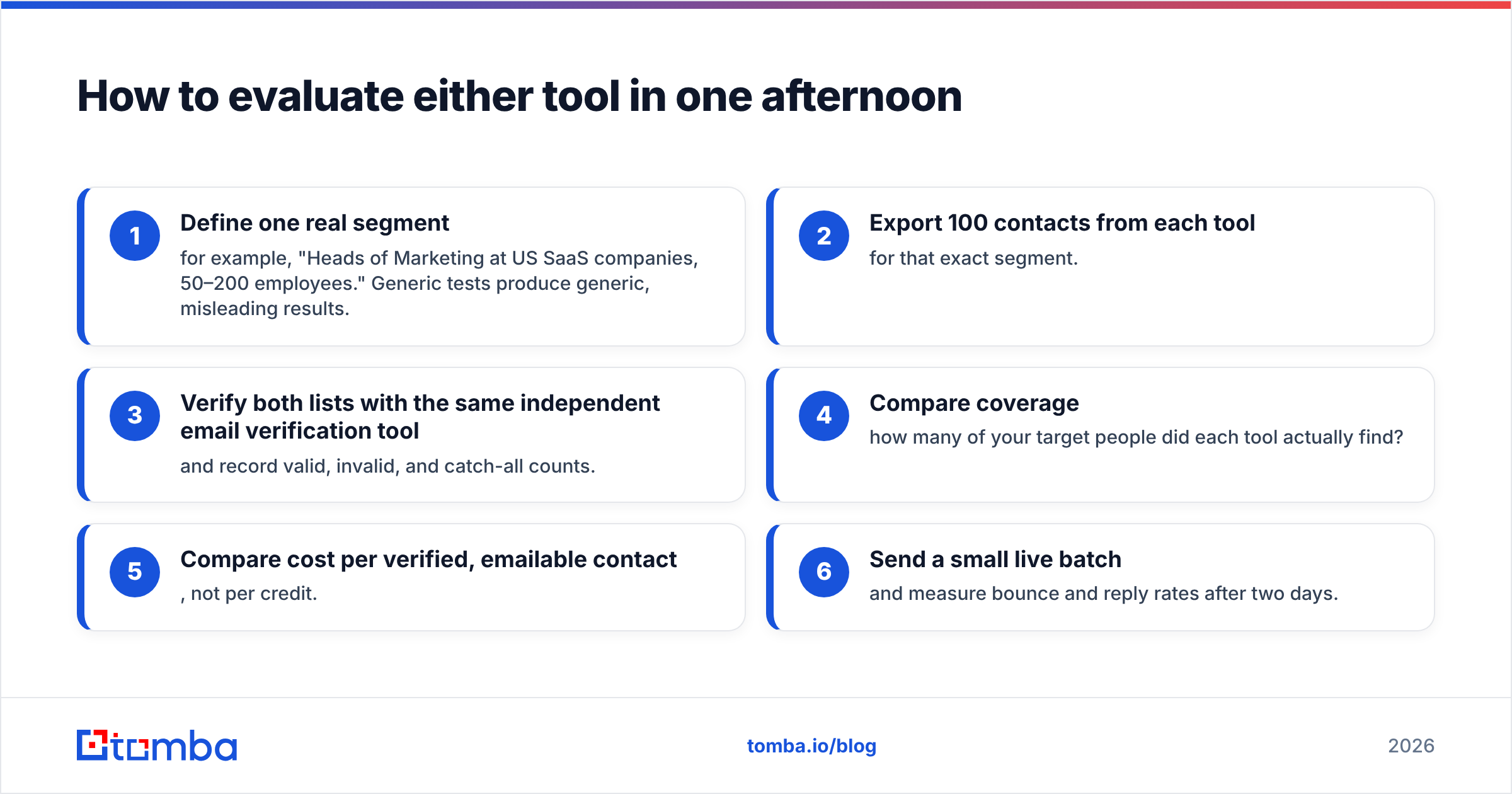
Run the same protocol on both so the comparison is fair:
- Define one real segment — for example, "Heads of Marketing at US SaaS companies, 50–200 employees." Generic tests produce generic, misleading results.
- Export 100 contacts from each tool for that exact segment.
- Verify both lists with the same independent email verification tool and record valid, invalid, and catch-all counts.
- Compare coverage — how many of your target people did each tool actually find?
- Compare cost per verified, emailable contact, not per credit.
- Send a small live batch and measure bounce and reply rates after two days.
Whichever tool delivers the most verified, reply-getting contacts per dollar wins — regardless of which has the flashier dashboard.
Final verdict: Bytemine vs UpLead#
UpLead is the stronger default in this matchup for most teams in 2026: transparent pricing, real-time verification at export, a large database, and a deep well of public reviews to set expectations. Bytemine can be a smart, lower-cost pick — but only if its trial proves accuracy in your segment, since its public data is thin.
But step back and check the real requirement. If you are not buying intent graphs and technographic filters, you are paying database prices to do a finder's job. For teams whose actual need is accurate, verified emails for a defined target list, Tomba's Email Finder delivers exactly that at a $49/mo entry point — with a built-in verifier, domain search, bulk processing, and an API, plus a free tier of 25 searches so you can run the 100-contact accuracy test before you spend a cent. Start there, measure your own bounce rate, and let the data — not the sales page — pick your winner.
Ready to find emails that actually work?
Join 150,000+ professionals who stopped guessing and started sending. Free credits on signup — no credit card required.
Get the Tomba newsletter
Practical outbound tactics and product updates — once every two weeks.
About the author