Bytemine vs Warpleads 2026: Which B2B Lead Tool Wins?
Bytemine and Warpleads both promise high-volume B2B leads, but they win on different fronts. Here's an honest 2026 breakdown of accuracy, pricing, and fit.
Choosing between Bytemine and Warpleads usually comes down to one question you do not see on either pricing page: do you want more leads, or do you want leads that actually land in an inbox? Both tools pitch volume. Neither volume claim matters if half the addresses bounce.
This is a neutral teardown of how the two stack up in 2026 — where each genuinely wins, where the marketing oversells, and when a dedicated email-finding-and-verification stack beats either one.
TL;DR#
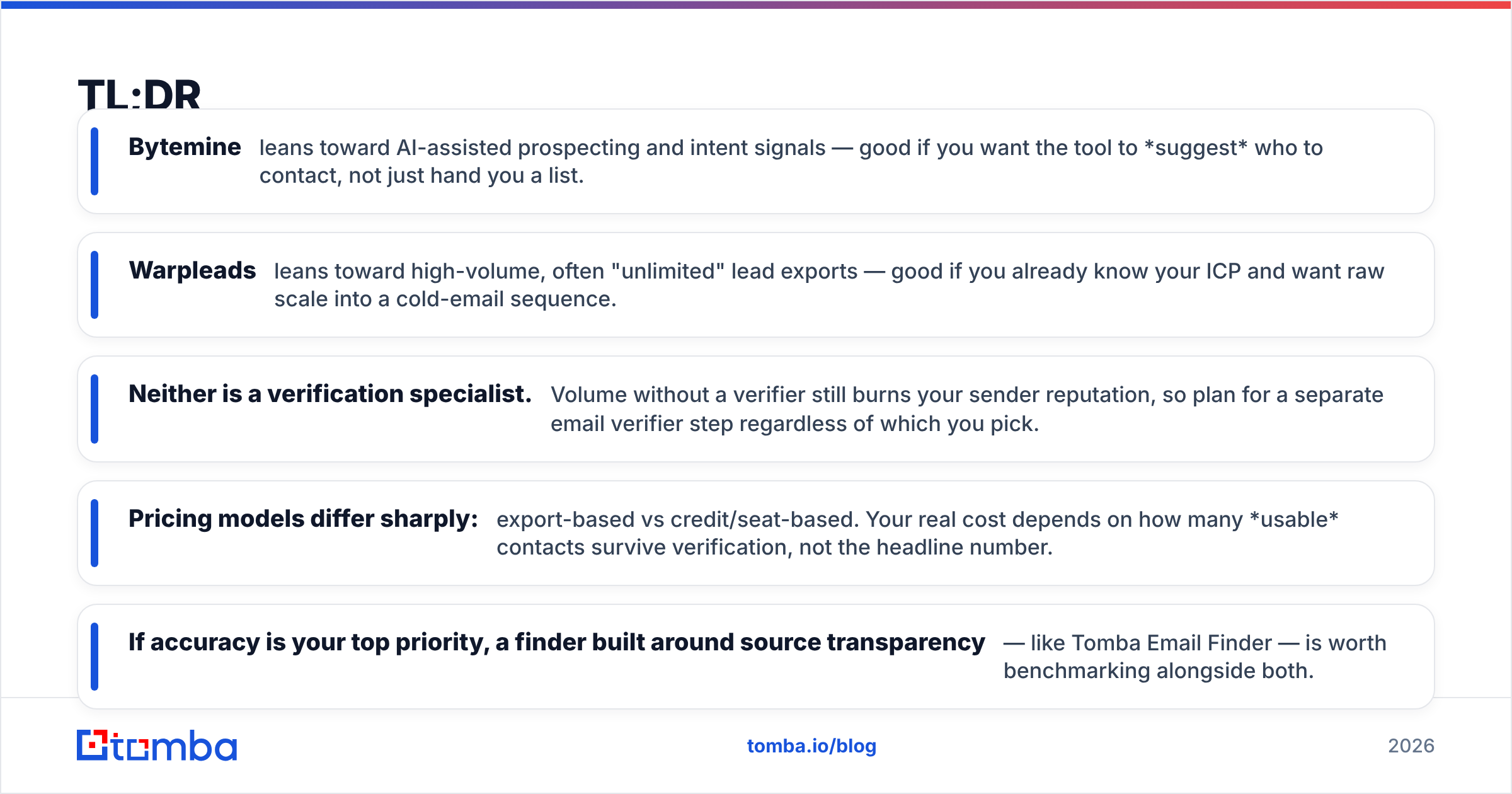
- Bytemine leans toward AI-assisted prospecting and intent signals — good if you want the tool to suggest who to contact, not just hand you a list.
- Warpleads leans toward high-volume, often "unlimited" lead exports — good if you already know your ICP and want raw scale into a cold-email sequence.
- Neither is a verification specialist. Volume without a verifier still burns your sender reputation, so plan for a separate email verifier step regardless of which you pick.
- Pricing models differ sharply: export-based vs credit/seat-based. Your real cost depends on how many usable contacts survive verification, not the headline number.
- If accuracy is your top priority, a finder built around source transparency — like Tomba Email Finder — is worth benchmarking alongside both.
What are Bytemine and Warpleads?#
Bytemine positions itself as an AI-driven B2B lead generation platform. The pitch is that it does more than search a database — it helps you decide who to reach based on firmographic and intent-style signals, then surfaces contact data for those accounts. You spend less time building lists by hand and more time reviewing a curated set.
Warpleads sits on the opposite end of the philosophy spectrum. Its headline feature is high-volume lead export, frequently marketed around "unlimited" or very large export ceilings. The assumption is that you already know your ideal customer profile and want to pour qualified-looking contacts into a cold outreach engine at scale.
Here is the honest framing: Bytemine optimizes for selection, Warpleads optimizes for volume. That single difference predicts almost everything else — pricing shape, data freshness trade-offs, and who each tool is actually built for.

How accurate is the data — Bytemine vs Warpleads?#
Accuracy is where volume-first tools quietly lose money for you. A list of 50,000 contacts at a 70% deliverable rate is functionally a list of 35,000 — and the 15,000 bad rows do real damage by inflating your bounce rate and dragging down sender reputation.
Bytemine's AI-curation angle can mean cleaner targeting, because it narrows before it hands you contacts. But narrower targeting is not the same as verified email addresses. Warpleads' volume model, by design, prioritizes coverage over per-record validation.
Two practical rules survive any vendor's marketing:
- Never trust an unverified export. Whatever the source, run contacts through verification before they touch a live sequence.
- Watch for catch-all domains. A domain that accepts everything will pass a naive check and bounce anyway — you need a real catch-all verifier to separate the deliverable from the dangerous.
This is the gap a dedicated finder fills. Tools that publish where their data comes from and bundle verification give you a deliverable number you can actually trust, rather than a raw count you have to discount.

Bytemine vs Warpleads vs Tomba: feature comparison#
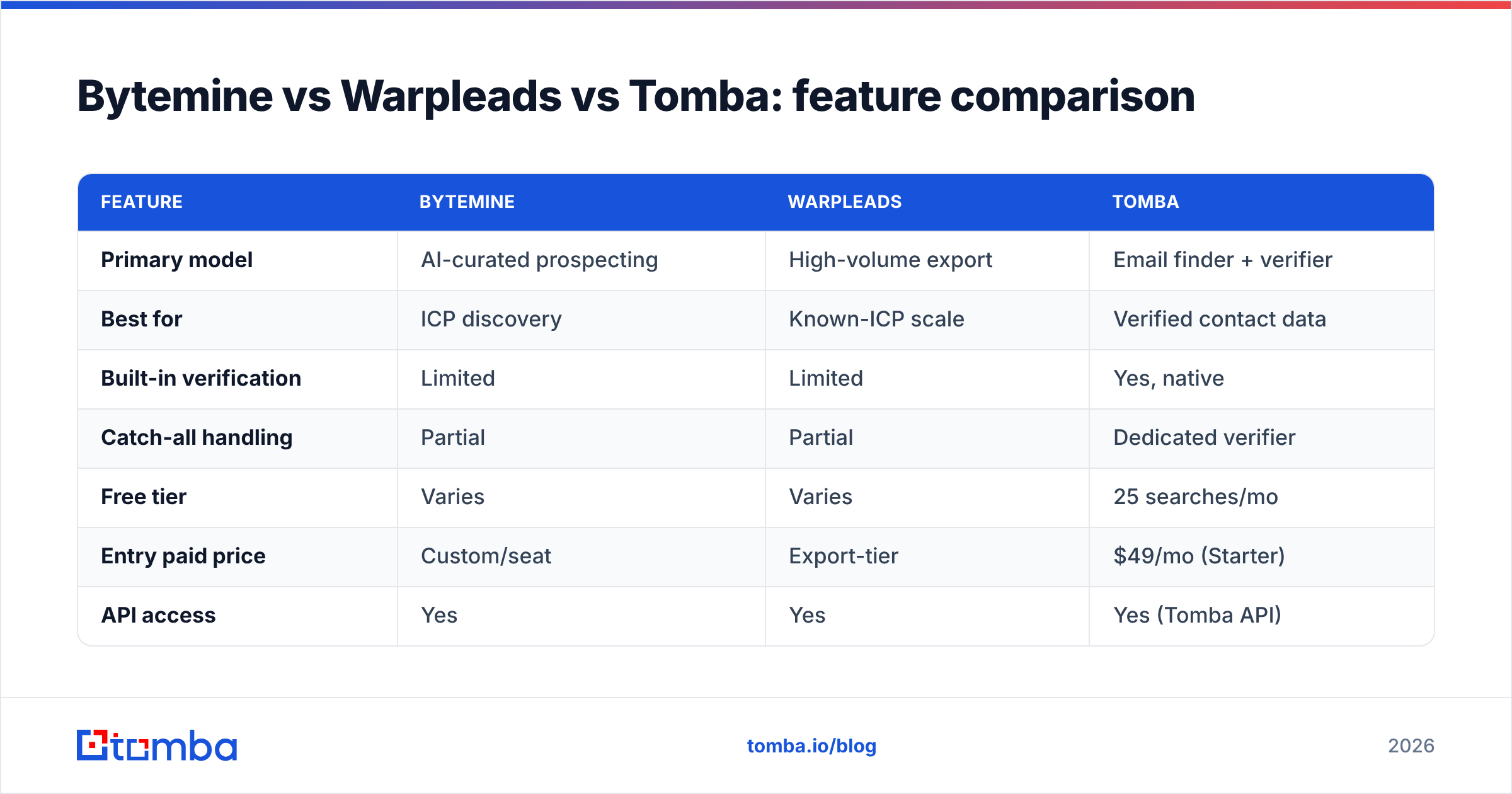
Here is the side-by-side. Treat the Tomba column as the "accuracy-first" reference point rather than a like-for-like clone of either tool.
| Feature | Bytemine | Warpleads | Tomba |
|---|---|---|---|
| Primary model | AI-curated prospecting | High-volume export | Email finder + verifier |
| Best for | ICP discovery | Known-ICP scale | Verified contact data |
| Built-in verification | Limited | Limited | Yes, native |
| Catch-all handling | Partial | Partial | Dedicated verifier |
| Free tier | Varies | Varies | 25 searches/mo |
| Entry paid price | Custom/seat | Export-tier | $49/mo (Starter) |
| API access | Yes | Yes | Yes (Tomba API) |
| Data source transparency | Limited | Limited | Published |
A few honest caveats. Bytemine and Warpleads both iterate quickly, so exact tier names and ceilings shift — confirm current numbers on their own sites before you commit. And "best for" is about fit, not a quality ranking: if your motion genuinely needs raw volume and you have a strong verification step downstream, Warpleads' model is legitimately useful.
Which pricing model actually costs less?#
The cheaper headline is rarely the cheaper outcome. Cost-per-usable-contact is the only metric that matters, and it depends on three things:
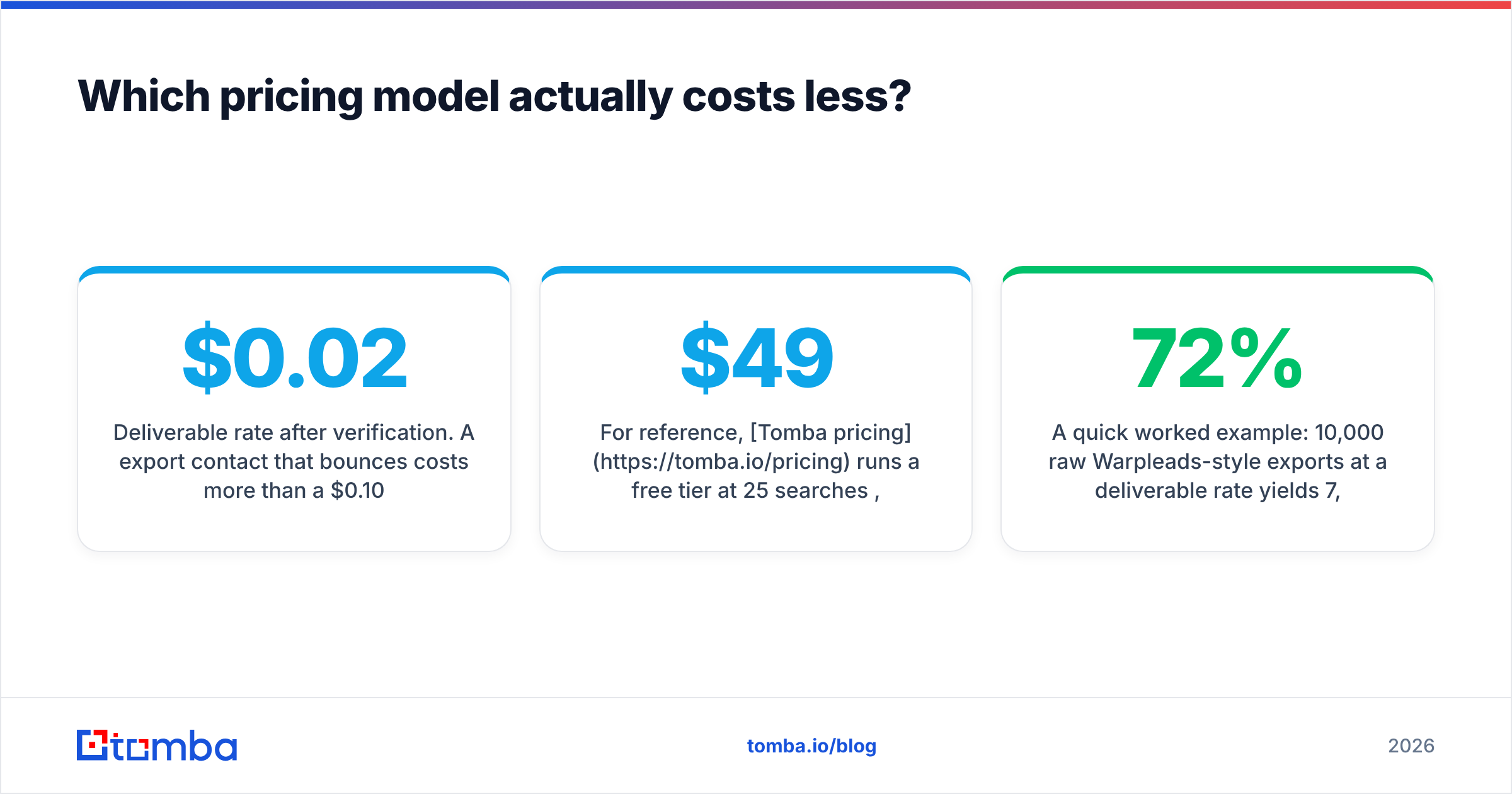
- Deliverable rate after verification. A $0.02 export contact that bounces costs more than a $0.10 verified one that converts.
- Wasted sending capacity. Bad addresses consume daily sending limits and warmup headroom you paid for elsewhere.
- Reputation damage. High bounce rates can throttle an entire domain, which is a cost that never shows up on the lead vendor's invoice.
For reference, Tomba pricing runs a free tier at 25 searches/month, Starter at $49/mo, Growth at $99/mo, and Pro at $249/mo, with verification included rather than billed as a separate add-on. When you compare against an export-priced tool, normalize both to "verified contacts delivered," not "rows exported."
A quick worked example: 10,000 raw Warpleads-style exports at a 72% deliverable rate yields 7,200 usable contacts. The same budget on a verified-first finder might yield fewer raw rows but a 95%+ deliverable rate — and your bounce rate, not your spreadsheet, decides whether the next campaign even sends.
Which should you choose — and when?#
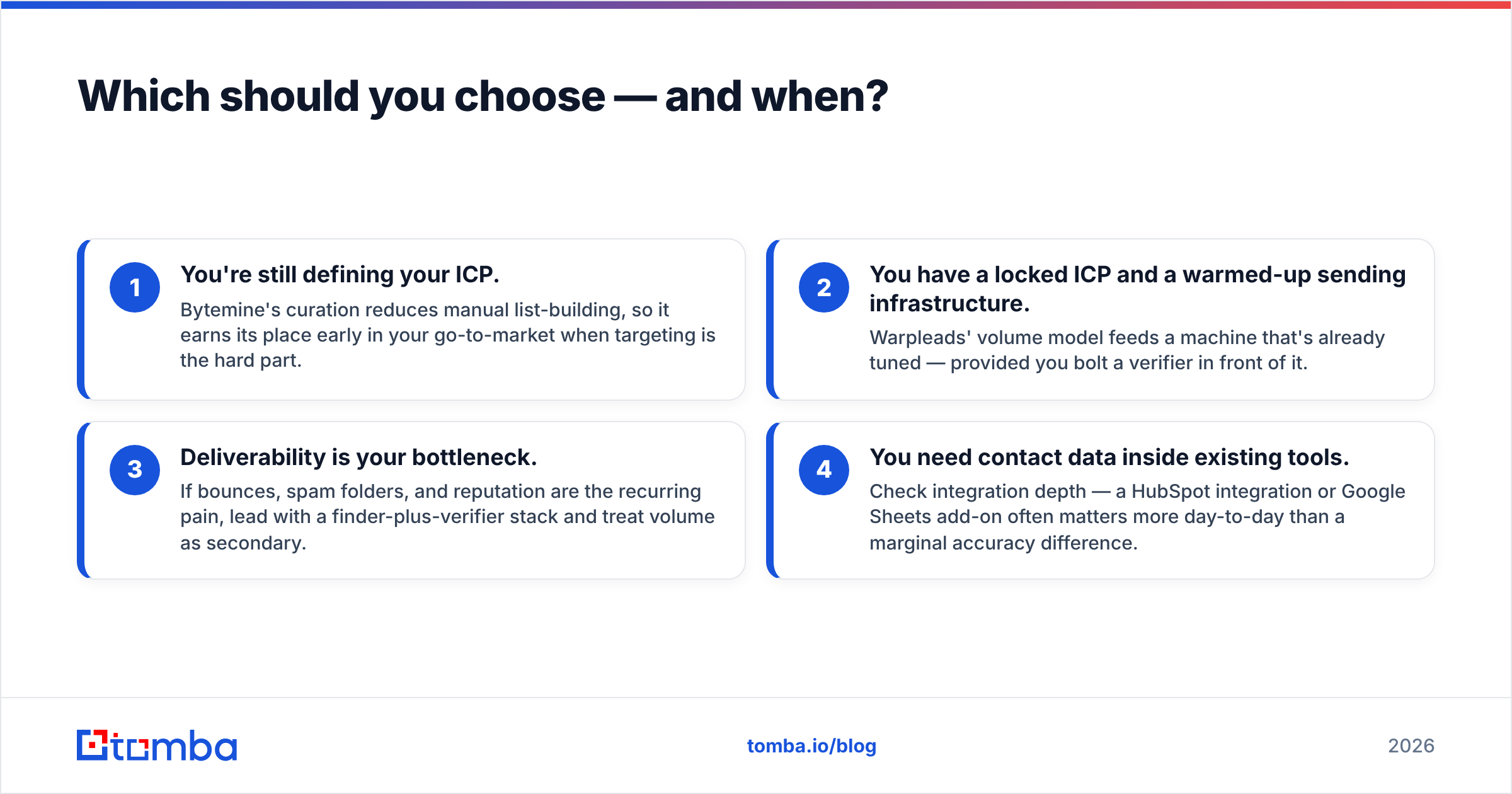
Match the tool to your motion, not to the loudest feature list:
- You're still defining your ICP. Bytemine's curation reduces manual list-building, so it earns its place early in your go-to-market when targeting is the hard part.
- You have a locked ICP and a warmed-up sending infrastructure. Warpleads' volume model feeds a machine that's already tuned — provided you bolt a verifier in front of it.
- Deliverability is your bottleneck. If bounces, spam folders, and reputation are the recurring pain, lead with a finder-plus-verifier stack and treat volume as secondary.
- You need contact data inside existing tools. Check integration depth — a HubSpot integration or Google Sheets add-on often matters more day-to-day than a marginal accuracy difference.
The pattern across all four: volume tools and curation tools both assume you'll handle verification. The moment you stop assuming that and make it a first-class step, your numbers stabilize regardless of which lead source you started from.
For broader options, it's also worth scanning the wider market on a neutral review site like G2 before committing to an annual plan — category leaders shift faster than any single comparison post can track. And if you're integrating into a CRM-heavy workflow, vendor documentation such as HubSpot's own guides on list hygiene reinforces why verification can't be skipped.
What about deliverability after the leads land?#
Finding the email is half the job. The other half is making sure it arrives. Even a perfectly verified list underperforms on a domain with no SPF/DKIM/DMARC alignment or a cold sending reputation. If your bounce and spam rates stay high after you fix data quality, the problem has moved downstream to email deliverability, and no lead vendor can fix that for you.
Two fast checks before any campaign:
- Validate your sending setup. Confirm authentication records are correct — a misconfigured SPF record alone can route good mail to spam.
- Verify in bulk, then segment. Run the full list through verification, quarantine catch-alls and risky addresses, and send to the clean tier first to protect your reputation.
This is why pairing any finder — Bytemine, Warpleads, or otherwise — with strong verification and deliverability hygiene beats chasing a bigger raw number.
The verdict#
There is no universal winner between Bytemine and Warpleads, because they solve different problems. Bytemine wins when who to contact is your hard question. Warpleads wins when how many is your hard question and your infrastructure is ready for scale. Both share the same blind spot: neither is a verification specialist, so both demand a clean-up step you have to own.
If your real goal is verified, deliverable B2B contacts with transparent sourcing — not just a longer list — start with a finder built around accuracy. Tomba Email Finder finds professional addresses by domain, name, or company, includes native verification and catch-all checks, and starts free at 25 searches a month before scaling to $49/mo. Run the same target accounts through it alongside Bytemine and Warpleads, compare the deliverable counts side by side, and let your bounce rate pick the winner.
Ready to find emails that actually work?
Join 150,000+ professionals who stopped guessing and started sending. Free credits on signup — no credit card required.
Get the Tomba newsletter
Practical outbound tactics and product updates — once every two weeks.
About the author