Bytemine vs ZoomInfo 2026: Which B2B Data Tool Wins?
Bytemine vs ZoomInfo, broken down by pricing, data accuracy, contracts, and fit. See which B2B data tool actually earns your budget in 2026 — and the cheaper third option.
TL;DR
- Bytemine is a lean, usage-friendly B2B data and email-finding tool aimed at small teams who want contacts without a sales call or an annual contract.
- ZoomInfo is the enterprise heavyweight: massive database, intent data, and workflow tooling — wrapped in multi-thousand-dollar annual contracts and seat minimums.
- The honest answer to "bytemine vs zoominfo" depends on scale: solo founders and SMB outbound teams rarely need ZoomInfo's depth or price tag; large RevOps orgs often do.
- Data accuracy is closer than the marketing suggests. Both decay; what matters is verification at send time, not the headline record count.
- If your real job is "find and verify work emails by domain without a contract," a focused tool like Tomba Email Finder covers most of that need from $49/mo — no annual lock-in.
What are Bytemine and ZoomInfo?#
Bytemine and ZoomInfo both sell the same core promise — accurate B2B contact data — but to very different buyers.
Bytemine positions itself as a no-friction lead intelligence and email-finder tool. You search a company or person, you get an email, you move on. Pricing is transparent and self-serve, and it leans toward individuals and small outbound teams who want results this afternoon, not after a procurement cycle.
ZoomInfo is the category's 800-pound gorilla. It's not just contact data — it's a full go-to-market platform: intent signals, org charts, technographics, workflow automation, conversation intelligence, and CRM enrichment. That breadth is real, and so is the price: ZoomInfo is famous for annual contracts that routinely land in the five-figure range, with seat minimums and add-on modules that stack quickly.
Think of it like transport. Bytemine is a reliable car you own outright — cheap to run, gets you where you're going. ZoomInfo is a chartered jet with a crew: enormously capable, but you're signing a contract and paying for the whole aircraft whether you fill the seats or not.

How do Bytemine and ZoomInfo compare on pricing?#
Pricing is where the two diverge hardest, and it's usually the deciding factor.
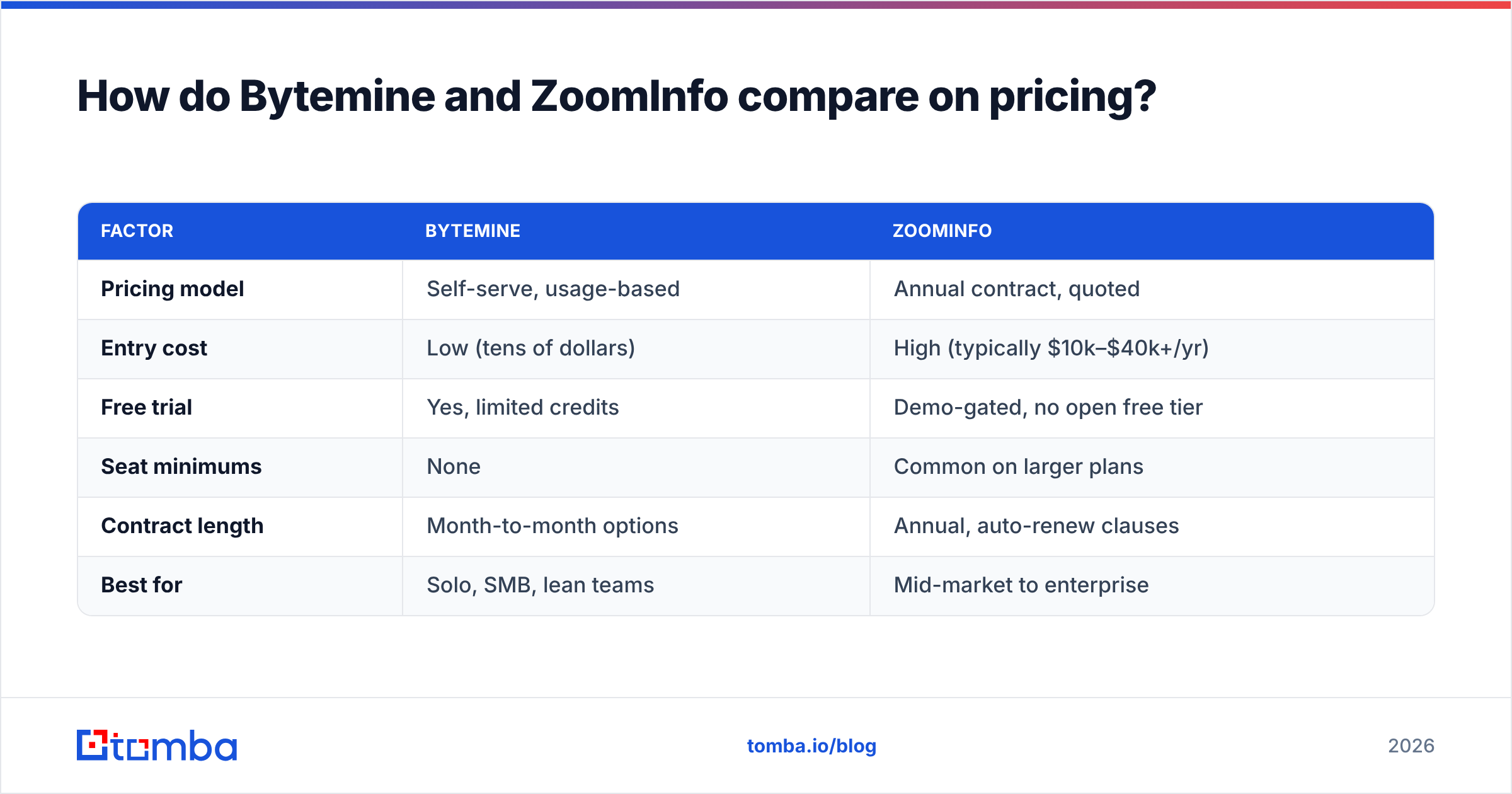
| Factor | Bytemine | ZoomInfo |
|---|---|---|
| Pricing model | Self-serve, usage-based | Annual contract, quoted |
| Entry cost | Low (tens of dollars) | High (typically $10k–$40k+/yr) |
| Free trial | Yes, limited credits | Demo-gated, no open free tier |
| Seat minimums | None | Common on larger plans |
| Contract length | Month-to-month options | Annual, auto-renew clauses |
| Best for | Solo, SMB, lean teams | Mid-market to enterprise |
The pattern is clear: Bytemine wins on accessibility, ZoomInfo wins on capability. ZoomInfo rarely publishes prices because deals are negotiated — and that opacity itself is a cost. You spend time in demos, negotiation, and legal review before you find a single email.
For most small teams, the math is brutal. If you need a few hundred verified emails a month, paying enterprise pricing for a platform you'll use at 5% capacity is hard to justify. That's exactly the gap leaner tools — including Tomba — were built to fill. You can compare a transparent, published rate card on the Tomba pricing page in under a minute, no quote required.

Is ZoomInfo more accurate than Bytemine?#
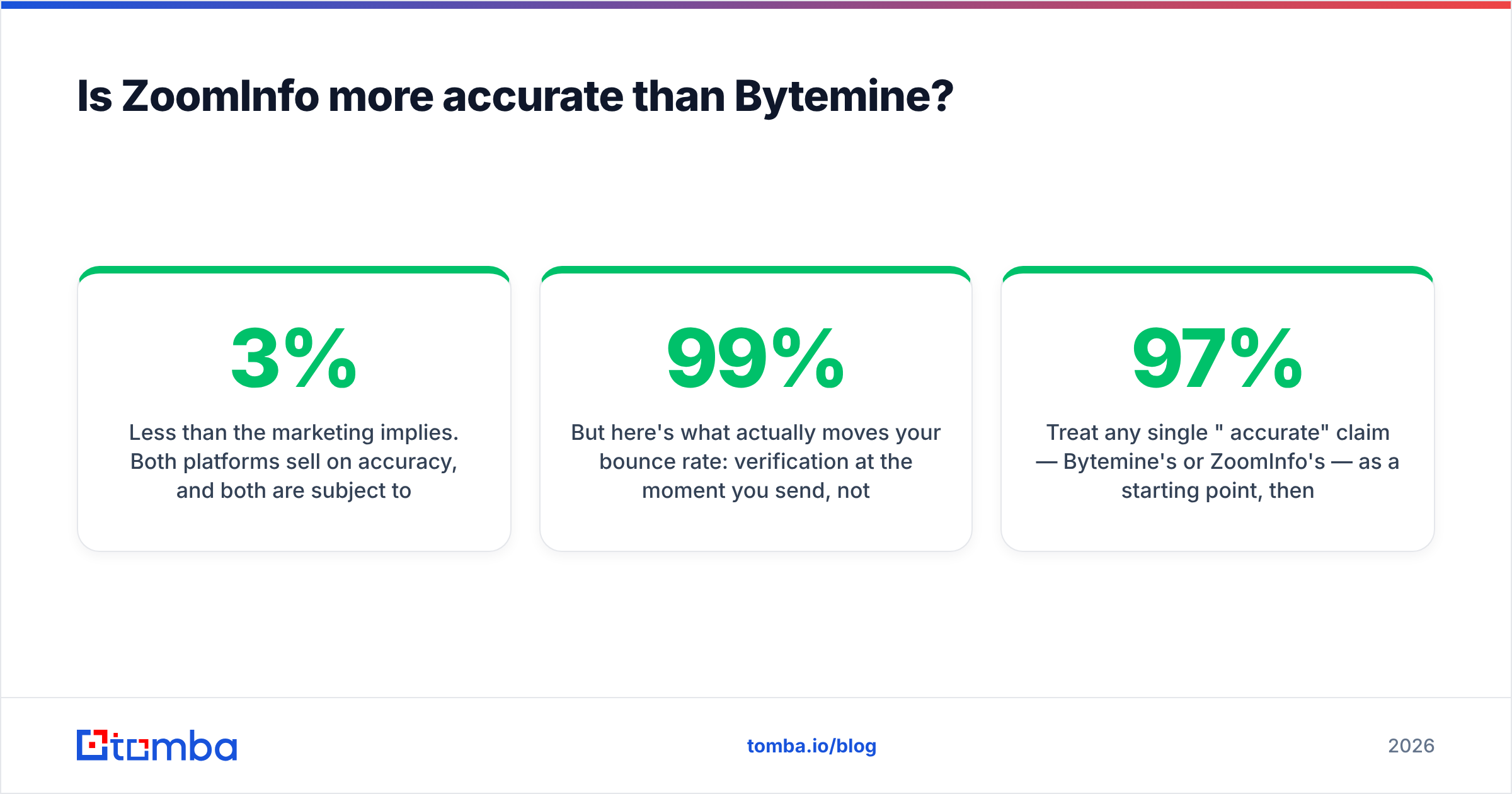
Less than the marketing implies. Both platforms sell on accuracy, and both are subject to the same hard reality: B2B data decays roughly 2-3% per month as people change jobs, companies rebrand, and domains shift.
ZoomInfo's advantage is breadth and refresh budget — a huge contributor network and machine learning that re-checks records at scale. Bytemine's advantage is focus: it does fewer things, so its email discovery and pattern detection are tuned tightly for that job.
But here's what actually moves your bounce rate: verification at the moment you send, not the database's headline accuracy claim. A record that was 99% accurate when scraped can be wrong by the time you email it. That's why a separate email verifier step — SMTP checks, catch-all detection, syntax validation — matters more than which vendor's marketing page quotes the higher percentage.
Three things determine real-world accuracy for any of these tools:
- Source diversity — how many independent signals confirm a record. More sources, fewer false positives. Tomba documents its data sources openly.
- Refresh cadence — how often records are re-checked against live signals.
- Live verification — whether the tool re-validates the email at request time instead of serving a stale cache.
Treat any single "97% accurate" claim — Bytemine's or ZoomInfo's — as a starting point, then verify before you hit send.
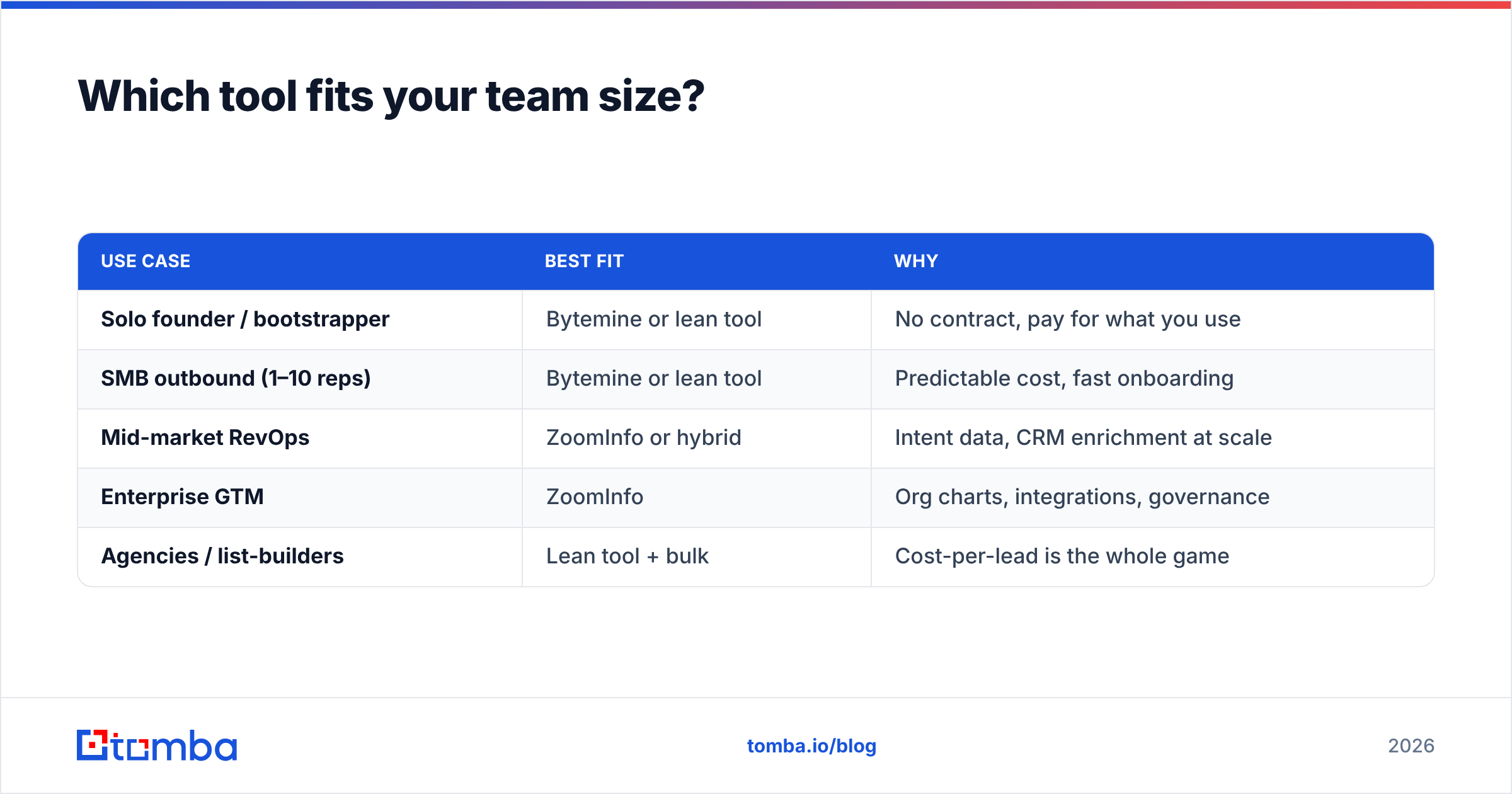
Which tool fits your team size?#
Match the tool to your scale and motion, not to its reputation.
| Use case | Best fit | Why |
|---|---|---|
| Solo founder / bootstrapper | Bytemine or lean tool | No contract, pay for what you use |
| SMB outbound (1–10 reps) | Bytemine or lean tool | Predictable cost, fast onboarding |
| Mid-market RevOps | ZoomInfo or hybrid | Intent data, CRM enrichment at scale |
| Enterprise GTM | ZoomInfo | Org charts, integrations, governance |
| Agencies / list-builders | Lean tool + bulk | Cost-per-lead is the whole game |
ZoomInfo earns its price when you genuinely use the platform: feeding intent signals to an SDR team, enriching thousands of CRM records nightly, mapping buying committees across a complex account. If you have a revenue operations function and a CRM full of records that need continuous enrichment, that depth pays for itself.
If you're running lean — finding contacts, verifying them, dropping them into a sequence — you're paying for a cockpit full of instruments you'll never touch. That's the most common reason teams go looking for an Apollo alternative or a ZoomInfo alternative in the first place: the bill outgrew the use case.
What are the trade-offs of each platform?#
Every tool buys you something and costs you something else. Here's the honest ledger.
Bytemine — pros and cons
- Pro: Low entry cost and self-serve signup — you're productive in minutes.
- Pro: No annual lock-in, so you can leave if it underdelivers.
- Con: Narrower feature set — light on intent data, org charts, and deep enrichment.
- Con: Smaller database than ZoomInfo for niche or international segments.
ZoomInfo — pros and cons
- Pro: Enormous database with strong North American coverage.
- Pro: Intent data, technographics, and workflow tooling in one platform.
- Con: Expensive, with annual contracts and auto-renewal clauses that catch teams off guard.
- Con: Overkill — and overpriced — for simple email-finding jobs.
The recurring complaint with ZoomInfo isn't data quality; it's commercial friction. Auto-renewals, hard-to-exit contracts, and pricing that scales faster than value for smaller teams. The recurring complaint with Bytemine is the opposite: great for the basics, but you may outgrow it if your GTM motion gets sophisticated.
You can sanity-check both reputations on independent review sites like G2 before committing — read the 2- and 3-star reviews, not just the highlights.
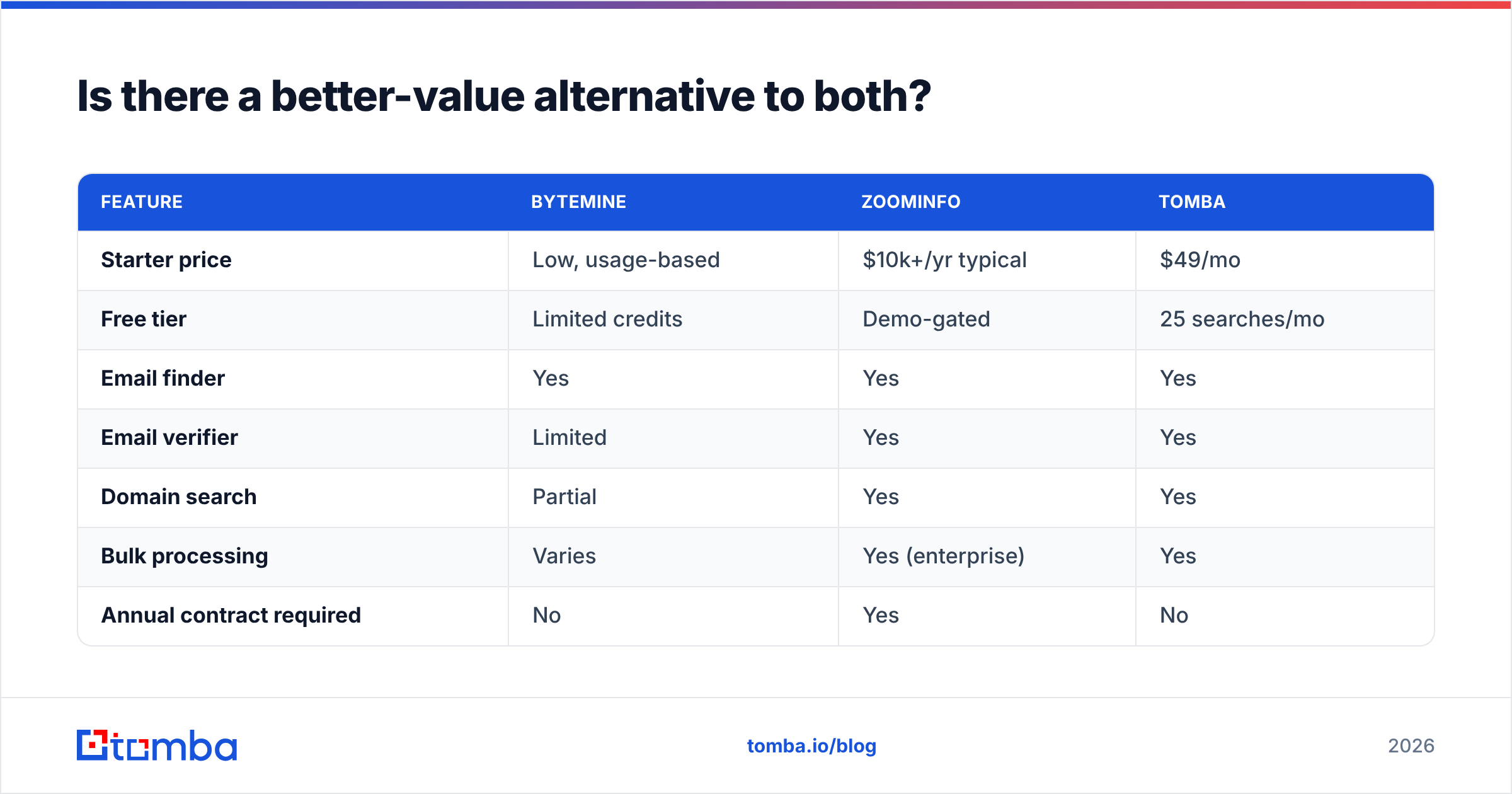
Is there a better-value alternative to both?#
Yes — if your core need is finding and verifying B2B emails without a contract, a focused email-finding platform beats both on cost-per-result.
This is the lane Tomba sits in. It's not trying to be a full GTM suite like ZoomInfo, and it's more transparent and feature-complete on the email side than a minimal tool. Where it fits the "bytemine vs zoominfo" debate:
| Feature | Bytemine | ZoomInfo | Tomba |
|---|---|---|---|
| Starter price | Low, usage-based | $10k+/yr typical | $49/mo |
| Free tier | Limited credits | Demo-gated | 25 searches/mo |
| Email finder | Yes | Yes | Yes |
| Email verifier | Limited | Yes | Yes |
| Domain search | Partial | Yes | Yes |
| Bulk processing | Varies | Yes (enterprise) | Yes |
| Annual contract required | No | Yes | No |
| API access | Varies | Add-on | Included |
Tomba's spread covers the jobs most teams actually run: find email addresses by name or domain, run a domain search to pull every public contact at a company, verify in bulk, and enrich records — all on published pricing that starts at $49/mo (Starter), scaling to Growth at $99/mo and Pro at $249/mo. There's a free tier with 25 searches a month to test accuracy on your own list before paying anything.
The point isn't that Tomba replaces ZoomInfo's intent data or org charts — it doesn't. It's that most teams comparing Bytemine and ZoomInfo never needed those modules. They needed accurate emails, verified, without a procurement cycle. For that specific job, paying enterprise rates is a tax, not an investment.
How should you decide?#
Run a three-question test before you sign anything.
- What's the actual job? If it's "find and verify work emails," you don't need a GTM platform. If it's "orchestrate intent-driven plays across a buying committee," you might.
- What's your monthly volume? Under a few thousand contacts, usage-based pricing almost always wins. Above that, with continuous CRM enrichment, ZoomInfo's model starts to make sense.
- Can you tolerate a contract? If a 12-month auto-renewing commitment makes you nervous, rule out ZoomInfo immediately — that's its model, and it won't change for you.
A practical path: start lean, prove the motion, and only escalate to an enterprise platform when you hit a wall the lean tool genuinely can't clear. It's far easier to graduate up from a month-to-month tool than to claw your way out of an annual contract you've outgrown in the wrong direction.
The bottom line#
Bytemine vs ZoomInfo comes down to scale and tolerance for contracts. ZoomInfo is the right call for enterprise GTM teams who will use its depth — intent data, enrichment, org mapping — and have the budget to match. Bytemine is the right call for lean teams who want contacts fast without a sales call. And for the large group of teams whose real need is simply accurate, verified B2B emails on transparent pricing, neither extreme is the best value.
If that's you, start with Tomba Email Finder. Find professional email addresses by domain, name, or company, verify them before you send, and keep your data clean — starting free with 25 searches a month and scaling on published pricing from $49/mo, with no annual contract to escape. Test it against your own list this week, measure the bounce rate, and let the numbers decide.
// get started
Find, verify and enrich your first contacts today
Start on the free plan with 25 searches a month, then scale when your team is ready.
Free plan · No credit card required · GDPR & CCPA
// about the author