Byteplant vs Leadzenai 2026: Data & Validation Compared
Byteplant validates the data you already have; Leadzen.ai finds new leads. Here's an honest 2026 breakdown of pricing, accuracy, and the better-fit alternative.
TL;DR
- Byteplant and Leadzen.ai solve different problems. Byteplant is a data-quality vendor (email, phone, and address validation). Leadzen.ai is a B2B lead-generation and prospect-discovery platform. Comparing them head-to-head only makes sense if you're trying to decide which gap to fill first.
- Pick Byteplant when you already own a contact list and need to clean it before sending. Pick Leadzen.ai when you need net-new contacts and company intelligence, mostly for the Indian and APAC market.
- Neither does both well. Byteplant won't find you new prospects; Leadzen.ai's verification is shallow compared to a dedicated validator.
- Pricing differs sharply. Byteplant is pay-as-you-go per validation; Leadzen.ai sells seat-and-credit subscriptions that get expensive at scale.
- If you want finding plus verification in one place, a combined platform like Tomba covers both jobs from a single API and a single bill.
What are Byteplant and Leadzen.ai?#
Short version: Byteplant cleans data, Leadzen.ai discovers it. They sit on opposite ends of the contact-data lifecycle, which is exactly why so many teams confuse them.
Byteplant is a German data-quality company best known for its Email Validator, Phone Validator, and Address Validation services. Its whole pitch is accuracy of records you already have: catch typos, kill spam traps, flag undeliverable mailboxes, and standardize postal addresses before they hit your CRM or your sending platform. It is infrastructure, not prospecting.
Leadzen.ai is an India-based lead-intelligence platform. It focuses on the front of the funnel: searching a contact database, surfacing decision-makers, enriching company profiles, and exporting prospect lists for outbound. Verification exists, but it's a supporting feature, not the core engine.
So the honest framing of byteplant vs leadzenai is not "which is better" — it's "which job are you hiring a tool to do." Cleaning a dirty list and building a new one are different jobs.

How do Byteplant and Leadzenai compare at a glance?#
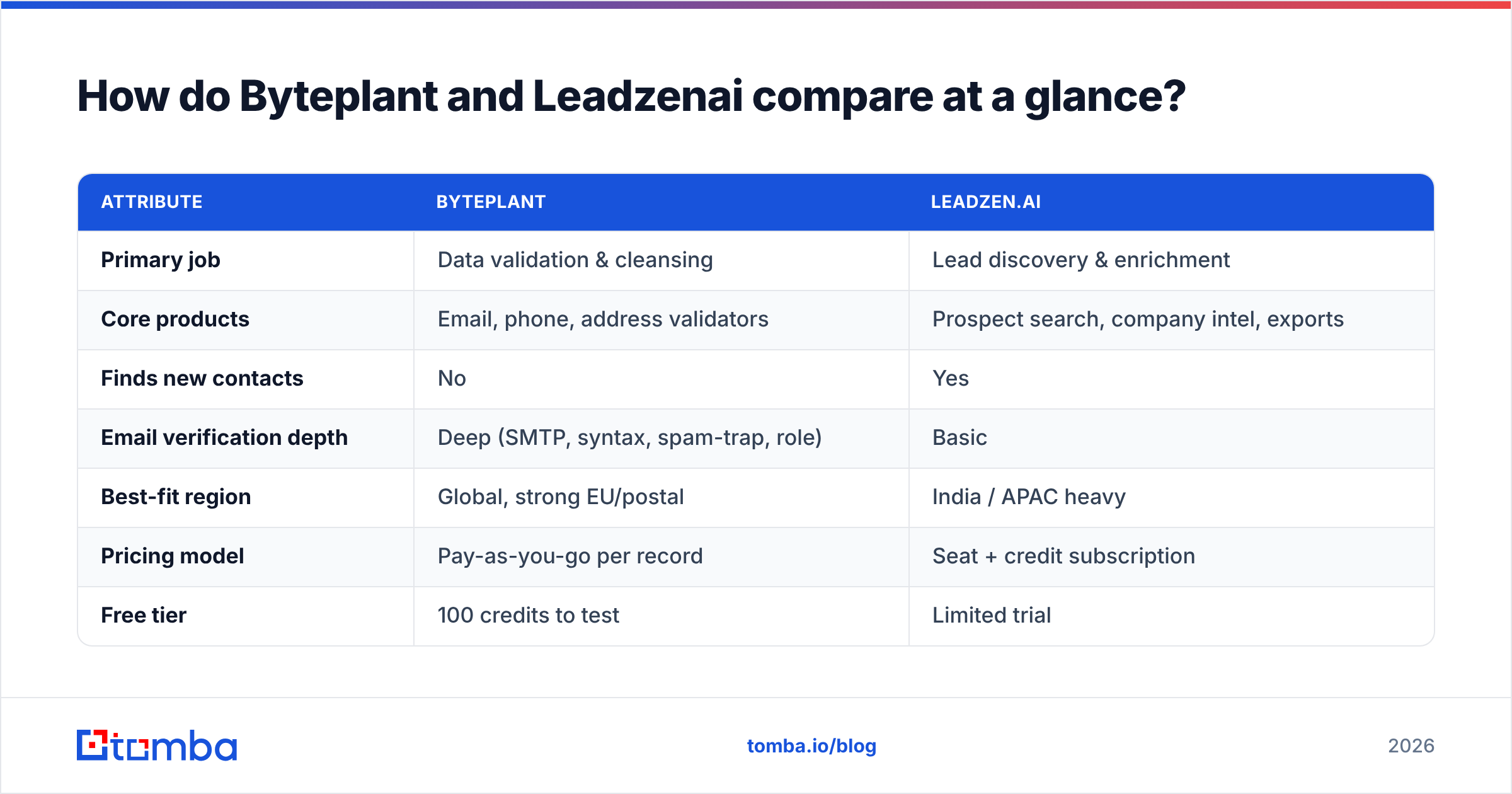
Here's the side-by-side across the attributes that actually drive a buying decision.
| Attribute | Byteplant | Leadzen.ai |
|---|---|---|
| Primary job | Data validation & cleansing | Lead discovery & enrichment |
| Core products | Email, phone, address validators | Prospect search, company intel, exports |
| Finds new contacts | No | Yes |
| Email verification depth | Deep (SMTP, syntax, spam-trap, role) | Basic |
| Best-fit region | Global, strong EU/postal | India / APAC heavy |
| Pricing model | Pay-as-you-go per record | Seat + credit subscription |
| Free tier | 100 credits to test | Limited trial |
| API access | Yes, well-documented | Yes, plan-gated |
| Ideal user | RevOps / data engineers | SDRs / lead-gen teams |
The table makes the split obvious. If your pain is "my bounce rate is killing my domain," Byteplant is on-topic. If your pain is "I have nobody to email," Leadzen.ai is on-topic. Most growing teams hit both pains within a quarter, which is where a single-purpose tool starts to feel narrow.
Is Byteplant better than Leadzenai for email accuracy?#
Yes — for verification specifically, Byteplant is the stronger tool. That's its specialty, and it shows.
Byteplant's Email Validator runs a layered check: syntax, domain and MX records, mailbox-level SMTP probing, plus detection of disposable domains, role addresses (info@, sales@), and known spam traps. For teams that care about email deliverability, that depth is the point — every invalid address you remove before a send protects your sender reputation.
Leadzen.ai does include validation when you export contacts, but it's closer to a syntax-and-domain sanity check than a full SMTP verification pass. That's fine for a first filter, but you would not want it to be the last line of defense before a cold campaign.
The catch: Byteplant only validates what you feed it. It has no opinion about who you should be contacting. So "better at accuracy" is true and also beside the point if your real bottleneck is sourcing.
A few practical notes on verification quality that apply to either tool:
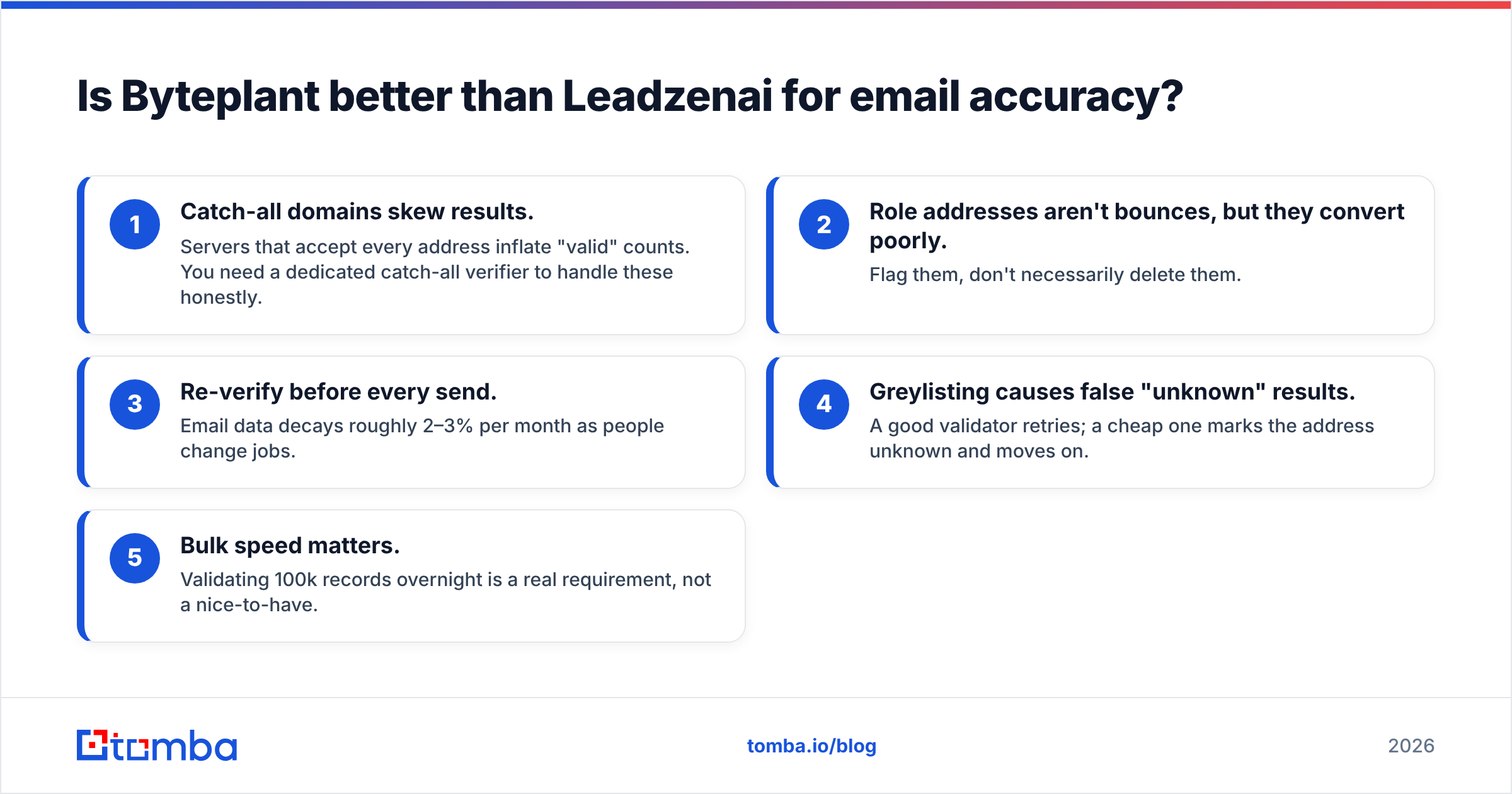
- Catch-all domains skew results. Servers that accept every address inflate "valid" counts. You need a dedicated catch-all verifier to handle these honestly.
- Role addresses aren't bounces, but they convert poorly. Flag them, don't necessarily delete them.
- Re-verify before every send. Email data decays roughly 2–3% per month as people change jobs.
- Greylisting causes false "unknown" results. A good validator retries; a cheap one marks the address unknown and moves on.
- Bulk speed matters. Validating 100k records overnight is a real requirement, not a nice-to-have.
Which one is better for finding new leads?#
Leadzen.ai wins this outright — Byteplant doesn't compete here at all.
Leadzen.ai's database lets you search by industry, geography, title, and company attributes, then export contacts with enrichment attached. For teams selling into the Indian market especially, its coverage of local companies and mobile numbers is a genuine strength that global tools often miss.
That said, two honest caveats:
- Coverage is regional. Outside India/APAC, the database thins out, and you'll feel it on North American or European searches.
- Verification is the weak link. As covered above, you'll still want a separate validation step before sending, which means a second tool and a second invoice.
Byteplant, again, is simply not a lead-finder. Asking it to source prospects is like asking a dishwasher to cook dinner — wrong appliance.
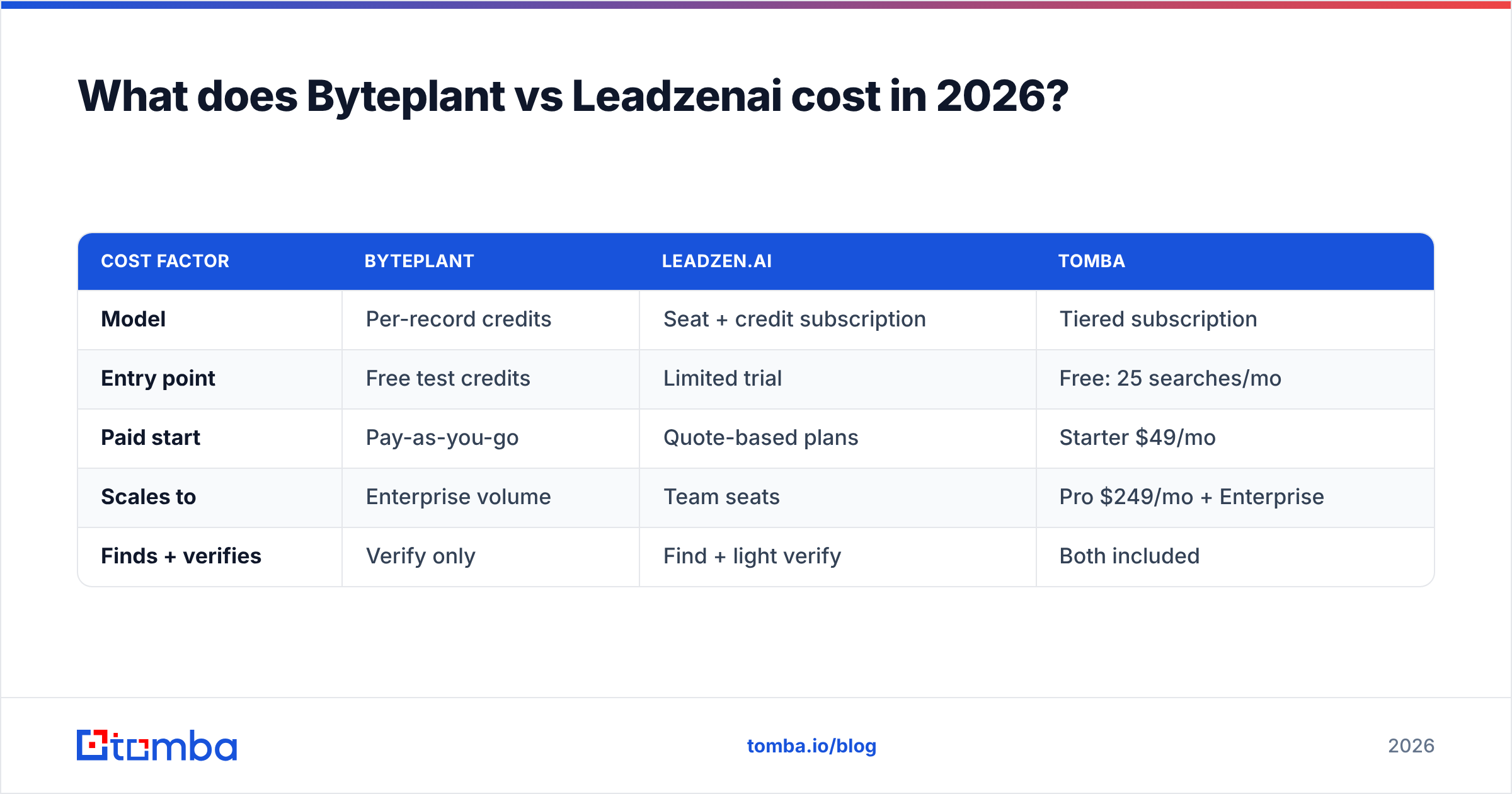
What does Byteplant vs Leadzenai cost in 2026?#
Different models, and that changes the math depending on volume.
Byteplant prices pay-as-you-go: you buy validation credits and burn them per record, with volume discounts as you scale. It's clean for spiky workloads — validate a big list once, pay once. There's a small free allotment to test.
Leadzen.ai sells subscription plans built around seats plus monthly credits for searches and exports. That's predictable for a team running steady outbound, but the per-credit cost climbs once you exhaust the included allotment, and unused credits often don't roll over.
| Cost factor | Byteplant | Leadzen.ai | Tomba |
|---|---|---|---|
| Model | Per-record credits | Seat + credit subscription | Tiered subscription |
| Entry point | Free test credits | Limited trial | Free: 25 searches/mo |
| Paid start | Pay-as-you-go | Quote-based plans | Starter $49/mo |
| Scales to | Enterprise volume | Team seats | Pro $249/mo + Enterprise |
| Finds + verifies | Verify only | Find + light verify | Both included |
The strategic point: if you buy Byteplant and Leadzen.ai to cover both jobs, you're paying two vendors, reconciling two data formats, and maintaining two integrations. For many teams that's more expensive — in money and ops time — than one platform that does finding and verification together. You can sanity-check that against transparent Tomba pricing before committing to a two-tool stack.
When should you choose each tool?#
Choose Byteplant if:
- You already have substantial contact lists and your problem is hygiene, not sourcing.
- You're a RevOps or data team enforcing quality at the CRM boundary.
- You need address and phone validation alongside email, in one vendor.
- Pay-as-you-go fits your spiky, project-based validation needs.
Choose Leadzen.ai if:
- You sell primarily into India or the broader APAC region.
- Your bottleneck is finding new decision-makers, not cleaning old ones.
- You want company intelligence bundled with contact data.
- You can live with light verification and add a validator later.
Choose a combined platform if:
- You need both jobs and don't want to stitch two tools together.
- You want a single email verifier and finder behind one API.
- You'd rather enrich, find, and verify from the same credit pool.
This is where the two-tool stack starts to look like a temporary arrangement rather than a strategy. Most teams that start with "a finder plus a validator" eventually consolidate — the integration tax is real, and reviews on G2 consistently flag data-tool sprawl as a top frustration for sales ops.
Is there a better all-in-one alternative?#
For teams that need finding and verification in one place, yes — a unified platform removes the seam between Byteplant and Leadzen.ai.
This is the gap Tomba is built for. Instead of buying discovery from one vendor and accuracy from another, you get both from a single product:
- Find professional addresses with the email finder, by name, company, or domain.
- Verify them with SMTP-level checks before you send — no separate validation subscription.
- Enrich records with firmographic and contact data through data enrichment, so a found lead arrives complete.
- Scale through one email finder API, one credit pool, and one bill.
Tomba won't replace Byteplant's postal-address validation, and it isn't trying to out-localize Leadzen.ai inside India. But for the common case — a B2B team that needs accurate emails for real decision-makers and wants to stop paying two vendors to get there — consolidating is usually the cleaner call.
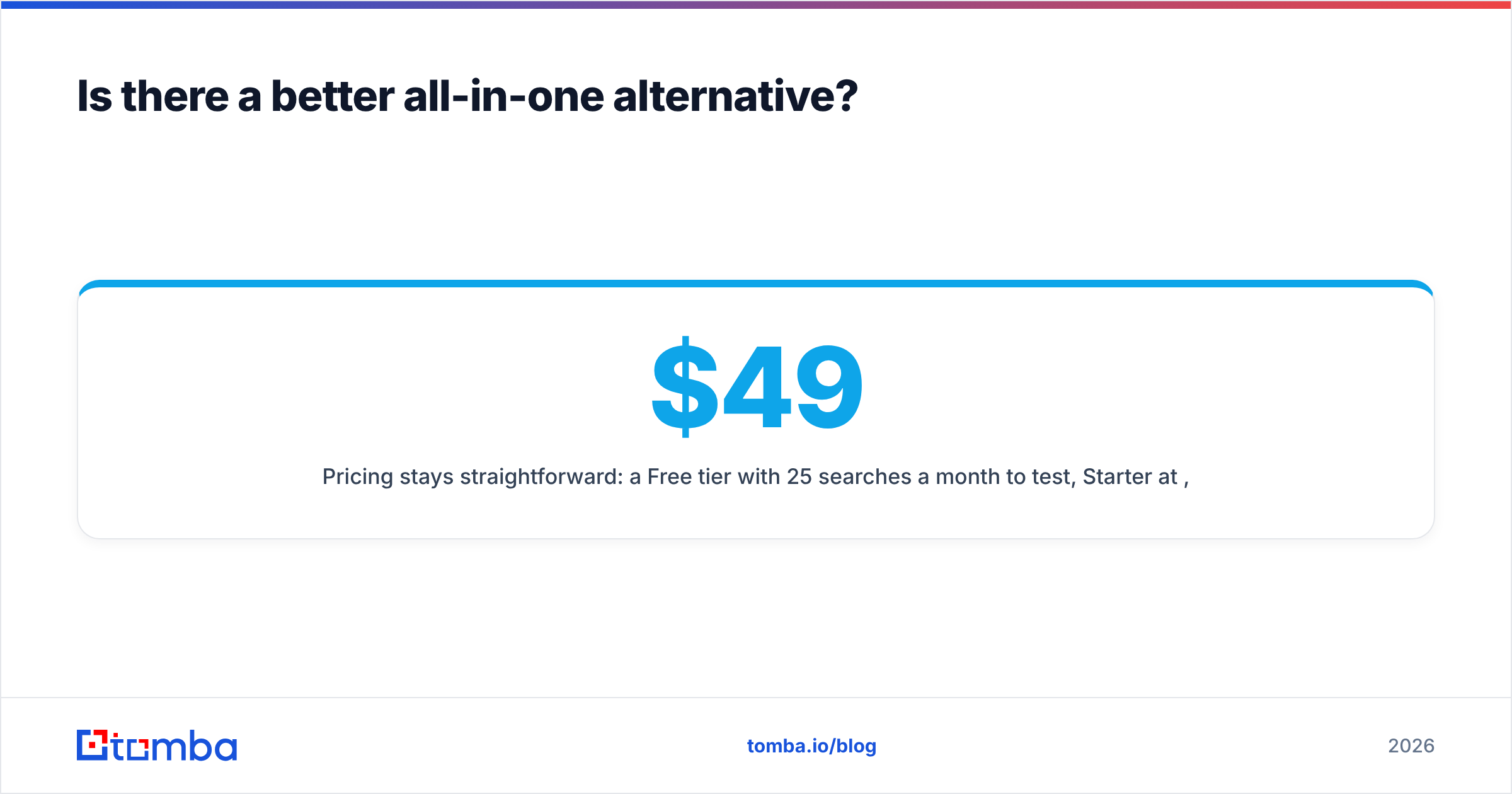
Pricing stays straightforward: a Free tier with 25 searches a month to test, Starter at $49/mo, Growth at $99/mo, and Pro at $249/mo, with Enterprise custom for high-volume needs. No per-record surprises, no stranded credits.
The bottom line on Byteplant vs Leadzenai#
You're not really choosing a winner — you're diagnosing a bottleneck. Byteplant is the right answer when dirty data is the problem and you need deep, reliable validation across email, phone, and address. Leadzen.ai is the right answer when an empty pipeline is the problem and you're selling into India/APAC.
The trap is needing both and buying both, then spending your week reconciling exports. If that's where you're headed, skip the seam: start with a platform that finds, verifies, and enriches in one flow. Spin up a free Tomba account, run the Tomba Email Finder against your next target account list, and verify the results in the same dashboard before a single email leaves your domain. One tool, one bill, accurate from the first send.
Ready to find emails that actually work?
Join 150,000+ professionals who stopped guessing and started sending. Free credits on signup — no credit card required.
Get the Tomba newsletter
Practical outbound tactics and product updates — once every two weeks.
About the author