C-Suite Sales in 2026: How to Sell to Executive Buyers
C-suite sales rewards reps who lead with business outcomes, reach the right inbox, and respect an executive's time. Here's the 2026 playbook that actually books meetings.
Selling to a CEO, CFO, or CRO is a different sport than selling to a manager. The buyer has less time, more skepticism, and a sharper filter for anything that wastes a calendar slot. Get the approach wrong and you never hear back. Get it right and one reply can move an entire deal.
This is a practical guide to c suite sales in 2026: who these buyers are, why most outreach dies in the trash, and the concrete moves that earn a meeting with the person who signs.
TL;DR#
- C-suite sales is outcome selling, not feature selling. Executives buy revenue, risk reduction, and time — not product specs.
- Reachability is half the battle. You cannot sell to an inbox you cannot find, so accurate contact data is the foundation.
- Brevity wins. The best executive emails are under 90 words, lead with a business result, and ask for one small thing.
- Multithread on purpose. Champions build your internal case; the C-suite approves it. You need both.
- Track the right metric. Reply-and-meeting rate from targeted senior accounts beats raw volume every time.
What is C-suite sales?#
C-suite sales is the practice of selling to the senior executives who own budget and strategy — the CEO, CFO, COO, CRO, CMO, CTO, and CISO. Think of it like getting a meeting with the head chef instead of the line cook: the chef decides what the whole kitchen buys, but they only give you five minutes and they can smell a weak pitch instantly.
These buyers behave differently from mid-level managers in three ways:
- They buy outcomes, not features. A VP of Engineering may care about your API. A CFO cares whether you cut cost or protect revenue.
- They delegate evaluation but keep the decision. Executives rarely run the trial themselves. They rely on a champion, then sign off.
- They protect their time ruthlessly. According to Gartner research on B2B buying, buying groups now involve six to ten stakeholders, and executives spend only a sliver of the cycle talking to any single vendor.
The takeaway: your job is not to explain your product to an executive. It is to make the business case so obvious and so fast that saying yes to a meeting feels low-risk.

Why do most C-suite emails get ignored?#
Most executive outreach fails before the pitch even lands, for reasons that have nothing to do with the offer.
The email never arrives. Senior titles change companies, and generic guessed addresses bounce. A bounce to a C-level inbox can also hurt your sender reputation, which quietly suppresses everything else you send. If you are guessing firstname@company.com, you are gambling with both the meeting and your domain health.
The message is about you. "We're the leading platform for..." is an instant delete. Executives scan for their own priorities, not your positioning.
It asks for too much. A 30-minute demo request from a cold CFO is a non-starter. You have not earned the calendar yet.
It ignores timing and trigger events. A message that lands the week after a funding round, a new hire, or an earnings miss is ten times more relevant than a random Tuesday blast.
Fixing deliverability starts with data quality. Before you write a single line, confirm the address is real with an email verifier so your carefully crafted note actually reaches a human.
How do you reach C-suite contacts reliably?#
You reach executives by combining accurate contact data with multiple channels, then leading with a business reason to connect.
Start with finding the right person and the right inbox. Use a domain search to map who holds which title at a target account, then pull the verified email with an email finder instead of guessing the format. For accounts where email alone stalls, a phone finder gives you a second channel that many reps ignore, which is exactly why it still works.
Then layer channels deliberately:
- Email for the crisp, outcome-led first touch.
- LinkedIn for warm context, social proof, and a lighter ask — pull the matching address with a LinkedIn finder when you want to move a conversation off-platform.
- Phone for the accounts that matter most, where a 20-second voicemail referencing your email dramatically lifts reply rates.
- Referral through a champion, which is the single highest-converting path into the C-suite.
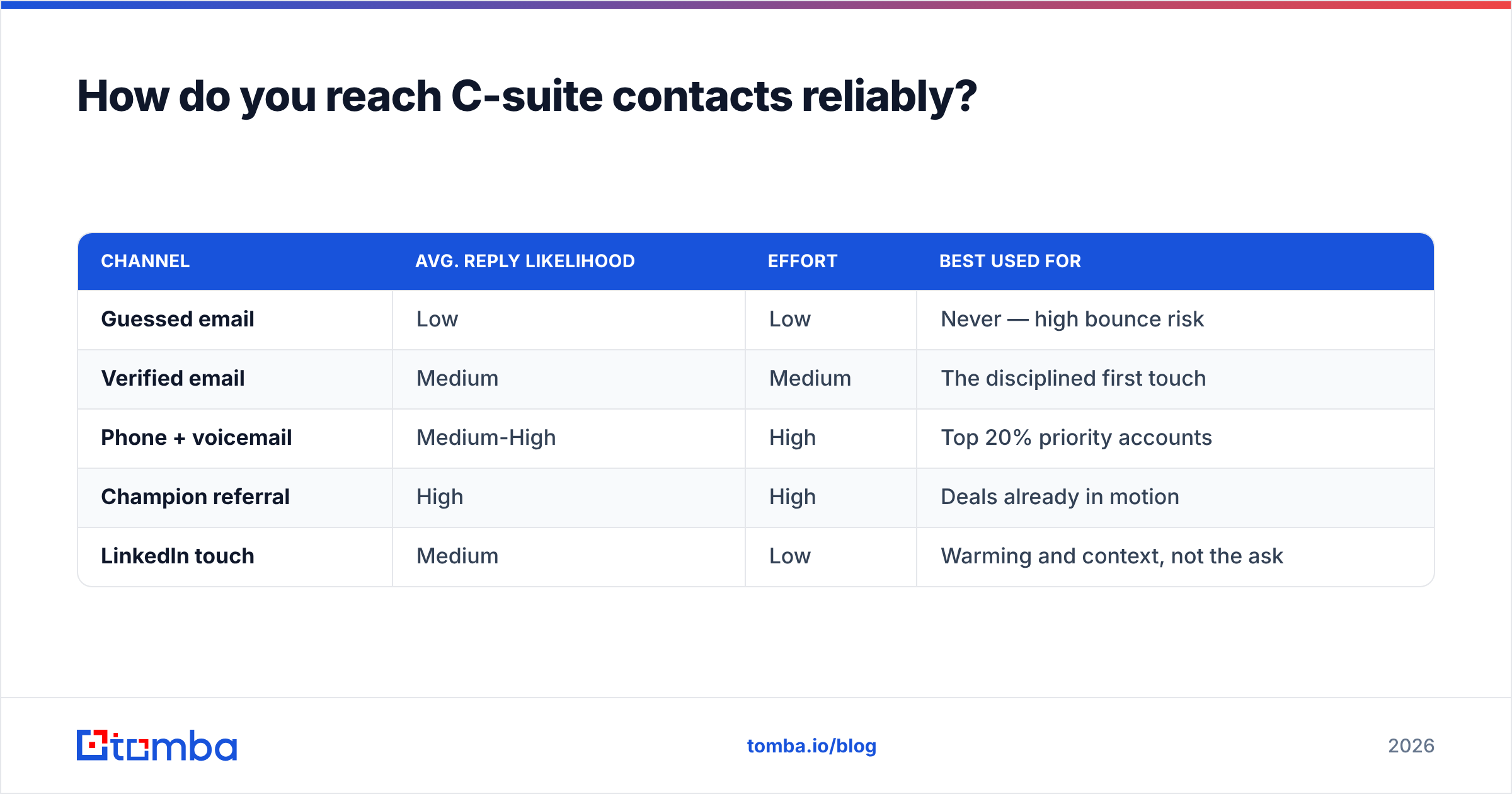
Here is how the common approaches compare in practice.
| Channel | Avg. reply likelihood | Effort | Best used for |
|---|---|---|---|
| Guessed email | Low | Low | Never — high bounce risk |
| Verified email | Medium | Medium | The disciplined first touch |
| Phone + voicemail | Medium-High | High | Top 20% priority accounts |
| Champion referral | High | High | Deals already in motion |
| LinkedIn touch | Medium | Low | Warming and context, not the ask |
The pattern is clear: verified data plus a second channel beats volume on any single channel. That is why teams pair an accurate finder with light data enrichment — so every executive record carries the title, company, and context you need to personalize at scale.
What should a C-suite sales email actually say?#
Keep it under 90 words, lead with a result, and ask for one small thing. A useful structure:
- One-line relevance hook. Tie to a trigger event or a peer they respect. ("Saw you just opened a second EU office.")
- One business outcome. Quantified if possible. ("We helped a similar team cut onboarding time 40%.")
- One low-friction ask. ("Worth a 10-minute look, or should I send the two-slide summary?")
Notice what is missing: no feature list, no company history, no five-paragraph backstory. The HubSpot sales blog and most modern outbound research agree that shorter, outcome-first messages outperform long ones with senior buyers.
A quick before-and-after:
- Weak: "Our AI-powered platform offers a comprehensive suite of tools to streamline your revenue operations and unlock synergies across your go-to-market motion."
- Strong: "Two competitors in your space cut ramp time by a third last quarter using us. Want the one-page breakdown, or a quick call?"
The strong version respects the reader, states a result, and makes the next step trivial.
How is selling to executives different from selling to managers?#
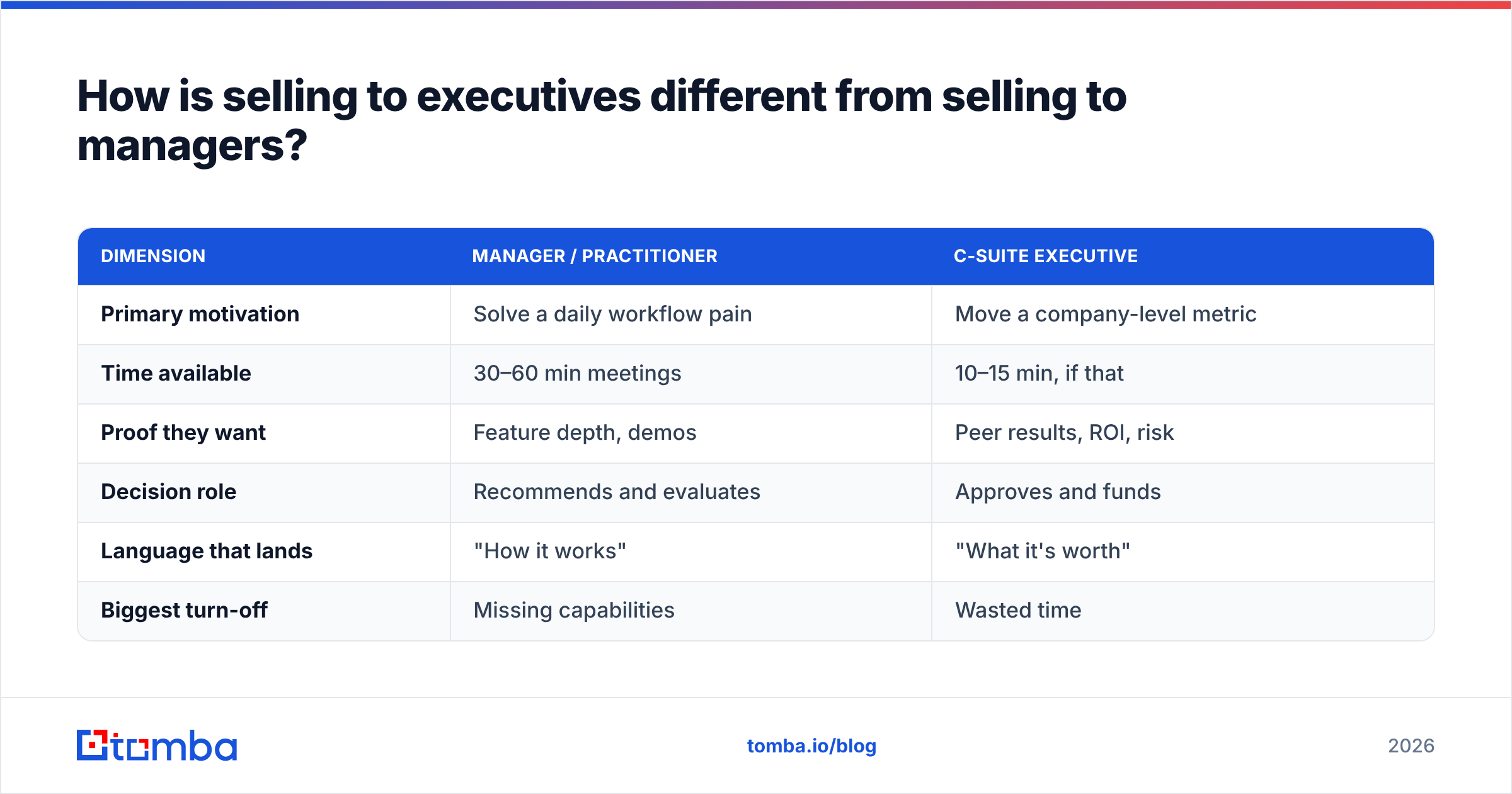
Executives and managers buy for different reasons, and treating them the same is the fastest way to stall a deal. The contrast is worth making explicit.
| Dimension | Manager / practitioner | C-suite executive |
|---|---|---|
| Primary motivation | Solve a daily workflow pain | Move a company-level metric |
| Time available | 30–60 min meetings | 10–15 min, if that |
| Proof they want | Feature depth, demos | Peer results, ROI, risk |
| Decision role | Recommends and evaluates | Approves and funds |
| Language that lands | "How it works" | "What it's worth" |
| Biggest turn-off | Missing capabilities | Wasted time |
The strategic implication: you sell through managers and to executives. Your champion at the practitioner level validates that the product works. Your executive conversation is about whether the outcome is worth the investment and the risk. Skip either layer and the deal gets stuck — a champion with no exec sponsor cannot get budget, and an exec with no champion has no one to trust the details.
This is why multithreading matters. Mapping three to five contacts per account — the champion, the economic buyer, and one or two influencers — turns a single fragile thread into a resilient buying group.
How do you build a C-suite target list that converts?#
Build the list around fit and trigger events, not just title. A great c suite sales list has three ingredients:
- Firmographic fit. Company size, industry, and growth stage where your outcome is most valuable.
- A named executive for each role you sell to. Not "the CFO" — the actual person, with a verified inbox.
- A reason to reach out now. Funding, leadership change, expansion, new product, a public pain point.
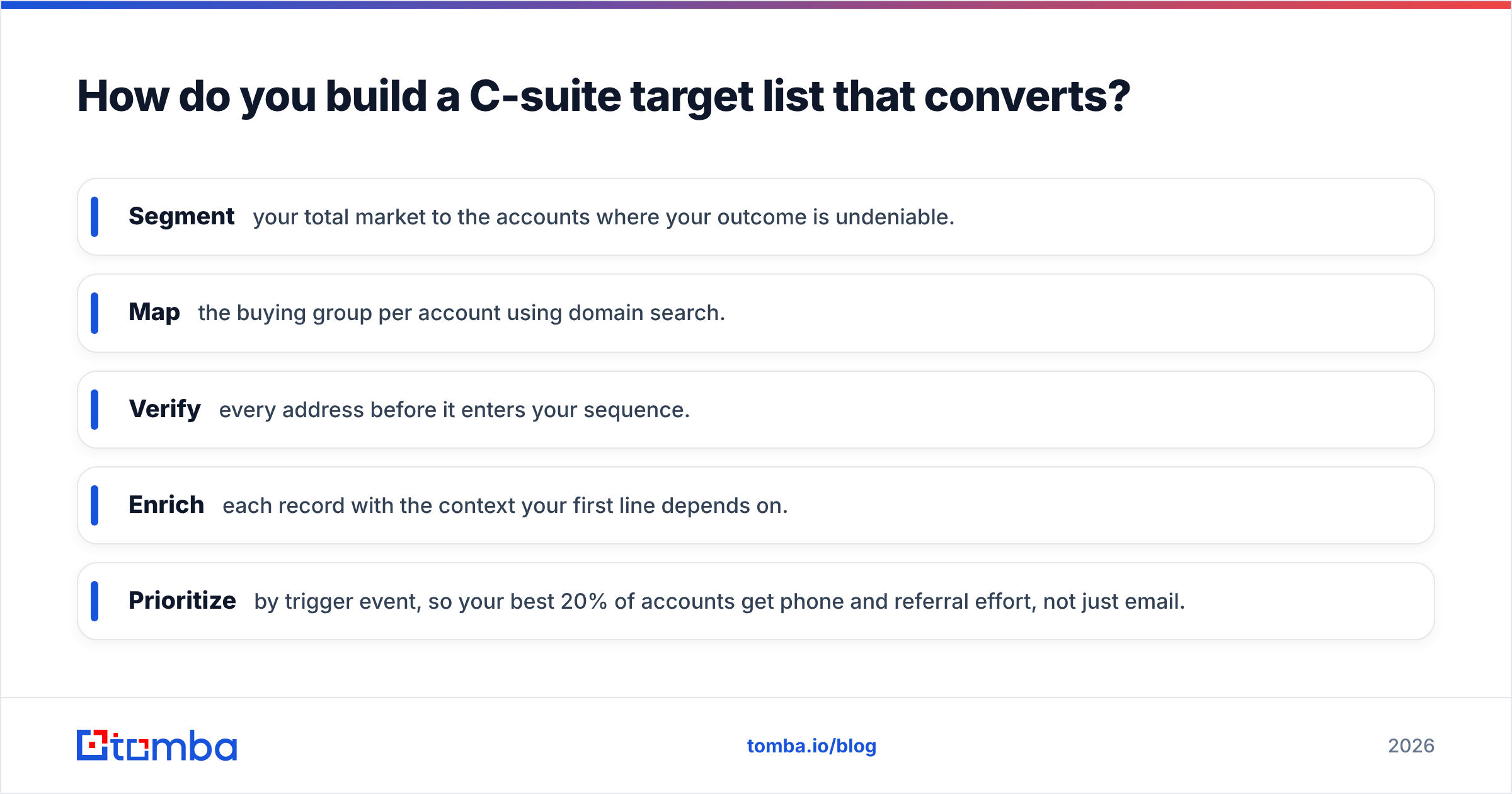
The workflow looks like this in practice:
- Segment your total market to the accounts where your outcome is undeniable.
- Map the buying group per account using domain search.
- Verify every address before it enters your sequence.
- Enrich each record with the context your first line depends on.
- Prioritize by trigger event, so your best 20% of accounts get phone and referral effort, not just email.
For teams working at scale, a bulk email finder turns a list of target companies and executive names into verified, sequence-ready contacts in one pass — which keeps your reps writing messages instead of hunting for addresses. If you would rather understand where that data comes from, Tomba is transparent about its data sources, which matters when you are betting on the accuracy of a CFO's email.
What metrics tell you C-suite sales is working?#
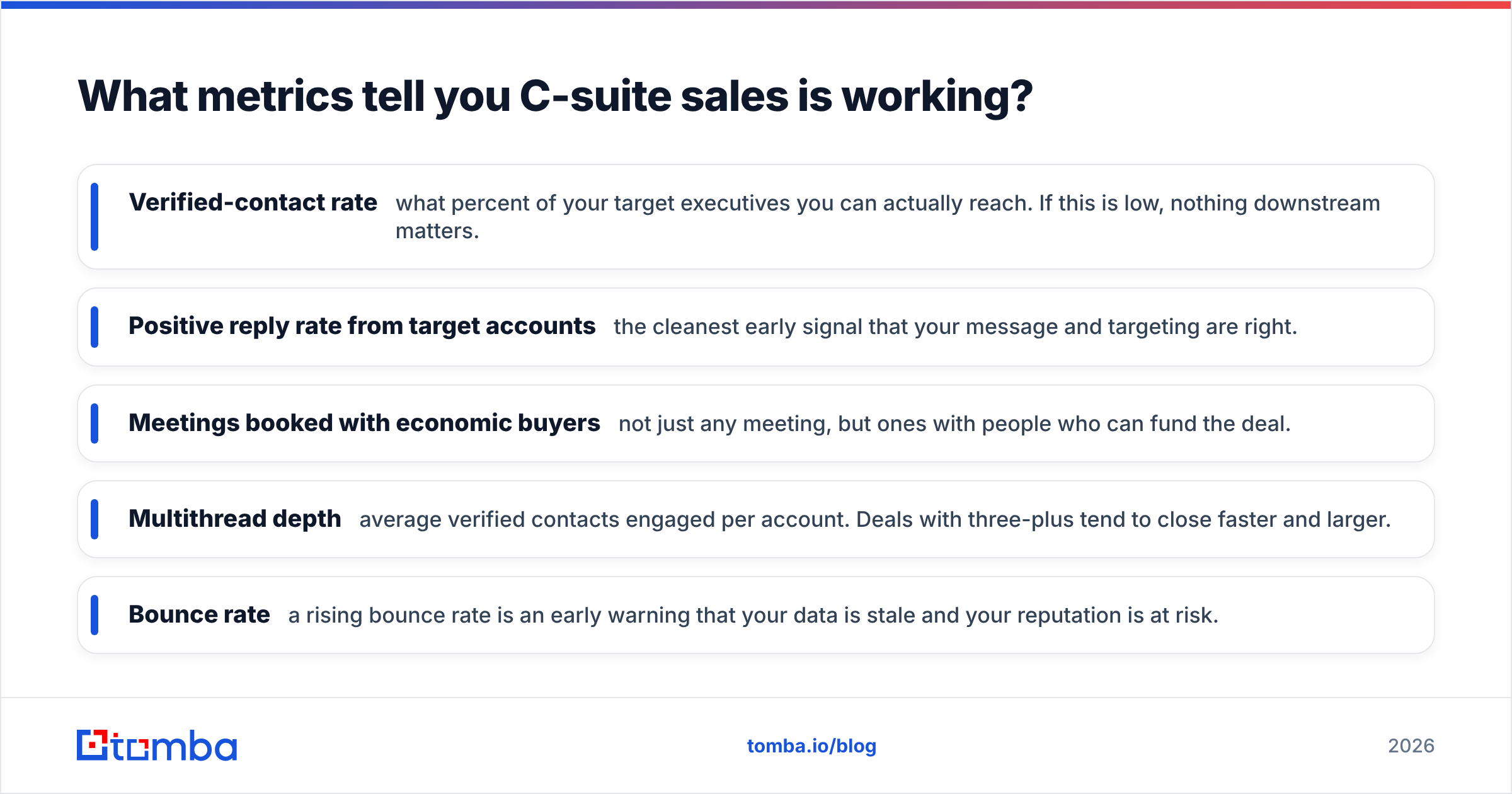
Measure quality of engagement, not quantity of activity. The metrics that actually predict pipeline from senior accounts:
- Verified-contact rate — what percent of your target executives you can actually reach. If this is low, nothing downstream matters.
- Positive reply rate from target accounts — the cleanest early signal that your message and targeting are right.
- Meetings booked with economic buyers — not just any meeting, but ones with people who can fund the deal.
- Multithread depth — average verified contacts engaged per account. Deals with three-plus tend to close faster and larger.
- Bounce rate — a rising bounce rate is an early warning that your data is stale and your reputation is at risk.
If you are chasing raw send volume, you are optimizing the wrong thing. Ten precise, verified, well-timed messages to the right executives beat a thousand guesses — and they protect your domain while they do it. Independent reviews on G2 consistently rank data accuracy as the top driver of outbound results for exactly this reason.
Common C-suite sales mistakes to avoid#
- Guessing email formats. Bounces waste the touch and damage deliverability. Verify first.
- Single-threading a champion. One person changes jobs and your deal dies. Map the group.
- Leading with features. Executives buy the result, not the mechanism.
- Asking for 30 minutes cold. Offer a two-slide summary or a 10-minute look instead.
- Ignoring timing. A relevant trigger event doubles your relevance overnight.
- No second channel. Email-only outreach leaves phone and referral — your two highest-converting paths — on the table.
The bottom line#
C-suite sales is won on three things: reaching the right person, saying something worth their time, and proving the outcome is worth the risk. The message strategy is learnable, but it only pays off if your outreach actually lands in the executive's inbox. That starts with clean, verified, accurate contact data.
If you want to stop guessing executive email addresses and start reaching the people who sign, Tomba's Email Finder turns a name and a company into a verified inbox in seconds, backed by a built-in verifier so your best messages never bounce. Start free with 25 searches a month, and check the Tomba pricing plans when you are ready to scale your executive outreach across the whole target list.
Related guides#
Ready to find emails that actually work?
Join 150,000+ professionals who stopped guessing and started sending. Free credits on signup — no credit card required.
Get the Tomba newsletter
Practical outbound tactics and product updates — once every two weeks.
About the author