C Suite Titles Explained: The 2026 Guide for B2B Sellers
CEO, CFO, CRO, CISO, CHRO - the C-suite keeps growing. Here's what every C-suite title actually owns, who controls budget, and how to reach the right one.

If you sell to businesses, C Suite titles decide whether you book the meeting or get ignored. The trick is simple. Read the title on the org chart before you hit send. "C-suite" gets thrown around like everyone agrees on what it means. But a CRO at a 40-person startup and a CRO at a Fortune 500 own very different mandates, budgets, and pain.
This guide decodes every major C Suite title in 2026. You'll learn what each role controls, which ones hold the budget, and how to reach the right executive without wasting your best line on the wrong inbox.
TL;DR#
- C-suite = the "Chief _______ Officer" executives who set strategy and control budget. The core five are CEO, CFO, COO, CTO, and CMO.
- The suite has expanded fast: CRO, CISO, CHRO, CDO, CPO, and CCO are now standard at mid-market and enterprise companies.
- Budget authority is not evenly spread. The CFO signs off, but the functional chief (CRO, CISO, CMO) usually owns the line item you're selling into.
- Title inflation is real. At small companies, "Chief" often means founder-operator; at enterprises it means a layer with VPs and directors beneath them.
- To reach the C-suite reliably, you need verified contact data, not guesses - a email finder plus enrichment beats spray-and-pray every time.
What does "C-suite" actually mean?#
The C-suite is the group of an organization's most senior executives, each carrying a "Chief" title and owning a functional domain. The "C" stands for Chief, and the "suite" is shorthand for the collection of them. Think of it as the company's cockpit. The pilots up front (the chiefs) set the heading. Everyone in the cabin (VPs, directors, managers) executes it.
Practically, being "in the C-suite" means three things: you report to the CEO or the board, you own a budget, and you're accountable for a company-wide function rather than a single team. That last part matters for sellers. A "Director of Marketing" runs campaigns; a CMO owns the entire revenue-generating narrative and the spend behind it. Same domain, very different level of authority.
According to Gartner, the number of distinct C-level roles at large enterprises has grown steadily. Functions like data, security, and customer experience became board-level concerns, so each earned its own chief. That expansion is exactly why generic "Dear Sir/Madam, decision-maker" outreach fails. There are now a dozen possible decision-makers, and only one or two actually own your problem.

What are the core C-suite titles?#
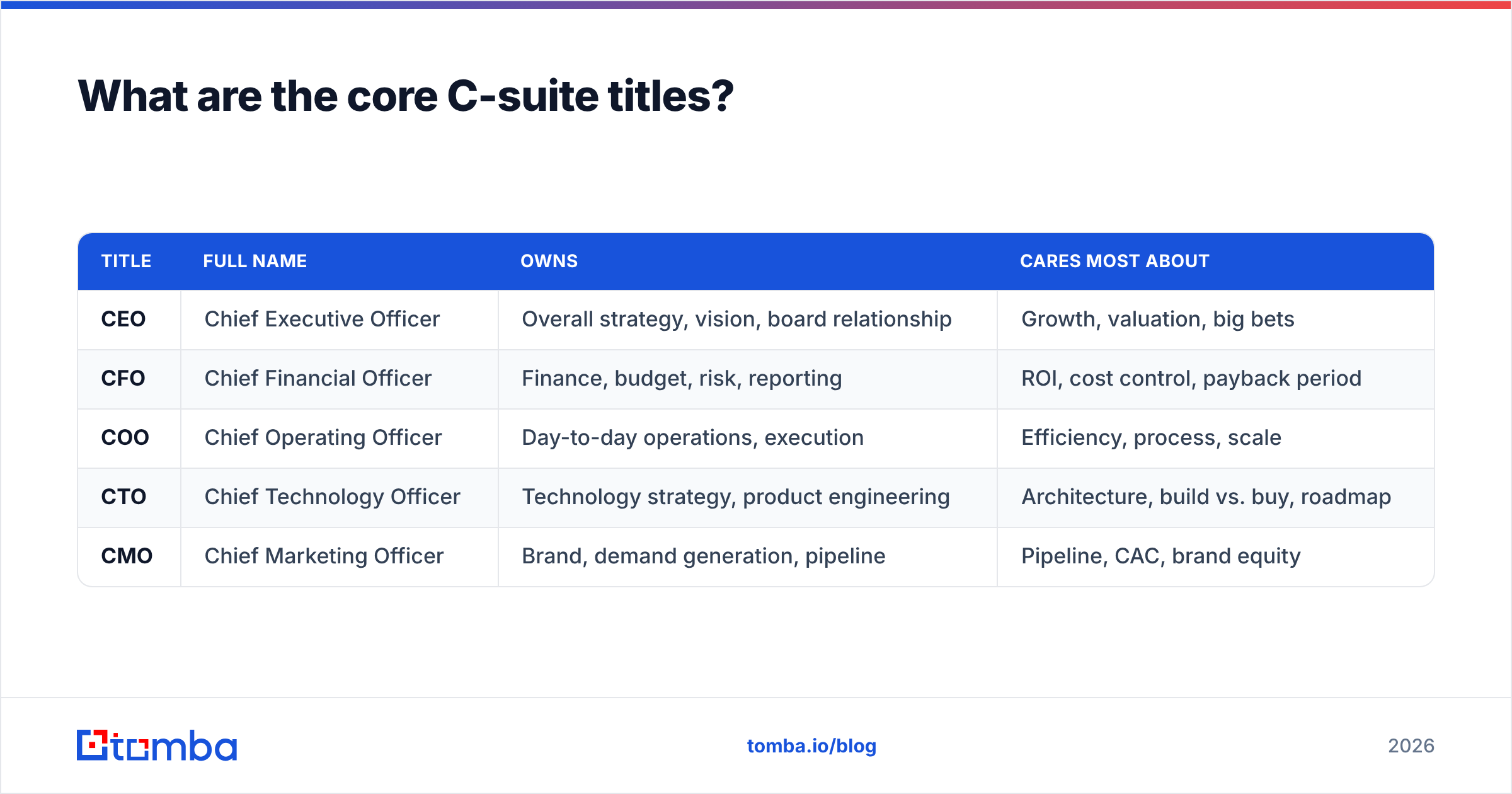
Start with the roles that exist at almost every company past a certain size. These five are the backbone of the executive team. If you can't name what each one owns, you're guessing at your buyer.
| Title | Full name | Owns | Cares most about |
|---|---|---|---|
| CEO | Chief Executive Officer | Overall strategy, vision, board relationship | Growth, valuation, big bets |
| CFO | Chief Financial Officer | Finance, budget, risk, reporting | ROI, cost control, payback period |
| COO | Chief Operating Officer | Day-to-day operations, execution | Efficiency, process, scale |
| CTO | Chief Technology Officer | Technology strategy, product engineering | Architecture, build vs. buy, roadmap |
| CMO | Chief Marketing Officer | Brand, demand generation, pipeline | Pipeline, CAC, brand equity |
A few nuances that trip up sellers:
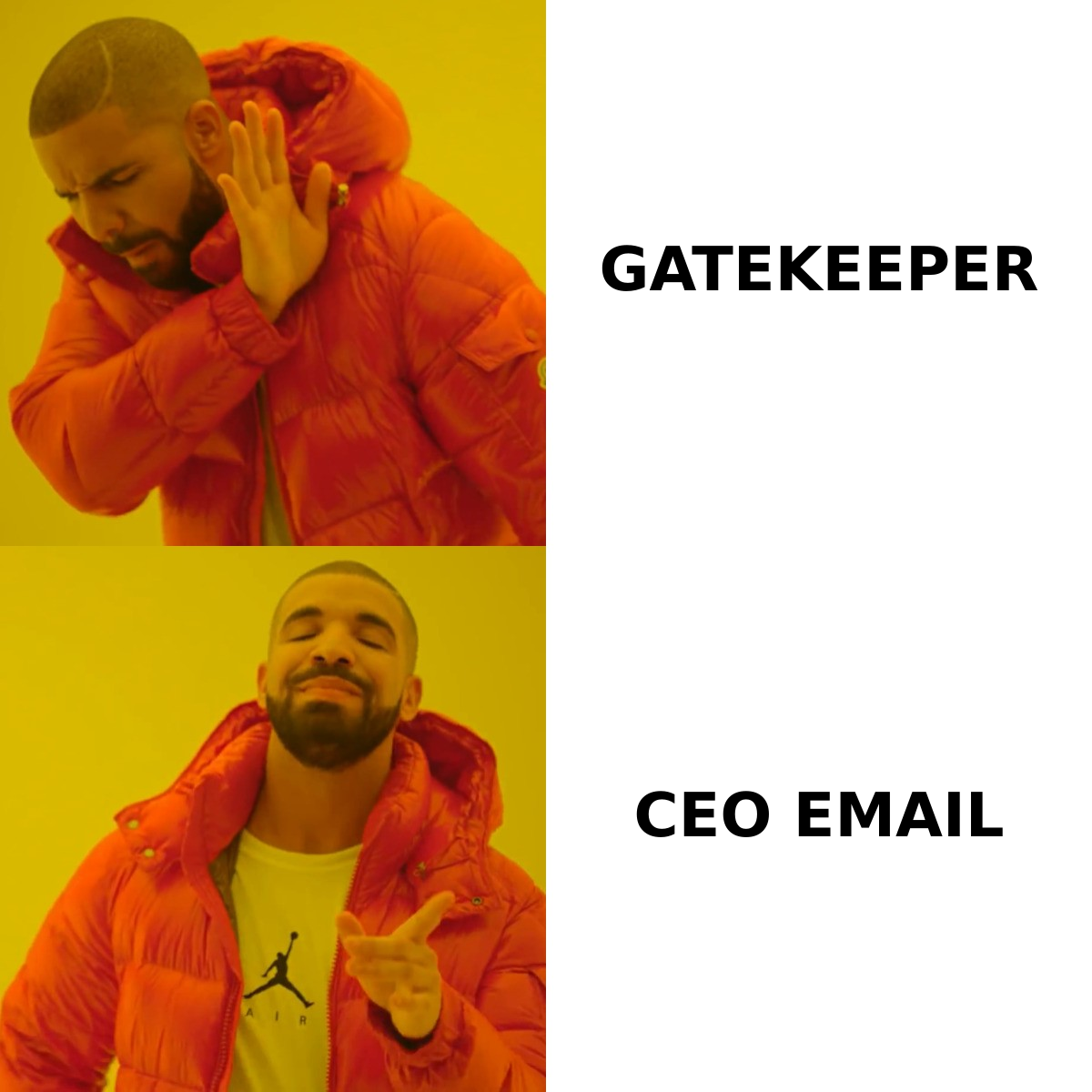
- The CEO is rarely your first touch for anything under six figures. They set direction but delegate purchasing. Pitching a $99/month tool to a CEO signals you don't understand their day.
- The CFO is a gatekeeper, not just a buyer. Even when another chief wants your product, the CFO controls whether the check clears. Speak to payback period and risk, not features.
- CTO vs. CIO is a common mix-up. The CTO usually owns what you build (product, external tech); the CIO owns what you run internally (IT, systems, infrastructure). At software companies the CTO dominates; at traditional enterprises the CIO holds real budget.
- The COO is the "everything else" chief - if a company has no CRO, the COO often absorbs revenue operations; if there's no CISO, security may report up through them.
Which new C-suite titles emerged by 2026?#
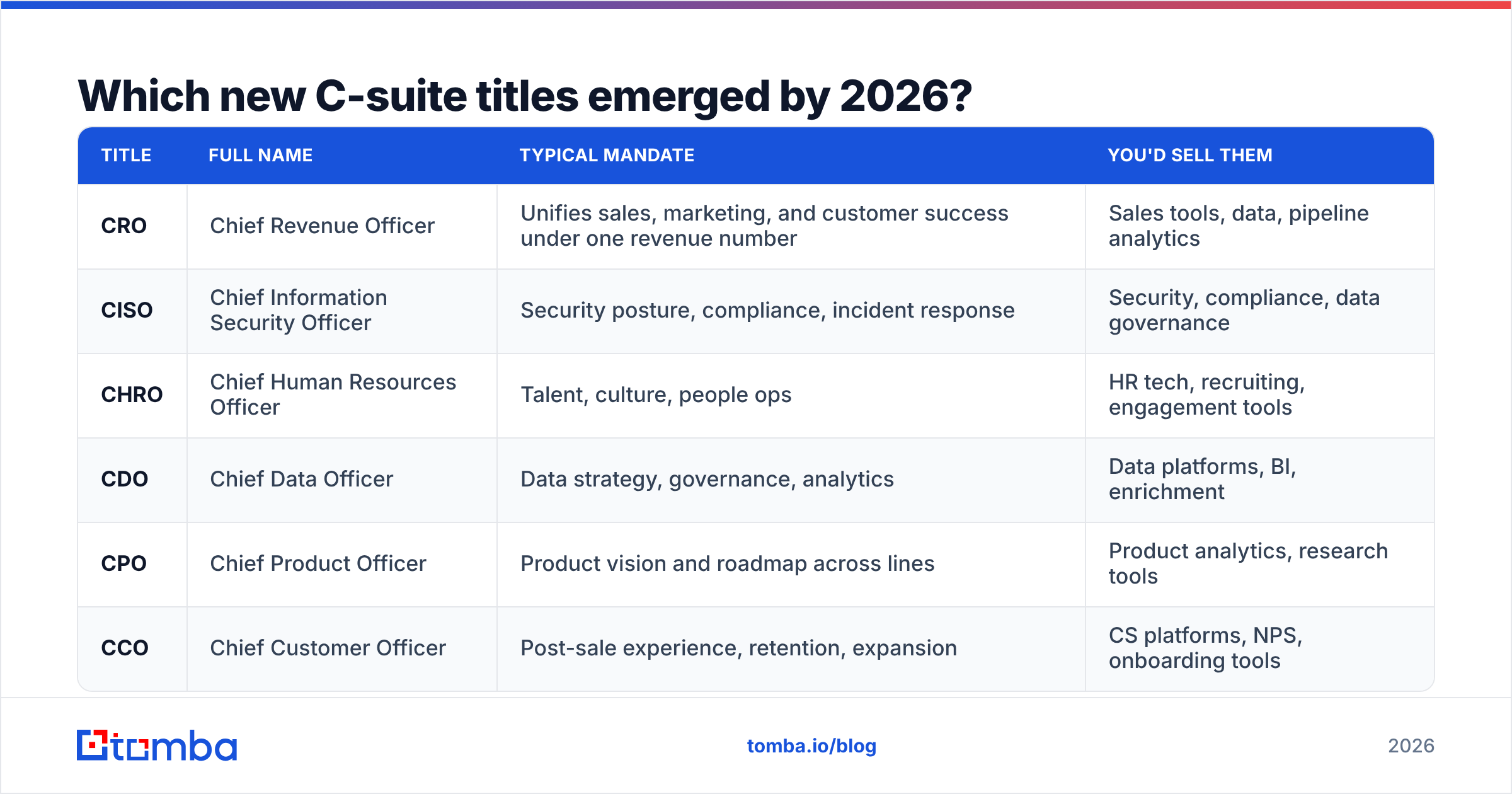
The classic five haven't gone anywhere, but the org chart around them has thickened. As companies got more data-driven, more security-conscious, and more focused on retention, entire new "Chief" roles appeared. If your ideal customer profile is mid-market or enterprise, these are frequently the actual budget owners for modern B2B tools.
| Title | Full name | Typical mandate | You'd sell them |
|---|---|---|---|
| CRO | Chief Revenue Officer | Unifies sales, marketing, and customer success under one revenue number | Sales tools, data, pipeline analytics |
| CISO | Chief Information Security Officer | Security posture, compliance, incident response | Security, compliance, data governance |
| CHRO | Chief Human Resources Officer | Talent, culture, people ops | HR tech, recruiting, engagement tools |
| CDO | Chief Data Officer | Data strategy, governance, analytics | Data platforms, BI, enrichment |
| CPO | Chief Product Officer | Product vision and roadmap across lines | Product analytics, research tools |
| CCO | Chief Customer Officer | Post-sale experience, retention, expansion | CS platforms, NPS, onboarding tools |
The CRO is the single most important addition for B2B sellers to understand. When a company hires a Chief Revenue Officer, it's signaling that sales, marketing, and success are being run as one system against one number. That's usually the person who buys prospecting data, sales engagement platforms, and data enrichment. They're accountable for the whole funnel, not a slice of it.
The CISO is the second one you can't ignore. Even if your buyer is the CRO or CMO, a security-conscious enterprise will route your contract through the CISO's team for a data-handling review. Knowing that role exists - and addressing security proactively - shortens deals instead of stalling them. HubSpot's research on buying committees consistently shows that enterprise deals now involve six to ten stakeholders, and the security reviewer is increasingly one of them.
Who really controls the budget in the C-suite?#
The functional chief owns the need; the CFO owns the approval. This split is the single most useful thing to internalize before you write a C-suite email.
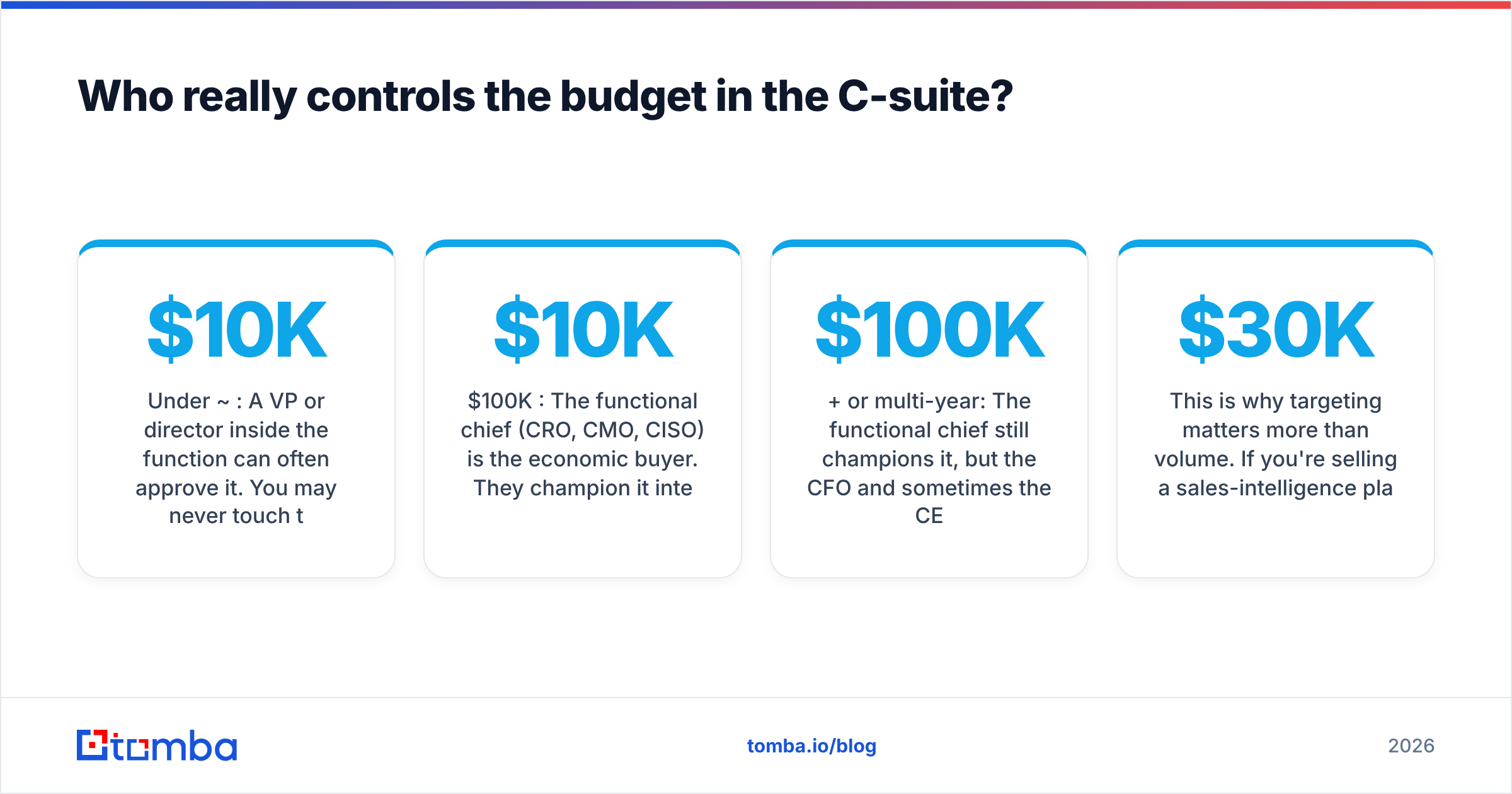
Here's how budget authority actually flows in most companies:
- Under ~$10K/year: A VP or director inside the function can often approve it. You may never touch the C-suite at all.
- $10K-$100K/year: The functional chief (CRO, CMO, CISO) is the economic buyer. They champion it internally and defend the spend.
- $100K+/year or multi-year: The functional chief still champions it, but the CFO and sometimes the CEO must co-sign. Deals at this level live or die on business case, not features.
This is why targeting matters more than volume. Say you're selling a $30K sales-intelligence platform. The CRO is your champion, the CFO is your approver, and the CEO is a distraction. Now say you're selling a $2M ERP migration. The CFO and CIO are co-owners, and the CEO is a required sponsor.
The mistake most reps make is treating "C-suite" as one monolithic inbox. It isn't. It's a network of specialists who each defend their own line item. Map the right one and your win rate climbs. Blanket the whole suite with the same message and you look like you're guessing.
How do C Suite titles map to your outreach?#
Once you know who owns what, your messaging writes itself. The trick is matching your value proposition to the metric that chief is measured on. Here's a fast reference for tailoring outreach by title:
- CEO - Lead with strategic outcome and competitive edge. Keep it to three sentences. Never open with product specs. They forward, they don't evaluate.
- CFO - Lead with payback period, risk reduction, and cost avoidance. Quantify everything. Vague ROI claims get deleted.
- CRO - Lead with pipeline impact, win-rate lift, or rep productivity. Show you understand their number. This is your warmest C-suite door for sales tools.
- CMO - Lead with demand, CAC efficiency, or attribution clarity. Reference their category and competitors.
- CISO - Lead with compliance, data handling, and how you reduce their attack surface. Never bury security in the fine print.
- CHRO / CDO / CPO - Lead with the specific function metric (time-to-hire, data quality, product adoption). Generic "growth" language reads as spam to specialists.
Notice the pattern: every title responds to its own metric. The same product, pitched three ways to three chiefs, will land three times better than one message blasted to all of them. This is where knowing C Suite titles stops being trivia and starts being pipeline.
How do you find and reach C-suite executives?#
Knowing the right title is step one. Getting a verified, deliverable email for that specific person is step two, and that's where most outreach falls apart. Executive contact data decays fast. Chiefs change companies, get promoted, and guard their inboxes behind gatekeepers and catch-all domains.
Here's a repeatable process that works:
- Identify the exact title on the org chart. Use LinkedIn, the company's leadership page, and press releases to confirm whether you want the CRO, the VP of Sales, or the COO. Don't assume - a 200-person company may have no CRO at all.
- Find the verified email. Rather than guessing
firstname@company.com, run the person and domain through a email finder that returns a confidence score and source. For whole leadership teams, a company email search surfaces every public address on the domain at once. - Verify before you send. C-suite domains are often catch-all, meaning the server accepts anything and bounces silently. Run addresses through an email verifier so your sender reputation survives the campaign.
- Enrich for context. Pull role, seniority, and company data so your first line proves you know who you're talking to.
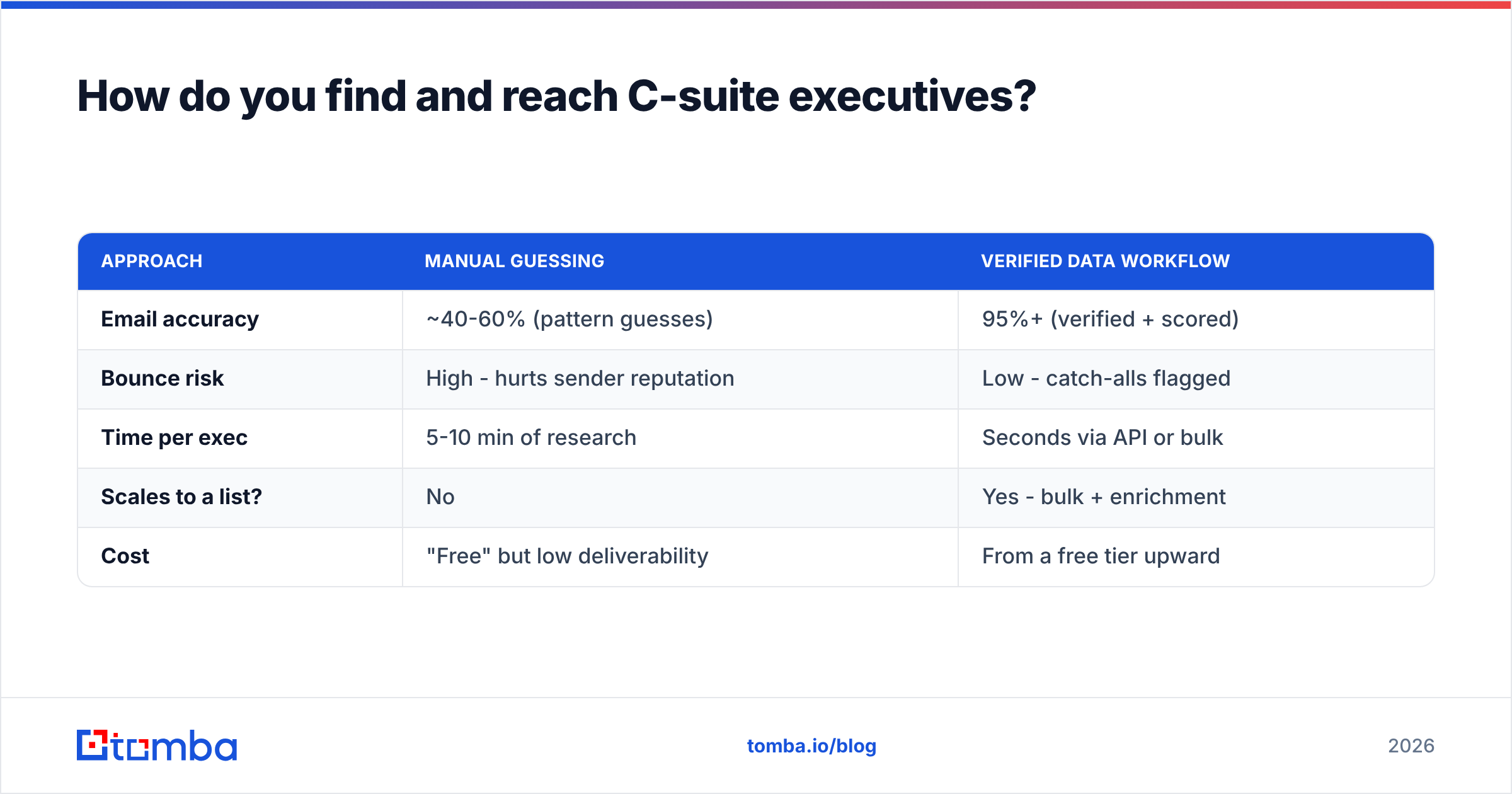
The comparison below shows why a purpose-built data workflow beats manual guessing when you're targeting expensive, hard-to-reach executives.
| Approach | Manual guessing | Verified data workflow |
|---|---|---|
| Email accuracy | ~40-60% (pattern guesses) | 95%+ (verified + scored) |
| Bounce risk | High - hurts sender reputation | Low - catch-alls flagged |
| Time per exec | 5-10 min of research | Seconds via API or bulk |
| Scales to a list? | No | Yes - bulk + enrichment |
| Cost | "Free" but low deliverability | From a free tier upward |
Tomba's free tier includes 25 searches per month. Paid plans start at $49/month on Starter and scale to Growth at $99/month - see full Tomba pricing for the tiers. That's meaningfully more forgiving than most enterprise data vendors, which is why it fits reps who target the C-suite without an enterprise data budget. (For a peer comparison, providers like BookYourData take a pay-as-you-go list-buying angle, which suits different workflows - buy-in-bulk versus find-and-verify on demand.)
C Suite Titles FAQ#
What is the difference between C-suite and executive? Every C-suite member is an executive, but not every executive is in the C-suite. "Executive" is a broad band that includes VPs and senior directors. The C-suite is specifically the "Chief" tier that reports to the CEO or board and owns a company-wide function.
Is the CRO more senior than the VP of Sales? Yes. The CRO sits in the C-suite and typically oversees sales, marketing, and customer success. A VP of Sales runs the sales org and usually reports into the CRO (or directly to the CEO if there's no CRO).
Which C-suite title controls the most budget? The CFO controls the approval of nearly all significant spend. But the largest operational budgets often sit with the COO, CTO/CIO (infrastructure), or CRO (go-to-market), depending on the company's model.
Do startups have a full C-suite? Rarely. Early-stage startups often have a CEO and CTO co-founder pair, with one person wearing several "chief" hats. Dedicated CROs, CISOs, and CDOs typically appear at Series B and beyond, or once headcount crosses ~100.
Why do some companies have so many C-titles? Functions like data, security, product, and customer experience became board-level priorities. So companies elevated their leads to "Chief" status to signal strategic importance and attract senior talent. It also reflects genuine complexity - each of those domains now needs a dedicated owner.
Reach the right chief with verified data#
Understanding C Suite titles tells you who to pitch. Getting the meeting requires reaching them - and executives don't answer messages sent to guessed addresses. Skip the pattern-guessing and start with verified, source-scored emails so your best pitch actually lands in the right inbox.
Put the Tomba Email Finder to work: enter a name and domain, get a confidence-scored professional email, verify it, and enrich it with role and company context before you write a single line. Start on the free tier, confirm the accuracy on your own target accounts, and scale up only when it's already paying you back. Map the title, find the person, verify the email - then send the message that gets a reply.
Related guides#
Ready to find emails that actually work?
Join 150,000+ professionals who stopped guessing and started sending. Free credits on signup — no credit card required.
Get the Tomba newsletter
Practical outbound tactics and product updates — once every two weeks.
About the author