CAC Calculator 2026: How to Measure Customer Acquisition Cost
Use a CAC calculator the right way: the exact formula, what to include, healthy CAC:LTV benchmarks, and how to cut acquisition costs in 2026.
CAC Calculator: How to Measure Customer Acquisition Cost in 2026
You can't grow a business on guesses about what a customer costs you. A CAC calculator turns scattered marketing and sales spend into one number you can defend in a board meeting and act on the next morning. This guide gives you the formula, the costs most teams forget to include, the benchmarks that separate a healthy model from a leaky one, and concrete ways to push CAC down in 2026.
TL;DR#
- CAC = total sales and marketing spend ÷ new customers acquired over the same period. Simple to write, easy to get wrong.
- Most teams understate CAC by leaving out salaries, tooling, and overhead — fully loaded CAC is the only number worth trusting.
- The metric that matters is CAC:LTV ratio. Aim for 3:1 or better, with a CAC payback under 12 months for SaaS.
- Blended CAC hides your worst channels. Always calculate paid CAC and organic CAC separately.
- The fastest lever on CAC is better targeting data — fewer wasted touches on bad-fit leads beats any clever ad tweak.
What is a CAC calculator?#
A CAC calculator is a simple model that divides everything you spent to win customers by the number of customers you actually won. Think of it like a grocery receipt for growth: you can feel like you're spending "about right," but until you add up the line items and divide by what you brought home, you don't know your real cost per item.
The core customer acquisition cost formula is:
CAC = (Total Sales Spend + Total Marketing Spend) ÷ Number of New Customers Acquired
Over a fixed window — usually a month, quarter, or year. If you spent $50,000 across sales and marketing in Q1 and closed 100 new customers, your CAC is $500.
That arithmetic is the easy part. The hard part is deciding what counts as "spend" and over what window — and that's where most calculators quietly lie to their owners.

What costs should a CAC calculator include?#
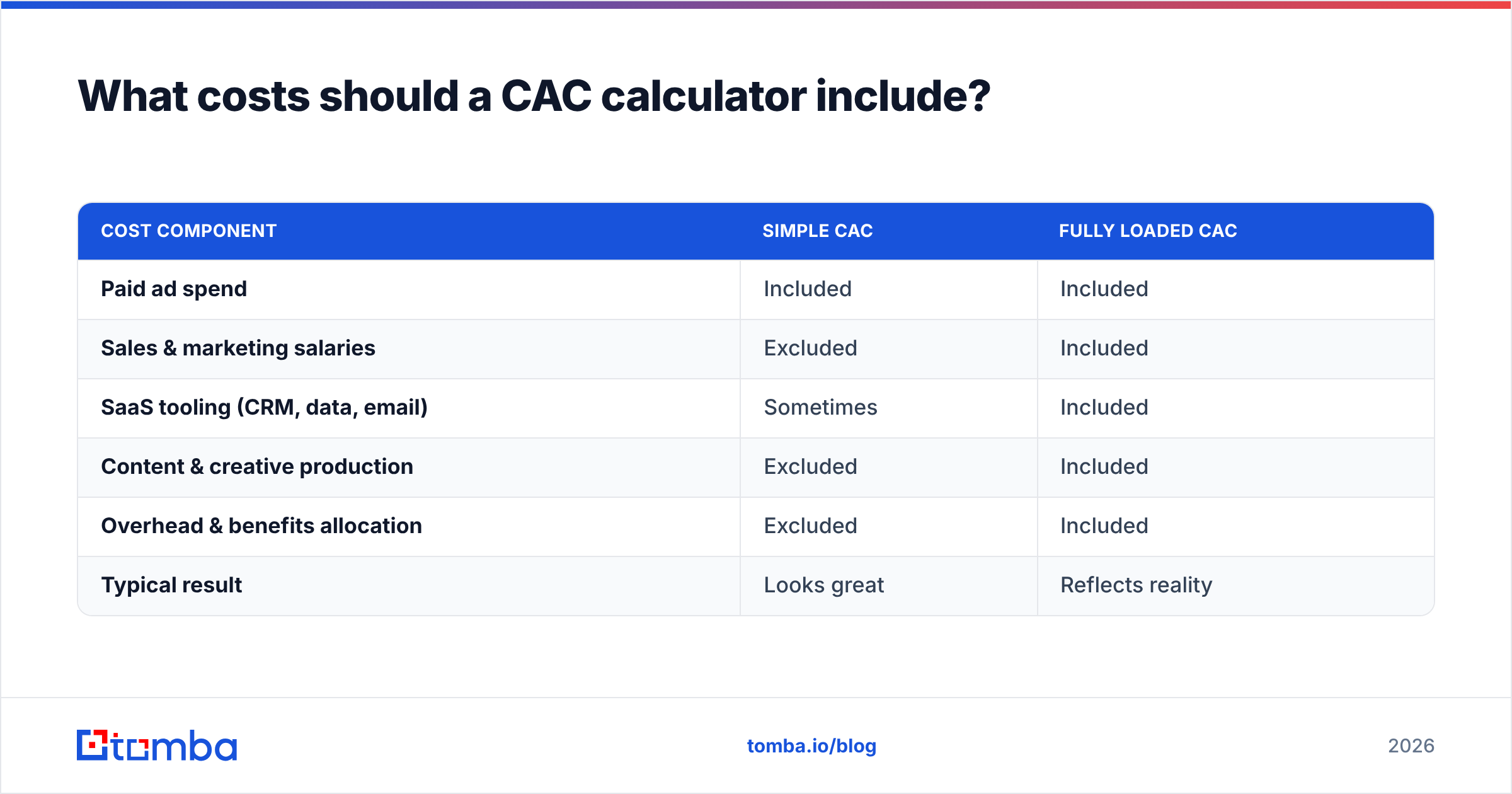
Here's where teams split into two camps. The simple CAC crowd counts ad spend and maybe agency fees. The fully loaded CAC crowd counts every dollar that touched acquisition. Only the second number is honest.
A complete CAC calculation should include:
- Paid media — Google, Meta, LinkedIn, retargeting, sponsorships, and any pay-per-click budget.
- Salaries and commissions — the loaded cost of your sales reps, SDRs, marketers, and a fair slice of leadership time.
- Tooling and software — CRM, sales engagement, data enrichment, email finders, analytics, and design tools used to acquire customers.
- Content and creative — freelancers, agencies, video production, and the cost of producing assets that fuel demand.
- Overhead allocation — the portion of rent, benefits, and admin that supports the go-to-market team.
| Cost component | Simple CAC | Fully loaded CAC |
|---|---|---|
| Paid ad spend | Included | Included |
| Sales & marketing salaries | Excluded | Included |
| SaaS tooling (CRM, data, email) | Sometimes | Included |
| Content & creative production | Excluded | Included |
| Overhead & benefits allocation | Excluded | Included |
| Typical result | Looks great | Reflects reality |
The gap between these two columns is often 2–3x. A founder who brags about a $40 CAC is usually quoting simple CAC; the fully loaded number that determines whether the business survives might be $120. Use the honest one.
How do you calculate CAC step by step?#
Run this every month and the number stops being a mystery.
- Pick your window. Match the period to your sales cycle. A 7-day SaaS trial can use monthly windows; a 9-month enterprise deal needs quarterly or trailing-twelve-month math so spend and closed customers line up.
- Total your sales spend. Rep and SDR salaries, commissions, sales tools, and travel.
- Total your marketing spend. Ad budget, marketing salaries, content, events, and martech.
- Count new customers — not leads, not signups. Only customers who actually paid in that window.
- Divide. Total spend ÷ new customers = CAC.
- Segment it. Recalculate by channel, by campaign, and by customer tier so the average doesn't hide the outliers.
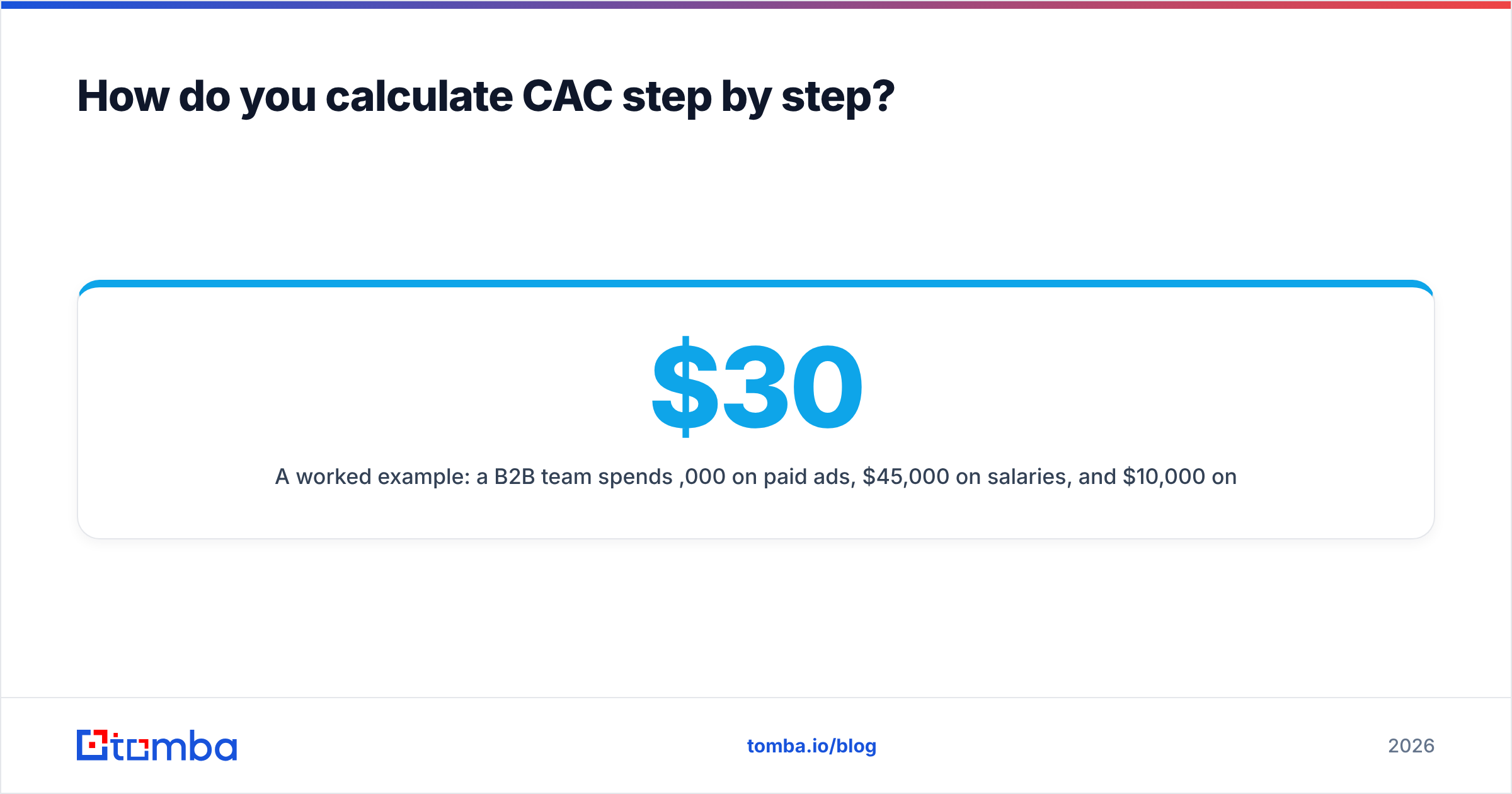
A worked example: a B2B team spends $30,000 on paid ads, $45,000 on salaries, and $10,000 on tooling in one quarter — $85,000 total. They close 170 new customers. CAC = $85,000 ÷ 170 = $500 per customer. If their average customer pays $1,800 over their lifetime, the model works. If the average customer pays $700, they're burning cash on every sale.
What is a good CAC, and how does CAC:LTV work?#
A good CAC is one your customers pay back several times over. In isolation, CAC means nothing — $500 is fantastic for an enterprise contract and catastrophic for a $9/month app. The number only makes sense next to lifetime value.
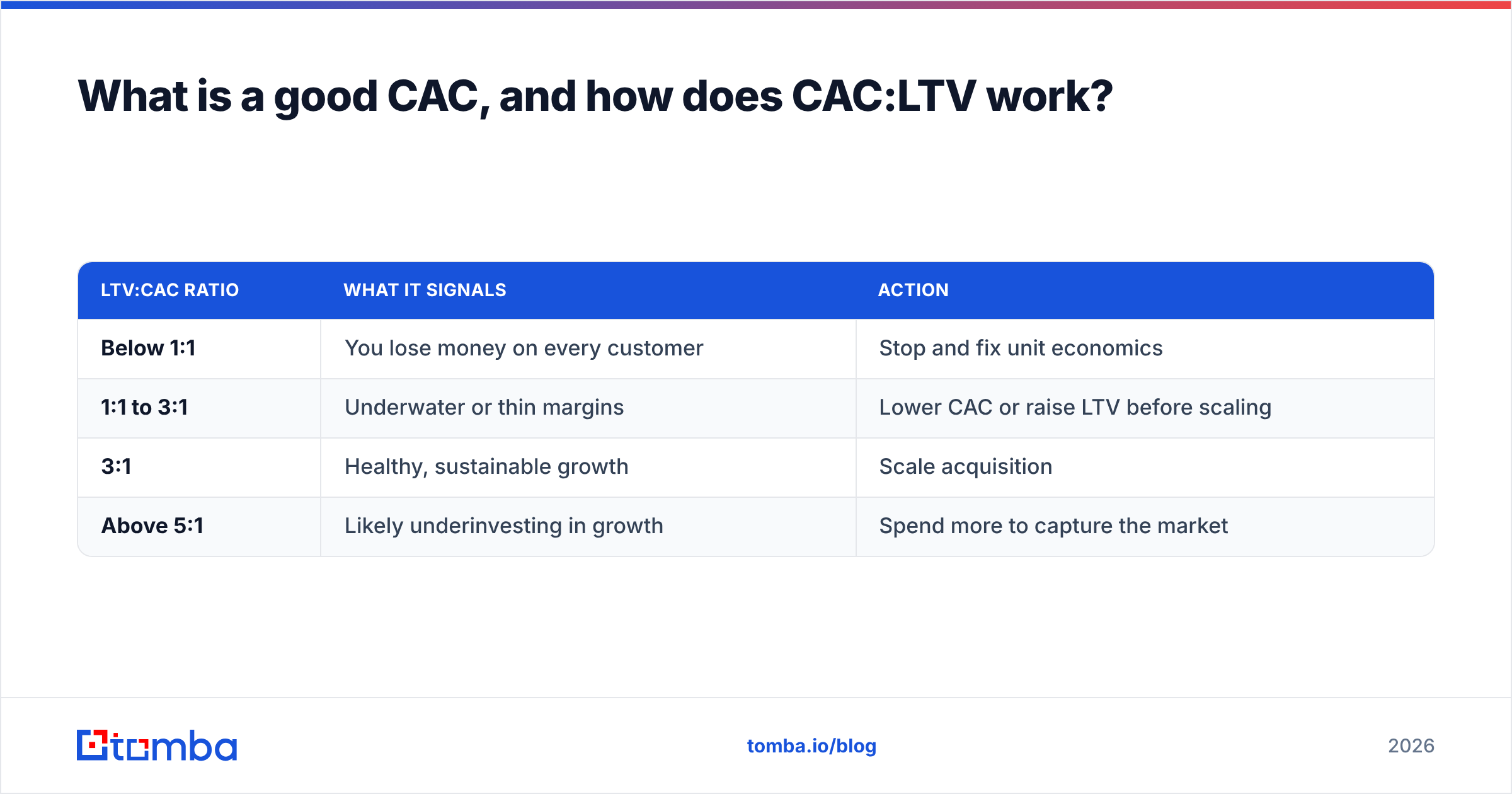
The benchmark to memorize is the LTV:CAC ratio:
| LTV:CAC ratio | What it signals | Action |
|---|---|---|
| Below 1:1 | You lose money on every customer | Stop and fix unit economics |
| 1:1 to 3:1 | Underwater or thin margins | Lower CAC or raise LTV before scaling |
| 3:1 | Healthy, sustainable growth | Scale acquisition |
| Above 5:1 | Likely underinvesting in growth | Spend more to capture the market |
The companion metric is CAC payback period — how many months of revenue it takes to earn back the cost of acquiring a customer. For most SaaS businesses, under 12 months is healthy and under 6 is excellent. According to widely cited SaaS benchmarks from analysts and operators, payback periods stretching past 18 months are an early warning that growth is being bought rather than earned.
Two ratios to track alongside CAC keep you honest about whether the engine is improving or just getting bigger.
Why is blended CAC dangerous?#
Blended CAC averages your best and worst channels into one comfortable lie. A single number can look healthy while one channel quietly subsidizes another that loses money on every deal.
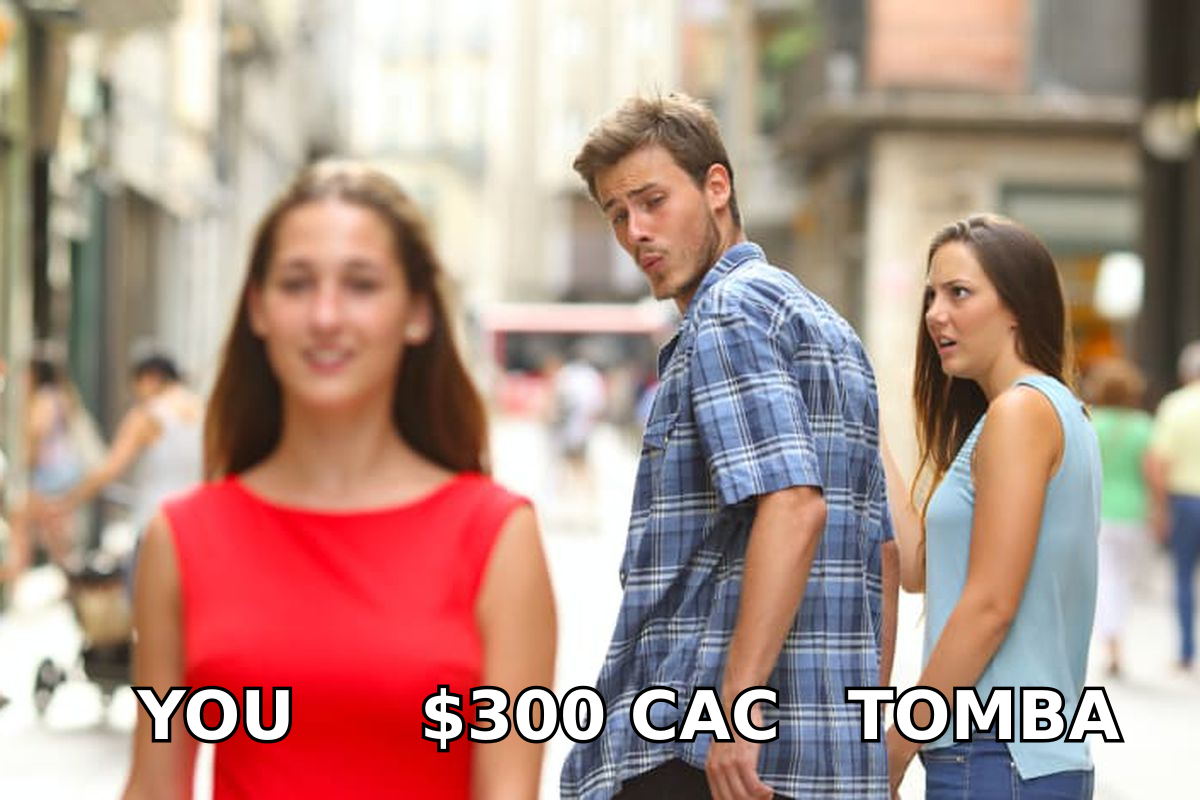
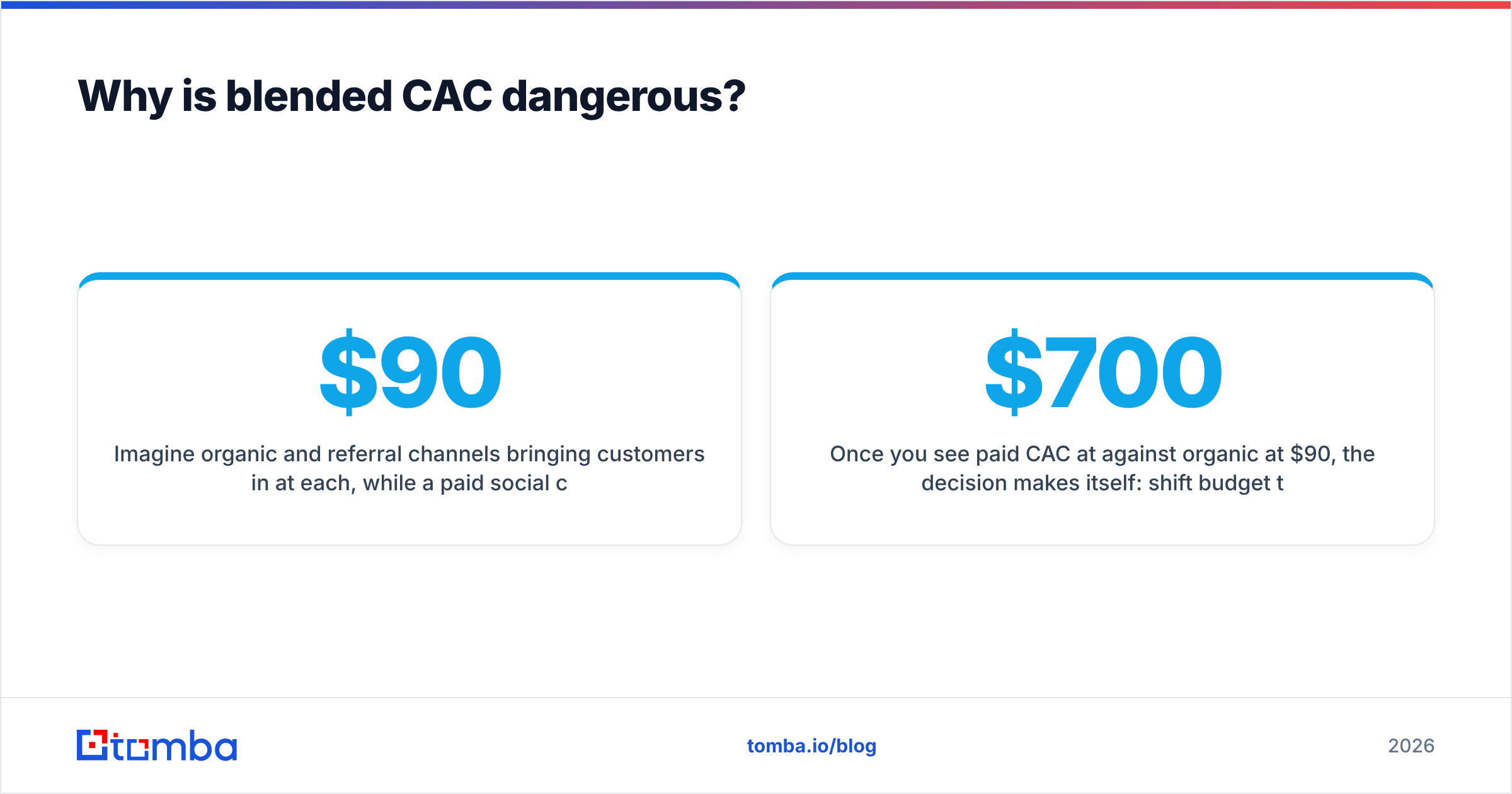
Imagine organic and referral channels bringing customers in at $90 each, while a paid social campaign brings them in at $700. Blend them and you might report $300 — a number that hides the fact that half your budget is on fire. Splitting CAC by channel exposes it:
- Organic / SEO CAC — content and SEO labor ÷ customers from organic.
- Paid CAC — ad spend plus campaign labor ÷ customers from paid.
- Outbound CAC — SDR and tooling cost ÷ customers from cold outreach.
- Referral CAC — incentive cost ÷ referred customers.
Once you see paid CAC at $700 against organic at $90, the decision makes itself: shift budget toward what's working and fix or kill what isn't. This is the daily work of revenue operations teams — turning one vanity average into a set of decisions.
How do you lower CAC in 2026?#
Lowering CAC comes down to two moves: spend less to reach the right people, or convert more of the people you reach. The highest-leverage tactics work on the input side — targeting — before you ever touch ad copy.
- Tighten your targeting data. Every email sent to a wrong-fit or bounced contact is pure waste loaded into your CAC. Clean, verified contact data means your reps spend time on real buyers, not dead ends.
- Verify before you send. Bounced emails wreck deliverability and inflate cost per reply. Running lists through an email verifier before outreach protects sender reputation and lifts conversion.
- Replace bought lists with built ones. Generic purchased databases are stale and shared with competitors. Building targeted lists from a current B2B database gets you contacts your rivals don't have.
- Shorten the sales cycle. Faster cycles mean lower carrying cost per customer. Enriching leads with firmographic and contact data up front lets reps prioritize and personalize instead of researching.
- Double down on owned channels. SEO, referral, and community compound over time and carry far lower marginal CAC than paid media. The CAC math rewards patience here.
- Automate the grunt work. Connecting your stack — see the available HubSpot integration and CRM syncs — removes manual data entry that eats payroll without producing pipeline.
The pattern across all of these: CAC drops most when you stop paying to reach people who were never going to buy. Tools like HubSpot and Salesforce help you measure and route demand, but the savings start with feeding them accurate, verified contact data in the first place.
How often should you recalculate CAC?#
Monthly for the dashboard, quarterly for decisions. A monthly CAC catches sudden spikes — a campaign gone wrong, a channel drying up — while a trailing-quarter or trailing-twelve-month view smooths out the noise so you're not overreacting to a single slow week.
Tie the cadence to your sales cycle. Short cycles can react monthly; long enterprise cycles need longer windows so the customers you count actually correspond to the spend that won them. Whatever rhythm you pick, keep it consistent — CAC is most useful as a trend line, not a one-time snapshot. A number that's been calculated the same way for eight quarters tells you far more than a perfectly precise number you computed once.
If you want to see how it stacks against peers, vendor and review sites like G2 publish category benchmarks you can sanity-check your ratios against — just remember most public figures quote simple CAC, not the fully loaded number you should be running internally.
Put a sharper CAC calculator to work#
The single biggest swing in your CAC isn't your ad creative — it's whether your outreach lands on real, reachable, in-market buyers. That's exactly where contact data quality pays off. The Tomba Email Finder helps you build accurate, verified prospect lists by domain, name, or company, so every dollar of sales and marketing spend goes toward people who can actually become customers. Pair it with verification and enrichment, start on the free tier of 25 searches a month, and scale through transparent Tomba pricing — Starter at $49/mo — as your pipeline grows. Lower waste in, lower CAC out.
// get started
Find, verify and enrich your first contacts today
Start on the free plan with 25 searches a month, then scale when your team is ready.
Free plan · No credit card required · GDPR & CCPA
// about the author